
 A SCHOLARLY BOOK REPOSITORY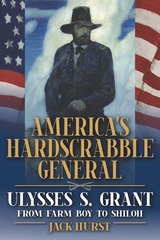
Renowned for his skill, courage, and indomitability during the Civil War, Ulysses S. Grant is considered a model for outstanding American generalship. However, unlike most of his fellow officers, Grant came from humble Midwestern beginnings and experienced a number of professional failures before rising to military prominence.
Grant grew up on a farm on the Ohio frontier and reluctantly attended West Point, where he finished in the middle of his class. In his early army career, he was often underestimated by his peers despite valiant service. After the Mexican War Grant’s “Hardscrabble” farm outside St. Louis failed, and when he decided to rejoin the U.S. army, he was given the unenviable command of a rowdy volunteer regiment, the 21st Illinois.
How did Grant—an average student, failed farmer, and common man—turn the 21st Illinois into a showcase regiment and become a successful general? In this engaging analysis, Jack Hurst argues that Grant’s military brilliance stemmed not from his West Point education but rather from his roots in America’s lower middle class and its commonsense values. His upbringing in the antebellum rural Midwest undergirded his military skill and helped him develop an innate humility, sense of justice, and ability to focus, leading him to form close relationships with his men.
Through a detailed account of Grant’s early years, from boyhood through the Battle of Shiloh, Hurst explores how Grant’s modest start and experiences in the Mexican War prefigured his greatest military triumphs. Ultimately Grant abandoned the traditional military practice of his time, which relied upon maneuver, and instead focused on fighting. His strategy to always move forward, win or lose, turned even his losses into essential elements of victory and characterized the aggressive, relentless approach that would ultimately win the Civil War and save the Union.
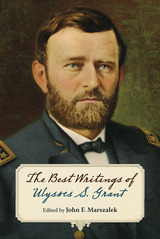
Famous for his military acumen and for his part in saving the Union during the American Civil War, Ulysses S. Grant also remains known for his two-volume memoirs, considered among the greatest military memoirs ever written. Grant’s other writings, however, have not received the same acclaim, even though they show the same literary skill. Originally published in the thirty-two volumes of The Papers of Ulysses S. Grant, the letters and speeches are the major source of information about Grant’s life and era and have played a key role in elevating his reputation to that of the leading general of the Civil War and the first of the modern presidents. In this collection, editor John F. Marszalek presents excerpts from Grant’s most insightful and skillfully composed writings and provides perspective through introductory comments tying each piece to the next. The result is a fascinating overview of Grant’s life and career.
In sixteen chronological chapters, selections from Grant’s letters and other writings reveal his personal thoughts on the major events of his momentous life, including the start of the Civil War, the capture of Vicksburg, Lincoln’s reelection, Lee’s surrender, his terms as president, the Panic of 1873, and his bouts of mouth and throat cancer. Throughout, Grant’s prose reveals clearly the power of his words and his ability to present them well. Although some historians have maligned his presidency as one of the most corrupt periods in American history, these writings reinforce Grant’s greatness as a general, demonstrate the importance of his presidency, and show him to be one of the driving forces of the nineteenth century.
With this compendium, Marszalek not only celebrates the literary talent of one of America’s greatest military figures but also vindicates an individual who, for so long, has been unfairly denigrated. A concise reference for students of American history and Civil War enthusiasts as well as a valuable introduction for those who are new to Grant’s writings, this volume provides intriguing insight into one of the nineteenth century’s most important Americans.
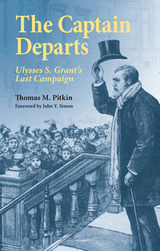
Early in 1885 Americans learned that General Grant was writing his Memoirs in a desperate race for time against an incurable cancer. Not generally known was the General’s precarious personal finances, made so by imprudent investments, and his gallant effort to provide for his family by his writing. For six months newspaper readers followed the dramatic contest, and the hearts of Americans were touched by the General’s last battle.
Grant’s last year was one of both personal and literary triumph in the midst of tragedy, as Thomas M. Pitkin shows in this memorable and inspiring book. The Memoirs was completed; its remarkable literary quality made ita triumph. Ultimately more than 300,000sets of the two-volume work were sold. And Grant accepted the inevitable with quiet courage, and faded away in a manner sadly familiar to many American families.
Though told without maudlin touches, the story of Grant’s last year will leave few readers emotionally uninvolved, for itis an account of pain and suffering as well as mighty deeds, and truly deserves to be considered the General’s final victory.
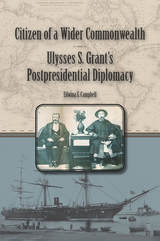
Traveling commercially and on U.S. Navy warships, Grant visited ports of call throughout the British Empire, Europe, and Asia, including Britain, France, Egypt, the Ottoman Empire, Greece, Italy, the Netherlands, Germany, Scandinavia, Russia, Spain, Portugal, Gibraltar, Ireland, India, Singapore, Hong Kong, China, and Japan. Along the way, he met with monarchs, ministers, and average citizens, creating the model for the summitry and public diplomacy practiced by future American presidents and articulating concepts of national self-determination, international organization, and the peaceful settlement of international disputes decades before Elihu Root’s advocacy of binding international arbitration and Woodrow Wilson’s proposal for the League of Nations.
Campbell reveals Grant to be a skillful envoy who brought to his travels the deep interest in foreign policy issues he had shown during his administration. Grant confirmed the United States’ commitment to Anglo-American cooperation, demonstrated America’s interest in the territorial integrity of China, affirmed American faith in universal (male) suffrage as the basis for governmental legitimacy, and asserted the importance of an international order based on equality and justice for all states and their citizens. Grant’s efforts shaped not only John Hay’s Open Door policy in 1899–1900 but also the broader American approach to twentieth-century international relations. Throughout the trip, Julia Grant proved essential to the success of her husband’s mission, and Campbell tells how the couple impressed people around the world with an enduring image of an American president and first lady.
By illuminating the significance of Grant’s often overlooked postpresidential travels, Citizen of a Wider Commonwealth establishes the eighteenth president as a key diplomat whose work strongly influenced the direction of future U.S. foreign policy and contributes substantially to the study of American international relations.
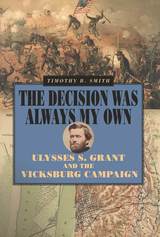
The Vicksburg Campaign, argues Timothy B. Smith, is the showcase of Ulysses S. Grant’s military genius. From October 1862 to July 1863, Grant tried repeatedly to capture the Confederate river city. His final, daring move allowed him to land an army in Mississippi and fight his way to the gates of Vicksburg. He captured the city and Confederate garrison on July 4, 1863, opening the Mississippi River for the Union.
This volume presents a fast-paced reexamination of Grant’s decision-making process during the Vicksburg maneuvers, battles, and siege. Smith details the course of campaigning on military, political, administrative, and personal levels. The successful military campaign required Grant to handle President Lincoln’s impatience, as well as to deal with troublesome general John A. McClernand, all while juggling administrative work. In addition, Grant was more than a military genius—he was also a husband and a father, and Smith shows how Grant’s family played a role in every decision he made.
Grant’s nontraditional choices went against the accepted theories of war, supply, and operations, as well as against the chief thinkers of the day, such as Henry Halleck, Grant’s superior. Yet Grant pulled off the victory in compelling fashion. In the first in-depth examination in decades, Smith shows how Grant’s decisions created and won the Civil War’s most brilliant, complex, decisive, and lengthy campaign.
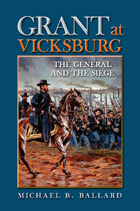
After an overview of Grant’s early Civil War career from his first battle through the early stages of the attacks on Vicksburg, Ballard describes in detail how Grant conducted the siege, examining his military decisions, placement of troops, strategy and tactics, engineering objectives, and relationships with other officers. Grant’s worried obsession with a perceived danger of a rear attack by Joseph Johnston’s Confederate army, Ballard shows, affected his decision making, and shows how threats of Confederate action occupied more of Grant’s time than did the siege itself.
In addition, Ballard soundly dispels a false story about Grant’s alleged drinking binge early in the siege that has been taken as truthful by many historians, examines how racism in Grant’s army impacted the lives of freed black people and slaves in the Vicksburg area, and explores Grant’s strained relationship with John McClernand, a politically appointed general from Illinois. The book concludes with the surrender of Vicksburg on July 4, 1863, the expulsion of Johnston and his army from the region, and demonstrates the impact of the siege on the outcome on the short and long-terms of Grant’s military career.
By analyzing Grant’s personality during the siege and how he dealt with myriad issues as both a general and an administrator, Grant at Vicksburg offers a revealing rendering of the legendary general.
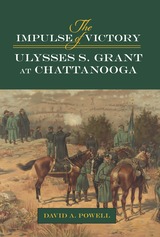
Union soldiers in the Army of the Cumberland, who were trapped and facing starvation or surrender in the fall of 1863, saw the arrival of Major General Ulysses S. Grant in Tennessee as an impetus to reverse the tides of war. David A. Powell’s sophisticated strategic and operational analysis of Grant’s command decisions and actions shows how his determined leadership relieved the siege and shattered the enemy, resulting in the creation of a new strategic base of Union operations and Grant’s elevation to commander of all the Federal armies the following year.
Powell’s detailed exploration of the Union Army of the Cumberland’s six-week-long campaign for Chattanooga is complemented by his careful attention to the personal issues Grant faced at the time and his relationships with his superiors and subordinates. Though unfamiliar with the tactical situation, the army, and its officers, Grant delivered another resounding victory. His success, explains Powell, was due to his tactical flexibility, communication with his superiors, perseverance despite setbacks, and dogged determination to win the campaign. Through attention to postwar accounts, Powell reconciles the differences between what happened and the participants’ memories of the events. He focuses throughout on Grant’s controversial decisions, showing how they were made and their impact on the campaign. As Powell shows, Grant’s choices demonstrate how he managed to be a thoughtful, deliberate commander despite the fog of war.
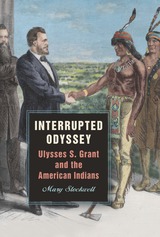
In the late 1860s, before becoming president, Grant collaborated with Ely Parker, a Seneca Indian who became his first commissioner of Indian affairs, on a plan to rescue the tribes from certain destruction. Grant hoped to save the Indians from extermination by moving them to reservations, where they would be guarded by the U.S. Army, and welcoming them into the nation as American citizens. By so doing, he would restore the executive branch’s traditional authority over Indian policy that had been upended by Jackson.
In Interrupted Odyssey, Stockwell rejects the common claim in previous Grant scholarship that he handed the reservations over to Christian missionaries as part of his original policy. In part because Grant’s plan ended political patronage, Congress overturned his policy by disallowing Army officers from serving in civil posts, abandoning the treaty system, and making the new Board of Indian Commissioners the supervisors of the Indian service. Only after Congress banned Army officers from the Indian service did Grant place missionaries in charge of the reservations, and only after the board falsely accused Parker of fraud before Congress did Grant lose faith in his original policy.
Stockwell explores in depth the ousting of Parker, revealing the deep-seated prejudices that fueled opposition to him, and details Grant’s stunned disappointment when the Modoc murdered his peace commissioners and several tribes—the Comanche, Kiowa, Cheyenne, and Sioux—rose up against his plans for them.
Though his dreams were interrupted through the opposition of Congress, reformers, and the tribes themselves, Grant set his country firmly toward making Indians full participants in the national experience. In setting Grant’s contributions against the wider story of the American Indians, Stockwell’s bold, thoughtful reappraisal reverses the general dismissal of Grant’s approach to the Indians as a complete failure and highlights the courage of his policies during a time of great prejudice.
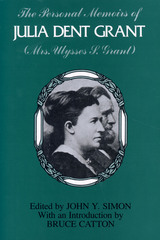
Written in the early twentieth century for her children and grandchildren and first published in 1975, these eloquent memoirs detail the life of General Ulysses S. Grant’s wife. First Lady Julia Dent Grant wrote her reminiscences with the vivacity and charm she exhibited throughout her life, telling her story in the easy flow of an afternoon conversation with a close friend. She writes fondly of White Haven, a plantation in St. Louis County, Missouri, where she had an idyllic girlhood and later met Ulysses.
In addition to relating the joys she experienced, Grant tells about the difficult and sorrowful times. Her anecdotes give fascinating glimpses into the years of the American Civil War. One recounts the night President Abraham Lincoln was assassinated. Grant insisted she and her husband turn down an invitation to the theater. Her decision saved her husband’s life: like Lincoln, he too had been marked for assassination.
Throughout these memoirs, which she ends with her husband’s death, Grant seeks to introduce her descendants to both her and the man she loved. She also strives to correct misconceptions that were circulated about him. She wanted posterity to share her pride in this man, whom she saw as one of America’s greatest heroes. Her book is a testament to their devoted marriage.
This forty-fifth-anniversary edition includes a new foreword by John F. Marszalek and Frank J. Williams, a new preface by Pamela K. Sanfilippo, the original foreword by Bruce Catton, the original introduction by editor John Y. Simon, recommendations for further reading, and more than twenty photographs of the Grants, their children, and their friends.
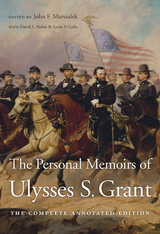
“Leaps straight onto the roster of essential reading for anyone even vaguely interested in Grant and the Civil War.”
—Ron Chernow, author of Grant
“Provides leadership lessons that can be obtained nowhere else… Ulysses Grant in his Memoirs gives us a unique glimpse of someone who found that the habit of reflection could serve as a force multiplier for leadership.”
—Thomas E. Ricks, Foreign Policy
Ulysses S. Grant’s memoirs, sold door-to-door by former Union soldiers, were once as ubiquitous in American households as the Bible. Mark Twain and Henry James hailed them as great literature, and countless presidents credit Grant with influencing their own writing. This is the first comprehensively annotated edition of Grant’s memoirs, clarifying the great military leader’s thoughts on his life and times through the end of the Civil War and offering his invaluable perspective on battlefield decision making. With annotations compiled by the editors of the Ulysses S. Grant Association’s Presidential Library, this definitive edition enriches our understanding of the pre-war years, the war with Mexico, and the Civil War. Grant provides essential insight into how rigorously these events tested America’s democratic institutions and the cohesion of its social order.
“What gives this peculiarly reticent book its power? Above all, authenticity… Grant’s style is strikingly modern in its economy.”
—T. J. Stiles, New York Times
“It’s been said that if you’re going to pick up one memoir of the Civil War, Grant’s is the one to read. Similarly, if you’re going to purchase one of the several annotated editions of his memoirs, this is the collection to own, read, and reread.”
—Library Journal
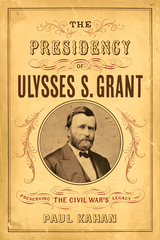
On December 5, 1876, President Ulysses S. Grant transmitted his eighth and final message to Congress. In reviewing his tenure as president, Grant proclaimed, “Mistakes have been made,” though he assured Congress, his administration’s “failures have been errors of judgment, not of intent.” Until recently, scholars have portrayed Grant as among the country’s worst chief executives. Though the scholarly consensus about Grant’s presidency is changing, the general public knows little, if anything, about his two terms, other than their outsized reputation for corruption. While scandals are undoubtedly part of the story, there is more to Grant’s presidency: Grant faced the Panic of 1873, the severest economic depression in U.S. history, defeated the powerful Senator Charles Sumner on the annexation of Cuba, and deftly avoided war with Spain while laying the groundwork for the “special relationship” between Great Britain and the United States. Grant’s efforts to ensure justice for African Americans and American Indians, however, were undercut by his own decisions and by the contradictory demands of the various constituencies that made up the Republican Party.
In The Presidency of Ulysses S. Grant: Preserving the Civil War’s Legacy, historian Paul Kahan focuses on the unique political, economic, and cultural forces unleashed by the Civil War and how Grant addressed these issues during his tumultuous two terms as chief executive. A timely reassessment, The Presidency of Ulysses S. Grant sheds new light on the business of politics in the decade after the Civil War and portrays an energetic and even progressive executive whose legacy has been overshadowed by both his wartime service and his administration’s many scandals.

As Grant battled relentlessly down the Tennessee River and across Tennessee, defending Shiloh, he was followed by an enterprising group of studio photographers hoping to profit from the public’s demand for images of the rising general from the West. They never stopped because Grant never stopped. Thus far, 307 distinct photographs have been found of Ulysses S. Grant, revealing him to be the most photographed American of the nineteenth century.
Readers of Ulysses S. Grant: A Photographic History travel alongside Grant through the Civil War and his two terms as president, on his unusual two-year journey around the world, and to his final days on Mount McGregor. The sheer volume of exposure shows the toll of duty, war, and command. From every angle, this collection captures Grant’s regard for soldier and family, his disregard of uniform, and his disheveled appearance that reflected his resilience. The reader will look into the eyes of a man who saw the worst and labored for the best.
This curated volume opens the largest collection of Grant photos to the public for the first time. Excerpts from Grant’s personal writings divulge his candid thoughts about the people he posed with and the situations he faced around the time the photographs were taken. An extraordinary addition to Grant scholarship, Ulysses S. Grant: A Photographic History will be the photographic reference work on Grant for decades to come as the simple man from Ohio continues to astonish the world.
READERS
Browse our collection.
PUBLISHERS
See BiblioVault's publisher services.
STUDENT SERVICES
Files for college accessibility offices.
RECENTLY PUBLISHED




UChicago Accessibility Resources
home | accessibility | search | about | contact us
BiblioVault ® 2001 - 2025
The University of Chicago Press