
 A SCHOLARLY BOOK REPOSITORY
Results by Title
2 books about Habermas
2 books about Habermas
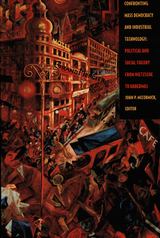
Confronting Mass Democracy and Industrial Technology
Political and Social Theory from Nietzsche to Habermas
John P. McCormick, ed.
Duke University Press, 2002
With a groundbreaking, interdisciplinary approach to German political and social theory, Confronting Mass Democracy and Industrial Technology provides fresh insight into the thought of many of the most influential intellectual figures of the twentieth century. Its essays detail the manner in which a wide range of German intellectuals grappled with the ramifications and implications of democracy, technology, knowledge, and control from the late Kaisserreich to the Weimar Republic, from the Third Reich and the Federal Republic through recently unified Germany.
Scholars representing the fields of political science, philosophy, history, law, literature, and cultural studies devote essays to the work of Nietzsche, Weber, Heidegger, Lukács, Schmitt, Marcuse, Adorno, and Habermas. They also discuss the writings of such figures as Brecht and Freud, who are not primarily thought of as political theorists, and explore the thought of Helmut Plessner and reformist theorists from East Germany who have been little studied in the English language. In the process of debating the nature and responsibilities of the modern state in an era of mass politics, unparalleled military technology, capacity for surveillance, and global media presence, the contributors question whether technology is best understood as an instrument of human design and collective control or as an autonomous entity that not only has a will and life of its own but one that forms the very fabric of modern humanity.
Scholars representing the fields of political science, philosophy, history, law, literature, and cultural studies devote essays to the work of Nietzsche, Weber, Heidegger, Lukács, Schmitt, Marcuse, Adorno, and Habermas. They also discuss the writings of such figures as Brecht and Freud, who are not primarily thought of as political theorists, and explore the thought of Helmut Plessner and reformist theorists from East Germany who have been little studied in the English language. In the process of debating the nature and responsibilities of the modern state in an era of mass politics, unparalleled military technology, capacity for surveillance, and global media presence, the contributors question whether technology is best understood as an instrument of human design and collective control or as an autonomous entity that not only has a will and life of its own but one that forms the very fabric of modern humanity.
Contributors. Seyla Benhabib, Richard J. Bernstein, Peter C. Caldwell, Richard Dienst, David Dyzenhaus, Andrew Feenberg, Nancy S. Love, John P. McCormick, Jan-Werner Müller, Gia Pascarelli, William E. Scheuerman, Steven B. Smith, Tracy B. Strong, Richard Wolin
[more]
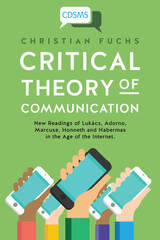
Critical Theory of Communication
New Readings of Lukács, Adorno, Marcuse, Honneth and Habermas in the Age of the Internet
Christian Fuchs
University of Westminster Press, 2016
This book contributes to the foundations of a critical theory of communication as shaped by the forces of digital capitalism. One of the world's leading theorists of digital media Professor Christian Fuchs explores how the thought of some of the Frankfurt School’s key thinkers can be deployed for critically understanding media in the age of the Internet. Five essays that form the heart of this book review aspects of the works of Georg Lukács, Theodor W. Adorno, Herbert Marcuse, Axel Honneth and Jürgen Habermas and apply them as elements of a critical theory of communication's foundations. The approach taken starts from Georg Lukács Ontology of Social Being, draws on the work of the Frankfurt School thinkers, and sets them into dialogue with the Cultural Materialism of Raymond Williams.
Critical Theory of Communication offers a vital set of new insights on how communication operates in the age of information, digital media and social media, arguing that we need to transcend the communication theory of Habermas by establishing a dialectical and cultural-materialist critical theory of communication.
It is the first title in a major new book series 'Critical Digital and Social Media Studies' published by the University of Westminster Press.
Critical Theory of Communication offers a vital set of new insights on how communication operates in the age of information, digital media and social media, arguing that we need to transcend the communication theory of Habermas by establishing a dialectical and cultural-materialist critical theory of communication.
It is the first title in a major new book series 'Critical Digital and Social Media Studies' published by the University of Westminster Press.
[more]
READERS
Browse our collection.
PUBLISHERS
See BiblioVault's publisher services.
STUDENT SERVICES
Files for college accessibility offices.
RECENTLY PUBLISHED




UChicago Accessibility Resources
home | accessibility | search | about | contact us
BiblioVault ® 2001 - 2026
The University of Chicago Press