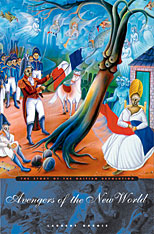
front cover of ......And the Dogs Were Silent/......Et les chiens se taisaient
......And the Dogs Were Silent/......Et les chiens se taisaient
Aimé Césaire. Translated and with an introduction by Alex Gil. With a foreword by Brent Hayes Edwards.
Duke University Press, 2024
Available to readers for the first time, Aimé Césaire’s three-act drama . . . . . . And the Dogs Were Silent—written during the Vichy regime in Martinique in 1943 and lost until 2008—dramatizes the Haitian Revolution and the rise and fall of Toussaint Louverture as its heroic leader. This bilingual English and French edition stands apart from Césaire’s more widely known 1946 closet drama. Following the slave revolts that sparked the revolution, Louverture arrives as both prophet and poet, general and visionary. With striking dramatic technique, Césaire retells the revolution in poignant encounters between rebels and colonial forces, guided by a prophetic chorus and Louverture’s steady ethical and political vision. In the last act, we reach the hero’s betrayal, his imprisonment, and his last stand against the lures of compromise. Césaire’s masterwork is a strikingly beautiful and brutal indictment of colonial cruelty and an unabashed celebration of Black rebellion and victory.
[more]

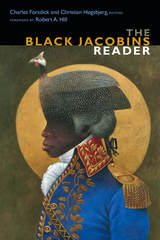
front cover of The Black Jacobins Reader
The Black Jacobins Reader
Charles Forsdick and Christian Høgsbjerg, editors
Duke University Press, 2017
Containing a wealth of new scholarship and rare primary documents, The Black Jacobins Reader provides a comprehensive analysis of C. L. R. James's classic history of the Haitian Revolution. In addition to considering the book's literary qualities and its role in James's emergence as a writer and thinker, the contributors discuss its production, context, and enduring importance in relation to debates about decolonization, globalization, postcolonialism, and the emergence of neocolonial modernity. The Reader also includes the reflections of activists and novelists on the book's influence and a transcript of James's 1970 interview with Studs Terkel.
 
 
Contributors. Mumia Abu-Jamal, David Austin, Madison Smartt Bell, Anthony Bogues, John H. Bracey Jr., Rachel Douglas, Laurent Dubois, Claudius K. Fergus, Carolyn E. Fick, Charles Forsdick, Dan Georgakas, Robert A. Hill, Christian Høgsbjerg, Selma James, Pierre Naville, Nick Nesbitt, Aldon Lynn Nielsen, Matthew Quest, David M. Rudder, Bill Schwarz, David Scott, Russell Maroon Shoatz, Matthew J. Smith, Studs Terkel
[more]

front cover of The Border of Lights Reader
The Border of Lights Reader
Bearing Witness to Genocide in the Dominican Republic
Megan Jeanette Myers
Amherst College Press, 2021
Border of Lights, a volunteer collective, returns each October to Dominican-Haitian border towns to bear witness to the 1937 Haitian Massacre ordered by Dominican dictator Rafael Leónidas Trujillo. This crime against humanity has never been acknowledged by the Dominican government and no memorial exists for its victims. A multimodal, multi-vocal space for activists, artists, scholars, and others connected to the BOL movement, The Border of Lights Reader provides an alternative to the dominant narrative that positions Dominicans and Haitians as eternal adversaries and ignores cross-border and collaborative histories. This innovative anthology asks large-scale, universal questions regarding historical memory and revisionism that countries around the world grapple with today.

"By bringing together in one volume poetry, visual arts, literary analysis, in-depth interviews and historical analysis this volume will provide its readers with a comprehensive view of the causes and the aftermath of the massacre." —Ramón Antonio Victoriano-Martínez, University of British Columbia

Contributions by Julia Alvarez, Amanda Alcántara, DeAndra Beard, Nancy Betances, Jésula Blanc, Matías Bosch Carcuro, Cynthia Carrión, Raj Chetty, Catherine DeLaura, Magaly Colimon, Juan Colón, Robin Maria DeLugan, Lauren Derby, Rosa Iris Diendomi Álvarez, Polibio Díaz, Rana Dotson, Rita Dove, Rhina P. Espaillat, Maria Cristina Fumagalli, Saudi García, Scherezade García, Juan Carlos González Díaz, Kiran C. Jayaram, Pierre Michel Jean, Nehanda Loiseau Julot, Jake Kheel, Carlos Alomia Kollegger, Jackson Lorrain “Jhonny Rivas”, Radio Marién, Padre Regino Martínez Bretón, Sophie Maríñez, April J. Mayes, Jasminne Mendez, Komedi Mikal PGNE, Osiris Mosquea, Megan Jeanette Myers, Rebecca Osborne, Ana Ozuna, Edward Paulino, John Presimé, Laura Ramos, Amaury Rodríguez, Doña Carmen Rodríguez de Paulino, The DREAM Project, Silvio Torres-Saillant, Ilses Toribio, Deisy Toussaint, Évelyne Trouillot, Richard Turits, William Vazquez, Chiqui Vicioso, Bridget Wooding, and Óscar Zazo.
[more]

front cover of The Borders of Dominicanidad
The Borders of Dominicanidad
Race, Nation, and Archives of Contradiction
Lorgia García Peña
Duke University Press, 2016
In The Borders of Dominicanidad Lorgia García-Peña explores the ways official narratives and histories have been projected onto racialized Dominican bodies as a means of sustaining the nation's borders. García-Peña constructs a genealogy of dominicanidad that highlights how Afro-Dominicans, ethnic Haitians, and Dominicans living abroad have contested these dominant narratives and their violent, silencing, and exclusionary effects. Centering the role of U.S. imperialism in drawing racial borders between Haiti, the Dominican Republic, and the United States, she analyzes musical, visual, artistic, and literary representations of foundational moments in the history of the Dominican Republic: the murder of three girls and their father in 1822; the criminalization of Afro-religious practice during the U.S. occupation between 1916 and 1924; the massacre of more than 20,000 people on the Dominican-Haitian border in 1937; and the 2010 earthquake in Haiti. García-Peña also considers the contemporary emergence of a broader Dominican consciousness among artists and intellectuals that offers alternative perspectives to questions of identity as well as the means to make audible the voices of long-silenced Dominicans.
[more]

front cover of Borders of Visibility
Borders of Visibility
Haitian Migrant Women and the Dominican Nation-State
by Jennifer L. Shoaff
University of Alabama Press, 2018

An anthropological study of Haitian migrant women in the Dominican Republic.

Borders of Visibility offers extremely timely insight into the Dominican Republic’s racist treatment of Haitian descendants within its borders. Jennifer L. Shoaff employs multisited feminist research to focus on the geographies of power that intersect to inform the opportunities and constraints that migrant women must navigate to labor and live within a context that largely denies their human rights, access to citizenship, and a sense of security and belonging.

Paradoxically, these women are both hypervisible because of the blackness that they embody and invisible because they are marginalized by intersecting power inequalities. Haitian women must contend with diffuse legal, bureaucratic and discursive state-local practices across “border” sites that situate them as a specific kind of threat that must be contained. Shoaff examines this dialectic of mobility and containment across various sites in the northwest Dominican Republic, including the official border crossing, transborder and regional used-clothing markets, migrant settlements (bateyes), and other rural-urban contexts.

Shoaff combines ethnographic interviews, participant observation, institutional analyses of state structures and nongovernmental agencies, and archival documentation to bring this human rights issue to the fore. Although primarily grounded in critical ethnographic practice, this work contributes to the larger fields of transnational feminism, black studies, migration and border studies, political economy, and cultural geography. Borders of Visibility brings much needed attention to Haitian migrant women’s economic ingenuity and entrepreneurial savvy, their ability to survive and thrive, their often impossible choices whether to move or to stay, returning them to a place of visibility, while exposing the very structures that continue to render them invisible and, thus, expendable over time.
[more]

front cover of Bêtes Noires
Bêtes Noires
Sorcery as History in the Haitian-Dominican Borderlands
Lauren Derby
Duke University Press, 2025
In Bêtes Noires, Lauren Derby explores storytelling traditions among the people of Haiti and the Dominican Republic, focusing on shape-shifting spirit demons called baka/bacá. Drawing on interviews with and life stories of residents in a central Haitian-Dominican frontier town, Derby contends that bacás—hot spirits from the sorcery side of vodou/vodú that present as animals and generate wealth for their owners—are a manifestation of what Dominicans call fukú de Colón, the curse of Columbus. The dogs, pigs, cattle, and horses that Columbus brought with him are the only types of animals that bacás become. As instruments of Indigenous dispossession, these animals and their spirit demons convey a history of trauma and racialization in Dominican popular culture. In the context of slavery and beyond, bacás keep alive the promise of freedom, since shape-shifting has long enabled fugitivity. As Derby demonstrates, bacás represent a complex history of race, religion, repression, and resistance.
[more]

front cover of Colonialism and Science
Colonialism and Science
Saint Domingue and the Old Regime
James E. McClellan III
University of Chicago Press, 2010

How was the character of science shaped by the colonial experience? In turn, how might we make sense of how science contributed to colonialism? Saint Domingue (now Haiti) was the world’s richest colony in the eighteenth century and home to an active society of science—one of only three in the world, at that time. In this deeply researched and pathbreaking study of the colony, James E. McClellan III first raised his incisive questions about the relationship between science and society that historians of the colonial experience are still grappling with today. Long considered rare, the book is now back in print in an English-language edition, accompanied by a new foreword by Vertus Saint-Louis, a native of Haiti and a widely-acknowledged expert on colonialism. Frequently cited as the crucial starting point in understanding the Haitian revolution, Colonialism and Science will be welcomed by students and scholars alike.

“By deftly weaving together imperialism and science in the story of French colonialism, [McClellan] . . . brings to light the history of an almost forgotten colony.”—Journal of Modern History

“McClellan has produced an impressive case study offering excellent surveys of Saint Domingue’s colonial history and its history of science.”—Isis
 

[more]

front cover of The Company of Heaven
The Company of Heaven
Stories from Haiti
Marilène Phipps-Kettlewell
University of Iowa Press, 2010

Marilène Phipps-Kettlewell’s award-winning stories transport you to Haiti—to a lush, lyrical, flamboyant, and spirit-filled Haiti where palm trees shine wet with moonlight and the sky paints a yellow screen over your head and the ocean sparkles with thousands of golden eyes—and keep you there forever. Her singular characters mysteriously address the deeper meanings of human existence. They also dream of escape, whether from themselves, from family, from Vodou, from financial and cultural difficulties and the politicians that create them, or from the country itself, but Haiti will forever remain part of their souls and part of the thoughts of her readers.

 Some characters do achieve escape through the mind or through sea voyage—escape found by surrendering to spectacular fantasies and madness and love, bargaining with God, joining the boat people. Marie-Ange Saint-Jacques’s mother sacrifices everything to ensure her daughter’s survival on a perilous boat trip, Angelina waits to fly away to Nou Yòk, Vivi creates her own circus with dozens of rescued dogs, Gustave dies a martyr to his faith. Throughout, the “I” who moves in and out of these dream-filled stories embraces the heavenly mysteries found in “the room where all things lost are stored with grace.”

We begin our journey to Haiti with images of a little girl in a pink bedroom reading by candlelight a book about the life of Saint Bernadette, surrounded by the bewitching scents, sounds, and textures of a Caribbean night. Each story stands by itself, but some characters can be followed from one story to another through the transformations they undergo as a result of their life experiences. In this way, the collection can be read as one story, the story of a family trapped in a personal and cultural drama and the story of the people with whom the family interacts, themselves burdened by the need to survive within Haiti’s rigorously class-determined society and blessed by their relationship to the company of heaven in which they live and for which they are destined.

[more]

front cover of Cruel Destiny and The White Negress
Cruel Destiny and The White Negress
Two Novels by Cléante Desgraves Valcin
Adam Nemmers
Rutgers University Press, 2024
Cléante Desgraves Valcin (1891-1956) was a poet, writer, and feminist—most prominently Haiti’s first published female novelist, who employed her sentimental fiction to explore matters of race, gender, nationalism, and sovereignty. A contemporary of Harlem Renaissance writers such as Nella Larsen and Zora Neale Hurston, Valcin emerged as an influential writer and political figure among the Black Atlantic diaspora.  Now, for the first time, her two acclaimed novels are available in English translation. 
 
Cruel Destiny (1929) tells the tragic love story of Armand and Adeline, drawn together by a magnetic attraction, yet kept apart by a dark family secret. Depicting the heavy expectations placed upon women in Haiti’s elite society, it also explores the troubled and twisted relationships between the Haitians and their former colonial masters, the French. 
 
In The White Negress (1934), a Frenchwoman moves to Haiti and is torn between two very different men, a Black Haitian lawyer, and a white American carpetbagger. Putting a fresh spin on the tired tragic mulatta trope, Valcin reveals the racial prejudices, class tensions, and anti-colonial resentments of an island under American occupation. 
 
Together, these two novels expand our understanding of Caribbean literature, as well as the political struggles and artistic triumphs of Black women in the Americas. 
 
[more]

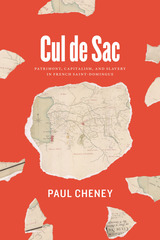
front cover of Cul de Sac
Cul de Sac
Patrimony, Capitalism, and Slavery in French Saint-Domingue
Paul Cheney
University of Chicago Press, 2017
In the eighteenth century, the Cul de Sac plain in Saint-Domingue, now Haiti, was a vast open-air workhouse of sugar plantations. This microhistory of one plantation owned by the Ferron de la Ferronnayses, a family of Breton nobles, draws on remarkable archival finds to show that despite the wealth such plantations produced, they operated in a context of social, political, and environmental fragility that left them weak and crisis prone.

Focusing on correspondence between the Ferronnayses and their plantation managers, Cul de Sac proposes that the Caribbean plantation system, with its reliance on factory-like production processes and highly integrated markets, was a particularly modern expression of eighteenth-century capitalism. But it rested on a foundation of economic and political traditionalism that stymied growth and adaptation. The result was a system heading toward collapse as planters, facing a series of larger crises in the French empire, vainly attempted to rein in the inherent violence and instability of the slave society they had built. In recovering the lost world of the French Antillean plantation, Cul de Sac ultimately reveals how the capitalism of the plantation complex persisted not as a dynamic source of progress, but from the inertia of a degenerate system headed down an economic and ideological dead end.
[more]

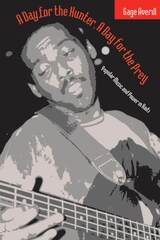
front cover of A Day for the Hunter, a Day for the Prey
A Day for the Hunter, a Day for the Prey
Popular Music and Power in Haiti
Gage Averill
University of Chicago Press, 1997
The history of Haiti throughout the twentieth century has been marked by oppression at the hands of colonial and dictatorial overlords. But set against this "day for the hunter" has been a "day for the prey," a history of resistance, and sometimes of triumph. With keen cultural and historical awareness, Gage Averill shows that Haiti's vibrant and expressive music has been one of the most highly charged instruments in this struggle—one in which power, politics, and resistance are inextricably fused.

Averill explores such diverse genres as Haitian jazz, troubadour traditions, Vodou-jazz, konpa, mini-djaz, new generation, and roots music. He examines the complex interaction of music with power in contexts such as honorific rituals, sponsored street celebrations, Carnival, and social movements that span the political spectrum.

With firsthand accounts by musicians, photos, song texts, and ethnographic descriptions, this book explores the profound manifestations of power and song in the day-to-day efforts of ordinary Haitians to rise above political repression.
[more]

front cover of The Emperor
The Emperor
Makenzy Orcel
Seagull Books, 2024
A tragicomic novel that explores deep-seated tensions and social violence in Haiti.
 
After committing an irreparable crime, the narrator of The Emperor waits in his bedroom for the police to arrest him. His past reverberates inside of him like a drum: his youth spent in captivity as a zonbi, under the control of a charlatan Vodou leader, and many an alienating dawn delivering the daily newspaper through the cutthroat neighborhoods of Port-au-Prince, Haiti. He now has blood on his hands because of the woman on the bus—the only woman he had ever loved.
 
Part crime fiction, part fable gone awry, The Emperor invites readers to follow the narrator’s life as he moves from the Haitian countryside to the sprawling city, learning about the corruptible nature of power in his quest for freedom. Along the way, Makenzy Orcel blends the marvelous with the real by introducing readers to an unforgettable cast of characters including the Very Old Sheep, a deceitful Emperor, and the narrator’s so-called Enlightened Colleague. Written with Orcel’s distinctive verve, this novel offers readers a story set in contemporary Haiti that is rich in poetry and full of narrative intrigue.
[more]

front cover of Ezili's Mirrors
Ezili's Mirrors
Imagining Black Queer Genders
Omise'eke Natasha Tinsley
Duke University Press, 2018
From the dagger mistress Ezili Je Wouj and the gender-bending mermaid Lasiren to the beautiful femme queen Ezili Freda, the Ezili pantheon of Vodoun spirits represents the divine forces of love, sexuality, prosperity, pleasure, maternity, creativity, and fertility. And just as Ezili appears in different guises and characters, so too does Omise’eke Natasha Tinsley in her voice- and genre-shifting, exploratory book Ezili's Mirrors. Drawing on her background as a literary critic as well as her quest to learn the lessons of her spiritual ancestors, Tinsley theorizes black Atlantic sexuality by tracing how contemporary queer Caribbean and African American writers and performers evoke Ezili. Tinsley shows how Ezili is manifest in the work and personal lives of singers Whitney Houston and Azealia Banks, novelists Nalo Hopkinson and Ana Lara, performers MilDred Gerestant and Sharon Bridgforth, and filmmakers Anne Lescot and Laurence Magloire—none of whom identify as Vodou practitioners. In so doing, Tinsley offers a model of queer black feminist theory that creates new possibilities for decolonizing queer studies.
[more]

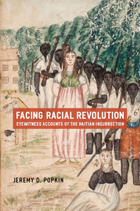
front cover of Facing Racial Revolution
Facing Racial Revolution
Eyewitness Accounts of the Haitian Insurrection
Jeremy D. Popkin
University of Chicago Press, 2008
The only truly successful slave uprising in the Atlantic world, the Haitian Revolution gave birth to the first independent black republic of the modern era. Inspired by the revolution that had recently roiled their French rulers, black slaves and people of mixed race alike rose up against their oppressors in a bloody insurrection that led to the burning of the colony’s largest city, a bitter struggle against Napoleon’s troops, and in 1804, the founding of a free nation.

Numerous firsthand narratives of these events survived, but their invaluable insights into the period have long languished in obscurity—until now. In Facing Racial Revolution, Jeremy D. Popkin unearths these documents and presents excerpts from more than a dozen accounts written by white colonists trying to come to grips with a world that had suddenly disintegrated. These dramatic writings give us our most direct portrayal of the actions of the revolutionaries, vividly depicting encounters with the uprising’s leaders—Toussaint Louverture, Boukman, and Jean-Jacques Dessalines—as well as putting faces on many of the anonymous participants in this epochal moment. Popkin’s expert commentary on each selection provides the necessary background about the authors and the incidents they describe, while also addressing the complex question of the witnesses’ reliability and urging the reader to consider the implications of the narrators’ perspectives.

Along with the American and French revolutions, the birth of Haiti helped shape the modern world. The powerful, moving, and sometimes troubling testimonies collected in Facing Racial Revolution significantly expand our understanding of this momentous event.
[more]

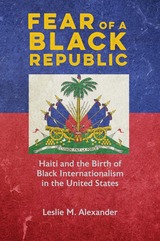
front cover of Fear of a Black Republic
Fear of a Black Republic
Haiti and the Birth of Black Internationalism in the United States
Leslie M. Alexander
University of Illinois Press, 2023
The emergence of Haiti as a sovereign Black nation lit a beacon of hope for Black people throughout the African diaspora. Leslie M. Alexander’s study reveals the untold story of how free and enslaved Black people in the United States defended the young Caribbean nation from forces intent on maintaining slavery and white supremacy. Concentrating on Haiti’s place in the history of Black internationalism, Alexander illuminates the ways Haitian independence influenced Black thought and action in the United States. As she shows, Haiti embodied what whites feared most: Black revolution and Black victory. Thus inspired, Black activists in the United States embraced a common identity with Haiti’s people, forging the idea of a united struggle that merged the destinies of Haiti with their own striving for freedom.

A bold exploration of Black internationalism’s origins, Fear of a Black Republic links the Haitian revolution to the global Black pursuit of liberation, justice, and social equality.
[more]

logo for Vanderbilt University Press
For the Sake of Black People and the Common Good
A Biography of Jean Price-Mars
Celucien Joseph
Vanderbilt University Press, 2026

Jean Price-Mars (1876–1969) was a doctor, teacher, diplomat, and one of Haiti’s most visionary intellectuals. This biography offers the first comprehensive look at his writings, revealing a thinker dedicated to the transformation of Haiti, the advancement of his people, and the broader Black Diaspora.

From his rigorous education and intellectual formation to his engagement with social, political, and cultural issues, Price-Mars championed women’s empowerment, gender equality, and transformative leadership. He reinterpreted the Haitian Revolution and Dessalines’ legacy while articulating Pan-Africanist ideals that connected Haiti to the wider Black world.

A modernist scholar and pluralist, Price-Mars affirmed the validity of all religions while remaining independent of any single tradition. His humanistic spirituality and radical epistemology reimagined race, culture, and nation-building, offering a new vision for Haiti and the possibilities of Black achievement across the Americas.

This book presents a full portrait of Price-Mars as a thinker, reformer, and moral visionary, and a man whose lifelong mission was nothing less than the birth of a new people and the pursuit of the common good.

[more]

front cover of Forgotten Friendships
Forgotten Friendships
Yugoslavia and the Anticolonial Francophone World
Alexandra Perišic
Amherst College Press, 2025

Forgotten Friendships: Yugoslavia and the Anticolonial Francophone World examines transnational friendships and alliances between intellectuals from Yugoslavia and the Francophone African and Caribbean world during the mid-twentieth century. The book argues that transnational political friendships helped shape major intellectual movements like Négritude, African socialism, and global socialist feminisms, which surged beyond national, regional, and even diasporic spaces. Blending archival research, literary analysis, and biography, the book fills a significant gap in our understanding of how intellectuals from the Global South and the socialist world collaborated on shared goals of decolonization, anti-racism, and socialist worldmaking.

Forgotten Friendships emphasizes the ways in which writers, intellectuals, and activists envisioned alternative futures rooted in collaboration across peripheries. Personal bonds of friendship were not mere footnotes to the anti-colonial struggle, but vital political tools for rethinking global solidarity.

[more]

front cover of Framing Silence
Framing Silence
Revolutionary Novels by Haitian Women
Chancy, Myriam J
Rutgers University Press, 1992

Raped and colonized, coerced and silenced--this has been the position of Haitian women within their own society, as well as how they have been seen by foreign occupiers. Romanticized symbols of nationhood, they have served, however unwillingly, as a politicized site of contestation between opposing forces.

In this first book-length study in English devoted exclusively to Haitian women's literature, Myriam Chancy finds that Haitian women have their own history, traditions, and stories to tell, tales that they are unwilling to suppress or subordinate to narratives of national autonomy. Issues of race, class, color, caste, nationality, and sexuality are all central to their fiction--as is an urgent sense of the historical place of women between the two U.S. occupations of the country. Their novels interrogate women's social and political stance in Haiti from an explicitly female point of view, forcefully responding to overt sexual and political violence within the nation's ambivalent political climate. Through daring and sensitive readings, simultaneously historical, fictional and autobiographical, Chancy explores this literature, seeking to uncover answers to the current crisis facing these women today, both within their country and in exile.The writers surveyed include Anne-christine d'Adesky, Ghislaine Rey Charlier, Marie Chauvet, Jan J. Dominique, Nadine Magloire, and Edwidge Danticat, whose work has recently achieved such high acclaim.
[more]

front cover of From Dessalines to Duvalier
From Dessalines to Duvalier
Race, Colour and National Independence in Haiti
Nicholls, David
Rutgers University Press, 1996
In this lively, provocative, and well-documented history, David Nicholls discusses the impact of "color" on the political relationship between the black majority and the mulatto elite during almost two hundred years of Haitian history. The divisive factor impeding harmony in Haitian culture, argues Nicholls, has not been race, but color. Identifying themselves as non-white, blacks and mulattos acknowledge racial unity. But color divisions, reinforced by religious, regional, and class differences, have nonetheless prevented the two groups from achieving poltitical and ideological unity. Nicholls grounds this sophisticated analysis in great historical detail and engaging, witty prose. Students and general readers alike will delight in this insightful and informative history of Haiti.
[more]

front cover of From Dessalines to Duvalier
From Dessalines to Duvalier
Race, Colour and National Independence in Haiti
Nicholls, David
Rutgers University Press, 1996
In this lively, provocative, and well-documented history, David Nicholls discusses the impact of "color" on the political relationship between the black majority and the mulatto elite during almost two hundred years of Haitian history. The divisive factor impeding harmony in Haitian culture, argues Nicholls, has not been race, but color. Identifying themselves as non-white, blacks and mulattos acknowledge racial unity. But color divisions, reinforced by religious, regional, and class differences, have nonetheless prevented the two groups from achieving poltitical and ideological unity. Nicholls grounds this sophisticated analysis in great historical detail and engaging, witty prose. Students and general readers alike will delight in this insightful and informative history of Haiti.
[more]

front cover of From Spaniard to Creole
From Spaniard to Creole
The Archaeology of Cultural Formation at Puerto Real, Haiti
Charles Robin Ewen
University of Alabama Press, 1991

Tracing the archaeological origins of Creole identity in the early colonial Caribbean.

While most studies of intercultural contact focus on the impact of the intrusive power on the native culture, this book examines the effects of the colonization process on the Spaniards in the New World during the 16th century. The site of Puerto Real on the north coast of Haiti serves as a case study. Based on the results of excavations at both Puerto Real and St. Augustine, Florida, this study suggests that the introduction of New World and African cultural elements into Spanish colonial culture began almost at contact. The model of acculturative processes, developed in St. Augustine and tested at Puerto Real, can serve to guide future Spanish colonial research. It can also be applied to non-Hispanic colonial sites in the New World. Did the French and British adapt to their new environments in a manner similar to the Spanish? Work done at Puerto Real demonstrates the utility of archaeology in the study of the effects of culture contact.

 

[more]

front cover of Gender and Violence in Haiti
Gender and Violence in Haiti
Women’s Path from Victims to Agents
Benedetta Faedi Duramy
Rutgers University Press, 2014
Women in Haiti are frequent victims of sexual violence and armed assault. Yet an astonishing proportion of these victims also act as perpetrators of violent crime, often as part of armed groups. Award-winning legal scholar Benedetta Faedi Duramy visited Haiti to discover what causes these women to act in such destructive ways and what might be done to stop this tragic cycle of violence.

Gender and Violence in Haiti is the product of more than a year of extensive firsthand observations and interviews with the women who have been caught up in the widespread violence plaguing Haiti. Drawing from the experiences of a diverse group of Haitian women, Faedi Duramy finds that both the victims and perpetrators of violence share a common sense of anger and desperation. Untangling the many factors that cause these women to commit violence, from self-defense to revenge, she identifies concrete measures that can lead them to feel vindicated and protected by their communities.

Faedi Duramy vividly conveys the horrifying conditions pervading Haiti, even before the 2010 earthquake. But Gender and Violence in Haiti also carries a message of hope—and shows what local authorities and international relief agencies can do to help the women of Haiti.
[more]

front cover of Georges Woke Up Laughing
Georges Woke Up Laughing
Long-Distance Nationalism and the Search for Home
Nina Glick Schiller and Georges Eugene Fouron
Duke University Press, 2001
Combining history, autobiography, and ethnography, Georges Woke Up Laughing provides a portrait of the Haitian experience of migration to the United States that illuminates the phenomenon of long-distance nationalism, the voicelessness of certain citizens, and the impotency of government in an increasingly globalized world. By presenting lively ruminations on his life as a Haitian immigrant, Georges Eugene Fouron—along with Nina Glick Schiller, whose own family history stems from Poland and Russia—captures the daily struggles for survival that bind together those who emigrate and those who stay behind.

According to a long-standing myth, once emigrants leave their homelands—particularly if they emigrate to the United States—they sever old nationalistic ties, assimilate, and happily live the American dream. In fact, many migrants remain intimately and integrally tied to their ancestral homeland, sometimes even after they become legal citizens of another country. In Georges Woke Up Laughing the authors reveal the realities and dilemmas that underlie the efforts of long-distance nationalists to redefine citizenship, race, nationality, and political loyalty. Through discussions of the history and economics that link the United States with countries around the world, Glick Schiller and Fouron highlight the forces that shape emigrants’ experiences of government and citizenship and create a transborder citizenry. Arguing that governments of many countries today have almost no power to implement policies that will assist their citizens, the authors provide insights into the ongoing sociological, anthropological, and political effects of globalization.

Georges Woke up Laughing will entertain and inform those who are concerned about the rights of people and the power of their governments within the globalizing economy.


“In my dream I was young and in Haiti with my friends, laughing, joking, and having a wonderful time. I was walking down the main street of my hometown of Aux Cayes. The sun was shining, the streets were clean, and the port was bustling with ships. At first I was laughing because of the feeling of happiness that stayed with me, even after I woke up. I tried to explain my wonderful dream to my wife, Rolande. Then I laughed again but this time not from joy. I had been dreaming of a Haiti that never was.”—from Georges Woke Up Laughing
[more]

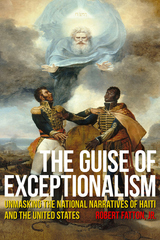
front cover of The Guise of Exceptionalism
The Guise of Exceptionalism
Unmasking the National Narratives of Haiti and the United States
Robert Fatton
Rutgers University Press, 2021
The Guise of Exceptionalism compares the historical origins of Haitian and American exceptionalisms. It also traces how exceptionalism as a narrative of uniqueness has shaped relations between the two countries from their early days of independence through the contemporary period. Exceptionalism is at the core of every national founding narrative. It allows countries to purge history of injurious stains, and embellish it with mythical innocence and claims of distinction. Exceptionalism also builds the bonds of solidarity that forge an imagined national fellowship of the chosen, but it excludes those deemed unfit for membership because of their race, ethnicity, gender, or class. Exceptionalism, however, is not frozen. As a social invention, it changes over time, but always within the parameters of its original principles. Our capacity to reinvent it is dependent on the degree of hegemony achieved by the ruling class, and if this class has the infrastructural power to gradually co-opt and include €the groups it had once excluded.
[more]

front cover of Haiti and the Revolution Unseen
Haiti and the Revolution Unseen
The Persistence of the Decolonial Imagination
Natalie Marie Léger
Vanderbilt University Press, 2025
With Haiti and the Revolution Unseen, Natalie Marie Léger alters the genealogy of the Haitian revolutionary subject in the archive of Caribbean cultural thought and shifts our attention to the revolutionists previously left out of the archive: Saint Domingue’s Africanized captives. She posits that canonical Caribbean writers of the Haitian Revolution (1791–1804), like C. L. R. James, Aimé Césaire, Alejo Carpentier, and Édouard Glissant, ignore the conditions of difference that inspired the captive populace’s dreams of freedom from French colonial rule. These authors replicate the forms of colonial power that they sought to vilify with their Haitian revolutionist texts because they excise the African Haitian revolutionist from the story of the Revolution. Despite the fact that two-thirds of the enslaved population were African born on the eve of the Revolution, canonized Caribbean literature of the Revolution writes the Haitian revolutionist as acculturated into the West. The absence of African Haitian revolutionists results in narratives that do not see Haitian ideas about Haiti and the Haitian Revolution. They are the stories of a Haiti and the Haitian Revolution unseen.
 
Léger writes against a Haiti- and Haitians-less idea of the Revolution. She asks scholars and artists of the Revolution to know Haitians as Ginens (African Haitians) and Haiti as Ayiti Ginen (Africa Haiti). This form of knowing demands a decolonial understanding of the Haitian Revolution and a reevaluation of its stories as told by influential twentieth-century Caribbean writers. The story she tells showcases the immense political impact of the African Haitian revolutionist’s philosophies of freedom in Saint Domingue and Haiti thereafter; and she argues that the absence of these philosophies in Caribbean classics of the Revolution demands consideration of why these classics continue to shape how the Revolution and Haiti are discussed in Caribbean Studies, Black Studies, Postcolonial Studies and Haitian Studies. More pressingly, Léger calls on artists and scholars of the Revolution to be mindful of how Haiti and Haitians are figured in narratives of the Revolution. The immense space Haiti holds in Caribbean imaginings of freedom and revolution makes mediating it, its Revolution, and peoples through a prejudiced gaze that serves the West hugely problematic, since a denigrated Haiti yields stunted visions of the Caribbean’s future. These conditions require attention to the pervasive presence of colonial paradigms for being in classic literatures of the Revolution and the way they undermine the generative manner Caribbean writers have used Haiti to think through their past, present, and future.
[more]

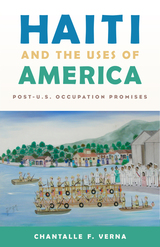
front cover of Haiti and the Uses of America
Haiti and the Uses of America
Post-U.S. Occupation Promises
Verna, Chantalle F.
Rutgers University Press, 2017
Contrary to popular notions, Haiti-U.S. relations have not only been about Haitian resistance to U.S. domination. In Haiti and the Uses of America, Chantalle F. Verna makes evident that there have been key moments of cooperation that contributed to nation-building in both countries.
 
In the years following the U.S. occupation of Haiti (1915-1934), Haitian politicians and professionals with a cosmopolitan outlook shaped a new era in Haiti-U.S. diplomacy. Their efforts, Verna shows, helped favorable ideas about the United States, once held by a small segment of Haitian society, circulate more widely. In this way, Haitians contributed to and capitalized upon the spread of internationalism in the Americas and the larger world.
 
[more]

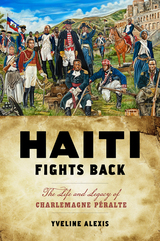
front cover of Haiti Fights Back
Haiti Fights Back
The Life and Legacy of Charlemagne Péralte
Yveline Alexis
Rutgers University Press, 2021
Winner of the 2021 Haitian Studies Association Book Prize​

Haiti Fights Back: The Life and Legacy of Charlemagne Péralte is the first US scholarly examination of the politician and caco leader (guerrilla fighter) who fought against the US military occupation of Haiti. The occupation lasted close to two decades, from 1915-1934. Alexis argues for the importance of documenting resistance while exploring the occupation’s mechanics and its imperialism. She takes us to Haiti, exploring the sites of what she labels as resistance zones, including Péralte’s hometown of Hinche and the nation’s large port areas--Port-au-Prince and Cap-Haïtien. Alexis offers a new reading of U.S. military archival sources that record Haitian protests as banditry. Haiti Fights Back illuminates how Péralte launched a political movement, and meticulously captures how Haitian women and men resisted occupation through silence, military battles, and writings. She locates and assembles rare, multilingual primary sources from traditional repositories, living archives (oral stories), and artistic representations in Haiti and the United States. The interdisciplinary work draws on legislation, cacos’ letters, newspapers, and murals, offering a unique examination of Péralte’s life (1885-1919) and the significance of his legacy through the twenty-first century. Haiti Fights Back offers a new approach to the study of the U.S. invasion of the Americas by chronicling how Caribbean people fought back.
 
[more]

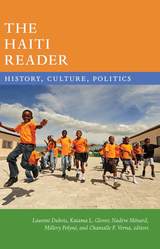
front cover of The Haiti Reader
The Haiti Reader
History, Culture, Politics
Laurent Dubois, Kaiama L. Glover, Nadève Ménard, Millery Polyné, and Chantalle F. Verna, editors
Duke University Press, 2020
While Haiti established the second independent nation in the Western Hemisphere and was the first black country to gain independence from European colonizers, its history is not well known in the Anglophone world. The Haiti Reader introduces readers to Haiti's dynamic history and culture from the viewpoint of Haitians from all walks of life. Its dozens of selections—most of which appear here in English for the first time—are representative of Haiti's scholarly, literary, religious, visual, musical, and political cultures, and range from poems, novels, and political tracts to essays, legislation, songs, and folk tales. Spanning the centuries between precontact indigenous Haiti and the aftermath of the 2010 earthquake, the Reader covers widely known episodes in Haiti's history, such as the U.S. military occupation and the Duvalier dictatorship, as well as overlooked periods such as the decades immediately following Haiti's “second independence” in 1934. Whether examining issues of political upheaval, the environment, or modernization, The Haiti Reader provides an unparalleled look at Haiti's history, culture, and politics.
[more]

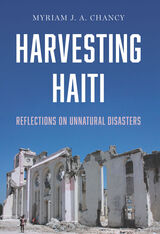
front cover of Harvesting Haiti
Harvesting Haiti
Reflections on Unnatural Disasters
Myriam J.A. Chancy
University of Texas Press, 2023

2024 Isis Duarte Book Prize, Haiti/ Dominican Republic Section, Latin American Studies Association
2024 Longlist, OCM Bocas Prize for Caribbean Literature, Bocas Lit Fest

This collection ponders the personal and political implications for Haitians at home and abroad resulting from the devastating 2010 earthquake.

The 7.0 magnitude earthquake that struck Haiti in January 2010 was a debilitating event that followed decades of political, social, and financial issues. Leaving over 250,000 people dead, 300,000 injured, and 1.5 million people homeless, the earthquake has had lasting repercussions on a struggling nation. As the post-earthquake political situation unfolded, Myriam Chancy worked to illuminate on-the-ground concerns, from the vulnerable position of Haitian women to the failures of international aid. Originally presented at invited campus talks, published as columns for a newspaper in Trinidad and Tobago, and circulated in other ways, her essays and creative responses preserve the reactions and urgencies of the years following the disaster.

In Harvesting Haiti, Chancy examines the structures that have resulted in Haiti's post-earthquake conditions and reflects at key points after the earthquake on its effects on vulnerable communities. Her essays make clear the importance of sustaining and supporting the dignity of Haitian lives and of creating a better, contextualized understanding of the issues that mark Haitians’ historical and present realities, from gender parity to the vexed relationship between Haiti and the Dominican Republic.
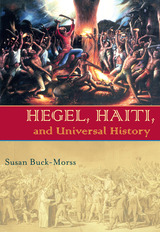
[more]

front cover of An Historical Account of the Black Empire of Hayti
An Historical Account of the Black Empire of Hayti
Marcus Rainsford
Duke University Press, 2013
As the first complete narrative in English of the Haitian Revolution, Marcus Rainsford's An Historical Account of the Black Empire of Hayti was highly influential in establishing nineteenth-century world opinion of this momentous event. This new edition is the first to appear since the original publication in 1805. Rainsford, a career officer in the British army, went to Haiti to recruit black soldiers for the British. By publishing his observations of the prowess of black troops, and recounting his meetings with Toussaint Louverture, Rainsford offered eyewitness testimonial that acknowledged the intelligence and effectiveness of the Haitian rebels. Although not an abolitionist, Rainsford nonetheless was supportive of the independent state of Haiti, which he argued posed no threat to British colonial interests in the West Indies, an extremely unusual stance at the time. Rainsford's account made an immediate impact upon publication; it was widely reviewed, and translated twice in its first year. Paul Youngquist's and Grégory Pierrot's critical introduction to this new edition provides contextual and historical details, as well as new biographical information about Rainsford. Of particular interest is a newly discovered miniature painting of Louverture attributed to Rainsford, which is reproduced along with the twelve engravings that accompanied his original account.
[more]

front cover of How Human Rights Can Build Haiti
How Human Rights Can Build Haiti
Activists, Lawyers, and the Grassroots Campaign
Fran Quigley
Vanderbilt University Press, 2014
A cataclysmic earthquake, revolution, corruption, and neglect have all conspired to strangle the growth of a legitimate legal system in Haiti. But as How Human Rights Can Build Haiti demonstrates, the story of lawyers-activists on the ground should give us all hope. They organize demonstrations at the street level, argue court cases at the international level, and conduct social media and lobbying campaigns across the globe. They are making historic claims and achieving real success as they tackle Haiti's cholera epidemic, post-earthquake housing and rape crises, and the Jean-Claude Duvalier prosecution, among other human rights emergencies in Haiti.


The only way to transform Haiti's dismal human rights legacy is through a bottom-up social movement, supported by local and international challenges to the status quo. That recipe for reform mirrors the strategy followed by Mario Joseph, Brian Concannon, and their clients and colleagues profiled in this book. Together, Joseph, Concannon, and their allies represent Haiti's best hope to escape the cycle of disaster, corruption, and violence that has characterized the country's two-hundred-year history. At the same time, their efforts are creating a template for a new and more effective human rights-focused strategy to turn around failed states and end global poverty.

[more]

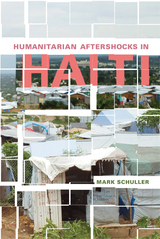
front cover of Humanitarian Aftershocks in Haiti
Humanitarian Aftershocks in Haiti
Schuller, Mark
Rutgers University Press, 2016
Winner of the 2016 Anthropology in Media Award from the American Anthropological Association 

The 2010 earthquake in Haiti was one of the deadliest disasters in modern history, sparking an international aid response—with pledges and donations of $16 billion—that was exceedingly generous. But now, five years later, that generous aid has clearly failed. In Humanitarian Aftershocks in Haiti, anthropologist Mark Schuller captures the voices of those involved in the earthquake aid response, and they paint a sharp, unflattering view of the humanitarian enterprise.  
 
Schuller led an independent study of eight displaced-persons camps in Haiti, compiling more than 150 interviews ranging from Haitian front-line workers and camp directors to foreign humanitarians and many displaced Haitian people. The result is an insightful account of why the multi-billion-dollar aid response not only did little to help but also did much harm, triggering a range of unintended consequences, rupturing Haitian social and cultural institutions, and actually increasing violence, especially against women. The book shows how Haitian people were removed from any real decision-making, replaced by a top-down, NGO-dominated system of humanitarian aid, led by an army of often young, inexperienced foreign workers. Ignorant of Haitian culture, these aid workers unwittingly enacted policies that triggered a range of negative results. Haitian interviewees also note that the NGOs “planted the flag,” and often tended to “just do something,” always with an eye to the “photo op” (in no small part due to the competition over funding). Worse yet, they blindly supported the eviction of displaced people from the camps, forcing earthquake victims to relocate in vast shantytowns that were hotbeds of violence.
 
Humanitarian Aftershocks in Haiti concludes with suggestions to help improve humanitarian aid in the future, perhaps most notably, that aid workers listen to—and respect the culture of—the victims of catastrophe.

[more]

front cover of The Idea of Haiti
The Idea of Haiti
Rethinking Crisis and Development
Millery Polyné
University of Minnesota Press, 2013


After Haiti was struck by a devastating earthquake on January 12, 2010, aid workers and offers of support poured in from around the world. Tellingly, though, news reports on the catastrophe and relief efforts frequently included a pejorative description of the country that outsiders were determined to rebuild: the troubled island nation, a nation plagued by political violence. There was much talk of inventing a “new” Haiti, which would presumably mimic Western modes of development and thus mitigate political instability and crisis.


As contributors to this wide-ranging book reveal, Haiti has long been marginalized as an embodiment of alterity, as the other, and the idea of a new Haiti is actually nothing new. An investigation of the notion of newness through the lenses of history and literature, urban planning, religion, and governance, The Idea of Haiti illuminates the politics and the narratives of Haiti’s past and present. The essays, which grow from original research and in-depth interviews, examine how race, class, and national development inform the policies that envision re-creating the country.


Together the contributors address important questions: How will the present narratives of deviance affect international relief and rebuilding efforts? What do Haitians themselves think about Haiti, old and new? What are the potential complications and weakness of aid strategies during these trying times? And what do we mean by crisis in Haiti?


Contributors: Yveline Alexis, Rutgers U; Wein Weibert Arthus, State U of Haiti; Greg Beckett, Bowdoin College; Alex Dupuy, Wesleyan U; Harley F. Etienne, U of Michigan; Robert Fatton Jr., U of Virginia; Sibylle Fischer, New York U; Elizabeth McAlister, Wesleyan U; Nick Nesbitt, Princeton U; Karen Richman, U of Notre Dame; Mark Schuller, York College (CUNY); Patrick Sylvain, Brown U; Évelyne Trouillot, State U of Haiti; Tatiana Wah, Columbia U.


[more]

front cover of In the Shadow of Powers
In the Shadow of Powers
Dantes Bellegarde in Haitian Social Thought
Patrick Bellegarde-Smith
Vanderbilt University Press, 2019
Out of a slave rebellion, Haiti was forged as an independent nation. This fact, in and of itself, should have been enough to perpetuate an image of Haitians as strong and agentive people. But leaders of countries on both sides of the Atlantic felt threatened by Haiti's beginnings and were intent on sapping it of resources. More than a century of various restrictions on trade, the imposition of crippling fines, and, eventually, a US occupation followed. Yet even as they suffered economically under these penalties, Haitians persisted, some of them becoming influential actors in the world of global politics.

Throughout much of the twentieth century and even to this day, there has been a dearth of scholarship on the intellectual and political contributions of Haitians. In the Shadow of Powers, first published in 1985, was a corrective to this oversight and remains a foundational text. Bellegarde-Smith traces the history of Haiti through the life and career of his grandfather Dantès Bellegarde, one of Haiti's influential diplomats and preeminent thinkers. As Brandon R. Byrd describes in his foreword to this new edition, "Bellegarde was driven by a subversive, racially inclusive vision of civilized progress. He believed in and continued to push for Haiti to establish an existence for itself, black people, and the colonized world independent of the considerable shadow cast by the world's military, economic, and industrial powers." Scholars and students who want to learn about the intellectual and political foundations of Haiti, its influence on other intellectuals worldwide, and its struggles against imperialism continue to find this to be an invaluable classic.
[more]

front cover of The Insistent Call
The Insistent Call
Rhetorical Moments in Black Anticolonialism, 1929-1937
Aric Putnam
University of Massachusetts Press, 2012

Throughout the nineteenth century, African heritage played an important role in black America, as personal memories and cultural practices continued to shape the everyday experience of people of African descent living under the shadow of slavery. Resisting efforts to de-Africanize their values, customs, and beliefs, Black Americans invoked their African roots in public arguments about their identity and place in the “new” world. At the outset of the twentieth century many still saw Africa primarily as the source of a common cultural and spiritual past. But after the 1920s, the meaning of African heritage changed as people of African descent expressed new relationships between themselves, the United States, and the African Diaspora.

In The Insistent Call, Aric Putnam studies the rhetoric of newspapers, literature, and political pamphlets that expressed this shift. He demonstrates that as people of African descent debated the United States' occupation of Haiti, the Liberian labor crisis, and the Italian invasion of Ethiopia, they formed a new collective identity, one that understood the African Diaspora in primarily political rather than cultural terms. In addition to uncovering a neglected period in the history of Black rhetoric, Putnam shows how rhetoric that articulates the interests of a population not defined by the boundaries of a state can still motivate collective action and influence policies.

[more]

front cover of Island Possessed
Island Possessed
Katherine Dunham
University of Chicago Press, 1994
Just as surely as Haiti is "possessed" by the gods and spirits of vaudun (voodoo), the island "possessed" Katherine Dunham when she first went there in 1936 to study dance and ritual. In this book, Dunham reveals how her anthropological research, her work in dance, and her fascination for the people and cults of Haiti worked their spell, catapulting her into experiences that she was often lucky to survive. Here Dunham tells how the island came to be possessed by the demons of voodoo and other cults imported from various parts of Africa, as well as by the deep class divisions, particularly between blacks and mulattos, and the political hatred still very much in evidence today. Full of the flare and suspense of immersion in a strange and enchanting culture, Island Possessed is also a pioneering work in the anthropology of dance and a fascinating document on Haitian politics and voodoo.
[more]

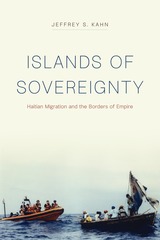
front cover of Islands of Sovereignty
Islands of Sovereignty
Haitian Migration and the Borders of Empire
Jeffrey S. Kahn
University of Chicago Press, 2018
In Islands of Sovereignty, anthropologist and legal scholar Jeffrey S. Kahn offers a new interpretation of the transformation of US borders during the late twentieth century and its implications for our understanding of the nation-state as a legal and political form. Kahn takes us on a voyage into the immigration tribunals of South Florida, the Coast Guard vessels patrolling the northern Caribbean, and the camps of Guantánamo Bay—once the world’s largest US-operated migrant detention facility—to explore how litigation concerning the fate of Haitian asylum seekers gave birth to a novel paradigm of offshore oceanic migration policing. Combining ethnography—in Haiti, at Guantánamo, and alongside US migration patrols in the Caribbean—with in-depth archival research, Kahn expounds a nuanced theory of liberal empire’s dynamic tensions and its racialized geographies of securitization. An innovative historical anthropology of the modern legal imagination, Islands of Sovereignty forces us to reconsider the significance of the rise of the current US immigration border and its relation to broader shifts in the legal infrastructure of contemporary nation-states across the globe.
 
[more]

front cover of Killing with Kindness
Killing with Kindness
Haiti, International Aid, and NGOs
Schuller, Mark
Rutgers University Press, 2012

Winner of the 2015 Margaret Mead Award from the American Anthropological Association and the Society for Applied Anthropology

After Haiti’s 2010 earthquake, over half of U.S. households donated to thousands of nongovernmental organizations (NGOs) in that country. Yet we continue to hear stories of misery from Haiti. Why have NGOs failed at their mission?

Set in Haiti during the 2004 coup and aftermath and enhanced by research conducted after the 2010 earthquake, Killing with Kindness analyzes the impact of official development aid on recipient NGOs and their relationships with local communities. Written like a detective story, the book offers rich ethnographic comparisons of two Haitian women’s NGOs working in HIV/AIDS prevention, one with public funding (including USAID), the other with private European NGO partners. Mark Schuller looks at participation and autonomy, analyzing donor policies that inhibit these goals. He focuses on NGOs’ roles as intermediaries in “gluing” the contemporary world system together and shows how power works within the aid system as these intermediaries impose interpretations of unclear mandates down the chain—a process Schuller calls “trickle-down imperialism.”

[more]

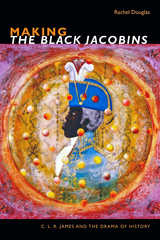
front cover of Making The Black Jacobins
Making The Black Jacobins
C. L. R. James and the Drama of History
Rachel Douglas
Duke University Press, 2019
C. L. R. James's The Black Jacobins remains one of the great works of the twentieth century and the cornerstone of Haitian revolutionary studies. In Making The Black Jacobins, Rachel Douglas traces the genesis, transformation, and afterlives of James's landmark work across the decades from the 1930s on. Examining the 1938 and 1963 editions of The Black Jacobins, the 1967 play of the same name, and James's 1936 play, Toussaint Louverture—as well as manuscripts, notes, interviews, and other texts—Douglas shows how James continuously rewrote and revised his history of the Haitian Revolution as his politics and engagement with Marxism evolved. She also points to the vital significance theater played in James's work and how it influenced his views of history. Douglas shows The Black Jacobins to be a palimpsest, its successive layers of rewriting renewing its call to new generations.
[more]

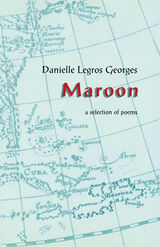
front cover of Maroon
Maroon
Danielle Legros Georges
Northwestern University Press, 2001

Maroon is the debut collection of Haitian-American poet Danielle Legros Georges, who writes of the pain of exile, the beauty of nature, and the delights of love in highly rhythmic, highly original language. The range of her voice is remarkable— from the comic to the tragic to the lyric. Her poetry is electric with an overpowering zest for life and vitality of language, as she examines the traumatic experiences that brought her parents to America and searches for a more complete understanding of self. 

[more]

front cover of MEDICAL REVOLUTIONARIES
MEDICAL REVOLUTIONARIES
The Enslaved Healers of Eighteenth-Century Saint Domingue
Karol K. Weaver
University of Illinois Press, 2006

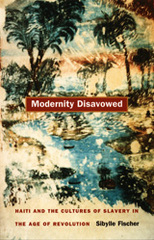
front cover of Modernity Disavowed
Modernity Disavowed
Haiti and the Cultures of Slavery in the Age of Revolution
Sibylle Fischer
Duke University Press, 2004
Modernity Disavowed is a pathbreaking study of the cultural, political, and philosophical significance of the Haitian Revolution (1791–1804). Revealing how the radical antislavery politics of this seminal event have been suppressed and ignored in historical and cultural records over the past two hundred years, Sibylle Fischer contends that revolutionary antislavery and its subsequent disavowal are central to the formation and understanding of Western modernity. She develops a powerful argument that the denial of revolutionary antislavery eventually became a crucial ingredient in a range of hegemonic thought, including Creole nationalism in the Caribbean and G. W. F. Hegel’s master-slave dialectic.

Fischer draws on history, literary scholarship, political theory, philosophy, and psychoanalytic theory to examine a range of material, including Haitian political and legal documents and nineteenth-century Cuban and Dominican literature and art. She demonstrates that at a time when racial taxonomies were beginning to mutate into scientific racism and racist biology, the Haitian revolutionaries recognized the question of race as political. Yet, as the cultural records of neighboring Cuba and the Dominican Republic show, the story of the Haitian Revolution has been told as one outside politics and beyond human language, as a tale of barbarism and unspeakable violence. From the time of the revolution onward, the story has been confined to the margins of history: to rumors, oral histories, and confidential letters. Fischer maintains that without accounting for revolutionary antislavery and its subsequent disavowal, Western modernity—including its hierarchy of values, depoliticization of social goals having to do with racial differences, and privileging of claims of national sovereignty—cannot be fully understood.
[more]

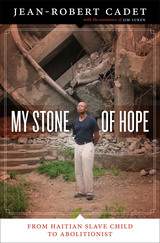
front cover of My Stone of Hope
My Stone of Hope
From Haitian Slave Child to Abolitionist
By Jean-Robert Cadet
University of Texas Press, 2011

There are 27 million slaves living in the world today—more than at any time in history. Three hundred thousand of them are impoverished children in Haiti, who "stay with" families as unpaid and uneducated domestic workers, subject to physical, emotional, and sexual abuse. This practice, known locally as restavek ("staying with"), is so widespread that one in ten Haitian children is caught up in this form of slavery.

Jean-Robert Cadet was a restavek in Haiti from the late 1950s until the early 1970s. He told the harrowing story of his youth in Restavec: From Haitian Slave Child to Middle-Class American—a landmark book that exposed ongoing child slavery in Haiti. Now in My Stone of Hope, Cadet continues his story from his early attempts to adjust to freedom in American society to his current life mission of eliminating child slavery through advocacy and education. As he recounts his own struggles to surmount the psychological wounds of slavery, Cadet puts a human face on the suffering that hundreds of thousands of Haitians still endure daily. He also builds a convincing case that child slavery is not just one among many problems that Haiti faces as the Western Hemisphere's poorest nation. Rather, he argues that the systematic abuse of so many of its children is Haiti's fundamental problem, because it creates damaged adults who seem incapable of governing the country justly or managing its economy productively.

For everyone concerned about the fate of Haiti, the welfare of children, and the freedom of people around the globe, My Stone of Hope sounds an irresistible call to action.

[more]

front cover of Open Gate
Open Gate
An Anthology of Haitian Creole Poetry
Edited by Paul Laraque and Jack Hirschman
Northwestern University Press, 2001
Open Gate is the first bilingual volume of Haitian Creole poetry published in English. Seven years in the making, this anthology is the result of the dedication of its editors and translators, Paul Laraque, Jack Hirschman and the Haitian poet Boadiba, as well as Max Manigat, one of the first teachers of Creole on the university level who was an invaluable advisor.

The editors focus on contemporary Creole poetry that reflects the struggle for human rights in Haiti. The book is divided into three sections: Pioneers of Modern Haitian Creole poetry, beginning with the founder of modern Haitian Creole literature, Felix Morisseu-Leroy (19131998); the flowering of Haitian poetry as represented by the literary movement, "Society of Butterflies," some of whose members were jailed or exiled by the bloody Duvalier dictatorship; and the New Generation featuring primarily those poets in the Diaspora whose work has been published in the last 15 years.
[more]

front cover of A Promise in Haiti
A Promise in Haiti
A Reporter's Notes on Families and Daily Lives
Mark Curnutte
Vanderbilt University Press, 2011
When a devastating earthquake struck near Port-au-Prince, Haiti, on January 12, 2010, the world reacted with a collective, yet distant, horror. For Cincinnati Enquirer reporter Mark Curnutte, hearing the news provoked a far more visceral response. Curnutte had grown to love Haiti and its people as only someone who had lived with Haiti's families could.


A Promise in Haiti is Curnutte's story of his time, spanning the last decade, living among several families in Gonaives, a city of 200,000 people a hundred kilometers north of Port-au-Prince. He began traveling to Haiti as a volunteer with the aid organization Hands Together, eventually building trust and credibility with many Haitians. Curnutte introduces the reader to the Cenecharles family, strained by entrenched unemployment and the need to continually travel for work. He is invited into the home of the Henrisma family, and is forced to reconcile journalistic detachment with basic compassion as he contributes financially to help them. The reader is confronted with a complicated, conflicted written and photographic record of a worldview that evolves right on the page. As a reporter, Curnutte found parallels between the lives he encountered in Gonaives and the world of the Great Depression recounted in James Agee and Walker Evans's Let Us Now Praise Famous Men. Agee and Evans loom large as a challenge and inspiration to Curnutte.


The result is equal parts homage to that historic chronicle, on-the-ground reporting, and introspective narrative on the lessons Gonaives taught Curnutte about his own life and family. In late February 2010, Curnutte went back to Haiti on assignment, but conditions made it impossible for him to return to Gonaives. The resulting frustration provoked a meditation on the monumental challenges that face Haiti -- and on the destructive cycle of international attention that constantly moves on to "The Next Big Story."

[more]

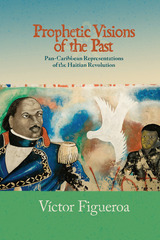
front cover of Prophetic Visions of the Past
Prophetic Visions of the Past
Pan-Caribbean Representations of the Haitian Revolution
Víctor Figueroa
The Ohio State University Press, 2015
In Prophetic Visions of the Past: Pan-Caribbean Representations of the Haitian Revolution, Víctor Figueroa examines how the Haitian Revolution has been represented in twentieth-century literary works from across the Caribbean. Building on the scholarship of key thinkers of the Latin American “decolonial turn” such as Enrique Dussel, Aníbal Quijano, Walter Mignolo, and Nelson Maldonado-Torres, Figueroa argues that examining how Haiti’s neighbors tell the story of the Revolution illuminates its role as a fundamental turning point in both the development and radical questioning of the modern/colonial world system.
 
Prophetic Visions of the Past includes chapters on literary texts from a wide array of languages, histories, and perspectives. Figueroa addresses work by Alejo Carpentier (Cuba), C. L. R. James (Trinidad), Luis Palés Matos (Puerto Rico), Aimé Césaire (Martinique), Derek Walcott (Saint Lucia), Edouard Glissant (Martinique), and Manuel Zapata Olivella (Colombia). While underscoring each writer’s unique position, Figueroa also addresses their shared geographical, historical, and sociopolitical preoccupations, which are closely linked to the region’s prolonged experience of colonial interventions. Ultimately, these analyses probe how, for the larger Caribbean region, the Haitian Revolution continues to reflect the tension between inspiring revolutionary hopes and an awareness of ongoing colonial objectification and exploitation.
 
[more]

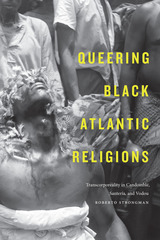
front cover of Queering Black Atlantic Religions
Queering Black Atlantic Religions
Transcorporeality in Candomblé, Santería, and Vodou
Roberto Strongman
Duke University Press, 2019
In Queering Black Atlantic Religions Roberto Strongman examines Haitian Vodou, Cuban Lucumí/Santería, and Brazilian Candomblé to demonstrate how religious rituals of trance possession allow humans to understand themselves as embodiments of the divine. In these rituals, the commingling of humans and the divine produces gender identities that are independent of biological sex. As opposed to the Cartesian view of the spirit as locked within the body, the body in Afro-diasporic religions is an open receptacle. Showing how trance possession is a primary aspect of almost all Afro-diasporic cultural production, Strongman articulates transcorporeality as a black, trans-Atlantic understanding of the human psyche, soul, and gender as multiple, removable, and external to the body.
[more]

front cover of Quiet Dawn
Quiet Dawn
Jean-Claude Fignolé. Translated and with an Introduction by Kaiama L. Glover and Laurent Dubois.
Duke University Press, 2025
Jean-Claude Fignolé’s Quiet Dawn tells an enthralling story of Haiti’s transition from French colony to independent Black republic. The swirling, multilayered novel provides intimate portraits of an eighteenth-century slaveholder, his wife, and their enslaved laborers set against the devastating backdrop of enslavement and revolution. Into this Gothic colonial tale Fignolé interweaves a series of tragic events involving a present-day French nun doing penance for the sins of her ancestors. One of the few contemporary Haitian novels to explicitly grapple with Haiti’s revolution, Quiet Dawn foregrounds issues of race, power, the continuing legacy of historical trauma, and the unresolved tensions between the past and present. Published in French in 1990 and appearing here in English for the first time, Quiet Dawn forcefully pushes against the silencing of Haiti’s past, belying its title to depict a clamorous Atlantic world that comprises Europe, Africa, and the vast expanse of the Americas.
[more]

front cover of Reclaiming Haiti's Futures
Reclaiming Haiti's Futures
Returned Intellectuals, Placemaking, and Radical Imagination
Darlène Elizabeth Dubuisson
Rutgers University Press, 2025

Winner of the 2024 Annual Book Award from the Society for Latin American and Caribbean Anthropology (SLACA)

Co-winner of the Isis Duarte Book Prize from the Latin American Studies Association 

Haiti was once a beacon of Black liberatory futures, but now it is often depicted as a place with no future where emigration is the only way out for most of its population. But Reclaiming Haiti's Futures tells a different story. It is a story about two generations of Haitian scholars who returned home after particular crises to partake in social change. The first generation, called jenerasyon 86, were intellectuals who fled Haiti during the Duvalier dictatorship (1957–1986). They returned after the regime fell to participate in the democratic transition through their political leadership and activism. The younger generation, dubbed the jenn doktè, returned after the 2010 earthquake to partake in national reconstruction through public higher education reform. An ethnography of the future, the book explores how these returned scholars resisted coloniality's fractures and displacements by working toward and creating inhabitability or future-oriented places of belonging through improvisation, rasanblaj (assembly), and radical imagination. By centering on Haiti and the Caribbean, the book offers insights not just into the Haitian experience but also into how fractures have come to typify more aspects of life globally and what we might do about it.

[more]

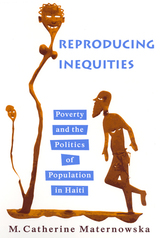
front cover of Reproducing Inequities
Reproducing Inequities
Poverty and the Politics of Population in Haiti
Maternowska, M. Catherine
Rutgers University Press, 2006

Residents of Haiti-one of the poorest and most unstable countries in the world-face a grim reality of starvation, violence, lack of economic opportunity, and minimal health care. For years, aid organizations have sought to alleviate the problems by creating health and family planning clinics, including one modern (and, by local standards, luxurious) center in the heart of Cit Soleil. During its height of service in the 1980s and 1990s, the clinic boasted nineteen staff members, an array of modern contraceptives, an accessible location, and convenient hours-but very few clients.

Why did this initiative fail so spectacularly despite surveys finding that residents would like to have fewer children? Why don't poor women heed the message of family planning, when smaller families seem to be in their best interest? In Reproducing Inequities, M. Catherine Maternowska argues that we too easily overlook the political dynamics that shape choices about family planning. Through a detailed study of the attempt to provide modern contraception in the community of Cit Soleil, Maternowska demonstrates the complex interplay between local and global politics that so often thwarts well-intended policy initiatives.

Medical anthropologists, she argues, have an important role to play in developing new action plans for better policy implementation. Ethnographic studies in desperate, dangerous locations provide essential data that can point the way to solutions for the dilemmas of contraception in poor communities worldwide.

 

[more]

front cover of Restavec
Restavec
From Haitian Slave Child to Middle-Class American
An Autobiography by Jean-Robert Cadet
University of Texas Press, 1998

African slaves in Haiti emancipated themselves from French rule in 1804 and created the first independent black republic in the Western Hemisphere. But they reinstituted slavery for the most vulnerable members of Haitian society—the children of the poor—by using them as unpaid servants to the wealthy. These children were—and still are—restavecs, a French term whose literal meaning of "staying with" disguises the unremitting labor, abuse, and denial of education that characterizes the children's lives.

In this memoir, Jean-Robert Cadet recounts the harrowing story of his youth as a restavec, as well as his inspiring climb to middle-class American life. He vividly describes what it was like to be an unwanted illegitimate child "staying with" a well-to-do family whose physical and emotional abuse was sanctioned by Haitian society. He also details his subsequent life in the United States, where, despite American racism, he put himself through college and found success in the Army, in business, and finally in teaching.

[more]

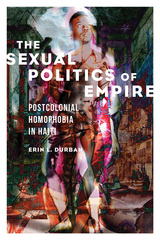
front cover of The Sexual Politics of Empire
The Sexual Politics of Empire
Postcolonial Homophobia in Haiti
Erin L. Durban
University of Illinois Press, 2023
Winner in the LAMMY Awards – Lambda Literary Awards, LGBTQ+ Studies category

Evangelical Christians and members of the global LGBTQI human rights movement have vied for influence in Haiti since the 2010 earthquake. Each side accuses the other of serving foreign interests. Yet each proposes future foreign interventions on behalf of their respective causes despite the country’s traumatic past with European colonialism and American imperialism. As Erin L. Durban shows, two discourses dominate discussions of intervention. One maintains imperialist notions of a backward Haiti so riddled with cultural deficiencies that foreign supervision is necessary to overcome Haitians’ resistance to progress. The other sees Haiti as a modern but failed state that exists only through its capacity for violence, including homophobia. In the context of these competing claims, Durban explores the creative ways that same-sex desiring and gender creative Haitians contend with anti-LGBTQI violence and ongoing foreign intervention.

Compelling and thought-provoking, The Sexual Politics of Empire examines LGBTQI life in contemporary Haiti against the backdrop of American imperialism and intervention.
[more]

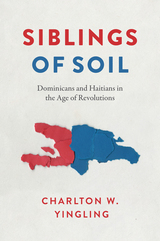
front cover of Siblings of Soil
Siblings of Soil
Dominicans and Haitians in the Age of Revolutions
Charlton W. Yingling
University of Texas Press, 2022

2023 Honorable Mention, Isis Duarte Book Prize, Haiti/ Dominican Republic section (LASA)

After revolutionary cooperation between Dominican and Haitian majorities produced independence across Hispaniola, Dominican elites crafted negative myths about this era that contributed to anti-Haitianism.


Despite the island’s long-simmering tensions, Dominicans and Haitians once unified Hispaniola. Based on research from over two dozen archives in multiple countries, Siblings of Soil presents the overlooked history of their shared imperial endings and national beginnings from the 1780s to 1822. Haitian revolutionaries both inspired and aided Dominican antislavery and anti-imperial movements. Ultimately, Santo Domingo's independence from Spain came in 1822 through unification with Haiti, as Dominicans embraced citizenship and emancipation. Their collaboration resulted in one of the most unique and inclusive forms of independence in the Americas.

Elite reactions to this era formed anti-Haitian narratives. Racial ideas permeated the revolution, Vodou, Catholicism, secularism, and even Deism. Some Dominicans reinforced Hispanic and Catholic traditions and cast Haitians as violent heretics who had invaded Dominican society, undermining the innovative, multicultural state. Two centuries later, distortions of their shared past of kinship have enabled generations of anti-Haitian policies, assumptions of irreconcilable differences, and human rights abuses.
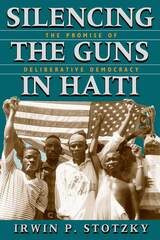
[more]

front cover of Silencing the Guns in Haiti
Silencing the Guns in Haiti
The Promise of Deliberative Democracy
Irwin P. Stotzky
University of Chicago Press, 1997
Silencing the Guns in Haiti traces Haiti's halting and uncertain quest for democracy from the perspective of someone who played a leading part in every stage of that process.

"A provocative study of the prospects for the rule of law in Haiti."—Marilyn Bowden, Miami Today

"[Stotzky] deepens insights into the contradictory obstacles to democratic governance in Haiti."—Library Journal

"Controversial and stimulating."—Choice

"Lucid and informative. . . . Stotzky gives readers a good foundation for understanding the pressures facing the impoverished but determined Caribbean island."—Islands
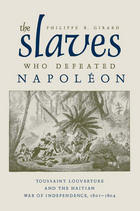
[more]

front cover of The Slaves Who Defeated Napoléon
The Slaves Who Defeated Napoléon
Toussaint Louverture and the Haitian War of Independence, 1801–1804
Philippe R. Girard
University of Alabama Press, 2011

A deeply researched and definitive account of the climactic battle at the end of the Haitian Revolution 

Among the many rebellions against European colonial empires, the Haitian Revolution against France is among the most dramatic and complex. Having begun in 1791 as France was in the throes of its own young revolution, the conflict reached its dramatic climax when Napoleon dispatched a heavily armed expeditionary force led by his brother-in-law Charles Leclerc to re-establish slavery and the sugar economy that had so enriched France. Philippe Girard’s Slaves Who Defeated Napoleon is a deeply researched and engrossing account of this invasion and its spectacular defeat.

For this ambitious account, Philippe Girard has studied not only primary records in Haiti itself but also rare documents from nineteen public and private archives and research libraries in French, U.S., British, and Spanish collections. His more inclusive approach provides a fuller, more accurate and detailed narrative. He reveals not only key military movements, but also less-known aspects like the activities of U.S. merchants, in-fighting within Napoleon’s government, and communication between both sides and other European powers. Girard fills the work with unforgettable stories of those who led or were caught up in the war, people like poorly armed Black soldiers who ambushed Bonaparte’s columns, French child drummers, Jewish bankers in Kingston, weapon smugglers from Quaker Philadelphia, Polish artillerists, and mixed-raced people struggling to preserve their freedom against both Black and white opponents.

Transcending pat ideological and racial categories, the book brings into focus an Atlantic society at the crossroads of African and European influences, where Haitian rebels fought France while embracing its ideals.

[more]

front cover of The Spirits and the Law
The Spirits and the Law
Vodou and Power in Haiti
Kate Ramsey
University of Chicago Press, 2011

Vodou has often served as a scapegoat for Haiti’s problems, from political upheavals to natural disasters. This tradition of scapegoating stretches back to the nation’s founding and forms part of a contest over the legitimacy of the religion, both beyond and within Haiti’s borders. The Spirits and the Law examines that vexed history, asking why, from 1835 to 1987, Haiti banned many popular ritual practices.

To find out, Kate Ramsey begins with the Haitian Revolution and its aftermath. Fearful of an independent black nation inspiring similar revolts, the United States, France, and the rest of Europe ostracized Haiti. Successive Haitian governments, seeking to counter the image of Haiti as primitive as well as contain popular organization and leadership, outlawed “spells” and, later, “superstitious practices.” While not often strictly enforced, these laws were at times the basis for attacks on Vodou by the Haitian state, the Catholic Church, and occupying U.S. forces. Beyond such offensives, Ramsey argues that in prohibiting practices considered essential for maintaining relations with the spirits, anti-Vodou laws reinforced the political marginalization, social stigmatization, and economic exploitation of the Haitian majority. At the same time, she examines the ways communities across Haiti evaded, subverted, redirected, and shaped enforcement of the laws. Analyzing the long genealogy of anti-Vodou rhetoric, Ramsey thoroughly dissects claims that the religion has impeded Haiti’s development.

[more]

logo for Pluto Press
Toussaint Louverture
A Black Jacobin in the Age of Revolutions
Charles Forsdick and Christian Høgsbjerg
Pluto Press, 2017
“In overthrowing me, you have done no more than cut down the trunk of the tree of the black liberty in St. Domingue—it will spring back from the roots, for they are numerous and deep.”
 
These are Toussaint Louverture’s last words before being taken to prison in France. Heroic leader of the only successful slave revolt in history, Louverture is one of the greatest anti-imperialist fighters who ever lived. Born into slavery on a Caribbean plantation, he was able to break from his bondage to lead an army of freed African slaves to victory against the professional armies of France, Spain, and Britain in the Haitian Revolution of 1791-1804.
 
In this lively narrative biography, Louverture’s fascinating life is explored through the prism of his radical politics. Charles Forsdick and Christian Høgsbjerg champion the “black Robespierre,” whose revolutionary legacy has inspired people and movements in the two centuries since his death. For anyone interested in the roots of modern resistance movements and black political radicalism, Louverture’s extraordinary life provides the perfect groundwork.
 
[more]

front cover of Toussaint Louverture
Toussaint Louverture
The Story of the Only Successful Slave Revolt in History; A Play in Three Acts
C. L. R. James Edited and Introduced by Christian Høgsbjerg
Duke University Press, 2013
In 1934 C. L. R. James, the widely known Trinidadian intellectual, writer, and political activist, wrote the play Toussaint Louverture: The Story of the Only Successful Slave Revolt in History, which was presumed lost until the rediscovery of a draft copy in 2005. The play's production, performed in 1936 at London's Westminster Theatre with a cast including the American star Paul Robeson, marked the first time black professional actors starred on the British stage in a play written by a black playwright. This edition includes the program, photographs, and reviews from that production, a contextual introduction and editorial notes on the play by Christian Høgsbjerg, and selected essays and letters by James and others. In Toussaint Louverture, James demonstrates the full tragedy and heroism of Louverture by showing how the Haitian revolutionary leader is caught in a dramatic conflict arising from the contradiction between the barbaric realities of New World slavery and the modern ideals of the Enlightenment. In his portrayal of the Haitian Revolution, James aspired to vindicate black accomplishments in the face of racism and to support the struggle for self-government in his native Caribbean. Toussaint Louverture is an indispensable companion work to The Black Jacobins (1938), James's classic account of Haiti's revolutionary struggle for liberation.
[more]

front cover of The United States Occupation of Haiti, 1915-1934
The United States Occupation of Haiti, 1915-1934
Schmidt, Hans
Rutgers University Press, 1995
"A good history of a sordid intervention that submitted a people to autocratic rule and did little for economic development." —The New York Times
"From Schmidt we get the full details . . . of the brutal racist practices inflicted on the Haitians for nearly all of the nineteen-year American presence in the country." —American Historical Review
"The only thoroughgoing study of one of the more discreditable American interventions overseas." —Journal of Interdisciplinary History
"Should become the standard work on the subject. . . .required reading for specialists in Caribbean studies and U.S.-Latin American relations." —Choice
"A valuable addition to Latin American and U.S. historiography." —Library Journal
"Schmidt sees American racism, bondholders cultures, the technocratic side of Progressivism, and the National City Bank looting of Haiti as the factors motivating Wilson's 1915 invasion....As a detailed case study in an exceptional manifestation of U. S. imperial control the book will attract a readership beyond students of Caribbean history." —Kirkus
"An important and well-documented account....an interesting case study in twentieth-century imperialism. Schmidt sees the occupation of Haiti as part of a general tendency in American foreign policy...Schmidt analyses in detail the mechanics of the invasion, and discusses the actions, attitudes, and policies of the  U.S. administration....A model of academic elegance." —Caribbean Studies
"All the more convincing because the author has used previously inaccessible archive materials." —Journal of American History

[more]

front cover of Urban Dwellings, Haitian Citizenships
Urban Dwellings, Haitian Citizenships
Housing, Memory, and Daily Life in Haiti
Vincent Joos
Rutgers University Press, 2022
Urban Dwellings, Haitian Citizenships explores the failed international reconstruction of Port-au-Prince after the devastating 2010 earthquake. It describes the failures of international aid in Haiti while it analyzes examples of Haitian-based reconstruction and economic practices. By interrogating the relationship between indigenous uses of the cityscape and the urbanization of the countryside within a framework that centers on the violence of urban planning, the book shows that the forms of economic development promoted by international agencies institutionalize impermanence and instability. Conversely, it shows how everyday Haitians use and transform the city to create spaces of belonging and forms of citizenship anchored in a long history of resistance to extractive economies. Taking readers into the remnants of failed industrial projects in Haitian provinces and into the streets, rubble, and homes of Port-au-Prince, this book reflects on the possibilities and meanings of dwelling in post-disaster urban landscapes.
[more]

front cover of Vodou Nation
Vodou Nation
Haitian Art Music and Cultural Nationalism
Michael Largey
University of Chicago Press, 2006
While the Haitian musical tradition is probably best known for the Vodou-inspired roots music that helped topple the two-generation Duvalier dictatorship, the nation’s troubled history of civil unrest and its tangled relationship with the United States is more intensely experienced through its art music, which combines French and German elements of classical music with Haiti's indigenous folk music. Vodou Nation examines art music by Haitian and African American composers who were inspired by Haiti’s history as a nation created by slave revolt. 

Around the time of the United States’s occupation of Haiti in 1915, African American composers began to incorporate Vodou-inspired musical idioms to showcase black artistry and protest white oppression. Together with Haitian musicians, these composers helped create what Michael Largey calls the “Vodou Nation,” an ideal vision of Haiti that championed its African-based culture as a bulwark against America’s imperialism. Highlighting the contributions of many Haitian and African American composers who wrote music that brought rhythms and melodies of the Vodou ceremony to local and international audiences, Vodou Nation sheds light on a black cosmopolitan musical tradition that was deeply rooted in Haitian culture and politics.
[more]

logo for University of Illinois Press
Vodou Rich
Haiti, Dancemakers, and Dedoublaj
Mario LaMothe
University of Illinois Press, 2026
Contemporary dance in Haiti challenges global stereotypes of its people, their country, and their worldmaking. Mario LaMothe profiles four celebrated Haitian choreographers to examine the influences that nurtured the generative and transgressive dance practices found today in the Caribbean nation.

LaMothe weaves Vodou teaching practices with humanist and social science theory to shed light on how choreographers move among ideas of Haitian bodies as vessels, producers, and traffickers of Vodou economies. As he shows, the dancemakers’ work maneuvers through national uncertainties and international caricatures of Haiti’s challenges. At the same time, it pivots between these phenomena via dedoublaj—the act of doubling, self-doubling, transformation, and soulful travel. LaMothe’s analysis of dedoublaj reveals how dancemakers reimagine Haitian bodies as self-possessed human beings remedying unjust practices, envisioning chances for solidarity and being, and setting a course for queerly paced futures.

Powerful and multidisciplinary, Vodou Rich explores Haitian dancemaking at home and its reception around the world.
[more]

front cover of We Dream Together
We Dream Together
Dominican Independence, Haiti, and the Fight for Caribbean Freedom
Anne Eller
Duke University Press, 2016
In We Dream Together Anne Eller breaks with dominant narratives of conflict between the Dominican Republic and Haiti by tracing the complicated history of Dominican emancipation and independence between 1822 and 1865. Eller moves beyond the small body of writing by Dominican elites that often narrates Dominican nationhood to craft inclusive, popular histories of identity, community, and freedom, summoning sources that range from trial records and consul reports to poetry and song. Rethinking Dominican relationships with their communities, the national project, and the greater Caribbean, Eller shows how popular anticolonial resistance was anchored in a rich and complex political culture. Haitians and Dominicans fostered a common commitment to Caribbean freedom, the abolition of slavery, and popular democracy, often well beyond the reach of the state. By showing how the island's political roots are deeply entwined, and by contextualizing this history within the wider Atlantic world, Eller demonstrates the centrality of Dominican anticolonial struggles for understanding independence and emancipation throughout the Caribbean and the Americas. 
 
[more]

front cover of Zora Neale Hurston, Haiti, and Their Eyes Were Watching God
Zora Neale Hurston, Haiti, and Their Eyes Were Watching God
La Vinia Delois Jennings
Northwestern University Press, 2013

Zora Neale Hurston wrote her most famous novel, Their Eyes Were Watching God, while in Haiti on a trip funded by a Guggenheim fellowship to research the region’s transatlantic folk and religious culture; this work grounded what would become her ethnography Tell My Horse: Voodoo and Life in Haiti and Jamaica. The essays in Zora Neale Hurston, Haiti, and “Their Eyes Were Watching God” persuasively demonstrate that Hurston’s study of Haitian Voudoun informed the characterization, plotting, symbolism, and theme of her novel. Much in the way that Voudoun and its North American derivative Voodoo are syncretic religions, Hurston’s fiction enacts a syncretic, performative practice of reference, freely drawing upon Greco-Roman, Judeo-Christian, and Haitian Voudoun mythologies for its political, aesthetic, and philosophical underpinnings. Zora Neale Hurston, Haiti, and “Their Eyes Were Watching God” connects Hurston’s work more firmly to the cultural and religious flows of the African diaspora and to the literary practice by twentieth-century American writers of subscripting in their fictional texts symbols and beliefs drawn from West and Central African religions.

[more]


Send via email Share on Facebook Share on Twitter