
 A SCHOLARLY BOOK REPOSITORY

Moses Maimonides was the most significant Jewish thinker, jurist, and doctor of the Middle Ages. Author of both a monumental code of Jewish law and the most influential and controversial work of Jewish philosophy, Maimonides looms larger than any other figure in the Jewish Middle Ages.
The essays in this volume were written to mark the 800th anniversary of Maimonides’s death in 1204. Written by the leading scholars in the field, they cover all aspects of Maimonides’s work and infuence. From his work on Jewish law to his unique understanding of God; from his view of the soul to his understanding of other religions; from his influence on Jewish scholars in the eastern Mediterranean to his impact on the emergence of modern Judaism—the essays in this volume cover all this and more. It is an indispensable collection for all those interested in the history of Judaism over the last 800 years.
Jacob Katz (1904–1998) was one of the greatest Jewish historians of the twentieth century. A pioneer of new foci and methods, Katz brought extraordinary insights to many aspects of Jewish life and its surrounding contexts.
With a keen eye for both “forests” and “trees,” Katz transformed our understanding of many areas of Jewish history, among them: Jewish-Christian relations in the Middle Ages, the social-historical significance of Jewish law, the rise of Orthodoxy in Germany and Hungary, and the emergence of modern anti-Semitism. In this volume, ten leading scholars critically discuss Katz’s work with an appreciation for Katz’s importance in reshaping the way Jewish history is studied.
The biblical commentaries of Rabbi Abraham ibn Ezra (1089/1092–1164/1167) have become indispensable to anyone desiring a full appreciation of the biblical text, and this noted scholar also wrote extensively on philology, philosophy, mathematics, and astrology. The six essays in this book explore ibn Ezra’s multifaceted work and intellectual legacy. They illuminate his exegetical methodology; the role of astrology in his work; his philological insights into the Hebrew language; the possibility of his influence on the great Jewish philosopher and jurist, Maimonides; the numerous supercommentaries called forth by his enigmatic commentary; and modern Jewish perspectives on him.
Contributors are Jay M. Harris, Simhah Kogut, Y. Tzvi Langermann, Nahum Sarna, Uriel Simon, and Isadore Twersky. Two of the essays are in Hebrew.
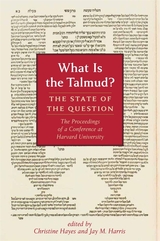
The Babylonian Talmud, or Bavli, stands as one of the central pillars of Jewish intellectual, cultural, and religious life. But what, precisely, is this monumental and heterogenous compilation? How was it formed, redacted, and transmitted? Who composed it and for what purpose? How was it shaped by its broader cultures and historical period? How was it received and re-conceived by subsequent generations, and what has the Talmud become in our day?
What Is the Talmud? collects essays that provide a comprehensive exploration of the Talmud’s origins, compilation, and redaction; its diverse genres and discursive practices; its historical and cultural setting; its preservation and study across generations; and its enduring influence on Jewish life and culture today.
The Babylonian Talmud, or Bavli, stands as one of the central pillars of Jewish intellectual, cultural, and religious life. But what, precisely, is this monumental and heterogenous compilation? How was it formed, redacted, and transmitted? Who composed it and for what purpose? How was it shaped by its broader cultures and historical period? How was it received and re-conceived by subsequent generations, and what has the Talmud become in our day?
What Is the Talmud? collects essays that provide a comprehensive exploration of the Talmud’s origins, compilation, and redaction; its diverse genres and discursive practices; its historical and cultural setting; its preservation and study across generations; and its enduring influence on Jewish life and culture today.
The Babylonian Talmud, or Bavli, stands as one of the central pillars of Jewish intellectual, cultural, and religious life. But what, precisely, is this monumental and heterogenous compilation? How was it formed, redacted, and transmitted? Who composed it and for what purpose? How was it shaped by its broader cultures and historical period? How was it received and re-conceived by subsequent generations, and what has the Talmud become in our day?
What Is the Talmud? collects essays that provide a comprehensive exploration of the Talmud’s origins, compilation, and redaction; its diverse genres and discursive practices; its historical and cultural setting; its preservation and study across generations; and its enduring influence on Jewish life and culture today.
READERS
Browse our collection.
PUBLISHERS
See BiblioVault's publisher services.
STUDENT SERVICES
Files for college accessibility offices.
RECENTLY PUBLISHED




UChicago Accessibility Resources
home | accessibility | search | about | contact us
BiblioVault ® 2001 - 2025
The University of Chicago Press