
 A SCHOLARLY BOOK REPOSITORY

Kenneth Draper’s new volume investigates genre, gender, and self-presentation in Horace’s first collection of Odes. It examines how Horace uses non-lyric genres—elegy, epic, invective, and philosophical discourse—to define his lyric project, responding to the rhetorical challenge of writing in the wake of civil war. It shows how Horace employs a “poetics of disguise and infiltration” in his engagement with these other genres. At times, he assimilates his lyric persona to an elegiac one, claiming to share elegy’s effeminacy and disinterest in politics. Similarly, he draws on philosophical discourse to present himself as too modest for heavy political themes. In both cases, he turns to clothing metaphors to identify the slight persona as a disguise that he may assume or discard as needed. Through this disingenuous self-presentation, he disavows interest in the masculine modes of epic and invective. Read as reflections on Horace’s own infiltration of epic territory, the examined scenes give clues about his motivations: focusing on the characters’ self-preservation amid dangers, he reminds readers of the risks and audacity of his project.
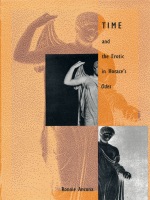
Drawing on contemporary theory, including recent work in feminist criticism, Ancona provides close readings of fourteen odes, which are presented in English translation as well as in Latin. Through a discussion of the poet’s use of various temporal devices—the temporal adverb, seasonal imagery, and the lover or beloved’s own temporality—she shows how Horace makes time dominate the erotic context and, further, how the version of love that appears in his poems is characterized by the lover’s desire to control the beloved. The romantic ideal of a timeless love, apparently rejected by the poet, emerges here instead as an underlying element of the poet’s portrayal of the erotic. In a critique of the predominant modes of recent Horatian scholarship on the love odes, Ancona offers an alternative view that takes into account the male gender of the lover and its effect on the structure of desire in the poems. By doing so, she advances a broader project in recent classical studies that aims to include discussion of features of classical literature, such as sexuality and gender, which have previously escaped critical attention.
Addressing aspects of Horace as a love poet—especially the dynamics of gender relations—that critics have tended to ignore, this book articulates his version of love as something not to be championed or condemned but rather to be seen as challengingly problematic. Of primary interest to classicists, it will also engage the attention of scholars and teachers in the humanities with specializations in gender, sexuality, lyric poetry, or feminist theory.
READERS
Browse our collection.
PUBLISHERS
See BiblioVault's publisher services.
STUDENT SERVICES
Files for college accessibility offices.
RECENTLY PUBLISHED



UChicago Accessibility Resources
home | accessibility | search | about | contact us
BiblioVault ® 2001 - 2026
The University of Chicago Press