
 A SCHOLARLY BOOK REPOSITORY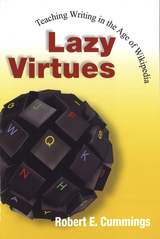
Focusing largely on the controversial website Wikipedia, the author explores the challenges confronting teachers of college writing in the increasingly electronic and networked writing environments their students use every day. Rather than praising or condemning that site for its role as an encyclopedia, Cummings instead sees it as a site for online collaboration between writers and a way to garner audience for student writing.
Applying an understanding of Commons-Based Peer Production theory, as developed by Yochai Benkler, this text is arranged around the following propositions:
-- Commons-Based Peer Production is a novel economic phenomenon which informs our current teaching model and describes a method for making sense of future electronic developments.
-- College writers are motivated to do their best work when they write for an authentic audience, external to the class.
-- Writing for a networked knowledge community invites students to participate in making knowledge, rather than only consuming it.
-- A plan for integrating networked writing for an external audience helps students understand the transition from high school to college writing.
-- Allowing students to review and self-select points of entry into electronic discourse fosters "laziness," or a new work dynamic where writers seek to better understand their own creativity in terms of a project's demands.
Lazy Virtues offers networked writing assignments to foster development of student writers by exposing them to the demands of professional audiences, asking them to identify and assess their own creative impulses in terms of a project's needs, and removing the writing teacher from the role of sole audience.
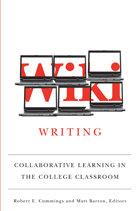
When most people think of wikis, the first---and usually the only---thing that comes to mind is Wikipedia. The editors of Wiki Writing: Collaborative Learning in the College Classroom, Robert E. Cummings and Matt Barton, have assembled a collection of essays that challenges this common misconception, providing an engaging and helpful array of perspectives on the many pressing theoretical and practical issues that wikis raise. Written in an engaging and accessible manner that will appeal to specialists and novices alike, Wiki Writing draws on a wealth of practical classroom experiences with wikis to offer a series of richly detailed and concrete suggestions to help educators realize the potential of these new writing environments.
Robert E. Cummings began work at Columbus State University in August 2006 as Assistant Professor of English and Director of First-Year Composition. Currently he also serves as the Writing Specialist for CSU's Quality Enhancement Plan, assisting teachers across campus in their efforts to maximize student writing in their curriculum. He recently concluded a three-year research study with the Inter/National Coalition for Electronic Portfolio Research and continues to research in the fields of computers and writing, writing across the curriculum, writing in the disciplines, and curricular reform in higher education.
Matt Barton is Assistant Professor, St. Cloud State University, Department of English-Rhetoric and Applied Writing Program. His research interests are rhetoric, new media, and computers and writing. He is the author of Dungeons and Desktops: A History of Computer Role-Playing Games and has published in the journals Text and Technology, Computers and Composition, Game Studies, and Kairos. He is currently serving as Associate Editor of Kairosnews and Managing Editor of Armchair Arcade.
"Wiki Writing will quickly become the standard resource for using wikis in the classroom."
---Jim Kalmbach, Illinois State University
digitalculturebooks is an imprint of the University of Michigan Press and the Scholarly Publishing Office of the University of Michigan Library dedicated to publishing innovative and accessible work exploring new media and their impact on society, culture, and scholarly communication. Visit the website at www.digitalculture.org.
READERS
Browse our collection.
PUBLISHERS
See BiblioVault's publisher services.
STUDENT SERVICES
Files for college accessibility offices.
RECENTLY PUBLISHED



UChicago Accessibility Resources
home | accessibility | search | about | contact us
BiblioVault ® 2001 - 2026
The University of Chicago Press