
 A SCHOLARLY BOOK REPOSITORY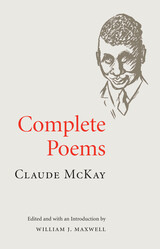
Containing more than three hundred poems, including nearly a hundred previously unpublished works, this unique collection showcases the intellectual range of Claude McKay (1889-1948), the Jamaican-born poet and novelist whose life and work were marked by restless travel and steadfast social protest. McKay's first poems were composed in rural Jamaican creole and launched his lifelong commitment to representing everyday black culture from the bottom up. Migrating to New York, he reinvigorated the English sonnet and helped spark the Harlem Renaissance with poems such as "If We Must Die." After coming under scrutiny for his communism, he traveled throughout Europe and North Africa for twelve years and returned to Harlem in 1934, having denounced Stalin's Soviet Union. By then, McKay's pristine "violent sonnets" were giving way to confessional lyrics informed by his newfound Catholicism.
McKay's verse eludes easy definition, yet this complete anthology, vividly introduced and carefully annotated by William J. Maxwell, acquaints readers with the full transnational evolution of a major voice in twentieth-century poetry.
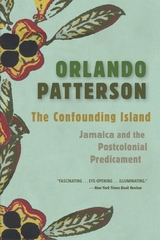
The preeminent sociologist and National Book Award–winning author of Freedom in the Making of Western Culture grapples with the paradox of his homeland: its remarkable achievements amid continuing struggles since independence.
There are few places more puzzling than Jamaica. Jamaicans claim their home has more churches per square mile than any other country, yet it is one of the most murderous nations in the world. Its reggae superstars and celebrity sprinters outshine musicians and athletes in countries hundreds of times its size. Jamaica’s economy is anemic and too many of its people impoverished, yet they are, according to international surveys, some of the happiest on earth. In The Confounding Island, Orlando Patterson returns to the place of his birth to reckon with its history and culture.
Patterson investigates the failures of Jamaica’s postcolonial democracy, exploring why the country has been unable to achieve broad economic growth and why its free elections and stable government have been unable to address violence and poverty. He takes us inside the island’s passion for cricket and the unparalleled international success of its local musical traditions. He offers a fresh answer to a question that has bedeviled sports fans: Why are Jamaican runners so fast?
Jamaica’s successes and struggles expose something fundamental about the world we live in. If we look closely at the Jamaican example, we see the central dilemmas of globalization, economic development, poverty reduction, and postcolonial politics thrown into stark relief.

A New York Times Book Review Editors’ Choice
Winner of a PROSE Award
“Fascinating…Eye-opening…Illuminating…Patterson carefully explores the complexity of the structural machinery behind Jamaica’s dazzling successes and dismal failures.”
—Carrie Gibson, New York Times Book Review
“In the ruins of postcolonial Jamaica, Patterson unearths a vibrant popular culture, centered in particular on dancehall music, that can provide new resources to address the postcolonial predicament.”
—Adom Getachew, The Nation
“Masterful…A memorable, nuanced, and insightful social analysis of the island and its place in global history. Highly recommended.”
—Daron Acemoglu, coauthor of Why Nations Fail
There are few places more puzzling than Jamaica. Jamaicans claim their home has more churches per square mile than any other country, yet it is one of the most murderous nations in the world. Its reggae superstars and celebrity sprinters outshine musicians and athletes in countries many times its size. Jamaica’s economy is anemic and many of its people impoverished, yet they are, according to international surveys, some of the happiest on earth. In The Confounding Island, Orlando Patterson returns to the place of his birth to reckon with its contradictions.
Patterson investigates the failures of Jamaica’s postcolonial democracy, exploring why the country has been unable to achieve broad economic growth and why its free elections and stable government have been unable to address violence and poverty. If we look closely at the Jamaican example, we see the central dilemmas of globalization, economic development, poverty reduction, and postcolonial politics thrown into stark relief.
Both by-products of and participants in globalization, ICIs operate on multiple levels and, since their emergence in the 1970s, have made significant contributions to the regional, national, and global economies. Gina Ulysse carefully explores how ICIs, determined to be self-employed, struggle with government regulation and other social tensions to negotiate their autonomy. Informing this story of self-fashioning with reflections on her own experience as a young Haitian anthropologist, Ulysse combines the study of political economy with the study of individual and collective identity to reveal the uneven consequences of disrupting traditional class, color, and gender codes in individual societies and around the world.
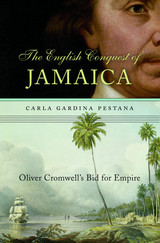
In 1654, England’s Lord Protector Oliver Cromwell conceived a plan of breathtaking ambition: the conquest of Spain’s vast American empire. As the first phase of his Western Design, a large expedition sailed to the West Indies, under secret orders to take Spanish colonies. The English Conquest of Jamaica presents entrenched imperial fantasies confronting Caribbean realities. It captures the moment when the revolutionary English state first became a major player in the Atlantic arena.
Although capturing Jamaica was supposed to be only the first step in Cromwell’s scheme, even that relatively modest acquisition proved difficult. The English badly underestimated the myriad challenges they faced, starting with the unexpectedly fierce resistance offered by the Spanish and other residents who tenaciously defended their island. After sixteen long years Spain surrendered Jamaica and acceded to an English presence in the Americas in the 1670 Treaty of Madrid. But by then, other goals—including profit through commerce rather than further conquest—had superseded the vision behind the Western Design.
Carla Gardina Pestana situates Cromwell’s imperial project in the context of an emerging Atlantic empire as well as the religious strife and civil wars that defined seventeenth-century England. Though falling short of its goal, Cromwell’s plan nevertheless reshaped England’s Atlantic endeavors and the Caribbean region as a whole. Long before sugar and slaves made Jamaica Britain’s most valuable colony, its acquisition sparked conflicts with other European powers, opened vast tropical spaces to exploitation by the purportedly industrious English, and altered England’s engagement with the wider world.

Growing up in a middle-class family in 1930s Kingston, Jamaica, still then a British colony, the young Stuart Hall found himself uncomfortable in his own home. He lived among Kingston's stiflingly respectable brown middle class, who, in their habits and ambitions, measured themselves against the white elite. As colonial rule was challenged, things began to change in Kingston and across the world. In 1951 a Rhodes scholarship took Hall across the Atlantic to Oxford University, where he met young Jamaicans from all walks of life, as well as writers and thinkers from across the Caribbean, including V. S. Naipaul and George Lamming. While at Oxford he met Raymond Williams, Charles Taylor, and other leading intellectuals, with whom he helped found the intellectual and political movement known as the New Left. With the emotional aftershock of colonialism still pulsing through him, Hall faced a new struggle: that of building a home, a life, and an identity in a postwar England so rife with racism that it could barely recognize his humanity.
With great insight, compassion, and wit, Hall tells the story of his early life, taking readers on a journey through the sights, smells, and streets of 1930s Kingston while reflecting on the thorny politics of 1950s and 1960s Britain. Full of passion and wisdom, Familiar Stranger is the intellectual memoir of one of our greatest minds.

In Higglers in Kingston, Winnifred Brown-Glaude puts the reader on the ground in frenetic urban Kingston, the capital and largest city in Jamaica. She explores the lives of informal market laborers, called "higglers," across the city as they navigate a corrupt and inaccessible "official" Jamaican economy. But rather than focus merely on the present-day situation, she contextualizes how Jamaica arrived at this point, delving deep into the island's history as a former colony, a home to slaves and masters alike, and an eventual nation of competing and conflicted racial sectors.
Higglers in Kingston weaves together contemporary ethnography, economic history, and sociology of race to address a broad audience of readers on a crucial economic and cultural center.
Inside Tenement Time is the first comprehensive treatment of literary and cultural texts on surveillance in the Caribbean. Covering the long historical arc of the twentieth to the twenty-first centuries, Inside Tenement Time uses Jamaica as a case study to examine moments of crisis and particular spaces, especially urban yard enclaves and their environs, in the Caribbean encounter with surveillance. Making the argument that the Caribbean situation reveals flexible hegemonies rather than provinces of exclusive control, the book demonstrates the countervailing force of sussveillance and spiritveillance, Afro-Indigenous variations on surveillance. Sussveillance and spiritveillance are exemplars of vernacular arts and sciences that operate at and within the frangible borders of state power, exposing the unique dynamics of surveillance in the region and marshalling the acts of imagination with which it contends. For example, the Smile Jamaica concert of 1976, headlined by reggae Superstar Bob Marley, and the reputedly US government-backed 2010 Tivoli Gardens incursion in West Kingston, both moments that have dramatic, even mythic residue in Caribbean and global memory, are among the real-life events brought into conversation with literary representations of this history.
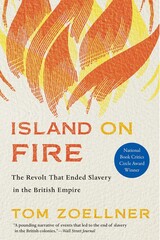
Winner of the National Book Critics Circle Award
“Impeccably researched and seductively readable…tells the story of Sam Sharpe’s revolution manqué, and the subsequent abolition of slavery in Jamaica, in a way that’s acutely relevant to the racial unrest of our own time.” —Madison Smartt Bell, author of All Souls’ Rising
The final uprising of enslaved people in Jamaica started as a peaceful labor strike a few days shy of Christmas in 1831. A harsh crackdown by white militias quickly sparked a full-blown revolt, leaving hundreds of plantation houses in smoking ruins. The rebels lost their daring bid for freedom, but their headline-grabbing defiance triggered a decisive turn against slavery.
Island on Fire is a dramatic day-by-day account of these transformative events. A skillful storyteller, Tom Zoellner uses diaries, letters, and colonial records to tell the intimate story of the men and women who rose up and briefly tasted liberty. He brings to life the rebellion’s enigmatic leader, the preacher Samuel Sharpe, and shows how his fiery resistance turned the tide of opinion in London and hastened the end of slavery in the British Empire.
“Zoellner’s vigorous, fast-paced account brings to life a varied gallery of participants…The revolt failed to improve conditions for the enslaved in Jamaica, but it crucially wounded the institution of slavery itself.” —Fergus M. Bordewich, Wall Street Journal
“It’s high time that we had a book like the splendid one Tom Zoellner has written: a highly readable but carefully documented account of the greatest of all British slave rebellions, the miseries that led to it, and the momentous changes it wrought.” —Adam Hochschild, author of Bury the Chains
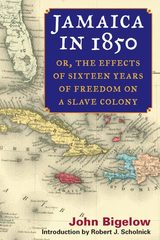
A reporter's firsthand portrait of formerly enslaved Jamaicans in the years after emancipation
John Bigelow’s Jamaica in 1850 provided an important document in the antislavery movement in the United States and Great Britain. Jamaica’s economy had collapsed after the 1838 emancipation. American supporters of enslavement used the Jamaican example to argue that abolition at home would unleash economic and social chaos. Bigelow’s vivid eyewitness reporting undermined that widely held view by proving Jamaica’s problems originated in the incompetence of absentee white planters and an obsolete colonial system. As Bigelow showed, many once-enslaved Jamaicans had in fact become successful small-scale landowners in the twelve years after emancipation while the large plantations languished.
Thomas combines historical research with fieldwork she conducted in Jamaica between 1993 and 2003. Drawing on her research in a rural hillside community just outside Kingston, she looks at how Jamaicans interpreted and reproduced or transformed on the local level nationalist policies and popular ideologies about progress. With detailed descriptions of daily life in Jamaica set against a backdrop of postcolonial nation-building and neoliberal globalization, Modern Blackness is an important examination of the competing identities that mobilize Jamaicans locally and represent them internationally.
Describing the hard working conditions on plantations and the harsh treatment of apprentices unjustly incarcerated, Williams argues that apprenticeship actually worsened the conditions of Jamaican ex-slaves: former owners, no longer legally permitted to directly punish their workers, used the Jamaican legal system as a punitive lever against them. Williams’s story documents the collaboration of local magistrates in this practice, wherein apprentices were routinely jailed and beaten for both real and imaginary infractions of the apprenticeship regulations.
In addition to the complete text of Williams’s original Narrative, this fully annotated edition includes nineteenth-century responses to the controversy from the British and Jamaican press, as well as extensive testimony from the Commission of Enquiry that heard evidence regarding the Narrative’s claims. These fascinating and revealing documents constitute the largest extant body of direct testimony by Caribbean slaves or apprentices.
No Bond but the Law reveals the longstanding and intimate relationship between state formation and private punishment. The construction of a dense, state-organized system of prisons began not with emancipation but at the peak of slave-based wealth in Jamaica, in the 1780s. Jamaica provided the paradigmatic case for British observers imagining and evaluating the emancipation process. Paton’s analysis moves between imperial processes on the one hand and Jamaican specificities on the other, within a framework comparing developments regarding punishment in Jamaica with those in the U.S. South and elsewhere. Emphasizing the gendered nature of penal policy and practice throughout the emancipation period, Paton is attentive to the ways in which the actions of ordinary Jamaicans and, in particular, of women prisoners, shaped state decisions.
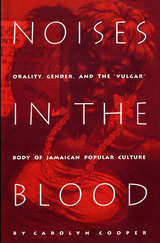
Cooper’s exploration of Jamaican popular culture covers a wide range of topics, including Bob Marley’s lyrics, the performance poetry of Louise Bennett, Mikey Smith, and Jean Binta Breeze, Michael Thelwell’s novelization of The Harder They Come, the Sistren Theater Collective’s Lionheart Gal, and the vitality of the Jamaican DJ culture. Her analysis of this cultural "noise" conveys the powerful and evocative content of these writers and performers and emphasizes their contribution to an undervalued Caribbean identity. Making the connection between this orality, the feminized Jamaican "mother tongue," and the characterization of this culture as low or coarse or vulgar, she incorporates issues of gender into her postcolonial perspective. Cooper powerfully argues that these contemporary vernacular forms must be recognized as genuine expressions of Jamaican culture and as expressions of resistance to marginalization, racism, and sexism.
With its focus on the continuum of oral/textual performance in Jamaican culture, Noises in the Blood, vividly and stylishly written, offers a distinctive approach to Caribbean cultural studies.
Normal0falsefalsefalseEN-USX-NONEX-NONEMicrosoftInternetExplorer4

Still on land are the villagers, the woman, and the sons who comprise life for Zachariah. While he struggles with the forces of nature, the natural faith of the villagers encounters the incapacity for belief of the troubled English doctor. As the superstitions and certainties of Jamaican life and the consequences of science meet, Winkler reveals a rich understanding of the precarious balance between thought and reality, between the coincidental and the miraculous.
"This is one of those rare novels that announces its presence with such modest grace that the size of its ambition and accomplishments steals gently into the consciousness."—Michael Thelwell, Washington Post Book World
"Mr. Winkler deftly unfurls his exquisitely written story, which is redolent of the colorful patois and chaotic flavor of rural Jamaican culture."—Bob Allen, Baltimore Sun
Winner of the Merle Curti Award
Winner of the James A. Rawley Prize
Winner of the Louis Gottschalk Prize
Longlisted for the Cundill Prize
“Vincent Brown makes the dead talk. With his deep learning and powerful historical imagination, he calls upon the departed to explain the living. The Reaper’s Garden stretches the historical canvas and forces readers to think afresh. It is a major contribution to the history of Atlantic slavery.”—Ira Berlin
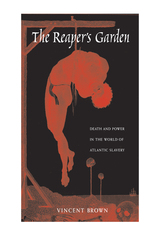
From the author of Tacky’s Revolt, a landmark study of life and death in colonial Jamaica at the zenith of the British slave empire.
What did people make of death in the world of Atlantic slavery? In The Reaper’s Garden, Vincent Brown asks this question about Jamaica, the staggeringly profitable hub of the British Empire in America—and a human catastrophe. Popularly known as the grave of the Europeans, it was just as deadly for Africans and their descendants. Yet among the survivors, the dead remained both a vital presence and a social force.
In this compelling and evocative story of a world in flux, Brown shows that death was as generative as it was destructive. From the eighteenth-century zenith of British colonial slavery to its demise in the 1830s, the Grim Reaper cultivated essential aspects of social life in Jamaica—belonging and status, dreams for the future, and commemorations of the past. Surveying a haunted landscape, Brown unfolds the letters of anxious colonists; listens in on wakes, eulogies, and solemn incantations; peers into crypts and coffins, and finds the very spirit of human struggle in slavery. Masters and enslaved, fortune seekers and spiritual healers, rebels and rulers, all summoned the dead to further their desires and ambitions. In this turbulent transatlantic world, Brown argues, “mortuary politics” played a consequential role in determining the course of history.
Insightful and powerfully affecting, The Reaper’s Garden promises to enrich our understanding of the ways that death shaped political life in the world of Atlantic slavery and beyond.

Jamaican music can be roughly divided into four eras, each with a distinctive beat - ska, rocksteady, reggae, and dancehall. Ska dates from about 1960 to mid-1966 and rocksteady from 1966 to 1968, while from 1969 to 1983 reggae was the popular beat. The reggae era had two phases, "early reggae" up to 1974 and "roots reggae" up to 1983. Since 1983 dancehall has been the prevalent the prevalent sound.
The authors describe each stage in the development of the music, identifying the most popular songs and artists, highlighting the significant social, political, and economic issues as they affected the music scene. While they write from a Jamaican perspective, the intended audience is "any person, local or foreign, interested in an intelligent discussion of reggae music and Jamaica." Featuring some four hundred illustrations that range from album covers to rare photos, Reggae Routes profiles the innumerable artists, producers, and recordings that secured an international audience for Jamaican music.
Artists discussed: Toots and the Maytals, the Wailers, Gaylads, Desmond Dekker, Delroy Wilson, Alton Ellis, Burning Spear, Itals, Wailing Souls, Skatalites, Heptones, and hundreds more.

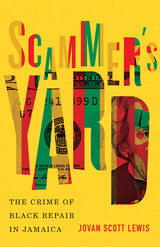
Tells the story of Jamaican “scammers” who use crime to gain autonomy, opportunity, and repair
There is romance in stealing from the rich to give to the poor, but how does that change when those perceived rich are elderly white North Americans and the poor are young Black Jamaicans? In this innovative ethnography, Jovan Scott Lewis tells the story of Omar, Junior, and Dwayne. Young and poor, they strive to make a living in Montego Bay, where call centers and tourism are the two main industries in the struggling economy. Their experience of grinding poverty and drastically limited opportunity leads them to conclude that scamming is the best means of gaining wealth and advancement. Otherwise, they are doomed to live in “sufferation”—an inescapable poverty that breeds misery, frustration, and vexation.
In the Jamaican lottery scam run by these men, targets are told they have qualified for a large loan or award if they pay taxes or transfer fees. When the fees are paid, the award never arrives, netting the scammers tens of thousands of U.S. dollars. Through interviews, historical sources, song lyrics, and court testimonies, Lewis examines how these scammers justify their deceit, discovering an ethical narrative that reformulates ideas of crime and transgression and their relationship to race, justice, and debt.
Scammer’s Yard describes how these young men, seeking to overcome inequality and achieve autonomy, come to view crime as a form of liberation. Their logic raises unsettling questions about a world economy that relegates postcolonial populations to deprivation even while expecting them to follow the rules of capitalism that exacerbate their dispossession. In this groundbreaking account, Lewis asks whether true reparation for the legacy of colonialism is to be found only through radical—even criminal—means.
Though centered on a single Jamaican sugar estate, Worthy Park, and dealing largely with the period of formal slavery, this book is firmly placed in far wider contexts of place and time. The "Invisible Man" of the title is found, in the end, to be not just the formal slave but the ordinary black worker throughout the history of the plantation system.
Michael Craton uses computer techniques in the first of three main parts of his study to provide a dynamic analysis of the demographic, health, and socioeconomic characteristics of the Worthy Park slaves as a whole. The surprising diversity and complex interrelation of the population are underlined in Part Two, consisting of detailed biographies of more than 40 individual members of the plantation's society, including whites and mulattoes as well as black slaves. This is the most ambitious attempt yet made to overcome the stereotyping ignorance of contemporary white writers and the muteness of the slaves themselves.
Part Three is perhaps the most original section of the book. After tracing the fate of the population between the emancipation of 1838 and the present day through genealogies and oral interviews, Craton concludes that the predominant feature of plantation life has not been change but continuity, and that the accepted definitions of slavery need considerable modification.
This book is the first to offer a combined social science and psychoanalytic perspective on reproductive behavior. The author emphasizes the personal histories of his subjects within their cultural environment, and takes into account the setting of the interview and the subjective responses of both interviewee and interviewer. The study reveals how Jamaicans, particularly women, relate to their own parents, learn about sex, experience sexual maturity and first intercourse, and perceive their relations with subsequent partners. Other themes examined are the significance of pregnancy, childbirth, and parenthood and the folk context of Jamaican beliefs about reproduction and contraception.
All of these are aspects of what the author terms a “culture of motherhood.” His unique approach illuminates the many complex factors that influence this population's use or nonuse of contraceptive methods. In his concluding chapter, Eugene Brody offers suggestions for reconciling the private needs of individuals and the public goals of Jamaican population policy. Although his research centers on one Caribbean island, his ideas are applicable to other developing countries. In Sex, Contraception, and Motherhood in Jamaica, family planning professionals, psychologists, psychiatrists, and social scientists will find an intriguing new approach to reproductive policy.
One of the most important voices of the Harlem Renaissance, Claude McKay is largely recognized for his work during the 1920s, which includes a major collection of poems, Harlem Shadows, as well as a critically acclaimed novel, Home to Harlem. But McKay was never completely comfortable with his literary reputation during this period. Throughout his world travels, he saw himself as an English lyricist.
In this compelling examination of the life and works of this complex poet, novelist, journalist, and short story writer, Josh Gosciak sheds light on McKay’s literary contributions beyond his interactions with Harlem Renaissance artists and writers. Working within English literary traditions, McKay crafted a verse out of hybridity and diaspora. Gosciak shows how he reinvigorated a modern pastoral through his encounters with some of the major aesthetic and political movements of the late Victorian and early modern periods.
Exploring new archival material as well as many of McKay’s lesser known poetic works, TheShadowed Country provides a unique interpretation of the writings of this major author.
Winner of the Jerry H. Bentley Book Prize, World History Association
The success of the English colony of Barbados in the seventeenth century, with its lucrative sugar plantations and enslaved African labor, spawned the slave societies of Jamaica in the western Caribbean and South Carolina on the American mainland. These became the most prosperous slave economies in the Anglo-American Atlantic, despite the rise of enlightened ideas of liberty and human dignity. Slave Law and the Politics of Resistance in the Early Atlantic World reveals the political dynamic between slave resistance and slaveholders’ power that marked the evolution of these societies. Edward Rugemer shows how this struggle led to the abolition of slavery through a law of British Parliament in one case and through violent civil war in the other.
In both Jamaica and South Carolina, a draconian system of laws and enforcement allowed slave masters to maintain control over the people they enslaved, despite resistance and recurrent slave revolts. Brutal punishments, patrols, imprisonment, and state-sponsored slave catchers formed an almost impenetrable net of power. Yet slave resistance persisted, aided and abetted by rising abolitionist sentiment and activity in the Anglo-American world. In South Carolina, slaveholders exploited newly formed levers of federal power to deflect calls for abolition and to expand slavery in the young republic. In Jamaica, by contrast, whites fought a losing political battle against Caribbean rebels and British abolitionists who acted through Parliament.
Rugemer’s comparative history spanning two hundred years of slave law and political resistance illuminates the evolution and ultimate collapse of slave societies in the Atlantic World.
Galvin highlights the unique alliance between the dancehall industry and community development efforts. As the central role of the state in supporting communities has diminished, the rise of private efforts such as dancehall becomes all the more crucial. The tension, however, between those involved in the industry and those within the neighborhoods is palpable and often dangerous. Amidst all this, individual Jamaicans interact with the dancehall industry and its culture to find their own paths of employment, social identity, and sexual mores.
As Sounds of the Citizens illustrates, the world of entertainment in Jamaica is serious business and uniquely positioned as a powerful force within the community.
A unique and important study, Stepping Forward examines the experiences of nineteenth- and twentieth-century black women in Africa and African diaspora communities from a variety of perspectives in a number of different settings.
This wide-ranging collection designed for classroom use explores the broad themes that have shaped black women’s goals, options, and responses: religion, education, political activism, migration, and cultural transformation. Essays by leading scholars in the field examine the lives of black women in the United States and the Caribbean Basin; in the white settler societies of Kenya, Zimbabwe, and South Africa; and in the black settler societies of Liberia and Sierra Leone.
Among the contributors to this volume are historians, political scientists, and scholars of literature, music, and law. What emerges from their work is an image of black women’s agency, self-reliance, and resiliency. Despite cultural differences and geographical variations, black women have provided foundations on which black communities have not only survived, but also thrived. Stepping Forward is a valuable addition to our understanding of women’s roles in these diverse communities.
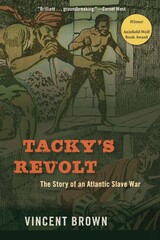
Winner of the Anisfield-Wolf Book Award
Winner of the Frederick Douglass Book Prize
Winner of the Elsa Goveia Book Prize
Winner of the James A. Rawley Prize in the History of Race Relations
Winner of the P. Sterling Stuckey Book Prize
Winner of the Harriet Tubman Prize
Winner of the Phillis Wheatley Book Award
Finalist for the Cundill Prize
“Brilliant…groundbreaking…Brown’s profound analysis and revolutionary vision of the Age of Slave War—from the too-often overlooked Tacky’s Revolt to the better-known Haitian Revolution—gives us an original view of the birth of modern freedom in the New World.”
—Cornel West
“Not only a story of the insurrection, but ‘a martial geography of Atlantic slavery,’ vividly demonstrating how warfare shaped every aspect of bondage…Forty years after Tacky’s defeat, new arrivals from Africa were still hearing about the daring rebels who upended the island.”
—Harper’s
“A sobering read for contemporary audiences in countries engaged in forever wars…It is also a useful reminder that the distinction between victory and defeat, when it comes to insurgencies, is often fleeting: Tacky may have lost his battle, but the enslaved did eventually win the war.”
—New Yorker
In the second half of the eighteenth century, as European imperial conflicts extended their domain, warring African factions fed their captives to the transatlantic slave trade while masters struggled to keep their restive slaves under the yoke. In this contentious atmosphere, a movement of enslaved West Africans in Jamaica organized to throw off that yoke by violence. Their uprising—which became known as Tacky’s Revolt—featured a style of fighting increasingly familiar today: scattered militias opposing great powers, with fighters hard to distinguish from noncombatants. Even after it was put down, the insurgency rumbled throughout the British Empire at a time when slavery seemed the dependable bedrock of its dominion. That certitude would never be the same, nor would the views of black lives, which came to inspire both more fear and more sympathy than before.
Tracing the roots, routes, and reverberations of this event, Tacky’s Revolt expands our understanding of the relationship between European, African, and American history as it speaks to our understanding of wars of terror today.
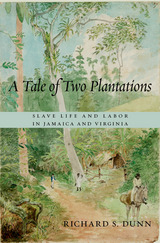
Forty years ago, after publication of his pathbreaking book Sugar and Slaves, Richard Dunn began an intensive investigation of two thousand slaves living on two plantations, one in North America and one in the Caribbean. Digging deeply into the archives, he has reconstructed the individual lives and collective experiences of three generations of slaves on the Mesopotamia sugar estate in Jamaica and the Mount Airy plantation in tidewater Virginia, to understand the starkly different forms slavery could take. Dunn’s stunning achievement is a rich and compelling history of bondage in two very different Atlantic world settings.
From the mid-eighteenth century to emancipation in 1834, life in Mesopotamia was shaped and stunted by deadly work regimens, rampant disease, and dependence on the slave trade for new laborers. At Mount Airy, where the population continually expanded until emancipation in 1865, the “surplus” slaves were sold or moved to distant work sites, and families were routinely broken up. Over two hundred of these Virginia slaves were sent eight hundred miles to the Cotton South.
In the genealogies that Dunn has painstakingly assembled, we can trace a Mesopotamia fieldhand through every stage of her bondage, and contrast her harsh treatment with the fortunes of her rebellious mulatto son and clever quadroon granddaughter. We track a Mount Airy craftworker through a stormy life of interracial sex, escape, and family breakup. The details of individuals’ lives enable us to grasp the full experience of both slave communities as they labored and loved, and ultimately became free.
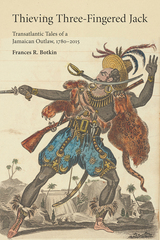
The fugitive slave known as “Three-Fingered Jack” terrorized colonial Jamaica from 1780 until vanquished by Maroons, self-emancipated Afro-Jamaicans bound by treaty to police the island for runaways and rebels. A thief and a killer, Jack was also a freedom fighter who sabotaged the colonial machine until his grisly death at its behest. Narratives about his exploits shed light on the problems of black rebellion and solutions administered by the colonial state, creating an occasion to consider counter-narratives about its methods of divide and conquer. For more than two centuries, writers, performers, and storytellers in England, Jamaica, and the United States have “thieved" Three Fingered Jack's riveting tale, defining black agency through and against representations of his resistance.
Frances R. Botkin offers a literary and cultural history that explores the persistence of stories about this black rebel, his contributions to constructions of black masculinity in the Atlantic world, and his legacies in Jamaican and United States popular culture.
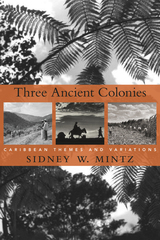
As a young anthropologist, Sidney Mintz undertook fieldwork in Jamaica, Haiti, and Puerto Rico. Fifty years later, the eminent scholar of the Caribbean returns to those experiences to meditate on the societies and on the island people who befriended him. These reflections illuminate continuities and differences between these cultures, but even more they exemplify the power of people to reveal their own history.
Mintz seeks to conjoin his knowledge of the history of Jamaica, Haiti, and Puerto Rico—a dynamic past born of a confluence of peoples of a sort that has happened only a few times in human history—with the ways that he heard people speak about themselves and their lives. Mintz argues that in Jamaica and Haiti, creolization represented a tremendous creative act by enslaved peoples: that creolization was not a passive mixing of cultures, but an effort to create new hybrid institutions and cultural meanings to replace those that had been demolished by enslavement. Globalization is not the new phenomenon we take it to be.
This book is both a summation of Mintz's groundbreaking work in the region and a reminder of how anthropology allows people to explore the deep truths that history may leave unexamined.
David Mason has characterized Lorna Goodison's work as a "revelation
to me, much of it beautiful for its simple negotiation of the line between
life and art."
One of the most distinguished
contemporary poets of the Caribbean, Goodison draws on both African and
European inheritances in her finely crafted poems, which often carry a
sense of language's healing power in the face of the pain of the past.
She deals thematically with the struggle of Caribbean women and writes
in a fashion that has developed from conversational to more ritualistic.
From reviews of Goodison's
earlier works:
"The evocative power
of Lorna Goodison's poetry derives its urgency and appeal from the heart-and-mind
concerns she has for language, history, racial identity, and gender."
Andrew Salkey -- World Literature Today
"A marvelous poet, one
to savor and to chant aloud."
-- Pat Monaghan, Booklist

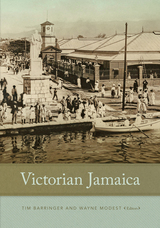
Contributors. Anna Arabindan-Kesson, Tim Barringer, Anthony Bogues, David Boxer, Patrick Bryan, Steeve O. Buckridge, Julian Cresser, John M. Cross, Petrina Dacres, Belinda Edmondson, Nadia Ellis, Gillian Forrester, Catherine Hall, Gad Heuman, Rivke Jaffe, O'Neil Lawrence, Erica Moiah James, Jan Marsh, Wayne Modest, Daniel T. Neely, Mark Nesbitt, Diana Paton, Elizabeth Pigou-Dennis, Veerle Poupeye, Jennifer Raab, James Robertson, Shani Roper, Faith Smith, Nicole Smythe-Johnson, Dianne M. Stewart, Krista A. Thompson
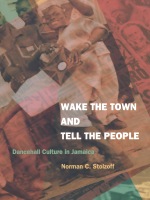
Norman C. Stolzoff brings a fan’s enthusiasm to his broad perspective on dancehall, providing extensive interviews, original photographs, and anthropological analysis from eighteen months of fieldwork in Kingston. Stolzoff argues that this enormously popular musical genre expresses deep conflicts within Jamaican society, not only along lines of class, race, gender, sexuality, and religion but also between different factions struggling to gain control of the island nation’s political culture. Dancehall culture thus remains a key arena where the future of this volatile nation is shaped. As his argument unfolds, Stolzoff traces the history of Jamaican music from its roots in the late eighteenth century to 1945, from the addition of sound systems and technology during the mid-forties to early sixties, and finally through the post-independence years from the early sixties to the present.
Wake the Town and Tell the People offers a general introduction for those interested in dancehall music and culture. For the fan or musicologist, it will serve as a comprehensive reference book.
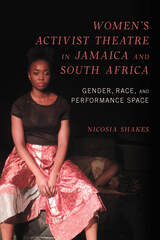
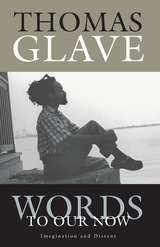
In these lyrical and powerful essays, Thomas Glave draws on his experiences as a politically committed, gay Jamaican American to deliver a condemnation of the prejudices, hatreds, and inhumanities that persist in the United States and elsewhere. Exposing the hypocrisies of liberal multiculturalism, Glave offers instead a politics of heterogeneity in which difference informs the theory and practice of democracy. At the same time, he experiments with language to provide a model of creative writing as a tool for social change. From the death of black gay poet Essex Hemphill to the revelations of abuse at Abu Ghraib, Glave puts forth an ethical understanding of human rights to make vital connections across nations, races, genders, and sexualities.
Thomas Glave is assistant professor of English at SUNY Binghamton. He is author of Whose Song? and Other Stories.
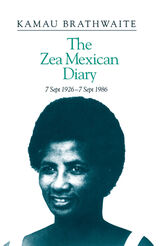
Zea Mexican is a tribute to Doris Brathwaite and an exploration of the creative potency of love. (The title comes from the name Brathwaite gave Doris, who was originally from Guyana of part Amerindian descent.) Exposing the intimacy of his marriage, this book is the closest Brathwaite has ever come to an autobiographical statement. In examining his life with Doris he found the courage to reveal something of his own character. But, more than an autobiography, Zea Mexican is an extraordinary work of literature, much of it written in the expressive “nation language” of Jamaica and the Caribbean. Brathwaite filters his pain through his poetic gift, presenting it to the reader with all the poignancy poetry conveys.
READERS
Browse our collection.
PUBLISHERS
See BiblioVault's publisher services.
STUDENT SERVICES
Files for college accessibility offices.
RECENTLY PUBLISHED





UChicago Accessibility Resources
home | accessibility | search | about | contact us
BiblioVault ® 2001 - 2025
The University of Chicago Press