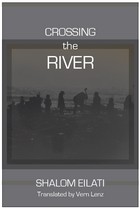
front cover of Crossing the River
Crossing the River
Shalom Eilati
University of Alabama Press, 2009

A child’s journey through war, memory, and survival—told with haunting clarity and poetic grace.

Crossing the River is a personal memoir—and more. Against the backdrop of Lithuania’s occupation—first by the Red Army, next by the Germans, and then again by the Russians—it is a story reflected through the prism of a sharp-eyed young child, Shalom Eilati. His story starts in the occupied Kovno Ghetto and ends with his flight across the Soviet border, through Poland and Germany and finally, his arrival in Palestine.

The adult survivor, while recalling the terrorized child that he was and how he then perceived the adult world, also takes stock of his present life. Throughout the memoir, Eilati attempts to reconcile his present life as a husband, father, scientist, and writer, with the images, feelings, and thoughts from the past that have left an indelible mark on his life and that continue to haunt him.

[more]

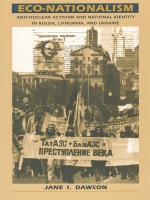
front cover of Eco-Nationalism
Eco-Nationalism
Anti-Nuclear Activism and National Identity in Russia, Lithuania, and Ukraine
Jane I. Dawson
Duke University Press, 1996
Eco-nationalism examines the spectacular rise of the anti-nuclear power movement in the former Soviet Union during the early perestroika period, its unexpected successes in the late 1980s, and its substantial decline after 1991. Jane I. Dawson argues that anti-nuclear activism, one of the most dynamic social forces to emerge during these years, was primarily a surrogate for an ever-present nationalism and a means of demanding greater local self-determination under the Soviet system. Rather than representing strongly held environmental and anti-nuclear convictions, this activism was a political effort that reflected widely held anti-Soviet sentiments and a resentment against Moscow’s domination of the region—an effort that largely disappeared with the dissolution of the USSR.
Dawson combines a theoretical framework based on models of social movements with extensive field research to compare the ways in which nationalism, regionalism, and other political demands were incorporated into anti-nuclear movements in Russia, Lithuania, Ukraine, Armenia, Tatarstan, and Crimea. These comparative case studies form the core of the book and trace differences among the various regional movements to the distinctive national identities of groups involved. Reflecting the new opportunities for research that have become available since the late 1980s, these studies draw upon Dawson’s extended on-site observation of local movements through 1995 and her unique access to movement activists and their personal archives.
Analyzing and documenting a development with sobering and potentially devastating implications for nuclear power safety in the former USSR and beyond, Eco-nationalism’s examination of social activism in late and postcommunist societies will interest readers concerned with the politics of global environmentalism and the process of democratization in the post-Soviet world.

[more]

front cover of Enemies for a Day
Enemies for a Day
Antisemitism and Anti-Jewish Violence in Lithuania under the Tsars
Darius Staliunas
Central European University Press, 2015

It begins by illustrating how widespread anti-Jewish feelings were among the Christian population in 19 th century, focusing on blood libel accusations as well as describing the role of modern antisemitism. Secondly, it tries to identify the structural preconditions as well as specific triggers that turned anti-Jewish feelings into collective violence and analyzes the nature of this violence. Lastly, pogroms in Lithuania are compared to anti-Jewish violence in other regions of the Russian Empire and East Galicia.

This research is inspired by the cultural turn in social sciences, an approach that assumes that violence is filled with meaning, which is “culturally constructed, discursively mediated, symbolically saturated, and ritually regulated.” The author argues that pogroms in Lithuania instead followed a communal pattern of ethnic violence and was very different from deadly pogroms in other parts of the Russian Empire.

[more]

front cover of Forest Brothers
Forest Brothers
The Account of an Anti-Soviet Lithuanian Freedom Fighter, 1944–1948
Translated and with an Introduction by Laima Vincė
Central European University Press, 2009
An autobiographical account of the armed resistance against the Soviet Union, which took place between 1944–1956. Published in English for the first time in unabridged form, Lukša's memoir remains one of the few reliable eye-witness accounts of the "Invisible Front", as dubbed by Soviet security forces. At its zenith 28,000 guerilla fighters participated in battles and skirmishes throughout Lithuania, Lukša (partisan codename Daumantas) being one of the leaders. Forest Brothers also documents the role of women in the resistance, giving equal credit to these often silent partners. In 1948 Lukša and two comrades broke through the Iron Curtain on the Polish border. He sought training from the French intelligence and from the CIA. Lukša was flown back into the Soviet Union under the radar on the night of October 4, 1950. He managed to survive and operate eleven months until his near capture and death on the night of September 5, 1951. His account, written during 1948–1950, while he was living in hiding in Paris, describes in vivid scenes and dialogue the daily struggles of the resistance.
[more]

logo for Rutgers University Press
From that Place and Time
A Memoir, 1938-1947
Dawidowicz, Lucy
Rutgers University Press, 2008
From that Place and Time is the memoir of Lucy S. Dawidowicz, an American-Jewish historian who set out to study Yiddish language and Jewish history at YIVO, the Jewish Scientific Institute in Vilna, Poland, in 1938. Escaping Poland only days before the Nazi onslaught, she worked in the New York YIVO during the war, and returned to Europe from 1946 to 1947 to aid Jewish displaced persons in Munich and Belsen with the American Jewish Joint Distribution Committee. Dawidowicz's memoir not only describes her pre-war year in Jewish Eastern Europe, but also treats the ghostly post-war period, and her role in salvaging what remained of Vilna's scorched Jewish archives and libraries.

Nancy Sinkoff's new introduction explores the historical forces, particularly the dynamic world of secular Yiddish culture, which shaped Dawidowicz's decision to journey to Poland and her reassessment of those forces in the last years of her life.

[more]

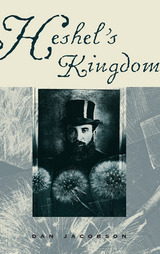
front cover of Heshel's Kingdom
Heshel's Kingdom
Dan Jacobson
Northwestern University Press, 1999
The Orthodox rabbi Heshel Melamed's sudden death by heart attack in 1919 set his widow and children free to leave Lithuania. In this deeply personal memoir, his grandson journeys to the nation after the fall of Communism, and his story is both a philosophical tableau of secularism, religion, and family and a communion with history's darkness-and, where possible, its illumination.
[more]

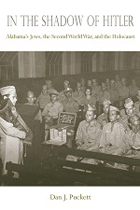
front cover of In the Shadow of Hitler
In the Shadow of Hitler
Alabama's Jews, the Second World War, and the Holocaust
Dan J. Puckett
University of Alabama Press, 2014
In the Shadow of Hitler chronicles the experiences of Alabama Jews as they worked to overcome their own divisions in order to aid European Jews before, during, and after the Second World War.

In this extensive study of how southern Jews in the United States responded to the Nazi persecution of European Jews, Dan J. Puckett recounts the divisions between Alabama Jews in the early 1930s. As awareness of the horrors of the Holocaust spread, Jews across Alabama from different backgrounds and from Reform, Conservative, and Orthodox traditions worked to bridge their internal divisions in order to mount efforts to save Jewish lives in Europe. Only by leveraging their collective strength were Alabama’s Jews able to sway the opinions of newspaper editors, Christian groups, and the general public as well as lobby local, state, and national political leaders.

Puckett’s comprehensive analysis is enlivened and illustrated by true stories that will fascinate all readers of southern history. One such story concerns the Altneuschule Torah of Prague and describes how the Nazis, during their brutal occupation of Czechoslovakia, confiscated 1,564 Torahs and sacred Judaic objects from communities throughout Bohemia and Moravia as exhibits in a planned museum to the extinct Jewish race. Recovered after the war by the Czech Memorial Scrolls Trust, the Altneuschule Torah was acquired in 1982 by the Orthodox congregation Ahavas Chesed of Mobile. Ahavas Chesed re-consecrated the scroll as an Alabama memorial to Czech Jews who perished in Nazi death camps.

In the Shadow of Hitler illustrates how Alabama’s Jews, in seeking to influence the national and international well-being of Jews, were changed, emerging from the war period with close cultural and religious cooperation that continues today.
[more]

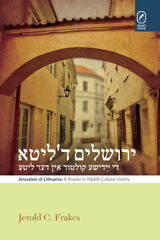
front cover of Jerusalem of Lithuania
Jerusalem of Lithuania
A Reader in Yiddish Cultural History
Jerold C. Frakes
The Ohio State University Press, 2011

Yerusholayim d’lite: di yidishe kultur in der lite (Jerusalem of Lithuania: A Reader in Yiddish Cultural History) by Jerold C. Frakes contains cultural, literary, and historical readings in Yiddish that vividly chronicle the central role Vilnius (Lithuania) played in Jewish culture throughout the past five centuries. It includes many examples of Yiddish literature, historiography, sociology, and linguistics written by and about Litvaks and includes work by prominent Yiddish poets, novelists, raconteurs, journalists, and scholars. In addition, Frakes has supplemented the primary texts with many short essays that contextualize Yiddish cultural figures, movements, and historical events.
 
Designed especially for intermediate and advanced readers of Yiddish (from the second-year of instruction), each text is individually glossed, including not only English definitions, but also basic grammatical information that will enable intermediate readers to progress to an advanced reading ability.
 
Because of its unique content, Yerusholayim d’lite will be of interest not only to university students of Yiddish language, literature, and culture, but it will be an invaluable resource for scholars and Yiddish reading groups and clubs worldwide, as well as for all general readers interested in Yiddish-language culture.
 
[more]

front cover of Life should be Transparent
Life should be Transparent
Conversations about Lithuania and Europe in the Twentieth Century and Today
Aurimas Svedas
Central European University Press, 2020

This book of thirteen conversations introduces us to the life of an exceptional person—theatre critic, Germanist, and long-time chair of the Open Lithuania Fund board—Irena Veisaitė. The dialogue between Lithuanian historian Aurimas Švedas and a woman who reflects deeply on her experiences reveals both one individual’s historically dramatic life and the fate of Europe and Lithuania in the twentieth century.

Through the complementary lenses of history and memory, we confront with Veisaitė the horrific events of the Holocaust, which brought about the end of the Lithuanian Jewish world. We also meet an array of world-class cultural figures, see fragments of legendary theatre performances, and hear meaningful words that were spoken or heard decades ago.

This book’s interlocutors do not so much seek to answer the question “What was it like?” but instead repeatedly ask each other: “What, how, and why do we remember? What is the meaning of our experiences? How can history help us to live in the present and create the future? How do we learn to understand and forgive?”

A series of Veisaitė’s texts, statements, and letters, presented at the end of the book suggest further ways of answering these questions.

[more]

front cover of Lithuanian Social Democracy in Perspective, 1893-1914
Lithuanian Social Democracy in Perspective, 1893-1914
Leonas Sabaliunas
Duke University Press, 1990
Lithuanian Social Democracy in Perspective is the first book in any Western language on Lithuanian Social Democracy. In this work Leonas Sabaliunas studies the conflict between and convergence of socialism and nationalism in pre-1914 Lithuania. He analyzes the interplay of ideological priorities by observing the operations of Marxist political parties, emphasizing the origins, development, and achievements of the Social Democratic Party of Lithuania.
But Sabaliunas also considers such partners and rivals as the Jewish Bund, the Polish Socialist Party, the Social Democracy of the Kingdom of Poland and Lithuania, and the Russian Social Democratic Labor Party. He focuses on the appearance of socialist parties at the local level, the politics of assertive behavior during the Russian Revolution of 1905–1906, the nature of interparty relations, and efforts to promote party unity. In particular, he investigates the projected relationship between Russia and its subject nationalities—a cardinal concern today as the Baltic peoples attempt to distance themselves from their Russian neighbors.
Sabaliunas clarifies current massive Lithuanian opposition to Moscow and to its version of socialism. He stresses that in Lithuania the socialist movement from the beginning not only sought solutions to social and economic problems but also addressed issues of ethnic and national interest, especially the question of national sovereignty.

[more]

front cover of Lithuanians in Michigan
Lithuanians in Michigan
Marius K. Grazulis
Michigan State University Press, 2009

In Lithuanians in Michigan Marius Grazulis recounts the history of an immigrant group that has struggled to maintain its identity. Grazulis estimates that about 20 percent of the 1.6 million Lithuanians who immigrated to the United States arrived on American shores between 1860 and 1918.
     While first-wave immigrants stayed mostly on the east coast, by 1920 about one-third of newly immigrated Lithuanians lived in Michigan, working in heavy industry and mining.
     With remarkable detail, Grazulis traces the ways these groups have maintained their ethnic identity in Michigan in the face of changing demographics in their neighborhoods and changing interests among their children, along with the challenges posed by newly arriving "modern" Lithuanian immigrants, who did not read the same books, sing the same songs, celebrate the same holidays, or even speak the same language that previous waves of Lithuanian immigrants had preserved in America. Anyone interested in immigrant history will find Lithuanians in Michigan simultaneously familiar, fascinating, and moving.
[more]

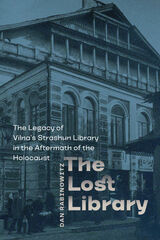
front cover of The Lost Library
The Lost Library
The Legacy of Vilna's Strashun Library in the Aftermath of the Holocaust
Dan Rabinowitz
Brandeis University Press, 2018
The Strashun Library was among the most important Jewish public institutions in Vilna, and indeed in Eastern Europe, prior to its destruction during World War II. Mattityahu Strashun, descended from a long and distinguished line of rabbis, bequeathed his extensive personal library of 5,753 volumes to the Vilna Jewish community on his death in 1885, with instructions that it remain open to all. In the summer of 1941, the Nazis came to Vilna, plundered the library, and shipped many of its books to Germany for deposition at a future Institute for Research into the Jewish Question. When the war ended, the recovery effort began. Against all odds, a number of the greatest treasures of the library could be traced. However, owing to its diverse holdings and its many prewar patrons, a custody battle erupted over the remaining holdings. Who should be heir to the Strashun Library? This book tells the story of the Strashun Library from its creation through the contentious battle for ownership following the war until present day. Pursuant to a settlement in 1958, the remnants of the greatest prewar library in Europe were split between two major institutions: the secular YIVO in the United States and the rabbinic library of Hechal Shlomo in Israel, a compromise that struck at the heart of the library’s original unifying mission.
[more]

front cover of Making a Great Ruler
Making a Great Ruler
Grand Duke Vytautas of Lithuania
Giedre Mickunaite
Central European University Press, 2006
Investigating the propaganda surrounding the grand duke, this study reveals that, in fact, there were two opposite images: that of a good ruler and that of a tyrant. The paradox is that frequently these opposites were based on the same features of the grand duke's character or episodes from his biography. The research is based on a wide array of written and visual sources as well as on records of oral tradition. Rich and diverse primary materials are analysed from the perspectives of political and social history, memorial culture, as well as iconography and rhetoric.
[more]

front cover of A Pragmatic Alliance
A Pragmatic Alliance
Jewish-Lithuanian political cooperation at the beginning of the 20th century
Vladas Sirutavicius
Central European University Press, 2011
Discusses the political cooperation between Jews and Lithuanians in the Tsarist Empire from the last decades of the 19th century until the early 1920s. These years saw the transformation of both Jewish and Lithuanian political life. Within the Jewish community, the previously dominant integrationists were now challenged both by those who believed that the Jews were not a religious but an ethnic or proto-nationalist group and those who believed that only with the abolition of capitalism and the establishment of a socialist state would Jewish integration be possible. Among the Lithuanians, the emergence of a modern national identity became increasingly prevalent.
[more]

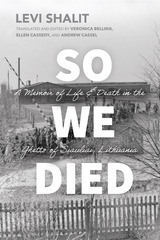
front cover of So We Died
So We Died
A Memoir of Life and Death in the Ghetto of Šiauliai, Lithuania
Levi Shalit, translated and edited by Veronica Belling, Ellen Cassedy, and Andrew Cassel, introduction by Veronica Belling, afterword by Justin Cammy
University of Alabama Press, 2025

In the shadow of death, Levi Shalit wrote to remember—so we would never forget.

So We Died: A Memoir of Life and Death in the Ghetto of Šiauliai, Lithuania (Azoy zaynen mir geshtorbn) is a powerful eyewitness account of the Shavl ghetto during the Nazi occupation of Lithuania. Written in Yiddish by Levi Shalit and available now for the first time in English, the work fills a stark void in historical records.

Shalit divided his work into four sections. In the first, he describes the German invasion of Šiauliai, the murder of thousands of Jews in the city and surrounding countryside, and the forced relocation of the surviving Jews into the Shavl ghetto. In the second, he describes daily life in the ghetto in engrossing detail. In the third, titled “The Masada Book,” Shalit describes ghetto residents’ attempt to organize a resistance group of which he himself was a member. In the fourth, he narrates the transformation of the ghetto into a concentration camp and the seizure and deportation of the community’s children.

Few accounts of the Shavl ghetto survived the war. Shalit’s work offers English-language readers a rare insight into a vital chapter of history. The translators artfully reveal Shalit’s literary prowess and the ways he illuminated the Shavl ghetto’s daily struggles, false hopes, and atrocities.

More than an account of a previously overlooked episode in Holocaust history, So We Died is a testament to the enduring power of the human spirit in the face of unspeakable tragedy. It offers keen insight into a time of war, fascism, and resistance. A must-read for anyone seeking understanding and remembrance.

[more]

front cover of Whitehorn's Windmill
Whitehorn's Windmill
Kazys Boruta
Central European University Press, 2009
Because of his political views, Kazys Boruta spent years in prison both before and after WWII. In the last phase of his life in Soviet Lithuania, he earned a living by translations published under a pseudonym. Most of Whitehorn’s Windmill (Baltaragio malunas) was written in 1942, during the German occupation. Bearing a lyrical style that gives full rein to the oral folktale tradition Lithuania is famous for, the novel is by turns romantic, farcical, fantastic, and tragic. The sense of spirituality that permeates the work reflects Lithuania’s pagan roots that were overlaid with an occasionally over-zealous Catholicism not so very long ago. The story is about Whitehorn the miller’s efforts to find a match for his beautiful daughter, Jurga, against various calamities with and among suitors, neighbors, priests and other inhabitants of the village, and ultimately against the devil’s spell. The interesting plot made the novel popular as juvenile literature, too.
[more]


Send via email Share on Facebook Share on Twitter