
 A SCHOLARLY BOOK REPOSITORY
"Besides the impact of their content, the clarity and reach of these essays force one to consider foundational questions concerning philosophy and its history."—Richard Watson, Journal of the History of Philosophy
In his first book to be translated into English, Vioulac radicalizes Heidegger’s understanding of truth as disclosure through the notion of truth as apocalypse. This “apocalypse of truth” works as an unveiling that reveals both the finitude and mystery of truth, allowing a full confrontation with truth-as-absence. Engaging with Heidegger, Marx, and St. Paul, as well as contemporary figures including Giorgio Agamben, Alain Badiou, and Slavoj Žižek, Vioulac’s book presents a subtle, masterful exposition of his analysis before culminating in a powerful vision of “the abyss of the deity.” Here, Vioulac articulates a portrait of Christianity as a religion of mourning, waiting for a god who has already passed by, a form of ever-present eschatology whose end has always already taken place. With a preface by Jean-Luc Marion, Apocalypse of Truth presents a major contemporary French thinker to English-speaking audiences for the first time.


While humanists have pondered the subject of love to the point of obsessiveness, philosophers have steadfastly ignored it. One might wonder whether the discipline of philosophy even recognizes love. The word philosophy means “love of wisdom,” but the absence of love from philosophical discourse is curiously glaring. So where did the love go? In The Erotic Phenomenon, Jean-Luc Marion asks this fundamental question of philosophy, while reviving inquiry into the concept of love itself.
Marion begins his profound and personal book with a critique of Descartes’ equation of the ego’s ability to doubt with the certainty that one exists—“I think, therefore I am”—arguing that this is worse than vain. We encounter being, he says, when we first experience love: I am loved, therefore I am; and this love is the reason I care whether I exist or not. This philosophical base allows Marion to probe several manifestations of love and its variations, including carnal excitement, self-hate, lying and perversion, fidelity, the generation of children, and the love of God. Throughout, Marion stresses that all erotic phenomena, including sentimentality, pornography, and even boasts about one’s sexual conquests, stem not from the ego as popularly understood but instead from love.
A thoroughly enlightening and captivating philosophical investigation of a strangely neglected subject, The Erotic Phenomenon is certain to initiate feverish new dialogue about the philosophical meanings of that most desirable and mysterious of all concepts—love.
This volume, the first translation into English of the work of this leading Catholic philosopher, offers a contemporary perspective on the nature of God.
"An immensely thoughtful book. . . . It promises a rich harvest. Marion's highly original treatment of the idol and the icon, the Eucharist, boredom and vanity, conversion and prayer takes theological and philosophical discussions to a new level."—Norman Wirzba, Christian Century
Jean-Luc Marion is one of the world’s foremost philosophers of religion as well as one of the leading Catholic thinkers of modern times. In God Without Being, Marion challenges a fundamental premise of traditional philosophy, theology, and metaphysics: that God, before all else, must be. Taking a characteristically postmodern stance and engaging in passionate dialogue with Heidegger, he locates a “God without Being” in the realm of agape, or Christian charity and love. If God is love, Marion contends, then God loves before he actually is.
In Negative Certainties, renowned philosopher Jean-Luc Marion challenges some of the most fundamental assumptions we have developed about knowledge: that it is categorical, predicative, and positive. Following Descartes, Kant, and Heidegger, he looks toward our finitude and the limits of our reason. He asks an astonishingly simple—but profoundly provocative—question in order to open up an entirely new way of thinking about knowledge: Isn’t our uncertainty, our finitude, and rational limitations, one of the few things we can be certain about?
Marion shows how the assumption of knowledge as positive demands a reductive epistemology that disregards immeasurable or disorderly phenomena. He shows that we have experiences every day that have no identifiable causes or predictable reasons and that these constitute a very real knowledge—a knowledge of the limits of what can be known. Establishing this “negative certainty,” Marion applies it to four aporias, or issues of certain uncertainty: the definition of man; the nature of God; the unconditionality of the gift; and the unpredictability of events. Translated for the first time into English, Negative Certainties is an invigorating work of epistemological inquiry that will take a central place in Marion’s oeuvre.
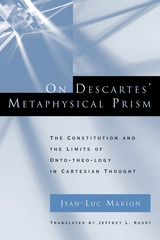
Expertly translated by Jeffrey Kosky, this work will appeal to historians of philosophy, students of religion, and anyone interested in the genealogy of contemporary thought and its contradictions.
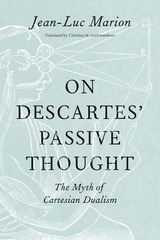
Descartes has long been associated with mind-body dualism, but Marion argues here that this is a historical misattribution, popularized by Malebranche and popular ever since both within the academy and with the general public. Actually, Marion shows, Descartes held a holistic conception of body and mind. He called it the meum corpus, a passive mode of thinking, which implies far more than just pure mind—rather, it signifies a mind directly connected to the body: the human being that I am. Understood in this new light, the Descartes Marion uncovers through close readings of works such as Passions of the Soul resists prominent criticisms leveled at him by twentieth-century figures like Husserl and Heidegger, and even anticipates the non-dualistic, phenomenological concepts of human being discussed today. This is a momentous book that no serious historian of philosophy will be able to ignore.
READERS
Browse our collection.
PUBLISHERS
See BiblioVault's publisher services.
STUDENT SERVICES
Files for college accessibility offices.
RECENTLY PUBLISHED



UChicago Accessibility Resources
home | accessibility | search | about | contact us
BiblioVault ® 2001 - 2024
The University of Chicago Press