
 A SCHOLARLY BOOK REPOSITORY

"Fortunately, in a blaze of good-humored . . . scholarship, [this] book helps brains unaccustomed to thinking about the future without jeopardizing the past imagine the wonder classical-music life might become if it embraced all people and all musics."—Laurence Vittes, Los Angeles Reader
"These essays will force us to rethink our position on many issues. . . [and] advance musicology into the twenty-first century."—Giulio Ongaro, American Music Teacher
With essays by Katherine Bergeron, Philip V. Bohlman, Richard Cohn and Douglas Dempster, Philip Gossett, Robert P. Morgan, Bruno Nettl, Don Michael Randel, Ruth A. Solie, and Gary Tomlinson.
Challenged in print for the unconventional aspects of his music, Monteverdi found himself at the center of a debate between defenders of Renaissance principles and the newest musical currents of the time. The principles of the seconda prattica, Ossi argues in this sophisticated analysis of Monteverdi's writings, music, and approaches to text-setting, were in fact much more significant to the course of Monteverdi's career than previously thought by modern scholars-not only did Monteverdi continue to pursue their aesthetic and theoretical implications for the rest of his life, but they also affected his dramatic compositions as well as his chamber vocal music and sacred works.
Ossi "divines the oracle" of Monteverdi's ambiguous theoretical concepts in a clear way and in terms of pure music; his book will enhance our understanding of Monteverdi as one of the most significant figures in western music history.
Jacques Barzun called this book “splendid.” Martin Gardner said it was “beautifully written, marvelous and entertaining.” It will provoke all serious readers to think in new ways about the grand patterns in art and life.
“Lovely, wistful. . . . Rothstein is a wonderful guide to the architecture of musical space, its tensions and relations, its resonances and proportions. . . . His account of what is going on in the music is unfailingly felicitous.”—New Yorker
“Provocative and exciting. . . . Rothstein writes this book as a foreign correspondent, sending dispatches from a remote and mysterious locale as a guide for the intellectually adventurous. The remarkable fact about his work is not that it is profound, as much of the writing is, but that it is so accessible.”—Christian Science Monitor
One of Harrison's central innovations is his reconstruction of the notion of harmony. Harrison understands harmonic power to flow not from chords as such but from the constituents of chords, reckoned for the most part as scale degrees of a key. This insight proves especially useful in analyzing the unusual progressions and key relations that characterize chromatic music.
Complementing the theoretical ideas is a critical history of nineteenth-century German harmonic theory in which Harrison traces the development of Hugo Riemann's ideas on dualism and harmonic function and examines aspects of Riemannian theory in the work of later theorists. Combining theoretical innovations with a sound historical understanding of those innovations, Harmonic Function in Chromatic Music will aid anyone studying this pivotal period of Western music history.
"An almost archetypal example of unpretentious and honest scholarship."—Alejandro Enrique Planchart, Journal of the American Musicological Society
In Indian culture, music forms an integral part of a broad framework of ideas that includes philosophy, cosmology, religion, literature, and science. Rowell works with the known theoretical treatises and the oral tradition in an effort to place the technical details of musical practice in their full cultural context. Many quotations from the original Sanskrit appear here in English translation for the first time, and the necessary technical information is presented in terms accessible to the nonspecialist. These features, combined with Rowell's glossary of Sanskrit terms and extensive bibliography, make Music and Musical Thought in Early India an excellent introduction for the general reader and an indispensable reference for ethnomusicologists, historical musicologists, music theorists, and Indologists.
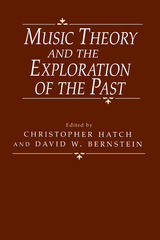
In nineteen essays dealing with musical theories from the twelfth to the twentieth century, two recurring themes emerge. One is the need to understand the historical circumstances of the writing and reception of theory, a humanistic approach that gives theory a place within social and intellectual history. The other is the advantages of applying contemporaneous theory to the music of a given period, thus linking theory to the history of musical styles and structures. The periods given principal attention in these essays are the Renaissance, the years around 1800, and the twentieth century.
Abundantly illustrated with musical examples, Music Theory and the Exploration of the Past offers models of new practical applications of theory to the analysis of music. At the same time, it raises the broader question of how historical knowledge can deepen the understanding of an art and of systematic writings about that art.
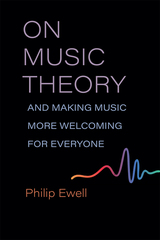
Since its inception in the mid-twentieth century, American music theory has been framed and taught almost exclusively by white men. As a result, whiteness and maleness are woven into the fabric of the field, and BIPOC music theorists face enormous hurdles due to their racial identities. In On Music Theory,Philip Ewell brings together autobiography, music theory and history, and theory and history of race in the United States to offer a black perspective on the state of music theory and to confront the field’s racist roots. Over the course of the book, Ewell undertakes a textbook analysis to unpack the mythologies of whiteness and western-ness with respect to music theory, and gives, for the first time, his perspective on the controversy surrounding the publication of volume 12 of the Journal of Schenkerian Studies. He speaks directly about the antiblackness of music theory and the antisemitism of classical music writ large and concludes by offering suggestions about how we move forward. Taking an explicitly antiracist approach to music theory, with this book Ewell begins to create a space in which those who have been marginalized in music theory can thrive.

Available in English for the first time, Prosdocimo's Tractatus plane musice (1412) and Tractatus musice speculative (1425) are exemplary texts for understanding the high sophistication of music theory in the early fifteenth century. Known for considering music as a science based on demonstrable mathematical principles, Prosdocimo praises Marchetto for his theory of plainchant but criticizes his influential Lucidarium for its heterodox mathematics. In dismissing Marchetto as a “mere performer,” Prosdocimo takes up matters as broad as the nature and definition of music and as precise as counterpoint, tuning, and ecclesiastical modes. The treatises also reveal much about Prosdocimo’s understanding of plainchant; his work with Euclid's Elementa; and his familiarity with the music theory of Boethius, Macrobius, and Johannes de Muris. A foremost authority on Italian music theory of the Middle Ages and early Renaissance, Jan Herlinger consults manuscripts from Bologna, Cremona, and Lucca in preparing these valuable first critical editions.


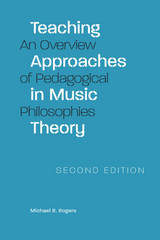
Drawing on decades of teaching experience and the collective wisdom of dozens of the most creative theorists in the country, Michael R. Rogers’s diverse survey of music theory—one of the first to comprehensively survey and evaluate the teaching styles, techniques, and materials used in theory courses—is a unique reference and research tool for teachers, theorists, secondary and postsecondary students, and for private study. This revised edition of Teaching Approaches in Music Theory: An Overview of Pedagogical Philosophies features an extensive updated bibliography encompassing the years since the volume was first published in 1984.
In a new preface to this edition, Rogers references advancements in the field over the past two decades, from the appearance of the first scholarly journal devoted entirely to aspects of music theory education to the emergence of electronic advances and devices that will provide a supporting, if not central, role in the teaching of music theory in the foreseeable future. With the updated information, the text continues to provide an excellent starting point for the study of music theory pedagogy.
Rogers has organized the book very much like a sonata. Part one, “Background,” delineates principal ideas and themes, acquaints readers with the author’s views of contemporary musical theory, and includes an orientation to an eclectic range of philosophical thinking on the subject; part two, “Thinking and Listening,” develops these ideas in the specific areas of mindtraining and analysis, including a chapter on ear training; and part three, “Achieving Teaching Success,” recapitulates main points in alternate contexts and surroundings and discusses how they can be applied to teaching and the evaluation of design and curriculum.
Teaching Approaches in Music Theory emphasizes thoughtful examination and critique of the underlying and often tacit assumptions behind textbooks, materials, and technologies. Consistently combining general methods with specific examples and both philosophical and practical reasoning, Rogers compares and contrasts pairs of concepts and teaching approaches, some mutually exclusive and some overlapping. The volume is enhanced by extensive suggested reading lists for each chapter.
This volume offers an unprecedented English translation of the second volume of Elementi teorico-practici di musica, with annotations and commentary. The translation is introduced with a study of Galeazzi's life and milieu, the genesis and sources for the Elementi, and its reception through the present day.
Taken together, these comprehensive volumes offer an authoritative account of the music of Africa. One of the most prominent experts on the subject, Gerhard Kubik draws on his extensive travels and three decades of study in many parts of the continent to compare and contrast a wealth of musical traditions from a range of cultures.
In the first volume, Kubik describes and examines xylophone playing in southern Uganda and harp music from the Central African Republic; compares multi-part singing from across the continent; and explores movement and sound in eastern Angola. And in the second volume, he turns to the cognitive study of African rhythm, Yoruba chantefables, the musical Kachamba family of Malaŵi, and African conceptions of space and time.
Each volume features an extensive number of photographs and is accompanied by a compact disc of Kubik’s own recordings. Erudite and exhaustive, Theory of African Music will be an invaluable reference for years to come.
In this second volume, Kubik explores a variety of topics, including Yoruba chantefables, the musical Kachamba family of Malawˆ i, and the cognitive study of African rhythm. Drawing on his remarkable ability to make cross-cultural comparisons, Kubik illuminates every facet of the African understanding of rhythm, from timing systems to elementary pulsation. His analysis of tusona ideographs in Luchazi culture leads to an exploration of African space/time concepts that synthesizes his theories of art, rhythm, and culture.
Featuring a large number of photographs and accompanied by a compact disc of Kubik’s own recordings, Theory of African Music, Volume II, will be an invaluable reference for years to come.
READERS
Browse our collection.
PUBLISHERS
See BiblioVault's publisher services.
STUDENT SERVICES
Files for college accessibility offices.
RECENTLY PUBLISHED






UChicago Accessibility Resources
home | accessibility | search | about | contact us
BiblioVault ® 2001 - 2024
The University of Chicago Press