
 A SCHOLARLY BOOK REPOSITORY
100 Details offers Kenneth Clark's personal choice of details of paintings in the National Gallery, London, and his responses to them. Clark chooses the pictures he likes best, hoping that we will come to like them too. The result is like taking a stroll through a glorious art collection with a critic of astounding eye and intellect at our side.
First published in 1938, the book is arranged in a series of facing page spreads, now reproduced in full color, enabling us to discern analogies and contrasts between painting that are rarely seen together--a faun from Piero di Cosimo, a satyr from Rubens. The running commentaries are Kenneth Clark at his best. They range from a few lines to an entire history of still life between Giotto and Picasso, all conveyed in easy style.
Clark insists that there are countless ways of enjoying paintings, provided we stop, look, and think. He has picked the ones to stop at: the detail makes us look. And his comments, wide in scope and catholic in approach, suggest lines of thought so diverse that it is inconceivable that none will strike a chord with the reader.
It was Waldron Phoenix Belknap who first discovered that in a large proportion of early Colonial portraits the compositions had been copied in whole or in part from mezzotints published in London. The tragic and untimely death in 1949 of the founder of The Belknap Press of Harvard University Press cut short a study of the foundations of American painting upon which he had been actively engaged, but the present volume brings together its author's contributions to art history.
Prepared for publication by the staff of the Waldron Phoenix Belknap, Jr., Research Library of American Painting, at the Henry Francis duPont Winterthur Museum, the book is divided into seven parts: The Identity of Robert Feke; Problems in Identification, De Peyster Portraits; New York Painters and Patrons: The Genealogical Approach; Painters and Craftsmen; Notes on Colonial Portraits; The Discoveries of Waldron Phoenix Belknap, Jr., concerning the Influence of the English Mezzotint on Colonial Painting; New York Portraits.
The many hundreds of names included in the work are brought together in an analytical index. Two hundred and eighty-four Colonial portraits and British mezzotints are illustrated in half-tone plates. There is a four-color frontispiece.
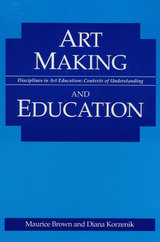
What is involved in "making art"? In what ways have Americans
introduced art making to students? In Art Making and Education, a
practicing artist and a historian of art education discuss from their
particular perspectives the production of studio and classroom art. Among
those to whom this book will appeal are prospective teachers, school administrators,
university-level art educators, and readers interested in the theory of
discipline-based art education.
"The sources are excellent. The bibliographical material is a must
for any candidate wanting to teach the visual arts and certainly for any
student hoping to become an artist."
-- William Klenk, University of Rhode Island
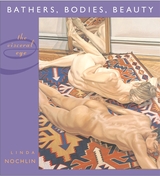
A leading feminist art historian on the nude body, from impressionism to postmodernism.
To some viewers, Renoir’s Great Bathers is the very picture of female sensuality and beauty. To others, the sentimentalized, sexualized prettiness of the image embodies a whole tradition of masculine mastery and feminine display. Still others find in the bathers a feminine fantasy of bodily liberation. Juxtaposing these opposing points of view, Linda Nochlin deftly uncovers the dissonances surrounding artistic representation of the female form from the nineteenth century to the present.
Nochlin begins by focusing on the painterly preoccupation with bathing, whether at the beach, in lakes and rivers, in public swimming pools, or in bathtubs. Why, she asks, did the nude figure, posed in or near water, become such a dominant trope in the history of Western art? Covering artists from Manet, Cezanne, Bonnard, and Picasso to late-twentieth-century and contemporary figures such as Philip Pearlstein, Anselm Kiefer, Alice Neel, and Jenny Saville, Nochlin develops a rich interpretative collage of the layered meanings ascribed to bodies in intimate settings. She concludes with a powerful essay on aging, infirmity, and death.
A deeply personal book—Nochlin herself is depicted in more than one of the paintings she discusses, and her discussion of old age is inspired by her own looming mortality—Bathers, Bodies, Beauty draws on a lifetime of loving, hating, and wrestling with art to reveal both the visceral disappointments and supreme joys of seeing it from a feminist perspective.
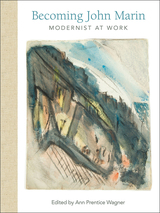
John Marin was a major figure among the cutting-edge circle of American modernist artists who showed his work in Alfred Stieglitz’s New York galleries from 1909 until 1950. A new collection of the artist’s work at the Arkansas Arts Center, given by Marin’s daughter-in-law, forms the basis of this first book of essays and images to concentrate on Marin’s drawings in the context of Marin’s life, his watercolors, and his etchings.
We follow Marin to his most famous subject matter: New York City and the coast of Maine. Foundational drawings and an unfinished watercolor of the towering Woolworth Building, still under construction when they were made in 1912, begin the story of a renowned group of watercolors first exhibited in 1913 at Alfred Stieglitz’s 291 Gallery and then at the ground-breaking 1913 Armory Show. Other images take us to lesser-known locales, such as the Ramapo Mountains in New York and New Jersey where Marin often painted when he couldn’t get to Maine. More obscure aspects of the artist’s career explored in this collection include portraits of friends and family, charming drawings of animals, and circus scenes.
Becoming John Marin invites readers to look over this important artist’s shoulder as he created and honed the sketches he would interpret into completed watercolors and etchings, illustrating the evolution of his style and methods as he transformed from intuitive draftsman to innovative modernist watercolorist and etcher.
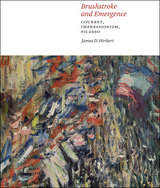
Yet the question of how much we can credit to the individual brushstroke is complicated—and in Brushstroke and Emergence, James D. Herbert uses that question as a starting point for an extended essay that draws on philosophy of mind, the science of emergence, and art history. Brushstrokes, he reminds us, are as much creatures of habit and embodied experience as they are of intent. When they gather in great numbers they take on a life of their own, out of which emerge complexity and meaning. Analyzing ten paintings by Courbet, Manet, Cézanne, Monet, Seurat, and Picasso, Herbert exposes vital relationships between intention and habit, the singular and the complex. In doing so, he uncovers a space worthy of historical and aesthetic analysis between the brushstroke and the self.
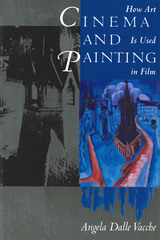
The visual image is the common denominator of cinema and painting, and indeed many filmmakers have used the imagery of paintings to shape or enrich the meaning of their films. In this discerning new approach to cinema studies, Angela Dalle Vacche discusses how the use of pictorial sources in film enables eight filmmakers to comment on the interplay between the arts, on the dialectic of word and image, on the relationship between artistic creativity and sexual difference, and on the tension between tradition and modernity.
Specifically, Dalle Vacche explores Jean-Luc Godard's iconophobia (Pierrot Le Fou) and Andrei Tarkovsky's iconophilia (Andrei Rubleov), Kenji Mizoguchi's split allegiances between East and West (Five Women around Utamaro), Michelangelo Antonioni's melodramatic sensibility (Red Desert), Eric Rohmer's project to convey interiority through images (The Marquise of O), F. W. Murnau's debt to Romantic landscape painting (Nosferatu), Vincente Minnelli's affinities with American Abstract Expressionism (An American in Paris), and Alain Cavalier's use of still life and the close-up to explore the realms of mysticism and femininity (Thérèse).
While addressing issues of influence and intentionality, Dalle Vacche concludes that intertextuality is central to an appreciation of the dialogical nature of the filmic medium, which, in appropriating or rejecting art history, defines itself in relation to national traditions and broadly shared visual cultures.
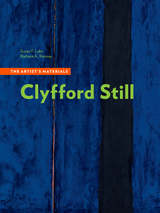
Among the most radical of the great American Abstract Expressionist painters, Clyfford Still has also long been among the least studied. Still severed ties with the commercial art world in the early 1950s, and his estate at the time of his death in 1980 comprised some 3,125 artworks—including more than 800 paintings—that were all but unknown to the art world. Susan F. Lake and Barbara A. Ramsay were granted access to this collection by the estate and by the Clyfford Still Museum in Denver, which houses this immense corpus today.
This volume, based on the authors’ materials research and enriched by their unprecedented access to Still’s artworks, paints, correspondence, studio records, and personal library, provides the first detailed account of his materials, working methods, and techniques. Initial chapters provide an engaging and erudite overview of the artist's life. Subsequent chapters trace the development of his visionary style, offer in-depth materials analysis of selected works from each decade of his career, and suggest new approaches to the care and conservation of his paintings. There is also a series of technical appendices as well as a full bibliography.

The Compelling Image will delight the art-lover who does not yet realize that Chinese painting can be as original and moving as El Greco or Cézanne. With a graceful authority, James Cahill explores the radiant painting of that tumultuous era when the collapse of the Ming Dynasty and the Manchu conquest of China dramatically changed the lives and thinking of artists and intellectuals.
The brilliant masters of the seventeenth century were reconsidering their artistic relationship to nature and to the painting of earlier times, while European pictorial arts introduced by Jesuit missionaries were profoundly influencing Chinese techniques. The reader/viewer is presented with a series of crucial distinctions of style and approach in a richly illustrated book that illuminates the whole character of Chinese painting.
Cahill begins with a relatively neglected artist, Chang Hung, who moved traditional forms ever closer to literal descriptions of nature, in contrast with the theorist painter Tung Ch’i-ch’ang, who turned the same traditional forms into powerful abstractions. A chapter focused on Wu Pin offers new and controversial ideas about the impact of European art, as well as a related phenomenon: revival of the highly descriptive early Sung styles. Looking especially at Ch’en Hung-shou, the greatest of the late Ming figure painters, Cahill examines a curious mixing of real people and conventionally rendered surroundings in portrait art of the period. He analyzes the expressionist experiments of the masters known as Individualists, and distinguishes these artists from the Orthodox school, concluding with a bold reassessment of the most eloquent of later Chinese painters, Tao-chi.
Over 250 illustrations, including twelve color plates, are drawn from collections in the United States, Europe, Japan, and China. This is a book for anyone interested in China, its past, and its art, and for the enthusiast who wishes to broaden the horizons of enjoyment by exposure to a most engaging writer on an exquisite era.
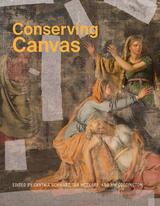
In 2019, Yale University, with the support of the Getty Foundation, held an international conference, where nearly four hundred attendees from more than twenty countries gathered to discuss a vital topic: how best to conserve paintings on canvas. It was the first major symposium on the subject since 1974, when wax-resin and glue-paste lining reigned as the predominant conservation techniques. Over the past fifty years, such methods, which were often destructive to artworks, have become less widely used in favor of more minimalist approaches to intervention. More recent decades have witnessed the reevaluation of traditional practices as well as focused research supporting significant new methodologies, procedures, and synthetic materials for the care and conservation of paintings on fabric supports.
Conserving Canvas compiles the proceedings of the conference, presenting a wide array of papers and posters that provide important global perspectives on the history, current state, and future needs of the field. Featuring an expansive glossary of terms that will be an invaluable resource for conservators, this publication promises to become a standard reference for the international conservation community.
The free online edition of this open-access publication is available at getty.edu/publications/conserving-canvas. Also available are free PDF and EPUB downloads of the book.
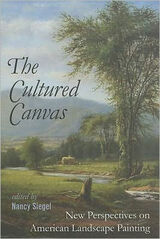
Written from aesthetic, sociopolitical, cultural, and literary perspectives, The Cultured Canvas explores myriad ways in which American visual culture can be evaluated through newly conceived thematic and ideological approaches. This book moves beyond our accepted notion of the oil painting on canvas to consider the term as both a literal and figurative surface upon which artists construct or construe the landscape as an intellectual, cultural, or physical entity. It provides an innovative reevaluation of traditional thought concerning the Hudson River School, Luminism, and artists of the Civil War era.
As interdisciplinary emphases are employed with increasing frequency in arts and humanities courses, the breadth and depth of topics covered in this collection will provide a much-needed text for scholars in American art history, nineteenth-century American studies, and landscape studies, in addition to serving as a complement to courses in American literature and culture.
Hardcover is un-jacketed.

and pictorial representations, The Double Screen shows how the
collaboration and tension between material form and image gives life to
a painting. A Chinese painting is often reduced to the image it bears;
its material form is dismissed; its intimate connection with social
activities and cultural conventions neglected.
A screen occupies a space and divides it, supplies an ideal surface for
painting, and has been a favorite pictorial image in Chinese art since
antiquity. Wu Hung undertakes a comprehensive analysis of the screen,
which can be an object, an art medium, a pictorial motif, or all three
at once. With its diverse roles, the screen has provided Chinese
painters with endless opportunities to reinvent their art.
The Double Screen provides a powerful non-Western perspective on
issues from portraiture and pictorial narrative to voyeurism,
masquerade, and political rhetoric. It will be invaluable to anyone
interested in the history of art and Asian studies.
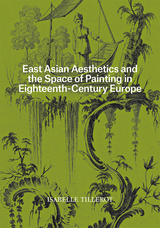
This volume offers the first critical account of how European imports of East Asian textiles, porcelain, and lacquers, along with newly published descriptions of the Chinese garden, inspired a revolution in the role of painting in early modern Europe. With particular focus on French interiors, Isabelle Tillerot reveals how a European enthusiasm for East Asian culture and a demand for novelty transformed the dynamic between painting and decor. Models of space, landscape, and horizon, as shown in Chinese and Japanese objects and their ornamentation, disrupted prevailing design concepts in Europe. With paintings no longer functioning as pictorial windows, they began to be viewed as discrete images displayed on a wall—and with that, their status changed from decorative device to autonomous work of art.
This study presents a detailed history of this transformation, revealing how an aesthetic free from the constraints of symmetry and geometrized order upended paradigms of display, enabling European painting to come into its own.
With newly commissioned essays and interviews by Hans Belting, Clémentine Deliss, Mamadou Diouf, Julia Grosse, Yvette Mutumba, Philippe Pirotte, and Manon Schwich, the book is presented in a bilingual English-German edition and also contains unique archival material, including manifestos, documents, and over four hundred illustrations.

Gerhard Richter is one of the most important and influential artists of the post-war era. For decades he has sought innovative ways to make painting more relevant, often through a multifaceted dialogue with photography. Today Richter is most widely recognized for the photo-paintings he made during the 1960s that rely on images culled from mass media and pop culture. Always fascinated with the limits and uncertainties of representation, he has since then produced landscapes, abstractions, glass and mirror constructions, prints, sculptures, and installations.
Though Richter has been known in the United States for quite some time, the highly successful retrospective of his work at the MoMA in 2002 catapulted him to unprecedented fame. Enter noted curator Dietmar Elger, who here presents the first biography of this contemporary artist. Written with full access to Richter and his archives, this fascinating book offers unprecedented insight into his life and work. Elger explores Richter’s childhood in Nazi Germany; his years as a student and mural painter in communist East Germany; his time in the West during the turbulent 1960s and ’70s, when student protests, political strife, and violence tore the Federal Republic of Germany apart; and his rise to international acclaim during the 1980s and beyond.
Richter has always been a difficult personality to parse and the seemingly contradictory strands of his artistic practice have frustrated and sometimes confounded critics. But the extensive interviews on which this book is based disclose a Richter who is far more candid, personal, and vivid than ever before. The result is a book that will be the foundational portrait of this artist for years to come.
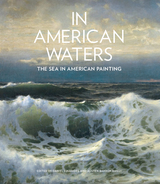
In American Waters is the catalog of an exhibition co-organized by Crystal Bridges Museum of American Art in Bentonville, Arkansas, and Peabody Essex Museum in Salem, Massachusetts.
The exhibition and this associated catalog invite visitors to discover the sea as an expansive way to reflect on American culture and environment, learn how coastal and maritime symbols moved inland across the United States, and question what it means to be “in American waters.” Work by Georgia O’Keeffe, Amy Sherald, Kay WalkingStick, Norman Rockwell, Hale Woodruff, Paul Cadmus, Thomas Hart Benton, Jacob Lawrence, Valerie Hegarty, Stuart Davis, and many others is included, along with essays from scholars, critics, and the curators.
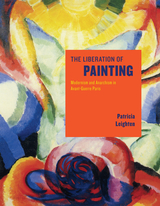
Leighten examines the circle of artists—Pablo Picasso, Juan Gris, František Kupka, Maurice de Vlaminck, Kees Van Dongen, and others—for whom anarchist politics drove the idea of avant-garde art, exploring how their aesthetic choices negotiated the myriad artistic languages operating in the decade before World War I. Whether they worked on large-scale salon paintings, political cartoons, or avant-garde abstractions, these artists, she shows, were preoccupied with social criticism. Each sought an appropriate subject, medium, style, and audience based on different conceptions of how art influences society—and their choices constantly shifted as they responded to the dilemmas posed by contradictory anarchist ideas. According to anarchist theorists, art should expose the follies and iniquities of the present to the masses, but it should also be the untrammeled expression of the emancipated individual and open a path to a new social order. Revealing how these ideas generated some of modernism’s most telling contradictions among the prewar Parisian avant-garde, The Liberation of Painting restores revolutionary activism to the broader history of modern art.
The sixteen essays collected here show the breadth and depth of Bonnefoy's writings on art, aesthetics, and poetics. His lyrical ruminations range across centuries and cultures, from Byzantium to postwar France, from the paintings of Piero della Francesca to the sculptures of Alberto Giacometti and the photographs of Henri Cartier-Bresson, from the Italian Giorgio Morandi to the American Edward Hopper. Always fascinated in his poetry by the nature of color and light and the power of the image, Bonnefoy continues to pursue these themes in his discussion of the lure and truth of representation. He sees the painter as a poet whose language is a visual one, and seeks to find out what visual artists can teach those who work with words. More philosophical than historical and more poetic than critical, the essays express Bonnefoy's deep sympathy for the creative process and his great passion for individual works of art.
Bonnefoy's engagement with great art in The Lure and the Truth of Painting sheds light on the philosophy of presence and being that animates his poems. This book will be welcomed by lovers of Bonnefoy's poems and by everyone interested in the creation, history, and appreciation of art.
Yves Bonnefoy's numerous books include New and Selected Poems and In the Shadow's Light, both published by the University of Chicago Press. Richard Stamelman is director of the Center for Foreign Languages, Literatures, and Cultures and professor of romance languages at Williams College. He is the author of Lost beyond Telling: Representations of Death and Absence in Modern French Poetry.
"Few exponents of contemporary French letters deserve the attention of the reading public in America more than Yves Bonnefoy. . . . [His] writings . . . are an important lighthouse on the contemporary cultural coastline."—Emily Grosholz, The Hudson Review
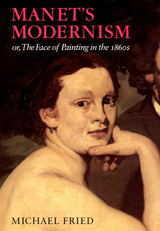
"Beautifully produced. . . . [Fried's] thought is always stimulating, if not provocative. This is an important book, which all students of modernism, in the broadest sense, will find rewarding."—Virginia Quarterly Review
"An astonishing piece of scholarship that will cause readers to rethink their understanding of Manet's influence, ambition, and achievement."—Gary Michael, Bloomsbury Review
"An audaciously brilliant book, long awaited and as essential reading for philosophers as for art historians."—Wayne Andersen, Common Knowledge
"Art history of the highest originality and distinction."—Arthur C. Danto, New York Times Book Review
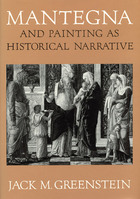
"Greenstein has raised the level of sophistication of the historical criticism of Renaissance painting by at least one whole notch; at the same time, he has written a book for everyone interested in problems of interpretation."—David Summers, University of Virginia
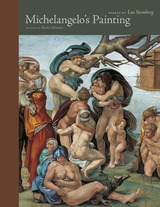
For half a century, Steinberg delved into Michelangelo’s work, revealing the symbolic structures underlying the artist’s highly charged idiom. This volume of essays and unpublished lectures elucidates many of Michelangelo’s paintings, from frescoes in the Sistine Chapel to the Conversion of St. Paul and the Crucifixion of St. Peter, the artist’s lesser-known works in the Vatican’s Pauline Chapel; also included is a study of the relationship of the Doni Madonna to Leonardo.
Steinberg’s perceptions evolved from long, hard looking. Almost everything he wrote included passages of old-fashioned formal analysis, but always put into the service of interpretation. He understood that Michelangelo’s rendering of figures, as well as their gestures and interrelations, conveys an emblematic significance masquerading under the guise of naturalism. Michelangelo pushed Renaissance naturalism into the furthest reaches of metaphor, using the language of the body to express fundamental Christian tenets once expressible only by poets and preachers.
Leo Steinberg was one of the most original art historians of the twentieth century, known for taking interpretive risks that challenged the profession by overturning reigning orthodoxies. Michelangelo’s Painting is the second volume in a series that presents Steinberg’s writings, selected and edited by his longtime associate Sheila Schwartz.
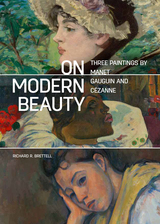
Brettell shapes his manifesto around three masterworks from the collection of the J. Paul Getty Museum: Édouard Manet’s Jeanne (Spring), Paul Gauguin’s Arii Matamoe (The Royal End), and Paul Cézanne’s Young Italian Woman at a Table. The provocative discussion reveals how each of these exceptional paintings, though depicting very different subjects—a fashionable actress, a preserved head, and a weary working woman—enacts a revolutionary, yet enduring, icon of beauty.

Available for the first time in English: the complete and annotated transcripts of Deleuze’s 1981 seminars on painting
From 1970 until 1987, Gilles Deleuze held a weekly seminar at the Experimental University of Vincennes and, starting in 1980, at Saint-Denis. In the spring of 1981, he began a series of eight seminars on painting and its intersections with philosophy. The recorded sessions, newly transcribed and translated into English, are now available in their entirety for the first time. Extensively annotated by philosopher David Lapoujade, On Painting illuminates Deleuze’s thinking on artistic creation, significantly extending the lines of thought in his book Francis Bacon.
Through paintings and writing by Rembrandt, Delacroix, Turner, Cézanne, Van Gogh, Klee, Pollock, and Bacon, Deleuze explores the creative process, from chaos to the pictorial fact. The introduction and use of color feature prominently as Deleuze elaborates on artistic and philosophical concepts such as the diagram, modulation, code, and the digital and the analogical. Through this scrutiny, he raises a series of profound and stimulating questions for his students: How does a painter ward off grayness and attain color? What is a line without contour? Why paint at all?
Written and thought in a rhizomatic manner that is thoroughly Deleuzian—strange, powerful, and novel—On Painting traverses both the conception of art history and the possibility of color as a philosophical concept.
Retail e-book files for this title are screen-reader friendly with images accompanied by short alt text and/or extended descriptions.
Looking at the political significance of cross-cultural encounters refracted through the visual languages of Orientalism, the contributors engage with pressing recent debates about indigenous agency, postcolonial identity, and gendered subjectivities. The very range of artists, styles, and forms discussed in this collection broadens contemporary understandings of Orientalist art. Among the artists considered are the Algerian painters Azouaou Mammeri and Mohammed Racim; Turkish painter Osman Hamdi; British landscape painter Barbara Bodichon; and the French painter Henri Regnault. From the liminal "Third Space" created by mosques in postcolonial Britain to the ways nineteenth-century harem women negotiated their portraits by British artists, the essays in this collection force a rethinking of the Orientalist canon.
This innovative volume will appeal to those interested in art history, theories of gender, and postcolonial studies.
Contributors. Jill Beaulieu, Roger Benjamin, Zeynep Çelik, Deborah Cherry, Hollis Clayson, Mark Crinson, Mary Roberts
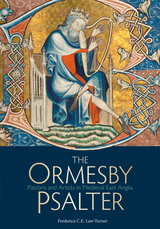
Housed in Oxford’s Bodleian Library for over 150 years, this enigmatic masterpiece is perhaps the most magnificent yet enigmatic of the great Gothic psalters produced in East Anglia in the first half of the fourteenth century. Manuscript expert Frederica C. E. Law-Turner places the psalter within a wider historical context and then deciphers its lush illuminations—scenes that vary wildly in tone from the comic to the bawdy to the mythic. Full-color photographs illustrate the text’s many characters: falcons and hunting dogs at bay, kings and courtesans, and other animals dressed in human garb. Created over a period of decades by previously unrecognized scribes and artists, the Ormesby Psalter is an exceptional amalgam of medieval art and history. For scholars of medieval life, as well as art historians, this new study will be an invaluable resource.
Offering a fresh look at German art during a period of extraordinary transition and precarity, James A. van Dyke focuses on overlooked but critically significant details in works completed by Otto Dix between 1919 and 1936. A small lump of paint, a monogram, an almost invisible self-portrait, the verso of a drawing, a patch of discoloration, and a web of fine cracks—van Dyke reveals such details, hidden in plain sight, as coded dialogue through which Dix addressed audiences and art-world insiders amid the combative world of cultural production in Weimar Germany. Sly, cutting, and provocative, these are the material traces of social relationships between the painter and those who represented threats to his professional ambition: an avant-garde mentor and rival, an increasingly skeptical critic, a prominent bourgeois photographer, and a local Nazi authority.
Proving that small things offer insight into the big picture, this book highlights Dix’s satirical, transgressive work as nuanced and polyvocal, reflecting the complex fields of power and economics in which the field of art is located.

In this wide-ranging study, Richard Neer shows how French painters of the seventeenth century developed radically new ways to connect art, perception, and ethics. Cutting across traditional boundaries of classicism and realism, Neer addresses four case studies: Nicolas Poussin, renowned for marrying ancient philosophy and narrative painting; Louise Moillon, who pioneered French still life in the 1630s; Georges de La Tour, a painter of intense and introspective nocturnes; and the Brothers Le Nain, specialists in genre and portraiture who inspired Courbet, Manet, and other painters of modern life. Setting these artists in dialogue with Montaigne, Descartes, Pascal, and others, ranging from the studios of Rome to the streets of Paris, this book provides fresh accounts of essential artworks—some well-known, others neglected—and new ways to approach the relation of art, theory, and daily life.

This compelling new study considers contemporary painting’s relationship with time and with events, ideas, and paintings from the past. Following French philosopher Jean-François Lyotard’s determination of painting as entailing a series of temporal sites, Painting, History and Meaning examines works that tendentiously engage with aspects and events derived from the past. Craig Staff explores art that has encompassed strategies of excavation, anachronism, and memorialization, examining key works by artists including Dana Schutz, Tomma Abts, Gerhard Richter, Marlene Dumas, Johannes Phokela, and Taus Makhacheva. A scholarly examination of contemporary painting through an innovative interdisciplinary research methodology, this fascinating study illuminates the complex relationship between art and history.
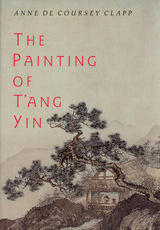
Anne De Coursey Clapp's work also explores larger issues of Ming painting raised by the artist's turbulent career. She describes the social and intellectual values exalted in Ming Suchou, its system of patronage, the contrast between the professional and amateur artist, and the formative influence of twelfth-century Sung dynasty styles on Suchou painters. Clapp shows how T'ang Yin's artistic inventions were made in the course of leading the revival of Sung dynasty styles in Suchou: tracing T'ang Yin's early studies of ancient and contemporary masters, she describes how he reworked an antique style, converting it into a vehicle of expression that reached fruition in a long series of fresh and powerful paintings of landscapes and birds-and-flowers. In the process, she revises the distorted version of middle Ming painting written by later Chinese art theorists to justify their own social and artistic values, noting especially the role of art patrons and their effect on artistic production.
Clapp analyzes the increasing currency of painting as a means of social exchange in ancient China. In particular, she identifies commemorative painting as a major genre of the later dynasties and explores the role it played in the oeuvres of professional masters with its humanistic implications for the Chinese view of the ideal scholarly man. Her broad view of T'ang Yin's career shows him divided between the professional and amateur camps of his time: in landscape and figural subjects he was aligned with the professionals; in flower subjects with the amateurs. Clap argues that the uneven distribution of styles and genres between this master who was subject to the market, and those who were independent of it, suggests that T'ang deliberately tried to expand the range of his paintings in order to appeal to buyers in the lower educational and social strata. Illustrated by some of T'ang Yin's most celebrated paintings and by some which are published for the first time, her work is of tremendous importance to art, literary, and cultural historians of Ming China.
"In this important work, Anne de Coursey Clapp has drawn a clear picture of T'ang Yin's life, patronage relationships, and contribution to the history of Chinese painting. In the person of T'ang Yin, she has chosen an ideal focus around which to examine some of the misleading stereotypes
which have distorted our understanding of Chinese painting since the seventeenth century. Marked by analytical clarity and scrupulous scholarship, her work is a welcome addition to the few works in English on individual Chinese artists."—Louise Yuhas, Occidental College
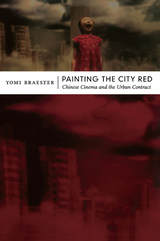
Drawing on extensive archival research, interviews with leading filmmakers and urban planners, and close readings of scripts and images, Braester describes how films and stage plays have promoted and opposed official urban plans and policies as they have addressed issues such as demolition-and-relocation plans, the preservation of vernacular architecture, and the global real estate market. He shows how the cinematic rewriting of historical narratives has accompanied the spatial reorganization of specific urban sites, including Nanjing Road in Shanghai; veterans’ villages in Taipei; and Tiananmen Square, centuries-old courtyards, and postmodern architectural landmarks in Beijing. In Painting the City Red, Braester reveals the role that film and theater have played in mediating state power, cultural norms, and the struggle for civil society in Chinese cities.
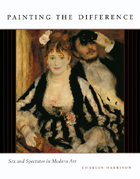
Arguing that the representation of women in art was crucial to the character of modernity, Harrison traces the history of female subjects as they began to gaze out of the picture to confront and engage their viewers. Combining sweeping conceptual history with telling investigations into the details of particular paintings, Painting the Difference deciphers the implications of sexual difference for the development of nineteenth- and twentieth-century art. Harrison shows how artists, reflecting the underlying anxieties of the time about gender, used female subjects' gazes both to create a sexualized relationship between these subjects and their viewers, and to simultaneously question that relationship. In considering works by artists such as Renoir, Manet, Degas, Cézanne, Picasso, and Matisse, as well as Rothko, Warhol, Cindy Sherman, and many more, Harrison incorporates elements of cultural criticism and social history into his arguments, and generous color illustrations permit the reader to test Harrison's claims against the works on which they are based. Rich with detail and compelling analysis, Painting the Difference offers cutting-edge interpretation grounded in the reality of magnificent works of art.
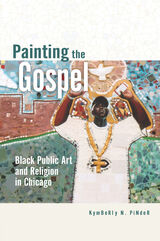
Painting the Gospel includes maps and tour itineraries that allow readers to make conceptual, historical, and geographical connections among the works.

Painting the Maya Universe is the first publication to present a definitive translation of the hieroglyphic texts painted on these objects. With many glyphs deciphered here for the first time, this analysis reveals much about how these vessels were perceived and used by the Maya, their owners’ names, and, in several cases, the names of the artists who created them. This information is combined with archaeological and other data, including nuclear chemical analyses, to correlate painting styles with specific Maya sites.
Published in conjunction with Duke University Museum of Art and an exhibition touring the United States, Painting the Maya Universe presents an astonishing visual record as well as a monumental scholarly achievement. With photographs by Justin Kerr, the foremost photographer of pre-Columbian art, it includes over 90 unique full-color rollout photographs, each showing the entire surface of an object in a single frame. The book also addresses the questions and controversy regarding the loss of information that occurs when objects are removed from their archaeological context to become part of public and private collections.
Painting the Maya Universe will energize discussion of Maya pottery, hieroglyphic texts, and iconography. Its photographs, a lasting resource on this great painting tradition, will stimulate and delight the eye. It is a breakthrough in art history and Latin American scholarship that will enrich general readers and scholars alike.
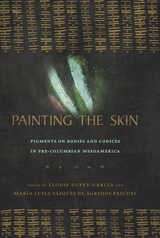
Painting the Skin brings together exciting research on painted skins in Mesoamerica. Chapters explore the materiality, uses, and cultural meanings of the colors applied to a multitude of skins, including bodies, codices made of hide and vegetal paper, and even building “skins.” Contributors offer physicochemical analysis and compare compositions, manufactures, and attached meanings of pigments and colorants across various social and symbolic contexts and registers. They also compare these Mesoamerican colors with those used in other ancient cultures from both the Old and New Worlds. This cross-cultural perspective reveals crucial similarities and differences in the way cultures have painted on skins of all types.
Examining color in Mesoamerica broadens understandings of Native religious systems and world views. Tracing the path of color use and meaning from pre-Columbian times to the present allows for the study of the preparation, meanings, social uses, and thousand-year origins of the coloring materials used by today’s Indigenous peoples.
Contributors:
María Isabel Álvarez Icaza Longoria
Christine Andraud
Bruno Giovanni Brunetti
David Buti
Davide Domenici
Élodie Dupey García
Tatiana Falcón Álvarez
Anne Genachte-Le Bail
Fabrice Goubard
Aymeric Histace
Patricia Horcajada Campos
Stephen Houston
Olivia Kindl
Bertrand Lavédrine
Linda R. Manzanilla Naim
Anne Michelin
Costanza Miliani
Virgina E. Miller
Sélim Natahi
Fabien Pottier
Patricia Quintana Owen
Franco D. Rossi
Antonio Sgamellotti
Vera Tiesler
Aurélie Tournié
María Luisa Vázquez de Ágredos Pascual
Cristina Vidal Lorenzo
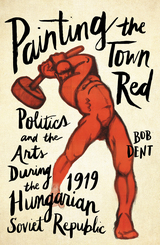
Tracing the long arc of chemically produced and reproduced art from the 1670s through the 1860s, the book reconsiders early photography by situating it in relationship to Reynolds’s replicated paintings and the literal engines of British industry. By following the chemicals, Painting with Fire remaps familiar stories about academic painting and pictorial experiment amid the industrialization of chemical knowledge.

One of the great kingdoms of human history, the Mughal empire is now lost to the relentless sweep of time. But the wealth of art treasures the Mughals left behind is nonetheless a lasting testament to the sumptuousness of their culture. Among the most notable vestiges of their art are the lush miniature paintings of Mughal imperial life, and Andrew Topsfield explores a rich array of these painted works in Paintings from Mughal India.
Between the sixteenth and eighteenth centuries, the Mughal emperors presided over a flourishing cultural renaissance, and these miniature paintings vividly depict the splendor of this period. Topsfield examines the paintings’ unique blend of Indian, Islamic, and Persian styles and analyzes their varied subjects—ranging from hunting, royal banquets, and other scenes of imperial life to legendary tales, mythic deities, and battles. Among the paintings featured in the book’s vibrant reproductions are works created between the reign of Akbar and the fall of Shah Jehanan—an era considered to be the height of Mughal painting—and illustrations from the celebrated Baharistan manuscript of 1595. A fascinating and gorgeously illustrated study, Paintings from Mughal India will be an invaluable resource for all art scholars and anyone interested in the legacy of the Mughal Empire.
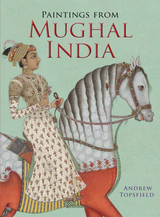
Andrew Topsfield examines these paintings that bear the influence of Indian, Islamic, and Persian styles and portray a variety of subjects, from hunting, royal banquets, and other scenes of imperial life to legends, battles, and mythic deities. Among the paintings featured in the book’s vibrant reproductions are illustrations from the celebrated Baharistan manuscript of 1595 and works created between the reign of Akbar and the fall of Shah Jahan in 1658—an era considered to be the height of Mughal art. For this new edition, Topsfield has made corrections and revisions reflecting new research.
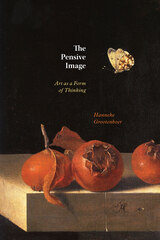
While the philosophical dimension of painting has long been discussed, a clear case for painting as a form of visual thinking has yet to be made. Traditionally, vanitas still life paintings are considered to raise ontological issues while landscapes direct the mind toward introspection. Grootenboer moves beyond these considerations to focus on what remains unspoken in painting, the implicit and inexpressible that manifests in a quality she calls pensiveness. Different from self-aware or actively desiring images, pensive images are speculative, pointing beyond interpretation. An alternative pictorial category, pensive images stir us away from interpretation and toward a state of suspension where thinking through and with the image can start.
In fluid prose, Grootenboer explores various modalities of visual thinking— as the location where thought should be found, as a refuge enabling reflection, and as an encounter that provokes thought. Through these considerations, she demonstrates that artworks serve as models for thought as much as they act as instruments through which thinking can take place. Starting from the premise that painting is itself a type of thinking, The Pensive Image argues that art is capable of forming thoughts and shaping concepts in visual terms.
Romances violate the casual, temporal, and logical cohesiveness of realist novels, and they do so in part by depicting love as a state of suspension, a condition outside of time. Steiner argues that because Renaissance and post-Renaissance painting also represents a suspended moment of perception with "unnatural" clarity and compression of meaning, it readily serves the romance as a symbol of antirealism. Yet the atemporality of stopped-action painting was actually an attempt to achieve pictorial realism—the way things "really" look. It is this paradox that interests Steiner: to signal their departure from realism, romances evoke the symbol of "realistic" visual artwork. Steiner explores this problem through analyses of Keats, Hawthorne, Joyce, and Picasso. She then examines a return to narrative conventions in visual art in the twentieth century, in the work of Lichtenstein and Warhol, and speculates on the fate of pictorial storytelling and the romance in postmodern art. An aesthetic fantasia of sorts, this study combines theory and analysis to illuminate an unexpected interconnection between literature and the visual arts.
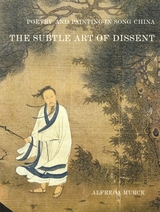
Throughout the history of imperial China, the educated elite used various means to criticize government policies and actions. During the Song dynasty (960-1278), some members of this elite found an elegant and subtle means of dissent: landscape painting.
By examining literary archetypes, the titles of paintings, contemporary inscriptions, and the historical context, Alfreda Murck shows that certain paintings expressed strong political opinions—some transparent, others deliberately concealed. She argues that the coding of messages in seemingly innocuous paintings was an important factor in the growing respect for painting among the educated elite and that the capacity of painting's systems of reference to allow scholars to express dissent with impunity contributed to the art's vitality and longevity.
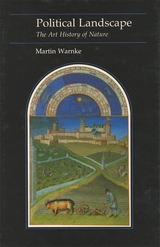
If a river runs through it, somewhere there is bound to be a bridge. Little in the landscape remains untouched by human hands, and every touch, from the simplest ditch to the most intricate monument, reveals a political decision or design. This is how Martin Warnke, one of Germany's leading art historians, looks at landscape in this book, which leads to a new way of seeing nature as we have appropriated, represented, and transformed it over time. Covering nearly a thousand years and most of western Europe, The Political Landscape provides a compelling summary history of modern humanity's ill-fated attempt to master nature.
Warnke finds evidence of the politicized landscape everywhere, on nature's own ground and in art, artifacts, and architecture, in features defined by the demands of conquest and defense, property rights and picturesque improvement, trade, tradition, communication, and commemoration. Whether considering the role of landscape in battle depictions, or investigating monumental figures from the Colossus of Rhodes to Mount Rushmore, or asking why gold backgrounds in paintings gave way to mountains topped with castles, Warnke reconfigures our idea of landscape, its significance, and its representations. The book sharpens our perceptions of nature in art and as art--a nature charged with symbol and meaning as a result of interventions by turns enlightened, insensitive, or, as now, dangerously corrosive.
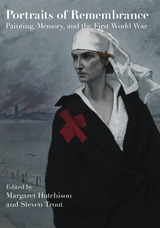
Although photography and moving pictures achieved ubiquity during the First World War as technological means of recording history, the far more traditional medium of painting played a vital role in the visual culture of combatant nations. The public’s appetite for the kind of up-close frontline action that snapshots and film footage could not yet provide resulted in a robust market for drawn or painted battle scenes.
Painting also figured significantly in the formation of collective war memory after the armistice. Paintings became sites of memory in two ways: first, many governments and communities invested in freestanding panoramas or cycloramas that depicted the war or featured murals as components of even larger commemorative projects, and second, certain paintings, whether created by official artists or simply by those moved to do so, emerged over time as visual touchstones in the public’s understanding of the war.
Portraits of Remembrance: Painting, Memory, and the First World War examines the relationship between war painting and collective memory in Australia, Austria, Belgium, Canada, Croatia, France, Germany, Great Britain, New Zealand, Russia, Serbia, Turkey, and the United States. The paintings discussed vary tremendously, ranging from public murals and panoramas to works on a far more intimate scale, including modernist masterpieces and crowd-pleasing expressions of sentimentality or spiritualism. Contributors raise a host of topics in connection with the volume’s overarching focus on memory, including national identity, constructions of gender, historical accuracy, issues of aesthetic taste, and connections between painting and literature, as well as other cultural forms.

A monumentalizing portrayal of a peasant bowed over by brutal toil, Man with a Hoe (1860–62) by Jean-François Millet (1814–1875) is arguably the most art historically significant painting in the J. Paul Getty Museum’s collection of nineteenth-century European art. This volume situates the work in the arc of Millet’s career and traces its fascinating and contentious reception, from its scandalous debut at the 1863 Paris Salon to the years following its acquisition by American collectors in the 1890s. The essays examine the painting’s tumultuous public life, beginning in France, where critics attacked it on aesthetic and political grounds as a radical realist provocation; through its transformative movement in the art market during the remaining years of the artist’s life and following his death; to its highly publicized arrival in California as a celebrated masterpiece. In the United States it was enlisted to serve philanthropic interests, became the subject of a popular poem, and once again became embroiled in controversy, in this case one that was strongly inflected by American racial politics. This is the first publication dedicated to the work since its acquisition by the Getty Museum in 1985.
This volume is published to accompany an exhibition on view at the J. Paul Getty Museum at the Getty Center from September 12 to December 10, 2023.
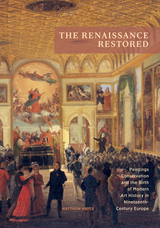
Repairing works of art and writing about them—the practices that became art conservation and art history—share a common ancestry. By the nineteenth century the two fields had become inseparably linked. While the art historical scholarship of this period has been widely studied, its restoration practices have received less scrutiny—until now.
This book charts the intersections between art history and conservation in the treatment of Italian Renaissance paintings in nineteenth-century Europe. Initial chapters discuss the restoration of works by Giotto and Titian, framed by the contemporary scholarship of art historians such as Jacob Burckhardt, G. B. Cavalcaselle, and Joseph Crowe that was redefining the earlier age. Subsequent chapters recount how paintings conservation was integrated into museum settings. The narrative uses period texts, unpublished archival materials, and historical photographs in probing how paintings looked at a time when scholars were writing the foundational texts of art history, and how contemporary restorers were negotiating the appearances of these works. The book proposes a model for a new conservation history, object focused yet enriched by consideration of a wider cultural horizon.
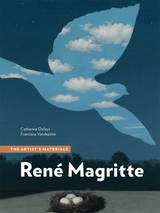
René Magritte (1898–1967) is the most famous Belgian artist of the twentieth century and a celebrated representative of the Surrealist movement. Much has been written about his practices, artistic community, and significance within the history of modernism, but little has been documented regarding his process.
This volume examines fifty oil paintings made by Magritte between 1921 and 1967, now held at the Royal Museums of Fine Arts of Belgium. This technical study of his works using noninvasive scientific imaging and chemical analysis reveals the artist’s painting materials, his habit of overpainting previous compositions, and the origins and mechanisms of surface and pigment degradation. Of interest to conservators, scientists, curators, and enthusiasts of twentieth-century art, this book expands our understanding of Magritte the artist and provides new and useful findings that will inform strategies for the future care of his works.
These are the questions Clark Hulse takes up in this sophisticated interdisciplinary study of Renaissance aesthetics. Proposing an archeology of artistic knowledge, Hulse examines the theoretical language through which the poets, painters, and patrons of the Renaissance conceived of the relationship between the arts. That language is embedded in what he calls a "rule of art," a specific set of categories, assumptions, and practices that defined the two art forms and the relationship between them. Hulse charts the rise of both forms to the status of liberal arts requiring special intellectual training for artist and patron alike. In the process, he uncovers the history of the practice of theory in the Renaissance, revealing how artistic discourse lived in the world.
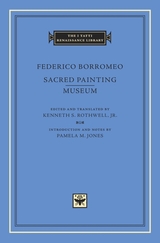
Federico Borromeo, Cardinal-Archbishop of Milan (1564–1631), is well known as a leading Catholic reformer and as the founder of the Ambrosiana library, art collection, and academy in that city. Less known is the fact that the institution's art museum was the culmination of many decades of reflection on the aesthetic qualities and religious roles of art. Borromeo recorded his reflections in two treatises.
De pictura sacra (Sacred Painting, 1624) laid out the rules that artists should follow when creating religious art. Borromeo touched on dozens of iconographical issues and in so doing drew on his deep knowledge not only of church fathers, councils, and scripture but also of classical art and literature. In Musaeum (1625) Borromeo showed a less doctrinaire and more personal side by walking the reader through the Ambrosiana and commenting on specific works in his collection. He offered some of the earliest and most important critiques to survive on works by artists such as Leonardo, Titian, and Jan Brueghel the Elder.
This volume offers, for the first time, translations of the treatises directly into English as well as freshly edited Latin texts, an introduction, extensive notes, and an appendix on the Academy of Design that was established in conjunction with the museum. These treatises will be of great interest to students of the history of art, museums, and religion.

Sassetta, the subtle genius from Siena, revolutionized Italian painting with an altarpiece for the small Tuscan town of Borgo San Sepolcro in 1437–1444. Originally standing some six yards high, double-sided, with a splendid gilt frame over the main altar of the local Franciscan church, it was the Rolls Royce of early Renaissance painting. But its myriad figures and scenes tempted the collectors of the nineteenth and twentieth centuries, and today its disassembled panels can be found in twelve museums throughout Europe and the United States.
To produce this landmark volume, experts in art and general history, painting technique and conservation, woodworking, architecture, and liturgy have joined forces across the boundaries of eight different nations. A model of collaboration, it opens new windows onto the creative process of the artist as he confronted a late-medieval church at a crossroad of cultures, the miracle-working body of a holy man, and a community of Franciscan friars breathing the exhilarating air of reform. To confront such challenges, Sassetta raised the most spiritual school of early Italian art, the Sienese, to a higher level of understanding, grace, and splendor.
That Sir Joshua Reynolds (1723–1792) became the most fashionable painter of his time was not simply due to his artistic gifts or good fortune. The art of pleasing, Richard Wendorf contends, was as much a part of Reynolds’s success—in his life and in his work—as the art of painting. The author’s examination of Reynolds’s life and career illuminates the nature of eighteenth-century English society in relation to the enterprise of portrait-painting. Conceived as an experiment in cultural criticism, written along the fault lines that separate (but also link) art history and literary studies, Sir Joshua Reynolds: The Painter in Society explores the ways in which portrait-painting is embedded in the social fabric of a given culture as well as in the social and professional transaction between the artist and his or her subject. In addition to providing a new view of Reynolds, Wendorf’s book develops a thoroughly new way of interpreting portraiture.
Wendorf takes us into Reynolds’s studio to show us the artist deploying his considerable social and theatrical skills in staging his sittings as carefully orchestrated performances. The painter’s difficult relationship with his sister Frances (also an artist and writer), his complicated maneuvering with patrons, the manner in which he set himself up as an artist and businessman, his highly politicized career as the first president of the Royal Academy of Arts: as each of these aspects of Reynolds’s practice comes under Wendorf’s scrutiny, a new picture of the painter emerges—more sharply defined and fully fleshed than the Reynolds of past portraits, and clearly delineating his capacity for provoking ambivalence among friends and colleagues, and among viewers and readers today.
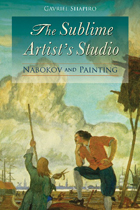
In his youth, Vladimir Nabokov aspired to become a landscape artist. Even though he eventually realized that his true vocation was literature, his keen sense of visual detail, nuanced perception of color, and vast knowledge of the fine arts are all manifest in his literary works, which abound with painters and paintings, real and imaginary, as well as with magnificent pictorial imagery rendered in a verbal medium. The relation of the visual arts to Nabokov’s work is the subject of The Sublime Artist’s Studio, an in-depth and detailed study of one of the most significant facets of this modern master’s oeuvre.
Gavriel Shapiro pursues his inquiry throughout Nabokov’s literary legacy—poetry, short prose, novels, plays, memoirs, lectures, essays, interviews, and letters. What is the import of Nabokov’s lifelong fascination with the Old Masters? How does landscape function in Nabokov’s writings? What was the author’s relationship to contemporary artists? By addressing these and other questions, while examining Nabokov’s references and allusions to the visual arts and to particular works and artists, Shapiro is able to reveal the centrality of painting to Nabokov’s belles lettres. His book offers a new and promising approach to one of the twentieth century’s most celebrated writers.
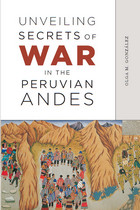
The Maoist guerrilla group Shining Path launched its violent campaign against the government in Peru’s Ayacucho region in 1980. When the military and counterinsurgency police forces were dispatched to oppose the insurrection, the violence quickly escalated. The peasant community of Sarhua was at the epicenter of the conflict, and this small village is the focus of Unveiling Secrets of War in the Peruvian Andes. There, nearly a decade after the event, Olga M. González follows the tangled thread of a public secret: the disappearance of Narciso Huicho, the man blamed for plunging Sarhua into a conflict that would sunder the community for years.
Drawing on extensive fieldwork and a novel use of a cycle of paintings, González examines the relationship between secrecy and memory. Her attention to the gaps and silences within both the Sarhuinos’ oral histories and the paintings reveals the pervasive reality of secrecy for people who have endured episodes of intense violence. González conveys how public secrets turn the process of unmasking into a complex mode of truth telling. Ultimately, public secrecy is an intricate way of “remembering to forget” that establishes a normative truth that makes life livable in the aftermath of a civil war.
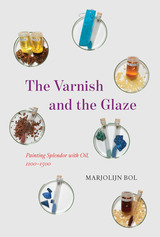
Panel painters in both the middle ages and the fifteenth century created works that evoke the luster of precious stones, the sheen of polished gold and silver, and the colorful radiance of stained glass. Yet their approaches to rendering these materials were markedly different. Marjolijn Bol explores some of the reasons behind this radical transformation by telling the history of the two oil painting techniques used to depict everything that glistens and glows—varnish and glaze.
For more than a century after his death, the fifteenth-century painter Jan van Eyck was widely credited with inventing varnish and oil paint, on account of his unique visual realism. Once this was revealed to be a myth, the verisimilitude of his work was attributed instead to a new translucent painting technique: the glaze. Today, most theories about how Van Eyck achieved this realism revolve around the idea that he was the first to discover or refine the glazing technique. Bol, however, argues that, rather than being a fifteenth-century refinement, varnishing and glazing began centuries before. Drawing from an extensive body of recipes, Bol pieces together how varnishes and glazes were first developed as part of the medieval art of material mimesis. Artisans embellished metalwork and wood with varnishes and glazes to imitate gold and gems; infused rock crystal with oil, resin, and colorants to imitate more precious minerals; and oiled parchment to transform it into the appearance of green glass. Likewise, medieval panel painters used varnishes and glazes to create the look of enamel, silk, and more.
The explorations of materials and their optical properties by these artists stimulated natural philosophers to come up with theories about transparent and translucent materials produced by the earth. Natural historians, influenced by medieval artists’ understanding of refraction and reflection, developed theories about gems, their creation, and their optical qualities.

The beaux-arts mural movement in America was fueled by energetic young artists and architects returning from training abroad. They were determined to transform American art and architecture to make them more thematically cosmopolitan and technically fluid and accomplished. The movement slowly coalesced around the decoration of mansions of the Gilded Age elite, mostly in New York, and of public buildings and institutions across the breadth of the country.
The Virgin and the Dynamo: Public Murals in American Architecture, 1893-1917 is the first book in almost a century to concentrate exclusively on the beaux-arts mural movement in the United States. Beginning with a short history of the movement from its inception in Boston during the American Renaissance, Bailey Van Hook focuses on the movement’s public manifestations in the period between the World’s Columbian Exposition in Chicago in 1893 and the First World War.
Professor Van Hook explores different aspects of the mural movement, the concept and meaning of “decoration,” the claim that murals are inherently democratic, the shift in preference from allegory to history, the gendered concept of modernity, the ideologies behind the iconography, and, finally, the decline of the movement when it began to be seen as old fashioned and anachronistic.
The Virgin and the Dynamo raises our understanding of the beaux-arts movement to a new level. For the general reader, this illustrated history will explain many familiar representations of local and national values.
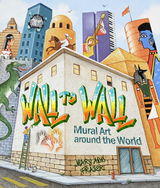
People have been drawing on walls since ancient times. They do it to create beauty, to tell a story, to make a statement, or just to say, “I was here.” You can find wall art in a remote cave in Patagonia and a desert castle in Jordan, a kingly palace in the Republic of Benin and the National Palace of Mexico, a miles-long flood channel in Los Angeles and a sky-high rooftop in Norway.
In Wall to Wall, award-winning author, illustrator, and muralist Mary Ann Fraser takes readers on a worldwide journey through time, stopping to see amazing mural art along the way. Stunning color illustrations and fascinating photographs illuminate both famous and little-known examples, and lighthearted text tells engaging stories about the people who inspired or created them. A glossary, selected bibliography, and section about the preservation of murals conclude the book. No reader will ever again pass by a mural—whether in a historic building, a museum, or out on the street—without stopping to take a closer look.
Ages ten to fourteen
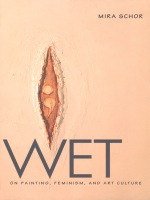
Bridging the gap between art practice, artwork, and critical theory, Wet includes some of Schor’s most influential essays that have made a significant contribution to debates over essentialism. Articles range from discussions of contemporary women artists Ida Applebroog, Mary Kelly, and the Guerrilla Girls, to "Figure/Ground," an examination of utopian modernism’s fear of the "goo" of painting and femininity. From the provocative "Representations of the Penis," which suggests novel readings of familiar images of masculinity and introduces new ones, to "Appropriated Sexuality," a trenchant analysis of David Salle’s depiction of women, Wet is a fascinating and informative collection.
Complemented by over twenty illustrations, the essays in Wet reveal Schor’s remarkable ability to see and to make others see art in a radically new light.

Taken from banners carried in a 1992 protest outside the Guggenheim Museum in New York, the title phrase “Where is Ana Mendieta?” evokes not only the suspicious and tragic circumstances surrounding her death but also the conspicuous absence of women artists from high-profile exhibitions. Drawing on the work of such theorists as Judith Butler, Joseph Roach, Edward Said, and Homi Bhabha, Blocker discusses the power of Mendieta’s earth-and-body art to alter, unsettle, and broaden the terms of identity itself. She shows how Mendieta used exile as a discursive position from which to disrupt dominant categories, analyzing as well Mendieta’s use of mythology and anthropology, the ephemeral nature of her media, and the debates over her ethnic, gender, and national identities.
As the first major critical examination of this enigmatic artist’s work, Where Is Ana Mendieta? will interest a broad audience, particularly those involved with the production, criticism, theory, and history of contemporary art.

Finalist, 2018 Miller Williams Poetry Prize
Ya Te Veo takes as its title the name of a mythical tree that eats people. Like the branches of that tree, the poems in this book seem to capture and nourish themselves on a diverse cast of would-be passers-by, drawing their life-force from the resulting synthesis of characters. Among the seized are poets and painters alongside musicians from Garth Brooks to Wu-Tang Clan to the composer Morton Feldman, whose mysterious personality serves as a backdrop in many poems for meditations on intimacy, ethics, and anxiety.
As the phrase “ya te veo” (“I see you”) implies, this is a book interested in revealing what we think is hidden, in questioning the gap inside all of us, a gap between what we feel and what we say and do, making space for our many contradictions.
Like the works of Feldman, these poems focus and recede, experimenting with form in order to accomplish a state of deep concentration. They impersonate sonnets, ghazals, terza rima, monologues, translations, and freestyles, but inexactly, embracing failed imitation as an opportunity to remix the familiar.
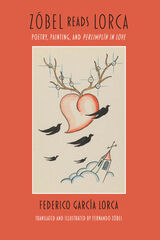
Painting, poetry, and music come together in Zóbel Reads Lorca, as Fernando Zóbel, a Harvard student who would become one of Spain’s most famous painters, translates and illustrates Federico García Lorca’s haunting play about the wounds of love.
The premiere of Amor de Don Perlimplín con Belisa en su jardín, an “erotic allelujia” which Lorca once called his most cherished play, was shut down in 1928 by Spanish government censors who confiscated the manuscript and locked it away in the pornography section of a state archive. Lorca rewrote the work in New York, and an amateur theater group brought it to the Spanish stage a few years later. Since his death, the play has also been transformed into ballet and opera.
Zóbel Reads Lorca presents Zóbel’s previously unpublished translation and features contextual essays from several scholars. Art historian Felipe Pereda studies Lorca in the context of Zóbel’s development as a painter, Luis Fernández Cifuentes describes the precarious and much-debated state of the humanities in Zóbel’s Harvard and throughout the United States in the 1940s, and Christopher Maurer delves into musical and visual aspects of the play’s American productions.
READERS
Browse our collection.
PUBLISHERS
See BiblioVault's publisher services.
STUDENT SERVICES
Files for college accessibility offices.
RECENTLY PUBLISHED


UChicago Accessibility Resources
home | accessibility | search | about | contact us
BiblioVault ® 2001 - 2025
The University of Chicago Press