
 A SCHOLARLY BOOK REPOSITORY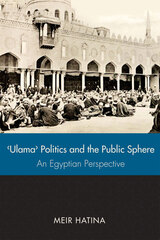
The status of the Sunni Ulama (religious scholars) in modern times has attracted renewed academic interest, in light of their assertiveness regarding moral and sociopolitical issues on the Arab-Muslim agenda. This has led to a reassessment of the narrative of historians and social scientists, who usually depicted the Ulama as marginal players in comparison with the new lay Islamists, and certainly with the Shia Ulama. The Sunni 'Ulama'’s vitality is undoubtedly related to the continuing Islamic resurgence, which since the 1970s has forced the political elites to rely increasingly on the religious establishment in order to neutralize the Islamist challenge, thus allowing the Ulama greater freedom of activity.
Hatina’s study returns to an earlier period and shows that such vitality has its roots in the second half of the nineteenth and the early twentieth centuries. Hatina traces the diverse Ulama reactions to this period of accelerated state building and national cohesion.
Anthropologists have a long tradition of prescient diagnoses of world events. Possessing a knowledge of culture, society, and history not always shared by the media's talking heads, anthropologists have played a crucial role in educating the general reader on the public debates from World War I to the second Gulf War.
This anthology collects over fifty commentaries by noted anthropologists such as Margaret Mead, Franz Boas, and Marshall Sahlins who seek to understand and explain the profound repercussions of U.S. involvement in the Middle East, Asia, Africa, and Latin America. Frequently drawing on their own fieldwork, the anthropologists go beyond the headlines to draw connections between indigenous cultures, corporate globalization, and contemporary political and economic crises. Venues range from the op-ed pages of internationally renowned newspapers such as the New York Times and the Washington Post to magazine articles and television interviews. Special sections entitled "Prelude to September 11" and "Anthropological Interpretations of September 11" include articles that provided many Americans with their first substantial introduction to the history of Islam, Central Asia, and the Middle East. Each article includes a brief introduction contextualizing the commentary.
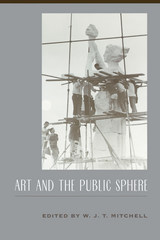
With contributions from the arts, philosophy, criticism, and the law, the thirteen essays in this volume explore the aesthetic, social, and political dynamics that make contemporary public art so controversial, and that that have placed recent art work at the center of public debates.
Contributors include Vito Acconci, "Public Space in a Private Time"; Agnes Denes, "The Dream"; W. J. T. Mitchell, "The Violence of Public Art: Do the Right Thing"; Ben Nicholson, "Urban Poises"; Michael North, "The Public as Sculpture: From Heavenly City to Mass Ornament"; Barbara Kruger, in an interview with W. J. T. Mitchell; Barbara Hoffman, "Law for Art's Sake in the Public Realm"; Richard Serra, "Art and Censorship"; James E. Young, "The Counter-Monument: Memory Against Itself in Germany Today": Charles Griswold, "The Vietnam Veterans Memorial and the Washington Mall: Philosophical Thoughts on Political Iconography"; John Hallmark Neff, "Daring to Dream"; and David Antin and Virginia Maksymowicz.
Presenting a balance of theoretical and performative essays by both critics and artists, this book will provide deep and discordant analyses of contemporary public art for general readers, as well as students and scholars of art, architecture, and public policy related to the arts.
Most of these articles originally appeared in the journal Critical Inquiry.

Articulating Dissent analyses the new communicative strategies of coalition protest movements and how these impact on a mainstream media unaccustomed to fractured articulations of dissent.
Pollyanna Ruiz shows how coalition protest movements against austerity, war and globalisation build upon the communicative strategies of older single issue campaigns such as the anti-criminal justice bill protests and the women’s peace movement. She argues that such protest groups are dismissed in the mainstream for not articulating a ‘unified position’ and explores the way in which contemporary protesters stemming from different traditions maintain solidarity.
Articulating Dissent investigates the ways in which this diversity, so inherent in coalition protest, affects the movement of ideas from the political margins to the mainstream. In doing so this book offers an insightful and original analysis of the protest coalition as a developing political form.

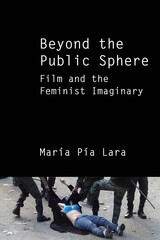
In Beyond the Public Sphere: Film and the Feminist Imaginary, the renowned philosopher and critical theorist María Pía Lara challenges the notion that the bourgeois public sphere is the most important informal institution between social and political actors and the state.
Drawing on a wide range of films—including The Milk of Sorrow, Ixcanul, Wadja, The Stone of Patience, Marnie, A Streetcar Named Desire, and Talk to Her—Lara dissects cinematic images of women’s struggles and their oppression. She builds on this analysis, developing a concept of the feminist social imaginary as a broader and more complex space that provides a way of thinking through the possibilities for emancipatory social transformation in response to forms of domination perpetuated by patriarchal capitalism.

Allen utilizes historical, philosophical, sociological, and legal sources to trace America's gradual embrace of corporate values. He argues that such values, including winning, efficiency, and profitability actually limit democratic involvement by devaluing discursive principles, creating an informed yet inactive public. Through an examination of professionalization in both the press and the law, corporate free speech rights, and free speech as property, Democracy, Inc. demonstrates that today's democracy is more about trying to control and manage citizens than giving them the freedom to participate. Allen not only calls on institutions to reform the way they understand and promote citizenship but also asks citizens to adopt a new ethic of public discourse that values understanding rather than winning.
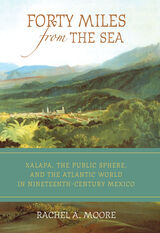
Over the course of the nineteenth century, despite its inland location, Xalapa became an important Atlantic community as it came to represent both a haven and a place of fortification for residents of Veracruz. Yellow fever, foreign invasion, and domestic discord drove thousands of residents of Veracruz, as well as foreign travelers, to seek refuge in Xalapa. At the same time, these adverse circumstances prompted the Mexican government to use Xalapa as a bulwark against threats originating in the Atlantic.
The influence of the Atlantic world thus stretched far into central Mexico, thanks to both the instability of the coastal region and the desire of government officials to “protect” central Mexico from volatile Atlantic imports. The boundaries established at Xalapa, however, encouraged goods, information, and people to collect in the city and thereby immerse the population in the developments of the Atlantic sphere. Thus, in seeking to protect the center of the country, government authorities more firmly situated Xalapa in the Atlantic world. This connection would be trumped by national affiliation only when native residents of Xalapa became more comfortable with their participation in the Mexican public sphere later in the nineteenth century.
The interdisciplinary and comparative nature of this study will make it appeal to those studying Atlantic history, including historians of Britain, the United States, Latin America, and Africa, as well as those studying communication, print culture, and postal history more broadly.
Girls in gangs are usually treated as objects of public criticism and rejection. Seldom are they viewed as objects worthy of understanding and even more rarely are they allowed to be active subjects who craft their own public persona—which is what makes this work unique. In this book, Marie "Keta" Miranda presents the results of an ethnographic collaboration with Chicana gang members, in which they contest popular and academic representations of Chicana/o youth and also construct their own narratives of self identity through a documentary film, It's a Homie Thang!
In telling the story of her research in the Fruitvale community of Oakland, California, Miranda honestly reveals how even a sympathetic ethnographer from the same ethnic group can objectify the subjects of her study. She recounts how her project evolved into a study of representation and its effects in the public sphere as the young women spoke out about how public images of their lives rarely come close to the reality. As Miranda describes how she listened to the gang members and collaborated in the production of their documentary, she sheds new light on the politics of representation and ethnography, on how inner city adolescent Chicanas present themselves to various publics, and on how Chicana gangs actually function.
For Habermas, the 'public sphere' was a social forum that allowed people to debate -- whether it was the town hall or the coffee house, maintaining a space for public debate was an essential part of democracy. Habermas’s controversial work examines the erosion of these spaces within consumer society and calls for new thinking about democracy today.
Drawing on Habermas’s early and more recent writings, this book examines the ‘public sphere’ in its full complexity, outlining its relevance to today’s media and culture. It will be of interest to students and scholars in a range of disciplines across the social sciences and humanities.

Moving student writing beyond academic discourse and into larger public spheres is a difficult task, but Christian R. Weisser’s study challenges composition instructors to do just that. This highly accessible book does what no other study has attempted to do: place the most current, cutting-edge theories and pedagogies in rhetoric and composition in their intellectual and historical contexts, while at the same time offering a unique, practical theory and pedagogy of public writing for use both inside and outside of the classroom.
By positing a theory of the public for composition studies, one which envisions the public sphere as a highly contested, historically textured, multilayered, and sometimes contradictory site, Weisser offers a new approach to the roles that compositionists might assume in their attempts to initiate progressive political and social change.
After first providing a historical context that situates composition’s recent interest in public writing, Weisser next examines recent theories in composition studies that consider writing an act of social engagement before outlining a more complex theory of the public based on the work of Jürgen Habermas. The resulting re-envisioning of the public sphere expands current conversations in rhetoric and composition concerning the public.
Weisser concludes with a holistic vision that places greater political and social import on addressing public issues and conversations in the composition classroom and that elucidates the role of the public intellectual as it relates specifically to compositionists in postmodern society.
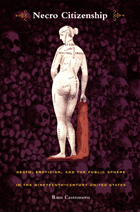
Moving from medical engravings, séances, and clairvoyant communication to Supreme Court decisions, popular literature, and physiological tracts, Necro Citizenship explores how rituals of inclusion and belonging have generated alienation and dispossession. Castronovo contends that citizenship does violence to bodies, especially those of blacks, women, and workers. “Necro ideology,” he argues, supplied citizens with the means to think about slavery, economic powerlessness, or social injustice as eternal questions, beyond the scope of politics or critique. By obsessing on sleepwalkers, drowned women, and other corpses, necro ideology fostered a collective demand for an abstract even antidemocratic sense of freedom. Examining issues involving the occult, white sexuality, ghosts, and suicide in conjunction with readings of Harriet Jacobs, Ralph Waldo Emerson, Frederick Douglass, Nathaniel Hawthorne, and Frances Harper, Necro Citizenship successfully demonstrates why Patrick Henry's “give me liberty or give me death” has resonated so strongly in the American imagination.
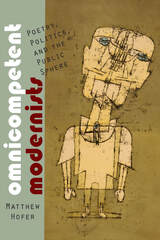
“It is difficult / to get the news from poems / yet men die miserably every day / for lack / of what is found there,” as the poet William Carlos Williams memorably declared. In Omnicompetent Modernists: Poetry, Politics, and the Public Sphere, Matthew Hofer examines, through a multilayered literary critique of interwar modernist poetry, what it might mean to get the news, and more, from a poet.
Using pragmatist ideas about the public sphere as a tool, Hofer reveals how Langston Hughes, Ezra Pound, and Mina Loy sought to use literature to both express and enable thought. In Hughes, Pound, and Loy, Hofer attends to poets whose work vigorously imagined possible new relationships between language, thinking, and public society. Each poet had different goals and used different methods, but all found both inspiration and encouragement in popular political theory. Hughes advocated for a more just vision of color and class in the United States. Pound sought to condemn those whom he associated with public harm, linguistically, socially, economically, and politically. Loy championed the “psycho-democratic” representation of women, in both public and private life.
Although Hughes, Pound, and Loy are rarely considered together, what unites these three writers is how each reconceived the public realm, and revolutionized aesthetic form to articulate those visions. Hofer combines sharp intellectual historiography with rigorous literary criticism and the result is a study that reinvigorates both the poems and poets under consideration and speaks to the immense power of language in manipulating public opinion—with pertinent implications for the politics of the present.

Arguing that the environmental movement has the potential to contribute to contemporary developments in political theory and social action by changing discursive practices both at the grassroots level and along the corridors of power, Torgerson draws on the theories of Hannah Arendt and others to advocate a performative type of political debate that values multiple opinions and is not always oriented toward reaching a single conclusion. Torgerson argues that in a world stuck in administrative and scientific gridlock, the theatrical, comic aspects of green politics are as important as other, more goal-oriented, aspects. Gestures of the carnivalesque—such as protestors sleeping in hammocks slung from trees targeted for destruction or funeral processions held for dying rivers—could be the key to the creation of what Torgerson refers to as a “green public sphere,” one that promises a reconfiguration of the relationship between human creativity and the natural world. While offering a number of concrete policy suggestions, his focus remains on the complexity and heterogeneity of green thinking and on the transformative promise implicit in green politics. In creating new ways to speak about the environment, Torgerson argues, the green movement offers a creative way to reconsider many larger issues of political theory and action.
The Promise of Green Politics will serve as a gateway to new thinking about green politics and the emerging possibilities of a diverse and vital green public sphere. As such, it will be valued by those interested in environmental and public policy, political theory, social activism, and the future of political action.
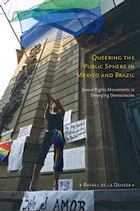
De la Dehesa studied the archives of activists, social-movement organizations, political parties, religious institutions, legislatures, and state agencies, and he interviewed hundreds of individuals, not only LGBT activists, but also feminists, AIDS and human-rights activists, party militants, journalists, academics, and state officials. He marshals his prodigious research to reveal the interplay between evolving representative institutions and LGBT activists’ entry into the political public sphere in Latin America, offering a critical analysis of the possibilities opened by emerging democratic arrangements, as well as their limitations. At the same time, exploring activists’ engagement with the international arena, he offers new insights into the diffusion and expression of transnational norms inscribing sexual rights within a broader project of liberal modernity. Queering the Public Sphere in Mexico and Brazil is a landmark examination of LGBT political mobilization.
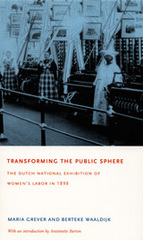
A comprehensive social history, Transforming the Public Sphere describes the planning and construction of the Exhibition of Women’s Labor and the event itself—the sights, the sounds, and the smells—as well as the role of exhibitions in late-nineteenth-century public culture. The authors discuss how the 1898 exhibition displayed the range and variety of women’s economic, intellectual, and artistic roles in Dutch culture, including their participation in such traditionally male professions as engineering, diamond-cutting, and printing and publishing. They examine how people and goods from the Dutch colonies were represented, most notably in an extensive open-air replica of a “Javanese village.” Grever and Waaldijk reveal the tensions the exhibition highlighted: between women of different economic classes; between the goal of equal rights for women and the display of imperial subjects and spoils; and between socialists and feminists, who competed fiercely with one another for working women’s support. Transforming the Public Sphere explores an event that served as the dress rehearsal for advances in women’s public participation during the twentieth century.

The most complete survey to date of the vibrant strands of this music and its colorful practitioners, Mountains of Music delineates a unique culture where music and music making are part of an ancient and treasured heritage. The sly humor, strong faith, clear regional identity, and musical convictions of these performers draw the reader into families and communities bound by music from one generation to another. For devotees as well as newcomers to this infectiously joyous and heartfelt music, Mountains of Music captures the strength of tradition and the spontaneous power of living artistry.
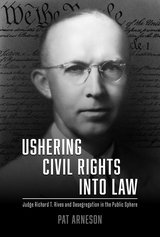
Illuminates the life and legacy of a federal jurist from Alabama, an unexpected but ardent defender of equal rights for all citizens under the law
Ushering Civil Rights into Law: Judge Richard T. Rives and Desegregation in the Public Sphere by Pat Arneson is a long-overdue exploration of one of the most consequential yet overlooked figures of the modern Civil Rights Movement. As debates over judicial philosophy and Civil Rights continue, Judge Richard T. Rives’s story serves as a powerful reminder of the judiciary’s role in shaping a more just society.
A native of Montgomery, Alabama, Judge Richard T. Rives served on the US Court of Appeals for the Fifth Circuit during the height of America’s battle over racial segregation. Once aligned with segregationist views, Rives underwent a profound evolution, emerging as a key legal architect of desegregation. His landmark ruling on behalf of the court in Browder v. Gayle ended segregation on Montgomery’s public buses and expanded the scope of Brown v. Board of Education beyond education. Rives’s decisions invalidated the legal underpinnings of Jim Crow laws and furthered equality in public education, voting rights, and jury selection. Writing for the court, Rives authored legal precedents that fundamentally reshaped the nation.
Through archival research, Arneson examines the cultural and political pressures Rives faced, the legal strategies he employed, and the lasting impact of his work. Constitutional rights remain a flashpoint in American discourse. Ushering Civil Rights into Law reveals how one judge’s principled stance helped define the legal landscape of modern Civil Rights and underscores the enduring significance of his legacy.
Examining the role of eroticism in citizenship and why only normalizing
constructions of homosexuality enable inclusion, Clarke reconsiders the work of Habermas and Foucault in relation to contemporary visibility politics, Kant’s moral and political theory, Marx’s analysis of value, and the sexualized dynamics of the Victorian cultural public sphere. The juxtaposition of Habermas with Foucault reveals the surprising value of reading the former in the context of queer politics and the usefulness of the theory of the public sphere for understanding contemporary identity politics and the visibility politics of the 1990s. Examining how a host of nonsexual factors impinge historically upon the constitution of sexual identities and practices, Clarke negotiates the relation between questions of publicity and categories of value. Discussions of television sitcoms (such as Ellen), marketing techniques, authenticity, and literary culture add to this daring analysis of visibility politics.
As a critique of the claim that equal representation of gays and lesbians necessarily constitutes progress, this significant intervention into social theory will find enthusiastic readers in the fields of Victorian, cultural, literary, and gay and lesbian studies, as well as other fields engaged with categories of identity.
READERS
Browse our collection.
PUBLISHERS
See BiblioVault's publisher services.
STUDENT SERVICES
Files for college accessibility offices.
RECENTLY PUBLISHED






UChicago Accessibility Resources
home | accessibility | search | about | contact us
BiblioVault ® 2001 - 2025
The University of Chicago Press