
 A SCHOLARLY BOOK REPOSITORY
Must the sins of America's past poison its hope for the future? Lately the American Left, withdrawing into the ivied halls of academe to rue the nation's shame, has answered yes in both word and deed. In Achieving Our Country, one of America's foremost philosophers challenges this lost generation of the Left to understand the role it might play in the great tradition of democratic intellectual labor that started with writers like Walt Whitman and John Dewey.
How have national pride and American patriotism come to seem an endorsement of atrocities--from slavery to the slaughter of Native Americans, from the rape of ancient forests to the Vietnam War? Achieving Our Country traces the sources of this debilitating mentality of shame in the Left, as well as the harm it does to its proponents and to the country. At the center of this history is the conflict between the Old Left and the New that arose during the Vietnam War era. Richard Rorty describes how the paradoxical victory of the antiwar movement, ushering in the Nixon years, encouraged a disillusioned generation of intellectuals to pursue "High Theory" at the expense of considering the place of ideas in our common life. In this turn to theory, Rorty sees a retreat from the secularism and pragmatism championed by Dewey and Whitman, and he decries the tendency of the heirs of the New Left to theorize about the United States from a distance instead of participating in the civic work of shaping our national future.
In the absence of a vibrant, active Left, the views of intellectuals on the American Right have come to dominate the public sphere. This galvanizing book, adapted from Rorty's Massey Lectures of 1997, takes the first step toward redressing the imbalance in American cultural life by rallying those on the Left to the civic engagement and inspiration needed for "achieving our country."

The bombing of the federal building in Oklahoma City, the emergence of militias and skinheads, the rise of the religious right, the attacks on Planned Parenthood clinics, the backlash against equal rights movements, the increase in poverty...these, according to Bob Altemeyer, are all versions of one story--the authoritarian personality in action. But aren't authoritarians Nazi types, kooks, the Klan? These are just the extreme examples, he argues. The Authoritarian Specter shows that many ordinary people today are psychologically disposed to embrace antidemocratic, fascist policies.
The book presents the latest results from a prize-winning research program on the authoritarian personality--a victory for the scientific method in the struggle to understand the worst aspects of ourselves. It connects for the first time the many ways authoritarianism undermines democracy. Many of our biggest problems, seemingly unrelated, have authoritarian roots. The scientific studies demonstrating this are extensive and thorough; their powerful findings are presented in a conversational, clear manner that engages readers from all backgrounds.
This is an important, timely work. It explains a growing movement to submit to a "man on horseback," to attack those who are different, to march in lockstep. Altemeyer reveals that these sentiments are strongly held even by many American lawmakers. These discoveries deserve careful attention in a presidential election year.
Christina Xydias shows that some right-leaning parties advocate for women’s rights and interests, while left- and right-leaning parties can be equally indifferent to lack of representation for women from marginalized groups. These findings follow from analyses of election results, transcripts from debates and speeches, and personal interviews, as well as from a close reading of intertwined military and citizenship policies that illustrate how women’s and ethnic minority groups’ rights are constructed.
Beyond Left, Right, and Center concludes with an analysis of women’s representation across OECD countries, showing that right-leaning parties are more likely to support women’s rights and interests in societies that are more egalitarian.
Economic inequality continues to be one of America’s most hotly debated topics. Still, there has been relatively little discussion of the fact that black-white gaps in joblessness, income, poverty and other measures were shrinking before the pandemic. Why was it happening, and why did this phenomenon go unacknowledged by so much media?
In The Black Boom, Jason L. Riley—acclaimed Wall Street Journal columnist and senior fellow at the Manhattan Institute—digs into the data and concludes that the economic lives of black people improved significantly under policies put into place during the Trump administration. To acknowledge as much is not to endorse the 45th president but to champion policies that achieve a clear moral objective shared by most Americans.
Riley argues that before the Covid-19 pandemic of 2020, the economic fortunes of blacks improved under Trump to an extent unseen under Obama and unseen going back several generations. Black unemployment and poverty reached historic lows, and black wages increased faster than white wages.
Less inequality is something that everyone wants, but disapproval of Trump’s personality and methods too often skewed the media’s appraisal of effective policies advocated by his administration. If we're going to make real progress in improving the lives of low-income minorities, says Riley, we must look beyond our partisan differences at what works and keep doing it. Unfortunately, many press outlets were unable or unwilling to do that.
Riley notes that political reporters were not unaware of this data. Instead, they chose to ignore or downplay it because it was inconvenient. In their view, Trump, because he was a Republican and because he was Trump, had it in for blacks, and thus his policy preferences would be harmful to minorities. To highlight that significant racial disparities were narrowing on his watch—that the administration’s tax and regulatory reforms were mainly boosting the working and middle classes rather than ‘the rich’—would have undermined a narrative that the media preferred to advance, regardless of its veracity.”
As with previous books in our New Threats to Freedom series, The Black Boom includes two essays from prominent experts who take issue with the author’s perspective. Juan Williams, a veteran journalist, and Wilfred Reilly, a political scientist, contribute thoughtful responses to Riley and show that it is possible to share a deep concern for disadvantaged groups while disagreeing on how best to help them.
The radical black left that played a crucial role in twentieth-century struggles for equality and justice has largely disappeared. Michael Dawson investigates the causes and consequences of the decline of black radicalism as a force in American politics and argues that the conventional left has failed to take race sufficiently seriously as a historical force in reshaping American institutions, politics, and civil society.
African Americans have been in the vanguard of progressive social movements throughout American history, but they have been written out of many histories of social liberalism. Focusing on the 1920s and 1930s, as well as the Black Power movement, Dawson examines successive failures of socialists and Marxists to enlist sympathetic blacks, and white leftists’ refusal to fight for the cause of racial equality. Angered by the often outright hostility of the Socialist Party and similar social democratic organizations, black leftists separated themselves from these groups and either turned to the hard left or stayed independent. A generation later, the same phenomenon helped fueled the Black Power movement’s turn toward a variety of black nationalist, Maoist, and other radical political groups.
The 2008 election of Barack Obama notwithstanding, many African Americans still believe they will not realize the fruits of American prosperity any time soon. This pervasive discontent, Dawson suggests, must be mobilized within the black community into active opposition to the social and economic status quo. Black politics needs to find its way back to its radical roots as a vital component of new American progressive movements.

Written with verve over a period of twenty years, these essays—most translated into English here for the first time—suggest why Bartra has become one of Latin America’s leading public intellectuals. The essays cover a broad range of topics, from the canonical forms of Mexican culture to the meaning of postnational identity in a globalizing age, from the repercussions of the 1994 Zapatista uprising to the 2000 election of Vicente Fox and the end of the PRI’s seven-decade rule. Across this range of topics, Bartra imparts astute insights into a critical period of transition in Mexican history, stressing throughout the importance of democracy, the complexity of identity, and the vibrancy of the Left. In Blood, Ink, and Culture, he provides a stimulating inside look at political and intellectual life in the southern reaches of North America.
The past six years have been marked by a contentious political atmosphere that has touched every arena of public life, including higher education. Though most college campuses are considered ideologically progressive, how can it be that the right has been so successful in mobilizing young people even in these environments?
As Amy J. Binder and Jeffrey L. Kidder show in this surprising analysis of the relationship between political activism on college campuses and the broader US political landscape, while liberal students often outnumber conservatives on college campuses, liberal campus organizing remains removed from national institutions that effectively engage students after graduation. And though they are usually in the minority, conservative student groups have strong ties to national right-leaning organizations, which provide funds and expertise, as well as job opportunities and avenues for involvement after graduation. Though the left is more prominent on campus, the right has built a much more effective system for mobilizing ongoing engagement. What’s more, the conservative college ecosystem has worked to increase the number of political provocations on campus and lower the public’s trust in higher education.
In analyzing collegiate activism from the left, right, and center, The Channels of Student Activism shows exactly how politically engaged college students are channeled into two distinct forms of mobilization and why that has profound consequences for the future of American politics.

One of the most maligned, misunderstood, and even mocked constituencies in American politics, gay Republicans regularly face condemnation from both the LGBTQ+ community and their own political party. Yet they’ve been active and influential for decades. Gay conservatives were instrumental, for example, in ending “Don’t Ask, Don’t Tell” and securing the legalization of same-sex marriage—but they also helped lay the groundwork for the rise of Donald Trump.
In Coming Out Republican, political historian and commentator Neil J. Young provides the first comprehensive history of the gay Right. From the 1950s up to the present day, Young excavates the multifarious origins, motivations, and evolutions of LGBTQ+ people who found their way to the institutions and networks of modern conservatism. Many on the gay Right have championed conservative values—like free markets, a strong national defense, and individual liberty—and believed that the Republican Party therefore offered LGBTQ+ people the best pathway to freedom. Meanwhile, that same party has actively and repeatedly demonized them. With his precise and provocative voice, Young details the complicated dynamics of being in—and yet never fully accepted into—the Republican Party.
Coming Out Republican provides striking insight into who LGBTQ+ conservatives are, what they want, and why many of them continue to align with a party whose rank and file largely seem to hate them. As the Republican Party renews its assaults on LGBTQ+ rights, understanding the significant history of the gay Right has never been more critical.
The Conservative Turn tells the story of postwar America’s political evolution through two fascinating figures: Lionel Trilling and Whittaker Chambers. Born at the turn of the twentieth century, they were college classmates who went on to intellectual prominence, sharing the questions, crises, and challenges of their generation.
A spy for the Soviet Union in the 1930s, Chambers became the main witness in the 1948 trial of Alger Hiss, which ended in Hiss’s conviction for perjury. The trial advanced the careers of Richard Nixon and Joseph McCarthy and marked the beginning of the Cold War mood in America. Chambers was also a major conservative thinker, a theorist of the postwar conservative movement.
Meanwhile, in the 1940s and 1950s, the literary critic Trilling wrote important essays that encouraged liberals to disown their radical past and to embrace a balanced maturity. Trilling’s liberal anti-communism was highly influential, culminating politically in the presidency of John F. Kennedy.
Kimmage argues that the divergent careers of these two men exemplify important developments in postwar American politics: the emergence of modern conservatism and the rise of moderate liberalism, crucially shaped by anti-communism. Taken together, these developments constitute a conservative turn in American political and intellectual life—a turn that continues to shape America’s political landscape.

Limited to neither a single discipline nor a particular intellectual figure, this book comprehensively views British cultural Marxism in terms of the dialogue between historians and the originators of cultural studies and in its relationship to the new left and feminist movements. From the contributions of Eric Hobsbawm, Christopher Hill, Rodney Hilton, Sheila Rowbotham, Catherine Hall, and E. P. Thompson to those of Perry Anderson, Barbara Taylor, Raymond Williams, Dick Hebdige, and Stuart Hall, Dworkin examines the debates over issues of culture and society, structure and agency, experience and ideology, and theory and practice. The rise, demise, and reorganization of journals such as The Reasoner, The New Reasoner, Universities and Left Review, New Left Review, Past and Present, are also part of the history told in this volume. In every instance, the focus of Dworkin’s attention is the intellectual work seen in its political context. Cultural Marxism in Postwar Britain captures the excitement and commitment that more than one generation of historians, literary critics, art historians, philosophers, and cultural theorists have felt about an unorthodox and critical tradition of Marxist theory.
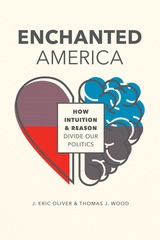
The answer, according to J. Eric Oliver and Thomas J. Wood, can be found in the most important force shaping American politics today: human intuition. Much of what seems to be irrational in American politics arises from the growing divide in how its citizens make sense of the world. On one side are rationalists. They use science and reason to understand reality. On the other side are intuitionists. They rely on gut feelings and instincts as their guide to the world. Intuitionists believe in ghosts and End Times prophecies. They embrace conspiracy theories, disbelieve experts, and distrust the media. They are stridently nationalistic and deeply authoritarian in their outlook. And they are the most enthusiastic supporters of Donald Trump. The primary reason why Trump captured the presidency was that he spoke about politics in a way that resonated with how Intuitionists perceive the world. The Intuitionist divide has also become a threat to the American way of life. A generation ago, intuitionists were dispersed across the political spectrum, when most Americans believed in both God and science. Today, intuitionism is ideologically tilted toward the political right. Modern conservatism has become an Intuitionist movement, defined by conspiracy theories, strident nationalism, and hostility to basic civic norms.
Enchanted America is a clarion call to rationalists of all political persuasions to reach beyond the minority and speak to intuitionists in a way they understand. The values and principles that define American democracy are at stake.
Is today’s left really new? How has the European radical left evolved?
Giorgos Charalambous answers these questions by looking at three moments of rapid political change - the late 1960s to late 1970s; the turn of the millennium; and post-2008. He challenges the conventional understanding of a ‘new left’, drawing out continuities with earlier movements and parties.
Charalambous examines the ‘Long ‘68’, symbolised by the May uprisings in France, which saw the rise of new left forces and the widespread criticism by younger radical activists of traditional communist and socialist parties. He puts this side by side with the turn of the millennium when the Global Justice Movement rose to prominence and changed the face of the international left, and also the period after the financial crash of 2008 and the rise of anti-austerity politics which initiated the most recent wave of new left parties such as Podemos in Spain and Syriza in Greece.
With a unique ‘two-level’ perspective, Charalambous approaches the left through both social movements and party politics, looking at identities, rhetoric and organization, and bringing a fresh new approach to radical history, as well as assessing challenges for both activists and scholars.
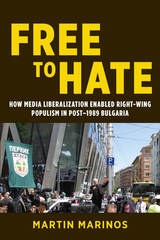
Bulgaria’s media-driven pivot to right-wing populism parallels political developments taking place around the world. Martin Marinos applies a critical political economy approach to place Bulgarian right-wing populism within the structural transformation of the country’s media institutions. As Marinos shows, media concentration under Western giants like Westdeutsche Allgemeine Zeitung and News Corporation have led to a neoliberal turn of commercialization, concentration, and tabloidization across media. The Right have used the anticommunism and racism bred by this environment to not only undermine traditional media but position their own outlets to boost new political entities like the nationalist party Ataka. Marinos’s ethnographic observations and interviews with local journalists, politicians, and media experts add on-the-ground detail to his account. He also examines several related issues, including the performative appeal of populist media and the money behind it.
A timely and innovative analysis, Free to Hate reveals where structural changes in media intersect with right-wing populism.

This is a history of political ideologies during the period famously described by Eric Hobsbawn as ‘The Age of Extremes’ - from the First World War to the collapse of the Soviet Union.
Ideologies in the Age of Extremes introduces the key ideologies of the age; liberalism, conservatism, communism and fascism. Willie Thompson identifies the political influence of mass movements as a key feature. He uses a powerful approach that considers the different ideologies in relation to each other. This allows him to shows that they often emerged from a common root or merged into a common future, stealing each other’s clothes and reinventing themselves as the stark opposite of a competing ideology.
This sophisticated yet accessible analysis will be of great interest to students of 20th century history and political theory.

". . . proof that the spirit of the free-ranging public intellectual is still very much alive."
-Newsday
"Alan Wolfe is one of liberalism's last and most loyal sons. His mind is naturally decent and diversified; large enough and fair enough to contain both conviction and doubt. His profound respect for real people does not interfere with his profound respect for real thought. The criticism that he practices is, I fear, a dying art, but it is also one of the glories of American democracy."
-Leon Wieseltier, New Republic
"Alan Wolfe is one of America's indispensable essayists. On a broad range of topics-race, religion, politics, the marketplace, the university, and more-he combines a scholar's erudition with a historian's feel for the past and a journalist's keen attunement to the shifting patterns of the current scene. Above all he is a true writer, graceful but fearless, who ponders the deep questions so often ignored in the clamor of our ongoing civic conversation. Anyone who wonders what the term 'public intellectual' really means will find the answer-in fact many answers-in this scintillating collection."
-Sam Tanenhaus, Vanity Fair

Raffaella A. Del Sarto examines the creation of Israel's neo-revisionist consensus about security threats and regional order, which took hold of Israeli politics and society after 2000 and persists today. The failed Oslo peace process and the trauma of the Second Palestinian Intifada triggered this shift to the right; conflicts with Hamas and Hezbollah and the inflammatory rhetoric of Iranian President Ahmadinejad additionally contributed to the creation of a general sense of being under siege. While Israel faces real security threats, Israeli governments have engaged in the politics of insecurity, promoting and amplifying a sense of besiegement. Lively political debate has been replaced by a general acceptance of the no-compromise approach to security and the Palestinians. The neo-revisionist right, represented by Benjamin Netanyahu and the Likud, has turned Israel away from the peace process and pushes maximalist territorial ambitions. But they have failed to offer a vision for an end to conflict, and there has been little debate about whether or not the hardline policies toward the region are counterproductive. Del Sarto explains this disappearance of dissent and examines the costs of Israel’s policies. She concludes that Israel’s feeling of being under siege has become entrenched, a two-state solution with the Palestinians is highly unlikely for the foreseeable future, and Israel’s international isolation is likely to increase. Del Sarto’s analysis of this tense political situation will interest scholars and students of the Israeli-Palestinian conflict, Middle East Studies, and International Relations.

Published with support from the Koret Jewish Studies Program
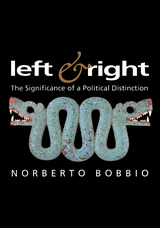
Bobbio argues that left and right are not absolute terms, but represent a shifting map of the political spectrum, relative to the particular cultural and historical contexts of a given time. The distinction continues to endure because it reflects the essentially antithetical nature and dynamics of democratic politics. In his accessible yet provocative style, Bobbio constructs a historically informed, analytic division of the political universe along two foundational axes, from equality to inequality, from liberty to authoritarianism. He then charts the past and present tendencies of the left and the right, in both their more moderate and more virulently extreme forms. Ultimately, for Bobbio, the measure of post-modern democracy will indeed lie in where and how we situate ourselves relative to these critical left/right parameters, in whether we cast ourselves, our votes, and our era in terms of political expediency, social viability, or moral responsibility.
A bestseller in Italy, where it sold over three hundred thousand copies, Left and Right is an important contribution to our understanding of global political developments in the 1990s and beyond.
Left-leaning political parties play an important role as representatives of the poor and disempowered. They once did so by promising protections from the forces of capital and the market’s tendencies to produce inequality. But in the 1990s they gave up on protection, asking voters to adapt to a market-driven world. Meanwhile, new, extreme parties began to promise economic protections of their own—albeit in an angry, anti-immigrant tone.
To better understand today’s strange new political world, Stephanie L. Mudge’s Leftism Reinvented analyzes the history of the Swedish and German Social Democrats, the British Labour Party, and the American Democratic Party. Breaking with an assumption that parties simply respond to forces beyond their control, Mudge argues that left parties’ changing promises expressed the worldviews of different kinds of experts. To understand how left parties speak, we have to understand the people who speak for them.
Leftism Reinvented shows how Keynesian economists came to speak for left parties by the early 1960s. These economists saw their task in terms of discretionary, politically-sensitive economic management. But in the 1980s a new kind of economist, who viewed the advancement of markets as left parties’ main task, came to the fore. Meanwhile, as voters’ loyalties to left parties waned, professional strategists were called upon to “spin” party messages. Ultimately, left parties undermined themselves, leaving a representative vacuum in their wake. Leftism Reinvented raises new questions about the roles and responsibilities of left parties—and their experts—in politics today.
How did liberalism, the great political tradition that from the New Deal to the 1960s seemed to dominate American politics, fall from favor so far and so fast? In this history of liberalism since the 1930s, a distinguished historian offers an eloquent account of postwar liberalism, where it came from, where it has gone, and why. The book supplies a crucial chapter in the history of twentieth-century American politics as well as a valuable and clear perspective on the state of our nation's politics today.
Liberalism and Its Discontents moves from a penetrating interpretation of Franklin D. Roosevelt and the New Deal to an analysis of the profound and frequently corrosive economic, social, and cultural changes that have undermined the liberal tradition. The book moves beyond an examination of the internal weaknesses of liberalism and the broad social and economic forces it faced to consider the role of alternative political traditions in liberalism's downfall. What emerges is a picture of a dominant political tradition far less uniform and stable--and far more complex and contested--than has been argued. The author offers as well a masterly assessment of how some of the leading historians of the postwar era explained (or failed to explain) liberalism and other political ideologies in the last half-century. He also makes clear how historical interpretation was itself a reflection of liberal assumptions that began to collapse more quickly and completely than almost any scholar could have imagined a generation ago. As both political history and a critique of that history, Liberalism and Its Discontents, based on extraordinary essays written over the last decade, leads to a new understanding of the shaping of modern America.

If Breivik did indeed act alone, he wouldn't be the first. Timothy McVeigh bombed a federal building in Oklahoma City based essentially on his own motivations. Eric Robert Rudolph embarked on a campaign of terror over several years, including the Centennial Park bombing at the 1996 Olympics. Ted Kaczynski was revealed to be the Unabomber that same year. And these are only the most notable examples. As George Michael demonstrates in Lone Wolf Terror and the Rise of Leaderless Resistance, they are not isolated cases. Rather, they represent the new way warfare will be conducted in the twenty-first century.
Lone Wolf Terror investigates the motivations of numerous political and ideological elements, such as right-wing individuals, ecoextremists, foreign jihadists, and even quasi-governmental entities. In all these cases, those carrying out destructive acts operate as "lone wolves" and small cells, with little or no connection to formal organizations. Ultimately, Michael suggests that leaderless resistance has become the most common tactical approach of political terrorists in the West and elsewhere.

Judy Kutulas takes us into the debates and outright fights between and within the ranks of organizations such as the League of American Writers, the John Reed Clubs, the Committee for Cultural Freedom, the American Civil Liberties Union, and the National Committee for the Defense of Political Prisoners. Showing how extremist views about the nature and value of communism triumphed over more moderate ones, she traces the transfer of the left’s leadership from one generation to the next. She describes how supporters of the People’s Front were discredited by the time of the Nazi-Soviet Pact and how this opened the way for a new generation of leaders better known as the New York intellectuals. In this shift, Kutulas identifies the beginnings of the liberal anti-communism that would follow World War II.
A book for students and scholars of the intersection of politics and culture, The Long War offers a new, informed perspective on the intellectual maneuvers of the American left of the 1930s and leads to a reinterpretation of the time and its complex legacy.
Losing to Win answers these questions through a novel theory of agenda-setting. Unlike other research that studies bills that become law, Jeremy Gelman begins from the opposite perspective. He studies why majority parties knowingly take up dead-on-arrival (DOA) bills, the ideas everyone knows are going to lose. In doing so, he argues that congressional parties’ decisions to play politics instead of compromising, and the topics on which they choose to bicker, are strategic and predictable. Gelman finds that legislative dysfunction arises from a mutually beneficial relationship between a majority party in Congress, which is trying to win unified government, and its allied interest groups, which are trying to enact their policies. He also challenges the conventional wisdom that DOA legislation is political theater. By tracking bills over time, Gelman shows that some former dead-on-arrival ideas eventually become law. In this way, ideas viewed as too extreme or partisan today can produce long-lasting future policy changes.
Through his analysis, Gelman provides an original explanation for why both parties pursue the partisan bickering that voters find so frustrating. He moves beyond conventional arguments that our discordant politics are merely the result of political polarization. Instead, he closely examines the specific circumstances that give rise to legislative dysfunction. The result is a fresh, straightforward perspective on the question we have all asked at some point, “Why can’t Democrats and Republicans stop fighting and just get something done?”

The first collection of critical essays to focus specifically on the fiction produced by American novelists of the Depression era, The Novel and the American Left contributes substantially to the newly emerging emphasis on twentieth-century American literary radicalism. Recent studies have recovered this body of work and redefined in historical and theoretical terms its vibrant contribution to American letters. Casey consolidates and expands this field of study by providing a more specific consideration of individual novels and novelists, many of which are reaching new contemporary audiences through reprints.
The Novel and the American Left focuses exclusively on left-leaning fiction of the Depression era, lending visibility and increased critical validity to these works and showing the various ways in which they contributed not only to theorizations of the Left but also to debates about the content and form of American fiction. In theoretical terms, the collection as a whole contributes to the larger reconceptualization of American modernity currently under way. More pragmatically, individual essays suggest specific authors, texts, and approaches to teachers and scholars seeking to broaden and/or complicate more traditional “American modernism” syllabi and research agendas.
The selected essays take up, among others, such “hard-core"” leftist writers as Mike Gold and Myra Page, who were associated with the Communist Party; the popular novels of James M. Cain and Kenneth Fearing, whose works were made into successful films; and critically acclaimed but nonetheless “lost” novelists such as Josephine Johnson, whose Now in November (Pulitzer Prize, 1936) anticipates and complicates the more popular agrarian mythos of Steinbeck’s The Grapes of Wrath.
This volume will be of interest not only to literary specialists but also to historians, social scientists, and those interested in American cultural studies.
"The distinguishing thing about the paranoid style is not that its exponents see conspiracies or plots here and there in history, but that they regard a 'vast' or 'gigantic' conspiracy as the motive force in historical events...The paranoid spokesman sees the fate of this conspiracy in apocalyptic terms--he traffics in the birth and death of whole worlds, whole political orders, whole systems of human values. He is always manning the barricades of civilization."
--From the book
A smart and succinct history of the Labour left
*A Guardian Book of the Day*
The defeat of socialist firebrand Jeremy Corbyn as Labour Leader in 2019 confirmed Tony Benn's famous retort 'the Labour party has never been a socialist party, although there have always been socialists in it.'
For over a hundred years, the British Labour Party has been a bastion for working-class organization and struggle. However, has it ever truly been on the side of the workers? Where do its interests really lie? And can we rely on it to provide a barrier against right-wing forces?
Simon Hannah's smart and succinct history of the Labour left guides us through the twists and turns of the party, from the Bevanite movement and the celebrated government of Clement Attlee, through the emergence of a New Left in the 1970s and the Blairism of the 1990s, to Corbyn's defeat and his replacement by Keir Starmer.
This new edition is updated throughout, with a new final chapter and conclusion bringing the story up to date.
The Perils of Populism shows how a feminist lens can help diagnose the factors behind the global rise of right-wing populism and teach us how to resist the threat it presents to democracy. Featuring interdisciplinary essays about politics in the United States, the Middle East, Europe, and India from a variety of acclaimed theorists and activists, the volume contributes to a rapidly expanding literature on gender and the far right. Together, these chapters offer a truly intersectional analysis of the problem, addressing everything from how populism has thrived in a “post-truth” era to the ways it appeals to working-class voters looking for an alternative to neoliberalism. Yet the authors also find reasons to be hopeful, as they showcase forms of grassroots feminist activism that challenge right-wing populism by advocating for racial and economic justice.
The shifting meaning of race and class in the age of Trump
The profound concentration of economic power in the United States in recent decades has produced surprising new forms of racialization. In Producers, Parasites, Patriots, Daniel Martinez HoSang and Joseph E. Lowndes show that while racial subordination is an enduring feature of U.S. political history, it continually changes in response to shifting economic and political conditions, interests, and structures.
The authors document the changing politics of race and class in the age of Trump across a broad range of phenomena, showing how new forms of racialization work to alter the economic protections of whiteness while promoting some conservatives of color as models of the neoliberal regime. Through careful analyses of diverse political sites and conflicts—racially charged elections, attacks on public-sector unions, new forms of white precarity, the rise of black and brown political elites, militia uprisings, multiculturalism on the far right—they highlight new, interwoven deployments of race in the ascendant age of inequality. Using the concept of “racial transposition,” the authors demonstrate how racial meanings and signification can be transferred from one group to another to shore up both neoliberalism and racial hierarchy.
From the militia movement to the Alt-Right to the mainstream Republican Party, Producers, Parasites, Patriots brings to light the changing role of race in right-wing politics.
Socialist doctrines had an important influence on Korean writers and intellectuals of the early twentieth century. From the 1910s through the 1940s, a veritable wave of anarchist, Marxist, nationalist, and feminist leftist groups swept the cultural scene with differing agendas as well as shared demands for equality and social justice. In The Proletarian Wave, Sunyoung Park reconstructs the complex mosaic of colonial leftist culture by focusing on literature as its most fertile and enduring expression. The book combines a general overview of the literary left with the intellectual portraits of four writers whose works exemplify the stylistic range and colonial inflection of socialist culture in a rapidly modernizing Korea. Bridging Marxist theory and postcolonial studies, Park confronts Western preconceptions about third-world socialist cultures while interrogating modern cultural history from a post–Cold War global perspective.
The Proletarian Wave provides the first historical account in English of the complex interrelations of literature and socialist ideology in colonial Korea. It details the origins, development, and influence of a movement that has shaped twentieth-century Korean politics and aesthetics alike through an analysis that simultaneously engages some of the most debated and pressing issues of literary historiography, Marxist criticism, and postcolonial cultural studies.
Budgeting has long been considered a rational process using neutral tools of financial management, but this outlook fails to consider the outside influences on leaders’ behavior. Steven G. Koven shows that political culture (moralistic, traditionalistic, individualistic) and ideological orientations (liberal vs. conservative) are at least as important as financial tools in shaping budgets.
Koven examines budget formation at the national, state, and local levels to demonstrate the strong influence of attitudes about how public money should be generated and spent. In addition to statistical data, the book includes recent case studies: the 1997 budget agreement; Governor George W. Bush’s use of the budget process to advance a conservative policy agenda in the state of Texas; and Mayor Marion Barry’s abuses of power in Washington, D.C.
Koven demonstrates that administrative principles are at best an incomplete guide for public officials and that budgeters must learn to interpret signals from the political environment.
The rise of new political competitors on the radical right is a central feature of many contemporary European party systems. The first study of its kind based on a wide array of comparative survey data, The Radical Right in Western Europe: A Comparative Analysis provides a unifying framework to explain why rightist parties are electorally powerful in some countries but not in others. The book argues that changes in social structure and the economy do not by themselves adequately explain the success of extremist parties. Instead we must look to the competitive struggles among parties, their internal organizational patterns, and their long-term ideological traditions to understand the principles governing their success.
Radical right authoritarian parties tend to emerge when moderate parties converge toward the median voter. But the success of these parties depends on the strategy employed by the right-wing political actors. Herbert Kitschelt's in-depth analysis, based on the experiences of rightist parties in Austria, Denmark, France, Germany, Italy, Norway, and Britain, reveals that the broadest appeal is enjoyed by parties that couple a fierce commitment to free markets with authoritarian, ethnocentric--or even racist--messages. The author also shows how a country's particular political constituency or its intellectual and organizational legacies may allow right-wing parties to diverge from these norms and still find electoral success. The book concludes by exploring the interaction between the development of the welfare state, cultural pluralization through immigrants, and the growth of the extreme right.
Herbert Kitschelt is Professor of Political Science at both Duke University and Humboldt University, Berlin. Anthony McGann is a Ph.D. candidate in political science at Duke University.
Citizens in democracies complain that political parties’ positions on major issues are too ambiguous for them to confidently understand. Why is party position ambiguity so common? Are party positions ambiguous because political parties fail in forming clear policies or because they deliberately blur their positions? Rationality of Irrationality argues that political parties are motivated to strategically blur their position on an issue when they struggle with a certain disadvantage in the issue. Specifically, political parties present an ambiguous position when their own supporters are divided in their stances on the issue. A political party also blurs position stances when voters do not acknowledge that the party has the ability and integrity to solve problems related to the issue. Political parties blur their position in these cases because ambiguous party positions divert voters’ attention from the issue. Voters support a political party whose policy positions on major issues are close to their own stances. However, voters cannot confidently and exactly estimate party positions on an issue when they are only ambiguous.
This surprising study of online political mobilization shows that money and organizational sophistication influence politics online as much as off, and casts doubt on the democratizing power of digital activism.
The internet has been hailed as a leveling force that is reshaping activism. From the Arab Spring and Occupy Wall Street to Black Lives Matter and #MeToo, digital activism seemed cheap, fast, and open to all. Now this celebratory narrative finds itself competing with an increasingly sinister story as platforms like Facebook and Twitter—once the darlings of digital democracy—are on the defensive for their role in promoting fake news. While hashtag activism captures headlines, conservative digital activism is proving more effective on the ground.
In this sharp-eyed and counterintuitive study, Jen Schradie shows how the web has become another weapon in the arsenal of the powerful. She zeroes in on workers’ rights advocacy in North Carolina and finds a case study with broad implications. North Carolina’s hard-right turn in the early 2010s should have alerted political analysts to the web’s antidemocratic potential: amid booming online organizing, one of the country’s most closely contested states elected the most conservative government in North Carolina’s history.
The Revolution That Wasn’t identifies the reasons behind this previously undiagnosed digital-activism gap. Large hierarchical political organizations with professional staff can amplify their digital impact, while horizontally organized volunteer groups tend to be less effective at translating online goodwill into meaningful action. Not only does technology fail to level the playing field, it tilts it further, so that only the most sophisticated and well-funded players can compete.

"A real contribution to Michigan history that gets to the root of the movements in twentieth-century American history that upon reflection can bring a certain discomfort and unease."
---Francis X. Blouin, Director of the Bentley Historical Library, University of Michigan
Throughout the twentieth century, Michigan became home to nearly every political movement in America that emerged from the grassroots. Citizens organized on behalf of concerns on the "left," on the "right," and in the "middle of the road." Right in Michigan's Grassroots: From the KKK to the Michigan Militia is about the people who supported movements that others, then and later, would denounce as disgraceful---members of the Ku Klux Klan during the 1920s, the followers of Father Charles Coughlin in the 1930s, anti-Communists and the John Birch Society in the post–World War II era, and the members of the Michigan Militia who first appeared in the 1990s.
The book explores the complex historical circumstances in Michigan that prompted the emergence of these organizations and led everyday men and women to head off, despite ridicule or condemnation, with plans unsanctioned and tactics unorthodox, variously brandishing weapons of intimidation, discrimination, fearmongering, and terror. Drawing heavily on primary sources, including the organizations' files and interviews with some of their leaders and surviving members, JoEllen Vinyard provides a far more complete portrait of these well-known extremist groups than has ever been available.

Contributors: Sonia E. Alvarez, María Constanza Diaz, Rachel Elfenbein, Elisabeth Jay Friedman, Niki Johnson, Victoria Keller, Edurne Larracoechea Bohigas, Amy Lind, Marlise Matos, Shawnna Mullenax, Ana Laura Rodríguez Gustá, Diego Sempol, Constanza Tabbush, Gwynn Thomas, Catalina Trebisacce, Annie Wilkinson
Sound System is the story of one musician’s journey to discover what exactly makes music so powerful. Years of touring, protesting, and performing have given Dave Randall an insider’s view of the music industry, enabling him to shed light on the most tightly held secrets of celebrity, commodification, and culture. He finds remarkable examples of music as a force of social change as well as something that has been used to keep people in their place throughout history. From the Glastonbury Festival to the Arab Spring, Pop Idol to Trinidadian Carnival, Randall finds political inspiration across the musical spectrum.
A blistering, intelligent polemic about the political power of music, Sound System investigates the raves, riots, and revolution of contemporary culture to answer the question—how can we make music serve the interest of the many, rather than the few?

Jessica Stites Mor looks at four in-depth case studies: the use of legal reform to accomplish the goals of solidarity embedded in Mexico's revolutionary constitution, visual and print media circulated by Cuba and its influence on the agenda of the Afro-Asian block at the United Nations, organizing on behalf of Palestinian nationalism in reshaping Argentina's socialist left, and the role of Latin American Catholic activists in challenging the South African apartheid state. These examples serve as a much-needed road map to navigate our current political climate and show us how solidarity movements might approach future struggles.
A look at the violent “Red Summer of 1919” and its intersection with the highly politicized New Negro movement and the Harlem Renaissance
With the New Negro movement and the Harlem Renaissance, the 1920s was a landmark decade in African American political and cultural history, characterized by an upsurge in racial awareness and artistic creativity. In Spectres of 1919 Barbara Foley traces the origins of this revolutionary era to the turbulent year 1919, identifying the events and trends in American society that spurred the black community to action and examining the forms that action took as it evolved.
Unlike prior studies of the Harlem Renaissance, which see 1919 as significant mostly because of the geographic migrations of blacks to the North, Spectres of 1919 looks at that year as the political crucible from which the radicalism of the 1920s emerged. Foley draws from a wealth of primary sources, taking a bold new approach to the origins of African American radicalism and adding nuance and complexity to the understanding of a fascinating and vibrant era.
Across the modern political spectrum, left-wing and right-wing political theorists have invested sport with ideological significance. That significance, however, varies distinctively and characteristically with the ideology—a phenomenon John Hoberman terms "ideological differentiation." Taking this phenomenon as its point of departure, this provocative work interprets the major sport ideologies of the twentieth century as distinct expressions of political doctrine.
Hoberman argues that a political ideology's interpretation of sport is shaped in part by the value it assigns to work and play as modes of experience; the political anthropologies of right and left can be distinguished by examining their resistance to—or affinity for—sportive imagery of their leaders and of the state itself; there exists a fascist temperament that shows an affinity to athleticism and the sphere of the body that is not shared by the left.
Tracing modern sport ideology back to its premodern antecedents, Hoberman examines the interpretations of sport that have been promulgated by European political intellectuals, such as cultural conservatives and contemporary neo-Marxists, and by the official ideologists of Nazi Germany, the Soviet Union, the German Democratic Republic, and China before and after Mao.
As a form of mass theater, sport can advertise any ideology. But the deeper relationship between sport and political ideology has never before been explored wth such vigor. Presenting the first general theory of sport and political ideology to appear in any language, Hoberman's groundbreaking work is a unique and invaluable contribution to the intellectual and political history of sport in the twentieth century.
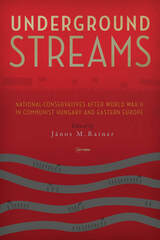
The authors of this edited volume address the hidden attraction that existed between the extremes of left and right, and of internationalism and nationalism under the decades of communist dictatorship in Eastern Europe. One might suppose that under the suppressive regimes based on leftist ideology and internationalism their right-wing opponents would have been defeated and ultimately removed. These essays, on the other hand, recount the itinerary of survival and revival of "right-wing" thought and activities under communist dictatorship. Resistance and accommodation are explored in the various phases from the Stalinist era to the demise of the Soviet Bloc, with the continuity provided by tacit or concealed right-wing discourses receiving particular consideration. The Eastern European right, both in its conservative and fascist version, centered on nationalism, a legitimizing factor that increased with the downfall of the regimes, and the authors thus accord nationalism special attention.
Two documentary sources for these essays that stand out are files of the security services and the exceptionally rich Oral History Archive compiled by the 1956 Institute in Budapest, Hungary.

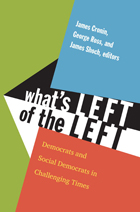
Contributors. Sheri Berman, James Cronin, Jean-Michel de Waele, Arthur Goldhammer, Christopher Howard, Jane Jenson, Gerassimos Moschonas, Sofia Pérez, Jonas Pontusson, George Ross, James Shoch, Sorina Soare, Ruy Teixeira
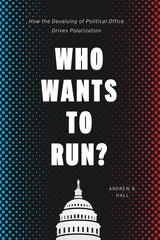
Andrew B. Hall argues that we have missed one of the most important reasons for this ideological gulf: the increasing reluctance of moderate citizens to run for office. While political scientists, journalists, and pundits have largely focused on voters, worried that they may be too partisan, too uninformed to vote for moderate candidates, or simply too extreme in their own political views, Hall argues that our political system discourages moderate candidates from seeking office in the first place. Running for office has rarely been harder than it is in America today, and the costs dissuade moderates more than extremists. Candidates have to wage ceaseless campaigns, dialing for dollars for most of their waking hours while enduring relentless news and social media coverage. When moderate candidates are unwilling to run, voters do not even have the opportunity to send them to office. To understand what is wrong with our legislatures, then, we need to ask ourselves the question: who wants to run? If we want more moderate legislators, we need to make them a better job offer.
A surging Republican populist.
The Democrat, hounded by corruption allegations; the Republican, dogged by business failures and ties to white supremacists.
The Republican turned out thousands of screaming supporters for speeches blaming illegal immigrants and crime on the Democrats, and the Democrat plummeted in the polls.
Sound familiar?
The '91 Louisiana Governor's race was supposed to be forgettable. But when former KKK Grand Wizard David Duke shocked the nation by ousting incumbent Republican Governor Buddy Roemer in the primary, the world took notice. Democrat Edwin Edwards, a former three-term governor and two-time corruption defendant, was left alone to face Duke in the general election—and he was going to lose.
Then a little-known state committeewoman stepped in with evidence of Duke's nefarious past. Could her evidence be enough to sway the minds of fired-up voters, or would Louisiana welcome a far-right radical into the highest office in the state?
Journalist Brian Fairbanks explores how the final showdown between Duke and Edwards in November 1991 led to a major shift in our national politics, as well as the rise of the radical right and white supremacist groups, and how history repeated itself in the 2016 presidential election. The story of these political "wizards," almost forgotten by history, remains eerily prescient and disturbingly relevant, and a compulsive page-turner.
Although an array of commentary and analyses focus on the New Right, little has been done to tell us who the women are on this side of the political spectrum. Are they social conservatives who call for the reassertion of traditional family values as promulgated by the federal government? Or do they align themselves with laissez-faire conservatives who abhor government intervention yet, like social conservatives, favor increased defense spending, and condemn communism and secular humanism. Rebecca E. Klatch provides the first coherent picture of who joins such movements and how they think.
This book draws upon a rich data source which includes in-depth interviews and field research at right-wing conferences and meetings. Rather than the image of right-wing women as a monolithic group of angry housewives who oppose feminism, the author finds a fundamental division among women of the New Right, with one constituency of women actually supporting part of the feminist vision. Analyzing varying perceptions of women of the New Right, the book examines their beliefs and values, their vision of America, their interpretations of Communism, big government, and feminism, as well as their view of themselves as women and as political actors.
In the series Women in the Political Economy, edited by Ronnie J. Steinberg.
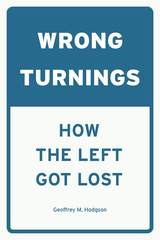
With Wrong-Turnings, Geoffrey M. Hodgson tracks changes in the meaning of the Left and offers suggestions for how the Left might reclaim some of its core values. The term Left originated during the French Revolution, when revolutionaries sought to abolish the monarchy and privilege and to introduce a new society based on liberty, equality, fraternity, and universal rights. Over time, however, the meaning radically changed, especially through the influence of socialism and collectivism. Hodgson argues that the Left must rediscover its roots in the Enlightenment and readopt Enlightenment values it has abandoned, such as those concerning democracy and universal human rights. Only then will it be prepared to address contemporary problems of inequality and the survival of democracy. Possible measures could include enhanced educational provisions, a guaranteed basic income, and a viable mechanism for fair distribution of wealth.
Wrong-Turnings is a truly pathbreaking work from one of our most prolific and respected institutional theorists. It will change our understanding of how the left got lost.
READERS
Browse our collection.
PUBLISHERS
See BiblioVault's publisher services.
STUDENT SERVICES
Files for college accessibility offices.
RECENTLY PUBLISHED





UChicago Accessibility Resources
home | accessibility | search | about | contact us
BiblioVault ® 2001 - 2025
The University of Chicago Press