
 A SCHOLARLY BOOK REPOSITORY
11 start with A start with A
During the nineteenth century, nearly ten thousand Americans traveled to Germany to study in universities renowned for their research and teaching. By the mid-twentieth century, American institutions led the world. How did America become the center of excellence in higher education? And what does that story reveal about who will lead in the twenty-first century?
Allies and Rivals is the first history of the ascent of American higher education seen through the lens of German-American exchange. In a series of compelling portraits of such leaders as Wilhelm von Humboldt, Martha Carey Thomas, and W. E. B. Du Bois, Emily J. Levine shows how academic innovators on both sides of the Atlantic competed and collaborated to shape the research university. Even as nations sought world dominance through scholarship, universities retained values apart from politics and economics. Open borders enabled Americans to unite the English college and German PhD to create the modern research university, a hybrid now replicated the world over.
In a captivating narrative spanning one hundred years, Levine upends notions of the university as a timeless ideal, restoring the contemporary university to its rightful place in history. In so doing she reveals that innovation in the twentieth century was rooted in international cooperation—a crucial lesson that bears remembering today.
The market revolution, participatory democracy, and voluntary associations have all been closely linked since the birth of the United States. American Creed explores the relationships among these three institutions, showing how charities and reform associations forged partnerships with government, provided important safety valves for popular discontent, and sparked much-needed economic development. McCarthy also demonstrates how the idea of philanthropy became crucially wedded to social activism during the Jacksonian era. She explores how acts of volunteerism and charity became involved with the abolitionist movement, educational patronage, the struggle against racism, and female social justice campaigns. What resulted, she contends, were heated political battles over the extent to which women and African Americans would occupy the public stage.
Tracing, then, the evolution of civil society and the pivotal role of philanthropy in the search for and exercise of political and economic power, this book will prove essential to anyone interested in American history and government.
In 1895 there was not a single case of dementia praecox reported in the United States. By 1912 there were tens of thousands of people with this diagnosis locked up in asylums, hospitals, and jails. By 1927 it was fading away . How could such a terrible disease be discovered, affect so many lives, and then turn out to be something else?
In vivid detail, Richard Noll describes how the discovery of this mysterious disorder gave hope to the overworked asylum doctors that they could at last explain—though they could not cure—the miserable patients surrounding them. The story of dementia praecox, and its eventual replacement by the new concept of schizophrenia, also reveals how asylum physicians fought for their own respectability. If what they were observing was a disease, then this biological reality was amenable to scientific research. In the early twentieth century, dementia praecox was psychiatry’s key into an increasingly science-focused medical profession.
But for the moment, nothing could be done to help the sufferers. When the concept of schizophrenia offered a fresh understanding of this disorder, and hope for a cure, psychiatry abandoned the old disease for the new. In this dramatic story of a vanished diagnosis, Noll shows the co-dependency between a disease and the scientific status of the profession that treats it. The ghost of dementia praecox haunts today’s debates about the latest generation of psychiatric disorders.
High-rise public housing developments were signature features of the post–World War II city. A hopeful experiment in providing temporary, inexpensive housing for all Americans, the "projects" soon became synonymous with the black urban poor, with isolation and overcrowding, with drugs, gang violence, and neglect. As the wrecking ball brings down some of these concrete monoliths, Sudhir Venkatesh seeks to reexamine public housing from the inside out, and to salvage its troubled legacy. Based on nearly a decade of fieldwork in Chicago's Robert Taylor Homes, American Project is the first comprehensive story of daily life in an American public housing complex.
Venkatesh draws on his relationships with tenants, gang members, police officers, and local organizations to offer an intimate portrait of an inner-city community that journalists and the public have only viewed from a distance. Challenging the conventional notion of public housing as a failure, this startling book re-creates tenants' thirty-year effort to build a safe and secure neighborhood: their political battles for services from an indifferent city bureaucracy, their daily confrontation with entrenched poverty, their painful decisions about whether to work with or against the street gangs whose drug dealing both sustained and imperiled their lives.
American Project explores the fundamental question of what makes a community viable. In his chronicle of tenants' political and personal struggles to create a decent place to live, Venkatesh brings us to the heart of the matter.
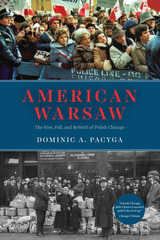
Every May, a sea of 250,000 people decked out in red and white head to Chicago’s Loop to celebrate the Polish Constitution Day Parade. In the city, you can tune in to not one but four different Polish-language radio stations or jam out to the Polkaholics. You can have lunch at pierogi food trucks or pick up pączkis at the grocery store. And if you’re lucky, you get to take off work for Casimir Pulaski Day. For more than a century, Chicago has been home to one of the largest Polish populations outside of Poland, and the group has had an enormous influence on the city’s culture and politics. Yet, until now, there has not been a comprehensive history of the Chicago Polonia.
With American Warsaw, award-winning historian and Polish American Dominic A. Pacyga chronicles more than a century of immigration, and later emigration back to Poland, showing how the community has continually redefined what it means to be Polish in Chicago. He takes us from the Civil War era until today, focusing on how three major waves of immigrants, refugees, and fortune seekers shaped and then redefined the Polonia. Pacyga also traces the movement of Polish immigrants from the peasantry to the middle class and from urban working-class districts dominated by major industries to suburbia. He documents Polish Chicago’s alignments and divisions: with other Chicago ethnic groups; with the Catholic Church; with unions, politicians, and city hall; and even among its own members. And he explores the ever-shifting sense of Polskość, or “Polishness.”
Today Chicago is slowly being eclipsed by other Polish immigrant centers, but it remains a vibrant—and sometimes contentious—heart of the Polish American experience. American Warsaw is a sweeping story that expertly depicts a people who are deeply connected to their historical home and, at the same time, fiercely proud of their adopted city. As Pacyga writes, “While we were Americans, we also considered ourselves to be Poles. In that strange Chicago ethnic way, there was no real difference between the two.”
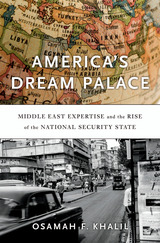
In T. E. Lawrence’s classic memoir Seven Pillars of Wisdom, Lawrence of Arabia claimed that he inspired a “dream palace” of Arab nationalism. What he really inspired, however, was an American idea of the area now called the Middle East that has shaped U.S. interventions over the course of a century, with sometimes tragic consequences. America’s Dream Palace brings into sharp focus the ways U.S. foreign policy has shaped the emergence of expertise concerning this crucial, often turbulent, and misunderstood part of the world.
America’s growing stature as a global power created a need for expert knowledge about different regions. When it came to the Middle East, the U.S. government was initially content to rely on Christian missionaries and Orientalist scholars. After World War II, however, as Washington’s national security establishment required professional expertise in Middle Eastern affairs, it began to cultivate a mutually beneficial relationship with academic institutions. Newly created programs at Harvard, Princeton, and other universities became integral to Washington’s policymaking in the region. The National Defense Education Act of 1958, which aligned America’s educational goals with Cold War security concerns, proved a boon for Middle Eastern studies.
But charges of anti-Americanism within the academy soon strained this cozy relationship. Federal funding for area studies declined, while independent think tanks with ties to the government flourished. By the time the Bush administration declared its Global War on Terror, Osamah Khalil writes, think tanks that actively pursued agendas aligned with neoconservative goals were the drivers of America’s foreign policy.
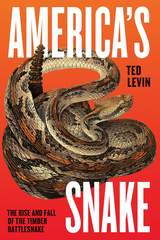
Yet most of us have never seen a timber rattler. Though they’re found in thirty-one states, and near many major cities, in contemporary America timber rattlesnakes are creatures mostly of imagination and innate fear.
Ted Levin aims to change that with America’s Snake, a portrait of the timber rattlesnake, its place in America’s pantheon of creatures and in our own frontier history—and of the heroic efforts to protect it against habitat loss, climate change, and the human tendency to kill what we fear. Taking us from labs where the secrets of the snake’s evolutionary history are being unlocked to far-flung habitats whose locations are fiercely protected by biologists and dedicated amateur herpetologists alike, Levin paints a picture of a fascinating creature: peaceable, social, long-lived, and, despite our phobias, not inclined to bite. The timber rattler emerges here as emblematic of America and also, unfortunately, of the complicated, painful struggles involved in protecting and preserving the natural world.
A wonderful mix of natural history, travel writing, and exemplary journalism, America’s Snake is loaded with remarkable characters—none more so than the snake at its heart: frightening, perhaps; endangered, certainly; and unquestionably unforgettable.
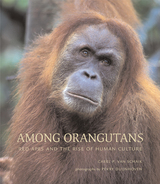
The local people know him as the "Man of the Forest," who refused to speak for fear of being put to work. And indeed the bear-like Sumatran orangutan, with his moon face, lanky arms, and shaggy red hair, does seem uncannily human; one of our closest relatives in the animal kingdom, the orangutan may have much to tell us about the origins of human intelligence, technology, and culture. In this book one of the world's leading experts on Sumatran orangutans, working in collaboration with nature photographer Perry van Duijnhoven, takes us deep into the disappearing world of these captivating primates.
In a narrative that is part adventure, part field journal, part call to conscience, Carel van Schaik introduces us to the colorful characters and complex lives of the orangutans who inhabit the vanishing forests of Sumatra. In compelling words and pictures, we come to know the personalities and temperaments of our primate cousins as they go about their days: building double-decker tree nests; using leaves as napkins, gloves, rain hats, and blankets, and sticks as backscratchers and probes; nurturing their infants longer and more intensely than any other nonhuman mammal. Here are the births and deaths, the first use of a tool, the defeat of a rival, the gradual loss of influence that, while fascinating to observe, may also help us to reconstruct human evolution.
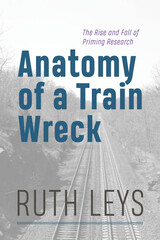
In 2012, a team of Belgian scientists reported that they had been unable to replicate a canonical experiment in the field of psychology known as “priming.” The original experiment, performed by John Bargh in the nineties, purported to show that words connoting old age unconsciously influenced—or primed—research subjects, causing them to walk more slowly. When researchers could not replicate these results, Nobel-winning psychologist Daniel Kahneman warned of “a train wreck looming” if Bargh and his colleagues could not address doubts about their work. Since then, the inability to replicate other well-known priming experiments has helped precipitate an ongoing debate over what has gone wrong in psychology, raising fundamental questions about the soundness of research practices in the field.
Anatomy of a Train Wreck offers the first detailed history of priming research from its origins in the early 1980s to its recent collapse. Ruth Leys places priming experiments in the context of contemporaneous debates not only over the nature of automaticity but also the very foundations of social psychology. While these latest discussions about priming have largely focused on methodology—including sloppy experimental practices, inadequate statistical methods, and publication bias—Leys offers a genealogy of the theoretical expectations and scientific paradigms that have guided and motivated priming research itself. Examining the intellectual strategies of scientists, their responses to criticism, and their assumptions about the nature of subjectivity, Anatomy of a Train Wreck raises crucial questions about the evidence surrounding unconscious influence and probes the larger stakes of the replication crisis: psychology’s status as a science.
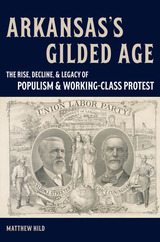
The story of farmer and labor protest in Arkansas during the late nineteenth century offers lessons relevant to contemporary
working-class Americans in what some observers have called the “new Gilded Age.”
READERS
Browse our collection.
PUBLISHERS
See BiblioVault's publisher services.
STUDENT SERVICES
Files for college accessibility offices.
RECENTLY PUBLISHED



UChicago Accessibility Resources
home | accessibility | search | about | contact us
BiblioVault ® 2001 - 2024
The University of Chicago Press