
 A SCHOLARLY BOOK REPOSITORY
Pagans’ advocate.
A professing pagan in an aggressively Christian empire, a friend of the emperor Julian and acquaintance of St. Basil, a potent spokesman for private and political causes—Libanius can tell us much about the tumultuous world of the fourth century.
Born in Antioch to a wealthy family steeped in the culture and religious traditions of Hellenism, Libanius rose to fame as a teacher of the classics in a period of rapid social change. In his lifetime Libanius was an acknowledged master of the art of letter writing. Today his letters—about 1550 of which survive—offer an enthralling self-portrait of this combative pagan publicist and a vivid picture of the culture and political intrigues of the eastern empire. A. F. Norman selects one eighth of the extant letters, which come from two periods in Libanius’ life, AD 355–365 and 388–393, letters written to Julian, churchmen, civil officials, scholars, and his many influential friends. The Letters are complemented, in this two-volume edition, by Libanius’ Autobiography (Oration 1), a revealing narrative that begins as a scholar’s account and ends as an old man’s private journal.
Also available in the Loeb Classical Library is a two-volume edition of Libanius’ Orations.
Pagans’ advocate.
A professing pagan in an aggressively Christian empire, a friend of the emperor Julian and acquaintance of St. Basil, a potent spokesman for private and political causes—Libanius can tell us much about the tumultuous world of the fourth century.
Born in Antioch to a wealthy family steeped in the culture and religious traditions of Hellenism, Libanius rose to fame as a teacher of the classics in a period of rapid social change. In his lifetime Libanius was an acknowledged master of the art of letter writing. Today his letters—about 1550 of which survive—offer an enthralling self-portrait of this combative pagan publicist and a vivid picture of the culture and political intrigues of the eastern empire. A. F. Norman selects one eighth of the extant letters, which come from two periods in Libanius’ life, AD 355–365 and 388–393, letters written to Julian, churchmen, civil officials, scholars, and his many influential friends. The Letters are complemented, in this two-volume edition, by Libanius’ Autobiography (Oration 1), a revealing narrative that begins as a scholar’s account and ends as an old man’s private journal.
Also available in the Loeb Classical Library is a two-volume edition of Libanius’ Orations.

So wrote Thomas Wentworth Higginson about his role in one of the most compelling and fascinating episodes in the history of the United States. As the colonel of the first regiment of black men in the Union army during the Civil War, Higginson was an early, articulate, and powerful crusader for civil rights, and his journal and letters, collected for the first time in this volume, present some of the most extraordinary documents of the Civil War.
Higginson was a politically engaged intellectual at the forefront of radical antislavery, labor, and feminist causes. Born in 1823 to a formerly wealthy but still prominent Brahmin family, he became one of America's leading social activists and a prominent writer, minister, and reformer. With the publication in 1869 of his classic Army Life in a Black Regiment, which drew on this journal, Higginson became one of the most important chroniclers of the Civil War. The Complete Civil War Journal and Selected Letters of Thomas Wentworth Higginson is the first comprehensive edition of his journal. Sensitively and thoroughly annotated by Christopher Looby and supplemented by a large selection of Higginson's wartime letters, this volume offers the most vivid and intimate picture of the radical interracial solidarity brought about by the transformative experience of the army camp and of Civil War life.
"The immediacy of Higginson's reflections, as well as their sharp insights, make this journal both distinctive and enduringly compelling . . . . Higginson's vivid texts can once again educate, gratify and delight readers."—Publishers Weekly
"This volume will enrich our understanding of the transformations that emancipation and war wrought."—Library Journal
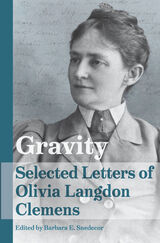
Henry Adams has been called an indispensable figure in American thought. Although he famously “took his own life” in the autobiographical Education of Henry Adams, his letters—more intimate and unbuttoned, though hardly unselfconscious—are themselves indispensable for an understanding of the man and his times.
This selection, the first based on the authoritative 6-volume Letters, represents every major private and public event in Adams’s life from 1858 to 1918 and confirms his reputation as one of the greatest letter writers of his time. Adams knew everyone who was anyone and went almost everywhere, and—true to the Adams family tradition—recorded it all. These letters to an array of correspondents from American presidents to Henry James to 5-year-old honorary nieces reveal Adams’s passion for politics and disdain for politicians, his snobbish delight in society and sincere affection for friends, his pose of dilettantism and his serious ambitions as writer and historian, his devastation at his wife’s suicide and his acquiescence in the role of Elizabeth Cameron’s “tame cat,” his wicked humor at others’ expense and his own reflexive self-depreciation.
This volume allows the reader to experience 19th-century America through the eyes of an observer on whom very little was lost, and to make the acquaintance of one of the more interesting personalities in American letters. As Ernest Samuels says in his introduction, “The letters lift the veil of old-age disenchantment that obscures the Education and exhibit Adams as perhaps the most brilliant letter writer of his time. What most engages one in the long course of his correspondence is the tireless range of his intellectual curiosity, his passionate effort to understand the politics, the science, and the human society of the world as it changed around him… It is as literature of a high order that his letters can finally be read.”
"He was a supreme artist in the intimacies and connections that bind people together or tear them apart," says Leon Edel in his introduction to this collection of Henry James's best letters. Edel has chosen, from the four-volume epistolarium already published, those letters which especially illuminate James's writing, his life, his thoughts and fancies, his literary theories, and his most meaningful friendships. In addition, there are two dozen letters that have never before been printed.
In its unity, its elegance, and its reflection of almost a century of Anglo-American life and letters, this correspondence can well be said to belong to literature as well as to biography. Besides epistles to James's friends and family--including his celebrated brother, William--there are letters to notables such as Flaubert and Daudet in France; Stevenson, Gosse, Wells, and Conrad in England; and Americans from William Dean Howells to Edith Wharton. The latter correspondence, in particular, enlarges our understanding of James's complex involvements with Wharton and her circle; among the previously unpublished letters are several to Wharton's rakish lover, Morton Fullerton.
This masterly selection allows us to observe the precocious adolescent, the twenty-six-year-old setting out for Europe, the perceptive traveler in Switzerland and Italy, and the man-about-London consorting with Leslie Stephen and William Morris, meeting Darwin and Rossetti, hearing Ruskin lecture, visiting George Eliot. The letters describe periods of stress as well as happiness, failure as well as success, loneliness as well as sociability. They portray in considerable psychological depth James's handling of his problems (particularly with his family), and they allow us to see him adjust his mask for each correspondent.
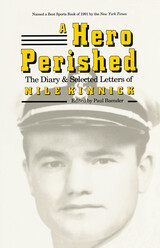
A Hero Perished tells Nile Kinnick's story. This grandson of an Iowa governor, the son of parents who disciplined him to strive for his measure of greatness, became a Heisman Trophy winner and national celebrity through a combination of talent and circumstance. Following his college successes, Kinnick began legal study to prepare for a political career, but with the approach of war he entered the Navy Air Corps to refashion himself as a fighter pilot. Assigned to the carrier USS Lexington on its premier cruise, he took off in a defective plane—and his death shocked a nation grown almost used to tragic loss.
For the first time, Kinnick tells his own tale through his engaging letters—all but one previously unpublished—and his diary, printed in its entirety for the first time. The result is a human, intimate look at the true person behind the myth, revealing both his foibles and his essential principles. A Hero Perished also includes a definitive text of Kinnick's moving Heisman Award acceptance speech and his impassioned commencement supper address, calling on the new Iowa graduates to achieve moral courage in a time of depression and war.
An illuminating comment on a time and attitude that have passed, A Hero Perished is of and about a football player, but it is not a football book—it is far more. This volume displays Kinnick—who was, despite his great gifts and achievements, a vulnerable and decent young man—in a time of great change and peril when a phase of our culture was passing away.

At times poetic but not a poem, prosaic but not an essay, a letter is often pure writing for writing’s sake. Such is the case for Rahel Varnhagen von Ense, née Levin, the illustrious German-Jewish Berlin literary salon hostess from the early nineteenth century. She penned over ten thousand letters to more than three hundred recipients, including princes, philosophers, poets, family members, and the family cook. Written with a wink at posterity, collected and first published after her passing by her husband, Karl August Varnhagen von Ense, these letters constitute a singular contribution to German literature.
Varied in subject—from family affairs to linguistic, literary, and pressing social concerns—the poignant lyricism of her letters is all the more remarkable when we take into account that High German was not her first language; she grew up speaking, reading, and writing primarily Yiddish. Her shaky social status as a woman and a member of a precarious minority, combined with an astounding lucidity and a rare capacity to put her thoughts into words, made her a force to be reckoned with in her lifetime and thereafter as one of Germany’s preeminent women of letters. As we see in I Just Let Life Rain Down on Me, her voice is as fresh and original as that of any of the recognized poets and thinkers of her day. As Rahel herself put it: “[O]ur language is our lived life; I invented mine for my own purposes, I was less able than many others to make use of preconceived turns of phrase, which is why mine are often clumsy, and in all respects faulty, but always true.”
Compiled and translated by Peter Wortsman, this rewarding volume affords English-speaking readers the first privileged peek at the mindset of one of Europe’s first and foremost women of letters.
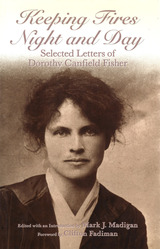
Eleanor Roosevelt called her one of the most influential women in America. Among the earliest and most assertive members of the Book-of-the-Month Club selection committee, Dorothy Canfield Fisher helped define literary taste in America for more than three decades. She helped shape the careers of such great writers as Pearl Buck, Isak Dinesen, and Richard Wright. A best-selling author herself, Fisher was also a deeply committed social activist. In Keeping Fires Night and Day, Mark J. Madigan collects much of Fisher's copious correspondence. With letters to Willa Cather, W.E.B. Du Bois, Albert Einstein, Robert Frost, Margaret Mead, James Thurber, and E.B. White, he documents Fisher's personal and professional life and career in a way that no biography could. Set against the American historical and cultural landscape from 1900 to 1958, these letters offer a firsthand account of one of the twentieth century's most remarkable women.
While Fisher's novels treated such conventional subjects as marriage and domestic life, her own life was anything but conventional. When her best-selling novels made her the chief breadwinner in her marriage, her husband, John Fisher, quietly assumed the role of secretary and editor of her work. Fluent in five languages, Dorothy Canfield Fisher founded a Braille press in France and introduced the educational methods of Dr. Maria Montessori to the United States. She became a pioneering advocate of adult education and served as the first woman on the Vermont Board of Education.
In letters to friends, fans, and colleagues, Fisher discussed her homelife, her work, and the world around her. Her passions and concerns-revealed in her correspondence with wit and poignancy-include the "New Woman' and the suffrage movement, racial discrimination and the emergence of the NAACP, the development of the national education system, two world wars, the depression, and the influence of book clubs in the literary market-place.
Dorothy Canfield Fisher "helped twentieth-century American literature to come of age," writes Clifton Fadimon in his Foreward. Yet lasting recognition has eluded her. In Keeping Fires Night and Day the distinctive voice of this gifted, intelligent and spirited woman is heard once again.
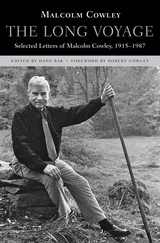
Critic, poet, editor, chronicler of the “lost generation,” and elder statesman of the Republic of Letters, Malcolm Cowley (1898–1989) was an eloquent witness to much of twentieth-century American literary and political life. These letters, the vast majority previously unpublished, provide an indelible self-portrait of Cowley and his time, and make possible a full appreciation of his long and varied career.
Perhaps no other writer aided the careers of so many poets and novelists. Faulkner, Fitzgerald, Hemingway, Kerouac, Tillie Olsen, and John Cheever are among the many authors Cowley knew and whose work he supported. A poet himself, Cowley enjoyed the company of writers and knew how to encourage, entertain, and when necessary scold them. At the center of his epistolary life were his friendships with Kenneth Burke, Allen Tate, Conrad Aiken, and Edmund Wilson. By turns serious and thoughtful, humorous and gossipy, Cowley’s letters to these and other correspondents display his keen literary judgment and ability to navigate the world of publishing.
The letters also illuminate Cowley’s reluctance to speak out against Stalin and the Moscow Trials when he was on staff at The New Republic—and the consequences of his agonized evasions. His radical past would continue to haunt him into the Cold War era, as he became caught up in the notorious “Lowell Affair” and was summoned to testify in the Alger Hiss trials.
Hans Bak supplies helpful notes and a preface that assesses Cowley’s career, and Robert Cowley contributes a moving foreword about his father.
---From the introduction by David Lehman
"In this lifetime of letters, Fairfield Porter reveals the complexity and passion of a protagonist in a novel by Dostoevsky or Henry James."
---Jane Freilicher
Fairfield Porter (1907-75) has been called by poet John Ashbery "perhaps the major American artist of the century." He was also known as a gifted art critic.
Beyond shedding light on his personal views, this collection of Fairfield Porter's letters demonstrates his profound contribution to American art and literature and displays his acumen as a political critic. The letters tell the story of a reserved artist and intellectual, torn between the tensions and pressures he felt among politics, family life, and painting-a man who forged a painting style outside the politically correct artistic perceptions of both left and right.
The collection includes letters from Porter's early travels to the Soviet Union, including a description of an interview with Trotsky, as well as some of his later letters to close friends, including Frank O'Hara, Kenneth Koch, Rod Padgett, Larry Rivers, and James Schuyler, among others. While the letters reveal many sides of the brilliant and independent-minded Porter, they also provide a cultural context for the time period and the circle of artists and poets with whom Porter associated. The letters not only tell a story of the artist himself but are also valuable documents of the political and artistic upheavals of the 1930s, 40s, and 50s.
This rich collection is introduced by poet and critic David Lehman and includes notes by Justin Spring, author of Porter's biography.
People in a Magazine collects Behrman's correspondence with his editors along with telegrams, interoffice memos, and editorial notes drawn from the magazine's archives—offering an unparalleled view of mid-twentieth-century literary life and the formative years of The New Yorker, from the time of Behrman's first contributions to the magazine in 1929 until his death.
As an "honored courtesan", Franco made her living by arranging to have sexual relations, for a high fee, with the elite of Venice and the many travelers—merchants, ambassadors, even kings—who passed through the city. Courtesans needed to be beautiful, sophisticated in their dress and manners, and elegant, cultivated conversationalists. Exempt from many of the social and educational restrictions placed on women of the Venetian patrician class, Franco used her position to recast "virtue" as "intellectual integrity," offering wit and refinement in return for patronage and a place in public life.
Franco became a writer by allying herself with distinguished men at the center of her city's culture, particularly in the informal meetings of a literary salon at the home of Domenico Venier, the oldest member of a noble family and a former Venetian senator. Through Venier's protection and her own determination, Franco published work in which she defended her fellow courtesans, speaking out against their mistreatment by men and criticizing the subordination of women in general. Venier also provided literary counsel when she responded to insulting attacks written by the male Venetian poet Maffio Venier.
Franco's insight into the power conflicts between men and women and her awareness of the threat she posed to her male contemporaries make her life and work pertinent today.
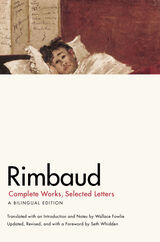
The first translation of the poet's complete works when it was published in 1966, Rimbaud: Complete Works, Selected Letters introduced a new generation of Americans to the alienated genius—among them the Doors's lead singer Jim Morrison, who wrote to translator Wallace Fowlie to thank him for rendering the poems accessible to those who "don't read French that easily." Forty years later, the book remains the only side-by-side bilingual edition of Rimbaud's complete poetic works.
Thoroughly revising Fowlie's edition, Seth Whidden has made changes on virtually every page, correcting errors, reordering poems, adding previously omitted versions of poems and some letters, and updating the text to reflect current scholarship; left in place are Fowlie's literal and respectful translations of Rimbaud's complex and nontraditional verse. Whidden also provides a foreword that considers the heritage of Fowlie's edition and adds a bibliography that acknowledges relevant books that have appeared since the original publication. On its fortieth anniversary, Rimbaud remains the most authoritative—and now, completely up-to-date—edition of the young master's entire poetic ouvre.
The author of The Desert, the book that made the American landscape accessible to the mainstream mind, was much less like his fellow environmental prophets John Muir and Henry David Thoreau than he would have had us believe. Van Dyke claimed to have wandered "alone on horseback for thousands of miles through the American Southwest and northern Mexico," as readers of The Desert—now in the millions since the book was published in 1901—were told. He did not. In The Secret Life of John C. Van Dyke, Teague and Wild unmask the desert saint with Van Dyke’s own recently discovered letters. These letters depict a privileged, patrician, and pampered member of the upper-class. His incriminating correspondence reveals that he saw most of the desert from plush railroad cars and grand hotel rooms. In the introduction, the editors clear up many misconceptions scholars currently hold about Van Dyke’s ecological principles, about his outdoorsmanship, and about his trip through the desert itself. As the centennial of the publication of The Desert approaches, this lively collection of letters helps set the record straight. The John C. Van Dyke unveiled in The Secret Life is a more varied character than we had supposed—still worthy of much admiration for his remarkable accomplishments, but still mysterious, and not the man we thought him to be.
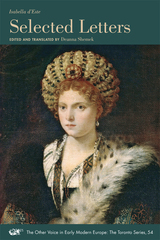
Isabella d’Este (1474–1539), daughter of the Este dukes of Ferrara and wife of Marchese Francesco II Gonzaga of Mantua, co-regent of the Gonzaga state, art collector, musician, diplomat, dynastic mother, traveler, reader, gardener, fashion innovator, and consummate politician, was also, as this volume attests, a prolific letter writer with a highly developed epistolary network. Presented here for the first time in any language is a representative selection from over 16,000 letters sent by Isabella to addressees across a wide social spectrum. Together, they paint a nuanced and colorful portrait of a brilliant and influential female protagonist of early modern European society.
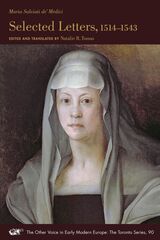
In recent years, there has been an upsurge of interest in Maria Salviati de’ Medici, specifically, in her role in Medici governance and her relationships with other members of the Medici court. Maria Salviati’s surviving correspondence documents a life spent close to the centers of Medici power in Florence and Rome, giving witness to its failures, resurrection, and eventual triumph. Presented here for the first time in English, this book is a representative sample of Maria’s surviving letters that document her remarkable life through a tumultuous period of Italian Renaissance history. While she earned the exasperation of some, she gained the respect of many more. Maria ended her life as an influential dowager, powerful intercessor for local Tuscans of all strata, and wise elder in Duke Cosimo I’s court. The first critical, analytical, biographical work on Maria Salviati de’ Medici’s life and letter-writing in English.
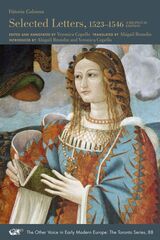
The most celebrated woman writer of the Italian Renaissance, Vittoria Colonna was known for her elegant poetry and use of the sonnet form to explore pressing religious questions. The selection of Colonna’s letters presented here for the first time in a collected edition was written to and from writers, artists, popes, cardinals, employees, and family members. Together they place Colonna at the center of intersecting epistolary networks as a political actor, theological thinker, literary practitioner, and caring friend. Revealing a historical woman speaking and acting with force in the world, these letters constitute a vital tool for anyone seeking to understand Colonna’s literary works. Newly translated, this work reveals new aspects and faces of the most celebrated woman writer of the Italian Renaissance.
A busy man with a busy life, DeVoto found time to write and answer letters in abundance. In 1933 he received a fan letter from Katharine Sterne, a young woman hospitalized with tuberculosis; his reply touched off an extraordinary eleven-year correspondence. Sterne had graduated with honors from Wellesley College in 1928 and had served as an assistant art critic at the New York Times before her illness. Despite her enforced invalidism she maintained an active intellectual life. Sterne and DeVoto wrote to each other until her death in 1944, sometimes in many pages and as often as twice a week, exchanging opinions about life, literature, art, current events, family news, gossip, and their innermost feelings. DeVoto’s biographer, Wallace Stegner, states that in these letters DeVoto “expressed himself more intimately than in any other writings.” Although their correspondence amounted to more than 868 letters (and is virtually complete on both sides), DeVoto and Sterne never met, both of them doubtless realizing that physical remoteness permitted a psychological proximity that was deeply nourishing.
This volume contains 140 of their letters. They have been selected by DeVoto’s son Mark, who has also provided detailed notes clarifying ambiguities and obscure references. Readers will enjoy these letters for their wit and literary flair, but they will also gain insight into the cultural and historical crosscurrents of the 1930s and ’40s while taking an intimate and engaging look at a friendship forged entirely through words.
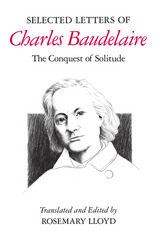
Writing to family, friends, and lovers, Baudelaire reveals the incidents and passions that went into his poetry. In letters to editors, idols, and peers—Hugo, Flaubert, Vigny, Wagner, Cladel, among others—he elucidates the methods and concerns of his own art and criticism and comments tellingly on the arts and politics of his day. In all, ranging from childhood to days shortly before his death, these letters comprise a complex and moving portrait of the quintessential poet and his time.
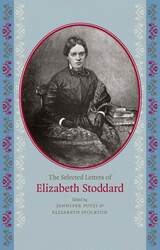
As scholars of epistolarity have recently argued, letters provide more than just a biographical narrative; they also should be understood as aesthetic performances themselves. The correspondence provides a sense of Stoddard as someone who understood letter writing as a distinct and important literary genre, making this collection particularly well suited for new conceptualizations of the epistolary genre.
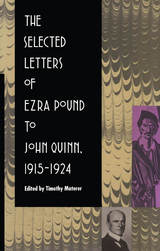
Pound wrote to John Quinn—a New York lawyer, an expert in business law, and a collector of unusual taste and discrimination—about these artists and many more, urging him to support their journals, collect their manuscripts, and buy and exhibit their paintings and sculptures. Quinn at one time owned manuscripts of Ulysses and The Waste Land, Brancusi’s sculpture Mlle. Pogany, and Picasso’s painting Three Musicians. Yet he was often skeptical about the value of new schools of art, such as Vorticism, and disturbed by the outspokenness of authors such as Joyce. Pound’s letters are unusually tactful when he counters Quinn’s doubts and explains the premises of experimental art. Pound’s letters to Quinn are touched with his characteristic humor and wordplay and are especially notable for their lucidity of expression, engendered by Pound’s deep respect for Quinn.

These working papers include a rich correspondence, letters which provide access to the sustained, perceptive body of critical and aesthetic thinking of Oppen’s poetic career. Provocative and witty comments on poetry and poetics, especially interesting for the development of an Objectivist aesthetics, and shrewd, deeply felt assessments about the politics of the twentieth century and its moral dilemmas are some of the issues attended to. This edition offers primary documentation about an influential poetics, a little-known movement, and its active figures. Given the aggressive studies of the politics of canon-formation, the interest in describing a historical context for individual literary achievement, and current debates about mainstream poetry, the rethinking of the Objectivist movement, and the collection of documents contributing to its poetics, is an important achievement in literary scholarship.
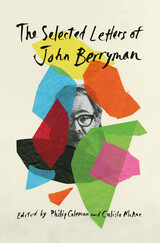
A wide-ranging, first-of-its-kind selection of Berryman’s correspondence with friends, loved ones, writers, and editors, showcasing the turbulent, fascinating life and mind of one of America’s major poets.
The Selected Letters of John Berryman assembles for the first time the poet’s voluminous correspondence. Beginning with a letter to his parents in 1925 and concluding with a letter sent a few weeks before his death in 1972, Berryman tells his story in his own words.
Included are more than 600 letters to almost 200 people—editors, family members, students, colleagues, and friends. The exchanges reveal the scope of Berryman’s ambitions, as well as the challenges of practicing his art within the confines of the publishing industry and contemporary critical expectations. Correspondence with Ezra Pound, Robert Lowell, Delmore Schwartz, Adrienne Rich, Saul Bellow, and other writers demonstrates Berryman’s sustained involvement in the development of literary culture in the postwar United States. We also see Berryman responding in detail to the work of writers such as Carolyn Kizer and William Meredith and encouraging the next generation—Edward Hoagland, Valerie Trueblood, and others. The letters show Berryman to be an energetic and generous interlocutor, but they also make plain his struggles with personal and familial trauma, at every stage of his career.
An introduction by editors Philip Coleman and Calista McRae explains the careful selection of letters and contextualizes the materials within Berryman’s career. Reinforcing the critical and creative interconnectedness of Berryman’s work and personal life, The Selected Letters confirms his place as one of the most original voices of his generation and opens new horizons for appreciating and interpreting his poems.
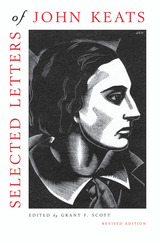
The letters of John Keats are, T. S. Eliot remarked, "what letters ought to be; the fine things come in unexpectedly, neither introduced nor shown out, but between trifle and trifle." This new edition, which features four rediscovered letters, three of which are being published here for the first time, affords readers the pleasure of the poet's "trifles" as well as the surprise of his most famous ideas emerging unpredictably.
Unlike other editions, this selection includes letters to Keats and among his friends, lending greater perspective to an epistolary portrait of the poet. It also offers a revealing look at his "posthumous existence," the period of Keats's illness in Italy, painstakingly recorded in a series of moving letters by Keats's deathbed companion, Joseph Severn. Other letters by Dr. James Clark, Percy Bysshe Shelley, and Richard Woodhouse--omitted from other selections of Keats's letters--offer valuable additional testimony concerning Keats the man.
Edited for greater readability, with annotations reduced and punctuation and spelling judiciously modernized, this selection recreates the spontaneity with which these letters were originally written.
The letters in this volume, written from 1941 to 1978, trace Brooks’s development from fledgling historian to recognized authority. Serving almost as an autobiography of her interactions with her contemporaries, this selection provides a new perspective on Brooks’s personality and growth as a scholar. Richly detailed, chatty, and covering a wide array of subjects, the letters afford an important glimpse into Brooks’s struggles, concerns, and interests.
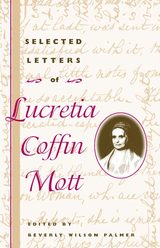
This landmark volume collects Lucretia Mott's correspondence for the first time, highlighting the length and breadth of her work as an activist dedicated to reform of almost every kind and providing an intimate glimpse of her family life.
Mott’s achievements left a mark on reform movements from abolition to women's rights. The letters cover her work in these causes as well as her founding of key antislavery organizations; her friendships with Harriet Tubman and Sojourner Truth; her efforts to bring Quakers into the abolitionist movement; and her part in organizing the 1848 Seneca Falls Woman's Rights Convention. Other correspondence cover her fifty-six-year marriage, the five children she raised to adulthood, and informal insights and news with and about her cherished family.
An invaluable resource, Selected Letters of Lucretia Coffin Mott reveals the incisive mind, sense of mission, and level-headed personality that made this extraordinary figure a major force in nineteenth-century American life.
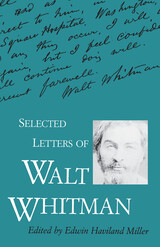
There has never been an edition of the selected letters of Walt Whitman, a remarkable fact considering how accustomed we are to becoming acquainted with major writers through their letters. Now Edwin Haviland Miller, editor of the six-volume collected writings of Whitman, has used his intimate knowledge of the "good gray poet's" correspondence to produce this revealing selection of 250 letters, introduced and annotated concisely and evocatively. Whitman in these letters is simple, direct, colloquial, adding a counterpoint to his artistic voice and persona as a poet.
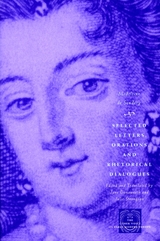
Selected Letters, Orations, and Rhetorical Dialogues is a careful selection of Scudéry's shorter writings, emphasizing her abilities as a rhetorical theorist, orator, essayist, and letter writer. It provides the first English translations of some of Scudéry's Amorous Letters, only recently identified as her work, as well as selections from her Famous Women, or Heroic Speeches, and her series of Conversations. The book will be of great interest to scholars of the history of rhetoric, French literature, and women's studies.
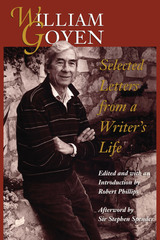
Proclaimed "one of the great American writers of short fiction" by the New York Times Book Review, William Goyen (1915-1983) had a quintessentially American literary career, in which national recognition came only after years of struggle to find his authentic voice, his audience, and an artistic milieu in which to create. These letters, which span the years 1937 to 1983, offer a compelling testament to what it means to be a writer in America.
A prolific correspondent, Goyen wrote regularly to friends, family, editors, and other writers. Among the letters selected here are those to such major literary figures as W. H. Auden, Archibald MacLeish, Joyce Carol Oates, William Inge, Elia Kazan, Elizabeth Spencer, and Katherine Anne Porter.
These letters constitute a virtual autobiography, as well as a fascinating introduction to Goyen's work. They add an important chapter to the study of American and Texas literature of the twentieth century.
READERS
Browse our collection.
PUBLISHERS
See BiblioVault's publisher services.
STUDENT SERVICES
Files for college accessibility offices.
RECENTLY PUBLISHED



UChicago Accessibility Resources
home | accessibility | search | about | contact us
BiblioVault ® 2001 - 2024
The University of Chicago Press