
 A SCHOLARLY BOOK REPOSITORY
Institutions pervade social life. They express community goals and values by defining the limits of socially acceptable behavior. Institutions are often vested with the resources, authority, and power to enforce the orthodoxy of their time. But institutions are also arenas in which both orthodoxies and authority can be contested. Between power and opposition lies the individual experience of the institutionalized. Whether in a boarding school, hospital, prison, almshouse, commune, or asylum, their experiences can reflect the positive impact of an institution or its greatest failings. This interplay of orthodoxy, authority, opposition, and individual experience are all expressed in the materiality of institutions and are eminently subject to archaeological investigation.
A few archaeological and historical publications, in widely scattered venues, have examined individual institutional sites. Each work focused on the development of a specific establishment within its narrowly defined historical context; e.g., a fort and its role in a particular war, a schoolhouse viewed in terms of the educational history of its region, an asylum or prison seen as an expression of the prevailing attitudes toward the mentally ill and sociopaths. In contrast, this volume brings together twelve contributors whose research on a broad range of social institutions taken in tandem now illuminates the experience of these institutions. Rather than a culmination of research on institutions, it is a landmark work that will instigate vigorous and wide-ranging discussions on institutions in Western life, and the power of material culture to both enforce and negate cultural norms.
Much of the work being done under the rubric of "new institutionalism" focuses on how institutions shape social, economic, and political outcomes. This emphasis on influence has provided students of economics, political science, and political economy with surprisingly little theory to account for the origins of such institutions. Yet without understanding how institutions form and consequently develop influence, much of the other work lacks context. The contributors fill this void by utilizing a variety of perspectives and theoretical approaches. The twin focus of these articles on the origins of institutions and the development of institutional influence yield innovative and suggestive outcomes. Topics range from the framing of the United States Constitution to debate over the Senate at the Federal Convention; from equilibrium and social institutions to democratic stability.
Contributors include Randall Calvert, Jon Elster, Avner Greif, Jack Knight, Paul Milgrom, Douglass North, William Riker, Norman Schofield, Itai Sened, and Barry Weingast.
Jack Knight is Assistant Professor of Political Science, Washington University, St. Louis. Itai Sened is Assistant Professor of Political Science, Tel Aviv University.

In How Informal Institutions Matter, Zeki Sarigil examines the role of informal institutions in sociopolitical life and addresses the following questions: Why and how do informal institutions emerge? To ask this differently, why do agents still create or resort to informal institutions despite the presence of formal institutional rules and regulations? How do informal institutions matter? What roles do they play in sociopolitical life? How can we classify informal institutions? What novel types of informal institutions can we identify and explain? How do informal institutions interact with formal institutions? How do they shape formal institutional rules, mechanisms, and outcomes? Finally, how do existing informal institutions change? What factors might trigger informal institutional change? In order to answer these questions, Sarigil examines several empirical cases of informal institution as derived from various issue areas in the Turkish sociopolitical context (i.e., civil law, conflict resolution, minority rights, and local governance) and from multiple levels (i.e., national and local).
Institutions and Economic Performance explores the question of why income per capita varies so greatly across countries. Even taking into account disparities in resources, including physical and human capital, large economic discrepancies remain across countries. Why are some societies but not others able to encourage investments in places, people, and productivity?
The answer, the book argues, lies to a large extent in institutional differences across societies. Such institutions are wide-ranging and include formal constitutional arrangements, the role of economic and political elites, informal institutions that promote investment and knowledge transfer, and others. Two core themes run through the contributors’ essays. First, what constraints do institutions place on the power of the executive to prevent it from extorting the investments and effort of other people and institutions? Second, when are productive institutions self-enforcing?
Institutions and Economic Performance is unique in its melding of economics, political science, history, and sociology to address its central question.

The modern analysis of institutions has taken two separate paths. Rational choice theories identified institutions as a strategic response to collective action problems and as instruments for the promotion of cooperation. Contrary to these theories, such cooperation is fundamental to social order and a prerequisite for economic growth and development. An alternate form of institutionalism, drawn from sociological and historical analysis, de-emphasized the role of choice, strategy, and design in the construction of many of the major institutions in social life. This form of institutional analysis pointed to the role of prior choices, common norms, and culture in making certain options and choices unthinkable or impossible. Institutions, according to this view, may represent a certain kind of social order, but they do not always promote cooperation and economic growth. The more recent theories in the "new institutionalism" bring these seemingly irreconcilable perspectives closer together. New institutionalists argue that institutions must be grounded in the social fabric, and thus rational choice must be combined with historical and cultural variables. The papers collected in this volume address the merging of rational choice and historical-sociological institutionalism in the "new institutionalism."
The contributors are Randall L. Calvert, Christopher Clague, Kathleen Cook, Peter Hall, Virginia Haufler, James Johnson, Gary Miller, Karol Soltan, Rosemary C. R. Taylor, Eric M. Uslaner, and Barry Weingast.
Karol Soltan is Associate Professor of Political Science, University of Maryland. Eric M. Uslaner is Professor of Political Science, University of Maryland. Virginia Haufler is Assistant Professor of Political Science, University of Maryland.

As concrete examples, Clark analyzes four court disputes in depth, showing that the concept of local autonomy has very different meanings and implications in each of them. These cases—Boston's defense of resident-preference hiring policies, conflict over urban land-use zoning in Toronto, a Chicago's suburb's fight against a sewage treatment plant, and the evolution of the City of Denver's power since 1900—demonstrate that legal reasoning is not impervious to other kinds of reasoning, and the solutions provided by the courts are not unique. To ground his explorations, Clark investigates both liberalism and structuralism, showing that both are inadequate bases for determining social policy. He mounts provocative critiques of the works of de Tocqueville, Nozick, Tiebout, and Posner on the one hand and Castells and Poulantzas on the other.
This ambitious and important work will command the interest of geographers, political scientists, economists, sociologists, and legal scholars.
For Janowitz, social control denotes a society's capacity to regulate itself within a moral framework that transcends simple self-interest. He poses urgent questions: Why has social control been so drastically weakened in our advanced industrial society? And what strategies can we use to strengthen it again?
The expanation rests in part on the changes in social structure which make it more and more complicated for citizens to calculate their political self-interest. At the same time, complex economic and defense problems also strain an already overburdened legislative system, making effective, responsive political rule increasingly difficult.
Janowitz concludes by assessing the response of the social sciences to the pressing problem of social control and asserts that new forms of citizen participation in the government must be found.
This book explores the distinct historical-political imagination of the self in the twentieth century and advances two arguments. First, it suggests that we should read the history of modern political philosophy afresh in light of a theme that emerges in the late eighteenth century: the rift between self and social institutions. Second, it argues that this rift was reformulated in the twentieth century in a manner that contrasts with the optimism of nineteenth-century thinkers regarding its resolution. It proposes a new political imagination of the twentieth century found in the works of Weber, Freud, and Foucault, and characterizes it as one of "entrapment."
Eyal Chowers shows how thinkers working within diverse theoretical frameworks and fields nevertheless converge in depicting a self that has lost its capacity to control or transform social institutions. He argues that Weber, Freud, and Foucault helped shape the distinctive thought and culture of the past century by portraying a dehumanized and distorted self marked by sameness. This new political imagination proposes coping with modernity through the recovery, integration, and assertion of the self, rather than by mastering and refashioning collective institutions.
In their introduction, the editors discuss points of convergence and disagreement with institutionally oriented research in economics and political science, and locate the "institutional" approach in relation to major developments in contemporary sociological theory. Several chapters consolidate the theoretical advances of the past decade, identify and clarify the paradigm's key ambiguities, and push the theoretical agenda in novel ways by developing sophisticated arguments about the linkage between institutional patterns and forms of social structure. The empirical studies that follow—involving such diverse topics as mental health clinics, art museums, large corporations, civil-service systems, and national polities—illustrate the explanatory power of institutional theory in the analysis of organizational change.
Required reading for anyone interested in the sociology of organizations, the volume should appeal to scholars concerned with culture, political institutions, and social change.
Clemens sheds new light on how farmers, workers, and women invented strategies to circumvent the parties. Voters learned to monitor legislative processes, to hold their representatives accountable at the polls, and to institutionalize their ongoing participation in shaping policy. Closely analyzing the organizational politics in three states—California, Washington, and Wisconsin—she demonstrates how the political opportunity structure of federalism allowed regional innovations to exert leverage on national political institutions.
An authoritative statement on the changes in American politics during the Progressive Era, this book will interest political scientists, sociologists, and American historians.
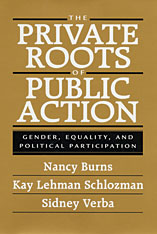
Why, after several generations of suffrage and a revival of the women's movement in the late 1960s, do women continue to be less politically active than men? Why are they less likely to seek public office or join political organizations? The Private Roots of Public Action is the most comprehensive study of this puzzle of unequal participation.
The authors develop new methods to trace gender differences in political activity to the nonpolitical institutions of everyday life--the family, school, workplace, nonpolitical voluntary association, and church. Different experiences with these institutions produce differences in the resources, skills, and political orientations that facilitate participation--with a cumulative advantage for men. In addition, part of the solution to the puzzle of unequal participation lies in politics itself: where women hold visible public office, women citizens are more politically interested and active. The model that explains gender differences in participation is sufficiently general to apply to participatory disparities among other groups--among the young, the middle-aged, and the elderly or among Latinos, African-Americans and Anglo-Whites.
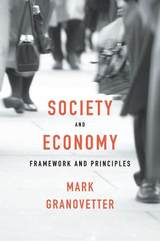
Society and Economy—a work of exceptional ambition by the founder of modern economic sociology—is the first full account of Mark Granovetter’s ideas about the diverse ways in which society and economy are intertwined.
The economy is not a sphere separate from other human activities, Granovetter writes. It is deeply embedded in social relations and subject to the same emotions, ideas, and constraints as religion, science, politics, or law. While some actions can be understood in traditional economic terms as people working rationally toward well-defined ends, much human behavior is harder to fit into that simple framework. Actors sometimes follow social norms with a passionate faith in their appropriateness, and at other times they conform without conscious thought. They also trust others when there is no obvious reason to do so. The power individuals wield over one another can have a major impact on economic outcomes, even when that power arises from noneconomic sources.
Although people depend on social norms, culture, trust, and power to solve problems, the guidance these offer is often murky and complicated. Granovetter explores how problem solvers improvise to assemble pragmatic solutions from this multitude of principles. He draws throughout on arguments from psychology, social network studies, and long-term historical and political analysis and suggests ways to maneuver back and forth among these approaches. Underlying Granovetter’s arguments is an attempt to move beyond such simple dualisms as agency/structure to a more complex and subtle appreciation of the nuances and dynamics that drive social and economic life.
Technological advance is the key driving force behind economic growth, argues Richard Nelson. Investments in physical and human capital contribute to growth largely as handmaidens to technological advance. Technological advance needs to be understood as an evolutionary process, depending much more on ex post selection and learning than on ex ante calculation. That is why it proceeds much more rapidly under conditions of competition than under monopoly or oligopoly.
Nelson also argues that an adequate theory of economic growth must incorporate institutional change explicitly. Drawing on a deep knowledge of economic and technological history as well as the tools of economic analysis, Nelson exposes the intimate connections among government policies, science-based universities, and the growth of technology. He compares national innovation systems, and explores both the rise of the United States as the world’s premier technological power during the first two-thirds of the twentieth century and the diminishing of that lead as other countries have largely caught up.
Lucid, wide-ranging, and accessible, the book examines the secrets of economic growth and why the U.S. economy has been anemic since the early 1970s.
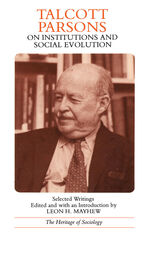
In his extensive introduction to this volume, Leon H. Mayhew brings a new focus and clarity to Talcott Parsons's work. Explicating Parsons on his own terms, Mayhew discusses the basic tools of Parsonian analysis and interprets the larger themes of his work. He provides a chronological account of the development of Parsons's thought, his presuppositions, and his position on the ideological spectrum of social thought.
Mayhew then presents twenty of Parsons's essays, touching on each of the major aspects of his work, including "action" theory and the celebrated four-function scheme. Other topics covered include the role of theory in social research, evolutionary universals in society, influence, control, and the mass media.
"Talcott Parsons on Institutions and Social Evolution will become a standard reference for those studying that development of his sociological ideas."—Martin Bulmer, The Times Higher Education Supplement
READERS
Browse our collection.
PUBLISHERS
See BiblioVault's publisher services.
STUDENT SERVICES
Files for college accessibility offices.
RECENTLY PUBLISHED







UChicago Accessibility Resources
home | accessibility | search | about | contact us
BiblioVault ® 2001 - 2024
The University of Chicago Press