
 A SCHOLARLY BOOK REPOSITORY
10 start with R start with R
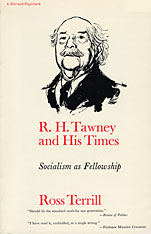
Economic historian, democratic socialist, educator, and British labor party activist, R. H. Tawney touched many worlds. His life, too, spanned great distance and change. When he was born in Calcutta in 1880, Gladstone, Tennyson, and Queen Victoria were flourishing and the British Empire was approaching its height. By the time of his death in 1962, the Empire had shrunk to a few tourist islands, and socialism, once so shocking, was now commonplace.
Ross Terrill, in this absorbing first study of Tawney’s thought, view his subject within three related contexts. The first is Tawney, the man. Terrill makes skillful use of unpublished material—the early diary, speech and lecture notes, letters, interviews with friends and associates—to tell the story of Tawney’s life in relation to his times. Second is social democracy. Tawney was one of its most influential philosophers and prophets, and this book argues for the continuing validity of his socialism as a path between capitalism and communism. Third is British politics. From Edwardian liberal “consensus” to mid-century collectivist “consensus,” Tawney’s long career, often at odds with prevailing orthodoxies, offers a window on British political culture.
Four key ideas are found in Tawney’s political thought: equality and the dispersion of power—the “shape of socialism”; function and citizenship—the “life of socialism.” These ideas, and indeed the life of the man himself, Terrill believes, are summed up in socialism as fellowship. “As long as men are men,” Tawney said, “a poor society cannot be too poor to find a right order of life, nor a rich society too rich to have need to seek it.”
This book is a blend of biography, history, and the study of political ideas. It provides a striking portrait of a remarkable man and a panorama of changing ideas and situations in the society where he tried to realize his socialist vision. It offers many glimpses of Tawney’s associates, among them Beveridge, the Webbs, Laski, A. P. Wadsworth, Temple, Margaret Cole, and Leonard Woolf; and surprising snippets, like the fact that Tawney used the phrase “private affluence and public squalor” in 1919.

With a focus on socialists, militant unionists, Wobblies, "Red" Finns, and Communists, The Red Coast covers the people, places, and events that made history-well-known events like the 1919 Armistice Day Tragedy in Centralia and the murders of labor activists William McKay and Laura Law in Aberdeen as well as lesser-known events that have been lost to posterity until now.
The Red Coast also delves deep into the lives and work of the region's anti-radical forces, examining the collective efforts of employers, news editors, and vigilantes to combat working-class organization. Topics include the Wobblies, the labor wars of the 1910s and 1930s, and the lumber and maritime industries. Labor historians, scholars, and general readers with interest in the working-class history of the Pacific Northwest will welcome this comprehensive and accessible account.
Kevin Floyd brings queer critique to bear on the Marxian categories of reification and totality and considers the dialectic that frames the work of Georg Lukács, Herbert Marcuse, and Fredric Jameson. Reading the work of these theorists together with influential queer work by such figures as Michel Foucault and Judith Butler, and alongside reconsiderations of such texts as The Sun Also Rises and Midnight Cowboy, Floyd reformulates these two central categories that have been inseparable from a key strand of Marxist thought and have marked both its explanatory power and its limitations. Floyd theorizes a dissociation of sexuality from gender at the beginning of the twentieth century in terms of reification to claim that this dissociation is one aspect of a larger dynamic of social reification enforced by capitalism.
Developing a queer examination of reification and totality, Kevin Floyd ultimately argues that the insights of queer theory require a fundamental rethinking of both.
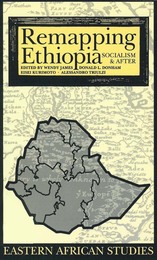
Governance everywhere is concerned with spatial relationships. Modern states “map” local communities, making them legible for the purposes of control. Ethiopia has gone through several stages of “mapping” in its imperial, revolutionary, and postrevolutionary phases.
In 1986 The Southern Marches of Imperial Ethiopia, a cross-disciplinary collection edited by Don Donham and Wendy James, opened up the study of center/periphery relations in the Ethiopian empire until the fall of the monarchy in 1974. This new volume examines similar themes, taking the story forward through the major changes effected by the socialist regime from the revolution of 1974 to its overthrow in 1991, and then into the current period that has been marked by moves toward local democracy and political devolution.
Topics include the changing fortunes of new and historic towns and cities, the impact of the Mengistu regime’s policies of villagization and resettlement, local aspects of the struggle against Mengistu and its aftermath, and the fate of border regions. Special attention is given to developments since 1991: to new local institutions and forms of autonomy, the links between the international diasporas of Ethiopia and the fortunes of their home areas. The collection draws on the work of established scholars as well as a new generation of Ethiopian and international researchers in the disciplines of anthropology, political science, history, and geography.
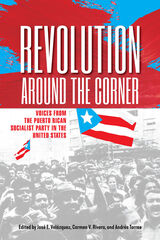
Active from the late 1960s until the mid-1990s, the U.S. branch of the Puerto Rican Socialist Party (PSP) worked simultaneously to build support for Puerto Rican independence and to engage in radical social change within the United States.
Revolution Around the Corner chronicles this unique social movement, describing various mass campaigns and the inner workings of the organization. The editors and contributors—all former members, leaders, and supporters of the PSP—offer a range of views and interpretations of their experience.
Combining historical accounts, personal stories, interviews, and retrospective analysis, Revolution Around the Corner examines specific actions such as the National Day of Solidarity (El Acto Nacional), the Bicentennial without Colonies, the Save Hostos struggle, and the Vieques campaign. Testimonies recount the pros and cons of membership diversity, as well as issues of loyalty and compañerismo. In addition, essays describe the PSP’s participation in coalitions and alliances with Left and progressive movements. The book concludes with the editors’ reflections on the PSP’s achievements, mistakes, and contributions.

This is an entirely new collection of Lenin's writing. For the first time it brings together crucial shorter works, to show that Lenin held a life-long commitment to freedom and democracy. Le Blanc has written a comprehensive introduction, which gives an accessible overview of Lenin's life and work, and explains his relevance to political thought today.
Lenin has been much maligned in the mainstream, accused of viewing 'man as modeling clay' and of 'social engineering of the most radical kind.' However, in contrast to today's world leaders, who happily turn to violence to achieve their objectives, Lenin believed it impossible to reach his goals 'by any other path than that of political democracy.'
This collection will be of immense value to students encountering Lenin for the first time, and those looking for a new interpretation of one of the 20th century's most inspiring figures.
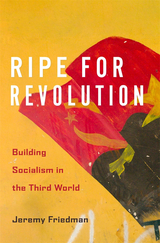
A historical account of ideology in the Global South as the postwar laboratory of socialism, its legacy following the Cold War, and the continuing influence of socialist ideas worldwide.
In the first decades after World War II, many newly independent Asian and African countries and established Latin American states pursued a socialist development model. Jeremy Friedman traces the socialist experiment over forty years through the experience of five countries: Indonesia, Chile, Tanzania, Angola, and Iran.
These states sought paths to socialism without formal adherence to the Soviet bloc or the programs that Soviets, East Germans, Cubans, Chinese, and other outsiders tried to promote. Instead, they attempted to forge new models of socialist development through their own trial and error, together with the help of existing socialist countries, demonstrating the flexibility and adaptability of socialism. All five countries would become Cold War battlegrounds and regional models, as new policies in one shaped evolving conceptions of development in another. Lessons from the collapse of democracy in Indonesia were later applied in Chile, just as the challenge of political Islam in Indonesia informed the policies of the left in Iran. Efforts to build agrarian economies in West Africa influenced Tanzania’s approach to socialism, which in turn influenced the trajectory of the Angolan model.
Ripe for Revolution shows socialism as more adaptable and pragmatic than often supposed. When we view it through the prism of a Stalinist orthodoxy, we miss its real effects and legacies, both good and bad. To understand how socialism succeeds and fails, and to grasp its evolution and potential horizons, we must do more than read manifestos. We must attend to history.
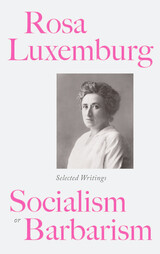
Rosa Luxemburg (1871-1919) was one of the most brilliant and passionate minds drawn to the revolutionary socialist movement. An outstanding social and economic theorist of the twentieth century, and a dedicated political activist, she proved willing to go to prison and even give her life for her beliefs.
Providing an extensive overview of her writings, this volume contains a number of items never before anthologised. Her work was broad in scope tackling capitalism and socialism; globalisation and imperialism; history; war and peace; social struggles, trade unions, political parties; class, gender, race; the interconnection of humanity with the natural environment. The editors provide an extensive and informative introduction outlining and evaluating her life and thought.
This is the most comprehensive introduction to the range of Rosa Luxemburg’s thought.
READERS
Browse our collection.
PUBLISHERS
See BiblioVault's publisher services.
STUDENT SERVICES
Files for college accessibility offices.
RECENTLY PUBLISHED




UChicago Accessibility Resources
home | accessibility | search | about | contact us
BiblioVault ® 2001 - 2024
The University of Chicago Press