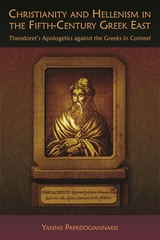
front cover of Christianity and Hellenism in the Fifth-Century Greek East
Christianity and Hellenism in the Fifth-Century Greek East
Theodoret’s Apologetics against the Greeks in Context
Yannis Papadogiannakis
Harvard University Press, 2012

This book—the first full-length study of the “last and most beautiful” apology against paganism, Theodoret’s Therapeutic for Hellenic Maladies—combines close readings of the text with detailed analysis of Theodoret’s arguments against Greek religion, philosophy, and culture and the ways in which that Greek influence interacts with other diverse ideas, practices, and developments in the fifth-century Roman empire.

The book’s larger underlying themes—the continuing debate between Christianity and Hellenism, and the relationship between classical and Christian literature—offer insights into more general late Roman and early Byzantine religious and cultural attitudes and issues, including the relations between pagan and Christian paideia, the cult of the martyrs, and the role of Christianity in the Roman empire.
[more]

front cover of The Correspondence of Theodoret of Cyrus
The Correspondence of Theodoret of Cyrus
The Collectio Sirmondiana, Volume 4
John F. Theodoret of Cyrus
Catholic University of America Press, 2025
Volumes 4 and 5 of the Library of Early Christianity, The Correspondence of Theodoret of Cyrus: The Collectio Sirmondiana, present a text and translation of the largest of three collections of Theodoret’s letters that have come down to us (first edited by the Jesuit father Jacques Sirmond, Paris 1642). Though pastor of the remote see of Cyrus in Syria, Theodoret was one of the major teachers of the eastern Christian church of the late fourth and early fifth century. These 147 letters place before us the myriad concerns, both spiritual and secular, of a late-antique bishop: Theodoret expounds theological and moral issues for fellow churchmen, begs imperial officials for tax relief for local landowners, provides for the sustenance and safety of refugees from the Vandal war in Africa, thanks a friend for a gift of wine. The edition of the Greek text is the work of John Petruccione. A textual introduction explains the relationships among the manuscripts, and the critical notes the choices made where the text is uncertain. The historical / theological introduction is the work of István Pásztori-Kupán, one of the foremost expositors of the thought of Theodoret and of his Antiochene predecessors and contemporaries. Two maps locate for the reader the place names mentioned in the letters, and three indices (a Scriptural Index, General Index, and Index of Modern Authors) complement the notes attached to the text and translation.
[more]

front cover of The Correspondence of Theodoret of Cyrus
The Correspondence of Theodoret of Cyrus
The Collectio Sirmondiana, Volume 4
John F. Theodoret of Cyrus
Catholic University of America Press, 2025
Volumes 4 and 5 of the Library of Early Christianity, The Correspondence of Theodoret of Cyrus: The Collectio Sirmondiana, present a text and translation of the largest of three collections of Theodoret’s letters that have come down to us (first edited by the Jesuit father Jacques Sirmond, Paris 1642). Though pastor of the remote see of Cyrus in Syria, Theodoret was one of the major teachers of the eastern Christian church of the late fourth and early fifth century. These 147 letters place before us the myriad concerns, both spiritual and secular, of a late-antique bishop: Theodoret expounds theological and moral issues for fellow churchmen, begs imperial officials for tax relief for local landowners, provides for the sustenance and safety of refugees from the Vandal war in Africa, thanks a friend for a gift of wine. The edition of the Greek text is the work of John Petruccione. A textual introduction explains the relationships among the manuscripts, and the critical notes the choices made where the text is uncertain. The historical / theological introduction is the work of István Pásztori-Kupán, one of the foremost expositors of the thought of Theodoret and of his Antiochene predecessors and contemporaries. Two maps locate for the reader the place names mentioned in the letters, and three indices (a Scriptural Index, General Index, and Index of Modern Authors) complement the notes attached to the text and translation.
[more]

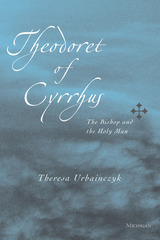
front cover of Theodoret of Cyrrhus
Theodoret of Cyrrhus
The Bishop and the Holy Man
Theresa Urbainczyk
University of Michigan Press, 2002
The writing of a saint's life can be as political as it is pious. In this, her second book, Theresa Urbainczyk demonstrates how one collection of saints' lives--the Religious History of Theodoret, bishop of Cyrrhus--both prescribes and describes the relationship between ascetics and the early Church.
With the conversion of Constantine and his subsequent championing of the Christian cause, the Church rapidly began to increase its wealth and status. As coins filled the coffers of God, some Christians came to feel that their religion had become corrupted. They fled to the desert wastes, seeking a purer, holier life. These recluses and ascetics are the subjects of Theodoret's Religious History. The Syrian bishop had known many of them, some for all his life.
Urbainczyk argues that Theodoret's work was not merely written as an act of piety, but was in fact a very political treatise, addressing the theological disputes of his day. The main tensions of the early fifth century lay between the sees of Syrian Antioch and Egyptian Alexandria. One of Theodoret's aims was to show that Syria had produced individuals as pious as those of Egypt, about whom much had already been written. Urbainczyk studies the social background of these Syrian ascetics, describes the relationship between Theodoret's heroes and the Church community, and investigates how Theodoret presents his own personal relationship with the holy men.
This book is the first to examine Theodoret's role in his own work. Urbainczyk argues that the intimate details of Theodoret's life were not let slip accidentally but were inserted deliberately to buttress his own threatened position and to show how these independent men of God deferred to no one but himself.
Theodoret of Cyrrhus is an invaluable study for students of late antiquity, scholars of early Church history, early medieval historiographers and hagiographers.
Theresa Urbainczyk is College Lecturer in Classics, University College, Dublin.
[more]


Send via email Share on Facebook Share on Twitter