
 A SCHOLARLY BOOK REPOSITORY
Results by Title
3 books about Women at
3 books about Women at

Labor Journalism, Labor Feminism
Women at the Federated Press
Victoria M. Grieve
University of Illinois Press, 2026
Founded in 1919, the Federated Press (FP) collected, compiled, and distributed news to America’s labor and radical newspapers. Victoria M. Grieve focuses on the lives and work of four correspondents and staffers—Jessie Lloyd, Julia Ruuttila, Virginia Gardner, and Miriam Kolkin—to examine the impact of women at the FP and across the labor movement.
These journalists wrote women into labor news by shedding light on essential issues like the need for equal pay and an end to discrimination. Their work increased women’s visibility in unions and the workforce while revealing that not only class but gender and race shaped their on-the-job experiences. Grieve also examines labor feminism within the larger stories of links between the Old Left and New Left and the FP’s pioneering role in articulating early iterations of intersectional feminism.
A compelling portrait of four women and a movement, Labor Journalism, Labor Feminism looks at an essential labor press organization and profiles politically active, leftist women who created relationships, established networks, and worked for social change.
These journalists wrote women into labor news by shedding light on essential issues like the need for equal pay and an end to discrimination. Their work increased women’s visibility in unions and the workforce while revealing that not only class but gender and race shaped their on-the-job experiences. Grieve also examines labor feminism within the larger stories of links between the Old Left and New Left and the FP’s pioneering role in articulating early iterations of intersectional feminism.
A compelling portrait of four women and a movement, Labor Journalism, Labor Feminism looks at an essential labor press organization and profiles politically active, leftist women who created relationships, established networks, and worked for social change.
[more]
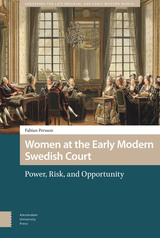
Women at the Early Modern Swedish Court
Power, Risk, and Opportunity
Fabian Persson
Amsterdam University Press, 2021
What was possible for a woman to achieve at an early modern court? By analysing the experiences of a wide range of women at the court of Sweden, this book demonstrates the opportunities open to women who served at, and interacted with, the court; the complexities of women's agency in a court society; and, ultimately, the precariousness of power. In doing so, it provides an institutional context to women's lives at court, charting the full extent of the rewards that they might obtain, alongside the social and institutional constrictions that they faced. Its longue durée approach, moreover, clarifies how certain periods, such as that of the queens regnant, brought new possibilities. Based on an extensive array of Swedish and international primary sources, including correspondence, financial records and diplomatic reports, it also takes into account the materialities used to create hierarchies and ceremonies, such as physical structures and spaces within the court. Comprehensive in its scope, the book is divided into three parts, which focus respectively on outsiders at court, insiders, and members of the royal family.
[more]

Women at The Hague
The International Congress of Women and Its Results
Jane Addams, Emily G. Balch, and Alice Hamilton
University of Illinois Press, 2003
In the midst of World War I, from April 28 to May 1, 1915, more than a thousand women from Europe and North America gathered in The Hague to discuss proposals for a peaceful end to the war. As one of the founders of the Woman's Peace Party, Jane Addams was among the attendees at the International Congress of Women, along with fellow social reformers and peace activists Emily G. Balch and Alice Hamilton. This book contains their journalistic accounts of the Congress's proceedings and results as well as their personal reflections on peace, war, politics, and the central role of women in the preservation of peace.
Following the conference in The Hague, Addams and Balch traveled around Europe as members of delegations visiting various governmental leaders to demand an end to the war. In this book they describe the activities of these delegations, painting a vivid portrait of the emerging women's peace movement.
With the continuing growth of the peace movement, the essays in Women at the Hague remain as timely as they were when first published in 1915. Addams, Balch, and Hamilton write compellingly about the organizing methods and collaborative spirit of the women's peace movement, conveying a strong awareness of the responsibility of women to protect the global community from the devastating effects of war.
Following the conference in The Hague, Addams and Balch traveled around Europe as members of delegations visiting various governmental leaders to demand an end to the war. In this book they describe the activities of these delegations, painting a vivid portrait of the emerging women's peace movement.
With the continuing growth of the peace movement, the essays in Women at the Hague remain as timely as they were when first published in 1915. Addams, Balch, and Hamilton write compellingly about the organizing methods and collaborative spirit of the women's peace movement, conveying a strong awareness of the responsibility of women to protect the global community from the devastating effects of war.
[more]
READERS
Browse our collection.
PUBLISHERS
See BiblioVault's publisher services.
STUDENT SERVICES
Files for college accessibility offices.
RECENTLY PUBLISHED



UChicago Accessibility Resources
home | accessibility | search | about | contact us
BiblioVault ® 2001 - 2025
The University of Chicago Press