Results by title
234 books match the query 'Americas (North, Central, South, West Indies)' and 25 start with a
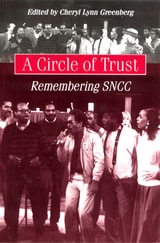
A Circle of Trust
Remembering SNCCGreenberg, Cheryl L
Rutgers University Press, 1998
"The reminiscences and reflections voiced at the SNCC reunion remind us of the remarkable vision and courageous dedication of the civil rights movement of the 1960s. Framed by Cheryl Greenberg's eloquent and probing introduction, the SNCC veterans' comments about the triumphs and limitations of their movement represent a major contribution to the historical literature on race and power in modern America." --Raymond Arsenault, University of South Florida
On the occasion of the SNCC's 25th anniversary, more than 500 people gathered at Trinity College in Connecticut to both celebrate and critique its accomplishments. More than 40 SNCC members tell their stories and reflect on the contributions, limits and legacies of the movement in A Circle of Trust. Engaging in spirited debate with each other, with historians of the movement, and with contemporary political culture more broadly, these former and perpetual activists speak of their vision of a just society and what still remains to be done. With increasing racial tension and the continued debate over integration and separatism in America in the 1990s, the content of this conference is more relevant than ever.
Cheryl Lynn Greenberg begins with an overview of SNCC and introduces each of the chapters of oral history. Participants explore the origins of SNCC, its early adoption of nonviolent protest, its ultimate renunciation of liberal integration and embrace of militant black radicalism, its refusal to repudiate far-left organizations, and controversies over the roles of women in SNCC and society at large. The result is a thoughtful, moving, sometimes acrimonious, sometimes celebratory account of one of the most significant civil rights organizations and its successes and failures.
A Dutch Family in the Middle Colonies
1660-1880Firth Haring Fabend
Rutgers University Press, 1991
As she traces the lives of the Harings and their neighbors, Fabend focuses on their marriage and childbearing patterns, living conditions, agricultural methods, and relative economic position. She investigates inheritance patterns, concluding that the position of women deteriorated under English law. She is equally interested in the political and religious life of the family. The Harings formed a church fitting their Pietist beliefs, and this church became central to community life. Their theology encouraged them to question religious authority, which in turn fostered the questioning of political authority. Their community became a seedbed for revolutionary activity. Fabend examines the family's position in the Revolution--primarily patriot--and the losses they suffered in that conflict.
The Harings of colonial America were ideal yeoman farmers, a class that stood well in the social hierarchy of the day. They were industrious, they prospered, and they participated in the civic life of colonial America. But once the new republic formed, they were not very visible. Fabend argues that they maintained their "Dutchness" more consciously than ever after the Revolution, which hindered their full participation in public affairs. In some ways, the fifth and sixth generations were more Dutch than the early generations.
A Firm Peace and Sincere Friendship?
Four Centuries Dutch-American StoriesJaap Jacobs
Amsterdam University Press, 2026
This book begins in the seventeenth century, when settlers commissioned by the West India Company settled on the south side of Manhattan and started a settlement that grew first into New Amsterdam and later into New York City. In 2024, both the Netherlands and the United States will commemorate these beginnings through commemorations, exhibitions, conferences and high-level Dutch visits to New York. 2024 is therefore a prime opportunity to tell the stories of the people who crossed the ocean and shaped the relationship between the Netherlands and the United States, and with New York in particular. The stories have a human touch, an emphasis on the individual as the bearer of one culture interacting with another. Feelings of admiration, liberation, expectation and hope play an important role in the stories. But there are also negative sides to Dutch-American history, for instance when it comes to the relationship with Native Americans and the Dutch role in American slavery. It is not going to be exclusively jubilant: success stories alternate with black pages here.
A Great Fear
Luís de Onís and the Shadow War against Napoleon in Spanish America, 1808–1812Timothy Hawkins
University of Alabama Press, 2019
A Great Fear: Luís de Onís and the Shadow War against Napoleon in Spanish America, 1808–1812 explores why Spanish Americans did not take the opportunity to seize independence in this critical period when Spain was overrun by French armies and, arguably, in its weakest state. In the first years after his appointment as Spanish ambassador to the United States, Luís de Onís claimed the heavy responsibility of defending Spanish America from the wave of French spies, subversives, and soldiers whom he believed Napoleon was sending across the Atlantic to undermine the empire.
As a leading representative of Spain’s loyalist government in the Americas, Onís played a central role in identifying, framing, and developing what soon became a coordinated response from the colonial bureaucracy to this perceived threat. This crusade had important short-term consequences for the empire. Since it paralleled the emergence of embryonic independence movements against Spanish rule, colonial officials immediately conflated these dangers and attributed anti-Spanish sentiment to foreign conspiracies.
Little direct evidence of Napoleon’s efforts at subversion in Spanish America exists. However, on the basis of prodigious research, Hawkins asserts that the fear of French intervention mattered far more than the reality. Reinforced by detailed warnings from Ambassador Onís, who found the United States to be the staging ground for many of the French emissaries, colonial officials and their subjects became convinced that Napoleon posed a real threat. The official reaction to the threat of French intervention increasingly led Spanish authorities to view their subjects with suspicion, as potential enemies rather than allies in the struggle to preserve the empire. In the long term, this climate of fear eroded the legitimacy of the Spanish Crown among Spanish Americans, a process that contributed to the unraveling of the empire by the 1820s.
This study draws on documents and official records from both sides of the Hispanic Atlantic, with extensive research conducted in Spain, Guatemala, Argentina, and the United States. Overall, it is a provocative interpretation of the repercussions of Napoleonic intrigue and espionage in the New World and a stellar examination of late Spanish colonialism in the Americas.
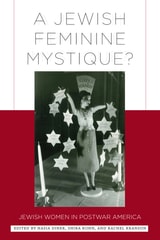
A Jewish Feminine Mystique?
Jewish Women in Postwar AmericaEdited by Hasia R. Diner, Shira Kohn, and Rachel Kranson
Rutgers University Press, 2010
As workers with or without pay, social justice activists, community builders, entertainers, and businesswomen, most Jewish women championed responsibilities outside their homes. Jewishness played a role in shaping their choices, shattering Friedan's assumptions about how middle-class women lived in the postwar years. Focusing on ordinary Jewish women as well as prominent figures such as Judy Holliday, Jennie Grossinger, and Herman Wouk's fictional Marjorie Morningstar, leading scholars explore the wide canvas upon which American Jewish women made their mark after the Second World War.
A Peregrine Ethnography
Reinterpreting Francisco Garcés’s Diary of Native Arizona and the Californias, 1775–1776Translated and Edited by Peter M. Whiteley
University of Arizona Press, 2026
In 1775–1776, Francisco Garcés, O.F.M., undertook a remarkable three-thousand-kilometer journey through modern Arizona and the Californias. As a participant in a side-branch of Juan Bautista de Anza’s colonizing expedition to San Francisco, Garcés recorded a diary that provides a fascinating glimpse of Native peoples, several who had minimal or no prior contact with the Spanish empire. Garcés described customs, detailed alliances and enmities, and offered recommendations, both missionary and military. When he reached Hopi from the west (the first European to do so), Garcés completed a route between Monterey and Santa Fe, in effect completing a road across North America a generation before Lewis and Clark. The Hopi leaders, who clearly understood the implications, expelled him, declaring their independence on July 4, 1776.
Garcés’s diary remains vital for the Indigenous history of western North America. Yet the standard translation is flawed, not least owing to the state of ethnographic knowledge when it was made (1900), resulting in more than a century of reiterated misinterpretations of Indigenous history by anthropologists and historians. Peter M. Whiteley identifies the ur-version of Garcés's diary—a previously unknown copy written up by Pedro Font—and offers a new translation focusing on ethnographic significance in geographic context. Presenting also the Spanish text, Whiteley engages directly with Garcés’s account and provides readers with new interpretation and context.
Garcés was a genuine ethnographer and his accounts of Hopi, River Yumans, Takic, Yokuts, Numic, and Pai peoples, contain unparalleled and foundational insights.
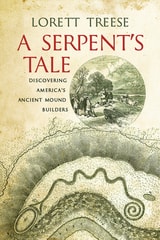
A Serpent's Tale
Discovering America's Ancient Mound BuildersLorett Treese
Westholme Publishing, 2016
When American settlers first crossed the Appalachian Mountains they were amazed to discover that the wilderness beyond contained ancient ruins—large man-made mounds and enclosures, and impressive earthen sculptures, such as a gigantic serpent. Reports trickled back to the eager ears of President Thomas Jefferson and others. However, most did not believe these earthworks had anything to do with Native Americans; rather, given the intense interest in the history of Western Civilization at the time, it became popular to speculate that the ruins had been built by refugees from Greece, Rome, Egypt—or even the lost continent of Atlantis. Since their discovery, the mounds have attracted both scholars and quacks, from the early investigations sponsored by the then new Smithsonian Institution to the visions of the American psychic Edgar Cayce.
As Lorett Treese explains in her fascinating history A Serpent’s Tale: Discovering America’s Ancient Mound Builders, the enigmatic nature of these antiquities fueled both fanciful claims and scientific inquiry. Early on, the earthworks began to fall to agricultural and urban development. Realizing that only careful on-site investigation could reveal the mysteries of the mounds, scholars hastened to document and classify them, giving rise to American archaeology as a discipline. Research made it possible to separate the Mound Builders into three distinct pre-contact Native American cultures. More recently, Mound Builder remains have attracted the practitioners of new disciplines like archaeoastronomy who suggest they may have functioned as calendars. There is no doubt that the abandoned monuments that made the Midwest’s Ohio Valley the birthplace of American archaeology have yet to reveal all the knowledge they contain on the daily lives and world views of persons of North American prehistory.

A Short History of Canada for Americans
Alfred Leroy Burt
University of Minnesota Press, 1942
A Short History of Canada for Americans was first published in 1942. Minnesota Archive Editions uses digital technology to make long-unavailable books once again accessible, and are published unaltered from the original University of Minnesota Press editions.
ANY FRIEND OF THE MOVEMENT
NETWORKING FOR BIRTH CONTROL 1920-1940JIMMY ELAINE WILKINS MEYER
The Ohio State University Press, 2004
Acts of Possession
Collecting in AmericaDilworth, Leah
Rutgers University Press, 2003
Drawing upon the body of theoretical work on collecting and focusing on individual as opposed to museum collections, the contributors investigate how, what, and why Americans have collected and explore the inherent meanings behind systems of organization and display. Essays consider the meanings of Thomas Jefferson's Indian Hall at Monticello; the pedagogical theories behind nineteenth-century children's curiosity cabinets; collections of Native American artifacts; and the ability of the owners of doll houses to construct meaning within the context of traditional ideals of domesticity.
The authors also consider some darker aspects of collecting-hoarding, fetishism, and compulsive behavior-scrutinizing collections of racist memorabilia and fascist propaganda. The final essay posits the serial killer as a collector, an investigation into the dangerous objectification of humans themselves.
By bringing fresh, interdisciplinary critical perspectives to bear on these questions, Dilworth and her coauthors weave a fascinating cultural history of collecting in America.
Africans to Spanish America
Expanding the DiasporaEdited by Sherwin K. Bryant, Rachel Sarah O’Toole, & Ben Vinson III
University of Illinois Press, 2014
Contributors are Joan C. Bristol, Nancy E. van Deusen, Leo J. Garofalo, Herbert S. Klein, Charles Beatty-Medina, Karen Y. Morrison, Rachel Sarah O'Toole, Frank "Trey" Proctor III, and Michele Reid-Vazquez.
Afrodescendants, Identity, and the Struggle for Development in the Americas
Bernd Reiter
Michigan State University Press, 2012
Indigenous people and African descendants in Latin America and the Caribbean have long been affected by a social hierarchy established by elites, through which some groups were racialized and others were normalized. Far from being “racial paradises” populated by an amalgamated “cosmic race” of mulattos and mestizos, Latin America and the Caribbean have long been sites of shifting exploitative strategies and ideologies, ranging from scientific racism and eugenics to the more sophisticated official denial of racism and ethnic difference. This book, among the first to focus on African descendants in the region, brings together diverse reflections from scholars, activists, and funding agency representatives working to end racism and promote human rights in the Americas. By focusing on the ways racism inhibits agency among African descendants and the ways African-descendant groups position themselves in order to overcome obstacles, this interdisciplinary book provides a multi-faceted analysis of one of the gravest contemporary problems in the Americas.
All God's Dangers
The Life of Nate ShawTheodore Rosengarten
University of Chicago Press, 2000

America, the Dream of My Life
Selections from the Federal Writers' Project's New Jersey Ethnic SurveyCohen, David Steven
Rutgers University Press, 1990
American Ethnic History
Themes and PerspectivesMcDonald, Jason J
Rutgers University Press, 2007
Chapters explore a range of topics, including how different ethnic groups arrived in the United States—whether through violence and coercion or willing immigration; the peculiar identification of Native Americans as “ethnic,” despite the fact that they are indigenous to the land; whether the American public’s attitudes toward and treatment of difference has been consistent with the nation’s professed egalitarian ideals; and how factors such as language, religion, class, gender, and intermarriage play in either strengthening or weakening ethnic identity and group solidarity.
An engaging and critical look at a term that remains stubbornly ambiguous in both scholarly discussion and the vernacular, this book makes an important contribution to the ongoing debates about “difference” in American society.
American Folklore
Richard M. Dorson
University of Chicago Press, 1961
Tracing the forms and content of American folklore, Mr. Dorson reveals the richness, pathos, and humor of genuine folklore, which he distinguishes from the "fakelore" of popularizers and chauvinists. At the same time, however, he shows what the creation of spurious folklore (the Paul Bunyan legends, for instance) discloses about our national character. Based upon authentic field collections and research, the examples cited include folkways, jests, boasts, tall tales, ballads, folk and legendary heroes.
"His volume enlarges our understanding of the American past and present through an empirical survey of the extant folk traditions and it also provides us with the means for appreciating what is valuable in these folk traditions."—Virginia Quarterly Review
American Labor and the Cold War
Grassroots Politics and Postwar Political CultureCherny, Robert
Rutgers University Press, 2004
The American labor movement seemed poised on the threshold of unparalleled success at the beginning of the post-World War II era. Fourteen million strong in 1946, unions represented thirty five percent of non-agricultural workers. Why then did the gains made between the 1930s and the end of the war produce so few results by the 1960s?
This collection addresses the history of labor in the postwar years by exploring the impact of the global contest between the United States and the Soviet Union on American workers and labor unions. The essays focus on the actual behavior of Americans in their diverse workplaces and communities during the Cold War. Where previous scholarship on labor and the Cold War has overemphasized the importance of the Communist Party, the automobile industry, and Hollywood, this book focuses on politically moderate, conservative workers and union leaders, the medium-sized cities that housed the majority of the population, and the Roman Catholic Church. These are all original essays that draw upon extensive archival research and some upon oral history sources.
American Multiculturalism and the Anti-Discrimination Regime
The Challenge to Liberal PluralismThomas F. Powers
St. Augustine's Press, 2023
An Account of the Antiquities of the Indians
A New Edition, with an Introductory Study, Notes, and Appendices by José Juan ArromFray Ramon Pané
Duke University Press, 1999
Edited by the noted Hispanist José Juan Arrom, Pané’s report is the only surviving direct source of information about the myths, ceremonies, and lives of the New World inhabitants whom Columbus first encountered. The friar’s text contains many linguistic and cultural observations, including descriptions of the Taíno people’s healing rituals and their beliefs about their souls after death. Pané provides the first known description of the use of the hallucinogen cohoba, and he recounts the use of idols in ritual ceremonies. The names, functions, and attributes of native gods; the mythological origin of the aboriginal people’s attitudes toward sex and gender; and their rich stories of creation are described as well.
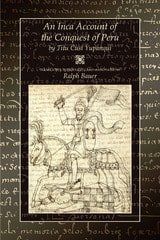
An Inca Account of the Conquest of Peru
Titu Cusi Yupanqui
University Press of Colorado, 2005
Titu Cusi tells of his father's maltreatment at the hands of the conquerors; his father's ensuing military campaigns, withdrawal, and murder; and his own succession as ruler. Although he continued to resist Spanish attempts at "pacification," Titu Cusi entertained Spanish missionaries, converted to Christianity, and then, most importantly, narrated his story of the conquest to enlighten Emperor Phillip II about the behavior of the emperor's subjects in Peru. This vivid narrative illuminates the Incan view of the Spanish invaders and offers an important account of indigenous resistance, accommodation, change, and survival in the face of the European conquest.
Informed by literary, historical, and anthropological scholarship, Bauer's introduction points out the hybrid elements of Titu Cusi's account, revealing how it merges native Andean and Spanish rhetorical and cultural practices. Supported in part by the Colorado Endowment for the Humanities.
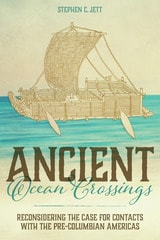
Ancient Ocean Crossings
Reconsidering the Case for Contacts with the Pre-Columbian AmericasStephen C. Jett
University of Alabama Press, 2017
In Ancient Ocean Crossings: Reconsidering the Case for Contacts with the Pre-Columbian Americas, Stephen Jett encourages readers to reevaluate the common belief that there was no significant interchange between the chiefdoms and civilizations of Eurasia and Africa and peoples who occupied the alleged terra incognita beyond the great oceans.
More than a hundred centuries separate the time that Ice Age hunters are conventionally thought to have crossed a land bridge from Asia into North America and the arrival of Columbus in the Bahamas in 1492. Traditional belief has long held that earth’s two hemispheres were essentially cut off from one another as a result of the post-Pleistocene meltwater-fed rising oceans that covered that bridge. The oceans, along with arctic climates and daunting terrestrial distances, formed impermeable barriers to interhemispheric communication. This viewpoint implies that the cultures of the Old World and those of the Americas developed independently.
Drawing on abundant and concrete evidence to support his theory for significant pre-Columbian contacts, Jett suggests that many ancient peoples had both the seafaring capabilities and the motives to cross the oceans and, in fact, did so repeatedly and with great impact. His deep and broad work synthesizes information and ideas from archaeology, geography, linguistics, climatology, oceanography, ethnobotany, genetics, medicine, and the history of navigation and seafaring, making an innovative and persuasive multidisciplinary case for a new understanding of human societies and their diffuse but interconnected development.
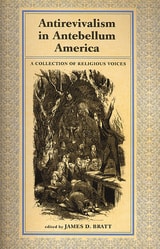
Antirevialism in Antebellum America
A Collection of Religious VoicesBratt, James D
Rutgers University Press, 2005
But revivalism has always generated opposition, too, even in its century of glory. In Anti-Revivalism in Antebellum America, James D. Bratt offers extensive introductions to primary anti-revivalist documents. These works range from the Philadelphia Methodist John F. Watson's protests against camp meetings in 1819, to Elizabeth Cady Stanton's "Eighty Years and More," written in 1898, in which she recalls her youthful encounter with revival preaching and her rebound into political activism and religious agnosticism. Through the recovered voices of antebellum religious critics, Bratt shows how American culture was already being reshaped a generation before the Civil War and how evangelical religion stood at the center of a "culture war."
If revivals typified the era when Americans launched and defined their new nation, then objections to these revivals embodied the growing discontent at what the nation had become. An important and long overdue collection, this book urges an understanding of anti-revival literature both in the context of the era when it emerged as well as in terms of the broader dynamic of American life.
Includes selections from Orestes Brownson, Horace Bushnell, Calvin Colton, Orville Dewey, Albert Baldwin Dod, George Elley, Charles G. Finney, John Williamson Nevin, Stephen Olin, Phoebe Palmer, Daniel Alexander Payne, Ephraim Perkins, Elizabeth Cady Stanton, Joseph Smith, Harriet Beecher Stowe, La Roy Sunderland, John Fanning Watson, Ellen G. White, and Friedrich C. D. Wyneken.

Are We One?
Jewish Identity in the United States and IsraelAuerbach, Jerold S
Rutgers University Press, 2001
What binds together Jews of Israel and the United States? Amid the hope and frustration generated by the Middle East peace process, the meaning of Jewish statehood is more vigorously contested than ever before. A secular democratic Israel, responsive to Western liberal values, is prepared to make peace with the Palestinians by sacrificing its own historic homeland. But a covenantal Israel, which draws its Jewish identity from divine promise and the biblical narrative, refuses to surrender to modern imperatives. As the very nature of Jewish statehood has become ever more polarized, American Jewish life has been profoundly affected by this fateful Zionist contradiction.
In Are We One? Jerold S. Auerbach presents a surprising new interpretation of this contemporary Jewish dilemma. The modern Jewish impulse to embrace Western values, he writes, exacts a terrible price. He offers a critical reassessment of Zionism, a challenging analysis of the sources of the identification of American Jews with Israel—and a gloomy prognosis of the future of Jewish life, both in Israel and the United States.
In a ringing indictment that is sure to spark controversy, he states that the eagerness of secular Israelis to import American culture reflects their sweeping rejection of Jewish and Zionist values. Indeed, the diminishing number of Israelis who actually remain faithful to Jewish religious and historical imperatives are denigrated as fundamentalist zealots by Israeli and American Jews alike. Present-day Israel now exhibits such Jewish self-loathing, he states, that it has depleted its own ability to inspire world Jewry.
In a groundbreaking book that draws upon original historical analysis and extensive personal experience in Israel, Auerbach invites readers to consider the debilitating consequences of an adulterated Jewish identity in Israel and in the United States for the very future of Judaism.
Arms and Men
A Study in American Military HistoryMillis, Walter
Rutgers University Press, 1981
--Richard H. Kohn
"In my opinion Arms and Men is a splendid piece of work, clearly organized, well argued and beautifully written. We have long needed an informed and intelligent commentary on the evolution of American military policy; and in Mr. Millis' book we have it. I think that his book will awaken great interest and be widely used. I am sure also that professional students of the subject will find it possible, after reading this book, to see the course of American military affairs with a new perspective. That is one of the great services performed by Mr. Millis. He has covered the whole subject with authority, but - thank heaven - in a short book, in which the arguments are not blunted by unnecessary detail."
--Gordon A. Craig
"This author knows weapons, politics and human nature. His perceptive grasp of these complexes shines in the writing."
--The New York Times
As Others See Chicago
Impressions of Visitors, 1673-1933Bessie Louise Pierce
University of Chicago Press, 2004
First published in 1933 by the University of Chicago Press to mark the occasion of the Century of Progress Exhibition, As Others See Chicago consists of writings culled from over a thousand men and women who visited the city and commented on the best and worst it had to offer, from the skyscrapers to the stockyards. Originally compiled by Bessie Louise Pierce, the first major historian of Chicago, and featuring her own incisive commentary, the volume brings together the impressions of visitors to Chicago over two and a half centuries, from the early years of Westward Expansion to the height of the Great Depression. In addition to writings from better known personalities such as Rudyard Kipling and Waldo Frank, the book collects the opinions of missionaries, aristocrats, journalists, and politicians—observers who were perfectly placed to comment on the development of the city, its inhabitants, and well known events that would one day define Chicago history, such as the Great Fire of 1871 and the 1893 World's Fair.
Taking us back to a time when Chicago was "more astonishing than the wildest visions of the most vagrant imaginations," As Others See Chicago offers an enthralling portrait of an enduring American metropolis.