Results by title
733 books match the query 'Environmental Conservation & Protection' and 58 start with a
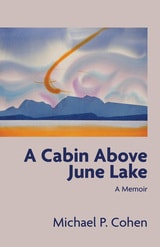
A Cabin Above June Lake
A MemoirMichael P. Cohen
University of Nevada Press, 2027
What does it mean to belong to a place that can never belong to you?
Set in the high country above June Lake on the eastern slope of the Sierra Nevada, this reflective narrative explores the enduring relationship between people and landscape. From their modest cabin near the headwaters of Reversed Creek, Michael and Valerie Cohen look across June Lake toward the vast expanse of the Great Basin. They are drawn to the region by its beauty and solitude, and the conviction that they are exactly where they ought to be.
Yet living in a place also means witnessing its transformation. Over nearly fifty years, the Cohens observe changes that reshape the Mono Basin and surrounding mountains: shifting economies, expanding development, record-breaking winters, wildfire threats, and the gradual erosion of community traditions.
Part memoir, part environmental reflection, part cultural history, this meditative narrative draws on writers and thinkers such as Ralph Waldo Emerson, Aldo Leopold, and Lew Welch. The Cohens’ efforts to maintain an aging cabin and a life together become a lens through which to examine stewardship, memory, resilience, and loss. This meditation on place returns to a question that has occupied generations of writers and naturalists: As the world continually reinvents itself, how must those who live within it respond?
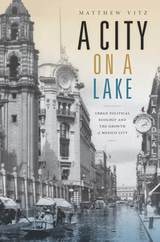
A City on a Lake
Urban Political Ecology and the Growth of Mexico CityMatthew Vitz
Duke University Press, 2018

A Favored Place
San Juan River Wetlands, Central Veracruz, A.D. 500 to the PresentBy Alfred H. Siemens
University of Texas Press, 1998
The wetlands of the San Juan Basin in Central Veracruz, Mexico, have been a favored place since the fifth century A.D., when Prehispanic people built an extensive network of canals and raised fields that allowed for almost year-round agriculture. Alfred Siemens' discovery of the remains of this network in the 1970s led him to uncover fifteen centuries of land-use history in the region. This book contains a full record of his findings.
Siemens organizes his history of the San Juan Basin around the question: What relationships exist between Prehispanic agriculture and the production systems of the tropical lowlands in our own time? This focus allows him to chart the changes in human perceptions and uses of the landscape, from the Prehispanic wetland agricultural system to the drained pastures of today's cattle ranches.
Amplified with air oblique photography, maps, and tables, and enriched with data from archaeology and colonial archives, this is an authoritative historical geography of a wetland landscape. Or, in the author's more modest words, "It seems to me that what I have here is a biography of a swamp."
A Field on Fire
The Future of Environmental HistoryEdited by Mark D. Hersey and Ted Steinberg
University of Alabama Press, 2019
Inspired by the pioneering work of preeminent environmental historian Donald Worster, the contributors to A Field on Fire: The Future of Environmental History reflect on the past and future of this discipline. Featuring wide-ranging essays by leading environmental historians from the United States, Europe, and China, the collection challenges scholars to rethink some of their orthodoxies, inviting them to approach familiar stories from new angles, to integrate new methodologies, and to think creatively about the questions this field is well positioned to answer.
Worster’s groundbreaking research serves as the organizational framework for the collection. Editors Mark D. Hersey and Ted Steinberg have arranged the book into three sections corresponding to the primary concerns of Worster’s influential scholarship: the problem of natural limits, the transnational nature of environmental issues, and the question of method. Under the heading “Facing Limits,” five essays explore the inherent tensions between democracy, technology, capitalism, and the environment. The “Crossing Borders” section underscores the ways in which environmental history moves easily across national and disciplinary boundaries. Finally, “Doing Environmental History” invokes Worster’s work as an essayist by offering self-conscious reflections about the practice and purpose of environmental history.
The essays aim to provoke a discussion on the future of the field, pointing to untapped and underdeveloped avenues ripe for further exploration. A forward thinker like Worster presents bold challenges to a new generation of environmental historians on everything from capitalism and the Anthropocene to war and wilderness. This engaging volume includes a very special afterword by one of Worster’s oldest friends, the eminent intellectual historian Daniel Rodgers, who has known Worster for close to fifty years.
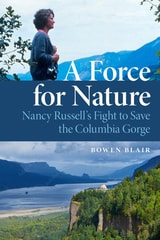
A Force for Nature
Nancy Russell's Fight to Save the Columbia GorgeBowen Blair
Oregon State University Press, 2022
The 85-mile-long Columbia Gorge forms part of the border between Oregon and Washington and is one of the nation’s most historic and scenic landscapes. Many of the region’s cultural divisions boil over here—urban versus rural, west of the mountains versus east—as well as clashes over private property rights, management of public lands, and tribal treaty rights.
In the early 1980s, as a new interstate bridge linked the City of Portland to rural counties in Washington, the Gorge’s renowned vistas were on the brink of destruction. Nancy Russell, forty-eight years old and with no experience in advocacy, fundraising, or politics, built a grassroots movement that overcame 70 years of failed efforts and bitter opposition from both Oregon and Washington governors, five of the six Gorge counties, 41,000 Gorge residents, and the Reagan administration. While building her campaign, Russell stopped subdivisions, factories, and government neglect through litigation brought by her organization, Friends of the Columbia Gorge, and last-second land purchases by the Trust for Public Land (TPL). Initially ignored, then demonized, Russell’s tires were slashed and her life threatened.
The Columbia River Gorge National Scenic Area Act barely passed—on the last day of the congressional session in 1986—and was signed by a reluctant President Reagan hours before the bill would die. Russell positioned the Friends to be a watchdog and orchestrated the purchase of thousands of acres of land for the public. Bowen Blair, an attorney, former executive director of Friends of the Columbia Gorge, and TPL senior vice president, brings an insider’s perspective to the tumultuous and inspiring story of this conservation battle.
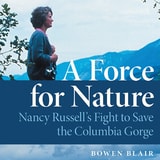
A Force for Nature
Nancy Russell's Fight to Save the Columbia GorgeBowen Blair
Oregon State University Press, 2022
The 85-mile-long Columbia Gorge forms part of the border between Oregon and Washington and is one of the nation’s most historic and scenic landscapes. Many of the region’s cultural divisions boil over here—urban versus rural, west of the mountains versus east—as well as clashes over private property rights, management of public lands, and tribal treaty rights.
In the early 1980s, as a new interstate bridge linked the City of Portland to rural counties in Washington, the Gorge’s renowned vistas were on the brink of destruction. Nancy Russell, forty-eight years old and with no experience in advocacy, fundraising, or politics, built a grassroots movement that overcame 70 years of failed efforts and bitter opposition from both Oregon and Washington governors, five of the six Gorge counties, 41,000 Gorge residents, and the Reagan administration. While building her campaign, Russell stopped subdivisions, factories, and government neglect through litigation brought by her organization, Friends of the Columbia Gorge, and last-second land purchases by the Trust for Public Land (TPL). Initially ignored, then demonized, Russell’s tires were slashed and her life threatened.
The Columbia River Gorge National Scenic Area Act barely passed—on the last day of the congressional session in 1986—and was signed by a reluctant President Reagan hours before the bill would die. Russell positioned the Friends to be a watchdog and orchestrated the purchase of thousands of acres of land for the public. Bowen Blair, an attorney, former executive director of Friends of the Columbia Gorge, and TPL senior vice president, brings an insider’s perspective to the tumultuous and inspiring story of this conservation battle.
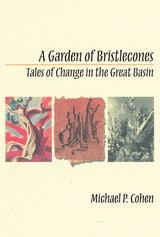
A Garden Of Bristlecones
Tales Of Change In The Great BasinMichael P. Cohen
University of Nevada Press, 1998
An engaging, well-illustrated natural and cultural history of the oldest living organism—the bristlecone pine. Since Edmund Schulman discovered in 1958 that individual bristlecones live nearly 5,000 years, the trees have been investigated primarily for the elaborate record their rings contain. The trees have been "read' closely, with major consequences for natural and human history. Historians have read local and global environmental change. Archaeologists have rewritten the history of civilization. Writers have transformed them into figures pertinent to the human dilemmas of time and eternity. A Garden of Bristlecones investigates professional and popular conceptions as a set of narratives drawn from the outside and inside of the trees. It reveals the premises of the investigators, the nature of their inquiry, and the extent of their knowledge, while also revealing the Great Basin bristlecone itself. Illustrations by Valerie Cohen.
A Good That Transcends
How US Culture Undermines Environmental ReformEric T. Freyfogle
University of Chicago Press, 2017
A lawyer by training, with expertise in property rights, Freyfogle uses his legal knowledge to demonstrate that bad land use practices are rooted in the way in which we see the natural world, value it, and understand our place within it. While social and economic factors are important components of our current predicament, it is our culture, he shows, that is driving the reform crisis—and in the face of accelerating environmental change, a change in culture is vital. Drawing upon a diverse array of disciplines from history and philosophy to the life sciences, economics, and literature, Freyfogle seeks better ways for humans to live in nature, helping us to rethink our relationship with the land and craft a new conservation ethic. By confronting our ongoing resistance to reform as well as pointing the way toward a common good, A Good That Transcends enables us to see how we might rise above institutional and cultural challenges, look at environmental problems, appreciate their severity, and both support and participate in reform.
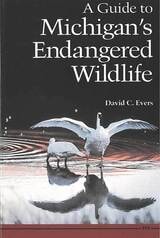
A Guide to Michigan's Endangered Wildlife
David C. Evers
University of Michigan Press, 1992
A Keener Perception
Ecocritical Studies in American Art HistoryEdited by Alan C. Braddock and Christoph Irmsher
University of Alabama Press, 2009
Issues of ecology--both as they appear in the works of nature writers and in the works of literary writers for whom place and the land are central issues--have long been of interest to literary critics, and have given rise over the last two decades to the now firmly established field of ecocriticism. The essays in this volume, written by art historians and literary critics, seek to bring the study of American art into the expanding discourse of ecocriticism.
A Keener Perception offers a series of case studies on topics ranging from John White's watercolors of the Carolina landscape executed during Sir Walter Raleigh's 1585 Roanoke expedition to photographs by environmental activist Eliot Porter. Rather than merely resurrect past instances of ecologically attuned art, this volume features essays that resituate many canonical figures, such as Thomas Eakins, Aaron Douglas, and Thomas Cole, in an ecocritical light by which they have yet to be viewed. Studying such artists and artworks through an ecocritical lens not only provides a better understanding of these works and the American landscape, but also brings a new interpretive paradigm to the field of art history--a field that many of these critics believe would do well to embrace environmental concerns as a vital area of research.
In highlighting the work of scholars who bring ecological agendas to their study of American art, as well as providing models for literary scholars who might like to better incorporate the visual arts into their own scholarship and teaching, A Keener Perception is truly a landmark collection--timely, consequential, and controversial.
A Meeting at the Mighty Mac
Alia Kirsch
Michigan Publishing Services, 2023
A Movement of the People
The Roots of Environmental Education and Advocacy in AlabamaKatie Lamar Jackson, Foreword by David Mathews
University of Alabama Press, 2017
A Movement of the People: The Roots of Environmental Education and Advocacy in Alabama is a detailed history of the Alabama Environmental Quality Association (AEQA). The AEQA helped to establish groundbreaking environmental protection and natural resource preservation policies for the state and the region and grew into one of the nation’s most progressive environmental education efforts.
The AEQA began in 1966 with the relatively simple political action agenda of cleaning up unsightly and unsanitary roadside trash. These inspired citizens collaborated with civic leaders to identify and remove illegal rural dumps and create more regulated landfills statewide. Eventually they became involved in the “Keep America Beautiful” campaign and with the US Public Health Service in its attempt to rid the state of the yellow-fever mosquito vector, Aedes aegypti, which breeds in standing, fetid water. The acme of these early efforts was the passage of Alabama’s Solid Waste Disposal Law of 1969, one of the nation’s first such bills.
The AEQA’s dedicated staff and supporters spearheaded other environmental projects, many of which remain active today, such as recycling programs with industry giants throughout the Southeast and the founding of the Bartram Trail Conference, a multistate initiative to identify and preserve the path that Quaker botanist William Bartram took through the territory before its formation into states.
Using recorded interviews with Martha McInnis, executive vice president of the AEQA, and full access to a meticulously preserved archive of the organization’s papers and artifacts, Katie Lamar Jackson relates this previously untold story of remarkable “citizen activism.” A Movementof the People is a valuable account of the organization’s growth and advancement, both economically and societally, which serves as a blueprint for successful civic activism and grassroots organizing.
A Natural History of Belize
Inside the Maya ForestBy Samuel Bridgewater
University of Texas Press, 2012
Belize's Chiquibul Forest is one of the largest remaining expanses of tropical moist forest in Central America. It forms part of what is popularly known as the Maya Forest. Battered by hurricanes over millions of years, occupied by the Maya for thousands of years, and logged for hundreds of years, this ecosystem has demonstrated its remarkable ecological resilience through its continued existence into the twenty-first century. Despite its history of disturbance, or maybe in part because of it, the Maya Forest is ranked as an important regional biodiversity hot spot and provides some of the last regional habitats for endangered species such as the jaguar, the scarlet macaw, Baird's tapir, and Morelet's crocodile.
A Natural History of Belize presents for the first time a detailed portrait of the habitats, biodiversity, and ecology of the Maya Forest, and Belize more broadly, in a format accessible to a popular audience. It is based in part on the research findings of scientists studying at Las Cuevas Research Station in the Chiquibul Forest. The book is unique in demystifying many of the big scientific debates related to rainforests. These include "Why are tropical forests so diverse?"; "How do flora and fauna evolve?"; and "How do species interact?" By focusing on the ecotourism paradise of Belize, this book illustrates how science has solved some of the riddles that once perplexed the likes of Charles Darwin, and also shows how it can assist us in managing our planet and forest resources wisely in the future.
A Natural State
Essays on TexasBy Stephen Harrigan
University of Texas Press, 1994
In this remarkable collection of essays, Stephen Harrigan explores, with an unfailing depth of feeling, the human longing to feel at home in the world of nature. In vivid and convincing prose, he evokes the landscape of his home territory, Texas, and his own reactions, sometimes droll, sometimes haunted, to the extraordinary power of place that Texas projects.

A New Green Order?
The World Bank and the Politics of the Global Environment FacilityZoe Young
Pluto Press, 2002
Investigating the workings of this little known aid fund, Zoe Young takes a critical look at the conflicts involved, focusing on how the GEF's agenda relates to questions of globalisation, knowledge and accountability in the United States and the World Bank.
As our landscapes, fertility, cultures and ecosystems are being destroyed every day, Zoe Young gives a disturbing account of the complex issues that must be addressed before the world's environment can be managed more democratically - and effectively.
A North Country Almanac
Reflections of an Old-School Conservationist in a Modern WorldThomas C Bailey
Michigan State University Press, 2018
A Place for Dialogue
Language, Land Use, and Politics in Southern ArizonaSharon McKenzie Stevens
University of Iowa Press, 2007
In A Place for Dialogue, Sharon McKenzie Stevens views the contradictions and collaborations involved in the management of public land in southern Arizona—and by extension the entire arid West—through the lens of political rhetoric. Revealing the socioecological relationships among cattlemen and environmentalists as well as developers and recreationists, she analyzes the ways that language shapes landscape by shaping decisions about land use.
Stevens focuses on the collaborative Sonoran Desert Conservation Plan initiated by Pima County, Arizona, the ubiquitous use of scientific argument to defend contradictory practices, and the construction and negotiation of rancher/environmentalist identities to illuminate both literally and metaphorically the dynamics of land use politics. Drawing specifically upon extensive interviews with a diverse array of agents on all sides of the debate—ranchers, environmentalists, scientists, land managers, government officials—on historical narratives, and on her own conflicting experiences as someone who grew up with those who work the western lands, she demonstrates that it is possible to use differences to solve, rather than to aggravate, the entrenched problems that bridge land and language.
By integrating her richly textured case study of a fragile region with rhetorical approaches to narrative, science-based argument, and collective identities, Stevens makes a significant contribution to the fields of rhetoric, land management, and cultural studies.
A Place in the Rain Forest
Settling the Costa Rican FrontierBy Darryl Cole-Christensen
University of Texas Press, 1997
In the 1950s, Darryl Cole-Christensen and his family were among the first settlers of the Coto Brus, an almost impenetrable, mountainous rain forest region of southeastern Costa Rica. In this evocative book, he captures the elemental struggles and rewards of settling a new frontier—an experience forever closed to most people in Western, urbanized society.
With the perspective of more than forty years' residence in the Coto Brus, Cole-Christensen ably describes both the settlers' dreams of bringing civilization and progress to the rain forest and the sweeping and irreversible changes they caused throughout the ecosystem as they cut the rain forest down. Writing neither to apologize for nor to defend their actions, he instead illuminates the personal and subjective factors that cause people to risk danger and hardship for the uncertain rewards of settling a frontier.
In his own words, Cole-Christensen says, "This is a book for the scientist who wants to recapture a sense of an incalculable world departed, for the student who asks: How is it that our forebears changed and restructured this land? For the adventurer who dreams of the expanse of frontiers, for every person who, having passed once through the darkening forest along a path in twilit stillness looks back to find that a blanket of murmurs remains."

A Practical Guide to Prairie Reconstruction
Carl Kurtz
University of Iowa Press, 2001
A Primer for Teaching Environmental History
Ten Design PrinciplesEmily Wakild and Michelle K. Berry
Duke University Press, 2018
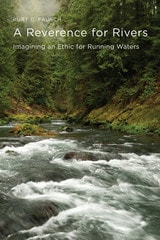
A Reverence for Rivers
Imagining an Ethic for Running WatersKurt D. Fausch
Oregon State University Press, 2025
In A Reverence for Rivers, Kurt Fausch draws on his experience as a stream ecologist, his interest in Indigenous cultures, and a thoughtful consideration of environmental ethics to explore human values surrounding freshwater ecosystems. Focusing on seven rivers across the globe—from the Salmon River in Oregon to the Sarufutsu River in Japan—he examines the growing ethical dilemmas threatening our rivers, including increasing demands for water, habitat fragmentation, overfishing, and deepening climate change.
How do we decide which rivers deserve legal protection? What is our right to water as humans? And how do we foster resilient rivers? Through a combination of scientific expertise and thoughtful observations of the natural world, Fausch translates the science of rivers into accessible language for readers and begins to address these questions. He weaves deep Indigenous histories throughout the book and includes personal visits to tribal lands to explore the traditional values held by several Indigenous groups. Fausch reminds us that our connection to rivers is personal and grounded in specific places, flowing from the stories we carry about our relationships with and responsibilities to these rivers.
In a final essay Fausch ponders Aldo Leopold’s statement that “nothing so important as an ethic is ever written,” but instead evolves in the minds of a thinking community. A Reverence for Rivers speaks to both the mind and the heart, offering perspectives so that we might begin to imagine and create an ethic for living with and caring for the running waters on which we rely for so much.
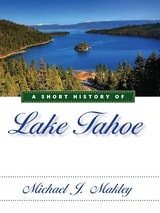
A Short History of Lake Tahoe
Michael J. Makley
University of Nevada Press, 2011
Lake Tahoe is one of the scenic wonders of the American West, a sapphire jewel that attracts millions of visitors each year. But the lake drew Native Americans to its summer shores for millennia, as well as more recent fortune hunters, scientists, and others.
A Short History of Lake Tahoe recounts the long, fascinating history of Lake Tahoe. Author Michael J. Makley examines the geology and natural history of the lake and introduces the people who shaped its history, including the Washoe Indians and such colorful characters as Mark Twain and legendary teamster Hank Monk, and later figures like entertainer Frank Sinatra and Olympic skier Julia Mancuso. He also covers the development of the lake's surrounding valley, including the impacts of mining, logging, and tourism, and the economic, political, and social controversies regarding the use and misuse of the lake's resources.
Generously illustrated with historic photographs, this book is an engaging introduction to one of the most magnificent sites in the world. It also illuminates the challenges of protecting natural beauty and a fragile environment while preserving public access and a viable economy in the surrounding communities.
A Social Ecology of Capital
Éric Pineault
Pluto Press, 2022
An original theory of contemporary capitalist growth and its socio-ecological contradictions
Capital is pushing into motion ever larger global material flows. In doing so it has come to depend on massive expenditures of energy, putting to work fossil fuels and the machines they animate to transform the world, accumulate power and grow the economy. The ecological relations and crises of today’s societies are driven by the processes of extraction of the elements that come together as a throughput of material and energy flows controlled by capital and shaped by its imperative of valorization.
In A Social Ecology of Capital, Éric Pineault proposes an original model of the fossil social metabolism that has sustained the growth of advanced capitalism in the last century.
Drawing on ecological economics and critical political economy, the book analyses how the social structures of accumulation, production, consumption and waste determine and regulate the material flow and the accumulation of material artifacts. Showing how social relations shape the ecology of capital, the book highlights the contradictions humanity now faces.
A Sugar Creek Chronicle
Observing Climate Change from a Midwestern WoodlandCornelia F. Mutel
University of Iowa Press, 2016
Moving between two timelines, Mutel pairs chapters about a single year in her Iowa woodland with chapters about her life as a fledgling and then professional student of nature. Stories of her childhood ramblings in Wisconsin and the solace she found in the Colorado mountains during early adulthood are merged with accounts of global environmental dilemmas that have redefined nature during her lifespan. Interwoven chapters bring us into her woodland home to watch nature’s cycles of life during a single year, 2012, when weather records were broken time and time again. Throughout, in a straightforward manner for a concerned general audience, Mutel integrates information about the science of climate change and its dramatic alteration of the planet in ways that clarify its broad reach, profound impact, and seemingly relentless pace.
It is not too late, she informs us: we can still prevent the most catastrophic changes. We can preserve a world full of biodiversity, one that supports human lives as well as those of our myriad companions on this planet. In the end, Mutel offers advice about steps we can all take to curb our own carbon emissions and strategies we can suggest to our policy-makers.
A Sustainable Future
12 Key Areas of Global ConcernEdited by Klaus Wiegandt
Haus Publishing, 2017
A Thirsty Land
The Fight for Water in TexasBy Seamus McGraw
University of Texas Press, 2018
As a changing climate threatens the whole country with deeper droughts and more furious floods that put ever more people and property at risk, Texas has become a bellwether state for water debates. Will there be enough water for everyone? Is there the will to take the steps necessary to defend ourselves against the sea? Is it in the nature of Americans to adapt to nature in flux?
The most comprehensive—and comprehensible—book on contemporary water issues, A Thirsty Land delves deep into the challenges faced not just by Texas but by the nation as a whole, as we struggle to find a way to balance the changing forces of nature with our own ever-expanding needs. Part history, part science, part adventure story, and part travelogue, this book puts a human face on the struggle to master that most precious and capricious of resources, water. Seamus McGraw goes to the taproots, talking to farmers, ranchers, businesspeople, and citizen activists, as well as to politicians and government employees. Their stories provide chilling evidence that Texas—and indeed the nation—is not ready for the next devastating drought, the next catastrophic flood. Ultimately, however, A Thirsty Land delivers hope. This deep dive into one of the most vexing challenges facing Texas and the nation offers glimpses of the way forward in the untapped opportunities that water also presents.

A Time to Gather Stones
Vladimir Soloukhin, Translated from the Russian and with an Introduction by Valerie Z. Nollan
Northwestern University Press, 1993
A Watershed Moment
The American West in the Age of LimitsEdited by Robert Frodeman, Evelyn Brister, and Luther Propst
University of Utah Press, 2024
The volume presents practical approaches to land use, land management, and community planning that are motivated by philosophical views on justice, quality of life, and sustainability in the American West. The contributors are policymakers, government employees, land and water managers, urban planners, biologists, tribal members, writers, and academics from a variety of backgrounds and perspectives. The result is a compelling vision of place-based, policy-oriented sustainability across the West.
A Week in Yellowstone's Thorofare
A Journey Through the Remotest PlaceMichael J. Yochim
Oregon State University Press, 2016
Drawing upon the first-person accounts of rangers who have patrolled the area, archival documents, and Michael Yochim’s personal experiences over almost three decades, A Week in Yellowstone’s Thorofare distinguishes between the notions of wildness and wilderness. Through historic vignettes, descriptions of natural resources, and the author’s own experiences, it argues that wildness is the most precious, and easily lost, attribute of wilderness.
The Thorofare is remote not only from roads, but also largely unexplored in the vast body of wilderness literature. A Week in Yellowstone’s Thorofare aims to fill that void. Recognizing both the value and the fragility of wildness, the rangers who manage the area have struggled through many eras to preserve it. This book chronicles many of the struggles through which it has remained protected for visitors today.
Yochim offers poignant insight into the passions that motivate those who manage, defend, and journey through the Thorofare. His story demonstrates the importance of wild places for touching and understanding a fundamental part of the human experience. Part history, memoir, travelogue, natural history, and reflection, the book will appeal to readers interested in preservation, the wilderness movement, the history of National Parks, or the natural treasures of Yellowstone.
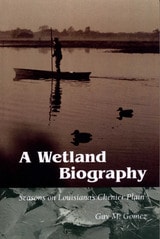
A Wetland Biography
Seasons on Louisiana’s Chenier PlainBy Gay M. Gomez
University of Texas Press, 1998
Louisiana's Chenier Plain is a 2,200-square-mile region of marshes and oak-covered ridges (cheniers) that stretches along the Gulf of Mexico from Sabine Lake to Vermilion Bay. Its inhabitants, some 6,000 people of Cajun and other ancestries, retain strong economic and cultural ties to the land and its teeming wildlife. They call it paradise...but it is a vulnerable paradise. In this multifaceted study, Gay Gomez explores the interaction of the land, people, and wildlife of the Chenier Plain, revealing both the uniqueness of the region and the challenges it faces.
After describing the geography and history of the Chenier Plain, Gomez turns to the lifeways of its people. Drawing on their words and stories, she tells how the chenier dwellers combine modern occupations with traditional pursuits such as alligator and waterfowl hunting, fur trapping, and fishing. She shows how these traditions of wildlife use provide both economic incentives for conservation and a source of personal and place identity. This portrait of a "working wetland" reveals how wildlife use and appreciation can give rise to a stewardship that balances biological, economic, and cultural concerns in species and habitat protection.
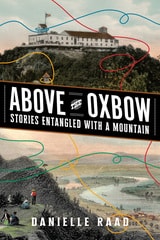
Above the Oxbow
Stories Entangled with a MountainDanielle R. Raad
West Virginia University Press, 2026
Above the Oxbow is a journey through the tangle of rich narratives surrounding Mount Holyoke, a locally cherished mountain in Western Massachusetts. It explores how visitors have forged connections with the mountain through various activities over the past two centuries. In an accessible blend of storytelling and scholarly analysis, Danielle Raad shows the significance of the landscape, historic sites, and material culture, revealing how cultural perspectives, community activism, collective memory, and personal experiences shape our understanding of a place. Situated at the intersection of public history and environmental history, this ethnography of place also discloses the curious stories of the Summit House, an erstwhile tramway, an airplane crash, and the local fight to conserve Mount Holyoke as a natural space and celebrates its myriad uses today.
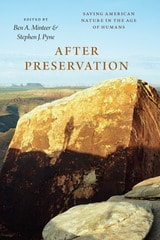
After Preservation
Saving American Nature in the Age of HumansEdited by Ben A. Minteer and Stephen J. Pyne
University of Chicago Press, 2015
Ben A. Minteer and Stephen J. Pyne bring together a stunning consortium of voices comprised of renowned scientists, historians, philosophers, environmental writers, activists, policy makers, and land managers to negotiate the incredible challenges that environmentalism faces. Some call for a new, post-preservationist model, one that is far more pragmatic, interventionist, and human-centered. Others push forcefully back, arguing for a more chastened and restrained vision of human action on the earth. Some try to establish a middle ground, while others ruminate more deeply on the meaning and value of wilderness. Some write on species lost, others on species saved, and yet others discuss the enduring practical challenges of managing our land, water, and air.
From spirited optimism to careful prudence to critical skepticism, the resulting range of approaches offers an inspiring contribution to the landscape of modern environmentalism, one driven by serious, sustained engagements with the critical problems we must solve if we—and the wild garden we may now keep—are going to survive the era we have ushered in.
Contributors include: Chelsea K. Batavia, F. Stuart (Terry) Chapin III, Norman L. Christensen, Jamie Rappaport Clark, William Wallace Covington, Erle C. Ellis, Mark Fiege, Dave Foreman, Harry W. Greene, Emma Marris, Michelle Marvier, Bill McKibben, J. R. McNeill, Curt Meine, Ben A. Minteer, Michael Paul Nelson, Bryan Norton, Stephen J. Pyne, Andrew C. Revkin, Holmes Rolston III, Amy Seidl, Jack Ward Thomas, Diane J. Vosick, John A. Vucetich, Hazel Wong, and Donald Worster.
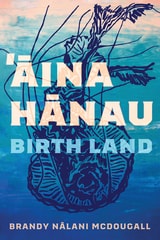
Aina Hanau / Birth Land
Brandy Nalani McDougall
University of Arizona Press, 2023
‘Āina Hānau / Birth Land is a powerful collection of new poems by Kanaka ʻŌiwi (Native Hawaiian) poet Brandy Nālani McDougall. ‘Āina hānau—or the land of one’s birth—signifies identity through intimate and familial connections to place and creates a profound bond between the people in a community. McDougall’s poems flow seamlessly between ‘Ōlelo Hawai‘i and English, forming rhythms and patterns that impress on the reader a deep understanding of the land. Tracing flows from the mountains to the ocean, from the sky to the earth, and from ancestor to mother to child, these poems are rooted in the rich ancestral and contemporary literature of Hawaiʻi —moʻolelo, moʻokūʻauhau, and mele —honoring Hawaiian ʻāina, culture, language, histories, aesthetics, and futures.
The poems in Āina Hānau / Birth Land cycle through sacred and personal narratives while exposing and fighting ongoing American imperialism, settler colonialism, militarism, and social and environmental injustice to protect the ʻāina and its people. The ongoing environmental crisis in Hawaiʻi, inextricably linked to colonialism and tourism, is captured with stark intensity as McDougall writes, Violence is what we settle for / because we’ve been led to believe / green paper can feed us / more than green land. The experiences of birth, motherhood, miscarriage, and the power of Native Hawaiian traditions and self-advocacy in an often dismissive medical system is powerfully narrated by the speaker of the titular poem, written for McDougall’s daughters.
‘Āina Hānau reflects on what it means to be from and belong to an ʻāina hānau, as well as what it means to be an ‘āina hānau, as all mothers serve as the first birth lands for their children.
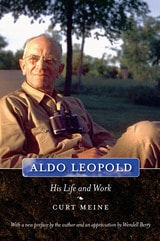
Aldo Leopold
His Life and WorkCurt D. Meine
University of Wisconsin Press, 2010
This biography of Aldo Leopold follows him from his childhood as a precocious naturalist to his profoundly influential role in the development of conservation and modern environmentalism in the United States. This edition includes a new preface by author Curt Meine and an appreciation by acclaimed Kentucky writer and farmer Wendell Berry.
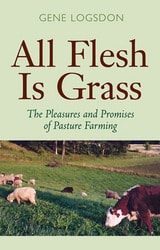
All Flesh Is Grass
The Pleasures and Promises of Pasture FarmingGene Logsdon
Ohio University Press, 2004
Amidst Mad Cow scares and consumer concerns about how farm animals are bred, fed, and raised, many farmers and homesteaders are rediscovering the traditional practice of pastoral farming. Grasses, clovers, and forbs are the natural diet of cattle, horses, and sheep, and are vital supplements for hogs, chickens, and turkeys. Consumers increasingly seek the health benefits of meat from animals raised in green paddocks instead of in muddy feedlots.
In All Flesh Is Grass: The Pleasures and Promises of Pasture Farming, Gene Logsdon explains that well-managed pastures are nutritious and palatable—virtual salads for livestock. Leafy pastures also hold the soil, foster biodiversity, and create lovely landscapes. Grass farming might be the solution for a stressed agricultural system based on an industrial model and propped up by federal subsidies.
In his clear and conversational style, Logsdon explains historically effective practices and new techniques. His warm, informative profiles of successful grass farmers offer inspiration and ideas. His narrative is enriched by his own experience as a “contrary farmer” on his artisan-scale farm near Upper Sandusky, Ohio.
All Flesh Is Grass will have broad appeal to the sustainable commercial farmer, the home-food producer, and all consumers who care about their food.
All the Boats on the Ocean
How Government Subsidies Led to Global OverfishingCarmel Finley
University of Chicago Press, 2017
In this transnational, interdisciplinary history, Carmel Finley answers these questions and more as she explores how government subsidies propelled the expansion of fishing from a coastal, in-shore activity into a global industry. While nation states struggling for ocean supremacy have long used fishing as an imperial strategy, the Cold War brought a new emphasis: fishing became a means for nations to make distinct territorial claims. A network of trade policies and tariffs allowed cod from Iceland and tuna canned in Japan into the American market, destabilizing fisheries in New England and Southern California. With the subsequent establishment of tuna canneries in American Samoa and Puerto Rico, Japanese and American tuna boats moved from the Pacific into the Atlantic and Indian Oceans after bluefin. At the same time, government subsidies in nations such as Spain and the Soviet Union fueled fishery expansion on an industrial scale, with the Soviet fleet utterly depleting the stock of rosefish (or Pacific ocean perch) and other groundfish from British Columbia to California. This massive global explosion in fishing power led nations to expand their territorial limits in the 1970s, forever changing the seas.
Looking across politics, economics, and biology, All the Boats on the Ocean casts a wide net to reveal how the subsidy-driven expansion of fisheries in the Pacific during the Cold War led to the growth of fisheries science and the creation of international fisheries management. Nevertheless, the seas are far from calm: in a world where this technologically advanced industry has enabled nations to colonize the oceans, fish literally have no place left to hide, and the future of the seas and their fish stocks is uncertain.
Almanac for the Anthropocene
A Compendium of Solarpunk FuturesPhoebe Wagner
West Virginia University Press, 2022
Original voices from across the solarpunk movement, which positions ingenuity, generativity, and community as ways to resist hopelessness in response to the climate crisis.
Almanac for the Anthropocene collects original voices from across the solarpunk movement, which positions ingenuity, generativity, and community as beacons of resistance to the hopelessness often inspired by the climate crisis. To point toward practical implementation of the movement’s ideas, it gathers usable blueprints that bring together theory and practice. The result is a collection of interviews, recipes, exercises, DIY instructions, and more—all of it amounting to a call to create hope through action.
Inspired by a commitment to the idea that there can be no environmental justice without decolonial and racial justice, Almanac for the Anthropocene unites in a single volume both academic and practical responses to environmental crisis.
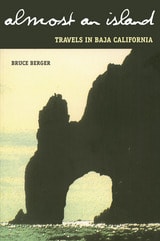
Almost an Island
Travels in Baja CaliforniaBruce Berger
University of Arizona Press, 1998
Eight hundred miles long, Baja California is the remotest region of the Sonoran desert, a land of volcanic cliffs, glistening beaches, fantastical boojum trees, and some of the greatest primitive murals in the Western Hemisphere. In Almost an Island, Berger recounts tales from his three decades in this extraordinary place, enriching his account with the peninsula's history, its politics, and its probable future—rendering a striking panorama of this land so close to the United States, so famous, and so little known.
Readers will meet a cast of characters as eccentric as the place itself: Brandy, who ranges the desert in a sand buggy while breathing from an oxygen tank; Katie, the chanteuse; nuns illegally raising pigs. They will encounter the tourist madness of a total eclipse, the story of the heir to an oasis, a musical Mata Hari, rare pronghorn antelope, and a pet tarantula. In prose as glittering as this desert engulfed by the sea, Almost an Island is a fascinating journey into the human heart of a spectacular land.
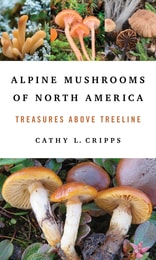
Alpine Mushrooms of North America
Treasures above TreelineCathy L. Cripps
University of Illinois Press, 2025
Features include:
- More than 200 color photographs
- Small size perfect for use in the field
- In-depth scientific information on 150 species, including some recently discovered and most not found outside alpine or Arctic habitats
- Division of species into ecological groups to aid with searching and identification
- Coverage of the Rocky Mountains of Montana, Wyoming, and Colorado, with extensions into British Columbia and Alaska, with many of the same mushrooms also found in the Arctic
- Tips on collecting for both professional researchers and amateur enthusiasts
- A conservation-based approach aimed at the general public, mycologists, researchers, naturalists, land managers, and others
Easy to use and charged with cutting-edge science, Alpine Mushrooms of North America is an expert guide to mycology’s final frontier.
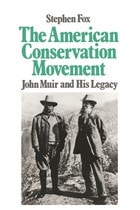
American Conservation Movement
John Muir And His LegacyStephen Fox
University of Wisconsin Press, 1986
John Muir and His Legacy is at once a biography of this remarkable man—the first work to make unrestricted use of all of Muir’s manuscripts and personal papers—and a history of the century-old fight to save the natural environment. Stephen Fox traces the conservation movement's diverse, colorful, and tumultuous history, from the successful campaign to establish Yosemite National Park in 1890 to the movement's present day concerns of nuclear waste and acid rain.
Conservation has run a cyclical course, Fox contends, from its origins in the 1890s when it was the province of amateurs, to its takeover by professionals with quasi-scientific notions, and back, in the 1960s to its original impetus. Since then man’s view of himself as “the last endangered species” has sparked an explosion of public interest in environmentalism.
First published in 1981 by Little, Brown, this book was warmly received as both a biography of Muir and a history of the American conservation movement. It is now available in this new Wisconsin paperback edition.

American Dunkirk
The Waterborne Evacuation of Manhattan on 9/11James M Kendra
Temple University Press, 2016
When the terrorist attacks struck New York City on September 11, 2001, boat operators and waterfront workers quickly realized that they had the skills, the equipment, and the opportunity to take definite, immediate action in responding to the most significant destructive event in the United States in decades. For many of them, they were “doing what needed to be done.”
American Dunkirk shows how people, many of whom were volunteers, mobilized rescue efforts in various improvised and spontaneous ways on that fateful date. Disaster experts James Kendra and Tricia Wachtendorf examine the efforts through fieldwork and interviews with many of the participants to understand the evacuation and its larger implications for the entire practice of disaster management.
The authors ultimately explore how people—as individuals, groups, and formal organizations—pull together to respond to and recover from startling, destructive events. American Dunkirk asks, What can these people and lessons teach us about not only surviving but thriving in the face of calamity?
American Fish and Wildlife Policy
The Human DimensionEdited by William R. Mangun
Southern Illinois University Press, 1992
These eleven original essays by leading wildlife management and public policy scholars deal with policy issues, management perspectives, and the public attitudes about wildlife that shape the world of the wildlife manager.
Part 1 contains William R. Mangun’s introductory essay "Fish and Wildlife Policy Issues" and Daniel J. Decker et al.’s "Toward a Comprehensive Paradigm of Wildlife."
Ann H. Harvey’s "Interagency Conflict and Coordination in Wildlife Management," Philip S. Cook and Ted T. Cable’s "Developing Policy for Public Access to Private Land," and Debra A. Rose’s "Implementing Endangered Species Policy" make up part 2.
Part 3 consists of Cliff Hamilton’s "Pursuing a New Paradigm in Funding State Fish and Wildlife Programs" and Trellis G. Green’s "Use of Economics in Federal and State Fishery Allocation Decisions."
The fourth part includes James J. Kennedy and Jack Ward Thomas’s "Exit, Voice, and Loyalty of Wildlife Biologists in Public Natural Resource/Environmental Agencies"; Jean C. Mangun et al.’s "Nonconsumptive Wildlife-Associated Recreation in the United States"; and Barbara A. Knuth’s "Natural Resource Hazards: Managing to Protect People from the Resource."
In part 5, Joseph F. Coates looks to the future in "Public Policy Actors and Futures."
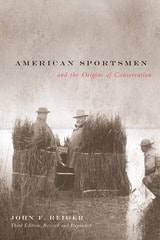
American Sportsmen and the Origins of Conservation, 3rd Ed
John F. Reiger
Oregon State University Press, 2001
Beginning in the 1870s, sportsmen across America formed hundreds of organizations that not only fostered responsibility for game habitats but also spearheaded the creation of national parks, forests, and wildlife refuges. Reiger tells how these "gentlemen" hunters and anglers, outdoor journals like Forest and Stream, and organizations such as the Boone and Crockett Club—founded by Theodore Roosevelt, George Bird Grinnell, and other prominent sportsmen—lobbied for laws regulating the taking of wildlife, and helped to arouse public interest in wilderness preservation.
In this new edition, Reiger traces the antecedents of the sportsmen's conservation movement to the years before the Civil War. He extends his coverage into the present by demonstrating how the nineteenth-century sportsman's code—with its demand for taking responsibility for the total environment—continues to be the cornerstone of the sporting ethic. A new Epilogue depicts leading environmental thinker Aldo Leopold as the best-known exponent of this hunter-conservationist ideal.
Praised as "one of the seminal works in conservation history" by historian Hal Rothman, Reiger's book continues to be essential reading for all concerned with how earlier Americans regarded the land, demonstrating even to those who oppose hunting that they share with sportsmen and sportswomen an awareness and appreciation of our fragile environment.
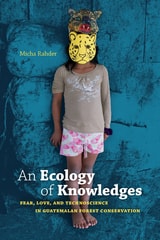
An Ecology of Knowledges
Fear, Love, and Technoscience in Guatemalan Forest ConservationMicha Rahder
Duke University Press, 2020
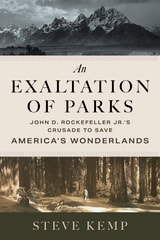
An Exaltation of Parks
John D. Rockefeller Jr.'s Crusade to Save America's WonderlandsSteve Kemp
University of Utah Press, 2025
America’s national parks are facing unprecedented challenges. With visitation pressures mounting and the National Park Service struggling to keep up, author and former park ranger Steve Kemp looks toward one exceptionally effective historical example of conservation philanthropy and park building—the collaboration between John D. Rockefeller Jr. and NPS legends Stephen Mather, Horace Albright, and Arno Cammerer.
An Exaltation of Parks reveals the inspiring story of this collaboration, showing how the partnership transformed some of America's most cherished national parks, including Acadia, Grand Teton, Great Smoky Mountains, Yellowstone, and Yosemite. It recounts Rockefeller’s lifelong dedication to conservation, digging into his own pockets and toiling as a volunteer to achieve his goals for converting private land into public use. Bringing to life the history and significance of America’s most magnificent landscapes, this volume is both a tribute to past conservation victories and a call to action for the future, emphasizing the need for continued vigilance to preserve these national treasures for generations to come.
An Extraordinary Year of Ordinary Days
By Susan Wittig Albert
University of Texas Press, 2010
From Eudora Welty's memoir of childhood to May Sarton's reflections on her seventieth year, writers' journals offer an irresistible opportunity to join a creative thinker in musing on the events—whether in daily life or on a global scale—that shape our lives. In An Extraordinary Year of Ordinary Days, best-selling mystery novelist Susan Wittig Albert invites us to revisit one of the most tumultuous years in recent memory, 2008, through the lens of 365 ordinary days in which her reading, writing, and thinking about issues in the wider world—from wars and economic recession to climate change—caused her to reconsider and reshape daily practices in her personal life.
Albert's journal provides an engaging account of how the business of being a successful working writer blends with her rural life in the Texas Hill Country and the Sangre de Cristo Mountains of New Mexico. As her eclectic daily reading ranges across topics from economics, food production, and oil and energy policy to poetry, place, and the writing life, Albert becomes increasingly concerned about the natural world and the threats facing it, especially climate change and resource depletion. Asking herself, "What does it mean? And what ought I do about it?", she determines practical steps to take, such as growing more food in her garden, and also helps us as readers make sense of these issues and consider what our own responses might be.
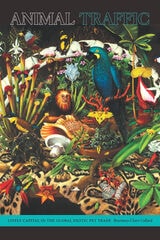
Animal Traffic
Lively Capital in the Global Exotic Pet TradeRosemary-Claire Collard
Duke University Press, 2020
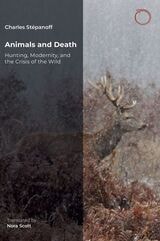
Animals and Death
Hunting, Modernity, and the Crisis of the WildCharles Stépanoff
HAU, 2026
Annotated Bibliography of Oregon Bird Literature Published Before 1935, An
George A. Jobanek
Oregon State University Press, 1997
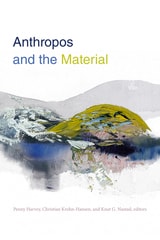
Anthropos and the Material
Penny Harvey, Christian Krohn-Hansen, and Knut Nustad, editors
Duke University Press, 2019