Results by title
775 books match the query 'Germany' and 53 start with a
A Culture of Light
Cinema and Technology in 1920s GermanyFrances Guerin
University of Minnesota Press, 2005

A Duel of Giants
Bismarck, Napoleon III, and the Origins of the Franco-Prussian WarDavid Wetzel
University of Wisconsin Press, 2001
Combining impeccable scholarship and literary elegance, David Wetzel depicts the drama of machinations and passions that exploded in a war that forever changed the face of European history.

A Final Reckoning
A Hannover Family's Life and Death in the ShoahRuth Gutmann, Foreword by Kenneth Waltzer
University of Alabama Press, 2013
A work of both childhood memory and adult reflection undergirded with scholarly research
Ruth Herskovits Gutmann’s powerful memoir recounts her life not only as a concentration camp inmate and survivor, but also as a sister and daughter. Born in 1928, Gutmann and her twin sister, Eva, escaped the growing Nazi threat in Germany on a Kindertransport to Holland in 1939.
Gutmann’s compelling story captures many facets of the Jewish experience in Nazi Germany. She describes her early life in Hannover as the daughter of a prominent and patriotic member of the Jewish community. Her flight on the Kindertransport offers a vivid, firsthand account of that effort to save the children of Jewish families. Her memories of the camps include coming to the attention of Josef Mengele, who often used twins in human experiments. Gutmann writes with moving clarity and nuance about the complex feelings of survivorship.
A Final Reckoning provides not only insights into Gutmann’s own experience as a child in the midst of the atrocities of the Holocaust, but also a window into the lives of those, like her father, who were forced to carry on and comply with the regime that would ultimately bring about their demise.

A Generation Divided
German Children and the Berlin WallThomas A. Davey
Duke University Press, 1987
Thomas Davey conducted interviews with children both sides of the Wall, participated in their daily lives, collected their drawings, talked with their teachers and families and grew aware of just how attentive children can be to moral and political subtleties of national life. The result is a revealing and dramatic portrait of a young generation coming to terms with complex national and historical circumstances of the two cites of East and West Berlin.

A History of German Jewish Bible Translation
Abigail Gillman
University of Chicago Press, 2018
This book is the first in English to offer a close analysis of German Jewish translations as part of a larger cultural project. Looking at four distinct waves of translations, Abigail Gillman juxtaposes translations within each that sought to achieve similar goals through differing means. As she details the history of successive translations, we gain new insight into the opportunities and problems the Bible posed for different generations and gain a new perspective on modern German Jewish history.

A Hitler Youth in Poland
The Nazi Children's Evacuation Program During World War IIJost Hermand
Northwestern University Press, 1997
During the Nazi era, millions of German children between the ages of seven and sixteen were taken from their homes and sent to Hitler Youth paramilitary camps to be toughened up and taught how to be "German." Separated from their families and sent to the far-flung corners of Europe, these children often endured incredible abuse by the adults in charge. In this memoir, Jost Hermand, a cultural critic and historian who spent much of his youth in five different camps, writes about his experiences as a small, unathletic boy thrown into a "wolf pack" governed by brutalization, dreary routine, and sadism.
Intelligent and persuasive, A Hitler Youth in Poland should be read by anyone interested in psychology or the history of everyday life in Hitler's Germany and the mental scars of adults born during the Nazi regime.

A House Divided
Orthodoxy and Schism in Nineteenth-Century Central European JewryJacob Katz
University Press of New England, 2005

A Jew in the New Germany
Henryk Broder
University of Illinois Press, 2003
This volume collects eighteen of Broder's essays, translated for the first time into English. The first was written in 1979 and the most recent deals with the post-9/11 realities of the war on terrorism, and its effects on the countries of Europe. Other essays address the debate over the construction of a Holocaust memorial in Berlin, the German response to the 1991 Gulf War, the politics of German reunification, and the rise of the new German nationalism.
Broder charts the recent evolution of German Jewish relations, using his own outsider status to hold up a mirror to the German people and point out that things have not changed for German Jews as much as non-Jews might think.

A Jewish Family in Germany Today
An Intimate PortraitY. Michal Bodemann
Duke University Press, 2005
Among the Kalman cousins are an art gallery owner, a body builder, a radio personality, a former chief financial officer of a prominent U.S. bank, and a sculptor. They discuss Zionism, anti-Semitism, what it means to root for the German soccer team, Schindler’s List, money, success, marriage and intermarriage, and family history. They reveal their different levels of engagement with Judaism and involvement with local Jewish communities. Kalman is a pseudonym, and their anonymity allows the family members to talk with passion and candor about their relationships and their lives as Jews.

A Jewish Orchestra in Nazi Germany
Musical Politics and the Berlin Jewish Culture LeagueLily E. Hirsch
University of Michigan Press, 2011
"Offers a clear introduction to a fascinating, yet little known, phenomenon in Nazi Germany, whose very existence will be a surprise to the general public and to historians. Easily blending general history with musicology, the book provides provocative yet compelling analysis of complex issues."
---Michael Meyer, author of The Politics of Music in the Third Reich
"Hirsch poses complex questions about Jewish identity and Jewish music, and she situates these against a political background vexed by the impossibility of truly viable responses to such questions. Her thorough archival research is complemented by her extensive use of interviews, which gives voice to those swept up in the Holocaust. A Jewish Orchestra in Nazi Germany is a book filled with the stories of real lives, a collective biography in modern music history that must no longer remain in silence."
---Philip V. Bohlman, author of Jewish Music and Modernity
"An engaging and downright gripping history. The project is original, the research is outstanding, and the presentation lucid."
---Karen Painter, author of Symphonic Aspirations: German Music and Politics, 1900-1945
The Jewish Culture League was created in Berlin in June 1933, the only organization in Nazi Germany in which Jews were not only allowed but encouraged to participate in music, both as performers and as audience members. Lily E. Hirsch's A Jewish Orchestra in Nazi Germany is the first book to seriously investigate and parse the complicated questions the existence of this unique organization raised, such as why the Nazis would promote Jewish music when, in the rest of Germany, it was banned. The government's insistence that the League perform only Jewish music also presented the organization's leaders and membership with perplexing conundrums: what exactly is Jewish music? Who qualifies as a Jewish composer? And, if it is true that the Nazis conceived of the League as a propaganda tool, did Jewish participation in its activities amount to collaboration?
Lily E. Hirsch is Assistant Professor of Music at Cleveland State University.

A Journey to Point Omega
Autobiography from 1964Josef Pieper
St. Augustine's Press, 2018
Themes with which the reader of his previous works would be well acquainted recur in this volume. The dedicated Catholic philosopher, who preferred his independence as a trainer of teachers to the less independent role of a professor in a Catholic university, was quite prepared to criticize developments in the Church which resulted from Vatican II. In his defense of the sacred, which he deemed threatened by popularizing trends in the Church, he criticized what he saw as the watered down language in modern German translations of Church liturgical texts; the growing preference for secular garb; and the compromising developments which saw the sacramental signs – surrounding baptism, for instance – being reduced to such an extent that they no longer had the power to signify their sacred meaning even to a well-intentioned congregation.
A great lover of the philosophy of Plato, Augustine, and Aquinas – among many others –, Pieper highlighted the need for living a life of truth. He did not consider truth to be merely something abstract but as something to be lived existentially. While he could explain his philosophy in clear rational terms, something which especially stood to him in his post-war lectures to eager students who were hungry for intellectual guidance and leadership, the great interest of his philosophy was, possibly, his preoccupation with mystery – that which impinges on our inner lives but frustrates all our attempts to account for it in purely rational terms.
As a philosopher – one might say a Christian philosopher – Pieper seems to have observed the traditional boundaries drawn between philosophy and theology. His generation was exposed to the modernist debates in the Church. It would have been deemed heretical to say that the Divine could be grasped by our purely human thought processes – access to the Divine being only possible through faith and grace. Pieper was no heretic. But he was also not altogether conservative. In fact, his philosophy, closely allied to existentialism – despite his care, for instance, to distance himself from the negative existentialism of Sartre – focused on the individual’s inner existential grasp of the most profound reality. Truth is to be found within us, even if it remains a mystery. What lies beyond death is, for the individual, the ultimate mystery.

A Matter of Time
Alex Capus
Haus Publishing, 2009

A Mythology of Forms
Selected Writings on ArtCarl Einstein
University of Chicago Press, 2019

A National Acoustics
Music and Mass Publicity in Weimar and Nazi GermanyBrian Currid
University of Minnesota Press, 2006
Offering a nuanced analysis of how publicity was constructed through radio programming, print media, popular song, and film, Currid examines how German citizens developed an emotional investment in the nation and other forms of collectivity that were tied to the sonic experience. Reading in detail popular genres of music—the Schlager (or “hit”), so-called gypsy music, and jazz—he offers a complex view of how they played a part in the creation of German culture.
A National Acoustics contributes to a new understanding of what constitutes the public sphere. In doing so, it illustrates the contradictions between Germany’s social and cultural histories and how the technologies of recording not only were vital to the emergence of a national imaginary but also exposed the fault lines in the contested terrain of mass communication.
Brian Currid is an independent scholar who lives in Berlin.

A Nation’s Undesirables
Mixed-Race Children and Whiteness in the Post-Nazi EraTracey Owens Patton
The Ohio State University Press, 2024
An innovative investigation of the entangled histories of race, transnational adoption, and post-Nazi Germany.
In a moving blend of family history and cutting-edge scholarship, Tracey Owens Patton’s A Nation’s Undesirables synthesizes work in rhetorical postmemory studies, critical adoption studies, Afrofuturism, and more to tell the story of her mother and aunt, Lore and Lilli. Two of thousands of children born to white German women and Black American men after World War II, the twins moved to the United States at age seven, where their mother renounced her parental rights and put them into the adoption system. They did not see her again for fifty-two years.Patton takes up the twins’ story and their reckoning with their mixed-race, Black German identity to disrupt standard narratives around World War II, Black experiences in Germany, and race and adoption. Combining family interviews, historical artifacts, and autoethnographic reflection, Patton composes a new narrative of women and Black German children in the postwar era. In examining the systemic racism of Germany’s efforts to move children like Lore and Lilli out of the country—and the suppression of German women’s bodily autonomy—Patton amplifies the once unacknowledged identities of these Black German children to broaden our understanding of citizenship, racism, and sexism after World War II.

A New Orient
From German Scholarship to Middle Eastern Studies in IsraelAmit Levy
Brandeis University Press, 2024
This study examines the history of Zionist academic Orientalism—referred to throughout as Oriental studies, the term contemporary English speakers would have used—in light of its German-Jewish background, as a history of knowledge transfer stretching along an axis from Germany to Palestine. The transfer, which took place primarily during the 1920s and 1930s, involved questions about the re-establishment, far from Germany, of a field of knowledge with deep German roots. Like other German-Jewish scholars arriving in Palestine at the time, some of the Orientalist agents of transfer did so out of Zionist conviction as olim (immigrants making aliyah, or literally “ascending” to the homeland), while others joined them later as refugees from Nazi Germany; both groups were integrated into the institutional apparatus of the Hebrew University. Unlike other fields of knowledge or professions, however, the transfer of Orientalist knowledge was unique in that the axis involved an essential change in the nature of its encounter with the Orient: from a textual-scientific encounter at German universities, largely disconnected from contemporary issues to a living, substantive, and unmediated encounter with an essentially Arab region—and the escalating Jewish-Arab conflict in the background. Within the new context, German-Jewish Orientalist expertise was charged with political and cultural significance it had not previously faced, fundamentally influencing the course of the discipline’s development in Palestine and Israel.
A People's History of the German Revolution
William A. Pelz
Pluto Press, 2018

A Saltire in the German Lands
Scottish Benedictine Monasteries in Germany 1575-1862Thomas McInally
Aberdeen University Press, 2017

A Slap in the Face
Abbas Khider
Seagull Books, 2018
In our era of mass migration, much of it driven by war and its aftermath, A Slap in the Face could not be more timely. It tells the story of Karim, an Iraqi refugee living in Germany whose right to asylum has been revoked in the wake of Saddam Hussein’s defeat. But Hussein wasn’t the only reason Karim left, and as Abbas Khider unfolds his story, we learn both the secret struggles he faced in his homeland and the battles with prejudice, distrust, poverty, and bureaucracy he has to endure in his attempts to make a new life in Germany. As he erupts in frustration at his caseworker and finally forces her to listen to his story, we get an account of a contemporary life upended by politics and violence, told with warmth and humor that, while surprising us, does nothing to lessen the outrages Karim describes.

A Ticket to Work
Policies for the Young Unemployed in Britain and GermanyBettina Kohlrausch
Campus Verlag, 2009
In A Ticket to Work, Bettina Kohlrausch examines the differing approaches taken by Britain and Germany to assisting young people with the often difficult transition from school to full-time work. Detailing the workings of such programs as skills training and job-placement assistance, the volume places those vocational training methods in the context of the general political and economic climate of the two nations, drawing a contrast between Britain’s more liberal market economy and Germany’s more structured and coordinated regime.
Aberrations of Mourning
Laurence A. Rickels
University of Minnesota Press, 2011
Rickels studies mourning and melancholia within and around psychoanalysis, analyzing the writings of such thinkers as Freud, Nietzsche, Lessing, Heinse, Artaud, Keller, Stifter, Kafka, and Kraus. Rickels maintains that we must shift the way we read literature, philosophy, and psychoanalysis to go beyond traditional Oedipal structures.
Aberrations of Mourning argues that the idea of the crypt has had a surprisingly potent influence on psychoanalysis, and Rickels shows how society’s disturbed relationship with death and dying, our inability to let go of loved ones, has resulted in technology to form more and more crypts for the dead by preserving them—both physically and psychologically—in new ways.

Abraham Geiger and the Jewish Jesus
Susannah Heschel
University of Chicago Press, 1998
Geiger, a pioneer of Reform Judaism and a founder of Jewish studies, developed a Jewish version of Christian origins. He contended that Jesus was a member of the Pharisees, a progressive and liberalizing group within first-century Judaism, and that he taught nothing new or original. This argument enraged German Protestant theologians, some of whom produced a tragic counterargument based on racial theory.
In this fascinating book, Susannah Heschel traces the genesis of Geiger's argument and examines the reaction to it within Christian theology. She concludes that Geiger initiated an intellectual revolt by the colonized against the colonizer, an attempt not to assimilate into Christianity by adopting Jesus as a Jew, but to overthrow Christian intellectual hegemony by claiming that Christianity—and all of Western civilization—was the product of Judaism.

Acolytes of Nature
Defining Natural Science in Germany, 1770-1850Denise Phillips
University of Chicago Press, 2012
Although many of the practical and intellectual traditions that make up modern science date back centuries, the category of “science” itself is a relative novelty. In the early eighteenth century, the modern German word that would later mean “science,” naturwissenschaft, was not even included in dictionaries. By 1850, however, the term was in use everywhere. Acolytes of Nature follows the emergence of this important new category within German-speaking Europe, tracing its rise from an insignificant eighteenth-century neologism to a defining rallying cry of modern German culture.
Today’s notion of a unified natural science has been deemed an invention of the mid-nineteenth century. Yet what Denise Phillips reveals here is that the idea of naturwissenschaft acquired a prominent place in German public life several decades earlier. Phillips uncovers the evolving outlines of the category of natural science and examines why Germans of varied social station and intellectual commitments came to find this label useful. An expanding education system, an increasingly vibrant consumer culture and urban social life, the early stages of industrialization, and the emergence of a liberal political movement all fundamentally altered the world in which educated Germans lived, and also reshaped the way they classified knowledge.

Aesthetics, Industry, and Science
Hermann von Helmholtz and the Berlin Physical SocietyM. Norton Wise
University of Chicago Press, 2018
In Aesthetics, Industry, and Science M. Norton Wise answers these questions not simply from a technical perspective of theories and practices but with a broader cultural view of what was happening in Berlin at the time. He emphasizes in particular how rapid industrial development, military modernization, and the neoclassical aesthetics of contemporary art informed the ways in which these young men thought. Wise argues that aesthetic sensibility and material aspiration in this period were intimately linked, and he uses these two themes for a final reappraisal of Helmholtz’s early work. Anyone interested in modern German cultural history, or the history of nineteenth-century German science, will be drawn to this landmark book.

Africa in Translation
A History of Colonial Linguistics in Germany and Beyond, 1814-1945Sara Pugach
University of Michigan Press, 2022
The study of African languages in Germany, or Afrikanistik, originated among Protestant missionaries in the early nineteenth century and was incorporated into German universities after Germany entered the “Scramble for Africa” and became a colonial power in the 1880s. Despite its long history, few know about the German literature on African languages or the prominence of Germans in the discipline of African philology. In Africa in Translation: A History of Colonial Linguistics in Germany and Beyond, 1814–1945, Sara Pugach works to fill this gap, arguing that Afrikanistik was essential to the construction of racialist knowledge in Germany. While in other countries biological explanations of African difference were central to African studies, the German approach was essentially linguistic, linking language to culture and national identity. Pugach traces this linguistic focus back to the missionaries’ belief that conversion could not occur unless the “Word” was allowed to touch a person’s heart in his or her native language, as well as to the connection between German missionaries living in Africa and armchair linguists in places like Berlin and Hamburg. Over the years, this resulted in Afrikanistik scholars using language and culture rather than biology to categorize African ethnic and racial groups. Africa in Translation follows the history of Afrikanistik from its roots in the missionaries’ practical linguistic concerns to its development as an academic subject in both Germany and South Africa throughout the nineteenth and twentieth centuries.
Jacket image: Perthes, Justus. Mittel und Süd-Afrika. Map. Courtesy of the University of Michigan's Stephen S. Clark Library map collection.

African Students in East Germany, 1949-1975
Sara Pugach
University of Michigan Press, 2022
This book explores the largely unexamined history of Africans who lived, studied, and worked in the German Democratic Republic. African students started coming to the East in 1951 as invited guests who were offered scholarships by the East German government to prepare them for primarily technical and scientific careers once they returned home to their own countries. Drawn from previously unexplored archives in Germany, Ghana, Kenya, Zambia, and the United Kingdom, African Students in East Germany, 1949–1975 uncovers individual stories and reconstructs the pathways that African students took in their journeys to the GDR and what happened once they got there. The book places these experiences within the larger context of German history, questioning how ideas of African racial difference that developed from the eighteenth through the early twentieth centuries impacted East German attitudes toward the students.
The book additionally situates African experiences in the overlapping contexts of the Cold War and decolonization. During this time, nations across the Western and Soviet blocs were inviting Africans to attend universities and vocational schools as part of a drive to offer development aid to newly independent countries and encourage them to side with either the United States or Soviet Union in the Cold War. African leaders recognized their significance to both Soviet and American blocs, and played on the desire of each to bring newly independent nations into their folds. Students also recognized their importance to Cold War competition, and used it to make demands of the East German state. The book is thus located at the juncture of many different histories, including those of modern Germany, modern Africa, the Global Cold War, and decolonization.
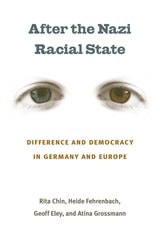
After the Nazi Racial State
Difference and Democracy in Germany and EuropeRita Chin, Heide Fehrenbach, Geoff Eley, and Atina Grossmann
University of Michigan Press, 2010
"After the Nazi Racial State offers a comprehensive, persuasive, and ambitious argument in favor of making 'race' a more central analytical category for the writing of post-1945 history. This is an extremely important project, and the volume indeed has the potential to reshape the field of post-1945 German history."
---Frank Biess, University of California, San Diego
What happened to "race," race thinking, and racial distinctions in Germany, and Europe more broadly, after the demise of the Nazi racial state? This book investigates the afterlife of "race" since 1945 and challenges the long-dominant assumption among historians that it disappeared from public discourse and policy-making with the defeat of the Third Reich and its genocidal European empire. Drawing on case studies of Afro-Germans, Jews, and Turks---arguably the three most important minority communities in postwar Germany---the authors detail continuities and change across the 1945 divide and offer the beginnings of a history of race and racialization after Hitler. A final chapter moves beyond the German context to consider the postwar engagement with "race" in France, Britain, Sweden, and the Netherlands, where waves of postwar, postcolonial, and labor migration troubled nativist notions of national and European identity.
After the Nazi Racial State poses interpretative questions for the historical understanding of postwar societies and democratic transformation, both in Germany and throughout Europe. It elucidates key analytical categories, historicizes current discourse, and demonstrates how contemporary debates about immigration and integration---and about just how much "difference" a democracy can accommodate---are implicated in a longer history of "race." This book explores why the concept of "race" became taboo as a tool for understanding German society after 1945. Most crucially, it suggests the social and epistemic consequences of this determined retreat from "race" for Germany and Europe as a whole.
Rita Chin is Associate Professor of History at the University of Michigan.
Heide Fehrenbach is Presidential Research Professor at Northern Illinois University.
Geoff Eley is Karl Pohrt Distinguished University Professor of Contemporary History at the University of Michigan.
Atina Grossmann is Professor of History at Cooper Union.
Cover illustration: Human eye, © Stockexpert.com.

Aftershocks of the New
Feminism and Film HistoryPetro, Patrice
Rutgers University Press, 2001
The beginning of this century has brought with it a host of assumptions about the newness of our technologies, globalized economies, and transnational media practices. Our own time is a period marked by experiences of fragmentation, sensation, and shock. The essays here are joined by a common concern to chart another side to modernity—precisely after the shock of the new—when the new ceases to be shocking, and when the extraordinary and the sensational become linked to the boring and the everyday. Patrice Petro explores how the mechanisms of modernism, German cinema, and feminist film theory have evolved, and she discusses the directions in which they are headed.
Petro’s essays—some published here for the first time—raise such questions as: What roles do television and other media play in film studies? What is the place of feminist film theory in our conceptions of film history? How is German film theory situated within international film theory?
Rather than continue to sensationalize sensation, Aftershocks of the New aims to lower the volume of debates over the place of cinema within the culture of modernity. And it accomplishes this by locating them within a more complex matrix of contending sensibilities, voices, and impulses.

Air Raid
Alexander Kluge
Seagull Books, 2014
A powerful work by the heralded writer, this collection is a touchstone event in German literature of the post-war era.
On April 8, 1945, several American bomber squadrons were informed that their German targets were temporarily unavailable due to cloud cover. As it was too late to turn back, the assembled ordnance of more than two hundred bombers was diverted to nearby Halberstadt. A mid-sized cathedral town of no particular industrial or strategic importance, Halberstadt was almost totally destroyed, and a then-thirteen-year-old Alexander Kluge watched his town burn to the ground.

Albrecht Altdorfer and the Origins of Landscape
Christopher S. Wood
University of Chicago Press, 1993
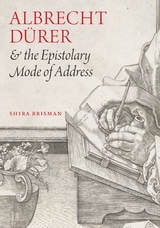
Albrecht Dürer and the Epistolary Mode of Address
Shira Brisman
University of Chicago Press, 2016
In the early modern period, before the establishment of a reliable postal system, letters faced risks of interception and delay. During the Reformation, the printing press threatened to expose intimate exchanges and blur the line between public and private life. Exploring the complex travel patterns of sixteenth-century missives, Brisman explains how these issues of sending and receiving informed Dürer’s artistic practices. His success, she contends, was due in large part to his development of pictorial strategies—an epistolary mode of address—marked by a direct, intimate appeal to the viewer, an appeal that also acknowledged the distance and delay that defers the message before it can reach its recipient. As images, often in the form of prints, coursed through an open market, and artists lost direct control over the sale and reception of their work, Germany’s chief printmaker navigated the new terrain by creating in his images a balance between legibility and concealment, intimacy and public address.

Alexander von Humboldt
A MetabiographyNicolaas A. Rupke
University of Chicago Press, 2008
This volume, the first metabiography of the great scientist, traces Humboldt’s biographical identities through Germany’s collective past to shed light on the historical instability of our scientific heroes.
“Rupke’s study . . . will doubtless become a standard reference for the Humboldt industry and for writers of scientific metabiographies to come.”—Isis
“Engaging. . . . Rupke’s meticulous analysis is fascinating on many scores.”—Times Higher Education Supplement (UK)
“A study borne of considerable scholarship and one with important methodological implications for historians of geography.”—Charles W. J. Withers, Progress in Human Geography
Allies and Rivals
German-American Exchange and the Rise of the Modern Research UniversityEmily J. Levine
University of Chicago Press, 2021
During the nineteenth century, nearly ten thousand Americans traveled to Germany to study in universities renowned for their research and teaching. By the mid-twentieth century, American institutions led the world. How did America become the center of excellence in higher education? And what does that story reveal about who will lead in the twenty-first century?
Allies and Rivals is the first history of the ascent of American higher education seen through the lens of German-American exchange. In a series of compelling portraits of such leaders as Wilhelm von Humboldt, Martha Carey Thomas, and W. E. B. Du Bois, Emily J. Levine shows how academic innovators on both sides of the Atlantic competed and collaborated to shape the research university. Even as nations sought world dominance through scholarship, universities retained values apart from politics and economics. Open borders enabled Americans to unite the English college and German PhD to create the modern research university, a hybrid now replicated the world over.
In a captivating narrative spanning one hundred years, Levine upends notions of the university as a timeless ideal, restoring the contemporary university to its rightful place in history. In so doing she reveals that innovation in the twentieth century was rooted in international cooperation—a crucial lesson that bears remembering today.

Among Unknown Tribes
Rediscovering the Photographs of Explorer Carl LumholtzBy Bill Broyles
University of Texas Press, 2014
An Aesthetics of Narrative Performance
Transnational Theater, Literature, and Film in Contemporary GermanyClaudia Breger
The Ohio State University Press, 2012

An American in Hitler's Berlin
Abraham Plotkin's Diary, 1932-33Abraham Plotkin; Edited & with an introduction by Catherine Collomp & Bruno Grop
University of Illinois Press, 2007
Compared to the writings of other American observers of the Third Reich, Plotkin's diary is unique in style, scope, themes, and time span. Most accounts of Hitler's rise to power emphasize political institutions by focusing on the Nazi party's clashes with other political forces. In contrast, Plotkin is especially attentive to socioeconomic factors, providing an alternative view from the left that stems from his access to key German labor and socialist leaders. Chronologically, the diary reports on the moment when Hitler's seizure of power was not yet inevitable and when leaders on the left still believed in a different outcome of the crisis, but it also includes Plotkin's account of the complete destruction of German labor in May 1933.
An Emotional State
The Politics of Emotion in Postwar West German CultureAnna M. Parkinson
University of Michigan Press, 2015
One of the book’s major contributions is that it offers an analytical distinction between emotion and affect, finding a compelling way to talk about affect and emotion that is informed by affect theory but that integrates psychoanalysis. The study draws on the psychoanalytic writings of Freud, Margarete and Alexander Mitscherlich, and André Green, while engaging with interdisciplinary theorists of affect including Barbara Rosenwein, Lauren Berlant, Ann Cvetkovich, and Eve Kosofsky Sedgwick among many others.

An Epitaph for German Judaism
From Halle to JerusalemEmil Fackenheim
University of Wisconsin Press, 2007
“An ‘epoch-making’ autobiography.”—Arnold Ages, Jewish Tribune

An Intimate History of Nazism
Love, Marriage, and Sexuality in the Third ReichElissa Mailänder
University of Wisconsin Press, 2027
Published to great acclaim in French and now available for the first time in English, this groundbreaking book explores how the Nazi regime used sexuality to promote political loyalty, conformity, and cohesion among “ordinary” Germans. Beginning before the collapse of the Weimar Republic and continuing through the postwar American occupation of Germany, Elissa Mailänder’s study highlights the complex and conflicted ways that sexual “liberation,” repression, and violence were used and experienced in the everyday lives of citizens of the Reich. Her analysis draws on a vast array of sources, from legal dossiers to private photographs and letters, as well as public archives, magazines, and movies. Mailänder’s findings are often uncomfortable; she demonstrates, for example, that a significant number of women who were not persecuted by the regime saw shifts in gender and sexual norms as positive developments—ones that some felt were lost under the American occupation, with its own routines of military sexual exploitation. What emerges is a portrait of a regime that was less interested in repressing sexuality than in reinventing it according to a racist, elitist, and homophobic agenda.
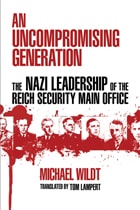
An Uncompromising Generation
The Nazi Leadership of the Reich Security Main OfficeMichael Wildt
University of Wisconsin Press, 2009
Wildt’s study traces the intellectual evolution of key members of the Reich Security Main Office (RSHA) from their days as students until the end of World War II. Established in 1939, this office fused together the Gestapo, the Criminal Police, and the Sicherheitsdienst (Security Service) of the SS. Far from being small cogs in a big bureaucratic machine, Wildt finds that the people who made up the RSHA constructed the concepts and operated the apparatus that carried out the Holocaust.
At the center of both theory and practice of persecution and genocide in Nazi-occupied Europe, these young men of the RSHA—none of whom envisioned the systematic annihilation of the European Jews—became radicalized. How this occurred is the central question of Wildt’s book. Wildt also discusses the postwar careers of the members of the RSHA. Strikingly, he shows how the leaders of the RSHA evaded the consequences of their actions under the Nazi regime and went on to have important careers in the rebuilt West Germany.
An alternate selection of the History Book Club and Military Book Club
An Underground Life
Memoirs of a Gay Jew in Nazi BerlinGad Beck; written with Frank Heibert, translated by Allison Brown
University of Wisconsin Press, 2000

Anchoress and Abbess in Ninth-Century Saxony
The Lives of Liutbirga of Wendhausen and Hathumoda of GandersheimFrederick S. Paxton
Catholic University of America Press, 2009

Animals under the Swastika
J. W. Mohnhaupt, translated by John R. J. Eyck
University of Wisconsin Press, 2022
Drawing from diaries, journals, school textbooks, and printed propaganda, J.W. Mohnhaupt tells these animals’ stories vividly and with an eye for everyday detail, focusing each chapter on a different facet of Nazism by way of a specific animal species: red deer, horses, cats, and more. Animals under the Swastika illustrates the complicated, thought-provoking relationship between Nazis and animals.
Anthropology and Antihumanism in Imperial Germany
Angela Elisabeth Zimmerman
University of Chicago Press, 2001
Drawing on sources ranging from scientific papers and government correspondence to photographs, pamphlets, and police reports of "freak shows," Zimmerman demonstrates how German imperialism opened the door to antihumanism. As Germans interacted more frequently with peoples and objects from far-flung cultures, they were forced to reevaluate not just those peoples, but also the construction of German identity itself. Anthropologists successfully argued that their discipline addressed these issues more productively—and more accessibly—than humanistic studies.
Scholars of anthropology, European and intellectual history, museum studies, the history of science, popular culture, and colonial studies will welcome this book.
Anthropology at War
World War I and the Science of Race in GermanyAndrew D. Evans
University of Chicago Press, 2010
Between 1914 and 1918, German anthropologists conducted their work in the midst of full-scale war. The discipline was relatively new in German academia when World War I broke out, and, as Andrew D. Evans reveals in this illuminating book, its development was profoundly altered by the conflict. As the war shaped the institutional, ideological, and physical environment for anthropological work, the discipline turned its back on its liberal roots and became a nationalist endeavor primarily concerned with scientific studies of race.
Combining intellectual and cultural history with the history of science, Anthropology at War examines both the origins and consequences of this shift. Evans locates its roots in the decision to allow scientists access to prisoner-of-war camps, which prompted them to focus their research on racial studies of the captives. Caught up in wartime nationalism, a new generation of anthropologists began to portray the country’s political enemies as racially different. After the war ended, the importance placed on racial conceptions and categories persisted, paving the way for the politicization of scientific inquiry in the years of the ascendancy of National Socialism.

Anti-Heimat Cinema
The Jewish Invention of the German LandscapeOfer Ashkenazi
University of Michigan Press, 2020
Archaeologies of Modernity
Avant-Garde BildungRainer Rumold
Northwestern University Press, 2015
Archaeologies of Modernity explores the shift from the powerful tradition of literary forms of Bildung—the education of the individual as the self—to the visual forms of “Bildung” (from Bild) that characterize German modernism and the European avant-garde. Interrelated chapters examine the work of Franz Kafka, Jean/Hans Arp, Walter Benjamin, and Carl Einstein, and of artists such as Oskar Kokoschka or Kurt Schwitters, in the light of the surge of an autoformation (Bildung) of verbal and visual images at the core of expressionist and surrealist aesthetics and the art that followed. In this first scholarly focus on modernist avant-garde Bildung in its entwinement of conceptual modernity with forms of the archaic, Rumold resituates the significance of the poet and art theorist Einstein and his work on the language of primitivism and the visual imagination. Archaeologies of Modernity is a major reconsideration of the conception of the modernist project and will be of interest to scholars across the disciplines.

Architecture in Translation
Germany, Turkey, and the Modern HouseEsra Akcan
Duke University Press, 2012
Armed Ambiguity
Women Warriors in German Literature and Culture in the Age of GoetheJulie Koser
Northwestern University Press, 2016
Armed Ambiguity is a fascinating examination of the tropes of the woman warrior constructed by print culture—including press reports, novels, dramatic works, and lyrical texts—during the decades-long conflict in Europe around 1800.
In it, Julie Koser sheds new light on how women’s bodies became a battleground for competing social, cultural, and political agendas in one of the most pivotal periods of modern history. She traces the women warriors in this work as reflections of the social and political climate in German-speaking lands, and she reveals how literary texts and cultural artifacts that highlight women’s armed insurrection perpetuated the false dichotomy of "public" versus "private" spheres along a gendered fault line. Koser illuminates how reactionary visions of "ideal femininity" competed with subversive fantasies of new femininities in the ideological battle being waged over the restructuring of German society.
Army of Hope, Army of Alienation
Culture and Contradiction in the American Army Communities of Cold War GermanyJohn P. Hawkins
University of Alabama Press, 2004
Army life has always been known as a life of sacrifice, challenge, and frustration, yet one filled also with deep satisfactions. This is so for the soldiers’ families as much as for the soldiers themselves. Over the years, military and civilian leaders of the US Army have tried to reduce the hardships of military life by creating an array of community services designed to provide social support for soldiers and families and help them live satisfying lives in military communities.
Unfortunately, this effort has not been particularly successful, and frustration, dissatisfaction, and alienation persist among soldiers and family member in the US Army communities in Germany. Discontent continues because the underlying sources of alienation in the Army and among its families are highly complex, poorly understood, and therefore hardly addressed by the Army’s quality-of-life programs that are intended to make soldier and family life more bearable.
In Army of Hope, Army of Alienation: Culture and Contradiction in the American Army Communities of Cold War Germany, the author seeks to penetrate the logic, social structure, and daily practice of life in the American military communities that lay scattered along the frontier between East and West Germany during the final years of the Cold War. In coming to understand the life and thought of these American soldiers and families, ordinary American citizens can learn much about their military forces and about their own society and culture. In addition, a greater understanding about how people work and live around an institution that is at once so important and yet tasked with a mission so different from that of ordinary pursuits can stimulate social scientists and concerned citizens to think differently about culture, society, and behavior in general.