Results by title
527 books match the query 'Novel' and 45 start with a
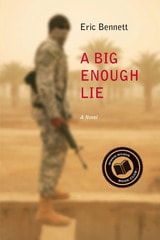
A Big Enough Lie
A NovelEric Bennett
Northwestern University Press, 2015
Awaiting a TV talk show appearance, John Townley is quaking with dread. He has published a best-selling memoir about the Iraq War, a page-turner climaxing in atrocity. In a green room beyond the soundstage, he braces himself to confront the charismatic soldier at the violent heart of it. But John has never actually seen the man before—nor served in Iraq, nor the military. Even so, and despite the deception, he knows his fabricated memoir contains stunning truths.
By turns comic, suspenseful, bitingly satirical, and emotionally potent, A Big Enough Lie pits personal mistruths against national ones of life-and-death consequence. Tracking a writer from the wilds of Florida to New York cubicles to Midwestern workshops to the mindscapes of Baghdad—and from love to heartbreak to solitary celebrity—Bennett’s novel probes our endlessly frustrated desire to grab hold of something (or somebody) true.
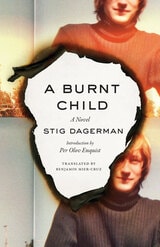
A Burnt Child
A NovelStig Dagerman
University of Minnesota Press, 2013
After the international success of his collection of World War II newspaper articles, German Autumn—a book that solidified his status as the most promising and exciting writer in Sweden—Stig Dagerman was sent to France with an assignment to produce more in this journalistic style. But he could not write the much-awaited follow-up. Instead, he holed up in a small French village and in the summer of 1948 created what would be his most personal, poignant, and shocking novel: A Burnt Child.
Set in a working-class neighborhood in Stockholm, the story revolves around a young man named Bengt who falls into deep, private turmoil with the unexpected death of his mother. As he struggles to cope with her loss, his despair slowly transforms to rage when he discovers his father had a mistress. But as Bengt swears revenge on behalf of his mother’s memory, he also finds himself drawn into a fevered and conflicted relationship with this woman—a turn that causes him to question his previous faith in morality, virtue, and fidelity.
Written in a taut and beautifully naturalistic tone, Dagerman illuminates the rich atmospheres of Bengt’s life, both internal and eternal: from his heartache and fury to the moody streets of Stockholm and the Hitchcockian shadows of tension and threat in the woods and waters of Sweden’s remote islands. A Burnt Child remains Dagerman’s most widely read novel, both in Sweden and worldwide, and is one of the crowning works of his short but celebrated career.
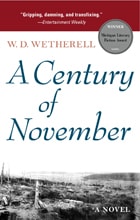
A Century of November
A NovelW. D. Wetherell
University of Michigan Press, 2009
Across western Canada the Spanish flu rages - the very disease that claimed Marden's wife three weeks earlier. Upon arriving in England, he learns that his son left behind a pregnant girlfriend. Soon his search widens to include locating the girl, too. Nearing the front lines, Marden seems to descend into the fires of hell as he navigates the mine-strewn killing fields of the trenches, still reeking with poison gas. Will he find the girl, and will he find an answer to the forces that drove him halfway around the world?
Author W. D. Wetherell has given us a novel of terrifying beauty, one that seems to occupy the place between waking and dreams. Its haunting words will linger long after the book is shut.
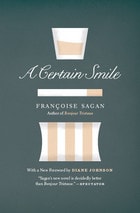
A Certain Smile
A NovelFrançoise Sagan
University of Chicago Press, 2011
A neglected classic about a young French woman in the 1950s risking romance, from the author of Bonjour Tristesse
Françoise Sagan is best known for her first novel, Bonjour Tristesse, which caused a scandal when she first published it at the age of eighteen in 1953. But her second novel, A Certain Smile, less shocking and more psychologically convincing, was preferred by many critics. Like Bonjour Tristesse, this story is set in Paris in the 1950s and told by a young student bored by her law books, restless and curious about love and sex. She is fond of her loyal boyfriend, but he, too, bores her. His worldly uncle strikes her as more exciting, appealingly risky and forbidden. Frank and spontaneous, vulnerable and cruel, thoughtless and insightful, Sagan's young narrator explores such perennial themes as unrequited love and the precarious balance of irrational emotions and self-restraint.

A Coin in Nine Hands
A NovelMarguerite Yourcenar
University of Chicago Press, 1994
"A Coin in Nine Hands has . . . passages that move close to poetry and a story that belongs in both literature and history."—Doris Grumbach, Los Angeles Times Book Review
"What lingers at the end of A Coin in Nine Hands is the shadowiness and puppetlike vagueness of the Dictator, and the compelling specificity of the so-called 'common people' revolving all around him."—Anne Tyler, The New Republic
"Within a few pages we have met half the major characters in this haunting, brilliantly constructed novel. . . . The studied perfection, the structural intricacy and brevity remind one of Camus. Yet by comparison, Yourcenar's prose is lavish, emotional and imagistic."—Cynthia King, Houston Post
"Transcends its specific time and place to become a portrait of vividly delineated characters caught in the vise of a tragically familiar political situation."—Publisher's Weekly
Best known as the author of Memoirs of Hadrian and The Abyss, Marguerite Yourcenar (1903-87) achieved countless literary honors and was the first woman ever elected to the Académie Française.
A Death in Harlem
A NovelKarla FC Holloway
Northwestern University Press, 2019
In A Death in Harlem, famed scholar Karla FC Holloway weaves a mystery in the bon vivant world of the Harlem Renaissance. Taking as her point of departure the tantalizingly ambiguous “death by misadventure” at the climax of Nella Larsen’s Passing, Holloway accompanies readers to the sunlit boulevards and shaded sidestreets of Jazz Age New York. A murder there will test the mettle, resourcefulness, and intuition of Harlem’s first “colored” policeman, Weldon Haynie Thomas.
Clear glass towers rising in Manhattan belie a city where people are often not what they seem. For some here, identity is a performance of passing—passing for another race, for another class, for someone safe to trust. Thomas’s investigation illuminates the societies and secret societies, the intricate code of manners, the world of letters, and the broad social currents of 1920s Harlem.
A Death in Harlem is an exquisitely crafted, briskly paced, and impeccably stylish journey back to a time still remembered as a peak of American glamour. It introduces Holloway as a fresh voice in storytelling, and Weldon Haynie Thomas as an endearing and unforgettable detective.
A Father's Words
A NovelRichard Stern
University of Chicago Press, 1990
"Richard Stern's novels are robustly intelligent, very funny, and beguilingly humane. He knows as much as anyone writing American prose about family mischief, intellectual shenanigans, love blunders—and about writing American prose."—Philip Roth
"A delectable rhetorical display. . . . "—The New Yorker
"Anyone who has read Richard Stern's previous novels won't need to be told he is an unusually crisp and intelligent writer, with a sharp edge to his wit; and in A Father's Words he runs true to form. Many of the book's pleasures are incidental: jokes, intellectual cadenzas, agile turns of phrase . . . The author's powers of farcical invention climax in a brilliant, bitter episode where . . . the younger man proclaims his final failure . . . Mr. Stern has written an excellent novel."—John Gross, New York Times
"Richard Stern is American letters' unsung comic writer about serious matters . . . [A Father's Words] produced in this reviewer an apostolic desire to convince a wider audience to try Stern, especially the vintage Stern."—Doris Grumbach, Chicago Tribune
A Friend of Kissinger
A NovelDavid Milofsky
University of Wisconsin Press, 2019
A History of Hands
A NovelRod Val Moore
University of Massachusetts Press, 2014
Soon, however, an elderly and possibly criminal doctor, offering free therapy, moves in, much to the dismay of bedridden Virge. While the physician endeavors to restore the patient's hands with a series of highly suspect injections, Virge recovers his sense of autonomy and an urge to escape the suffocating domestic circumstances that have perhaps caused his illnesses in the first place.
A History of Hands is a novel that invites the reader into a richly and eccentrically detailed world where fevered imaginations and dark comedy prevail, but where the determination to escape the ambiguities of illness leads to the equal ambiguities of health and freedom.
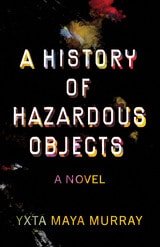
A History of Hazardous Objects
A NovelYxta Maya Murray
University of Nevada Press, 2024
Simultaneously, Laura is trying to write the history section of a Congressional report titled the National Near-Earth Object Preparedness Strategy and Action Plan. This report will advise Congress that it must develop a system to detect and deflect PHOs, and the section Laura is working on cites several historical meteorite impacts as proof that the Earth is now undefended against a significant impact event.
A story about family, love, risk, and science, A History of Hazardous Objects contemplates how experiencing trauma and pain may help us secure a safer and more just world.
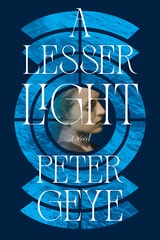
A Lesser Light
A NovelPeter Geye
University of Minnesota Press, 2025
On the rocky shores of Lake Superior, a piercing story of selfhood and determinism develops: is the future what we’re handed or what we make of it?
It’s 1910, and Theodulf Sauer has finally achieved a position befitting his ego: master lighthouse keeper at a newly commissioned station towering above Lake Superior. When his new wife, Willa, arrives on the first spring ferry, it’s clear her life has taken the opposite turn: after being summoned home from college to Duluth when her father dies, she and her scheming mother find themselves destitute, and Willa is rushed into this ill-suited arranged marriage before she can comprehend her fate.
As the lighthouse station establishes, the new relationship teeters between tense and hostile, with little mutual understanding or tenderness. Willa takes solace in her learned fascination with the cosmos, especially (despite her husband’s suspicion of the event) in viewing the imminent Halley’s Comet. Under ominous night skies, Theodulf stands sentry over the lake, clinging to long-ago and faraway memories of happiness that fill him with longing and shame.
Into this impasse, a clairvoyant girl and her resolute uncle emerge from across the cove. They see through the Sauers’ thin façade and, by turns and in different ways, convey promise, sympathy, and insight that counter Willa’s despair. Armed with renewed self-determination, Willa forges a path to happiness. But before she can grasp it, tragedy comes to their remote beacon, and her future plunges toward a dark unknown.
Set against a brooding and beautiful landscape, A Lesser Light is a story about industry and calamity, science versus superstition, inner desire countered with societal expectations—and the consequences when these forces collide in the wilderness of rapid social change.
A Man in Charge
A NovelMorris Philipson
University of Chicago Press, 2000

A Naked Singularity
A NovelSergio De La Pava
University of Chicago Press, 2012
The mind-bending, brilliant, often hilarious PEN Award-winning classic novel of justice, the law, and the brutal gap between the two.
A Naked Singularity tells the story of Casi, a child of Colombian immigrants who lives in Brooklyn and works in Manhattan as a public defender--one who, tellingly has never lost a trial. Never. In the book, we watch what happens when his sense of justice and even his sense of self begin to crack--and how his world then slowly devolves. It’s a huge, ambitious novel clearly in the vein of DeLillo, Foster Wallace, Pynchon, and even Melville, and it's told in a distinct, frequently hilarious voice, with a striking human empathy at its center. Its panoramic reach takes readers through crime and courts, immigrant families and urban blight, media savagery and media satire, scatology and boxing, and even a breathless heist worthy of any crime novel. If InfiniteJest stuck a pin in the map of mid-90s culture and drew our trajectory from there, A Naked Singularity does the same for the feeling of surfeit, brokenness, and exhaustion that permeates our civic and cultural life today. In the opening sentence of William Gaddis’s A Frolic of His Own, a character sneers, "Justice? You get justice in the next world. In this world, you get the law." A Naked Singularity reveals the extent of that gap, and lands firmly on the side of those who are forever getting the law.
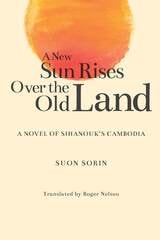
A New Sun Rises Over the Old Land
A Novel of Sihanouk’s CambodiaSuon Sorin
National University of Singapore Press, 2020
First published in 1961, eight years after Cambodia gained independence from French colonial rule, A New Sun Rises Over the Old Land is an iconic work of modern Khmer literature, a singularly illuminating document of the new nation. This is one of the first English translations of a modern Khmer novel, and the text is accompanied by an extended introduction that situates the author in his historical and artistic context and examines the novel’s literary value.
A Probable State
The Novel, the Contract, and the JewsIrene Tucker
University of Chicago Press, 2000
Whereas previous critics have explored the relationship between liberalism and the novel by studying the novel's liberal characters, Tucker argues that the liberal subject is represented not merely within the novel, but in the experience of the novel's form as well. With special attention to George Eliot, Henry James, Oliver Wendell Holmes, and S. Y. Abramovitch, Tucker shows how we can understand liberalism and the novel as modes of recognizing and negotiating with history.
A Saint Is Born in Chima
A NovelBy Manuel Zapata Olivella
University of Texas Press, 1991
When the paralyzed cripple Domingo Vidal is rescued unsinged from a burning house, the people of Chima believe they have witnessed a miracle. Domingo becomes their patron "saint," and tales of his miracles multiply. Domingo makes the rains come, cures the blind and lame, and swells barren wombs with new life. But is Domingo really a saint, or is he a pagan idol? Padre Berrocal calls the people heretics, but they are afraid not to worship Domingo. To what excesses will superstition and ignorance drive the frightened people of Chima?
This novel, published in 1963 as En Chimá nace un santo, makes important connections between the frustrations of poverty and the excesses of religious fanaticism. Zapata Olivella indicts the dogmatic attitudes of religious and civil institutions as a major cause of the creation of local cults like the one that grows up around "Saint" Domingo. In Zapata Olivella's compelling narrative, the struggle over Domingo points up both the inflexibility of established institutions and the potential power for change that lies within the hands of a determined populace.
A Song over Miskwaa Rapids
A NovelLinda LeGarde Grover
University of Minnesota Press, 2023
A fifty-year-old mystery converges with a present-day struggle over family, land, and history—now available in paperback
When a rock is dislodged from its slope by mischievous ancestors, the past rises to meet the present, and Half-Dime Hill gives up a gruesome secret it has kept for half a century. Some people of Mozhay Point have theories about what happened; others know—and the discovery stirs memories long buried, reviving a terrible story yet to be told.
Returning to the fictional Ojibwe reservation in northern Minnesota she has so deftly mapped in her award-winning books, Linda LeGarde Grover reveals traumas old and new as Margie Robineau, in the midst of a fight to keep her family’s long-held allotment land, uncovers events connected to a long-ago escape plan across the Canadian border, and the burial—at once figurative and painfully real—of not one crime but two. While Margie is piecing the facts together, Dale Ann is confronted by her own long-held secrets and the truth that the long ago and the now, the vital and the departed are all indelibly linked, no matter how much we try to forget.
As the past returns to haunt those involved, Margie prepares her statement for the tribal government, defending her family’s land from a casino development and sorting the truths of Half-Dime Hill from the facts that remain there. Throughout the narrative, a chorus of spirit women gather in lawn chairs with coffee and cookies to reminisce, reflect, and speculate, spinning the threads of family, myth, history, and humor—much as Grover spins another tale of Mozhay Point, weaving together an intimate and complex novel of a place and its people.
Retail e-book files for this title are screen-reader friendly.
A Stricken Field
A NovelMartha Gellhorn
University of Chicago Press, 2011
Martha Gellhorn was one of the first—and most widely read—female war correspondents of the twentieth century. She is best known for her fearless reporting in Europe before and during WWII and for her brief marriage to Ernest Hemingway, but she was also an acclaimed novelist.
A Thousand Souls
A Novel in StoriesCatherine Tudish
Acre Books, 2026
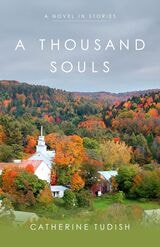
Catching sight of the village of Neptune nestled in a remote Vermont valley, a traveler likens it to “a lost kingdom.” The fourteen stories in Catherine Tudish’s gorgeously crafted volume interweave the lives of three generations in this “embarrassingly pretty town” of “upward of a thousand souls” as they inevitably touch the outside world. A boy born of a secret affair travels by train to South Carolina for a first-time meeting with his respected father. A recent widow and Boston transplant solves the mystery of a teen girl gone missing. A beloved sheriff breaks up a drug operation, only to get busted himself for helping undocumented workers evade ICE. The disappointed wife of a rural mail driver presents him with a nude portrait—of herself. A shy girl with a speech impediment loses her stutter when she befriends and speaks to a black bear. Another boy has nightmares that seem to be the memories of a distant stranger’s tragedy.
Even as their loyalties and traditions are tested through loss, betrayal, and startling discovery, the characters in A Thousand Souls embody the belonging that comes from a close-knit community. Sharply observed, wry, and deeply tender, these stories resonate with both the intricacy and cost of interconnection as the years pass, and ordinary lives take unexpected turns.
A Time Far Past
A Novel of Viet NamLe Luu
University of Massachusetts Press, 1997
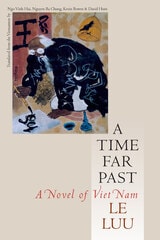
In its intricate sketching of complicated alliances, personal debts, and human interactions, A Time Far Past explores the complex layering of family and village history and Party and feudal authority. It also paints a vivid picture of the vast dislocations in Vietnamese culture caused by the political and military turmoil of the Indochina wars.
A Time Far Past was enormously popular in Vietnam, where it was first published in 1986, selling more than 120,000 copies and winning that country's national prize for fiction.
A Voice from the River
A NovelDan Gerber
Michigan State University Press, 2005
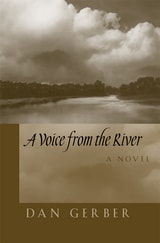
This novel is one of Dan Gerber's triumphs. From the author of American Atlas, Out of Control, and Grass Fires, Gerber's A Voice From the River followed Grass Fires to prominence on national bestseller lists. This novel once again affirms the Gerber's solid reputation for writing about the confrontation of the Spirit World and what some consider to be the Last of Days.
A Wider Reality
Representative Lives, Modernity, and the NovelHeather Brink-Roby
University of Chicago Press, 2026
Theorizes how treating lives as “representative” has been used, in and beyond the novel, to frame the problems and paradoxes of modernity.
Claims that someone or something is “representative” newly saturated nineteenth-century culture; readers were asked to accept that the “representative” particular could stand in for and reflect a wider unit to which it belongs—specifically because it illustrates the relevant attributes, experiences, or behaviors of that wider unit. Heather Brink-Roby considers why this discourse of representativeness surged in nineteenth-century Britain: why it became insistent and examined in domains ranging from philosophical logic and astronomy to literary criticism and the novel. Fiction offered an especially inventive site for using the dynamics of representativeness to frame certain key nineteenth-century concerns, including isolation, freedom, and modern yearning, even as representativeness developed the novel’s dual and contradictory status as both the genre of the individual and the genre of society.
Brink-Roby theorizes the complex restructuring of thought involved in the nineteenth century turn to representativeness and examines how the dynamics of representativeness itself—in addition to the content treated as representative—have shaped the way that modern existence is imagined. Offering fresh readings of novelists including Charles Dickens, George Eliot, Thomas Hardy, and Thomas Martin Wheeler and drawing on a variety of other sources such as natural history monographs, logic textbooks, and medical articles, A Wider Reality shows how representativeness became the basis of a new economy of meaning, seeing, and knowing.

A World for Julius
A NovelAlfredo Bryce Echenique
University of Wisconsin Press, 2004
Julius was born in a mansion on Salaverry Avenue, directly across from the old San Felipe Hippodrome. Life-size Disney characters and cowboy movie heroes romp across the walls of his nursery. Out in the carriage house, his great-grandfather’s ornate, moldering carriage takes him on imaginary adventures. But Julius’s father is dead, and his beautiful young mother passes through her children’s lives like an ephemeral shooting star. Despite the soft shelter of family and money, hard realities overshadow Julius’s expanding world, just as the rugged Andes loom over his home in Lima.
This lyrical, richly textured novel, first published in 1970 as Un mundo para Julius, opens new territory in Latin American literature with its focus on the social elite of Peru. In this postmodern novel Bryce Echenique incisively charts the decline of an influential, centuries-old aristocratic family faced with the invasion of foreign capital in the 1950s.
Winner of the Outstanding Translation Award of the American Literary Translators Association and the Columbia University Translation Center Award.
Abracadabra
A NovelDavid Kranes
University of Nevada Press, 2017
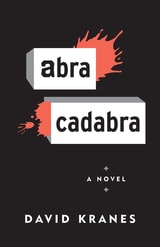
Magicians and misdirection, gambling, down-on-one’s-luck, the crazed sense of possibility and impossibility, mistaken identity, impersonators and body doubles, people acting bizarrely with all sorts of chaos, collisions, and overlaps thrown in for good measure. Again and again the reader is swept into treacherous waters, always confident that the writer is in control of his material. Because the many twists and turns the plot takes are all but impossible to anticipate, the experience of reading Abracadabra is deliciously magical.
Afternoon Men
A NovelAnthony Powell
University of Chicago Press, 1931
More explorations of relationships and vanity than plot-driven narratives, Powell’s early works reveal the stirrings of the unequaled style, ear for dialogue, and eye for irony that would reach their caustic peak in his epic, A Dance to the Music of Time.
In Afternoon Men, the earliest and perhaps most acid of Powell’s novels, we meet the museum clerk William Atwater, a young man stymied in both his professional and romantic endeavors. Immersed in Atwater’s coterie of acquaintances—a similarly unsatisfied cast of rootless, cocktail-swilling London sophisticates—we learn of the conflict between his humdrum work life and louche social scene, of his unrequited love, and, during a trip to the country, of the absurd contrivances of proper manners.
A satire that verges on nihilism and a story touched with sexism and equal doses self-loathing and self-medication, AfternoonMen has a grim edge to it. But its dialogue sparks and its scenes grip, and for aficionados of Powell, this first installment in his literary canon will be a welcome window onto the mind of a great artist learning his craft.
Agents and Patients
A NovelAnthony Powell
University of Chicago Press, 1936
In Agents and Patients, we return to London with the newly wealthy, memorably named Blore-Smith: an innocent, decent enough chap . . . and a drip. Vulnerable to the machinations of those with less money and more lust, Blore-Smith falls victim to two con artists whose ploys carry him through to the art galleries and whorehouses of Paris, Berlin, and beyond.
Written from a vantage point both high and necessarily narrow, Powell’s early novels nevertheless deal in the universal themes that would become a substantial part of his oeuvre: pride, greed, and what makes people behave as they do. Filled with eccentric characters and piercing insights, Powell’s work is achingly hilarious, human, and true.
Alexander The Great
A NovelNikos Kazantzakis
Ohio University Press, 1982
Nikos Kazantzakis is no stranger to the heroes of Greek antiquity. In this historical novel based on the life of Alexander the Great, Kazantzakis has drawn on both the rich tradition of Greek legend and the documented manuscripts from the archives of history to recreate an Alexander in all his many-faceted images—Alexander the god; Alexander the descendant of Heracles performing the twelve labors; Alexander the mystic, the daring visionary destined to carry out a divine mission; Alexander the flesh-and-blood mortal who, on occasion, is not above the common soldier’s brawling and drinking.
The novel, which resists the temptation to portray Alexander in the mantle of purely romantic legend, covers his life from age fifteen to his death at age thirty-two. It opens with Alexander’s first exploit, the taming of the horse, Bucephalas, and is seen in great part through the eyes of his young neighbor who eventually becomes an officer in his army and follows him on his campaign to conquer the world.
The book, which was written primarily as an educational adjunct for young readers, is intended for the adult mind as well, and like the legends of old, is entertaining as well as instructive for readers of all ages. It was originally published in Greece in serial form in 1940, and was republished in a complete volume in 1979.
Alexander the Great
A NovelNikos Kazantzakis
Ohio University Press, 2025
Newly translated, this classic novel is sure to delight readers of all ages as it explores the legendary conqueror’s life, ambitions, and humanity.
Nikos Kazantzakis’s Alexander the Great is a biographical novel about one of antiquity’s greatest political and military leaders. In Kazantzakis’s story, Alexander of Macedonia does not conquer for conquest’s sake; instead, he seeks to spread the light of Hellenism to the known world, unite humanity through Greek ideals and culture, and bring together East and West.
The story begins in Pella, the lavish capital of Macedonia, in the fourth century BCE. A teenager named Stefanos rushes to the royal stadium for a remarkable event that has drawn every male citizen of this capital city: the taming of a wild and uniquely powerful horse named Bucephalus. Relying on raw strength and force, even seasoned generals fail to subdue Bucephalus; but through skill, kindness, and insight, the fifteen-year-old Alexander is able to befriend the beast. Alexander’s symbolic taming of chaos foretells his rise to power and demonstrates the qualities he will carry with him throughout his lifelong campaign of conquest.
Through the eyes of Stefanos, who becomes Alexander’s personal attendant and most trusted companion, Kazantzakis follows the Macedonian army through triumphant campaigns across Persia, Egypt, and India, greatly expanding the boundaries of the ancient Hellenic world. Kazantzakis presents Alexander not only as an ingenious military strategist but also as a reflective human being. Alexander oscillates between the human and the divine but will ultimately be betrayed by the former. Kazantzakis narrates Alexander’s struggles and conquests all the way to Babylon, where he meets his untimely death at just thirty-three years of age.
This iconic novel also explores Alexander’s profound relationship with his mentor, Aristotle, who instills in him a lifelong thirst for knowledge. Alexander the Great offers a compelling blend of history, myth, and philosophy and will appeal to readers fascinated by ancient Greece, epic heroes, and humanity’s timeless quest for the meaning of life.
All That Rises
A NovelAlma García
University of Arizona Press, 2023
What follows is a story in which mysteries are unraveled, odd alliances are forged, and the boundaries between lives blur in destiny-changing ways—all in a place where the physical border between two countries is as palpable as it is porous, and the legacies of history are never far away. There are no easy solutions to the issues the characters face in this story, and their various realities—as undocumented workers, Border Patrol agents, the American supervisor of a Mexican factory employing an impoverished workforce—never play out against a black-and-white moral canvas. Instead, they are complex human beings with sometimes messy lives who struggle to create a place for themselves in a part of the world like no other, even as they are forced to confront the lives they have made.
All That Rises is about secrets, lies, border politics, and discovering where you belong—within a family, as well as in the world beyond. It is a novel for the times we live in, set in a place many people know only from the news.
All That Road Going
A NovelA. G. Mojtabai
Northwestern University Press, 2008
In the middle of the night, somewhere in Oklahoma—or is it Missouri?—a bus hurtles down an anonymous American highway. Its passengers, among them two children traveling on their own, a retired salesman, an unwed teenage mother, an unemployed chemist, and the driver who ferries and broods over all of them, are in the middle of their journeys. Soon, two of the passengers will be lost, and then the bus itself will lose its way.
The open road and, before that, the open frontier have long been part of the American romance, cherished features of the nation's traditional vision of itself. In her latest novel, A. G. Mojtabai stands this tradition on its head. Instead of the expansive thrust into unknown territory, the camaraderie of the open road, adventure, and the joys of vagabondage, we witness constriction, isolation, and fear. Instead of freedom, we find people fleeing from coast to coast in search of home and the ever-beckoning, ever-retreating promise of a better life. Richly drawn, evocative, and thought-provoking, All That Road Going is a challenging new departure from the road novel canon.
All Things Tending towards the Eternal
A NovelKathleen Lee
Northwestern University Press, 2015
Traveling through China in 1989, not long after the Tiananmen Square massacre, Fanny hopes to make sense of her brother Bruno’s death in a motorcycle accident by finding a woman with whom he had exchanged letters. On her journey Fanny’s fate becomes entwined with a handsome British rogue, an American of Russian-Cuban descent returning to Tashkent, and two Chinese men—one who loves Charles Dickens, the other a budding, entrepreneurial con man—struggling to find their way in a country undergoing tumultuous transformation. Kathleen Lee’s debut novel explores the tension between the allure of the unfamiliar that draws us to distant lands and its unbidden tendency to reveal us to ourselves. With its rollicking sense of humor and slyly lyrical voice, as well as an extraordinary deftness in the rendering of place, All Things Tending towards the Eternal is an unforgettable ride.
All This Belongs to Me
A NovelPetra Hulova
Northwestern University Press, 2009
Winner of the American Literary Translators Association 2010 National Translation Award
Petra Hůlová became an overnight sensation when All This Belongs to Me was originally published in Czech in 2002, when the author was just twenty-three years old. She has since established herself as one of the most exciting young novelists in Europe today. Writings from an Unbound Europe is proud to publish the first translation of her work in English.
All This Belongs to Me chronicles the lives of three generations of women in a Mongolian family. Told from the point of view of a mother, three sisters, and the daughter of one of the sisters, this story of secrets and betrayals takes us from the daily rhythms of nomadic life on the steppe to the harsh realities of urban alcoholism and prostitution in the capital, Ulaanbaatar. All This Belongs to Me is a sweeping family saga that showcases Hůlová's genius.
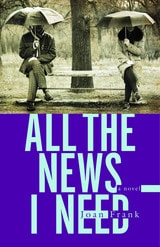
All the News I Need
a novelJoan Frank
University of Massachusetts Press, 2017
Because of course she feels what he feels. . . . People their age natter along not copping to it but the awareness is billboarded all over their faces—a wavering, a hesitation, even those who used to crow and jab the air. The tablecloth of certainty, with all its sparkly settings, has been yanked, and not artfully. It's why people drink.
All The News I Need probes the modern American response to inevitable, ancient riddles—of love and sex and mortality.
Frances Ferguson is a lonely, sharp-tongued widow who lives in the wine country. Oliver Gaffney is a painfully shy gay man who guards a secret and lives out equally lonely days in San Francisco. Friends by default, Fran and Ollie nurse the deep anomie of loss and the creeping, animal betrayal of aging. Each loves routine but is anxious that life might be passing by. To crack open this stalemate, Fran insists the two travel together to Paris. The aftermath of their funny, bittersweet journey suggests those small changes, within our reach, that may help us save ourselves—somewhere toward the end.
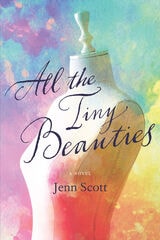
All the Tiny Beauties
A NovelJenn Scott
Acre Books, 2022
All the Tiny Beauties begins with a kitchen fire that sends the reclusive Webster Jackson to the home of his new neighbor, Colleen, who discovers him on her doorstep wearing a lacy peignoir, his house in flames. Unwilling to take responsibility for the lonely eccentric, Colleen reaches out to Webb’s estranged daughter, Debra. She also helps him find a live-in companion, a young adult reeling from the loss of her childhood friend.
Moving among perspectives and generations, we see the longings and vulnerabilities that drive and impede these characters as their stories intertwine—Webb’s first love clashing with his last; Colleen embarking on a secret affair with Debra; the older Webb and his young housemate, Hannah, forming a bond over tragedy, guilt, and his passion for baking.
Confronting the many ways they’ve failed others as well as themselves, Webb, Colleen, Hannah, and Debra slowly find ways forward and ways out. While exploring the fragile nature of our connections to one another, All the Tiny Beauties asks larger questions about the constraints society imposes that warp and wound, leading us to deny those things that make us wholly ourselves.
Alligators May Be Present
A NovelAndrew Furman
University of Wisconsin Press, 2005
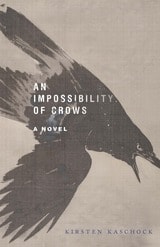
An Impossibility of Crows
A NovelKirsten Kaschock
University of Massachusetts Press, 2026
A story of mothers, monsters, and the science of longing
In this daring and evocative tale, Agnes Krahn, a chemist trained in Philadelphia, returns to her childhood home after the death of her father. Just a stone's throw from the haunted fields of Gettysburg, the small town of Letort, Pennsylvania is where the Krahn family has lived for six generations—bound by twisted folk wisdom and an uncanny kinship with the crows that loom over their land.
Back in the grim farmhouse of her youth, Agnes is drawn into the strange legacy she tried to leave behind. When she discovers an abandoned nest in the barn, she becomes consumed by a scientific—and deeply personal—experiment: to breed a crow large and intelligent enough to carry her daughter, Mina, to a freedom Agnes has never known herself. As the bird grows, so does its terrifying potential—manifest in language, cunning, and a violent will of its own. What begins as a gesture of love and liberation turns darkly obsessive, echoing the dangerous ambition of Frankenstein’s monster and the generational trauma buried in the soil of her family’s past.
A thoroughly modern, feminist novel, this is a story of mothers and daughters, inheritance and isolation, and the thin line between care and control. It confronts themes of self-harm and self-preservation, as well as memory and myth, in a narrative as visceral and uncanny as the bird that rises at its heart.
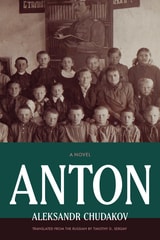
Anton
A NovelAleksandr Chudakov, Timothy D. Sergay
Northwestern University Press, 2027
A landmark work of contemporary Russian literature, now in English for the first time
Set in a fictitious town in North Kazakhstan settled by political and ethnic exiles, this panoramic narrative follows the relationship between the titular character Anton, a Moscow historian of the vital “1960s generation,” and his grandfather, Leonid, a titan of physical and intellectual rigor who is now on the verge of death. As Anton contemplates the fading away of that once-powerful vitality, he lets his thoughts plunge deep into the past, presented in a series of fine-grained sketches, scattered reminiscences, and subtly interconnected episodes, back and forth from childhood to present day. The resulting novel is a “Soviet family Robinson”: the history of rugged and free-thinking intellectuals eking out a tolerable, even enviable homestead existence despite the difficulties of the Stalin years. One of the most vibrant works of literary fiction created since the fall of the Soviet Union, Aleksandr Chudakov’s Anton is a testament to humanity's tenacity and tenderness.
Aransas
A NovelBy Stephen Harrigan
University of Texas Press, 2014
Arc and the Sediment
a NovelChristine Allen-Yazzie
Utah State University Press, 2007
This tale, though dark and difficult, is infused with tart, twisted humor. Confused, disheveled, self-deprecating, and self-destructive, Gretta is also sharp and funny. Here, first-time novelist Christine Allen-Yazzie breaks apart her own narrative arc but with gritty reality seals it near-shut again, if in rearrangement, drawing us into Gretta's wrestling match with herself, her husband, her addiction, and the road.
The Arc and the Sediment received an honorable mention from the James Jones First Novel Competition, and it won the Utah Arts Council Annual Writing Competiton Publishing Prize.
Archipelagoes
Insular Fictions from Chivalric Romance to the NovelSimone Pinet
University of Minnesota Press, 2010
Pinet looks closely at Amadís de Gaula and the Liber insularum archipelagi as the first examples of these genres. Both isolario and chivalric romance (libros de caballerías) make of the island a flexible yet cohesive framework that becomes intrinsic to the construction of their respective genres. The popularity of these forms throughout the seventeenth century in turn bears witness to the numerous possibilities the archipelagic structure offered, ultimately taken up by the grand genres of each discipline—the atlas and the novel.
Moving from verbal descriptions to engravings and tapestry weavings, and from the chivalric politics and ethics proposed in the Amadís de Gaula to the Insula Barataria episode in Don Quixote, Pinet’s analysis of insularity and the use of the island structure reveals diverging roles for fiction, illuminating both the emergence of the novel and contemporary philosophical discussion on fiction.
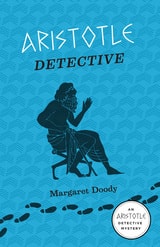
Aristotle Detective
An Aristotle Detective NovelMargaret Doody
University of Chicago Press, 2014
In Aristotle Detective, we first meet Stephanos—naive Watson to Aristotle’s learned Holmes—a young landed Athenian and student of Aristotle. With the aid of his cunning, olive-loving teacher, Stephanos must clear his exiled cousin of murder and save his family’s honor in a tense public trial. Will Stephanos survive to cinch the case?
Art Is Everything
A NovelYxta Maya Murray
Northwestern University Press, 2021
In her funny, idiosyncratic, and propulsive new novel, Art Is Everything, Yxta Maya Murray offers us a portrait of a Chicana artist as a woman on the margins. L.A. native Amanda Ruiz is a successful performance artist who is madly in love with her girlfriend, a wealthy and pragmatic actuary named Xōchitl. Everything seems under control: Amanda’s grumpy father is living peacefully in Koreatown; Amanda is about to enjoy a residency at the Guggenheim Museum in New York and, once she gets her NEA, she’s going to film a groundbreaking autocritical documentary in Mexico.
But then everything starts to fall apart when Xōchitl’s biological clock begins beeping, Amanda’s father dies, and she endures a sexual assault. What happens to an artist when her emotional support vanishes along with her feelings of safety and her finances? Written as a series of web posts, Instagram essays, Snapchat freakouts, rejected Yelp reviews, Facebook screeds, and SmugMug streams-of-consciousness that merge volcanic confession with eagle-eyed art criticism, Art Is Everything shows us the painful but joyous development of a mid-career artist whose world implodes just as she has a breakthrough.
Arthouse
A NovelJeffrey DeShell
University of Alabama Press, 2011
From film to film, Jeffrey DeShell follows a forty-something failed film studies academic—The Professor. While The Professor is reinvented with each new chapter (or film), what remains is DeShell’s inventive deconstruction and representation of modern cinema. At times borrowing imagery, plot, or character elements, and at times rendering lighting, rhythm, costuming, or shot sequences into fictional language, The Professor’s journey sends him from the Southwestern town of Pueblo, Colorado, into the role of rescuer as he aids an attempted-rape victim, and finally to Italy. Ultimately though, The Professor is left alone, struggling to reconcile the real world with his life in cinema.
As If a Bird Flew By Me
A NovelSara Greenslit
University of Alabama Press, 2011
“The world is full of continuous conversations: Now is surrounded by Past, and both are encircled by Forever.” So states an unnamed narrator in As if a Bird Flew by Me.
Celia lives in the contemporary Midwest. Ann is an accused witch, executed during the Salem witch trials. Two women separated by time and place yet yoked by heritage and history. Set in three time periods, stories within stories unfold, and Greenslit’s language seamlessly weaves Celia’s modern life with the historical record of Ann’s demise alongside dazzling renderings of animal life. Greenslit’s hybrid of fiction and nonfiction occupies that rarest of airs: it is a book that illuminates, line by line and page by page, how it should be read.
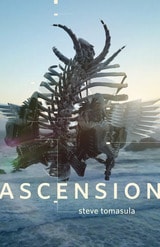
Ascension
A NovelSteve Tomasula
University of Alabama Press, 2022
A visually stunning narrative of three eras in humankind’s vexed relationship with nature.
Ascension is a novel about the end of nature, or rather, the end of three “natures”: the time just before Darwin changed the natural world; the 1980s, just as the digital and genetic revolutions begin to replace “nature” with “environment”; and today, a time when we have the ability to manipulate nature at both the scale of the planet and at the genome. The narrative follows three different biologists on the brink of each of these cultural extinctions to explore how nature occupies our imaginations and how our imaginations bring the natural world, and our place in it, into existence.
Ascension is a story of how we continually remake the world and are in turn remade by the new nature we’ve created. It is the story of humans yearning to understand their families, themselves, and the world they live in as it comes to a close, leaving them to anticipate what will follow. Rich in visual depictions of the natural world—from nineteenth century engraving and paintings to twentieth century photography and twenty-first century databases—Ascension uses the materials of three eras to drive home our inability to escape nature, and the ways our fates are irrevocably bound together even as our actions usher in an end-time.