Results by title
704 books match the query 'Political Process' and 27 start with a

A A Political Space
Reading The Global Through Clayoquot SoundWarren Magnusson
University of Minnesota Press, 2002
An innovative look at the convergence of global trends and local struggles in this out-of-the-way place.
On the remote outer coast of Vancouver Island in British Columbia, Clayoquot Sound might seem to be situated at the periphery of contemporary power and authority. And yet, as the disputed land of native peoples and the contentious site of corporate logging in one of the world’s last remaining temperate rain forests, Clayoquot Sound is also squarely in the middle of global politics today. These authors develop a new way of making sense of the rapidly changing character of political life in our day, revealing the political problems and possibilities inherent in the convergence of the global and the local so dramatically enacted in Clayoquot Sound.
Contributors: Umeek of Ahousaht (E. Richard Atleo), Malaspina U College, British Columbia; William Chaloupka, U of Montana; Thom Kuehls, Weber State U; Timothy W. Luke, Virginia Polytechnic; R. Michael M’Gonigle, U of Victoria; Catriona Sandilands, York U, Toronto; Gary C. Shaw, California State U, Stanislaus; R. B. J. Walker, Keele U, UK; Sharon Zukin, Brooklyn College and CUNY.rights: CAN
A COVID Charter, A Better World
Toby Miller
Rutgers University Press, 2021
A COVID Charter, A Better World outlines the steps needed to reform public policies and fix the structural vulnerabilities that the current pandemic has made so painfully clear. Leading scholar Toby Miller argues that we must resist neoliberalism’s tendency to view health in terms of individual choices and market-driven solutions, because that fails to preserve human rights. He addresses the imbalance of geopolitical power to explain how we arrived at this point and shows that the pandemic is more than just a virus—it’s a social disease. By examining how the U.S., Britain, Mexico, and Colombia have responded to the COVID-19 crisis, Miller investigates corporate, scientific, and governmental decision-making and the effects those decisions have had on disadvantaged local communities. Drawing from human rights charters ratified by various international organizations, he then proposes a COVID charter, calling for a new world that places human lives above corporate profits.
A Critique of Political Science
A History of the Caucus for a New Political ScienceClyde W. Barrow
University of Michigan Press, 2026
A Critique of Political Science distinguishes between the discipline of political science (methods and concepts) and the profession of political science (persons and institutions) to move disciplinary history beyond its current form as intellectual history toward a politics of political science. The book argues that understanding the development of a discipline requires the same type of theoretical analysis that political scientists apply to other political institutions. By examining universities and professional associations as political institutions, this approach puts political struggles and ideological conflict at the very core of disciplinary history. In reviewing 50 years of debate, controversy, and in-fighting in the political science profession, the book serves as a critique of the profession and the discipline of political science, which remains woefully disengaged from the concerns of ordinary citizens, particularly the working class and the poor throughout the world.
A Culture of Corruption?
Coping with Government in Post-communist EuropeWilliam L. Miller
Central European University Press, 2001
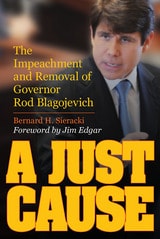
A Just Cause
The Impeachment and Removal of Governor Rod BlagojevichBernard H. Sieracki. Foreword by Jim Edgar
Southern Illinois University Press, 2016
During the predawn hours of December 9, 2008, an FBI team swarmed the home of Illinois governor Rod Blagojevich and took him away in handcuffs. The shocking arrest, based on allegations of corruption and extortion, launched a chain of political events never before seen in Illinois. In A Just Cause, Bernard H. Sieracki delivers a dynamic firsthand account of this eight-week political crisis, beginning with Blagojevich’s arrest, continuing through his impeachment and trial, and culminating in his conviction and removal from office. Drawing on his own eyewitness observations of the hearings and trial, the comments of interviewees, trial transcripts, and knowledge gained from decades of work with the Illinois legislature, Sieracki tells the compelling story of the first impeachment and removal from office of an Illinois governor, while providing a close look at the people involved.
A Just Cause depicts Blagojevich as a master of political gamesmanship, a circus ringmaster driven by personal ambition and obsessed with private gain. Sieracki examines in depth the governor’s unethical behavior while in office, detailing a litany of partisan and personal hostilities that spanned years. He thoroughly covers the events leading to Blagojevich’s downfall and the reactions of the governor’s cohorts. The author discusses the numerous allegations against Blagojevich, including attempts to “sell” appointments, jobs, and contracts in exchange for financial contributions. Sieracki then exhaustively recounts Blagojevich’s senate trial and the governor’s removal from office.
This engrossing volume is both a richly detailed case study of the American checks-and-balances system and an eyewitness account of unprecedented events. It will appeal to anyone interested in the stunning, true tale of a state upholding the maxim “The welfare of the people is the supreme law.”
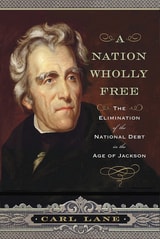
A Nation Wholly Free
The Elimination of the National Debt in the Age of JacksonCarl Lane
Westholme Publishing, 2014
“An engaging treatment of a topic of perennial concern and frequent misunderstanding, this lucid tale of the brief moment when the United States was debt-free should be on every Congress member’s bedside table.”—Peter J.Woolley, Professor of Comparative Politics, Fairleigh Dickinson University
When President James Monroe announced in his 1824 message to Congress that, barring an emergency, the large public debt inherited from the War for Independence, the Louisiana Purchase, and the War of 1812 would be extinguished on January 1, 1835, Congress responded by crafting legislation to transform that prediction into reality. Yet John Quincy Adams,Monroe’s successor, seemed not to share the commitment to debt freedom, resulting in the rise of opposition to his administration and his defeat for reelection in the bitter presidential campaign of 1828. The new president, Andrew Jackson, was thoroughly committed to debt freedom, and when it was achieved, it became the only time in American history when the country carried no national debt. In A Nation Wholly Free: The Elimination of the National Debt in the Age of Jackson, award-winning economic historian Carl Lane shows that the great and disparate issues that confronted Jackson, such as internal improvements, the “war” against the Second Bank of the United States, and the crisis surrounding South Carolina’s refusal to pay federal tariffs, become unified when debt freedom is understood as a core element of Jacksonian Democracy.
The era of debt freedom lasted only two years and ten months. As the government accumulated a surplus, a fully developed opposition party emerged—the beginning of our familiar two-party system—over rancor about how to allocate the newfound money. Not only did government move into an oppositional party system at this time, the debate about the size and role of government distinguished the parties in a pattern that has become familiar to Americans. The partisan debate over national debt and expenditures led to poorly thought out legislation, forcing the government to resume borrowing. As a result, after Jackson left office in 1837, the country fell into a major depression. Today we confront a debt that exceeds $17 trillion. Indeed, we have been borrowing ever since that brief time we freed ourselves from an oversized debt. A thoughtful, engaging account with strong relevance to today, A Nation Wholly Free is the fascinating story of an achievement that now seems fanciful.
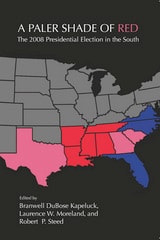
A Paler Shade of Red
The 2008 Presidential Election in the SouthBranwell DuBose Kapeluck
University of Arkansas Press, 2009
A Thousand Steps to Parliament
Constructing Electable Women in MongoliaManduhai Buyandelger
University of Chicago Press, 2022
Mongolia has often been deemed an “island of democracy,” commended for its rapid adoption of free democratic elections in the wake of totalitarian socialism. The democratizing era, however, brought alongside it a phenomenon that Manduhai Buyandelger terms “electionization”—a restructuring of elections from time-grounded events into a continuous neoliberal force that governs everyday life beyond the electoral period. In this way, electoral campaigns have come to substitute for the functions of governing, from social welfare to the private sector, requiring an accumulation of wealth and power beyond the reach of most women candidates. In A Thousand Steps to Parliament, Buyandelger shows how successful women candidates instead use strategies of self-polishing to cultivate charisma and a reputation for being oyunlag, or intellectful. This carefully crafted identity can be called the “electable self”: treating their bodies and minds as pliable and renewable, women candidates draw from the same practices of neoliberalism that have unsustainably commercialized elections. By tracing the complicated, contradictory paths to representation that women in Mongolia must walk, A Thousand Steps to Parliament holds a mirror up to democracies the world over, revealing an urgent need to grapple with the encroaching effects of neoliberalism in our global political systems.
A Troubled Birth
The 1930s and American Public OpinionSusan Herbst
University of Chicago Press, 2021
Herbst contends that the idea that there was a public—whose opinions mattered—emerged during the Great Depression, with the diffusion of radio, the devastating impact of the economic collapse on so many people, the appearance of professional pollsters, and Franklin Roosevelt’s powerful rhetoric. She argues that public opinion about issues can only be seen as a messy mixture of culture, politics, and economics—in short, all the things that influence how people live. Herbst deftly pins down contours of public opinion in new ways and explores what endures and what doesn’t in the extraordinarily troubled, polarized, and hyper-mediated present. Before we can ask the most important questions about public opinion in American democracy today, we must reckon yet again with the politics and culture of the 1930s.

A Twentieth Century Prophet
Oscar Jaszi, 1875-1957György Litván
Central European University Press, 2006
A Voice but No Power
Organizing for Social Justice in MinneapolisDavid Forrest
University of Minnesota Press, 2022
Examining the work of social justice groups in Minneapolis following the 2008 recession
Since the Great Recession, even as protest and rebellion have occurred with growing frequency, many social justice organizers continue to displace as much as empower popular struggles for egalitarian and emancipatory change. In A Voice but No Power, David Forrest explains why this is the case and explores how these organizers might better reach their potential as advocates for the abolition of exploitation, discrimination, and other unjust conditions.
Through an in-depth study of post-2008 Minneapolis—a center of progressive activism—Forrest argues that social justice organizers so often fall short of their potential largely because of challenges they face in building what he calls “contentious identities,” the public identities they use to represent their constituents and counteract stigmatizing images such as the “welfare queen” or “the underclass.” In the process of assembling, publicizing, and legitimating contentious identities, he shows, these organizers encounter a series of political hazards, each of which pushes them to make choices that weaken movements for equality and freedom. Forrest demonstrates that organizers can achieve better outcomes, however, by steadily working to remake their hazardous political terrain.
The book’s conclusion reflects on the 2020 uprising that followed the police killing of George Floyd, assessing what it means for the future of social justice activism. Ultimately, Forrest’s detailed analysis contributes to leading theories about organizing and social movements and charts possibilities for further emboldening grassroots struggles for a fairer society.

A Wide Net of Solidarity
Antiracism and Anti-Imperialism from the Americas to the GlobeAnne Garland Mahler
Duke University Press, 2025
Activist Media
Documenting Movements and Networked SolidarityGino Canella
Rutgers University Press, 2022
Now more than ever, activists are using media to document injustice and promote social and political change. Yet with so many media platforms available, activists sometimes fail to have a coherent media and communication strategy.
Drawing from his experiences as a documentary filmmaker with Black Lives Matter 5280 and Service Employees International Union (SEIU) Local 105 in Denver, Colorado, Gino Canella argues that activist media create opportunities for activists to navigate conflict and embrace their political and ideological differences. Canella details how activist media practices—interviewing organizers, script writing, video editing, posting on social media, and hosting community screenings—foster solidarity among grassroots organizers.
Informed by media theory, this book explores how activists are using media to mobilize supporters, communicate their values, and reject anti-union rhetoric. Furthermore, it demonstrates how collaborative media projects can help activists build broad-based coalitions and amplify their vision for a more equitable and just society.
After Wallace
The 1986 Contest for Governor and Political Change in AlabamaPatrick R. Cotter
University of Alabama Press, 2009
With the retirement of an aging and ill George Wallace, both the issues and candidates contending for the office were able to set the course of Alabama politics for generations to follow. Whereas the Wallace regimes were particular to Alabama, and the gubernatorial campaign was conducted in a partial vacuum with his absence, Alabama also experienced a wave of partisan realignment. A once solidly Democratic South was undergoing a tectonic political shift as white voters in large numbers abandoned their traditional Democratic political home for the revived Republicans, a party shaped in many respects by the Wallace presidential bids of 1968 and 1972 and the Reagan revolution of the 1980s.
Alabama's own Democratic Party contributed to this massive shift with self-destructive campaign behavior that disgusted many of its traditional voters who wound up staying home or voting for a little-known Republican. From the gubernatorial election of 1986 came the shaky balance between the two parties that exists today.
After Wallace recollects and analyzes how these shifts occurred, citing extensive newspaper coverage from the time as well as personal observations and poll data collected by the authors. This volume is certain to be a valuable work for any political scientist, especially those with an interest in Alabama or southern politics.
Agenda Setting, Policies, and Political Systems
A Comparative ApproachEdited by Christoffer Green-Pedersen and Stefaan Walgrave
University of Chicago Press, 2014
Agenda Setting and Political Attention brings together essays on eleven countries and two broad themes. Contributors to the first section analyze the extent to which party and electoral changes and shifts in the partisan composition of government have led—or not led—to policy changes in the United States, the United Kingdom, the Netherlands, Denmark, Switzerland, and France. The second section turns the focus on changing institutional structures in Germany, Italy, Belgium, Spain, and Canada, including the German reunification and the collapse of the Italian party system. Together, the essays make clear the efficacy of the agenda-setting approach for understanding not only how policies evolve, but also how political systems function.
Alt-Labor and the New Politics of Workers' Rights
Daniel J. Galvin
Russell Sage Foundation, 2024
Alt-labor groups have long offered their members services and organizing opportunities to contest their unfair treatment on the job. But many groups have grown frustrated by the limited impact of these traditional strategies and have turned to public policy to scale up their work. They have successfully led campaigns to combat wage theft, raise the minimum wage, improve working conditions, strengthen immigrants’ rights, and more. These successes present something of a puzzle: relative to their larger, wealthier, and better-connected opponents, alt-labor groups are small, poor, and weak. Their members are primarily low-wage immigrant workers and workers of color who are often socially, economically, and politically marginalized. With few exceptions, the groups lack large dues-paying memberships and are dependent on philanthropic foundations and other unpredictable sources of funding. How, given their myriad challenges, have alt-labor groups managed to make gains for their members?
Galvin reveals that alt-labor groups are leveraging their deep roots in local communities, their unique position in the labor movement, and the flexibility of their organizational forms to build their collective power and extend their reach. A growing number of groups have also become more politically engaged and have set out to alter their political environments by cultivating more engaged citizens, influencing candidate selection processes, and expanding government capacities. These efforts seek to enhance alt-labor groups’ probabilities of success in the near term while incrementally shifting the balance of power over the long term.
Alt-Labor and the New Politics of Workers’ Rights comprehensively details alt-labor’s turn to policy and politics, provides compelling insights into the dilemmas the groups now face, and illuminates how their efforts have both invigorated and complicated the American labor movement.
Ambition, Competition, and Electoral Reform
The Politics of Congressional Elections Across TimeJamie L. Carson and Jason M. Roberts
University of Michigan Press, 2013
In Ambition, Competition, and Electoral Reform, Jamie L. Carson and Jason M. Roberts present an original study of U.S. congressional elections and electoral institutions for 1872-1944 from a contemporary political science perspective. Using data on late nineteenth and early twentieth century congressional elections, the authors test the applicability in a historical context of modern political science theories, assess the effects of institutional reforms, and identify the factors that shape the competitiveness of elections. They present several key findings: the strategic politicians theory is applicable in an era without candidate-centered campaigns; there was an incumbency advantage prior to the full development of candidate-centered campaigns; institutional reforms have had a significant effect on elections; and the degree of electoral competition frequently correlates with elected officials' responsiveness to citizens.
America at Risk
Threats to Liberal Self-Government in an Age of UncertaintyRobert Faulkner and Susan Shell, Editors
University of Michigan Press, 2009
America at Risk gathers original essays by a distinguished and bipartisan group of writers and intellectuals to address a question that matters to Americans of every political persuasion: what are some of the greatest dangers facing America today? The answers, which range from dwindling political participation to rising poverty, and religion to empire, add up to a valuable and timely portrait of a particular moment in the history of American ideas.
While the opinions are many, there is a central theme in the book: the corrosion of the liberal constitutional order that has long guided the country at home and abroad. The authors write about the demonstrably important dangers the United States faces while also breaking the usual academic boundaries: there are chapters on the family, religious polarization, immigration, and the economy, as well as on governmental and partisan issues.
America at Risk is required reading for all Americans alarmed about the future of their country.
Contributors
- Traci Burch
- James W. Ceaser
- Robert Faulkner
- Niall Ferguson
- William A. Galston
- Hugh Heclo
- Pierre Manent
- Harvey C. Mansfield
- Peter Rodriguez
- Kay Lehman Schlozman
- Susan Shell
- Peter Skerry
- James Q. Wilson
- Alan Wolfe
Robert Faulkner is Professor of Political Science at Boston College. Susan Shell is Professor of Political Science at Boston College.
"America at Risk goes well beyond the usual diagnoses of issues debated in public life like immigration, war, and debt, to consider the Republic’s founding principles, and the ways in which they have been displaced by newer thoughts and habits in contemporary America. A critical book for understanding our present condition."
—Francis Fukuyama, Bernard L. Schwartz Professor of International Political Economy, Johns Hopkins School of Advanced International Studies
"In this penetrating book, the nation’s finest social and political thinkers from across the spectrum take a careful and no-holds-barred look at the dangers facing the American political system. The conclusions are more unsettling than reassuring---but that is because they are honest and real."
—Norm Ornstein, Resident Scholar, American Enterprise Institute
"In the midst of overwrought pundits, irate soccer moms, and outraged bloggers, it is difficult to distinguish genuine dangers from false alarms and special pleading. This book enables us to do so, in a way that helps us to actually think about, not just feel anxious about, threats to those features of American society that are worth cherishing. The authors range in ideology and expertise, but they are uniformly judicious, incisive, and informative. This is a fascinating book about issues that the political system usually ignores or exaggerates."
—Jennifer L. Hochschild, Henry LaBarre Jayne Professor of Government and Professor of African and African American Studies, Harvard University
American Business and Political Power
Public Opinion, Elections, and DemocracyMark A. Smith
University of Chicago Press, 2000
Rather than succumbing to corporate America, Smith argues, representatives paradoxically become more responsive to their constituents when facing a united corporate front. Corporations gain the most influence over legislation when they work with organizations such as think tanks to shape Americans' beliefs about what government should and should not do.
Americans, Congress, and Democratic Responsiveness
Public Evaluations of Congress and Electoral ConsequencesDavid R. Jones and Monika L. McDermott
University of Michigan Press, 2010
rampant in the political science literature, Jones and McDermott show that the people are in control, determining not only the direction of policy in Congress, but also who stays, who retires, and who faces difficult reelection efforts. This book makes an important correction to our understanding of how Congress operates."
---Sean M. Theriault, University of Texas at Austin
An Extraordinary Scandal
The Westminster Expenses Crisis and Why It Still MattersEmma Crewe and Andrew Walker
Haus Publishing, 2019
Featuring interviews with the members of parliament, journalists, and officials close to the center of the turmoil, An Extraordinary Scandal tells the story of what really happened. Andrew Walker, the tax expert who oversaw the parliamentary expenses system, and Emma Crewe, a social scientist specializing in the institutions of parliament, bring fascinating perspectives—from both inside and outside parliament—to this account. Far from attempting provide a defense of any the parties involved, An Extraordinary Scandal explains how the parliament fell out of step with the electorate and became a victim of its own remote institutional logic, growing to become at odds with an increasingly open, meritocratic society.
Charting the crisis from its 1990s origins—when Westminster began, too slowly, to respond to wider societal changes—to its aftermath in 2010, the authors examine how the scandal aggravated the developing crisis of trust between the British electorate and Westminster politicians that continues to this day. Their in-depth research reveals new insight into how the expenses scandal acted as a glimpse of what was to come, and they reveal where the scandal’s legacy can be traced in the new age of mistrust and outrage, in which politicians are often unfairly vulnerable to being charged in the court of public opinion by those they represent.

An Israeli in Palestine
Resisting Dispossession, Redeeming IsraelJeff Halper
Pluto Press, 2010
Israeli anthropologist and activist Jeff Halper throws a harsh light on the Israeli-Palestinian conflict from the point of view of a critical insider. While the Zionist founders of Israel created a vibrant society, culture and economy, they did so at a high price: Israel could not maintain its exclusive Jewish character without imposing on the country's Palestinian population policies of ethnic cleansing, occupation and discrimination, expressed most graphically in its ongoing demolition of thousands of Palestinian homes, both inside Israel and in the Occupied Territories.
An Israeli in Palestine records Halper's journey 'beyond the membrane' that shields his people from the harsh realities of Palestinian life to his 'discovery' that he was actually living in another country: Palestine. Without dismissing the legitimacy of his own country, he realises that Israel is defined by its oppressive relationship to the Palestinians.
This second edition is includes an epilogue gauging the chances for peace after the failed Annapolis process.
An Uncommon Man
The Life and Times of Senator Claiborne PellG. Wayne Miller
University Press of New England, 2011
Are All Politics Nationalized?
Evidence from the 2020 Campaigns in PennsylvaniaEdited by Stephen K. Medvic, Matthew M. Schousen, and Berwood A. Yost
Temple University Press, 2023
Given the news media’s focus on national issues and debates, voters might be expected to make decisions about state and local candidates based on their views of the national parties and presidential candidates. However, nationalization as a concept, and the process by which politics becomes nationalized, are not fully understood. Are All Politics Nationalized? addresses this knowledge gap by looking at the behavior of candidates and the factors that influence voters’ electoral choices.
The editors and contributors examine the 2020 elections in six Pennsylvania districts to explore the level of nationalization in campaigns for Congress and state legislature. They also question if politicians are encouraging nationalized behavior and straight ticket voting—especially with down-ballot races.
Are All Politics Nationalized? concludes that issues specific to particular districts—such as fracking and local union politics—still matter, and candidates are eager to connect with voters by highlighting their ties to the local community. National politics do trickle down to local races, but races up and down the ballot are still heavily localized.
Are We the 99%?
The Occupy Movement, Feminism, and IntersectionalityHeather McKee Hurwitz
Temple University Press, 2021
The protestors that comprised the Occupy Wall Street movement came from diverse backgrounds. But how were these activists—who sought radical social change through many ideologies—able to break down oppressions and obstacles within the movement? And in what ways did the movement perpetuate status-quo structures of inequality?
Are We the 99%? is the first comprehensive feminist and intersectional analysis of the Occupy movement. Heather McKee Hurwitz considers how women, people of color, and genderqueer activists struggled to be heard and understood. Despite cries of “We are the 99%,” signaling solidarity, certain groups were unwelcome or unable to participate. Moreover, problems with racism, sexism, and discrimination due to sexuality and class persisted within the movement.
Using immersive first-hand accounts of activists’ experiences, online communications, and media coverage of the movement, Hurwitz reveals lessons gleaned from the conflicts within the Occupy movement. She compares her findings to those of other contemporary protest movements—nationally and globally—so that future movements can avoid infighting and deploy an “intersectional imperative” to embrace both diversity and inclusivity.
Asian American Political Participation
Emerging Constituents and Their Political IdentitiesJanelle S. Wong
Russell Sage Foundation, 2012
Assault on the Media
The Nixon YearsWilliam E. Porter and Thomas A. Mascaro
University of Michigan Press, 2024
Informed by a half-century of historical analyses and released documents, this expanded edition of William E. Porter’s award-winning Assault on the Media analyzes new documents of significance; synthesizes recent historical analyses; incorporates legal evaluations by journalism scholars; and traces how Nixon-era plans cultivated the divisive state of 21st-century society and amplified assaults on journalism. It also evaluates lasting concerns about the Supreme Court’s Pentagon Papers decision and journalists cited for contempt as a form of prior restraint; the currencies of power and race in protecting confidential sources; and regulatory decisions that hamper effective journalism. Assault on the Media not only documents the incidents and circumstances of governmental intimidation, harassment, and regulation of the news media during the Nixon presidency, but it offers insights into the long-term effects and their relevance today.