Results by title
479 books match the query 'Sources' and 57 start with a

A Cardboard Castle?
An Inside History of the Warsaw Pact, 1955-1991The National Security Archive Mastny
Central European University Press, 2005
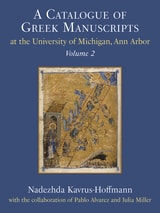
A Catalogue of Greek Manuscripts at the University of Michigan, Ann Arbor, Volume 2
Nadezhda Kavrus-Hoffmann with the collaboration of Pablo Alvarez and Julia Miller
University of Michigan Press, 2026
A Catalogue of Greek Manuscripts at the University of Michigan, Ann Arbor, Volume II unveils the rich diversity and enduring legacy of the Greek manuscript tradition preserved in one of North America's largest collections. Building on the acclaimed first volume, this second and concluding volume offers comprehensive illustrated descriptions of eighty-four manuscripts and fragments housed in the University of Michigan Library's Special Collections Research Center. The discovery of twenty-three previously unknown manuscripts and fragments significantly expands our understanding of Byzantine and post-Byzantine book culture, illuminating the remarkable continuity of Greek scholarly, liturgical, and artistic traditions from the ninth through the nineteenth centuries.
Each entry integrates codicological features, handwriting analysis, textual content, decoration, binding, provenance, and references to earlier scholarship as well as high-quality color plates to illustrate representative pages, script types, and illuminations. Among the exceptional highlights are a fragment of The Great Calculation According to the Indians by Maximos Planoudes, preserving portions of this rare mathematical treatise otherwise lost; an illuminated 1371 copy of The Heavenly Ladder by John Klimax, created by the renowned scribe Joasaph II of the Hodegon Monastery in Constantinople; and a newly identified manuscript containing rare patristic homilies linked to the sixteenth-century Choniates scriptorium in Venice.
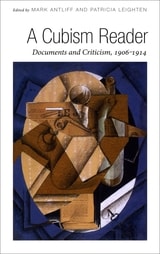
A Cubism Reader
Documents and Criticism, 1906-1914Mark Antliff and Patricia Leighten
University of Chicago Press, 2008
This definitive anthology covers the historical genesis of cubism from 1906 to 1914, with documents that range from manifestos and poetry to exhibition prefaces and reviews to articles that address the cultural, political, and philosophical issues related to the movement. Most of the texts Mark Antliff and Patricia Leighten have selected are from French sources, but their inclusion of carefully culled German, English, Czech, Italian, and Spanish documents speaks to the international reach of cubist art and ideas. Equally wide-ranging are the writers represented—a group that includes Guillaume Apollinaire, Gertrude Stein, Jean Metzinger, Albert Gleizes, Fernand Léger, Francis Picabia, André Salmon, Raymond Duchamp-Villon, Henri Le Fauconnier, and many others.
These diverse selections—unabridged and freshly translated—represent a departure from the traditional view of cubism as shaped almost exclusively by Picasso and Braque. Augmented by Antliff and Leighten’s insightful commentary on each entry, as well as many of the articles’ original illustrations, A Cubism Reader ultimately broadens the established history of the movement by examining its monumental contributions from a variety of contemporary perspectives.
A Documentary History of Arkansas
C. Fred Williams
University of Arkansas Press, 2013
A Documentary History of Communism in Russia
From Lenin to GorbachevEdited by Robert V. Daniels
University Press of New England, 2001
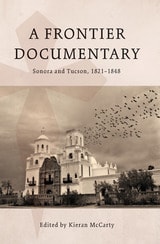
A Frontier Documentary
Sonora and Tucson, 1821–1848Edited by Kieran McCarty
University of Arizona Press, 1997
These documents give a sense of immediacy to the military operations, Indian activities, and missionary work going on in Tucson and the surrounding areas. They also demonstrate that Hispanic families maintained continuity in military and political control on the frontier, and clearly show that the frontier was not beset by anarchy in spite of the change in national government. In the forty chapters of translated documents in this collection, the voices of those who lived in what is now the Arizona-Sonora border region provide firsthand accounts of the people and events that shaped their era. These documents record such events as the arrival of the first Americans, the reconstruction of Tucson’s presidio wall, and conflict between Tohono O’odham villagers and Mexicans. All are set against the backdrop of an unrelenting Apache offensive that heightened after the departure of the Spanish military but that was held in check by civilian militias. Each chapter begins with a brief introduction in which historian Kieran McCarty provides background on the documents’ context and authorship. Taken together, they offer a fascinating look at this little-known period and provide a unique panorama of southwestern history.

A Good Quarrel
America's Top Legal Reporters Share Stories from Inside the Supreme CourtTimothy R. Johnson and Jerry Goldman, Editors
University of Michigan Press, 2009
While reading what top legal reporters say about some of the most important U.S. Supreme Court oral arguments in recent history, go to www.goodquarrel.com to listen to audio and hear for yourself the very style and delivery of the oral arguments that have shaped the history of our nation's highest law. See Preface for full instructions.
Contributors
- Charles Bierbauer, CNN
- Lyle Denniston, scotusblog.com
- Fred Graham, Court TV
- Brent Kendall, Los Angeles Daily Journal
- Steve Lash, Houston Chronicle
- Dahlia Lithwick, Slate.com
- Tony Mauro, American Lawyer Media
- Tim O'Brien, ABC News
- David Savage, Los Angeles Times
- Greg Stohr, Bloomberg News
- Nina Totenberg, NPR
Timothy R. Johnson teaches in the Department of Political Science and the Law School at the University of Minnesota.
Jerry Goldman teaches political science at Northwestern University and directs the OYEZ Project, a multimedia archive devoted to the Supreme Court, at www.oyez.org.
Cover sketch by Dana Verkouteren
"Supreme Court oral arguments are good government in action. A Good Quarrel brilliantly showcases this important aspect of the Court's work."
---Paul Clement, Partner, King & Spalding, and former United States Solicitor General
"Few legal experiences are as exhilarating as a Supreme Court oral argument---a unique art form that this superb collection brings vividly to life."
---Kathleen Sullivan, Partner, Quinn Emanuel Urquhart Oliver and Hedges, and former Dean, Stanford Law School
"[A Good Quarrel] shines a brilliant spotlight on the pivotal moment of advocacy when the Supreme Court confronts the nation's most profound legal questions."
---Thomas C. Goldstein, Partner, Akin Gump, and Lecturer, Supreme Court Litigation, Harvard Law School and Stanford Law School
"A brilliant way to understand America's most important mysterious institution."
---Lawrence Lessig, Stanford Law School

A Guide to Sources of Texas Criminal Justice Statistics
R. Scott Harnsberger
University of North Texas Press, 2011

A Guide to the Naval Records in the National Archives of the UK
Edited by Randolph Cock and N. A. M. Rodger
University of London Press, 2008
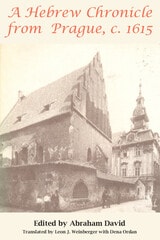
A Hebrew Chronicle from Prague, C. 1615
Abraham David
University of Alabama Press, 1993
"This slender anonymous work, spanning 1389 to 1611, presents the priorities and concerns of a Jewish community straddling the late medieval and early modern periods. Ample footnotes and explanations provide the lay reader with sufficient background to understand the references to historical events and figures, to ideologies and to institutions. A comprehensive introduction presents the realities of Prague and Bohemia, as well as offering a helpful discussion of the chronicle and other contemporary Jewish accounts."
—Conservative Jewish Quarterly
"In about 1615 an anonymous Jew from Prague composed a short Hebrew chronicle to recount 'the expulsions, miracles, and other occurrences befalling [the Jews] in Prague and the other lands of our long exile.' Abraham David discovered the manuscript [and] added glosses, historical notes, and an introduction. . . . The chronicle, with its brief annual entries, is not a continuous narrative, but does give a feeling of immediacy, like a newspaper."
—Polin: Studies in Polish Jewry
A Leaf of Voices
Stories of the American Civil War in the Words of Those Who Lived and Died, 1861-65Jennifer McSpadden
Indiana Historical Society Press, 2014
A Mighty Change
An Anthology of Deaf American Writing, 1816 - 1864Christopher Krentz
Gallaudet University Press, 2000
“I need not tell you that a mighty change has taken place within the last half century, a change for the better,” Alphonso Johnson, the president of the Empire State Association of Deaf-Mutes, signed to hundreds of assembled deaf people in 1869. Johnson pointed to an important truth: the first half of the 19th century was a period of transformation for deaf Americans, a time that saw the rise of deaf education and the coalescence of the nation’s deaf community.
This volume contains original writing by deaf people that both directed and reflected this remarkable period of change. It begins with works by Laurent Clerc, the deaf Frenchman who came to the United Sates in 1816 to help found the first permanent school for deaf students in the nation. Partially through is writing, Clerc impressed hearing Americans–most of whom had never met an educated deaf person before–with his intelligence and humanity.
Other deaf writers shared their views with society through the democratic power of print. Included here are selections by James Nack, a deaf poet who surprised readers with his mellifluous verse; John Burnet, who published a book of original essays, fiction, and poetry; Edmund Booth, a frontiersman and journalist; John Carlin, who galvanized the drive for a national college for deaf people; Laura Redden, a high-achieving student who would go on to become an accomplished reporter; and Adele Jewel, a homeless deaf woman living in Michigan.
The final sections contain documents related to deaf events and issues at mid-century: the grand reunion of alumni of the American Asylum for the Deaf in 1850; the dedication of the Thomas Hopkins Gallaudet monument in Hartford; the debate over the viability of a deaf state; and the triumphant inauguration of the National Deaf-Mute College (now Gallaudet University) in 1864, which in many ways culminated this period of change. Taken together, the individual texts in this remarkable collection provide a valuable historical record and a direct glimpse of the experiences, attitudes, and rhetoric of deaf Americans during this time of change.
A Muslim American Slave
The Life of Omar Ibn SaidOmar Ibn Said; translated from the Arabic, edited, and with an introduction by Ala Alryyes
University of Wisconsin Press, 2011
Born to a wealthy family in West Africa around 1770, Omar Ibn Said was abducted and sold into slavery in the United States, where he came to the attention of a prominent North Carolina family after filling “the walls of his room with piteous petitions to be released, all written in the Arabic language,” as one local newspaper reported. Ibn Said soon became a local celebrity, and in 1831 he was asked to write his life story, producing the only known surviving American slave narrative written in Arabic.
In A Muslim American Slave, scholar and translator Ala Alryyes offers both a definitive translation and an authoritative edition of this singularly important work, lending new insights into the early history of Islam in America and exploring the multiple, shifting interpretations of Ibn Said’s narrative by the nineteenth-century missionaries, ethnographers, and intellectuals who championed it.
This edition presents the English translation on pages facing facsimile pages of Ibn Said’s Arabic narrative, augmented by Alryyes’s comprehensive introduction, contextual essays and historical commentary by leading literary critics and scholars of Islam and the African diaspora, photographs, maps, and other writings by Omar Ibn Said. The result is an invaluable addition to our understanding of writings by enslaved Americans and a timely reminder that “Islam” and “America” are not mutually exclusive terms.
This edition presents the English translation on pages facing facsimile pages of Ibn Said’s Arabic narrative, augmented by Alryyes’s comprehensive introduction and by photographs, maps, and other writings by Omar Ibn Said. The volume also includes contextual essays and historical commentary by literary critics and scholars of Islam and the African diaspora: Michael A. Gomez, Allan D. Austin, Robert J. Allison, Sylviane A. Diouf, Ghada Osman, and Camille F. Forbes. The result is an invaluable addition to our understanding of writings by enslaved Americans and a timely reminder that “Islam” and “America” are not mutually exclusive terms.
Best Books for General Audiences, selected by the American Association of School Librarians
A Perfect Picture Of Hell
Eyewitness Accounts By Civil War Prisoners From 12Th IoTed Genoways
University of Iowa Press, 2000
From the shooting of an unarmed prisoner at Montgomery, Alabama, to a successful escape from Belle Isle, from the swelling floodwaters overtaking Cahaba Prison to the inferno that finally engulfed Andersonville, A Perfect Picture of Hell is a collection of harrowing narratives by soldiers from the 12th Iowa Infantry who survived imprisonment in the South during the Civil War.
Editors Ted Genoways and Hugh Genoways have collected the soldiers' startling accounts from diaries, letters, speeches, newspaper articles, and remembrances. Arranged chronologically, the eyewitness descriptions of the battles of Shiloh, Corinth, Jackson, and Tupelo, together with accompanying accounts of nearly every famous Confederate prison, create a shared vision
A Precarious Happiness
Adorno and the Sources of NormativityPeter E. Gordon
University of Chicago Press, 2023
A strikingly original account of Theodor Adorno’s work as a critique animated by happiness—now in paperback.
"Gordon’s confidently gripping and persistently subtle interpretation brings a new tone to the debate about Adorno’s negativism."—Jürgen Habermas
Theodor Adorno is often portrayed as a totalizing negativist, a scowling contrarian who looked upon modern society with despair. Peter E. Gordon thinks we have this wrong: if Adorno is uncompromising in his critique, it is because he sees in modernity an unfulfilled possibility of human flourishing. In a damaged world, Gordon argues, all happiness is likewise damaged but not wholly absent. Through a comprehensive rereading of Adorno’s work, A Precarious Happiness recovers Adorno’s commitment to traces of happiness—fragments of the good amid the bad. Ultimately, Gordon argues that social criticism, while exposing falsehoods, must also cast a vision for an unrealized better world.

A Race at Bay
New York Times Editorials on "the Indian Problem," 1860 - 1900Robert G. Hays. Foreword by Paul Simon
Southern Illinois University Press, 1997
Robert G. Hays chronicles the "Indian problem" precisely as it was explained to Americans through the editorial columns of the New York Times between 1860 and 1900, the years when battles between white settlers and Native Americans split a nation and its spirit apart.
Covering the final forty-one years of the nineteenth century, Hays’s collection of Times editorials gives readers what current accounts cannot: perspectives by contemporary writers with unique insights into the public images of Native Americans and their place in a nation bent on expansion. The authentic voices of a national newspaper’s daily record speak with an urgency both immediate and real.
These editorials express the unbridled bitterness and raw ambition of a nation immersed in an agenda of conquest. They also resonate with the struggle to find a common ground. Some editorials are patronizing and ironic: "Yet it seems pitiful to cage so fine a savage among a herd of vulgar criminals in a penitentiary." Others include a willingness to poke fun: "Many persons on the platform were astonished to find that an ‘illiterate barbarian’ could handle the weapon of sarcasm. The truth is that the Indians spoke far better than ninety-nine out of a hundred members of congress." And yet others evince an attitude of respect, which set the tone for reconciling national ambition with natural rights.
In some instances, the Times allowed Native Americans to tell their own stories, as in this eloquent, moving account of the testimony of Satanta, the warrior chief of the Kiowas: "A certain dim foreboding of the Indians’ fate swept across his mind, and in its passage lit his eyes up with a fierce light, and his voice rose to a pitch of frenzy as he exclaimed: ‘We don’t want to settle—I love to roam over the prairie; there I am free and happy."
History demonstrates that the costs of owning one’s soil and one’s destiny remain without measure. Many of the problems blocking the progress of Native Americans continue unsolved: unemployment, infant mortality, suicide, crime, alcoholism, and poverty. Following such works as Helen Hunt Jackson’s A Century of Dishonor and Dee Brown’s Bury My Heart at Wounded Knee, Hays looks back on the records of national history for the roots of our challenges today.
A Rule for Children and Other Writings
Jacqueline Pascal
University of Chicago Press, 2003
This book presents selections from the whole of Pascal's career as a writer, including her witty adolescent poetry and her pioneering treatise on the education of women, A Rule for Children, which drew on her experiences as schoolmistress at Port-Royal. Readers will also find Pascal's devotional treatise, which matched each moment in Christ's Passion with a corresponding virtue that his female disciples should cultivate; a transcript of her interrogation by church authorities, in which she defended the controversial theological doctrines taught at Port-Royal; a biographical sketch of her abbess, which presented Pascal's conception of the ideal nun; and a selection of letters offering spirited defenses of Pascal's right to practice her vocation, regardless of patriarchal objections.
A Selection of Modernized Recipes from Food in the Civil War
The SouthJennifer Billock
Michigan State University Press, 2015
A Sip from the "Well of Grace"
Medieval Texts from the Apostolic PenitentiaryKirsi Salonen
Catholic University of America Press, 2009
A Sourcebook for Classical Rhetoric
John Tomarchio
Catholic University of America Press, 2023

A Texas Baptist History Sourcebook
A Companion to McBeth's Texas BaptistsJoseph E. Early Jr.
University of North Texas Press, 2004
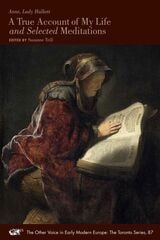
A True Account of My Life and Selected Meditations
Lady Anne Halkett
Iter Press, 2022
Born in the early 1620s, Anne, Lady Halkett (née Murray) grew up on the fringes of the English court during a period of increasing political tension. From 1644 to 1699, Halkett recorded her personal and political experiences in both England and Scotland in a series of manuscript meditations and an autobiographical narrative called A True Account of My Life. Royalism, romance, and contemporary religious debates are central to Halkett’s vivid portrayal of her life as a single woman, wife, mother, and widow. Collectively, the materials edited here offer the opportunity to explore how Halkett’s meditational practice informed her life writing in the only version of her writings to date available in a fully modernized edition. The forty-four meditations in this volume redefine the importance of Halkett’s contribution to seventeenth-century life writing.
African Intellectual Heritage
Molefi Asante
Temple University Press, 1996
African Women Writing Resistance
An Anthology of Contemporary VoicesJennifer Browdy de Hernandez
University of Wisconsin Press, 2010
Contributors include internationally recognized authors and activists such as Wangari Maathai and Nawal El Saadawi, as well as a host of vibrant new voices from all over the African continent and from the African diaspora. Interdisciplinary in scope, this collection provides an excellent introduction to contemporary African women’s literature and highlights social issues that are particular to Africa but are also of worldwide concern. It is an essential reference for students of African studies, world literature, anthropology, cultural studies, postcolonial studies, and women’s studies.
Outstanding Book, selected by the Public Library Association
Best Books for High Schools, Best Books for Special Interests, and Best Books for Professional Use, selected by the American Association of School Libraries
Albertus Magnus On Animals V1 2
A Medieval Summa Zoologica Revised EditionKenneth F. Kitchell Jr.and Irven Michael Resnick
The Ohio State University Press, 2018
In his work De animalibus, Albert integrated the vast amount of information on nature that had come down to him in previous centuries: the exposition of Michael Scotus’s translation from the Arabic of Aristotle’s books on the natural world (Books 1–19), Albert’s own revisions to Aristotle’s teachings (Books 20–21), and a “dictionary” of animals appropriated largely from the De natura rerum of Thomas of Cantimpré (Books 22–26). Albert’s comprehensive treatise on living things was acknowledged as the reputable authority in biology for almost five hundred years.
In this translated and annotated edition, Kenneth F. Kitchell Jr. and Irven Michael Resnick illuminate the importance of this work, allowing Albert’s magnum opus to be better understood and more widely appreciated than ever before. Broken into two volumes (Books 1–10 and 11–26),Albertus Magnus On Animals is a veritable medieval scientific encyclopedia, ranging in topics from medicine, embryology, and comparative anatomy to women, hunting and everyday life, commerce, and much more—an essential work for historians, medievalists, scientists, and philosophers alike.
Alchemy and Authority in the Holy Roman Empire
Tara Nummedal
University of Chicago Press, 2007
Drawing on criminal trial records, contracts, laboratory inventories, satires, and vernacular alchemical treatises, Alchemy and Authority in the Holy Roman Empire situates the everyday alchemists, largely invisible to modern scholars until now, at the center of the development of early modern science and commerce. Reconstructing the workaday world of entrepreneurial alchemists, Tara Nummedal shows how allegations of fraud shaped their practices and prospects. These debates not only reveal enormously diverse understandings of what the “real” alchemy was and who could practice it; they also connect a set of little-known practitioners to the largest questions about commerce, trust, and intellectual authority in early modern Europe.
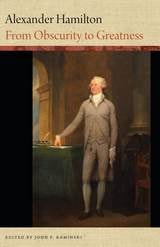
Alexander Hamilton
From Obscurity to GreatnessJohn P. Kaminski
Wisconsin Historical Society Press, 2016
Editor John P. Kaminski has gathered a remarkable collection of quotations by and about Alexander Hamilton that paint for us a nuanced portrait of a complex man. Through his own words and the words of his contemporaries -- including the man who killed him in a duel, Aaron Burr -- we can gain a better understanding of this fascinating man who rose from anonymity on a small Caribbean island to the corridors of power.

All God's Dangers
The Life of Nate ShawTheodore Rosengarten
University of Chicago Press, 2000
Aloha Betrayed
Native Hawaiian Resistance to American ColonialismNoenoe K. Silva
Duke University Press, 2004
Alutiiq Villages under Russian and U.S. Rule
Sonja Luehrmann
University of Alaska Press, 2009

America's War
Talking about the Civil War and Emancipation on Their 150th AnniversariesAmerican Library Association, 2012
American Appetites
A Documentary ReaderJennifer Jensen Wallach
University of Arkansas Press, 2014
An Account of the Antiquities of the Indians
A New Edition, with an Introductory Study, Notes, and Appendices by José Juan ArromFray Ramon Pané
Duke University Press, 1999
Edited by the noted Hispanist José Juan Arrom, Pané’s report is the only surviving direct source of information about the myths, ceremonies, and lives of the New World inhabitants whom Columbus first encountered. The friar’s text contains many linguistic and cultural observations, including descriptions of the Taíno people’s healing rituals and their beliefs about their souls after death. Pané provides the first known description of the use of the hallucinogen cohoba, and he recounts the use of idols in ritual ceremonies. The names, functions, and attributes of native gods; the mythological origin of the aboriginal people’s attitudes toward sex and gender; and their rich stories of creation are described as well.
An Emotional State
The Politics of Emotion in Postwar West German CultureAnna M. Parkinson
University of Michigan Press, 2015
One of the book’s major contributions is that it offers an analytical distinction between emotion and affect, finding a compelling way to talk about affect and emotion that is informed by affect theory but that integrates psychoanalysis. The study draws on the psychoanalytic writings of Freud, Margarete and Alexander Mitscherlich, and André Green, while engaging with interdisciplinary theorists of affect including Barbara Rosenwein, Lauren Berlant, Ann Cvetkovich, and Eve Kosofsky Sedgwick among many others.

An Islamic Alliance
Ali Dinar and the Sanusiyya, 1906-1916Jay Spaulding and Lidwien Kapteijns
Northwestern University Press, 2011
Ancient Pathways and Hidden Pursuits
Religion, Morals, and Magic in the Ancient WorldGeorg Luck
University of Michigan Press, 2000
The present volume includes the author's thoughts on Greek and Roman religions, early Christianity, Greek and Roman psychology and morals, and magic and the occult. Luck's main findings explore generally neglected areas of ancient civilization, locating magic and philosophy with religion as vehicles for moral and psychological guidance. Throughout this study, one finds meaning in "superstitious" and conflicting patterns of behavior and learns much about the nature of the human soul. This collection will serve as a valuable reference for those interested in the driving motivations of ancient man.
"The topics of the individual articles in this volume are very central and of great humanistic appeal, and they indeed form a thematic unity concerning man and religion in Greek and Roman society." --Ludwig Koenen, Herbert C. Youtie Distinguished University Professor of Papyrology, University of Michigan
Georg Luck is Professor of Classics, emeritus, The Johns Hopkins University.

Ancient Records of Egypt
VOL. 2: THE EIGHTEENTH DYNASTYTranslated and Edited by James Henry Breasted
University of Illinois Press, 2001
The Eighteenth Dynasty saw the consolidation of the cult of Amun and the expansion of the temple of Amun-Re at Karnak, as well as a religious revolution under King Akhenaten that involved abandoning Thebes as a religious capital and royal residence and founding a new city devoted to the service of the new solar god, Aten. Breasted presents records of the biography and coronation of Queen Hatshepsut, including reliefs that depict the queen's expedition to the land of Punt. Also in this volume are the annals of Thutmose III, providing the most complete account of the military achievements of any Egyptian king; scenes representing the supernatural birth and coronation by the gods of his son, Amenhotep II; and inscriptions from the tomb of Rekhmire, prime minister or vizier under Thutmose III, that include a listing of taxes paid to the temple and foreign tribute proceeding from the king's two decades of military activity in Asia.
A herculean assemblage of primary documents, many of which have deteriorated to illegibility since its original publication, Ancient Records of Egypt illuminates both the incredible complexity of Egyptian society and the almost insuperable difficulties of reconstructing a lost civilization.
Ancient Records of Egypt
Vol. 3: The Nineteenth DynastyTranslated and Edited by James Henry Breasted
University of Illinois Press, 2001
In the context of a long history of mutilating and altering reliefs for political purposes, Breasted discusses the insertion into a relief of the figure of Ramesses II in order to reinforce his claim to the throne. This volume also includes the treaty of alliance that sealed peace with the Hittites under Ramesses II; a series of documents that record the invasion of Libyans and Mediterranean Sea people during the reign of Merneptah; and the Great Temple of Abu Simbel, the most remarkable of the rock-cut temples of Egypt.
This first complete paperback edition of Breasted's five-volume Ancient Records of Egypt makes available to a new audience a milestone in Egyptology and in the compilation of documentary histories. Clearly annotated for the lay reader, the documents provide copious evidence of trade relations, construction activities, diplomatic envoys, foreign expeditions, and other aspects of a vigorous, highly organized, and centrally controlled society. Breasted's commentary is both rigorously documented and accessible, suffused with a contagious fascination for the events, the personalities, the cultural practices, and the sophistication these records indicate
Ancient Records of Egypt
Vol. 5: Supplementary Bibliographies and IndicesTranslated and Edited by James Henry Breasted: Supplementary Bibliographies by Peter A. Piccione
University of Illinois Press, 2001
An indispensable companion to any of the other volumes of Ancient Records of Egypt, the Supplementary Bibliographies and Indices facilitates direct access to specific information on the people, places, and inscriptions catalogued by James Henry Breasted. Exhaustively compiled and intelligently arranged, these indices include the kings and queens, temples and geographical locations, divine names, and titles and ranks encompassed by three thousand years of Egyptian history. Also provided are indices of all Egyptian, Hebrew, and Arabic terms mentioned in the texts, as well as a complete listing of the records with their location in Lepsius's Denkmäler.
This first paperback edition of Ancient Records of Egypt features the important addition of bibliographies by Peter A. Piccione, together with an introduction that puts Breasted's historical commentaries into modern perspective. These bibliographies offer valuable guidance on new translations and modern treatments of the inscriptions included in Ancient Records of Egypt. Professor Piccione points the reader toward recent studies of Egyptian chronology and modern scholarship on Egyptian and Nubian history. He also provides information on anthologies of Egyptian texts in translation and topographical bibliographies that suggest further reading on specific ancient Egyptian monuments, texts, and reliefs.
Ancient Records of Egypt
vol. 1: The First through the Seventeenth DynastiesTranslated and Edited by James Henry Breasted: Introduction by Peter A. Piccione
University of Illinois Press, 2001
Breasted's monumental work, originally published from 1906 to 1907, encompasses twenty-six dynasties spanning more than three millennia: from ca. 3050 B.C. to 525 B.C. For each document, Breasted provides information on location, condition, historical significance, and content. Beginning with the earliest known official annals of Egypt, the Palermo Stone, Breasted catalogs the realm's official activities, including royal succession, temple construction, property distribution, and foreign conquest. He tracks the careers of scores of kings, queens, government officials, military leaders, powerful statesmen, and influential courtiers, reproducing their autobiographies, letters of favor, paeans, mortuary gifts, and tomb inscriptions. Clearly annotated for the lay reader, the documents provide copious evidence of trade relations, construction activities, diplomatic envoys, foreign expeditions, and other aspects of a vigorous, highly organized, and centrally controlled society.
Breasted's commentary is both rigorously documented and accessible, suffused with a contagious fascination for the events, the personalities, the cultural practices, and the sophistication these records indicate. A herculean assemblage of primary documents, many of which have deteriorated to illegibility in the intervening century, Ancient Records of Egypt illuminates both the incredible complexity of Egyptian society and the almost insuperable difficulties of reconstructing a lost civilization.
This first paperback edition of Ancient Records of Egypt features a new introduction and supplementary bibliographies by Peter A. Piccione. Setting Breasted's work in the context of the development of American Egyptology, Piccione discusses Breasted's establishment of the Oriental Institute of the University of Chicago, with corporate support by John D. Rockefeller and other benefactors, and surveys the ambitious body of publications with which Breasted laid the foundation for future Egyptian studies.
Ancient Records of Egypt
vol. 4: The Twentieth through the Twenty-sixth DynastiesTranslated and Edited by James Henry Breasted
University of Illinois Press, 2001
Volume 4 includes intriguing records of the harem conspiracy and legal documents that indicate the extent of robberies of royal tombs. Records of the Nile levels at Karnak provide important chronological landmarks, while the Stela of Piye (Piankhi), which documents the Nubian kingdom already in existence as a full-fledged power, provides information on the internal political climate of Egypt during a time when no aggressive monarch controlled the whole country. Breasted also notes where these ancient Egyptian records intersect with accounts of the same events from other sources, such as the mutiny of Psamtik I's troops as inscribed on the alabaster statue of Nesuhor and as narrated by Herodotus.
In effect, Ancient Records of Egypt offers a valuable dual record. On the one hand, Breasted presents the events and personages of ancient Egypt as recorded in the documents. On the other hand, he presents a history of the documents themselves. Fragmentary or partially destroyed, carved on temple and tomb walls or written on fragile scrolls of leather or papyrus, even inscribed on the coffins and temple linens of the royal and priestly mummy wrappings, these records offer an irreplaceable primary source on a fascinating civilization.
Ancient Roman Villas
The Essential SourcebookGuy P. R. Métraux
J. Paul Getty Trust, The, 2024
While the term villa is generic today, its meaning extended across the entirety of ancient Roman life: villas supplied food, oil, and wine to towns and cities and produced raw materials for craft industries and building construction. Villas were also venues for pleasure, relaxation, and the cultivation of friendships and the mind. Many were known for their spectacular sites, architecture, decoration, and furnishings. They came to be ubiquitous throughout ancient Rome's European and Mediterranean rural hegemony.
This volume compiles a wealth of newly translated Latin and ancient Greek sources—treatises, letters, poems, histories, biographies, and other works of literary art—to vividly convey the architectural, economic, social, political, and cultural significance of ancient Roman villas, from their Greek antecedents through the early Christian period. Thematic chapters reveal ancient Roman attitudes on villa architecture, agricultural operations, and the practices of buying, building, and decorating villas as well as entertaining and pursuing leisure there. References to family, gender relations, and the lives of enslaved persons aim to situate, if only indirectly, a broad range of experiences within villas. Supplemented by generous commentaries, copious annotation, a comprehensive bibliography, and a glossary, this definitive sourcebook equips scholars and students alike for further research and makes for fascinating reading.
Anna Howard Shaw
The Work of Woman SuffrageTrisha Franzen
University of Illinois Press, 2014
With this first scholarly biography of Anna Howard Shaw (1847-1919), Trisha Franzen sheds new light on an important woman suffrage leader who has too often been overlooked and misunderstood.
An immigrant from a poor family, Shaw grew up in an economic reality that encouraged the adoption of non-traditional gender roles. Challenging traditional gender boundaries throughout her life, she put herself through college, worked as an ordained minister and a doctor, and built a tightly-knit family with her secretary and longtime companion Lucy E. Anthony.
Drawing on unprecedented research, Franzen shows how these circumstances and choices both impacted Shaw's role in the woman suffrage movement and set her apart from her native-born, middle- and upper-class colleagues. Franzen also rehabilitates Shaw's years as president of the National American Woman Suffrage Association, arguing that Shaw's much-belittled tenure actually marked a renaissance of both NAWSA and the suffrage movement as a whole.
Anna Howard Shaw: The Work of Woman Suffrage presents a clear and compelling portrait of a woman whose significance has too long been misinterpreted and misunderstood.
Anna Trapnel’s Report and Plea; or, A Narrative of Her Journey from London into Cornwall
Anna Trapnel
Iter Press, 2016
In 1654, Anna Trapnel — a Baptist, Fifth Monarchist, millenarian, and visionary from London — fell into a trance during which she prophesied passionately and at length against Oliver Cromwell and his government. The prophecies attracted widespread public attention, and resulted in an invitation to travel to Cornwall. Her Report and Plea, republished here for the first time, is a lively and engaging firsthand account of the visit, which concluded in her arrest, a court hearing, and imprisonment. Part memoir, part travelogue, and part impassioned defense of her beliefs and actions, the Report and Plea offers vivid and fascinating insight into the life and times of an early modern woman claiming her place at the center of the tumultuous political events of mid-seventeenth-century England.
Anonimo Mexicano
Richley Crapo and Bonnie Glass-Coffin
Utah State University Press, 2005
Antirevialism in Antebellum America
A Collection of Religious VoicesBratt, James D
Rutgers University Press, 2005
But revivalism has always generated opposition, too, even in its century of glory. In Anti-Revivalism in Antebellum America, James D. Bratt offers extensive introductions to primary anti-revivalist documents. These works range from the Philadelphia Methodist John F. Watson's protests against camp meetings in 1819, to Elizabeth Cady Stanton's "Eighty Years and More," written in 1898, in which she recalls her youthful encounter with revival preaching and her rebound into political activism and religious agnosticism. Through the recovered voices of antebellum religious critics, Bratt shows how American culture was already being reshaped a generation before the Civil War and how evangelical religion stood at the center of a "culture war."
If revivals typified the era when Americans launched and defined their new nation, then objections to these revivals embodied the growing discontent at what the nation had become. An important and long overdue collection, this book urges an understanding of anti-revival literature both in the context of the era when it emerged as well as in terms of the broader dynamic of American life.
Includes selections from Orestes Brownson, Horace Bushnell, Calvin Colton, Orville Dewey, Albert Baldwin Dod, George Elley, Charles G. Finney, John Williamson Nevin, Stephen Olin, Phoebe Palmer, Daniel Alexander Payne, Ephraim Perkins, Elizabeth Cady Stanton, Joseph Smith, Harriet Beecher Stowe, La Roy Sunderland, John Fanning Watson, Ellen G. White, and Friedrich C. D. Wyneken.
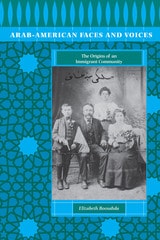
Arab-American Faces and Voices
The Origins of an Immigrant CommunityBy Elizabeth Boosahda
University of Texas Press, 2003
As Arab Americans seek to claim their communal identity and rightful place in American society at a time of heightened tension between the United States and the Middle East, an understanding look back at more than one hundred years of the Arab-American community is especially timely. In this book, Elizabeth Boosahda, a third-generation Arab American, draws on over two hundred personal interviews, as well as photographs and historical documents that are contemporaneous with the first generation of Arab Americans (Syrians, Lebanese, Palestinians), both Christians and Muslims, who immigrated to the Americas between 1880 and 1915, and their descendants.
Boosahda focuses on the Arab-American community in Worcester, Massachusetts, a major northeastern center for Arab immigration, and Worcester's links to and similarities with Arab-American communities throughout North and South America. Using the voices of Arab immigrants and their families, she explores their entire experience, from emigration at the turn of the twentieth century to the present-day lives of their descendants. This rich documentation sheds light on many aspects of Arab-American life, including the Arab entrepreneurial motivation and success, family life, education, religious and community organizations, and the role of women in initiating immigration and the economic success they achieved.
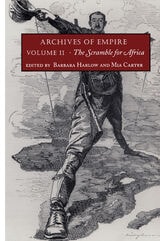
Archives of Empire
Volume 2. The Scramble for AfricaBarbara Harlow and Mia Carter, eds.
Duke University Press, 2004
While focusing on the expansion of the British Empire, The Scramble for Africa illuminates the intense nineteenth-century contest among European nations over Africa’s land, people, and resources. Highlighting the 1885 Berlin Conference in which Britain, France, Germany, Portugal, and Italy partitioned Africa among themselves, this collection follows British conflicts with other nations over different regions as well as its eventual challenge to Leopold of Belgium’s rule of the Congo. The reports, speeches, treatises, proclamations, letters, and cartoons assembled here include works by Henry M. Stanley, David Livingstone, Joseph Conrad, G. W. F. Hegel, Winston Churchill, Charles Darwin, and Arthur Conan Doyle. A number of pieces highlight the proliferation of companies chartered to pursue Africa’s gold, diamonds, and oil—particularly Cecil J. Rhodes’s British South Africa Company and Frederick Lugard’s Royal Niger Company. Other documents describe debacles on the continent—such as the defeat of General Gordon in Khartoum and the Anglo-Boer War—and the criticism of imperial maneuvers by proto-human rights activists including George Washington Williams, Mark Twain, Olive Schreiner, and E.D. Morel.
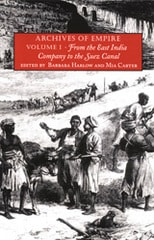
Archives of Empire
Volume I. From The East India Company to the Suez CanalBarbara Harlow and Mia Carter, eds.
Duke University Press, 2003
Tracing the beginnings of the British colonial enterprise in South Asia and the Middle East, From the Company to the Canal brings together key texts from the era of the privately owned British East India Company through the crises that led to the company’s takeover by the Crown in 1858. It ends with the momentous opening of the Suez Canal in 1869. Government proclamations, military reports, and newspaper articles are included here alongside pieces by Rudyard Kipling, Charles Dickens, John Stuart Mill, Karl Marx, Benjamin Disraeli, and many others. A number of documents chronicle arguments between mercantilists and free trade advocates over the competing interests of the nation and the East India Company. Others provide accounts of imperial crises—including the trial of Warren Hastings, the Indian Rebellion (Sepoy Mutiny), and the Arabi Uprising—that highlight the human, political, and economic costs of imperial domination and control.
Archiving Medical Violence
Consent and the Carceral StateChristopher Perreira
University of Minnesota Press, 2023
A major new reading of a U.S. public health system shaped by fraught perceptions of culture, race, and criminality
At the heart of Archiving Medical Violence is an interrogation of the notions of national and scientific progress, marking an advance in scholarship that shows how such violence is both an engine of medical progress and, more broadly, the production of empire. It reads the medical archive through a lens that centers how it is produced, remembered, and contested within cultural production and critical memory.
In this innovative and interdisciplinary book, Christopher Perreira argues that it is in the contradictions of settler colonialism and racial capitalism that we find how medical violence is narrated as a public good. He presents case studies from across a range of locations—Hawai‘i, California, Louisiana, Guatemala—and historical periods from the nineteenth century on. Examining national and scientific conceptions of progress through the lens of medicine and public health, he places official archives in dialogue with visual and literary works, patient writing, and more.
Archiving Medical Violence explores the contested public terrains for narrating value and vulnerabilities, bodies and geographical locations. Ultimately, Perreira reveals for us a medical imaginary built on racialized criminality driving contemporary politics of citizenship, memory, and identity.
Retail e-book files for this title are screen-reader friendly with images accompanied by short alt text and/or extended descriptions.