Results by title
418 books match the query 'Southern States' and 34 start with a

A Conditional Embrace
Black Queer Feminism in PerformanceKristyl D. Tift
The Ohio State University Press, 2026
In A Conditional Embrace, Kristyl D. Tift seeks to understand how Black queer women theater and film artists depict their own survival in heterosexist temporalities and spaces. Using the framework of lovin’ on—a theory inspired by Black feminist thought, performance theory, and queer theory—Tift closely reads the works of a selection of artists to investigate the “conditional embrace” of Black queer art in society. Her intersectional and intertextual methodology considers the text and body as part and parcel of performance work, allowing her to examine the multiple and complex intersections of identity at play in works meant to be read and performed. Tift puts the work of more visible artists such as Dee Rees, Sharon Bridgforth, and Staceyann Chin in direct conversation with lesser-known contributors to Black queer feminist performance such as Shirlene Holmes and Donnetta Lavinia Grays, analyzing not only their plays, installations, and poetry but also interviews, personal essays, performances, and more. Centering the works of artists situated, by birth or migration, in the Southern US and the Caribbean, A Conditional Embrace explores how artists at the margins of art and society represent Black queer women’s survival through processes of self-making, community-building, and homemaking.

A Family Practice
The Russell Doctors and the Evolving Business of Medicine, 1799-1989William D. Lindsey
University of Arkansas Press, 2020
The authors take a wide-ranging look at the meaning of intergenerational vocations and the role of family, the economy, and social issues on the evolution of medical education and practice in the United States.

A Festival of Violence
An Analysis of Southern Lynchings, 1882-1930Stewart Tolnay and E.M. Beck
University of Illinois Press, 1995
practice. Stewart Tolnay and E. M. Beck empirically test competing explanations of the causes of lynching, using U.S. Census and historical voting data and a newly constructed inventory of southern lynch victims. Among their surprising findings: lynching responded to fluctuations in the price of cotton, decreasing in frequency when prices rose and increasing when they fell.
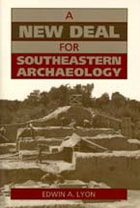
A New Deal for Southeastern Archaeology
Edwin A. Lyon
University of Alabama Press, 1996
Recipient of the 1994 Anne B. and James B. McMillan Prize
This comprehensive study provides a history of New Deal archaeology in the Southeast in the 1930s and early 1940s and focuses on the projects of the Federal Emergency Relief Administration, the Civil Works Administration, the Works Progress Administration, the Tennessee Valley Authority, the National Park Service, and the Smithsonian Institution.
Utilizing primary sources including correspondence and unpublished reports, Lyon demonstrates the great importance of the New Deal projects in the history of southeastern and North American archaeology. New Deal archaeology transformed the practice of archaeology in the Southeast and created the basis for the discipline that exists today. With the current emphasis on curation and repatriation, archaeologists and historians will find this volume invaluable in reconstructing the history of the projects that generated the many collections that now fill our museums.
A New Vision of Southern Jewish History
Studies in Institution Building, Leadership, Interaction, and MobilityMark K. Bauman, Foreword by Ronald H. Bayor
University of Alabama Press, 2019
Essays from a prolific career that challenge and overturn traditional narratives of southern Jewish history
Mark K. Bauman, one of the foremost scholars of southern Jewish history working today, has spent much of his career, as he puts it, “rewriting southern Jewish history” in ways that its earliest historians could not have envisioned or anticipated, and doing so by specifically targeting themes and trends that might not have been readily apparent to those scholars. A New Vision of Southern Jewish History: Studies in Institution Building, Leadership, Interaction, and Mobility features essays collected from over a forty-year career, including a never-before-published article.
The prevailing narrative in southern Jewish history tends to emphasize the role of immigrant Jews as merchants in small southern towns and their subsequent struggles and successes in making a place for themselves in the fabric of those communities. Bauman offers assessments that go far beyond these simplified frameworks and draws upon varieties of subject matter, time periods, locations, tools, and perspectives over three decades of writing and scholarship.
A New Vision of Southern Jewish History contains Bauman’s studies of Jewish urbanization, acculturation and migration, intra- and inter-group relations, economics and business, government, civic affairs, transnational diplomacy, social services, and gender—all complicating traditional notions of southern Jewish identity. Drawing on role theory as informed by sociology, psychology, demographics, and the nature and dynamics of leadership, Bauman traverses a broad swath—often urban—of the southern landscape, from Savannah, Charleston, and Baltimore through Atlanta, New Orleans, Galveston, and beyond the country to Europe and Israel.
Bauman’s retrospective volume gives readers the opportunity to review a lifetime of work in a single publication as well as peruse newly penned introductions to his essays. The book also features an “Additional Readings” section designed to update the historiography in the essays.
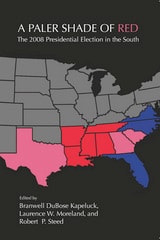
A Paler Shade of Red
The 2008 Presidential Election in the SouthBranwell DuBose Kapeluck
University of Arkansas Press, 2009
A Question of Class
The Redneck Stereotype in Southern FictionDuane Carr
University of Wisconsin Press, 1997

A Rift in the Clouds
Race and the Southern Federal Judiciary, 1900-1910Brent J. Aucoin
University of Arkansas Press, 2007
A Rock Garden in the South
Elizabeth A. Lawrence
Duke University Press, 1990
Lawrence, in her usual exquisite prose, deals with the full range of rock gardening topics in this work. She addresses the unique problem of cultivating rock gardens in the South, where the growing season is prolonged and humidity and heat are not conducive to such planting. She describes her own experiences in making a rock garden, with excellent advice on placing stones, constructing steps, ordering plants, and making cuttings.
At the same time, what she writes about here is in large part of interest to gardeners everywhere and for gardens with or without rocks. As always, she thoroughly discusses the plants she has tried—recommending bulbs and other perennials of all sorts, annuals, and woody plants—with poetic descriptions of the plants themselves as well as specific and useful cultural advice. A Rock Garden in the South includes an encyclopedia of plants alphabetized by genus and species and divided into two parts: wood and non-woody plants.

A Selection of Modernized Recipes from Food in the Civil War
The SouthJennifer Billock
Michigan State University Press, 2015
A Socialist Utopia in the New South
The Ruskin Colonies in Tennessee and Georgia, 1894-1901W. Fitzhugh Brundage
University of Illinois Press, 1996
This first book-length study of the Ruskin colonies shows how several hundred utopian socialists gathered as a cooperative community in Tennessee and Georgia in the late nineteenth century. The communitarians' noble but fatally flawed act of social endeavor revealed the courage and desperation they felt as they searched for alternatives to the chaotic and competitive individualism of the age of robber barons and for a viable model for a just and humane society at a time of profound uncertainty about public life in the United States.
A World Engraved
Archaeology of the Swift Creek CultureEdited by Mark Williams and Daniel T. Elliott
University of Alabama Press, 1998
This major summary of the current state of archaeological research on the Swift Creek culture is the first comprehensive collection ever published concerning the Swift Creek people.
The Swift Creek people, centered in Georgia and surrounding states from A.D. 100 to 700, are best known from their pottery, which was decorated before firing with beautiful paddle-stamped designs--some of the most intricate and fascinating in the world.
Comprehensive in scope, this volume details the discovery of this culture, summarizes what is known about it at the present time, and shows how continued improvements in the collection and analysis of archaeological data are advancing our knowledge of this extinct society.
Although they know nothing of Swift Creek language and little about its society, archaeologists have collected valuable information about the
economic strategies of Swift Creek inhabitants. What archaeologists know best, however, is that the Swift Creek people were some of the best wood carvers the world has seen, and their pottery will stand as their lasting legacy for all time. This book presents and preserves their legacy.
Africa in America
Slave Acculturation and Resistance in the American South and the British Caribbean, 1736-1831Michael Mullin
University of Illinois Press, 1992
African American Life in the Rural South, 1900-1950
Edited with an introduction by R. Douglas Hurt
University of Missouri Press, 2003
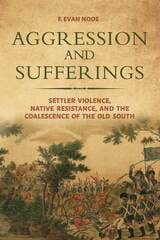
Aggression and Sufferings
Settler Violence, Native Resistance, and the Coalescence of the Old SouthF. Evan Nooe
University of Alabama Press, 2024
WINNER OF THE FRANCIS B. SIMKINS AWARD, SOUTHERN HISTORICAL ASSOCIATION
WINNER OF THE 2024 BEST FIRST BOOK AWARD FROM PHI ALPHA THETA, THE NATIONAL HISTORY HONOR SOCIETY
A bold reconceptualization of how settler expansion and narratives of victimhood, honor, and revenge drove the conquest and erasure of the Native South and fed the emergence of a distinct white southern identity.
In 1823, Tennessee historian John Haywood encapsulated a foundational sentiment among the white citizenry of Tennessee when he wrote of a “long continued course of aggression and sufferings” between whites and Native Americans. According to F. Evan Nooe, “aggression” and “sufferings” are broad categories that can be used to represent the framework of factors contributing to the coalescence of the white South.
Traditionally, the concept of coalescence is an anthropological model used to examine the transformation of Indigenous communities in the Eastern Woodlands from chieftaincies to Native tribes, confederacies, and nations in response to colonialism. Applying this concept to white southerners, Nooe argues that through the experiences and selective memory of settlers in the antebellum South, white southerners incorporated their aggression against and suffering at the hands of the Indigenous peoples of the Southeast in the coalescence of a regional identity built upon the violent dispossession of the Native South. This, in turn, formed a precursor to Confederate identity and its later iterations in the long nineteenth century.
Geographically, Aggression and Sufferings prioritizes events in South Carolina, Florida, Tennessee, Georgia, and Alabama. Nooe considers how divergent systems of violence and justice between Native Americans and white settlers (such as blood revenge and concepts of honor) functioned in the region and examines the involved societies’ conflicting standards on how to equitably resolve interpersonal violence. Finally, Nooe explores how white southerners constructed, propagated, and perpetuated harrowing tales of colonizers as both victims and heroes in the violent expulsion of the region’s Native peoples from their homelands. This constructed sense of regional history and identity continued to flower into the antebellum period, during western expansion, and well through the twentieth century.
AlabamaNorth
African-American Migrants, Community, and Working-Class Activism in Cleveland, 1915-45Kimberley L. Phillips
University of Illinois Press, 1999
Langston Hughes called it "a great dark tide from the South": the unprecedented influx of blacks into Cleveland that gave the city the nickname "Alabama North." Kimberley L. Phillips reveals the breadth of working class black experiences and activities in Cleveland and the extent to which these were shaped by traditions and values brought from the South.
Migrants' moves north established complex networks of kin and friends and infused Cleveland with a highly visible southern African American culture. Phillips examines the variety of black fraternal, benevolent, social, and church-based organizations that working class migrants created and demonstrates how these groups prepared the way for new forms of individual and collective activism in workplaces and the city. Giving special consideration to the experiences of working class black women, AlabamaNorth reveals how migrants' expressions of tradition and community gave them a new consciousness of themselves as organized workers and created the underpinning for new forms of black labor activism.

Allen Tate
John V. Glass III
Catholic University of America Press, 2016

Almost Family
Roy Hoffman
University of Alabama Press, 2000
Nebraska Waters is black. Vivian Gold is Jewish. In an Alabama kitchen where, for nearly thirty years, they share cups of coffee, fret over their children, and watch the civil rights movement unfold out their window, and into their homes, they are like family—almost.
As Nebraska makes her way, day in and out, to Vivian’s house to cook and help tend the Gold children, the “almost” threatens to widen into a great divide. The two women’s husbands affect their relationship, as do their children, Viv Waters and Benjamin Gold, born the same year and coming of age in a changing South. The bond between the women both strengthens and frays.
Winner of the Lillian Smith Book Award and Alabama Library Association Award for fiction, Roy Hoffman’s Almost Family explores the relationship that begins when one person goes to work for another, and their friendship—across lines of race, income, and religion—develops degrees of understanding yet growing misunderstanding.

Almost Family
35th Anniversary EditionRoy Hoffman
University of Alabama Press, 2018
Nebraska Waters is black. Vivian Gold is Jewish. In an Alabama kitchen where, for nearly thirty years, they share cups of coffee, fret over their children, and watch the civil rights movement unfold out their window, and into their homes, they are like family—almost.
As Nebraska makes her way, day in and out, to Vivian’s house to cook and help tend the Gold children, the “almost” threatens to widen into a great divide. The two women’s husbands affect their relationship, as do their children, Viv Waters and Benjamin Gold, born the same year and coming of age in a changing South. The bond between the women both strengthens and frays.
Winner of the Lillian Smith Book Award and Alabama Library Association Award for fiction, Roy Hoffman’s Almost Family explores the relationship that begins when one person goes to work for another, and their friendship—across lines of race, income, and religion—develops degrees of understanding yet growing misunderstanding. This edition commemorates the 35th anniversary of the book’s publication and features a foreword by the author and includes a discussion guide for readers and book clubs.
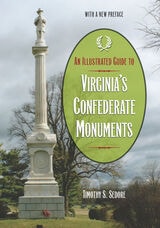
An Illustrated Guide to Virginia's Confederate Monuments
Timothy S. Sedore
Southern Illinois University Press, 2011
From well-known battlefields, such as Manassas, Fredericksburg, and Appomattox, to lesser-known sites, such as Sinking Spring Cemetery and Rude’s Hill, Sedore leads readers on a vivid journey through Virginia’s Confederate history. Tablets, monoliths, courthouses, cemeteries, town squares, battlefields, and more are cataloged in detail and accompanied by photographs and meticulous commentary. Each entry contains descriptions, fascinating historical information, and location, providing a complete portrait of each site.
Much more than a visual tapestry or a tourist’s handbook, An Illustrated Guide to Virginia’s Confederate Monuments draws on scholarly and field research to reveal these sites as public efforts to reconcile mourning with Southern postwar ideologies. Sedore analyzes in depth the nature of these attempts to publicly explain Virginia’s sense of grief after the war, delving deep into the psychology of a traumatized area. From commemorations of famous generals to memories of unknown soldiers, the dead speak from the pages of this sweeping companion to history.
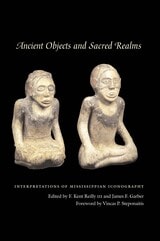
Ancient Objects and Sacred Realms
Interpretations of Mississippian IconographyEdited by F. Kent Reilly, III, and James F. Garber
University of Texas Press, 2006
Between AD 900-1600, the native peoples of the Mississippi River Valley and other areas of the Eastern Woodlands of the United States conceived and executed one of the greatest artistic traditions of the Precolumbian Americas. Created in the media of copper, shell, stone, clay, and wood, and incised or carved with a complex set of symbols and motifs, this seven-hundred-year-old artistic tradition functioned within a multiethnic landscape centered on communities dominated by earthen mounds and plazas. Previous researchers have referred to this material as the Southeastern Ceremonial Complex (SECC).
This groundbreaking volume brings together ten essays by leading anthropologists, archaeologists, and art historians, who analyze the iconography of Mississippian art in order to reconstruct the ritual activities, cosmological vision, and ideology of these ancient precursors to several groups of contemporary Native Americans. Significantly, the authors correlate archaeological, ethnographic, and art historical data that illustrate the stylistic differences within Mississippian art as well as the numerous changes that occur through time. The research also demonstrates the inadequacy of the SECC label, since Mississippian art is not limited to the Southeast and reflects stylistic changes over time among several linked but distinct religious traditions. The term Mississippian Iconographic Interaction Sphere (MIIS) more adequately describes the corpus of this Mississippian art. Most important, the authors illustrate the overarching nature of the ancient Native American religious system, as a creation unique to the native American cultures of the eastern United States.

Annotated Bibliography of Southern American English
James B. McMillan
University of Alabama Press, 1989
The only book-length bibliography on the speech of the American South, this volume focuses on the pronunciation, vocabulary, grammar, naming practices, word play, and other aspects of language that have interested researchers and writers for two centuries. Compiled here are the works of linguists, historians, anthropologists, sociologists, and educators, as well as popular commentators.
With over 3,800 entries, this invaluable resource is a testament to the significance of Southern speech, long recognized as a distinguishing feature of the South, and the abiding interest of Southerners in their speech as a mark of their identity. The entries encompass Southern dialects in all their distinctive varieties—from Appalachian to African American, and sea islander to urbanite.
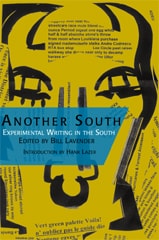
Another South
Experimental Writing in the SouthEdited by Bill Lavender, with an introduction by Hank Lazer
University of Alabama Press, 2002
Another South is an anthology of poetry from contemporary southern writers who are working in forms that are radical, innovative, and visionary. Highly experimental and challenging in nature, the poetry in this volume, with its syntactical disjunctions, formal revolutions, and typographic playfulness, represents the direction of a new breed of southern writing that is at once universal in its appeal and regional in its flavor.
Focusing on poets currently residing in the South, the anthology includes both emerging and established voices in the national and international literary world. From the invocations of Andy Young’s “Vodou Headwashing Ceremony” to the blues-informed poems of Lorenzo Thomas and Honorée Jeffers, from the different voicings of John Lowther and Kalamu ya Salaam to the visual, multi-genre art of Jake Berry, David Thomas Roberts, and Bob Grumman, the poetry in Another South is rich in variety and enthusiastic in its explorations of new ways to embody place and time. These writers have made the South lush with a poetic avant-garde all its own, not only redefining southern identity and voice but also offering new models of what is possible universally through the medium of poetry.
Hank Lazer’s introductory essay about “Kudzu textuality” contextualizes the work by these contemporary innovators. Like the uncontrollable runaway vine that entwines the southern landscape, their poems are hyperfertile, stretching their roots and shoots relentlessly, at once destructive and regenerative. In making a radical departure from nostalgic southern literary voices, these poems of polyvocal abundance are closer in spirit to "speaking in tongues" or apocalyptic southern folk art—primitive, astonishing, and mystic.
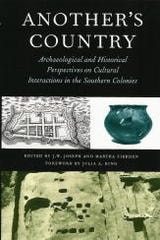
Another's Country
Archaeological and Historical Perspectives on Cultural Interactions in the Southern ColoniesEdited by J.W. Joseph and Martha Zierden
University of Alabama Press, 2001
The 18th-century South was a true melting pot, bringing together colonists from England, France, Germany, Ireland, Switzerland, and other locations, in addition to African slaves—all of whom shared in the experiences of adapting to a new environment and interacting with American Indians. The shared process of immigration, adaptation, and creolization resulted in a rich and diverse historic mosaic of cultures.
The cultural encounters of these groups of settlers would ultimately define the meaning of life in the nineteenth-century South. The much-studied plantation society of that era and the Confederacy that sprang from it have become the enduring identities of the South. A full understanding of southern history is not possible, however, without first understanding the intermingling and interactions of the region’s eighteenth-century settlers. In the essays collected here, some of the South’s leading historical archaeologists examine various aspects of the colonial experience, attempting to understand how cultural identity was expressed, why cultural diversity was eventually replaced by a common identity, and how the various cultures intermeshed.
Written in accessible language, this book will be valuable to archaeologists and non-archaeologists alike. Cultural, architectural, and military historians, cultural anthropologists, geographers, genealogists, and others interested in the cultural legacy of the South will find much of value in this book.
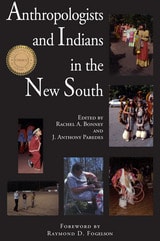
Anthropologists and Indians in the New South
Edited by Rachel Bonney and J. Anthony Paredes; Foreword by Raymond D. Fogelson
University of Alabama Press, 2001
A clear assessment of the growing mutual respect and strengthening bond between modern Native Americans and the researchers who explore their past
Southern Indians have experienced much change in the last half of the 20th century. In rapid succession since World War II, they have passed through the testing field of land claims litigation begun in the 1950s, played upon or retreated from the civil rights movement of the 1960s, seen the proliferation of “wannabe” Indian groups in the 1970s, and created innovative tribal enterprises—such as high-stakes bingo and gambling casinos—in the 1980s. The Native American Graves Protection and Repatriation Act of 1990 stimulated a cultural renewal resulting in tribal museums and heritage programs and a rapprochement with their western kinsmen removed in “Old South” days.
Anthropology in the South has changed too, moving forward at the cutting edge of academic theory. This collection of essays reflects both that which has endured and that which has changed in the anthropological embrace of Indians from the New South. Beginning as an invited session at the 30th-anniversary meeting of the Southern Anthropological Society held in 1996, the collection includes papers by linguists, archaeologists, and physical anthropologists, as well as comments from Native Americans.
This broad scope of inquiry—ranging in subject from the Maya of Florida, presumed biology, and alcohol-related problems to pow-wow dancing, Mobilian linguistics, and the “lost Indian ancestor” myth—results in a volume valuable to students, professionals, and libraries. Anthropologists and Indians in the New South is a clear assessment of the growing mutual respect and strengthening bond between modern Native Americans and the researchers who explore their past.
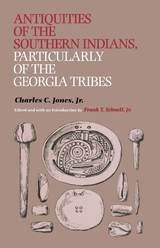
Antiquities of the Southern Indians, Particularly of the Georgia Tribes
Charles C. Jones, Jr. edited and with an introduction by Frank T. Schnell, Jr.
University of Alabama Press, 1999
A Dan Josselyn Memorial Publication
This reissue of Charles Jones’s classic investigations of the Mound Builders will be an invaluable resource for archaeologists today
Long a classic of southeastern archaeology, Charles Jones’s Antiquities of the Southern Indians was a groundbreaking work that linked historic tribes with prehistoric “antiquities.” Published in 1873, it predated the work of Cyrus Thomas and Clarence Moore and remains a rich resource for modern scholars.
Jones was a pioneer of archaeology who not only excavated important sites but also related his findings to other sites, to contemporary Indians, and to artifacts from other areas. His work covers all of the southeastern states, from Virginia to Louisiana, and is noted for its insights into the De Soto expedition and the history of the Creek Indians.
Best known for refuting the popular myth of the Mound Builders, Jones proposed a connection between living Native Americans of the 1800s and the prehistoric peoples who had created the Southeast’s large earthen mounds. His early research and culture comparisons led to the eventual demise of the Mound Builder myth.
For this reissue of Jones’s book, a new introduction by Frank Schnell places Jones’s work in the context of his times and relates it to current research in the Southeast. An engagingly written work enhanced by numerous maps and engravings, Antiquities of the Southern Indians will serve today’s scholars and fascinate all readers interested in the region’s prehistory.

Apocalypse South
Judgment, Cataclysm, and Resistance in the Regional ImaginaryAnthony Dyer Hoefer
The Ohio State University Press, 2012
Appointed
An American NovelWilliam H. Anderson
West Virginia University Press, 2019
Appointed is a recently recovered novel written by William Anderson and Walter Stowers, two of the editors of the Detroit Plaindealer, a long-running and well-regarded African American newspaper of the late nineteenth century. Drawing heavily on nineteenth-century print culture, the authors tell the story of John Saunders, a college-educated black man living and working in Detroit. Through a bizarre set of circumstances, Saunders befriends his white employer’s son, Seth Stanley, and the two men form a lasting, cross-racial bond that leads them to travel together to the American South. On their journey, John shows Seth the harsh realities of American racism and instructs him in how he might take responsibility for alleviating the effects of racism in his own home and in the white world broadly.
As a coauthored novel of frustrated ambition, cross-racial friendship, and the tragedy of lynching, Appointed represents a unique contribution to African American literary history. This is the first scholarly edition of Appointed, and it includes a collection of writings from the Plaindealer, the authors’ short story “A Strange Freak of Fate,” and an introduction that locates Appointed and its authors within the journalistic and literary currents of the United States in the late nineteenth century.
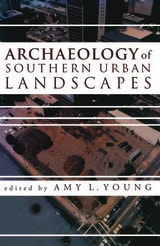
Archaeology of Southern Urban Landscapes
Amy L Young
University of Alabama Press, 2000
Groundbreaking essays in urban archaeology highlight the impact of towns and cities on the southern landscape.
The rapid growth and development of urban areas in the South have resulted in an increase in the number of urban archaeology projects required by federal and state agencies. These projects provide opportunities not only to investigate marginal areas between the town and countryside but also to recover information long buried beneath the earliest urban structures. Such projects have also created a need for a one-volume update on archaeology as it is practiced in the urban areas of the southeastern United States.
Archaeology of Southern Urban Landscapes will assist practitioners and scholars in the burgeoning fields of urban and landscape archaeology by treating the South as a distinctive social, geographic, and material entity and by focusing on the urban South rather than the stereotypical South of rural plantations. The case studies in this volume span the entire southeastern United States, from Annapolis to New Orleans and from colonial times to the 19th century. The authors address questions involving the function of cities, interregional diversity, the evolution of the urban landscape, and the impact of the urban landscape on southern culture. By identifying the relationship between southern culture and the South's urban landscapes, this book will help us understand the built landscape of the past and predict future growth in the region.
Archipelagoes of My South
Episodes in the Shaping of a Region, 1830–1965J. Mills Thornton III
University of Alabama Press, 2016
A collection of essays representing forty-five years of reflection on the central problems of southern history bound together by a common concern with defining the crucial interaction of race and class in the formation of southern politics and life
“The tourist archipelagoes of my South / are prisons, too, corruptible” writes the poet Derek Walcott. While Walcott refers to the islands of the Caribbean, the analogous idea of a land made into solitary islands by an imprisoned and inherited corruption is historian J. Mills Thornton III’s American South. The captivating essays in Archipelagoes of My South: Episodes in the Shaping of a Region, 1830–1965 address this overarching and underlying narrative of Alabama politics and the history of the South.
Highlighting events as significant as the role of social and economic conflict in the southern secession movement, various aspects of Reconstruction, and the role of the Ku Klux Klan in the politics of the 1920s, Thornton draws from various points in the southern past in an effort to identify and understand the sources of the region’s power. Moreover, each essay investigates its subject matter and peels back layers with an aim to clarify why the enormous diversity of the southern experience makes that power so great, all the while allowing the reader to see connections that would not otherwise be apparent.
Archipelagoes of My South gathers previously uncollected essays into a single volume covering the entire length and breadth of Thornton’s career. The author’s principal concerns have always been the arc of regional evolution and the significance of the local. Thus, the mechanisms of political and social change and the interrelationships across eras and generations are recurring themes in many of these essays.
Even those who have spent their entire lives in the South may be unaware of the fractured layers of history that lie beneath the landscape they inhabit. For those southern residents who seek to comprehend more of their own past, this landmark compilation of essays on Alabama and southern history endeavors to provide illumination and enlightenment.
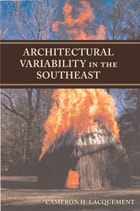
Architectural Variability in the Southeast
Edited by Cameron H. Lacquement
University of Alabama Press, 2007
Some of the most visible expressions of human culture are illustrated architecturally. Unfortunately for archaeologists, the architecture being studied is not always visible and must be inferred from soil inconsistencies or charred remains. This study deals with research into roughly a millennium of Native American architecture in the Southeast and includes research on the variation of construction techniques employed both above and below ground. Most of the architecture discussed is that of domestic houses with some emphasis on large public buildings and sweat lodges. The authors use an array of methods and techniques in examining native architecture including experimental archaeology, ethnohistory, ethnography, multi-variant analysis, structural engineering, and wood science technology. A major portion of the work, and probably the most important in terms of overall significance, is that it addresses the debate of early Mississippian houses and what they looked like above ground and the changes that occurred both before and after the arrival of Europeans.

Ariel's Ecology
Plantations, Personhood, and Colonialism in the American TropicsMonique Allewaert
University of Minnesota Press, 2013
What happens if we abandon the assumption that a person is a discrete, world-making agent who acts on and creates place? This, Monique Allewaert contends, is precisely what occurred on eighteenth-century American plantations, where labor practices and ecological particularities threatened the literal and conceptual boundaries that separated persons from the natural world.
Integrating political philosophy and ecocriticism with literary analysis, Ariel’s Ecology explores the forms of personhood that developed out of New World plantations, from Georgia and Florida through Jamaica to Haiti and extending into colonial metropoles such as Philadelphia. Allewaert’s examination of the writings of naturalists, novelists, and poets; the oral stories of Africans in the diaspora; and Afro-American fetish artifacts shows that persons in American plantation spaces were pulled into a web of environmental stresses, ranging from humidity to the demand for sugar. This in turn gave rise to modes of personhood explicitly attuned to human beings’ interrelation with nonhuman forces in a process we might call ecological.
Certainly the possibility that colonial life revokes human agency haunts works from Shakespeare’s Tempest and Montesquieu’s Spirit of the Laws to Spivak’s theories of subalternity. In Allewaert’s interpretation, the transformation of colonial subjectivity into ecological personhood is not a nightmare; it is, rather, a mode of existence until now only glimmering in Che Guevara’s dictum that postcolonial resistance is synonymous with “perfect knowledge of the ground.”

Artificial Southerner
Equivocations and Love SongsPhilip Martin
University of Arkansas Press, 2001

Asian Americans in Dixie
Race and Migration in the SouthEdited by Jigna Desai and Khyati Y. Joshi
University of Illinois Press, 2013