Results by title
132 books match the query 'Thomas, Aquinas, Saint' and 26 start with a
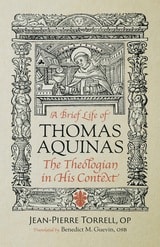
A Brief Life of Aquinas
The Theologian in His ContextJean-Pierre Torrell
Catholic University of America Press, 2024
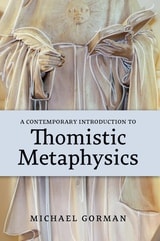
A Contemporary Introduction to Thomistic Metaphysics
Michael Gorman
Catholic University of America Press, 2023
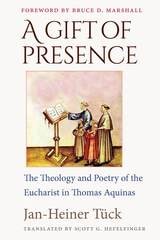
A Gift of Presence
The Theology and Poetry of the Eucharist in Thomas AquinasJan Heiner Tück
Catholic University of America Press, 2018
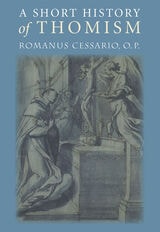
A Short History of Thomism
Romanus Cessario, O.P.
Catholic University of America Press, 2005
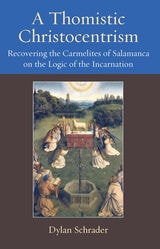
A Thomistic Christocentrism
Recovering the Carmelites of Salamanca on the Logic of the IncarnationDylan Schrader
Catholic University of America Press, 2021
A Thomistic Introduction to Modern Psychology
Leslie Kelley
Catholic University of America Press, 2026
A Trinitarian Anthropology
Adrienne von Speyr & Hans Urs von Balthasar in Dialogue with Thomas AquinasMichele M. Schumacher
Catholic University of America Press, 2014
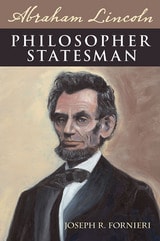
Abraham Lincoln, Philosopher Statesman
Joseph R. Fornieri
Southern Illinois University Press, 2014
2015 ISHS Superior Achievement Award
What constitutes Lincoln’s political greatness as a statesman? As a great leader, he saved the Union, presided over the end of slavery, and helped to pave the way for an interracial democracy. His great speeches provide enduring wisdom about human equality, democracy, free labor, and free society. Joseph R. Fornieri contends that Lincoln’s political genius is best understood in terms of a philosophical statesmanship that united greatness of thought and action, one that combined theory and practice. This philosophical statesmanship, Fornieri argues, can best be understood in terms of six dimensions of political leadership: wisdom, prudence, duty, magnanimity, rhetoric, and patriotism. Drawing on insights from history, politics, and philosophy, Fornieri tackles the question of how Lincoln’s statesmanship displayed each of these crucial elements.
Providing an accessible framework for understanding Lincoln’s statesmanship, this thoughtful study examines the sixteenth president’s political leadership in terms of the traditional moral vision of statecraft as understood by epic political philosophers such as Aristotle and St. Thomas Aquinas. Fornieri contends that Lincoln’s character is best understood in terms of Aquinas’s understanding of magnanimity or greatness of soul, the crowning virtue of statesmanship. True political greatness, as embodied by Lincoln, involves both humility and sacrificial service for the common good. The enduring wisdom and timeless teachings of these great thinkers, Fornieri shows, can lead to a deeper appreciation of statesmanship and of its embodiment in Abraham Lincoln.
With the great philosophers and books of western civilization as his guide, Fornieri demonstrates the important contribution of normative political philosophy to an understanding of our sixteenth president. Informed by political theory that draws on the classics in revealing the timelessness of Lincoln’s example, his interdisciplinary study offers profound insights for anyone interested in the nature of leadership, statesmanship, political philosophy, political ethics, political history, and constitutional law.
Analogies of Transcendence
Stephen M. Fields
Catholic University of America Press, 2016
Analogy after Aquinas
Domenic D'Ettore
Catholic University of America Press, 2018
Angels and Demons
Serge-Thomas Bonino
Catholic University of America Press, 2016
Aquinas and Analogy
Ralph McInerny
Catholic University of America Press, 1996
Aquinas and Sartre
On Freedom, Personal Identity, and the Possibility of HappinessStephen Wang
Catholic University of America Press, 2009
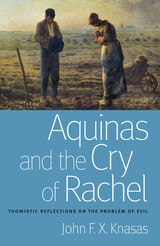
Aquinas and the Cry of Rachel
John F.X. Knasas
Catholic University of America Press, 2013
Generally speaking, possible philosophical accounts for evil are two kinds: cosmological or personal. The cosmological account has evils rebounding to the perfection of creation. The personal account would have evils suffered rebounding to the good of the sufferer. Knasas argues that for Aquinas no philosophical resolution of these two kinds of accounts
is possible. This argument is based upon Aquinas's understanding of the human as an intellector of analogical being. Such an understanding establishes two truths. First, the human is by nature only a principal part of the created whole. Second, there is the philosophically discernible possibility of supernatural elevation by the creator.
Hence, as far as philosophy can discern, evil may have a natural explanation or it may have a supernatural one. The Thomistic philosopher has no answer as to why evil exists because that philosopher discerns too many possible ones. In that respect, Aquinas's thinking on evil is similar to his thinking about the philosophical knowledge of the biblical
truth of the world's creation in time. Such a creation is one metaphysical possibility among others. Some authors that Aquinas and the Cry of Rachel considers are: Anthony Flew and Albert Camus, Jacques Maritain and Charles Journet, William Rowe, Marily McCord Adams, William Hasker, John Hick, David Ray Griffin, David Hume, Diogenes Allen, J. L. Mackie, Alvin Plantinga, Richard Swinburne, Bruce Reichenbach,
Brian Davies, and Eleonore Stump.
Aquinas and the Early Chinese Masters
Chinese Philosophy and Catholic TheologyJoshua Brown
Catholic University of America Press, 2025
Aquinas and the Theology of the Body
Thomas Petri
Catholic University of America Press, 2016
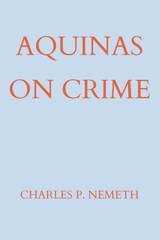
Aquinas on Crime
Charles P. Nemeth
St. Augustine's Press, 2008
Not much escapes the intellect and imagination of the Angelic Doctor, St. Thomas Aquinas. Whether it be love, children, education, moral reasoning, happiness or the proper dispositions for human existence, St. Thomas seems an expert in all of it. Crime and criminal conduct are no exceptions to this general tendency with him. Not only does he have much to say about it, what he relates is perpetually fresh and surely the bedrock of what is now taken for granted. In this short treatise, the focus targets St. Thomas’s criminal codification – his law of crimes.
Indeed the magnanimity of his crimes code is a subject matter not yet treated in any detail in the scholarly literature. While parts and pieces are covered in many quarters, the literature has yet to develop a systematic, codified examination of Thomistic criminal law. The essence of the endeavor is threefold: first, how does St. Thomas factor the nature of the human person into the concept of criminal culpability and personal responsibility; second, what types of criminal conduct does St. Thomas specifically delineate and define; and lastly, what is Thomas’s view of mitigation and defense, as well as the corresponding punishment meted out for criminal conduct? This short commentary zeroes in on Thomistic Criminal Law – a project which will illuminate the root, the heritage and the foundation of modern criminal codification.
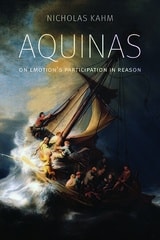
Aquinas on Emotion's Participation in Reason
Nicholas Kahm
Catholic University of America Press, 2019
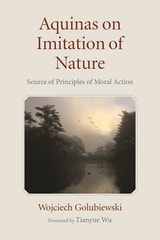
Aquinas on Imitation of Nature
Source of Principles of Moral ActionWojciech Golubiewski
Catholic University of America Press, 2022
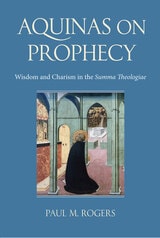
Aquinas on Prophecy
Wisdom and Charism in the <i>Summa Theologiae</i>Paul M. Rogers
Catholic University of America Press, 2023
Aquinas on Transubstantiation
Reinhard Hutter
Catholic University of America Press, 2019
Aquinas on the Divine Ideas as Exemplar Causes
Gregory T. Doolan
Catholic University of America Press, 2008
Aquinas the Augustinian
Michael Dauphinais
Catholic University of America Press, 2007
Aquinas's Summa
background, structure, & receptionJean-Pierre Torrell
Catholic University of America Press, 2005
Aquinas
God and ActionDavid B. Burrell C.S.C.
University of Scranton Press, 2008
Aquinas’s Neoplatonism in the Summa Theologiae on God
A Short IntroductionWayne J. Hankey
St. Augustine's Press, 2016