Results by title
331 books match the query 'World Literature' and 31 start with a
A Bohemian Youth
Josef Hirsal
Northwestern University Press, 1997
Josef Hiršal's experimental novel is a Dada-like romp through the life of a young man born into a Bohemian peasant family. Told in five parts, A Bohemian Youth begins with a word to the wise, moves on to the text, continues with notes and with notes to the note, and ends with a note on the notes to the notes.
More than just a tongue-in-cheek parody of a literary memoir, A Bohemian Youth is a glimpse of the First Czechoslovak Republic as seen through the eyes of a young peasant from the provinces. Abounding in intimate details--the manners of a servant girl, the habits of the town homosexual, the sounds of popular music; the way people eat in wartime—Hiršal's novel is a wrenching and hilarious tale of a young man's emotional and sexual awakening.
A Certain Smile
A NovelFrançoise Sagan
University of Chicago Press, 2011
A neglected classic about a young French woman in the 1950s risking romance, from the author of Bonjour Tristesse
Françoise Sagan is best known for her first novel, Bonjour Tristesse, which caused a scandal when she first published it at the age of eighteen in 1953. But her second novel, A Certain Smile, less shocking and more psychologically convincing, was preferred by many critics. Like Bonjour Tristesse, this story is set in Paris in the 1950s and told by a young student bored by her law books, restless and curious about love and sex. She is fond of her loyal boyfriend, but he, too, bores her. His worldly uncle strikes her as more exciting, appealingly risky and forbidden. Frank and spontaneous, vulnerable and cruel, thoughtless and insightful, Sagan's young narrator explores such perennial themes as unrequited love and the precarious balance of irrational emotions and self-restraint.
A Curious Land
Stories from HomeSusan Muaddi Darraj
University of Massachusetts Press, 2015
Susan Muaddi Darraj's short story collection about the inhabitants of a Palestinian West Bank village, Tel al-Hilou, spans generations and continents to explore ideas of memory, belonging, connection, and, ultimately, the deepest and richest meaning of home. A Curious Land gives voice to the experiences of Palestinians in the last century.
An excerpt from A Curious Land:
When Rabab lowered the magad and clapped-clapped to the well in her mother's too-big slippers, the stone jar digging into her shoulder, she didn't, at first, see the body. The morning sun glazed everything around her—the cement homes, the iron rails along one wall, the bars on the windows, the stones around the well—and made her squint her itchy eyes.
She was hungry. That was all.
They'd arrived here only last night, stopping as soon as Awwad and the men were sure the army had moved south. It must have been the third time in just a few weeks—collapse the tents, load the mules, disappear into the sands. She hoped this war would end soon, and she didn't really care who won, as long as it ended because they hadn't eaten well in two years. In the past few months, her mother had sold all her gold, except for her bracelet made of liras. It was the only thing left, and she was holding onto it, and Rabab realized, so were they all; she imagined that, the day it was sold, when her mother's wrist was bare, would signal that they were at the end.
A Dance to the Music of Time
First MovementAnthony Powell
University of Chicago Press, 1995
A Dance to the Music of Time is a landmark work of fiction, praised by readers and critics and other novelists throughout the 75 years since the first volume was published. Equal parts funny and heartbreaking, clever and moving, Anthony Powell's universally acclaimed epic encompasses a four-volume panorama of twentieth century London.
Hailed by Time as "brilliant literary comedy as well as a brilliant sketch of the times," A Dance to the Music of Time opens just after World War I and carries through the 1950s, with all the changes of society, characters, and relationships that those shifting eras bring.
Four very different young men on the threshold of manhood dominate this opening volume of A Dance to the Music of Time. The narrator, Jenkins—a budding writer—shares a room with Templer, already a passionate womanizer, and Stringham, aristocratic and reckless. Widmerpool, as hopelessly awkward as he is intensely ambitious, lurks on the periphery of their world. Amid the fever of the 1920s and the first chill of the 1930s, these four gain their initiations into sex, society, business, and art. A masterpiece of modern fiction, Powell's epic creates a rich portrait of life in England between the wars.
"Reading Powell," says the New York Times, "is like living someone else's life, inextricably entangled with your own." Give this first volume a try, and you'll find characters and scenes and insights that will stay with you for the rest of your life.
Includes these novels:
A Question of Upbringing
A Buyer's Market
The Acceptance World
A Dance to the Music of Time
Fourth MovementAnthony Powell
University of Chicago Press, 1995
A Dance to the Music of Time is a landmark work of fiction, praised by readers and critics and other novelists throughout the 75 years since the first volume was published. Equal parts funny and heartbreaking, clever and moving, Anthony Powell's universally acclaimed epic encompasses a four-volume panorama of twentieth century London. Hailed by Time as "brilliant literary comedy as well as a brilliant sketch of the times," A Dance to the Music of Time opens just after World War I and carries through the 1950s, with all the changes to society, character, and relationships those shifting eras bring.
In this final volume of A Dance to the Music of Time, Nick Jenkins describes a world of ambition, intrigue, and dissolution. England has won the war, but its costs, physical and moral, were vast. Widmerpool's wife sets a snare for the young writer X. Trapnel, while her husband suffers private agony and public humiliation. Set against a background of politics, business, high society, and the counterculture in England and Europe, this magnificent work of art sounds an unforgettable requiem for an age.
"Reading Powell," says the New York Times, "is like living someone else's life, inextricably entangled with your own." Give this first volume a try, and you'll find characters and scenes and insights that will stay with you for the rest of your life.
Includes these novels:
Books Do Furnish a Room
Temporary Kings
Hearing Secret Harmonies
A Dance to the Music of Time
Second MovementAnthony Powell
University of Chicago Press, 1995
A Dance to the Music of Time is a landmark work of fiction, praised by readers and critics and other novelists throughout the 75 years since the first volume was published. Equal parts funny and heartbreaking, clever and moving, Anthony Powell's universally acclaimed epic encompasses a four-volume panorama of twentieth century London. Hailed by Time as "brilliant literary comedy as well as a brilliant sketch of the times," A Dance to the Music of Time opens just after World War I and continues through the 1950s.
In the background of this second volume of A Dance to the Music of Time, the rumble of distant events in Germany and Spain presages the storm of World War II. In England, even as the whirl of marriages and adulteries, fashions and frivolities, personal triumphs and failures gathers speed, men and women find themselves on the brink of fateful choices.
"Reading Powell," says the New York Times, "is like living someone else's life, inextricably entangled with your own." Give this first volume a try, and you'll find characters and scenes and insights that will stay with you for the rest of your life
Includes these novels:
At Lady Molly's
Casanova's Chinese Restaurant
The Kindly Ones
A Dance to the Music of Time
Third MovementAnthony Powell
University of Chicago Press, 1995
A Dance to the Music of Time is a landmark work of fiction, praised by readers and critics and other novelists throughout the 75 years since the first volume was published. Equal parts funny and heartbreaking, clever and moving, Anthony Powell's universally acclaimed epic encompasses a four-volume panorama of twentieth century London. Hailed by Time as "brilliant literary comedy as well as a brilliant sketch of the times," A Dance to the Music of Time opens just after World War I and continues through the 1950s and all the changes to life, society, and relationships those shifting eras bring.
In this third volume of A Dance to the Music of Time, we again meet Widmerpool, doggedly rising in rank; Jenkins, shifted from one dismal army post to another; Stringham, heroically emerging from alcoholism; Templer, still on his eternal sexual quest. Here, too, we are introduced to Pamela Flitton, one of the most beautiful and dangerous women in modern fiction. Wickedly barbed in its wit, uncanny in its seismographic recording of human emotions and social currents, this saga stands as an unsurpassed rendering of England's finest yet most costly hour.
"Reading Powell," says the New York Times, "is like living someone else's life, inextricably entangled with your own." Give Dance a try, and you'll find characters and scenes and insights that will stay with you for the rest of your life.
Includes these novels:
The Valley of Bones
The Soldier's Art
The Military Philosophers
A Land the Size of Binoculars
Igor Klekh
Northwestern University Press, 2004
Throughout, Klekh studies landscapes as intimate as the terrain between fathers and sons and as broad as the wild, mysterious Carpathian Mountains. His work has been compared to that of Borges, Eco, and the magical realists, and celebrated for its synthesis of numerous literary traditions, its use of esoteric knowledge, and its breathtaking prose.
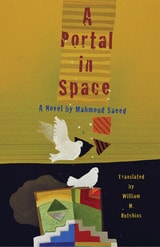
A Portal in Space
By Mahmoud Saeed, Translated by William M. Hutchins
University of Texas Press, 2015
A Portal in Space, set in Basra, Iraq, during the Iran-Iraq War (1980–1988), follows the lives of Anwar, a newly minted architect, and the other members of his affluent family as they attempt to maintain a sense of normality during the frequent bombing attacks from Iran. When Anwar joins the Iraqi army and then goes missing in action, his family struggles to cope with uncertainty over his fate. His mother falls into depression and secludes herself in the family home, while his father shifts his attention from his duties as a judge to the weekly pilgrimage to Baghdad seeking information on his son—and to Zahra, the young widow he meets there.
Emotionally engaging, A Portal in Space is a wry, wise tale of human beings striving to retain their humanity during a war that is anything but humane. Mahmoud Saeed succeeds brilliantly in bringing the sights and sounds of Iraq to life on the page—whether in a bunker on the front lines of the Iran-Iraq War or in the parlor of a fortune-teller in Baghdad. As Zahra says of the novel she is writing: “It is a normal novel that contains love, war, life, deceit, and death.”
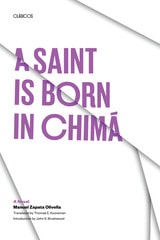
A Saint Is Born in Chima
A NovelBy Manuel Zapata Olivella
University of Texas Press, 1991
When the paralyzed cripple Domingo Vidal is rescued unsinged from a burning house, the people of Chima believe they have witnessed a miracle. Domingo becomes their patron "saint," and tales of his miracles multiply. Domingo makes the rains come, cures the blind and lame, and swells barren wombs with new life. But is Domingo really a saint, or is he a pagan idol? Padre Berrocal calls the people heretics, but they are afraid not to worship Domingo. To what excesses will superstition and ignorance drive the frightened people of Chima?
This novel, published in 1963 as En Chimá nace un santo, makes important connections between the frustrations of poverty and the excesses of religious fanaticism. Zapata Olivella indicts the dogmatic attitudes of religious and civil institutions as a major cause of the creation of local cults like the one that grows up around "Saint" Domingo. In Zapata Olivella's compelling narrative, the struggle over Domingo points up both the inflexibility of established institutions and the potential power for change that lies within the hands of a determined populace.
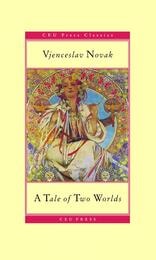
A Tale of Two Worlds
Vjenceslav Novak
Central European University Press, 2014

Absinthe
World Literature in Translation: The Islamicate in TranslationJaideep Pandey
Michigan Publishing Services, 2025
Guest-edited by Razieh Araghi and Jaideep Pandey, this special issue explores the rich, multilingual, and transregional literary worlds shaped by and within the Islamicate sphere.
From the Mughal court to Metro Detroit, from Malayalam ghazals to Kurdish-inflected Persian prison poetry, this issue brings together literary translations and critical reflections that unsettle assumptions about language, identity, and belonging. Rather than framing the Islamicate as a fixed geography or religious category, Absinthe 31 approaches it as a set of fluid crossings—linguistic, cultural, historical, and affective.
The issue features work in and from an expansive range of languages, including Persian, Arabic, Malayalam, Kurdish, Assamese, Amazigh, Armeno-Turkish, Dari, and Urdu—foregrounding both canonical and marginalized voices. It includes new English translations of ghazals, sīrahs, biographies, and poems originally written by poets and thinkers working across sectarian, linguistic, and national boundaries, and often negotiating minority or diasporic positionalities.
In addition to the translated works, many contributions are accompanied by translator commentaries that reflect on the ethics, politics, and poetics of translating from within the Islamicate literary landscape. Together, they suggest that translation is not just a means of access, but a mode of thinking—a method native to the Islamicate tradition itself. Spanning from the premodern courts of empire to contemporary diasporic communities, Absinthe 31 offers readers a vibrant and pluralistic vision of the Islamicate as a dynamic literary terrain shaped by continual movement, negotiation, and transformation.
Absinthe
World Literature in Translation: Vol. 23 Unscripted: An Armenian PalimpsestEdited by Tamar M. Boyadjian
Michigan Publishing Services, 2017
Absinthe 23, guest-edited by Tamar M. Boyadjian, invites translators to move beyond purely prescriptive applications of translation, interpretation, and the localization of national literatures—and the mere translation of a “minor” literature into a major language—to consider their translations of contemporary Armenian literature as part of larger, non-compartmentalized cultural and theoretical frameworks and disciplines such as comparative literature, Mediterranean studies, Postcolonial studies, Diaspora studies, Trauma studies, and others. The issue includes contemporary Armenian texts from living authors, chosen as significant works that challenge, shape, and complicate conversations on transcultural analysis, and theories and practices related to translating.
Absinthe: A Journal of World Literature in Translation publishes foreign literature in English translation, with a particular focus on previously untranslated contemporary fiction, poetry, and creative non-fiction by living authors. The magazine has its home in the Department of Comparative Literature at the University of Michigan and is edited by graduate students in the Department, as well as by occasional guest editors.
Absinthe
World Literature in Translation: Vol. 24: World HellenismsAli Bolcakan, Will Stroebel and Peter Vorissis
Michigan Publishing Services, 2018
Absinthe 24 pushes and prods Hellenism beyond its geographic and cultural comfort zones, and sets it tumbling off beyond both internal and external borders of its nation-state, in a wide-ranging but always site-specific and localized itinerary. At each stop along the way, this Greekness finds its plurals—hence the “Hellenisms” of the title. While they present no unified topography, tongue or even topic, these Hellenisms map out the contours of a shared conversation. Today’s Hellenism isn’t limited to Hellas, nor to the Hellenic language. The selected texts in this volume explore Greece from the perspective of visitors, displaced persons, and marginalized people looking in, or, conversely, from the perspective of locals striving to break out.
Absinthe: A Journal of World Literature in Translation publishes foreign literature in English translation, with a particular focus on previously untranslated contemporary fiction, poetry, and creative non-fiction by living authors. The magazine has its home in the Department of Comparative Literature at the University of Michigan and is edited by graduate students in the Department, as well as by occasional guest editors.
Absinthe
World Literature in Translation: Vol. 25: Barings // Bearings: Contemporary Women's Writing in CatalanMegan Berkobien and María Cristina Hall
Michigan Publishing Services, 2018
Edited by Megan Berkobien and María Cristina Hall, Barings // Bearings collects sixteen pieces of contemporary women’s writing in Catalan together with the brilliantly understated illustrations of the artist Elisa Monsó.
This special issue of Absinthe witnesses a living, Catalan language through the emotional labor of translation. It is also a testament to the thriving worlds of women’s writing in Catalan, with time-travelling fiction by Bel Olid (tr. Bethan Cunningham), regrets on pregnancy sublimated into an airborne taxi ride in a story by Tina Vallès (tr. Jennifer Arnold), Mireia Vidal-Conte’s poetry reflecting on Virginia Woolf’s suicide (tr. María Cristina Hall), a story of revenge on an abusive elderly woman by Anna Maria Villalonga (tr. Natasha Tanna), as well as reflections on war, bookstores, and generational conflict in post-Franco Spain. These often surreal pieces of Catalan fiction are informed by several essays and works of literary memoir, including those by Marta Rojals (tr. Alicia Meier) on the state of the Catalan language and Najat El Hachmi (tr. Julia Sanches) on the conditions of growing up in Catalonia as the daughter of Moroccan parents. These latter pieces resist and explore the contours of multilingualism, highlighting the intra- and interlingual reality of spoken Catalan alongside Spanish and Amazigh. Barings // Bearings invokes the feeling of a people through the work of a new generation of translators.
Absinthe
World Literature in Translation: Volume 26: Vibrate! Resounding the Frequencies of Africana in TranslationFrieda Ekotto
Michigan Publishing Services, 2020
Absinthe
World Literature in Translation: Volume 27: Through German: Contemporary Literature in TranslationLauren Beck
Michigan Publishing Services, 2021
Absinthe
World Literature in Translation: Volume 28: Orphaned of Light: Translating Arab and Arabophone MigrationGraham Liddell
Michigan Publishing Services, 2022
Absinthe 28: Orphaned of Light features contemporary literature of migration translated from and to Arabic. In short stories, creative nonfiction essays, poetry, and selections from novels, a multiplicity of migration experiences is brought to the fore: life in diaspora, undocumented labor, refugeehood, human trafficking, internal displacement, exile.
This issue brings together names familiar to readers of Arabic literature in translation, such as Ghassan Kanafani and Saadi Youssef, with writers making their English-language debuts, such as Dearborn, MI-based Kurdish Iraqi poet Gulala Nouri and Libyan novelist Mohamad Alasfar. Likewise, the issue includes veteran translators Marilyn Booth, Nancy Roberts, and Khaled Mattawa alongside newcomers, several of them graduate students at the University of Michigan.
Each piece is accompanied by a translator’s reflection that meditates on the work’s themes as well as the creative process of translation, and the issue’s poetry is presented in a side-by-side Arabic-English format.
Absinthe 28 comes to us at a time when, according to the UN, one in every 78 people on earth is displaced. This collection serves as a reminder that translation and migration are inextricably linked.
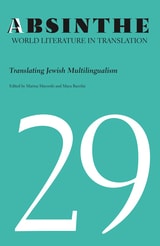
Absinthe
World Literature in Translation: Volume 29: Translating Jewish MultilingualismMarina Mayorski
Michigan Publishing Services, 2023
Absinthe 29: Translating Jewish Multilingualism showcases the variety of languages and genres in which modern Jewish writers have expressed themselves. Spanning short stories, essays, poetry, and selections from novels, the selection of literary works featured in this issue of Absinthe cuts across distinctions between European and non-European literary traditions and addresses diverse themes, including social class, gender, immigration, religious traditions, love and marriage, and the act of writing itself.
Rather than consider disparate Jewish languages and histories in isolation, we bring them into conversation within an open-ended framework that explores Jewish multilingualism in the modern world. The multilingual narrative of Jewish modernity told through them, in seven languages, spans from the 1880s to the 2020s.
Its wide geographical distribution ranges from Tel Aviv to São Paulo through Buenos Aires, Istanbul, Thessaloniki, Livorno, Warsaw, Prague, and Chicago. Each text and context exhibits different aspects of the Jewish encounter with the conditions of modern society, exemplifying the ways in which Jewish writing engages and negotiates different cultures and traditions.
The new volume of Absinthe foregrounds the multilingual legacy of Jewish migration and diasporic life that has become ubiquitous in modern Jewish writing, and it is evident in the enriching and disruptive presence of multiple languages and literary traditions in each of these texts. The title of this volume, Translating Jewish Multilingualism, refers both to the English translations of these texts and to the processes of translation, mediation, and hybridization encapsulated in the works themselves.
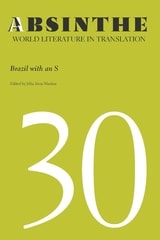
Absinthe
World Literature in Translation: Volume 30: Brazil with an SEdited by Julia Irion Martins
Michigan Publishing Services, 2024
The 2024 issue of Absinthe: World Literature in Translation is a celebration of contemporary Brazilian literature, including short fiction and poetry, as well as excerpts from novels and sections from a recently published—but never produced—cinema novo screenplay.
Absinthe 30: Brazil with an ‘S' features English-language translations of work by several acclaimed Brazilian writers, including the likes of Caio Fernando Abreu, Joaquim Pedro de Andrade, Maria Valéria Rezende, and Clarah Averbuck, as well as that of more emergent voices in the Brazilian literary scene, such as Natalia Timerman, Natércia Pontes, and Maria Esther Maciel, among others. Each contribution follows a critical reflection written by its translator, and many of the contributions are accompanied by an original illustration by São Paulo-based artist Thereza Nardelli.
Guest-edited by Júlia Irion Martins, Absinthe 30 sheds light on Brazil’s regional diversity, presenting an image of Brazil beyond samba and soccer. The contents of this issue run the gamut, from deals with the capital-D Devil to encounters with lowercase-d devils on dating apps, from reflections on everyday malaise and COVID-era anxieties to snapshots of life during the AIDS crisis. The issue broadly confronts questions of belonging, mourning, family, gender, and sexuality, with many of its pieces—written between the early-20th century and as recently as 2024—demonstrating a preoccupation with formal experimentation, genre, and literary style.
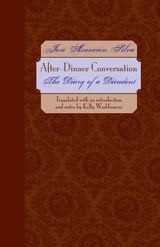
After-Dinner Conversation
The Diary of a DecadentBy José Asunción Silva
University of Texas Press, 2005
Lost in a shipwreck in 1895, rewritten before the author's suicide in 1896, and not published until 1925, José Asunción Silva's After-Dinner Conversation (De sobremesa) is one of Latin America's finest fin de siècle novels and the first one to be translated into English. Perhaps the single best work for understanding turn-of-the-twentieth-century writing in South America, After-Dinner Conversation is also cited as the continent's first psychological novel and an outstanding example of modernista fiction and the Decadent sensibility.
Semi-autobiographical and more important for style than plot, After-Dinner Conversation is the diary of a Decadent sensation-collector in exile in Paris who undertakes a quest to find his beloved Helen, a vision whom his fevered imagination sees as his salvation. Along the way, he struggles with irreconcilable urges and temptations that pull him in every direction while he endures an environment indifferent or hostile to spiritual and intellectual pursuits, as did the modernista writers themselves. Kelly Washbourne's excellent translation preserves Silva's lush prose and experimental style. In the introduction, one of the most wide-ranging in Silva criticism, Washbourne places the life and work of Silva in their literary and historical contexts, including an extended discussion of how After-Dinner Conversation fits within Spanish American modernismo and the Decadent movement. Washbourne's perceptive comments and notes also make the novel accessible to general readers, who will find the work surprisingly fresh more than a century after its composition.
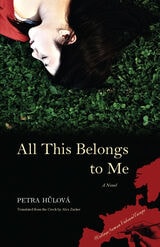
All This Belongs to Me
A NovelPetra Hulova
Northwestern University Press, 2009
Winner of the American Literary Translators Association 2010 National Translation Award
Petra Hůlová became an overnight sensation when All This Belongs to Me was originally published in Czech in 2002, when the author was just twenty-three years old. She has since established herself as one of the most exciting young novelists in Europe today. Writings from an Unbound Europe is proud to publish the first translation of her work in English.
All This Belongs to Me chronicles the lives of three generations of women in a Mongolian family. Told from the point of view of a mother, three sisters, and the daughter of one of the sisters, this story of secrets and betrayals takes us from the daily rhythms of nomadic life on the steppe to the harsh realities of urban alcoholism and prostitution in the capital, Ulaanbaatar. All This Belongs to Me is a sweeping family saga that showcases Hůlová's genius.
Among the Bieresch
Klaus Hoffer
Seagull Books, 2016
Among the Bieresch is Hans’s story—one of bizarre customs, tangled relationships, and the struggle between two mystical sects. The novel, translated by Isabel Fargo Cole, is a German cult favorite and a masterwork of culture shock fiction that revels in exploring oppressive cultural baggage and assimilation. Readers will encounter here an amalgam drawing from Kafka, Borges, and Beckett, among others, combining to make Klaus Hoffer’s novel a world utterly its own.
“One of the few works that will loom from the dust of this century one day.”—Urs Widmer
And Let the Earth Tremble at Its Centers
By Gonzalo Celorio
University of Texas Press, 2009
Professor Juan Manuel Barrientos prefers footsteps to footnotes. Fighting a hangover, he manages to keep his appointment to lead a group of students on a walking lecture among the historic buildings of downtown Mexico City. When the students fail to show up, however, he undertakes a solo tour that includes more cantinas than cathedrals. Unable to resist either alcohol itself or the introspection it inspires, Professor Barrientos muddles his personal past with his historic surroundings, setting up an inevitable conclusion in the very center of Mexico City.
First published in Mexico in the late 1990s, And Let the Earth Tremble at Its Centers was immediately lauded as a contemporary masterpiece in the long tradition of literary portraits of Mexico City. It is a book worthy of its dramatic title, which is drawn from a line in the Mexican national anthem.
Gonzalo Celorio first earned a place among the leading figures of Mexican letters for his scholarship and criticism, and careful readers will recognize a scholar's attention to accuracy within the novel's dyspeptic descriptions of Mexico City. The places described are indeed real (this edition includes a map that marks those visited in the story), though a few have since closed or been put to new uses. Dick Gerdes's elegant translation now preserves them all for a new audience.
And Other Stories
Georgi Gospodinov
Northwestern University Press, 2007

Animals at the End of the World
By Gloria Susana Esquivel, translated by Robin Myers
University of Texas Press, 2020
Animals at the End of the World begins with an explosion, which six-year-old Inés mistakes for the end of the world that she has long feared. In the midst of the chaos, she meets the maid’s granddaughter, Mariá, who becomes her best friend and with whom she navigates the adult world in her grandparents’ confined house. Together, they escape the house and confront the “animals” that populate Bogotá in the 1980s. But Inés soon realizes she cannot count on either María or her preoccupied and conflicted parents. Alone, she must learn to decipher her outer and inner worlds, confronting both armies of beasts and episodes of domestic chaos. In the process, she also learns what it means to test boundaries, break rules, and cope with the consequences.
The first novel by Colombian author Gloria Susana Esquivel, Animals at the End of the World is a poetic and moving coming-of-age story that lingers long after its final page.
Anton
A NovelAleksandr Chudakov, Timothy D. Sergay
Northwestern University Press, 2027
A landmark work of contemporary Russian literature, now in English for the first time
Set in a fictitious town in North Kazakhstan settled by political and ethnic exiles, this panoramic narrative follows the relationship between the titular character Anton, a Moscow historian of the vital “1960s generation,” and his grandfather, Leonid, a titan of physical and intellectual rigor who is now on the verge of death. As Anton contemplates the fading away of that once-powerful vitality, he lets his thoughts plunge deep into the past, presented in a series of fine-grained sketches, scattered reminiscences, and subtly interconnected episodes, back and forth from childhood to present day. The resulting novel is a “Soviet family Robinson”: the history of rugged and free-thinking intellectuals eking out a tolerable, even enviable homestead existence despite the difficulties of the Stalin years. One of the most vibrant works of literary fiction created since the fall of the Soviet Union, Aleksandr Chudakov’s Anton is a testament to humanity's tenacity and tenderness.
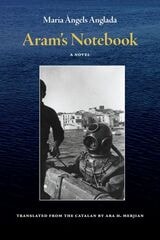
Aram's Notebook
Maria Àngels Anglada
Swan Isle Press, 2024
Like any other fifteen-year-old boy, Aram might never have written the events of his still young life, except that he found himself suddenly plunged into exile, fleeing certain death. In 1915, the Ottoman authorities undertook the wholesale extermination of the Armenian people; hundreds of thousands of men, women, and children like Aram suffered one of the twentieth century’s most savage persecutions. Inspired by the plight of the murdered modernist poet Daniel Varoujan (1884–1915), this novel follows Aram and his widowed mother on their flight toward a new life on—and under—the sea. From recollections of his father’s meditations on Homer to a life-changing apprenticeship as a coral fisherman off the coasts of Cataluña and Marseille, Aram’s tale dives into a future that might help redeem a harrowing past. Aram's Notebook examines the Armenian Genocide through a narrative in which poets and poetry loom large. Aram’s tale evokes a struggle not simply for physical survival, but for saving memory from the clutches of destruction. Evocatively translated from the original Catalan by Ara Merjian.
Arson
Laura Freudenthaler
Seagull Books, 2025
A feverish and unsettling meditation on climate collapse, Arson is told through the fragmented perspectives of two individuals struggling to make sense of a world consumed by fire. An unnamed narrator, a writer plagued by anxiety and writer’s block, watches as the planet, her relationships, and even her ability to dream are ravaged by environmental disaster. Meanwhile, an insomniac scientist, obsessed with tracking wildfires, clings to data as his last grip on control, meticulously recording every flame that devours the forests.
Their narratives unfold in a disorienting rhythm—one slipping between lyrical introspection and panic, the other drowning in statistics and methodical observation. As fires rage across the planet, both search for meaning and survival: the narrator wanders the charred countryside in search of life amid destruction, while the scientist compulsively documents landscapes that should never be burning. Echoing Ingeborg Bachmann’s famous words, “With my burned hand I write about the nature of fire,” Laura Freudenthaler crafts a haunting, kaleidoscopic portrait of a world on the brink. Arson is not just a novel about climate change—it is an urgent, dreamlike reckoning with our fascination and horror at the beauty and devastation wrought by fire.
Ask Your Dad
Jan Balabán
Karolinum Press, 2026
The final novel of acclaimed Czech fiction writer Jan Balabán.
Ask Your Dad centers on what Christian tradition calls “the last things.” Three siblings struggle to come to terms with the death of their father, the doctor Jan Nedoma, while also confronting a posthumous accusation made by his best friend, who accuses Nedoma of having collaborated with communist authorities. The bitter irony at the heart of the novel is that it is no longer possible for the siblings to ask their father what really happened. Questions of meaning, moral integrity, and the consequences of human actions permeate the meditative novel and are rendered with a harrowing directness. Poignantly, the novel was published posthumously.
Avala Is Falling
Biljana Jovanovic
Central European University Press, 2020
In Avala Is Falling, Jovanović’s breakout success in 1978, a young woman challenges the expectations that teachers, parents, bus drivers, and doctors have for her. The “Avala” of the title refers to a mountain south of Belgrade which is home to some of Serbia’s most important nationalist monuments and shrines; it is also the site of the main mental hospital for the region, and its “falling” is the unexpected fulfillment of a prophecy from a traditional Serbian folk song. Jovanović’s use of stream of consciousness in her characters’ thinking and speaking, as well as of intertextuality in description and plot advancement heralded the arrival of an innovative new writer who was determined to break with the of traditional concerns of earlier women writers.
This book is now recognized as much more than “jeans prose,” although the fame the book achieved under that characterization eventually pushed it to cult status. Jovanović is now considered a major avant-garde writer, whose stylistic innovations were as challenging as her women-centered themes.