Results by title
8812 books match the query 'Political Science' and 626 start with a
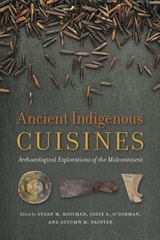
Ancient Indigenous Cuisines
Archaeological Explorations of the MidcontinentEdited by Susan M. Kooiman, Jodie A. O'Gorman, and Autumn M. Painter
University of Alabama Press, 2025
New essays from foodways archaeology related to cuisine in social, cultural, and environmental contexts.
This collection of original essays is the first to cover recent trends in foodways archaeology in the Midwest using the concept of cuisine: the selection of food ingredients and methods of food preparation, cooking, and serving/consumption in relation to their social, cultural, and environmental contexts. This work span the Early Archaic (9000 BC) to Late Precontact (up to around AD 1500) in ecological zones of present-day Michigan, Indiana, Illinois, Wisconsin, Minnesota, North Dakota, and Manitoba. Chapters trace development from hunter-gathering to horticultural practices to the more robust farming/fishing/hunting model centered on maize, squash, and other domesticates.
As Susan M. Kooiman, Jodie A. O’Gorman, and Autumn M. Painter note, identification of past cooking habits and evolving methods for foodstuffs identification can help archaeologists to reconstruct foodways and connect food behaviors with identity and associated fundamental societal beliefs. Contributors to this collection use cutting-edge methods and perspectives and consider a range of questions and outcomes that demonstrate the versatility and strength of culinary studies. To move the field forward, contributors also note areas for further analysis and improvement.
This volume targets archaeologists and students, archaeobotanists and zooarchaeologists, and those curious about Indigenous food culture. Engaging content includes chapters on the construction of earth ovens, the use-alteration of pottery and residue, a discussion of cuisine combining plant and animal data with ceramic trends, and the various contexts of plates to understand cooking methods and the social role of cuisine. Others examine faunal remains, the plant remains of feasting, the introduction of maize, the use of limestone nixtamalization, and archaeobotanical assemblages that reveal shifts in cuisine. A conclusion addresses the question, Why cuisine?
CONTRIBUTORS
Rebecca K. Albert / Alleen Betzenhauser / Jennifer R. Haas / Mary M. King / Susan M. Kooiman / Mary E. Malainey / Terrance J. Martin / Fernanda Neubauer / Kelsey Nordine / Jodie A. O’Gorman / Autumn M. Painter / Jeffrey M. Painter / Kimberly Schaefer / Mary Simon
And Justice for All?
The Claims of Human Rights, Volume 103Ian Balfour and Eduardo Cadava, eds.
Duke University Press, 0
Grappling with the philosophical and theoretical questions at the heart of human rights, these essays take into consideration current political configurations such as sovereignty, genocide, humanitarian intervention, and the neglected domain of cultural rights (the right to a cultural identity). Drawing on Enlightenment thinking about human rights at the same time that they analyze the central concepts at work there—including the “humanity of man” and the nature of rights or of law—the contributors make a necessary intervention in a world system that Enlightenment thinkers could scarcely have envisioned.
Contributors. Etienne Balibar, Rony Brauman, Wendy Brown, Rebecca Comay, Jacques Derrida, Paul Downes, Werner Hamacher, Thomas Keenan, Susan Maslan, Jacques Rancière, Bruce Robbins, Avital Ronell, Gayatri Chakravorty Spivak, Elsa Stamatopoulou, Slavoj Zizek

Andre Gorz
A Critical IntroductionConrad Lodziak and Jeremy Tatman
Pluto Press, 1997
In the first accessible introduction to his work in English, Lodziak and Tatman trace the development of Gorz's political and philosophical theory over a period of more than four decades. Gorz's influence on European intellectual and political culture is examined, as is Gorz's own formative influences.
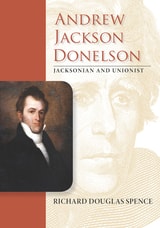
Andrew Jackson Donelson
Jacksonian and UnionistRichard Douglas Spence
Vanderbilt University Press, 2017
As his uncle's secretary, he weathered Old Hickory's tumultuous presidency, including the notorious "Petticoat War." Building his own political career, he served as US chargé d'affaires to the Republic of Texas, where he struggled against an enigmatic President Sam Houston, British and French intrigues, and the threat of war by Mexico, to achieve annexation. As minister to Prussia, Donelson enjoyed a ringside seat to the revolutions of 1848 and the first attempts at German unification. A firm Unionist in the mold of his uncle, Donelson denounced the secessionists at the Nashville Convention of 1850. He attempted as editor of the Washington Union to reunite the Democratic party, and, when he failed, he was nominated as Millard Fillmore's vice-presidential running mate on the Know-Nothing party ticket in 1856. He lived to see the Civil War wreck the Union he loved, devastate his farms, and take the lives of two of his sons.
Angry Public Rhetorics
Global Relations and Emotion in the Wake of 9/11Celeste Michelle Condit
University of Michigan Press, 2018
These voices show that anger is more effective for producing some collective actions, such as rallying supporters, reifying existing worldviews, motivating attack, enforcing shared norms, or threatening from positions of power; and less effective for others, like broadening thought, attracting new allies, adjudicating justice across cultural norms, or threatening from positions of weakness. Because social anger requires shared norms, collectivized anger cannot serve social justice. In order for anger to be a force for global justice, the world’s peoples must develop shared norms to direct discussion of international relations. Angry Public Rhetorics provides guidance for such public forums.
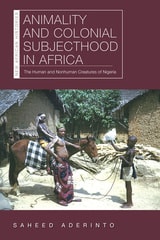
Animality and Colonial Subjecthood in Africa
The Human and Nonhuman Creatures of NigeriaSaheed Aderinto
Ohio University Press, 2022

Animals under the Swastika
J. W. Mohnhaupt, translated by John R. J. Eyck
University of Wisconsin Press, 2022
Drawing from diaries, journals, school textbooks, and printed propaganda, J.W. Mohnhaupt tells these animals’ stories vividly and with an eye for everyday detail, focusing each chapter on a different facet of Nazism by way of a specific animal species: red deer, horses, cats, and more. Animals under the Swastika illustrates the complicated, thought-provoking relationship between Nazis and animals.
Another Freedom
The Alternative History of an IdeaSvetlana Boym
University of Chicago Press, 2010
By offering a fresh look at the strange history of this idea, Another Freedom delivers a nuanced portrait of freedom, one whose repercussions will be felt well into the future.
Another World Was Possible
A Century of Movements, Volume 2005Duane J. Corpis and Ian Christopher Fletcher, eds.
Duke University Press, 0
The collection argues that radical movements offer an intriguing counternarrative to the more familiar history of imperialism and globalization in the twentieth century. One essay illuminates the radical anticolonial and diasporic South Asian Ghadar movement, which worked to free India from British rule. Another delves into the global politics of South African radicalism between antifascism and apartheid in the 1940s and 1950s. A third essay explores the encounter between U.S. black activists and Cuban revolutionaries in the 1960s. In an interview, a Latina activist illustrates the transnational scope of contemporary social movements by describing her organizing work among immigrants in Atlanta, Georgia.
Contributors. Adina Black, Mansour Bonakdarian, Duane J. Corpis, Ian Christopher Fletcher, Yael Simpson Fletcher, Robert Gregg, Bob Hannigan, Chia Yin Hsu, Madhavi Kale, R. J. Lambrose, Christopher Joon-Hai Lee, Teresa Meade, Adelina Nicholls, Enrique C. Ochoa, Susan D. Pennybacker, Maia Ramnath, Besenia Rodriguez
Another World Was Possible is the companion issue to Two, Three, Many Worlds (Radical History Review, #91).

Answer the Call
Virtual Migration in Indian Call CentersAimee Carrillo Rowe
University of Minnesota Press, 2013
What happens over time to Indians who spend their working hours answering phone calls from Americans—and acting like Americans themselves? To find out, the authors of Answer the Call conducted long-term interviews with forty-five agents, trainers, managers, and CEOs at call centers in Bangalore and Mumbai from 2003 to 2012. For nine or ten hours every day, workers in call centers are not quite in India or America but rather in a state of “virtual migration.” Encouraged to steep themselves in American culture from afar, over time the agents come to internalize and indeed perform Americanness for Americans—and for each other.
Call center agents “migrate” through time and through the virtual spaces generated by voice and information sharing. Drawing from their rich interviews, the authors show that the virtual migration agents undergo has no geographically distant point of arrival, yet their perception of moving is not merely abstract. Over the duration of the job, agents’ sense of place and time changes: agents migrate but still remain, leaving them somewhere in between—between India and America, experience and imagination, class mobility and consumption, tradition and modernity, here and there, then and now, past and future.
However tangible and elastic their virtual mobility might seem in these relatively lucrative jobs, it is also suspended within the confines of the very boundaries they migrate across. Having engaged with these vivid and often poignant interviews, readers will never again be indifferent to an Indian agent’s greeting at the other end of a toll-free call: “Hello, my name is Roxanne. How may I help you?”
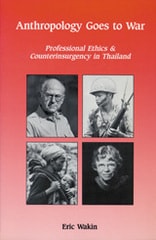
Anthropology Goes to War
Professional Ethics and Counterinsurgency in ThailandEric Wakin
University of Wisconsin Press, 1998
Now back in print, Eric Wakin's Anthropology Goes to War is the first comprehensive study of what became known as the Thailand Controversy—and a timely reminder of a debate whose echoes may be heard in our own time.
Anthropology at the Front Lines of Gender-Based Violence
Jennifer R. Wies
Vanderbilt University Press, 2011
Anti-Atlas
Critical Area Studies from the East of the WestEdited by Tim Beasley-Murray, Wendy Bracewell, and Michal Murawski
University College London, 2025
Anti-Atlas uses the upheavals of Eastern Europe as a lens through which to rethink the politics of area studies. This collection unsettles traditional hierarchies, questioning how knowledge is produced, who controls it, and how we divide the world into “areas.”
Consisting of an eclectic mix of scholars from Europe, the UK, and North America, the book experiments with diverse genres—from academic essays and autobiographical reflections to travel guides and data visualizations. Through this innovative approach, the editors propose a manifesto for area studies to be more critical and reflexive; to be undisciplined and deeply engaged with local perspectives.
By dismantling the assumptions embedded in atlases and disciplinary boundaries, Anti-Atlas invites readers to think differently about how we construct and categorize the world. Of particular interest to scholars of area studies and critical theory, this work reassesses what it means to study places in an era of geopolitical rupture.

Anti-Communism in Britain During the Early Cold War
A Very British Witch-HuntMatthew Gerth
University of London Press, 2022
The Cold War produced in many countries a form of political repression and societal paranoia which often infected governmental and civic institutions. In the West, the driving catalyst for the phenomenon was anti-communism. While much has been written on the post-war American red scare commonly known as McCarthyism, the domestic British response to the “red menace” during the early Cold War has until now received little attention. Anti-communism in Britain During the Early Cold War is the first book to examine how British Cold War anti-communism transpired and manifested as McCarthyism raged across the Atlantic.
Drawing from a wealth of archival material, this book demonstrates that while policymakers and politicians in Britain sought to differentiate their anti-communist initiatives from the “witch hunt hysteria” occurring in the United States, they were often keen to conduct—albeit less publicly—their own hunts as well. Through analyzing how domestic anti-communism exhibited itself in state policies, political rhetoric, party politics, and the trade union movement, Matthew Gerth argues that an overreaction to the communist threat occurred. In striking detail, this book describes a nation at war with a specific political ideology and its willingness to use a variety of measures to either disrupt or eradicate its influence.
Anti-Drug Policies in Colombia
Successes, Failures, and Wrong TurnsAlejandro Gaviria
Vanderbilt University Press, 2017
The book covers many topics: the economics of drug production, the policies to reduce consumption and decrease supply during the Plan Colombia, the effects of the drug problem on Colombia's international relations, the prevention of money laundering, the connection between drug trafficking and paramilitary politics, and strategies against organized crime. Beyond the diversity in topics, there is a common thread running through all the chapters: the need to analyze objectively what works and what does not, based on empirical evidence. Presented here for the first time to an English-speaking audience, this book is a contribution to a debate that urgently needs to transcend ideology and preconceived opinions.

Anti-Indianism in Modern America
A Voice from Tatekeya's EarthElizabeth Cook-Lynn
University of Illinois Press, 2000
Addressing Native American studies past, present, and future, the essays in New Indians, Old Wars tackle the discipline head-on, presenting a radical revision of the popular view of the American West in the process. Instead of luxuriating in the West's past glories or accepting the widespread historians' view of it as a shared place, Elizabeth Cook-Lynn argues that the American West should be fundamentally understood as stolen.
Cook-Lynn says that the Indian Wars of Resistance to the nineteenth- and twentieth-century colonial effort to seize native lands and resources must be given standing in the face of the ever-growing imperial narrative of America--because the terror the world is now witnessing may be the direct consequence of events which began in America's earliest dealings with the natives of this continent. Cook-Lynn's story examines the ongoing and perennial relationship of conflict between colonizers and indigenous people, and it is a story that every American must read.
Cook-Lynn understands that the story of the American West teaches the political language of land theft and tyranny. She argues that to remedy this situation, Native American studies must be considered and pursued as its own discipline, rather than as a subset of history or anthropology. She makes an impassioned claim that such a shift, not merely an institutional or theoretical change, could allow Native American studies to play an important role in defending the sovereignty of indigenous nations today.

Anti-fascism in European History
From the 1920s to TodayJože Pirjevec
Central European University Press, 2023
The increasing radicalization of political life in most countries in Europe lends special relevance to studies of the antifascist legacies on the continent. This insightful collection of essays is an in-depth review of antifascism in Slovenia, setting it in the context of related movements elsewhere in Europe. The period treated by the 19 essays comprises the interwar period, World War Two, and the post-war decades. The comparative and transnational perspectives advanced by the volume change our understanding of antifascism.
The essays deal with the right-wing but also left-wing instrumentalization of antifascism, with a particular focus on the communist and post-communist periods. The authors point out that antifascism comes in various strains, whether inspired by liberalism, social democracy, communism, monarchism, anarchism, or even Christian conservatism. The contributors bring to light several overlooked antifascist actors, campaigns, and organisations, mostly in Slovenia and the Adriatic area.
Anti-modernism
Radical Revisions of Collective IdentityAhmet Ersoy
Central European University Press, 2014
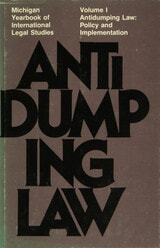
Antidumping Law
Policy and ImplementationJohn H. Jackson, Editor
University of Michigan Press, 1979
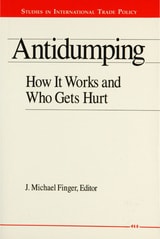
Antidumping
How It Works and Who Gets HurtJ. Michael Finger
University of Michigan Press, 1993
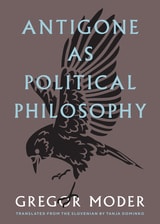
Antigone as Political Philosophy
Gregor Moder, Tanja Dominko
Northwestern University Press, 2026
Offering a new perspective on Sophocles’s Antigone as a model for reimagining humanity’s future—and its end
Why read Antigone today? The premise of this accessible, essayistic work is that humanity finds itself at a crossroads, where it must reinvent itself or perish—a condition similar to Antigone’s own. Rereading Antigone via Hegel’s engagement with the text can help us understand what it means for a human age to come to an end: that is, to think of our age as an episode whose collapse is also an engine of historical change.
Gregor Moder argues that the task of humanity today may not be to defend the minimal remnants of our civilization but to say farewell to it—to give it a proper burial. As Moder explicates, the central problem of this foundational tragedy lies in the positions of brother and sister, man and woman, representing human and divine law and the institutions of the state and the family. Through a fresh reading of both Sophocles’s play and Hegel’s productive reworking of the Greek myth, Moder’s analysis shows that sometimes the only way through deep social contradictions is in unraveling the framework that has constructed them.
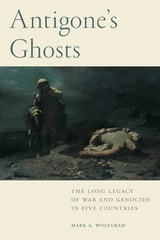
Antigone's Ghosts
The Long Legacy of War and Genocide in Five CountriesWolfgram, Mark A
Bucknell University Press, 2019
Published by Bucknell University Press. Distributed worldwide by Rutgers University Press.

Apache Reservation
Indigenous Peoples and the American StateBy Richard J. Perry
University of Texas Press, 1993
"Indian reservations" were the United States' ultimate solution to the "problem" of what to do with native peoples who already occupied the western lands that Anglo settlers wanted. In this broadly inclusive study, Richard J. Perry considers the historical development of the reservation system and its contemporary relationship to the American state, with comparisons to similar phenomena in Canada, Australia, and South Africa.
The San Carlos Apache Reservation of Arizona provides the lens through which Perry views reservation issues. One of the oldest and largest reservations, its location in a minerals- and metals-rich area has often brought it into conflict with powerful private and governmental interests. Indeed, Perry argues that the reservation system is best understood in terms of competition for resources among interest groups through time within the hegemony of the state. He asserts that full control over their resources—and hence, over their lives—would address many of the Apache's contemporary economic problems.
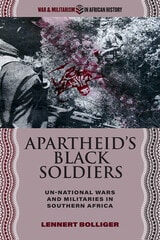
Apartheid’s Black Soldiers
Un-national Wars and Militaries in Southern AfricaLennart Bolliger
Ohio University Press, 2021
New oral histories from Black Namibian and Angolan troops who fought in apartheid South Africa’s security forces reveal their involvement, and its impact on their lives, to be far more complicated than most historical scholarship has acknowledged.
In anticolonial struggles across the African continent, tens of thousands of African soldiers served in the militaries of colonial and settler states. In southern Africa, they often made up the bulk of these militaries and, in some contexts, far outnumbered those who fought in the liberation movements’ armed wings. Despite these soldiers' significant impact on the region’s military and political history, this dimension of southern Africa’s anticolonial struggles has been almost entirely ignored in previous scholarship.
Black troops from Namibia and Angola spearheaded apartheid South Africa’s military intervention in their countries’ respective anticolonial war and postindependence civil war. Drawing from oral history interviews and archival sources, Lennart Bolliger challenges the common framing of these wars as struggles of national liberation fought by and for Africans against White colonial and settler-state armies.
Focusing on three case studies of predominantly Black units commanded by White officers, Bolliger investigates how and why these soldiers participated in South Africa’s security forces and considers the legacies of that involvement. In tackling these questions, he rejects the common tendency to categorize the soldiers as “collaborators” and “traitors” and reveals the un-national facets of anticolonial struggles.
Finally, the book’s unique analysis of apartheid military culture shows how South Africa’s military units were far from monolithic and instead developed distinctive institutional practices, mythologies, and concepts of militarized masculinity.
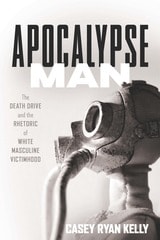
Apocalypse Man
The Death Drive and the Rhetoric of White Masculine VictimhoodCasey Ryan Kelly
The Ohio State University Press, 2020
Exemplified by President Donald J. Trump’s slogan “Make American Great Again,” white masculinity has become increasingly organized around melancholic attachments to an imagined past when white men were still atop the social hierarchy. How and why are white men increasingly identifying as victims of social, economic, and political change? Casey Ryan Kelly’s Apocalypse Man seeks to answer this question by examining textual and performative examples of white male rhetoric—as found among online misogynist and incel communities, survivalists and “doomsday preppers,” gender-motivated mass shooters, gun activists, and political demagogues. Using sources ranging from reality television and Reddit manifestos to gun culture and political rallies, Kelly ultimately argues that death, victimhood, and fatalism have come to underwrite the constitution of contemporary white masculinity.
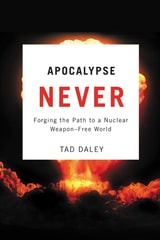
Apocalypse Never
Forging the Path to a Nuclear Weapon-Free WorldDaley, Tad
Rutgers University Press, 2012
Apocalypse Never maintains that the abolition of nuclear weapons is both essential and achievable, and reveals in fine detail what we need to do--both governments and movements--to make it a reality. Daley insists that while global climate change poses the single greatest long-term peril to the human race, the nuclear challenge in its many incarnation--nuclear terror, nuclear accident, a nuclear crisis spinning out of control--poses the single most immediate peril. Daley launches a wholesale assault on the nuclear double standard--the notion that the United States permits itself thousands of these weapons but forbids others from aspiring to even one--insisting that it is militarily unnecessary, morally indefensible, and politically unsustainable. He conclusively repudiates the most frequent objection to nuclear disarmament, "the breakout scenario"--the possibility that after abolition someone might whip back the curtain, reveal a dozen nuclear warheads, and proceed to "rule the world."
On the wings of a brand new era in American history, Apocalypse Never makes the case that a comprehensive nuclear policy agenda from President Obama, one that fully integrates nonproliferation with disarmament, can both eliminate immediate nuclear dangers and set us irreversibly on the road to abolition. In jargon-free language, Daley explores the possible verification measures, enforcement mechanisms, and governance structures of a nuclear weapon-free world. Most importantly, he decisively argues that universal nuclear disarmament is something we can transform from a utopian fantasy into a concrete political goal.
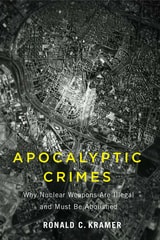
Apocalyptic Crimes
Why Nuclear Weapons Are Illegal and Must Be AbolishedRonald C. Kramer
Rutgers University Press, 2025
Kramer argues that any country holding on to its nuclear arsenal—including the United States—is committing a criminal act. Offering a sharp rebuke to the common claim that nuclear stockpiles serve to deter the escalation of conflict, Apocalyptic Crimes emphasizes the harm caused by the mere possession of these deadly weapons. It further considers the culpability of political officials, acting as representatives of the state, whose threatening statements about nuclear weapons contain actions or omissions that violate specific international laws. But Kramer also shows how a nuclear apocalypse might be averted and offers a pathway to disarmament. Through critical analysis and a specific criminology of nuclear weapons, Kramer outlines the political actions necessary to rewind the Doomsday Clock and pull the world back from the brink of destruction—before the clock strikes midnight.

Appetites of Empire
Food, Farming, and Fitness Rhetorics During the Obama EraDustin Greenwalt
University of Alabama Press, 2026
In Imperial Styles: Food, Farming, and Fitness Rhetorics During the Obama Era, Dustin Greenwalt examines how discussions of food, farming, and fitness became influential sites for negotiating questions of identity, citizenship, health, and economic life during the early twenty-first century.
Appointment of Judges
The Johnson PresidencyBy Neil D. McFeeley
University of Texas Press, 1987
The selection of federal judges constitutes one of the more significant legacies of any president; the choices of Lyndon Baines Johnson affected important social policies for decades. This book explores the process of making judicial appointments, examining how judges were selected during Johnson's administration and the president's own participation in the process. Appointment of Judges: The Johnson Presidency is the first in-depth study of the judicial selection process in the Johnson years and is one of the few books that has analyzed any individual president's process.
Based on sources in the archives of the Lyndon Baines Johnson Library and correspondence from senators, party officials, Justice Department officers, the American Bar Association, Supreme Court justices, and the candidates themselves, the book is an important exploration of a significant aspect of presidential power. The author shows that Johnson recognized the great impact for social and economic policy the judiciary could have in America and sought out judges who shared his vision of the Great Society. More than any previous president since William Howard Taft, Johnson took an active personal role in setting up the criteria for choosing judges and in many cases participated in decisions on individual nominees. The president utilized the resources of the White House, the Department of Justice, other agencies, and private individuals to identify judicial candidates who met criteria of compatible policy perspective, excellent legal qualifications, political or judicial experience, youth, and ethnic diversity. The book notes how the criteria and judicial selection process evolved over time and how it operated during the transitions between Kennedy and Johnson and between Johnson and Nixon.
Arab Responses to Fascism and Nazism
Attraction and RepulsionBy Israel Gershoni
University of Texas Press, 2014
The first book to present an analysis of Arab response to fascism and Nazism from the perspectives of both individual countries and the Arab world at large, this collection problematizes and ultimately deconstructs the established narratives that assume most Arabs supported fascism and Nazism leading up to and during World War II. Using new source materials taken largely from Arab memoirs, archives, and print media, the articles reexamine Egyptian, Syrian, Lebanese, Palestinian, and Iraqi responses in the 1930s and throughout the war.
While acknowledging the individuals, forces, and organizations that did support and collaborate with Nazi Germany and fascist Italy, Arab Responses to Fascism and Nazism focuses on the many other Arab voices that identified with Britain and France and with the Allied cause during the war. The authors argue that many groups within Arab societies—elites and non-elites, governing forces, and civilians—rejected Nazism and fascism as totalitarian, racist, and, most important, as new, more oppressive forms of European imperialism. The essays in this volume argue that, in contrast to prevailing beliefs that Arabs were de facto supporters of Italy and Germany—since “the enemy of my enemy is my friend”—mainstream Arab forces and currents opposed the Axis powers and supported the Allies during the war. They played a significant role in the battles for control over the Middle East.
Arbitrary Rule
Slavery, Tyranny, and the Power of Life and DeathMary Nyquist
University of Chicago Press, 2013
Throughout, Nyquist demonstrates how principles relating to political slavery and tyranny are bound up with a Roman jurisprudential doctrine that sanctions the power of life and death held by the slaveholder over slaves and, by extension, the state, its representatives, or its laws over its citizenry.

Archie Green
The Making of a Working-Class HeroSean Burns
University of Illinois Press, 2011

Archipelagoes of My South
Episodes in the Shaping of a Region, 1830–1965J. Mills Thornton III
University of Alabama Press, 2016
A collection of essays representing forty-five years of reflection on the central problems of southern history bound together by a common concern with defining the crucial interaction of race and class in the formation of southern politics and life
“The tourist archipelagoes of my South / are prisons, too, corruptible” writes the poet Derek Walcott. While Walcott refers to the islands of the Caribbean, the analogous idea of a land made into solitary islands by an imprisoned and inherited corruption is historian J. Mills Thornton III’s American South. The captivating essays in Archipelagoes of My South: Episodes in the Shaping of a Region, 1830–1965 address this overarching and underlying narrative of Alabama politics and the history of the South.
Highlighting events as significant as the role of social and economic conflict in the southern secession movement, various aspects of Reconstruction, and the role of the Ku Klux Klan in the politics of the 1920s, Thornton draws from various points in the southern past in an effort to identify and understand the sources of the region’s power. Moreover, each essay investigates its subject matter and peels back layers with an aim to clarify why the enormous diversity of the southern experience makes that power so great, all the while allowing the reader to see connections that would not otherwise be apparent.
Archipelagoes of My South gathers previously uncollected essays into a single volume covering the entire length and breadth of Thornton’s career. The author’s principal concerns have always been the arc of regional evolution and the significance of the local. Thus, the mechanisms of political and social change and the interrelationships across eras and generations are recurring themes in many of these essays.
Even those who have spent their entire lives in the South may be unaware of the fractured layers of history that lie beneath the landscape they inhabit. For those southern residents who seek to comprehend more of their own past, this landmark compilation of essays on Alabama and southern history endeavors to provide illumination and enlightenment.
Architects of Long Change
The Expert Roots of Post-Socialism in Czechoslovakia (1980–1995)Edited by Michal Kopecek
Karolinum Press, 2026
Architects of Long Change examines expert forms of governance and their legitimization before 1989, as well as the transfer of expert knowledge and practices of political and social management during the democratic transition. The contributors argue that so-called neoliberal governance was not solely the result of imported Western political and cultural models, but was also shaped by intellectual, mental, and sociocultural continuities from the period of late socialism. These continuities—and the broader hypothesis of a “long systemic change” spanning from 1980 to 1995—are explored through case studies in legal science, sociology, urban planning, environmental studies, psychotherapy, and business management.
Architects of Long Change offers a novel perspective on the late communist dictatorship, the democratic revolution of 1989, and the early development of liberal democracy and capitalism in Czechoslovakia and later the Czech Republic.
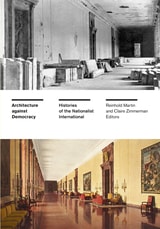
Architecture against Democracy
Histories of the Nationalist InternationalReinhold Martin
University of Minnesota Press, 2024
Examining architecture’s foundational role in the repression of democracy
Reinhold Martin and Claire Zimmerman bring together essays from an array of scholars exploring the troubled relationship between architecture and antidemocratic politics. Comprising detailed case studies throughout the world spanning from the early nineteenth century to the present, Architecture against Democracy analyzes crucial occasions when the built environment has been harnessed as an instrument of authoritarian power.
Alongside chapters focusing on paradigmatic episodes from twentieth-century German and Italian fascism, the contributors examine historic and contemporary events and subjects that are organized thematically, including the founding of the Smithsonian Institution, Ellis Island infrastructure, the aftermath of the Paris Commune, Cold War West Germany and Iraq, Frank Lloyd Wright’s domestic architecture, and Istanbul’s Taksim Square. Through the range and depth of these accounts, Architecture against Democracy presents a selective overview of antidemocratic processes as they unfold in the built environment throughout Western modernity, offering an architectural history of the recent “nationalist international.”
As new forms of nationalism and authoritarian rule proliferate across the globe, this timely collection offers fresh understandings of the role of architecture in the opposition to democracy.
Contributors: Esra Akcan, Cornell U; Can Bilsel, U of San Diego; José H. Bortoluci, Getulio Vargas Foundation; Charles L. Davis II, U of Texas at Austin; Laura diZerega; Eve Duffy, Duke U; María González Pendás, Cornell U; Paul B. Jaskot, Duke U; Ana María León, Harvard U; Ruth W. Lo, Hamilton College; Peter Minosh, Northeastern U; Itohan Osayimwese, Brown U; Kishwar Rizvi, Yale U; Naomi Vaughan; Nader Vossoughian, New York Institute of Technology and Columbia U; Mabel O. Wilson, Columbia U.
Architecture and the Right to Heal
Resettler Nationalism in the Aftermath of Conflict and DisasterEsra Akcan
Duke University Press, 2025
Architecture as a Way of Seeing and Learning
The Built Environment as an Added Educator in East African Refugee CampsNerea Amorós Elorduy
University College London, 2021
Displaced before they were born, children living in long-term refugee camps along the East African Rift grow and learn surrounded by ready-made structures. Architecture as a Way of Seeing and Learning explores what these built environments teach us about both childhood development and refugee assistance. With an eye toward architecture, Nerea Amorós Elorduy models how a more empathetic approach to refugee relief might both decolonize humanitarian aid and nurture the learning of young children.
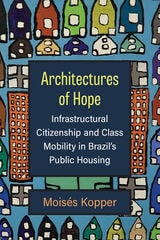
Architectures of Hope
Infrastructural Citizenship and Class Mobility in Brazil's Public HousingMoisés Kopper
University of Michigan Press, 2022
Architectures of Hope examines how communal idealism, electoral politics, and low-income consumer markets made first-time homeownership a reality for millions of low-income Brazilians over the last ten years.
Drawing on a five-year-long ethnography among city planners, architects, street-level bureaucrats, politicians, market and bank representatives, community leaders, and past, present, and future beneficiaries, Moisés Kopper tells the story of how a group of grassroots housing activists rose from oblivion to build a model community. He explores the strategies set forth by housing activists as they waited and hoped for—and eventually secured—homeownership through Minha Casa Minha Vida’s public-private infrastructure. By showing how these efforts coalesced in Porto Alegre—Brazil’s once progressive hotspot—he interrogates the value systems and novel arrangements of power and market that underlie the country’s post-neoliberal project of modern and inclusive development.
By chronicling the making and remaking of material hope in the aftermath of Minha Casa Minha Vida, Architectures of Hope reopens the future as a powerful venue for ethnographic inquiry and urban development.

Archive of Tongues
An Intimate History of BrownnessMoon Charania
Duke University Press, 2023
Archives of Infamy
Foucault on State Power in the Lives of Ordinary CitizensNancy Luxon
University of Minnesota Press, 2019
Expanding the insights of Arlette Farge and Michel Foucault’s Disorderly Families into policing, public order, (in)justice, and daily life
What might it mean for ordinary people to intervene in the circulation of power between police and the streets, sovereigns and their subjects? How did the police come to understand themselves as responsible for the circulation of people as much as things—and to separate law and justice from the maintenance of a newly emergent civil order? These are among the many questions addressed in the interpretive essays in Archives of Infamy.
Crisscrossing the Atlantic to bring together unpublished radio broadcasts, book reviews, and essays by historians, geographers, and political theorists, Archives of Infamy provides historical and archival contexts to the recent translation of Disorderly Families by Arlette Farge and Michel Foucault. This volume includes new translations of key texts, including a radio address Foucault gave in 1983 that explains the writing process for Disorderly Families; two essays by Foucault not readily available in English; and a previously untranslated essay by Farge that describes how historians have appropriated Foucault.
Archives of Infamy pushes past old debates between philosophers and historians to offer a new perspective on the crystallization of ideas—of the family, gender relations, and political power—into social relationships and the regimes of power they engender.
Contributors: Roger Chartier, Collège de France; Stuart Elden, U of Warwick; Arlette Farge, Centre national de recherche scientifique; Michel Foucault (1926–1984); Jean-Philippe Guinle, Catholic Institute of Paris; Michel Heurteaux; Pierre Nora, École des Hautes Études en Sciences Sociales; Michael Rey (1953–1993); Thomas Scott-Railton; Elizabeth Wingrove, U of Michigan.

Archives of the Insensible
Of War, Photopolitics, and Dead MemoryAllen Feldman
University of Chicago Press, 2015
Excavating a scenography of trials—formal or covert, orchestrated or improvised, criminalizing or criminal—Feldman shows how the will to truth disappears into the very violence it interrogates. He maps the sensory inscriptions and erasures of war, highlighting war as a media that severs factuality from actuality to render violence just. He proposes that war promotes an anesthesiology that interdicts the witness of a sensory and affective commons that has the capacity to speak truth to war. Feldman uses layered deconstructive description to decelerate the ballistical tempo of war to salvage the embodied actualities and material histories that war reduces to the ashes of collateral damage, the automatism of drones, and the opacities of black sites. The result is a penetrating work that marries critical visual theory, political philosophy, anthropology, and media archeology into a trenchant dissection of emerging forms of sovereignty and state power that war now makes possible.
Archiving Sovereignty
Law, History, ViolenceStewart Motha
University of Michigan Press, 2018
Sovereignty is often cast as a limit-concept, constituent force, determining the boundary of law. Archiving Sovereignty reverses this to explain how judicial pronouncements inscribe and sustain extravagant claims to exceptionality and sovereign solitude. This wide-ranging, critical work distinguishes between myths that sustain neocolonial orders and fictions that generate new forms of political and ethical life.
Archiving the Unspeakable
Silence, Memory, and the Photographic Record in CambodiaMichelle Caswell
University of Wisconsin Press, 2014
Winner, Waldo Gifford Leland Award, Society of American Archivists
Longlist, ICAS Book Prize, International Convention of Asia Scholars

Arctic Politics
Conflict and Cooperation in the Circumpolar NorthOran R. Young
Dartmouth College Press, 1992
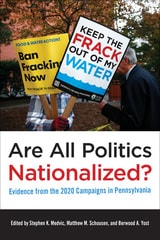
Are All Politics Nationalized?
Evidence from the 2020 Campaigns in PennsylvaniaEdited by Stephen K. Medvic, Matthew M. Schousen, and Berwood A. Yost
Temple University Press, 2023
Given the news media’s focus on national issues and debates, voters might be expected to make decisions about state and local candidates based on their views of the national parties and presidential candidates. However, nationalization as a concept, and the process by which politics becomes nationalized, are not fully understood. Are All Politics Nationalized? addresses this knowledge gap by looking at the behavior of candidates and the factors that influence voters’ electoral choices.
The editors and contributors examine the 2020 elections in six Pennsylvania districts to explore the level of nationalization in campaigns for Congress and state legislature. They also question if politicians are encouraging nationalized behavior and straight ticket voting—especially with down-ballot races.
Are All Politics Nationalized? concludes that issues specific to particular districts—such as fracking and local union politics—still matter, and candidates are eager to connect with voters by highlighting their ties to the local community. National politics do trickle down to local races, but races up and down the ballot are still heavily localized.
Are We There Yet?
The Myths and Realities of Autonomous VehiclesEdited by Michael A. Pagano
University of Illinois Press, 2020
The new volume in the Urban Agenda series examines the technological questions still surrounding autonomous vehicles and the uncertain societal and legislative impact of widespread AV adoption. Assessing both short- and long-term concerns, the authors probe how autonomous vehicles might change transportation but also land use, energy consumption, mass transit, commuter habits, traffic safety, job markets, the freight industry, and supply chains. At the same time, the essays discuss opportunities for industry, researchers, and policymakers to make the autonomous future safer, more efficient, and more mobile.
Contributors: Austin Brown, Stan Caldwell, Chris Hendrickson, Kazuya Kawamura, Taylor Long, and P. S. Srira.
Are We the 99%?
The Occupy Movement, Feminism, and IntersectionalityHeather McKee Hurwitz
Temple University Press, 2021
The protestors that comprised the Occupy Wall Street movement came from diverse backgrounds. But how were these activists—who sought radical social change through many ideologies—able to break down oppressions and obstacles within the movement? And in what ways did the movement perpetuate status-quo structures of inequality?
Are We the 99%? is the first comprehensive feminist and intersectional analysis of the Occupy movement. Heather McKee Hurwitz considers how women, people of color, and genderqueer activists struggled to be heard and understood. Despite cries of “We are the 99%,” signaling solidarity, certain groups were unwelcome or unable to participate. Moreover, problems with racism, sexism, and discrimination due to sexuality and class persisted within the movement.
Using immersive first-hand accounts of activists’ experiences, online communications, and media coverage of the movement, Hurwitz reveals lessons gleaned from the conflicts within the Occupy movement. She compares her findings to those of other contemporary protest movements—nationally and globally—so that future movements can avoid infighting and deploy an “intersectional imperative” to embrace both diversity and inclusivity.
Are Worker Rights Human Rights?
Richard P. McIntyre
University of Michigan Press, 2008
"In a much-needed intervention, Ric McIntyre recasts the debate about globalization and labor rights and speeds us to the heart of the matter: the battle between transnational corporations who distance themselves from responsibility for the fate of workers, and labor activists who seek to reestablish bonds of accountability and moral obligation. The stakes in this struggle are enormous, and Dr. McIntyre provides crucial insight into the economic and political dynamics that define it."
---Scott Nova, Executive Director, Worker Rights Consortium, Washington, DC
"This book presents an insightful, powerful corrective to the contemporary debate over worker rights. McIntyre identifies the limitations of thinking of worker rights as individualized human rights and challenges us instead to examine how rights are defined through conventional thinking and class interest. The product is rich and compelling: McIntyre's investigation demands of us that we be far more attentive to the contradictory effects of ‘rights talk.' I recommend this book enthusiastically to all those who advocate for a just economic order the world over."
---George DeMartino, Associate Professor of Political Economy, the Josef Korbel School of International Studies, University of Denver
"An important contribution to the interdisciplinary study of labor. McIntyre's book will challenge the debate over labor rights on all fronts."
---Michael Hillard, Professor of Economics, University of Southern Maine
"A timely examination of our modern 'sweating system' . . . essential reading for all workers who hope for greater dignity in the workplace and greater fairness in society."
---Janet Knoedler, Associate Professor of Economics, Bucknell University
"Ric McIntyre convincingly shows how local actions, regulations changes, and international norms can combine to establish collective rights for workers."
---Gilles Raveaud, Assistant Professor in Economics, University of Saint-Denis, France, and cofounder of the "post-autistic economics movement"
"An important, timely, and needed contribution to our understanding of worker rights."
---Patrick McHugh, Associate Professor of Management, George Washington University
"Workers of the world, unite!" Karl Marx's famous call to action still promises an effective means of winning human rights in the modern global economy, according to economist Richard P. McIntyre. Currently, the human rights movement insists upon a person's right to life, freedom, and material necessities. In democratic, industrial nations such as the United States, the movement focuses more specifically on a person's civil rights and equal opportunity.
The movement's victories since WWII have come at a cost, however. The emphasis on individual rights erodes collective rights---the rights that disadvantaged peoples need to assert their most basic human rights. This is particularly true for workers, McIntyre argues. By reintroducing Marxian and Institutional analysis, he reveals the class relations and power structures that determine the position of workers in the global economy. The best hope for achieving workers' rights, he concludes, lies in grassroots labor organizations that claim the right of association and collective bargaining.
At last, an economist offers a vision for human rights that takes both moral questions and class relations seriously.
Richard P. McIntyre is Director of the University Honors Program and Professor of Economics at the University of Rhode Island.
Area and Administration
James W. Fesler
University of Alabama Press, 2008
A foundational classic on the organization and coordination of modern government.
This fresh publication of James W. Fesler’s classic, Area and Administration is a powerful work of intellectual history. Richly illustrating how the Great Depression and World War II shaped the thinking of scholars who helped build modern American government.
It is also an authoritative work of powerful insight. The challenges of linking the center with the front lines, or securing vertical and horizonal coordination, and of connecting area and function, have only become more important in twenty-first century government. Fesler’s path-breaking book provides an extraordinarily useful foundation for grappling with issues that have become even more important for governance.

Arendt, Kant, and the Enigma of Judgment
Martin Blumenthal-Barby
Northwestern University Press, 2023
A nuanced extrapolation of Hannah Arendt’s theory of judgment through her highly provocative reading of Immanuel Kant
More than a half century after it was first published, Hannah Arendt’s Origins of Totalitarianism rose to the top of best-seller lists as readers grappled with the triumph of Trumpism. Arendt, Kant, and the Enigma of Judgment directs our attention to her later thought, the posthumously published and highly provocative Lectures on Kant’s Political Philosophy. Martin Blumenthal-Barby puts this work in dialogue with Arendt’s other writings, including her notes on Kant’s Critique of Judgment, to outline her own theory of judgment for the twentieth century. In an era of post-truths and artificial intelligence, the idea that authentic judgment—for example, the ability to distinguish right from wrong—is incommensurable with abstract, automated processes lies at the center of Arendt’s late work and at the fore of our collective reckoning.
Rather than presenting us with a fixed account, Blumenthal-Barby suggests, Arendt’s drawing and redrawing of conceptual distinctions is itself an enactment of judgment, a process that challenges and complicates what she says at every turn. In so doing, Arendt, in thoroughly Kantian fashion, establishes judgment as a performative category that can never be taught but only demonstrated. As sharp as it is timely, this incisive book reminds us why a shared reality matters in a time of intense political polarization and why the democratic project, vulnerable as it may appear today, crucially depends on it.