Results by title
3576 books match the query 'American' and 350 start with a
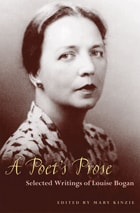
A Poet’s Prose
Selected Writings Of Louise BoganLouise Bogan
Ohio University Press, 2005
Although best known as a master of the formal lyric poem, Louise Bogan (1897–1970) also published fiction and what would now be called lyrical essays. A Poet’s Prose: Selected Writings of Louise Bogan showcases her devotion to compression, eloquence, and sharp truths.
Louise Bogan was poetry reviewer for the New Yorker for thirty-eight years, and her criticism was remarkable for its range and effect. Bogan was responsible for the revival of interest in Henry James and was one of the first American critics to notice and review W. H. Auden. She remained intellectually and emotionally responsive to writers as different from one another as Caitlin Thomas, Dorothy Richardson, W. B. Yeats, André Gide, and Rainer Maria Rilke.
Bogan’s short stories appeared regularly in magazines during the 1930s, penetrating the social habits of the city as well as the loneliness there. The autobiographical element in her fiction and journals, never entirely confessional, spurred some of her finest writing. The distinguished poet and critic Mary Kinzie provides in A Poet’s Prose a selection of Bogan's best criticism, prose meditations, letters, journal entries, autobiographical essays, and published and unpublished fiction.
Louise Bogan won the Bollingen Prize in 1954 for her collected poems. She is the subject of the Pulitzer Prize-winning biography by Elizabeth Frank, Louise Bogan: A Portrait.
A Point Is That Which Has No Part
Liz Waldner
University of Iowa Press, 2000
The innocence and Keatsian beauty of Euclid's geometry become poignant from a perspective that encompasses all that is non-Euclidean as well as space, time, and the theory of matter. With rare wit and linguistic daring, Waldner opens resonant channels of communication that show there is indeed more than meets the eye—or the mind—in her poems.
Hand to Mouth (Twist and Shout)
Cold comes slow up out
of the darkness among the leaves
that smell so good when bruised
Do you, too, recognize me
god so soon?
Her First Reckoning
Pour wine into vessels the violet of woods,
wine of the reddening stars.
You are god, you can do it.
Your lover calls you St. John the Conqueror.
I have heard her.
This is the name of a root.
Asperge the thousands and thousands of rooms
in which photosynthesis promises sun
to the acolyte cells. Rain yourself on a leaf.
Birch. The bark is malleable as mushroom flesh.
Show that you know me. Scratch out my name
with this tree. My name of trees.
On the day I arrive at the door of my death,
myself now hard to tell
from the trees that had hid it from me,
I will demand that you love me.
You made me like this.
Why did you make me like this?
Transitive, Intransitive: Extemporary Measures
Two crows above the marsh: sew.
Stitch the seventeen sleek shades of blue
to the shadow-patterned greens below.
See fit to make me a suitable view who
having nowhere to else to go
might as well wear this world well.
Llama necks periscope the view:
yonder, across the water, you
testing the air now a crow
chases a redwing blackbird through.
What can I show you who sees
I don't believe? For now,
what the eye of the needle sees:
through through through:
clouds, birds, me, trees;
soon: in, out, with, to;
something moving, something moved:
a stitch in time's an avenue,
future's sutures' revenue—
“the shining hour” improved.
A Power to Translate the World
New Essays on Emerson and International CultureEdited by David LaRocca and Ricardo Miguel-Alfonso
Dartmouth College Press, 2016
A Private State
StoriesCharlotte Bacon
University of Massachusetts Press, 1998
Here is a finely crafted collection of stories about women who have arrived at awkward edges in their lives. Some are adolescents, some at the brink of old age, and some find themselves suddenly ill or pregnant. Others come to the abrupt discovery that their marriages are not as whole as they had believed, while a few tumble onto startling secrets. But despite their range in age and situation, they all try to use their new knowledge to stitch together a fresh pattern by which to live.
While most of the action unfolds along the East Coast—in Maryland, Maine, Boston, Philadelphia, New York—several of the women travel to Arizona, California, and Jamaica. Often the light is too bright in these glittery places and they wonder why they have come. Many seem to be searching for a sense of home, which one girl describes as a place that is “complete and full of longing all at once.”
Yet this desire for a personal territory, a point of constancy, is not necessarily rewarded: in this book, separations lead to divorce, sisters continue to misread each other, cancers kill. Still, the women refuse to turn their gaze away from what the world has thrown in their path. Often as not, they pick it up, wonder at it, test its relevance, and continue on, not happier perhaps, but certainly more knowing.
With humor and insight, Charlotte Bacon illuminates the unexpected ambiguities of women's lives. A Private State marks the arrival of an extremely talented writer.
A Profile of Twentieth-Century American Poetry
Edited by Jack Myers and David Wojahn
Southern Illinois University Press, 1991
Seven chronologically arranged essays—each covering roughly a decade from 1908 through 1988—plus two special-focus essays on black and female poets, an introduction by Ed Folsom, and a preface by editors Jack Myers and David Wojahn, outline the critical, creative, aesthetic, and cultural forces at work in the American poetry of this century. Several contributors, including Michael Heller, Richard Jackson, and Jonathan Holden, have recently published important book-length critical studies in their essay area; all have published well-regarded collections of their own poetry.

A Psalm for Cottondale
PoemsSharony A. Green
University of Alabama Press, 2026
A lyrical journey through memory, place, and resilience in the heart of Alabama
A Psalm for Cottondale is a lyrical meditation on memory, place, and survival in the American South. Through a sequence of interconnected free-verse poems, Sharony Green reflects on life in Cottondale, Alabama, where change unfolds in ways that can be both poignant and unexpected. Rooted in the histories, landscapes, and cultural currents of an Alabama college town, the collection explores how one place can evoke the memory of many others, inviting readers to consider broader questions of identity, belonging, and endurance.
Written in a clear, steady voice, these poems balance intimacy with historical awareness, allowing inherited stories, silences, and everyday moments to emerge with quiet power. Green’s careful craftsmanship and emotional restraint lend authority to the collection, while a subtle psalmic undercurrent adds spiritual depth without sacrificing nuance. As the poems move through themes of joy, grief, witness, and renewal, Cottondale becomes both a physical community and a symbolic terrain shaped by race, land, memory, and hope.
Inspired by writings that engage history, geography, and culture, A Psalm for Cottondale offers an elegant and deeply attentive reflection on Southern and American life, illuminating the ways people endure, adapt, and find meaning in a changing world. Ideal for readers of contemporary poetry, Southern literature, African American studies, place-based writing, and works that explore history, memory, faith, and community through a lyrical lens.
A Publisher's Paradise
Expatriate Literary Culture in Paris, 1890-1960Colette Colligan
University of Massachusetts Press, 2014
From 1890 to 1960, some of Anglo-America's most heated cultural contests over books, sex, and censorship were staged not at home, but abroad in the City of Light. Paris, with its extraordinary liberties of expression, became a special place for interrogating the margins of sexual culture and literary censorship, and a wide variety of English language “dirty books” circulated through loose expatriate publishing and distribution networks.
A Publisher's Paradise explores the political and literary dynamics that gave rise to this expatriate cultural flourishing, which included everything from Victorian pornography to the most daring and controversial modernist classics. Colette Colligan tracks the British and French politicians and diplomats who policed Paris editions of banned books and uncovers offshore networks of publishers, booksellers, authors, and readers. She looks closely at the stories the “dirty books” told about this publishing haven and the smut peddlers and literary giants it brought together in transnational cultural formations. The book profiles an eclectic group of expatriates living and publishing in Paris, from relatively obscure figures such as Charles Carrington, whose list included both The Picture of Dorian Gray and the pornographic novel Randiana, to bookshop owner Sylvia Beach, famous for publishing James Joyce's Ulysses in 1922.
A Publisher's Paradise is a compelling exploration of the little-known history of foreign pornography in Paris and the central role it played in turning the city into a modernist outpost for literary and sexual vanguardism, a reputation that still lingers today in our cultural myths of midnight in Paris.
A Question of Character
Scientific Racism and the Genres of American Fiction, 1892-1912Catherine Ann Boeckmann
University of Alabama Press, 2005
Boeckmann links character, literary genre, and science, revealing how major literary works both contributed to and disrupted the construction of race in turn-of-the-century America.
In A Question of Character, Cathy Boeckmann establishes a strong link between racial questions and the development of literary traditions at the end of the 19th century in America. This period saw the rise of "scientific racism," which claimed that the races were distinguished not solely by exterior appearance but also by a set of inherited character traits. As Boeckmann explains, this emphasis on character meant that race was not only a thematic concern in the literature of the period but also a generic or formal one as well.
Boeckmann explores the intersections between race and literary history by tracing the language of character through both scientific and literary writing. Nineteenth-century pseudo-sciences such as phrenology and physiognomy had a vocabulary for discussing racial character that overlapped conceptually with the conventions for portraying race in literature. Through close readings of novels by Thomas Dixon, Mark Twain, William Dean Howells, Charles Chesnutt, and James Weldon Johnson—each of which deals with a black character "passing" as white—Boeckmann shows how this emphasis on character relates to the shift from romantic and sentimental fiction to realism. Because each of these genres had very specific conventions regarding the representation of character, genres often dictated how races could be depicted.
A Race at Bay
New York Times Editorials on "the Indian Problem," 1860 - 1900Robert G. Hays. Foreword by Paul Simon
Southern Illinois University Press, 1997
Robert G. Hays chronicles the "Indian problem" precisely as it was explained to Americans through the editorial columns of the New York Times between 1860 and 1900, the years when battles between white settlers and Native Americans split a nation and its spirit apart.
Covering the final forty-one years of the nineteenth century, Hays’s collection of Times editorials gives readers what current accounts cannot: perspectives by contemporary writers with unique insights into the public images of Native Americans and their place in a nation bent on expansion. The authentic voices of a national newspaper’s daily record speak with an urgency both immediate and real.
These editorials express the unbridled bitterness and raw ambition of a nation immersed in an agenda of conquest. They also resonate with the struggle to find a common ground. Some editorials are patronizing and ironic: "Yet it seems pitiful to cage so fine a savage among a herd of vulgar criminals in a penitentiary." Others include a willingness to poke fun: "Many persons on the platform were astonished to find that an ‘illiterate barbarian’ could handle the weapon of sarcasm. The truth is that the Indians spoke far better than ninety-nine out of a hundred members of congress." And yet others evince an attitude of respect, which set the tone for reconciling national ambition with natural rights.
In some instances, the Times allowed Native Americans to tell their own stories, as in this eloquent, moving account of the testimony of Satanta, the warrior chief of the Kiowas: "A certain dim foreboding of the Indians’ fate swept across his mind, and in its passage lit his eyes up with a fierce light, and his voice rose to a pitch of frenzy as he exclaimed: ‘We don’t want to settle—I love to roam over the prairie; there I am free and happy."
History demonstrates that the costs of owning one’s soil and one’s destiny remain without measure. Many of the problems blocking the progress of Native Americans continue unsolved: unemployment, infant mortality, suicide, crime, alcoholism, and poverty. Following such works as Helen Hunt Jackson’s A Century of Dishonor and Dee Brown’s Bury My Heart at Wounded Knee, Hays looks back on the records of national history for the roots of our challenges today.
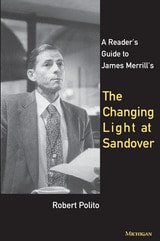
A Reader's Guide to James Merrill's The Changing Light at Sandover
Robert Polito
University of Michigan Press, 1995
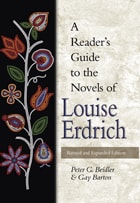
A Reader's Guide to the Novels of Louise Erdrich
Peter G. Beidler & Gay Barton
University of Missouri Press, 2006
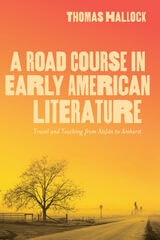
A Road Course in Early American Literature
Travel and Teaching from Atzlán to AmherstThomas Hallock
University of Alabama Press, 2021
Essays that fuse literary scholarship and personal travelogue to explore American identity
A Road Course in Early American Literature: Travel and Teaching from Atzlán to Amherst explores a two-part question: what does travel teach us about literature, and how can reading guide us to a deeper understanding of place and identity? Thomas Hallock charts a teacher’s journey to answering these questions, framing personal experiences around the continued need for a survey course covering early American literature up to the mid-nineteenth century.
Hallock approaches literary study from the overlapping perspectives of pedagogue, scholar, unrepentant tourist, husband, father, friend, and son. Building on Ralph Waldo Emerson’s premise that there is “creative reading as well as creative writing,” Hallock turns to the vibrant and accessible tradition of American travel writing, employing the form of biblio-memoir to bridge the impasse between public and academic discourse and reintroduce the dynamic field of early American literature to wider audiences.
Hallock’s own road course begins and ends at the Low country of Georgia and South Carolina, following a circular structure of reflection. He weaves his journey through a wide swath of American literatures and authors: from Native American and African American oral traditions, to Wheatley and Equiano, through Emerson, Poe, and Dickinson, among others. A series of longer, place-oriented narratives explore familiar and lesser-known literary works from the sixteenth-century invasion of Florida through the Mexican War of 1846–1848 and the American Civil War. Shorter chapters bridge the book’s central themes—the mapping of cognitive and physical space, our personal stake in reading, the tensions that follow earlier acts of erasure, and the impossibility of ever fully shutting out the past.
Exploring complex cultural histories and contemporary landscapes filled with ghosts and new voices, this volume draws inspiration from a tradition of travel, place-oriented, and literature-based works ranging from William Carlos Williams’s In the American Grain and Jack Kerouac’s On the Road to Alice Walker’s In Search of Our Mother’s Gardens, Wendy Lesser’s Why I Read: The Serious Pleasure of Books, and Rebecca Mead’s My Life in Middlemarch.
An accompanying bibliographic essay is periodically updated and available at Hallock’s website: www.roadcourse.us.
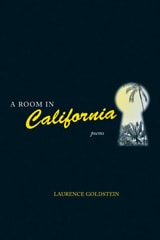
A Room in California
Laurence Goldstein
Northwestern University Press, 2005
His most ambitious book to date, the subjects in this collection range from the aging pear tree and the domestic living room, to Nordic witches and Nazi demons. Some poems are in fixed forms including the villanelle "Rock Star," the sonnet translation from Verlaine, "Langueur," and the rhymed quatrains of a narrative poem adapted from a short story by Arthur Miller. Other poems employ organic style to explore the poet's situation, or predicament, in the culture he has outlived and the culture he has inherited.

A SUPERFICIAL READING OF HENRY JAMES
PREOCCUPATIONS WITH THE MATERIAL WORLDTHOMAS J OTTEN
The Ohio State University Press, 2006
A Sail to Great Island
Alan Feldman
University of Wisconsin Press, 2004
A Saturnalia of Bunk
Selections from The Free Lance, 1911–1915H. L. Mencken
Ohio University Press, 2017
H. L. Mencken’s reputation as a journalist and cultural critic of the twentieth century has endured well into the twenty-first. His early contributions as a writer, however, are not very well known. He began his journalistic career as early as 1899 and in 1910 cofounded the Baltimore Evening Sun. The next year he initiated a column—The Free Lance—that ran six days a week for four and a half years, until the Sun discontinued it, partially in response to Mencken’s controversial defense of Germany during World War One.
In this early forum for his renowned wit, Mencken broached many of the issues to which he would return again and again over his career, establishing himself as a fearless iconoclast willing to tackle the most divisive subjects and apply a heady mix of observation, satire, and repartee to clear away what he regarded as the “saturnalia of bunk” that clouded American thinking. The Free Lance reveals Mencken at his scintillating best as a journalist, polemicist, and satirist.
These columns are collected here for the first time, edited and annotated by Mencken expert and critic S. T. Joshi. This extraordinary collection is an invaluable resource for Mencken scholars and fans and provides an entertaining immersion into the early twentieth-century American zeitgeist.

A Scholar's Guide to Geographical Writing on the American and Canadian Past
Edited by Michael P. Conzen, Thomas A. Rumney, and Graeme Wynn
University of Chicago Press, 1993
A Sense of Things
The Object Matter of American LiteratureBill Brown
University of Chicago Press, 2003
Brown's captivating new study explores the roots of modern America's fascination with things and the problem that objects posed for American literature at the turn of the century. This was an era when the invention, production, distribution, and consumption of things suddenly came to define a national culture. Brown shows how crucial novels of the time made things not a solution to problems, but problems in their own right. Writers such as Mark Twain, Frank Norris, Sarah Orne Jewett, and Henry James ask why and how we use objects to make meaning, to make or remake ourselves, to organize our anxieties and affections, to sublimate our fears, and to shape our wildest dreams. Offering a remarkably new way to think about materialism, A Sense of Things will be essential reading for anyone interested in American literature and culture.
A Shadow on Our Hearts
Soldier-Poetry, Morality, and the American War in VietnamAdam Gilbert
University of Massachusetts Press, 2018
The soldier-poets provide important insights into the ethical dimensions of their physical and psychological surroundings before, during, and after the war. They also offer profound perspectives on the relationships between American soldiers and the Vietnamese people. From firsthand experiences, they reflect on what it meant to be witnesses, victims, and perpetrators of the war's violence. And they advance an uncompromising vision of moral responsibility that indicts a range of culprits for the harms caused by the conflict. Gilbert explores the powerful and perceptive work of these soldier-poets through the lens of morality and presents a radically alternative, deeply personal, and ethically penetrating account of the American war in Vietnam.
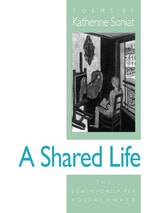
A Shared Life
Katherine Soniat
University of Iowa Press, 1993
There is a controlled, unpretentious constancy to Katherine Soniat's passionate, wise poetry that reminds one of the language of Elizabeth Bishop. Yet her voice is singular; there is an elegance of line, a centered quality that makes the poems more courtly than visceral. One tends to trust what is given in these beautifully rendered images and this gentle music.
The poems are particularly crafted, partly meditative, yet the poet handles larger themes easily and with grace, without the shrillness that sometimes seems common in our time. Her gift for metaphoric language is evident. She has an even-tempered, deeply intelligent mode which carries from poem to poem.
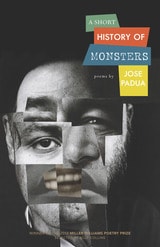
A Short History of Monsters
PoemsJose Padua
University of Arkansas Press, 2019
Winner, 2019 Miller Williams Poetry Prize
“We are the happy riders on the stream of Padua’s consciousness . . . a smart, sympathetic mind at work.”
—Billy Collins
Drawing on the spirit of New York City in decades past, A Short History of Monsters presents the sins and obsessions of a poet nimble in beat and slam traditions. In his first full-length collection, Jose Padua wrestles with an American dream interrupted by failure, excess, and other nightmares. Often brash and unruly, these poems range from recollections of lost, drunken days to unadorned manifestations of hope. Throughout, the speaker redefines his relationship to pop culture, praising it, skewering it, and mourning it by turns.
The poems that make up A Short History of Monsters tend toward both dark humor and epiphany, diving deeply into their own despair and rising up again with existential absurdity. This is a poetry that gets down into the grit and grime of the real world, digging out a space to experience being alive as miraculous in and of itself.

A Spy in the Enemy's Country
The Emergence of Modern Black LiteratureDonald A. Petesch
University of Iowa Press, 1991

A Spy in the House of Love
Anaïs Nin
Ohio University Press, 2014
Although Anaïs Nin found in her diaries a profound mode of self-creation and confession, she could not reveal this intimate record of her experiences during her lifetime. Instead, she turned to literary fiction, transforming her private writings into artfully crafted novels that explore female desire, identity, and emotional complexity.
A Spy in the House of Love is a classic of psychological and women’s fiction, centered on Sabina, a woman torn between her longing for artistic freedom, romantic adventure, and sensual fulfillment, and the social expectations that constrain her. Moving through a bohemian, Parisian-inspired world, Sabina navigates multiple relationships in her search for passion, meaning, and self-understanding.
Written at a time when Nin’s own life was shaped by conflicting loyalties and intense relationships, the novel offers a deeply introspective exploration of love, infidelity, erotic longing, and self-discovery. As Sabina confronts her inner divisions, she asks a timeless question: can one indulge the fantasies and restless pursuit of desire without facing profound emotional consequences?
A landmark of modernist literature and feminist writing, A Spy in the House of Love remains a powerful, evocative portrait of a woman’s inner life—ideal for readers of classic literary fiction, experimental narrative, and character-driven novels about relationships and desire.
A Story Larger than My Own
Women Writers Look Back on Their Lives and CareersEdited by Janet Burroway
University of Chicago Press, 2014
Kumin, who went on to win the Pulitzer Prize for poetry, was part of a groundbreaking generation of women writers who came of age during the midcentury feminist movement. By challenging the status quo and ultimately finding success for themselves, they paved the way for future generations of writers. In A Story Larger than My Own, Janet Burroway brings together Kumin, Julia Alvarez, Jane Smiley, Erica Jong, and fifteen other accomplished women of this generation to reflect on their writing lives.
The essays and poems featured in this collection illustrate that even writers who achieve critical and commercial success experience a familiar pattern of highs and lows over the course of their careers. Along with success comes the pressure to sustain it, as well as a constant search for subject matter, all too frequent crises of confidence, the challenges of a changing publishing scene, and the difficulty of combining writing with the ordinary stuff of life—family, marriage, jobs. The contributors, all now over the age of sixty, also confront the effects of aging, with its paradoxical duality of new limitations and newfound freedom.
Taken together, these stories offer advice from experience to writers at all stages of their careers and serve as a collective memoir of a truly remarkable generation of women.
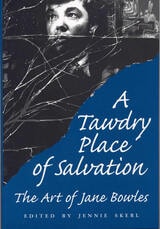
A Tawdry Place of Salvation
The Art of Jane BowlesEdited by Jennie Skerl
Southern Illinois University Press, 1997
Through these essays—which deal with Bowles’s published as well as her unpublished work—Skerl seeks to generate serious critical attention for an important but neglected female experimental writer of the mid-twentieth century and to celebrate her originality, power, and craft.
Based in disciplines and theoretical approaches that range from feminist criticism to Middle Eastern studies, from postmodernism to queer theory, and from Victorianism to the Beat Generation, the essayists naturally approach Bowles’s fiction and drama from a wide variety of critical perspectives. All of these essays are unpublished and written for this volume.
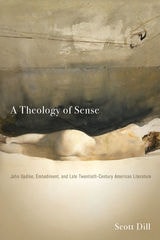
A Theology of Sense
John Updike, Embodiment, and Late Twentieth-Century American LiteratureScott Dill
The Ohio State University Press, 2018

A Timeshare
Margaret Ross
Omnidawn, 2015
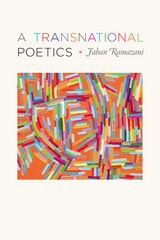
A Transnational Poetics
Jahan Ramazani
University of Chicago Press, 2009
Poetry is often viewed as culturally homogeneous—“stubbornly national,” in T. S. Eliot’s phrase, or “the most provincial of the arts,” according to W. H. Auden. But in A Transnational Poetics, Jahan Ramazani uncovers the ocean-straddling energies of the poetic imagination—in modernism and the Harlem Renaissance; in post–World War II North America and the North Atlantic; and in ethnic American, postcolonial, and black British writing. Cross-cultural exchange and influence are, he argues, among the chief engines of poetic development in the twentieth and twenty-first centuries.
Reexamining the work of a wide array of poets, from Eliot, Yeats, and Langston Hughes to Elizabeth Bishop, Lorna Goodison, and Agha Shahid Ali, Ramazani reveals the many ways in which modern and contemporary poetry in English overflows national borders and exceeds the scope of national literary paradigms. Through a variety of transnational templates—globalization, migration, travel, genre, influence, modernity, decolonization, and diaspora—he discovers poetic connection and dialogue across nations and even hemispheres.
A Trauma Artist
Tim O'Brien and the Fiction of VietnamMark A. Heberle
University of Iowa Press, 2001
A Trauma Artist examines how O'Brien's works variously rewrite his own traumatization during the war in Vietnam as a never-ending fiction that paradoxically "recovers" personal experience by both recapturing and (re)disguising it. Mark Heberle considers O'Brien's career as a writer through the prisms of post-traumatic stress disorder, postmodernist metafiction, and post-World War II American political uncertainties and public violence.
Based on recent conversations with O'Brien, previously published interviews, and new readings of all his works through 1999, this book is the first study to concentrate on the role and representation of trauma as the central focus of all O'Brien's works, whether situated in Vietnam, in post-Vietnam America, or in the imagination of protagonists suspended between the two. By doing so, Heberle redefines O'Brien as a major U.S. writer of the late twentieth century whose representations of self-damaging experiences and narratives of recovery characterize not only the war in Vietnam but also relationships between fathers and sons and men and women in the post-traumatic culture of the contemporary United States.
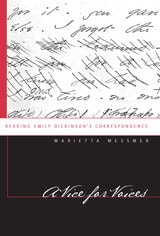
A Vice for Voices
Reading Emily Dickinson's CorrespondenceMarietta Messmer
University of Massachusetts Press, 2009
Concentrating on Dickinson's exchanges with childhood friends, as well as with Susan Gilbert Dickinson, Elizabeth Holland, Austin Dickinson, Thomas Wentworth Higginson, and the mysterious "Master," Marietta Messmer explores the poet's gradual shift from writing confessional letters to developing her unique "vice for voices" by creating fictionalized epistolary personae. While radically challenging nineteenth-century letter-writing conventions, these personae also subvert the narrowly circumscribed roles available to women at that time. Messmer shows how Dickinson used this double-voiced mode of correspondence to manipulate and interrogate a variety of male-dominated, "authorized" literary, religious, and sociocultural discourses.
A Visitable Past
Views of Venice by American Artists, 1860-1915Margaretta M. Lovell
University of Chicago Press, 1988
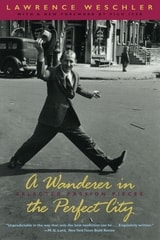
A Wanderer in the Perfect City
Selected Passion PiecesLawrence Weschler
University of Chicago Press, 2006
Indeed, the eight essays collected in A Wanderer in the Perfect City do soar into the realm of passion as Weschler profiles people who “were just moseying down the street one day, minding their own business, when suddenly and almost spontaneously, they caught fire, they became obsessed, they became intensely focused and intensely alive.” With keen observations and graceful prose, Weschler carries us along as a teacher of rudimentary English from India decides that his destiny is to promote the paintings of an obscure American abstract expressionist; a gifted poker player invents a more exciting version of chess; an avant-garde Russian émigré conductor speaks Latin, exclusively, to his infant daughter; and Art Spiegelman composes Maus. But simple summaries can’t do these stories justice: like music, they derive their character from digressions and details, cadence and tone. And like the upwelling of passion Weschler’s characters feel, they are better experienced than explained.
“Weschler seems so hungry for life that the rest of us become hungry for him . . . a magician, a performer, and a scholar. All in one.”—from the Foreword by Pico Iyer
“Weschler is the owner of a large dose of novelistic vision, and a particularly poetic set of ears, but . . . as important an endowment as a novelist’s eye or a poet’s ear is still the journalistic nose which led him down the proverbial alley.”—National Post (Canada)
“Weschler is a thoughtful observer and a superb storyteller.”—Minneapolis Star Tribune
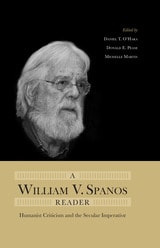
A William V. Spanos Reader
Humanist Criticism and the Secular ImperativeEdited by Daniel T. O'Hara, Donald E. Pease, Michelle Martin
Northwestern University Press, 2015
The American critic William V. Spanos, a pioneer of postmodern theory and co-founder of one of its principal organs, the journal boundary 2, is, in the words of A William V. Spanos Reader coeditor Daniel T. O’Hara, everything that current post-modern theory is accused of not being: polemical, engaged, prophetic, passionate. Informed by his experience as a prisoner of war in Dresden, Spanos saw dire con-sequences for life in modernist aesthetic experiments, and he thereafter imbued his work with a constructive aspect ever in the name of more life.

A Woman Speaks
The Lectures, Seminars, and Interviews of Anaïs NinEvelyn J. Hinz
Ohio University Press, 1975
In this book Anaïs Nin speaks with warmth and urgency on those themes which have always been closest to her: relationships, creativity, the struggle for wholeness, the unveiling of woman, the artist as magician, women reconstructing the world, moving from the dream outward, and experiencing our lives to the fullest possible extent.
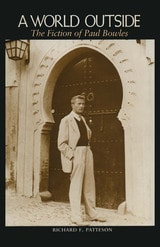
A World Outside
The Fiction of Paul BowlesBy Richard F. Patteson
University of Texas Press, 1987
Expatriation, the sense of being "outside" or exposed, is a central theme in the life and work of Paul Bowles. Beginning with Bowles' account of a frightening childhood memory, A World Outside explores how the dichotomies of inside and outside, safety and danger, enclosure and exposure—fundamental dualities in Bowles' fiction—have their deepest origin in the fabric of Bowles' own life and also mark his kinship with other twentieth-century writers. Like V. S. Naipaul, Paul Bowles is one of those writers who have an uncanny grasp of what it is like never to feel "at home."
In this much-needed study, Richard Patteson explores how this sense of "outsidedness" characterizes one's experience in a world in which many of the traditional shelters—social, familial, religious—seem to have lost their ability to protect. He discovers that storytelling is the vehicle by which both Bowles and his characters attempt to domesticate inchoate experience, bringing it into the familiar interior of human comprehension.
The music world has for decades recognized Paul Bowles' stature as a composer, but his fiction is only recently receiving the close attention it has long deserved from students of American and contemporary literature. Bowles is an author who neither sought nor received the kind of publicity often lavished on his contemporaries but one whom an ever-growing audience regards as a commanding figure of twentieth-century American literature.
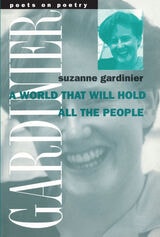
A World That Will Hold All the People
Suzanne Gardinier
University of Michigan Press, 1996

A World of Words
Language and Displacement in the Fiction of Edgar Allan PoeMichael J. S. Williams
Duke University Press, 1988
AAA vol 58 num 1
The University of Chicago Press
University of Chicago Press Journals, 2019
AAA vol 58 num 2
The University of Chicago Press
University of Chicago Press Journals, 2019
AAA vol 59 num 1
The University of Chicago Press
University of Chicago Press Journals, 2020
AAA vol 59 num 2
The University of Chicago Press
University of Chicago Press Journals, 2020
AMART vol 33 num 3
The University of Chicago Press
University of Chicago Press Journals, 2019
AMERIFIL.TXT
A Commonplace BookDouglas Crase
University of Michigan Press, 1996
The twenty-three American writers who appear in the book range chronologically from the colonial thinker John Wise to the contemporary poet John Ashbery. Their appearances are arranged to comment almost interactively on identifiable American issues like "Doing Your Thing," "How Writing Is Written," "Pursuit of Happiness," and "Right to Privacy." Douglas Crase has said that he finds rearrangement morally and artistically more interesting than opinions, as rearrangement involves choice and commitment, while opinions are only held. In the end, readers may conclude that Amerifil.Txt is not a commonplace book at all, but rather a spiritual autobiography of its compiler.
Douglas Crase is a widely anthologized poet, essayist, and critic. His acclaimed volume of poetry The Revisionist earned nominations for the National Book Critics Circle Award and the American Book Award in poetry. He has received an Ingram-Merrill Award, a Whiting Writer's Award, and fellowships from the MacArthur and Guggenheim foundations and the American Academy and Institute of Arts and Letters.
ARRIVAL
PoemsCheryl Boyce-Taylor
Northwestern University Press, 2017
ARRIVAL is a poetic love story between mother and daughter. The poems are road maps, intertwining generations with a narrative beginning in 1950 with a woman who is pregnant with twins. In her seventh month she delivers a stillborn boy and a baby girl weighing less than two pounds. From there, the evocation of a series of catastrophic family events brings forth Cheryl Boyce-Taylor’s power to strip her readers down to their most vulnerable. Boyce-Taylor is steeped in the narratives of Trinidad and New York City, colored with metaphorical stew-pot images. She revels in her lyrical range as she weaves these poetic retellings of family, place, and identity.
Abide
Jake Adam York
Southern Illinois University Press, 2014
Winner, 2015 Colorado Book Award
Finalist, 2015 National Book Critics Circle Award
In the years leading up to his recent passing, Alabama poet Jake Adam York set out on a journey to elegize the 126 martyrs of the civil rights movement, murdered in the years between 1954 and 1968. Abide is the stunning follow-up to York’s earlier volumes, a memorial in verse for those fallen. From Birmingham to Okemah, Memphis to Houston, York’s poems both mourn and inspire in their quest for justice, ownership, and understanding.
Within are anthems to John Earl Reese, a sixteen-year-old shot by Klansmen through the window of a café in Mayflower, Texas, where he was dancing in 1955; to victims lynched on the Oklahoma prairies; to the four children who perished in the Birmingham church bombing of 1963; and to families who saw the white hoods of the Klan illuminated by burning crosses. Juxtaposed with these horrors are more loving images of the South: the aroma of greens simmering on the stove, “tornado-strong” houses built by loved ones long gone, and the power of rivers “dark as roux.”
Throughout these lush narratives, York resurrects the ghosts of Orpheus, Sun Ra, Howlin’ Wolf, Thelonious Monk, Woody Guthrie, and more, summoning blues, jazz, hip-hop, and folk musicians for performances of their “liberation music” that give special meaning to the tales of the dead.
In the same moment that Abide memorializes the fallen, it also raises the ethical questions faced by York during this, his life’s work: What does it mean to elegize? What does it mean to elegize martyrs? What does it mean to disturb the symmetries of the South’s racial politics or its racial poetics?
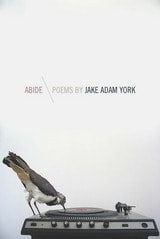
A bittersweet elegy for the poet himself, Abide is as subtle and inviting as the whisper of a record sleeve, the gasp of the record needle, beckoning us to heed our history.
Abortion, Choice, and Contemporary Fiction
The Armageddon of the Maternal InstinctJudith Wilt
University of Chicago Press, 1990
In the opening of the book, Wilt discusses real case histories of several women. After studying the ambiguities of their decisions, she turns to their counterpoints depicted in contemporary fiction. Working from a feminist perspective, Wilt traces the theme of maternal choice in works by Margaret Atwood, Margaret Drabble, Joan Didion, Mary Gordon, Alice Walker, Toni Morrison, Gloria Naylor, Marge Piercy, Thomas Keneally, Graham Swift, Ernest Hemingway, William Faulkner, John Barth, John Irving, and others.
Behind the political, medical, and moral debates on abortion, Wilt argues, is a profound psychocultural shock at the recognition that maternity is passing from the domain of instinct to that of conscious choice. Although never wholly instinctual, maternity's potential capture by consciousness raises complex questions. The novels Wilt discusses portray worlds in which principles are endangered by sexual inequality, male power and hidden male fear of abandonment, impotence, female submission, and covert rage, and, in the case of black maternity, the hideous aftermath of slavery.
Wilt provides a resonant new context for debates—whether political or personal—on the issue of abortion and maternal choice. Ultimately she enables us to rethink how we shape our own identities and lives.
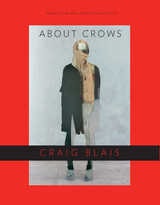
About Crows
Craig Blais
University of Wisconsin Press, 2013
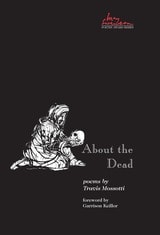
About the Dead
Travis Mossotti
Utah State University Press, 2011
Travis Mossotti writes with humor, gravity, and humility about subjects grounded in a world of grit, where the quiet mortality of working folk is weighed. To Mossotti, the love of a bricklayer for his wife is as complex and simple as life itself: “ask him to put into words what that sinking is, / that shudder in his chest, as he notices / the wrinkles gathering at the corners of her mouth.” But not a whiff of sentiment enters these poems, for Mossotti has little patience for ideas of the noble or for sympathetic portraits of hard-used saints. His vision is clear, as clear as the memory of how scarecrows in the rearview, “each of them, stuffed / into a body they didn’t choose, resembled / your own plight.” His poetry embraces unsanctimonious life with all its wonder, its levity, and clumsiness. About the Dead is an accomplished collection by a writer in control of a wide range of experience, and it speaks to the heart of any reader willing to catch his “drift, and ride it like the billowed / end of some cockamamie parachute all the way / back to the soft, dysfunctional, waiting earth.”
Above Time
Emerson's and Thoreau's Temporal RevolutionsJames R. Guthrie
University of Missouri Press, 2001
In Above Time, James R. Guthrie explores the origins of the two preeminent transcendentalists' revolutionary approaches to time, as well as to the related concepts of history, memory, and change. Most critical discussions of this period neglect the important truth that the entire American transcendentalist project involved a transcendence of temporality as well as of materiality. Correspondingly, both writers call in their major works for temporal reform, to be achieved primarily by rejecting the past and future in order to live in an amplified present moment.
Emerson and Thoreau were compelled to see time in a new light by concurrent developments in the sciences and the professions. Geologists were just then hotly debating the age of the earth, while zoologists were beginning to unravel the mysteries of speciation, and archaeologists were deciphering the Egyptian hieroglyphs. These discoveries worked collectively to enlarge the scope of time, thereby helping pave the way for the appearance of Darwin's Origin of Species in 1859.
Well aware of these wider cultural developments, Emerson and Thoreau both tried (although with varying degrees of success) to integrate contemporary scientific thought with their preexisting late-romantic idealism. As transcendentalists, they already believed in the existence of "correspondences"—affinities between man and nature, formalized as symbols. These symbols could then be decoded to discover the animating presence in the world of eternal laws as pervasive as the laws of science. Yet unlike scientists, Emerson and Thoreau hoped to go beyond merely understanding nature to achieving a kind of passionate identity with it, and they believed that such a union might be achieved only if time was first recognized as being a purely human construct with little or no validity in the rest of the natural world. Consequently, both authors employ a series of philosophical, rhetorical, and psychological strategies designed to jolt their readers out of time, often by attacking received cultural notions about temporality.
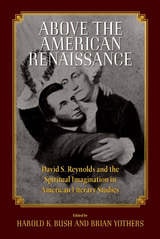
Above the American Renaissance
David S. Reynolds and the Spiritual Imagination in American Literary StudiesHarold K. Bush
University of Massachusetts Press, 2018
In addition to the editors and David S. Reynolds, contributors include Jeffrey Bilbro, Dawn Coleman, Jonathan A. Cook, Tracy Fessenden, Zachary Hutchins, Richard Kopley, Mason I. Lowance Jr., John Matteson, Christopher N. Phillips, Vivian Pollak, Michael Robertson, Gail K. Smith, Claudia Stokes, and Timothy Sweet.