Results by title
1272 books match the query 'Asia' and 110 start with a
Agricultural Reason in the Shadow of Subsistence Capitalism
A Rural Ontology from Western IndiaArjun Appadurai
HAU, 2024
This collection of essays by Arjun Appadurai based on his fieldwork in rural Maharashtra, India, in the early 1980s is one of the few anthropological treatments of agricultural reasoning. In conversation with agronomists, economists, and development anthropologists, the essays explore the ways agricultural technologies, changes in how surface wells are dug and managed, the provision and sharing of food and management of time, issues of scale in studying rural lives, and how local knowledge is formed and transformed reveal the distinctive character of rural Indian sociality. Locating these features in the context of “subsistence capitalism,” Appadurai draws our attention to the importance of relational practices and the pull of autonomy. These essays offer a close look at an agrarian society at the pivotal moment of its encounter with capitalist transformation and study ideas of measurement, sociality, and independence.
Ah Ku and Karayuki-san
Prostitution in Singapore, 1870—1940James F. Warren
National University of Singapore Press, 2009
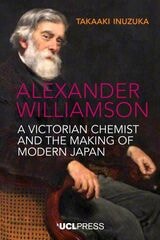
Alexander Williamson
A Victorian Chemist and the Making of Modern JapanTakaaki Inuzuka
University College London, 2021
Alexander Williamson was a leading scientist and professor of chemistry at University College London in the late nineteenth century. He taught and cared for visiting Japanese students, assisting them with their goal of modernizing Japan. This short, accessible biography explores his contribution to nineteenth-century science, as well as his lasting impact on Japanese society. In 1863 five students from the Chōshū clan, with a desperate desire to learn from the West, made their way to England. They were put in the care of Williamson and his wife. Their mission was to learn about cutting-edge Western technology, science, economics, and politics. When they returned home, they rapidly became leading figures in Japanese life. The remarkable story of the part Williamson and University College London played in the modernization of Japan is little known today. This biography will promote a deeper understanding of Williamson’s scientific innovations and his legacy for Anglo-Japanese relations.
Alien Forms and Minor Genres
A Speculative Handbook of Academic LaborTina Chen
Duke University Press, 2026
Alignment, Alliance, and American Grand Strategy
Zachary Selden
University of Michigan Press, 2016
Amid calls for retrenchment or restraint, Selden makes the case that a policy focused on maintaining American military preeminence and the demonstrated willingness to use force may be what sustains the cooperation of second-tier states, which in turn help to maintain US hegemony at a manageable cost.
Alimentary Tracts
Appetites, Aversions, and the PostcolonialParama Roy
Duke University Press, 2010
Interpreting texts that have addressed cooking, dining, taste, hungers, excesses, and aversions in South Asia and its diaspora since the mid-nineteenth century, Roy relates historical events and literary figures to tropes of disgust, abstention, dearth, and appetite. She analyzes the fears of pollution and deprivation conveyed in British accounts of the so-called Mutiny of 1857, complicates understandings of Mohandas K. Gandhi’s vegetarianism, examines the “famine fictions” of the novelist-actor Mahasweta Devi, and reflects on the diasporic cookbooks and screen performances of Madhur Jaffrey. This account of richly visceral global modernity furnishes readers with a new idiom for understanding historical action and cultural transformation.
Along The Ganges
Ilija Trojanow
Haus Publishing, 2014
Amazons of the Huk Rebellion
Gender, Sex, and Revolution in the PhilippinesVina A. Lanzona
University of Wisconsin Press, 2009
Drawing on interviews with over one hundred veterans of the movement, Vina A. Lanzona explores the Huk rebellion from the intimate and collective experiences of its female participants, demonstrating how their presence, and the complex questions of gender, family, and sexuality they provoked, ultimately shaped the nature of the revolutionary struggle.
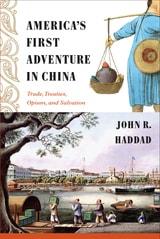
America's First Adventure in China
Trade, Treaties, Opium, and SalvationJohn R Haddad
Temple University Press, 2014
In America's First Adventure in China, John Haddad provides a colorful history of the evolving cultural exchange and interactions between these countries. He recounts how American expatriates adopted a pragmatic attitude-as well as an entrepreneurial spirit and improvisational approach-to their dealings with the Chinese. Haddad shows how opium played a potent role in the dreams of Americans who either smuggled it or opposed its importation, and he considers the missionary movement that compelled individuals to accept a hard life in an alien culture.
As a result of their efforts, Americans achieved a favorable outcome—they established a unique presence in China—and cultivated a relationship whose complexities continue to grow.
America's Japan and Japan's Performing Arts
Cultural Mobility and Exchange in New York, 1952-2011Barbara E. Thornbury
University of Michigan Press, 2013
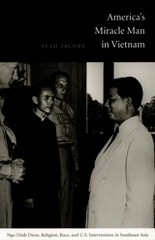
America's Miracle Man in Vietnam
Ngo Dinh Diem, Religion, Race, and U.S. Intervention in Southeast AsiaSeth Jacobs
Duke University Press, 2004
A diplomatic and cultural history, America’s Miracle Man in Vietnam draws on government archives, presidential libraries, private papers, novels, newspapers, magazines, movies, and television and radio broadcasts. Jacobs shows in detail how, in the 1950s, U.S. policymakers conceived of Cold War anticommunism as a crusade in which Americans needed to combine with fellow Judeo-Christians against an adversary dangerous as much for its atheism as for its military might. He describes how racist assumptions that Asians were culturally unready for democratic self-government predisposed Americans to excuse Diem’s dictatorship as necessary in “the Orient.” By focusing attention on the role of American religious and racial ideologies, Jacobs makes a crucial contribution to our understanding of the disastrous commitment of the United States to “sink or swim with Ngo Dinh Diem.”
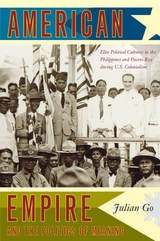
American Empire and the Politics of Meaning
Elite Political Cultures in the Philippines and Puerto Rico during U.S. ColonialismJulian Go
Duke University Press, 2007
American Empire and the Politics of Meaning is an examination of how these efforts to provide the elite of Puerto Rico and the Philippines a practical education in self-government played out on the ground in the early years of American colonial rule, from 1898 until 1912. It is the first systematic comparative analysis of these early exercises in American imperial power. The sociologist Julian Go unravels how American authorities used “culture” as both a tool and a target of rule, and how the Puerto Rican and Philippine elite received, creatively engaged, and sometimes silently subverted the Americans’ ostensibly benign intentions. Rather than finding that the attempt to transplant American-style democracy led to incommensurable “culture clashes,” Go assesses complex processes of cultural accommodation and transformation. By combining rich historical detail with broader theories of meaning, culture, and colonialism, he provides an innovative study of the hidden intersections of political power and cultural meaning-making in America’s earliest overseas empire.
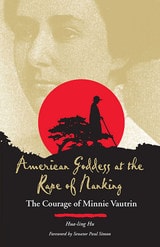
American Goddess at the Rape of Nanking
The Courage of Minnie VautrinHua-ling Hu
Southern Illinois University Press, 2001
The Japanese army’s brutal four-month occupation of the city of Nanking during the 1937 Sino-Japanese War is known, for good reason, as “the rape of Nanking.” As they slaughtered an estimated three hundred thousand people, the invading soldiers raped more than twenty thousand women—some estimates run as high as eighty thousand. Hua-ling Hu presents here the amazing untold story of the American missionary Minnie Vautrin, whose unswerving defiance of the Japanese protected ten thousand Chinese women and children and made her a legend among the Chinese people she served.
Vautrin, who came to be known in China as the “Living Goddess” or the “Goddess of Mercy,” joined the Foreign Christian Missionary Society and went to China during the Chinese Nationalist Revolution in 1912. As dean of studies at Ginling College in Nanking, she devoted her life to promoting Chinese women’s education and to helping the poor.
At the outbreak of the war in July 1937, Vautrin defied the American embassy’s order to evacuate the city. After the fall of Nanking in December, Japanese soldiers went on a rampage of killing, burning, looting, rape, and torture, rapidly reducing the city to a hell on earth. On the fourth day of the occupation, Minnie Vautrin wrote in her diary: “There probably is no crime that has not been committed in this city today. . . . Oh, God, control the cruel beastliness of the soldiers in Nanking.”
When the Japanese soldiers ordered Vautrin to leave the campus, she replied: “This is my home. I cannot leave.” Facing down the blood-stained bayonets constantly waved in her face, Vautrin shielded the desperate Chinese who sought asylum behind the gates of the college. Vautrin exhausted herself defying the Japanese army and caring for the refugees after the siege ended in March 1938. She even helped the women locate husbands and sons who had been taken away by the Japanese soldiers. She taught destitute widows the skills required to make a meager living and provided the best education her limited sources would allow to the children in desecrated Nanking.
Finally suffering a nervous breakdown in 1940, Vautrin returned to the United States for medical treatment. One year later, she ended her own life. She considered herself a failure.
Hu bases her biography on Vautrin’s correspondence between 1919 and 1941 and on her diary, maintained during the entire siege, as well as on Chinese, Japanese, and American eyewitness accounts, government documents, and interviews with Vautrin’s family.
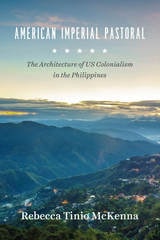
American Imperial Pastoral
The Architecture of US Colonialism in the PhilippinesRebecca Tinio McKenna
University of Chicago Press, 2017
In American Imperial Pastoral, Rebecca Tinio McKenna examines the design, construction, and use of Baguio, making visible the physical shape, labor, and sustaining practices of the US’s new empire—especially the dispossessions that underwrote market expansion. In the process, she demonstrates how colonialists conducted market-making through state-building and vice-versa. Where much has been made of the racial dynamics of US colonialism in the region, McKenna emphasizes capitalist practices and design ideals—giving us a fresh and nuanced understanding of the American occupation of the Philippines.
American Studies as Transnational Practice
Turning toward the TranspacificEdited by Yuan Shu and Donald E. Pease
Dartmouth College Press, 2016
American Tropics
Articulating Filipino AmericaAllan Punzalan Isaac
University of Minnesota Press, 2006

Among the Afghans
Arthur Bonner
Duke University Press, 1987
Bonner therefore brings both recent experience and the sharp eye of a veteran journalist to an analysis of the Afghan situation: the tenacity and courage of the resistance, the massive emmigration, and the toll taken by the seemingly endless conflict on the country and its people.
The author has seen both the great and small of Afghanistan--both the seared flesh of the hand that an Afghan mujahidin held in the fire to demonstrate his courage and the geopolitical reasons that impelled the former Soviet Union of set its might and treasure against a people who resisted with a fierce and sometimes (to Western eyes) thoughtless courage. This is the story of these antagonists--sobering, chilling, and finally enlightening.
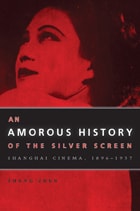
An Amorous History of the Silver Screen
Shanghai Cinema, 1896-1937Zhang Zhen
University of Chicago Press, 2005
The first sustained historical study of the emergence of cinema in China, An Amorous History of the Silver Screen is a fascinating narrative that illustrates the immense cultural significance of film and its power as a vehicle for social change. Named after a major feature film on the making of Chinese cinema, only part of which survives, An Amorous History of the Silver Screen reveals the intricacies of this cultural movement and explores its connections to other art forms such as photography, architecture, drama, and literature. In light of original archival research, Zhang Zhen examines previously unstudied films and expands the important discussion of how they modeled modern social structures and gender roles in early twentieth-century China.
The first volume in the new and groundbreaking series Cinema and Modernity, An Amorous History of the Silver Screen is an innovative—and well illustrated—look at the cultural history of Chinese modernity through the lens of this seminal moment in Shanghai cinema.
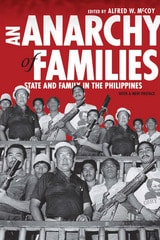
An Anarchy of Families
State and Family in the PhilippinesAlfred W. McCoy
University of Wisconsin Press, 2009
Edited by Alfred W. McCoy, An Anarchy of Families explores the pervasive influence of the modern dynasties that have led the Philippines during the past century. Exemplified by the Osmeñas and Lopezes, elite Filipino families have formed a powerful oligarchy—controlling capital, dominating national politics, and often owning the media. Beyond Manila, strong men such as Ramon Durano, Ali Dimaporo, and Justiniano Montano have used “guns, goons, and gold” to accumulate wealth and power in far-flung islands and provinces. In a new preface for this revised edition, the editor shows how this pattern of oligarchic control has continued into the twenty-first century, despite dramatic socio-economic change that has supplanted the classic “three g’s” of Philippine politics with the contemporary “four c’s”—continuity, Chinese, criminality, and celebrity.
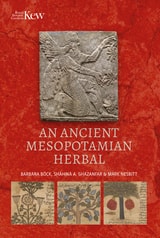
An Ancient Mesopotamian Herbal
Barbara Boeck, Shahina Ghazanfar, and Mark Nesbitt
Royal Botanic Gardens, Kew, 2024
Traditional medical systems continue to impact the lives of people around the globe. These systems vary greatly in their underlying beliefs, but all commonly rely on the consumption of plant matter as a central practice. An Ancient Mesopotamian Herbal is a new, fully illustrated book that explores the uses of plants in traditional medicine and how these botanical roots extend to modern, “conventional” medicinal treatments.
Divided into two parts, An Ancient Mesopotamian Herbal introduces the lands and ancient cultures of Mesopotamia before surveying the different forms of evidence and research methods informing this academic book. The book then looks to the modern day, focusing on thirty case studies of plant-based drugs. Bridging the divide between the humanities and sciences and using new research and data from modern-day Iraq and surrounding areas, An Ancient Mesopotamian Herbal draws on the expertise of archeo-botanists, scientists, and Assyriologists specializing in historic Mesopotamian medicine to provide new identifications of Assyrian and Babylonian herbal medicines while giving a concise overview of ancient Mesopotamian herbal lore.
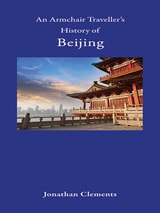
An Armchair Traveller's History of Beijing
Jonathan Clements
Haus Publishing, 2016
Home to capitals of several states over time, the site of modern Beijing has been ruled by Mongolian chiefs and the glorious Ming emperors, whose tombs can still be found on its outskirts. Through Beijing, we can experience Chinese history itself, including its more famous residents—including Khubilai Khan, Mulan, and Marco Polo. Special emphasis is placed on Beijing’s precarious heritage in the twenty-first century, as modern construction wipes out much of the old city to make way for homes for twenty million people.
This book also offers detailed information on sites of tourist interest, including the pros and cons of different sections of the Great Wall and the best ways to see the Forbidden City and the fast-disappearing relics of the city’s Manchu and Maoist eras. A chapter on food and drink examines not only local delicacies, but the many other Chinese dishes that form part of Beijing’s rich dining traditions. With its blend of rich history and expert tips, An Armchair Traveller’s History of Beijing is an essential introduction to one of the world’s most remarkable cities.
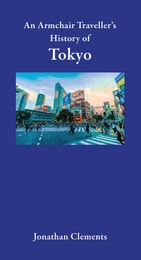
An Armchair Traveller's History of Tokyo
Jonathan Clements
Haus Publishing, 2018
Tokyo, meaning “Eastern Capital,” has only enjoyed that name and status for 150 years. Before that, it was a medieval outpost designed to keep watch over rich farmlands. But this seemingly unassuming geographical location ultimately led to its status as a supercity. Though the imperial court ruled Japan from the sleepy city of Kyoto, the landowners of the Kanto plain where Tokyo lies held the true wealth and power in Japan, which they eventually asserted in a series of bloody civil wars. The Tokyo region became the administrative center of Japan’s Shogun overlords and the site of a vibrant urban culture home to theaters, taverns, and brothels. After the Meiji Restoration in 1868, it became Japan’s true capital, home to the emperors, the seat of government, and a site of rapid urban growth.
Anyone who’s ever longed to look upon Mount Fuji, embody the bravery of the Samurai, or savor the world’s finest sushi will find themselves transported from the comfort of their armchair while reading Clements’s account of Tokyo.
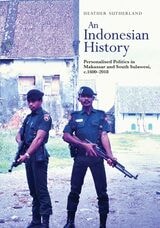
An Indonesian History
Personalized Politics in Makassar and South Sulawesi, c.1600-2018Heather Sutherland
National University of Singapore Press, 2024
Indonesia, the world’s fourth most populous country, is a vast archipelago with a relatively short history of unified rule. The devolution of power to the provinces after 1998 has meant that regional social traditions and historical legacies are powerful forces in contemporary politics. South Sulawesi (Southwest Celebes), a crucial and understudied region of Indonesia, is no exception.
Starting in 1669, tensions between the Dutch East India Company’s cosmopolitan port town of Makassar and the aggressive, competitive dynasties of the interior began to shape peninsula politics. A strong ethnic Chinese community embodied the town’s wide horizons, while in the countryside, the nobility’s engagement with Islam ranged from symbiotic co-optation to hostility. Religion, rather than politics, framed the main challenges to authority. Finally integrated in 1965, the city and province remain among the most clientelist in the country, their politics personalized and transactional. Nevertheless, the large city of Makassar is booming. Dutch indirect rule and neocolonial strategies entrenched the power of local elites, who resisted changes imposed by Batavia or, after 1950, by Jakarta.
In this history, Heather Sutherland’s long-term perspective avoids dichotomies like continuity and change or autonomy and dependence, recognizing that trade-offs have always been fundamental to interaction within and between town and country and between the province and distant capitals.
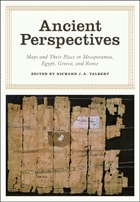
Ancient Perspectives
Maps and Their Place in Mesopotamia, Egypt, Greece, and RomeEdited by Richard J. A. Talbert
University of Chicago Press, 2012
Ancient Perspectives encompasses a vast arc of space and time—Western Asia to North Africa and Europe from the third millennium BCE to the fifth century CE—to explore mapmaking and worldviews in the ancient civilizations of Mesopotamia, Egypt, Greece, and Rome. In each society, maps served as critical economic, political, and personal tools, but there was little consistency in how and why they were made. Much like today, maps in antiquity meant very different things to different people.
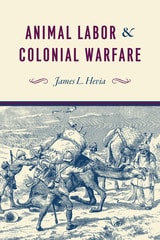
Animal Labor and Colonial Warfare
James L. Hevia
University of Chicago Press, 2018
In Animal Labor and Colonial Warfare, James Hevia examines the use of camels, mules, and donkeys in colonial campaigns of conquest and pacification, starting with the Second Afghan War—during which an astonishing 50,000 to 60,000 camels perished—and ending in the early twentieth century. Hevia explains how during the nineteenth and twentieth centuries a new set of human-animal relations were created as European powers and the United States expanded their colonial possessions and attempted to put both local economies and ecologies in the service of resource extraction. The results were devastating to animals and human communities alike, disrupting centuries-old ecological and economic relationships. And those effects were lasting: Hevia shows how a number of the key issues faced by the postcolonial nation-state of Pakistan—such as shortages of clean water for agriculture, humans, and animals, and limited resources for dealing with infectious diseases—can be directly traced to decisions made in the colonial past. An innovative study of an underexplored historical moment, Animal Labor and Colonial Warfare opens up the animal studies to non-Western contexts and provides an empirically rich contribution to the emerging field of multispecies historical ecology.
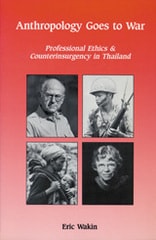
Anthropology Goes to War
Professional Ethics and Counterinsurgency in ThailandEric Wakin
University of Wisconsin Press, 1998
Now back in print, Eric Wakin's Anthropology Goes to War is the first comprehensive study of what became known as the Thailand Controversy—and a timely reminder of a debate whose echoes may be heard in our own time.
Anti-Japan
The Politics of Sentiment in Postcolonial East AsiaLeo T. S. Ching
Duke University Press, 2019
Antinomies of Modernity
Essays on Race, Orient, NationVasant Kaiwar and Sucheta Mazumdar, eds.
Duke University Press, 2003
Drawing on archival sources and fieldwork, the contributors explore aspects of modernity within societies of South Asia, the Middle East, and Africa. Whether considering how European ideas of Orientalism became foundational myths of Indian nationalism; how racial caste systems between blacks, South Asians, and whites operate in post-apartheid South Africa; or how Indian immigrants to the United States negotiate their identities, these essays demonstrate that the contours of cultural and identity politics did not simply originate in metropolitan centers and get adopted wholesale in the colonies. Colonial and postcolonial modernisms have emerged via the active appropriation of, or resistance to, far-reaching European ideas. Over time, Orientalism and nationalist and racialized knowledges become indigenized and acquire, for all practical purposes, a completely "Third World" patina. Antinomies of Modernity shows that people do make history, constrained in part by political-economic realities and in part by the categories they marshal in doing so.
Contributors. Neville Alexander, Andrew Barnes, Vasant Kaiwar, Sucheta Mazumdar, Minoo Moallem, Mohamad Tavakoli-Targhi, A. R. Venkatachalapathy, Michael O. West
Antiquarianism and Intellectual Life in Europe and China, 1500-1800
Peter N. Miller and François Louis, editors
University of Michigan Press, 2012
This book is a project in comparative history, but along two distinct axes, one historical and the other historiographical. Its purpose is to constructively juxtapose the early modern European and Chinese approaches to historical study that have been called "antiquarian." As an exercise in historical recovery, the essays in this volume amass new information about the range of antiquarian-type scholarship on the past, on nature, and on peoples undertaken at either end of the Eurasian landmass between 1500 and 1800. As a historiographical project, the book challenges the received---and often very much under conceptualized---use of the term "antiquarian" in both European and Chinese contexts. Readers will not only learn more about the range of European and Chinese scholarship on the past---and especially the material past---but they will also be able to integrate some of the historiographical observations and corrections into new ways of conceiving of the history of historical scholarship in Europe since the Renaissance, and to reflect on the impact of these European terms on Chinese approaches to the Chinese past. This comparison is a two-way street, with the European tradition clarified by knowledge of Chinese practices, and Chinese approaches better understood when placed alongside the European ones.
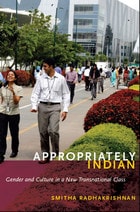
Appropriately Indian
Gender and Culture in a New Transnational ClassSmitha Radhakrishnan
Duke University Press, 2011
Radhakrishnan explains how this transnational class creates an Indian culture that is self-consciously distinct from Western culture, yet compatible with Western cosmopolitan lifestyles. She describes the material and symbolic privileges that accrue to India’s high-tech workers, who often claim ordinary middle-class backgrounds, but are overwhelmingly urban and upper caste. They are also distinctly apolitical and individualistic. Members of this elite class practice a decontextualized version of Hinduism, and they absorb the ideas and values that circulate through both Indian and non-Indian multinational corporations. Ultimately, though, global Indianness is rooted and configured in the gendered sphere of home and family.
Archaism and Actuality
Japan and the Global Fascist ImaginaryHarry Harootunian
Duke University Press, 2023
Archives, Archival Practices, and the Writing of History in Premodern Korea
Jungwon Kim, special issue editor
Duke University Press, 0
Contributors. Ksenia Chizhova, Jungwon Kim, Sung-Eun Thomas Kim, Franklin Rausch, Graeme Reynolds, Sem Vermeersch, Sixiang Wang, Yuan Ye
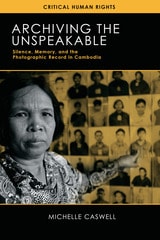
Archiving the Unspeakable
Silence, Memory, and the Photographic Record in CambodiaMichelle Caswell
University of Wisconsin Press, 2014
Winner, Waldo Gifford Leland Award, Society of American Archivists
Longlist, ICAS Book Prize, International Convention of Asia Scholars
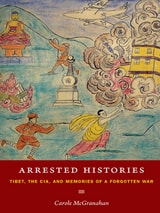
Arrested Histories
Tibet, the CIA, and Memories of a Forgotten WarCarole McGranahan
Duke University Press, 2010
Drawing on rich ethnographic and historical research, McGranahan tells the story of the Tibetan resistance and the social processes through which this history is made and unmade, and lived and forgotten in the present. Fulfillment of veterans’ desire for recognition hinges on the Dalai Lama and “historical arrest,” a practice in which the telling of certain pasts is suspended until an undetermined time in the future. In this analysis, struggles over history emerge as a profound pain of belonging. Tibetan cultural politics, regional identities, and religious commitments cannot be disentangled from imperial histories, contemporary geopolitics, and romanticized representations of Tibet. Moving deftly from armed struggle to nonviolent hunger strikes, and from diplomatic offices to refugee camps, Arrested Histories provides powerful insights into the stakes of political engagement and the cultural contradictions of everyday life.
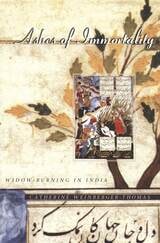
Ashes of Immortality
Widow-Burning in IndiaCatherine Weinberger-Thomas
University of Chicago Press, 1999
Ashes of Immortality attempts to see the satis through Hindu eyes, providing an extensive experiential and psychoanalytic account of ritual self-sacrifice and self-mutilation in South Asia. Based on fifteen years of fieldwork in northern India, where the state-banned practice of sati reemerged in the 1970s, as well as extensive textual analysis, Weinberger-Thomas constructs a radically new interpretation of satis. She shows that their self-immolation transcends gender, caste and class, region and history, representing for the Hindus a path to immortality.
Asia First
China and the Making of Modern American ConservatismJoyce Mao
University of Chicago Press, 2015
Mao explores the deep resonance American conservatives felt with the defeat of Chiang Kai-Shek and his exile to Taiwan, which they lamented as the loss of China to communism and the corrosion of traditional values. In response, they fomented aggressive anti-communist positions that urged greater action in the Pacific, a policy known as “Asia First.” While this policy would do nothing to oust the communists from China, it was powerfully effective at home. Asia First provided American conservatives a set of ideals—American sovereignty, selective military intervention, strident anti-communism, and the promotion of a technological defense state—that would bring them into the global era with the positions that are now their hallmark.
Asia as Method
Toward DeimperializationKuan-Hsing Chen
Duke University Press, 2010
Chen is one of the most important intellectuals working in East Asia today; his writing has been influential in Taiwan, South Korea, Hong Kong, Japan, Singapore, and mainland China for the past fifteen years. As a founding member of the Inter-Asia Cultural Studies Society and its journal, he has helped to initiate change in the dynamics and intellectual orientation of the region, building a network that has facilitated inter-Asian connections. Asia as Method encapsulates Chen’s vision and activities within the increasingly “inter-referencing” East Asian intellectual community and charts necessary new directions for cultural studies.
Asia in the Making of Europe, Volume I
The Century of Discovery. Book 1.Donald F. Lach
University of Chicago Press, 1994
Volume I: The Century of Discovery brings together "everything that a European could know of India, Southeast Asia, China, and Japan, from printed books, missionary reports, traders' accounts and maps" (The New York Review of Books). Volume II: A Century of Wonder examines the influence of that vast new body of information about Asia on the arts, institutions, literatures, and ideas of sixteenth-century Europe.
Asia in the Making of Europe, Volume I
The Century of Discovery. Book 2.Donald F. Lach
University of Chicago Press, 1994
Volume I: The Century of Discovery brings together "everything that a European could know of India, Southeast Asia, China, and Japan, from printed books, missionary reports, traders' accounts and maps" (The New York Review of Books). Volume II: A Century of Wonder examines the influence of that vast new body of information about Asia on the arts, institutions, literatures, and ideas of sixteenth-century Europe.
Asia in the Making of Europe, Volume II
A Century of Wonder. Book 1: The Visual ArtsDonald F. Lach
University of Chicago Press, 1970
The rise to world dominance of the Western nations in modern times and the rapid industrial growth of the West, which outpaced the East in technical and military achievements, have led to a historical eclipse of the ancient and brilliant cultures of Asia.
Historican Donald F. Lach, in his influential scholarly work, Asia in the Making of Europe, points out that an eclipse is never permanent, that this one was never total, and that there was a period in early modern times when Asia and Europe were close rivals in brilliance and mutual influence.
Asia in the Making of Europe, Volume II
A Century of Wonder. Book 2: The Literary ArtsDonald F. Lach
University of Chicago Press, 1994
Volume I: The Century of Discovery brings together "everything that a European could know of India, Southeast Asia, China, and Japan, from printed books, missionary reports, traders' accounts and maps" (The New York Review of Books). Volume II: A Century of Wonder examines the influence of that vast new body of information about Asia on the arts, institutions, literatures, and ideas of sixteenth-century Europe.
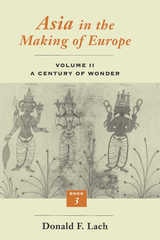
Asia in the Making of Europe, Volume II
A Century of Wonder. Book 3: The Scholarly DisciplinesDonald F. Lach
University of Chicago Press, 1994
Volume I: The Century of Discovery brings together "everything that a European could know of India, Southeast Asia, China, and Japan, from printed books, missionary reports, traders' accounts and maps" (The New York Review of Books). Volume II: A Century of Wonder examines the influence of that vast new body of information about Asia on the arts, institutions, literatures, and ideas of sixteenth-century Europe.
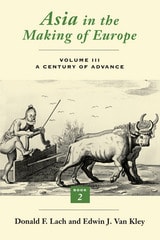
Asia in the Making of Europe, Volume III
A Century of Advance. Book 2, South AsiaDonald F. Lach and Edwin J. Van Kley
University of Chicago Press, 1993
In Volume III: A Century of Advance, the authors have researched seventeenth-century European writings on Asia in an effort to understand how contemporaries saw Asian societies and peoples.
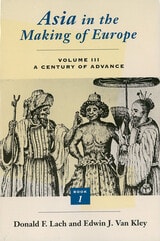
Asia in the Making of Europe, Volume III
A Century of Advance. Book 1: Trade, Missions, LiteratureDonald F. Lach and Edwin J. Van Kley
University of Chicago Press, 1993
In Volume III: A Century of Advance, the authors have researched seventeenth-century European writings on Asia in an effort to understand how contemporaries saw Asian societies and peoples.
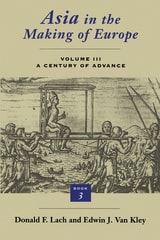
Asia in the Making of Europe, Volume III
A Century of Advance. Book 3: Southeast AsiaDonald F. Lach and Edwin J. Van Kley
University of Chicago Press, 1993
In Volume III: A Century of Advance, the authors have researched seventeenth-century European writings on Asia in an effort to understand how contemporaries saw Asian societies and peoples.
Asia in the Making of Europe, Volume III
A Century of Advance. Book 4: East AsiaDonald F. Lach and Edwin J. Van Kley
University of Chicago Press, 1993
In Volume III: A Century of Advance, the authors have researched seventeenth-century European writings on Asia in an effort to understand how contemporaries saw Asian societies and peoples.

Asia in the Making of Europe, Volume III
A Century of Advance. Books 1-4Donald F. Lach and Edwin J. Van Kley
University of Chicago Press, 1993
In Volume III: A Century of Advance, the authors have researched seventeenth-century European writings on Asia in an effort to understand how contemporaries saw Asian societies and peoples.
Asia/Pacific as Space of Cultural Production
Rob Wilson and Arif Dirlik, eds.
Duke University Press, 1995
From New Zealand to Japan, Taiwan to Hawaii, this innovative volume presents essays, poems, and memoirs by prominent Asia/Pacific writers that resist appropriation by transnational capitalism through the articulation of autonomous local identities and counter-histories of place and community. In addition, cultural critics spanning several locations and disciplines deconstruct representations—particularly those on film and in novels—that perpetuate Asia/Pacific as a realm of EuroAmerican fantasy.
This collection, a much expanded edition of boundary 2, offers a new perception of the Asia/Pacific region by presenting the Pacific not as a paradise or vast emptiness, but as a place where living, struggling peoples have constructed contemporary identities out of a long history of hegemony and resistance. Asia/Pacific as Space of Cultural Production will prove stimulating to readers with an interest in the Asia/Pacific region, and to scholars in the fields of Asian, American, Pacific, postcolonial, and cultural studies.
Contributors. Joseph P. Balaz, Chris Bongie, William A. Callahan, Thomas Carmichael, Leo Ching, Chiu Yen Liang (Fred), Chungmoo Choi, Christopher L. Connery, Arif Dirlik, John Fielder, Miriam Fuchs, Epeli Hau`ofa, Lawson Fusao Inada, M. Consuelo León W., Katharyne Mitchell, Masao Miyoshi, Steve Olive, Theophil Saret Reuney, Peter Schwenger, Subramani, Terese Svoboda, Jeffrey Tobin, Haunani-Kay Trask, John Whittier Treat, Tsushima Yuko, Albert Wendt, Rob Wilson
AsiaPacifiQueer
Rethinking Genders and SexualitiesEdited by Fran Martin, Peter A. Jackson, Mark McLelland, and Audrey Yue
University of Illinois Press, 2007
Asian Aesthetics
Ken-ichi Sasaki
National University of Singapore Press, 2011
The book is divided into five sections, dealing with Japanese, Korean, Chinese, Indian and Southeast Asian aesthetics. Individual chapters provide in-depth investigations of specific traditions, embracing both classical as well as modern aesthetic forms. The author suggest that Japanese culture is characterized by an openness to diverse cultural influences, Korean culture by "peninsularity," Chinese culture by parallels with the West, Indian culture by "rasa" (a kind of "cosmic" feeling that is distinct from one who feels), and Southeast Asian culture by dilemmas of modernization. The volume as a whole integrates these studies, clarifying essential elements of each aesthetic culture and drawing on this material to characterize an Asian civilization that transcends individual countries and cultures.