Results by title
1726 books match the query 'Film' and 139 start with a
After Hitchcock
Influence, Imitation, and IntertextualityEdited by David Boyd and R. Barton Palmer
University of Texas Press, 2006
Alfred Hitchcock is arguably the most famous director to have ever made a film. Almost single-handedly he turned the suspense thriller into one of the most popular film genres of all time, while his Psycho updated the horror film and inspired two generations of directors to imitate and adapt this most Hitchcockian of movies. Yet while much scholarly and popular attention has focused on the director's oeuvre, until now there has been no extensive study of how Alfred Hitchcock's films and methods have affected and transformed the history of the film medium.
In this book, thirteen original essays by leading film scholars reveal the richness and variety of Alfred Hitchcock's legacy as they trace his shaping influence on particular films, filmmakers, genres, and even on film criticism. Some essays concentrate on films that imitate Hitchcock in diverse ways, including the movies of Brian de Palma and thrillers such as True Lies, The Silence of the Lambs, and Dead Again. Other essays look at genres that have been influenced by Hitchcock's work, including the 1970s paranoid thriller, the Italian giallo film, and the post-Psycho horror film. The remaining essays investigate developments within film culture and academic film study, including the enthusiasm of French New Wave filmmakers for Hitchcock's work, his influence on the filmic representation of violence in the post-studio Hollywood era, and the ways in which his films have become central texts for film theorists.
Afterimage
Film, Trauma And The HolocaustJoshua Hirsch
Temple University Press, 2003
Joshua Hirsch explores the changes in documentary brought about by cinema verite, culminating in Shoah. He then turns to teh appearance of a fictional posttraumatic cinema, tracing its development through the vivid flashbacks in Resnais' Hiroshima, mon amour to the portrayal of pain and memory in Pawnbroker. He excavates a posttraumatic autobiography in three early films by the Hungarian Istvan Szabo. Finally, Hirsch examines the effects of postmodernism on posttraumatic cinema, looking at Schindler's List and a work about a different form of historical trauma, History and Memory, a videotape dealing with the internment of Japanese Americans during the Second World War.
Sweeping in its scope, Afterimage presents a new way of thinking about film and history, trauma and its representation.

Afterimages of Gilles Deleuze’s Film Philosophy
D. N. Rodowick
University of Minnesota Press, 2009
The French philosopher Gilles Deleuze was one of the most innovative and revolutionary thinkers of the twentieth century. Author of more than twenty books on literature, music, and the visual arts, Deleuze published the first volume of his two-volume study of film, Cinema 1: The Movement-Image, in 1983 and the second volume, Cinema 2: The Time-Image, in 1985. Since their publication, these books have had a profound impact on the study of film and philosophy. Film, media, and cultural studies scholars still grapple today with how they can most productively incorporate Deleuze's thought.
The first new collection of critical studies on Deleuze's cinema writings in nearly a decade, Afterimages of Gilles Deleuze's Film Philosophy provides original essays that evaluate the continuing significance of Deleuze's film theories, accounting systematically for the ways in which they have influenced the investigation of contemporary visual culture and offering new directions for research.
Contributors: Raymond Bellour, Centre Nationale de Recherches Scientifiques; Ronald Bogue, U of Georgia; Giuliana Bruno, Harvard U; Ian Buchanan, Cardiff U; James K. Chandler, U of Chicago; Tom Conley, Harvard U; Amy Herzog, CUNY; András Bálint Kovács, Eötvös Loránd U; Patricia MacCormack, Anglia Ruskin U; Timothy Murray, Cornell U; Dorothea Olkowski, U of Colorado; John Rajchman, Columbia U; Marie-Claire Ropars-Wuilleumier, U Paris VIII; Garrett Stewart, U of Iowa; Damian Sutton, Glasgow School of Art; Melinda Szaloky, UC Santa Barbara.
Aftershocks of the New
Feminism and Film HistoryPetro, Patrice
Rutgers University Press, 2001
The beginning of this century has brought with it a host of assumptions about the newness of our technologies, globalized economies, and transnational media practices. Our own time is a period marked by experiences of fragmentation, sensation, and shock. The essays here are joined by a common concern to chart another side to modernity—precisely after the shock of the new—when the new ceases to be shocking, and when the extraordinary and the sensational become linked to the boring and the everyday. Patrice Petro explores how the mechanisms of modernism, German cinema, and feminist film theory have evolved, and she discusses the directions in which they are headed.
Petro’s essays—some published here for the first time—raise such questions as: What roles do television and other media play in film studies? What is the place of feminist film theory in our conceptions of film history? How is German film theory situated within international film theory?
Rather than continue to sensationalize sensation, Aftershocks of the New aims to lower the volume of debates over the place of cinema within the culture of modernity. And it accomplishes this by locating them within a more complex matrix of contending sensibilities, voices, and impulses.
Against the Avant-Garde
Pier Paolo Pasolini, Contemporary Art, and NeocapitalismAra H. Merjian
University of Chicago Press, 2020
Agents of Liberations
Holocaust Memory in Contemporary Art and Documentary FilmZoltán Kékesi
Central European University Press, 2015
Agnes Varda
Kelley Conway
University of Illinois Press, 2015
Air Force
Edited, with an introduction by Lawrence Suid; Tino T. Balio, Series Editor
University of Wisconsin Press, 1983
Released in 1943, Air Force was immediately hailed as the definitive "patriotic heart-throb in celluloid" that America, engulfed in war and passionately bent on victory, was primed to embrace. Lawrence Suid charts the evolution of this cinematic success in his introduction to the screenplay, tracing the tangled network of artistic, military, and nationalist interests that molded this film and made it, even after the martial fervor had settled, a standard against which all future films about war would be measured.
Throughout the filming, there was tension between the aims of the War Department and those of Howard Hawks. Hawks would ultimately produce more than stilted propaganda: it is the skillfully modulated tension, the ambience of men in war, and the total immersion in action and adventure that make this a Hollywood classic still savored and studied today.
Alan Rudolph's Trouble in Mind
Tampering with MythsCaryl Flinn
University of Michigan Press, 2023
Despite a career spanning over forty years, filmmaker Alan Rudolph has flown largely under the radar of independent film scholars and enthusiasts, often remembered as Robert Altman’s protégé. Through a reading of his 1985 film Trouble in Mind, Caryl Flinn demonstrates that Rudolph is long overdue for critical re-evaluation.
Exploring Trouble in Mind’s influence on indie filmmaking, Rudolph’s dream-like style, and the external political influences of the Reagan era, Flinn effectively conveys the originality of Rudolph’s work through this multifaceted film. Utilizing archival materials and interviews with Rudolph himself and his collaborators, Flinn argues for this career-defining film’s relevance to American independent cinema and the decade of the 1980s. Amply illustrated with frame enlargements and set photographs, this book uncovers new production stories and reception contexts of a film that Flinn argues deserves a place in the limelight.
Albert Maysles
Joe McElhaney
University of Illinois Press, 2008
Alejandro González Iñárritu
Celestino Deleyto and Maria del Mar Azcona
University of Illinois Press, 2010

Alien Identities
Exploring Differences in Film and FictionEdited by Deborah Cartmell, Heidi Kaye, I. Q. Hunter, and Imelda Whelehan
Pluto Press, 1999
Alienhood
Citizenship, Exile, And The Logic Of DifferenceKatarzyna Marciniak
University of Minnesota Press, 2006
Using examples from exilic literature and cinema, including the works of Julia Alvarez, Eva Hoffman, Gregory Nava, and Roman Polanski, Alienhood theorizes multicultural experiences of liminal characters that belong in the interstices between nations. Investigating gendered, racialized, and ideological formations of “aliens,” Marciniak’s readings put into dialogue narratives from both the second world and the third world in relation to “first worldness.” This dialogue problematizes the meanings of “transnational” and brings the so-called second world into these debates. In doing so, Marciniak reorients the study of immigrant or exile subjects beyond the celebrated notion of transnationalism.
With its unique focus on “aliens” in relation to discourses of immigration, exile, and displacement, Alienhood shows how transnationality is, for many dislocated people, an unattainable privilege.
Katarzyna Marciniak is associate professor of English at Ohio University.

All about Almodóvar
A Passion for CinemaBrad Epps
University of Minnesota Press, 2009
All about Almodóvar offers new perspectives on the filmmaker’s artistic vision and cinematic preoccupations, influences, and techniques. Through overviews of his oeuvre and in-depth analyses of specific films, the essays here explore a diverse range of subjects: Almodóvar’s nuanced use of television and music in his films; his reworkings of traditional film genres such as comedy, horror, and film noir; his penchant for melodrama and its relationship to melancholy, violence, and coincidence; his intricate questioning of sexual and national identities; and his increasingly sophisticated inquiries into visuality and its limits.
Closing with Almodóvar’s own diary account of the making of Volver and featuring never-before-seen photographs from El Deseo production studio, All about Almodóvar both reflects and illuminates its subject’s dazzling eclecticism.
All for Beauty
Makeup and Hairdressing in Hollywood's Studio EraAdrienne L. McLean
Rutgers University Press, 2022
Allegories Of Underdevelopment
Aesthetics and Politics in Modern Brazilian CinemaIsmail Xavier
University of Minnesota Press, 1997
Examines the centrality of Cinema Novo to filmmaking in Brazil.
“A camera in the hand and ideas in the head” was the primary axiom of the young originators of Brazil’s Cinema Novo. This movement of the 1960s and early 1970s overcame technical constraints and produced films on minimal budgets. In Allegories of Underdevelopment, Ismail Xavier examines a number of these films, arguing that they served to represent a nation undergoing a political and social transformation into modernity.
Its best-known voice, filmmaker Glauber Rocha claimed that Cinema Novo was driven by an “aesthetics of hunger.” This scarcity of means demanded new cinematic approaches that eventually gave rise to a legitimate and unique Third World cinema. Xavier stands in the vanguard of scholars presenting and interpreting these revolutionary films—from the masterworks of Rocha to the groundbreaking experiments of Julio Bressane, Rogério Sganzerla, Andrea Tonacci and Arthur Omar—to an English-speaking audience. Focusing on each filmmaker’s use of narrative allegories for the “conservative modernization” Brazil and other nations underwent in the 1960s and 1970s, Xavier asks questions relating to the connection between film and history. He examines the way Cinema Novo transformed Brazil’s cultural memory and charts the controversial roles that Marginal Cinema and Tropicalism played in this process. Among the films he discusses are Black God, White Devil, Land in Anguish, Red Light Bandit, Macunaíma, Antônio das Mortes, The Angel Is Born, and Killed the Family and Went to the Movies.A compelling chronicle of the history of modern Brazilian cinema, Allegories of Underdevelopment brings to light the work of many filmmakers who are virtually unknown in the English-speaking world.
Alternative Realities
Carl Plantinga
Rutgers University Press, 2021
Alternative Realities explores how these distinctions between cinematic fantasy and filmic realism are more porous than we might think. Through a close analysis of CGI-heavy blockbusters like Wonder Woman and Guardians of the Galaxy, it considers how even popular fantasies are grounded in emotional and social realities. Conversely, it examines how mockumentaries like This is Spinal Tap satirically call attention to the highly stylized techniques documentarians use to depict reality.
Alternative Realities takes us on a journey through many different genres of film, from the dream-like and subjective realities depicted in movies like Eternal Sunshine of the Spotless Mind and Memento, to the astonishing twists of movies like Shutter Island and The Matrix, which leave viewers in a state of epistemic uncertainty. Ultimately, it shows us how the power of cinema comes from the unique way it fuses together the objective and the subjective, the fantastical and the everyday.

Alternative Worlds in Hollywood Cinema
James Walters
Intellect Books, 2008
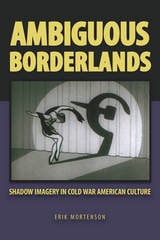
Ambiguous Borderlands
Shadow Imagery in Cold War American CultureErik Mortenson
Southern Illinois University Press, 2016
After contextualizing the postwar use of shadow imagery in the wake of the atomic bomb, Ambiguous Borderlands looks at shadows in print works, detailing the reemergence of the pulp fiction crime fighter the Shadow in the late-1950s writings of Sylvia Plath, Amiri Baraka, and Jack Kerouac. Using Freudian and Jungian conceptions of the unconscious, Mortenson then discusses Kerouac’s and Allen Ginsberg’s shared dream of a “shrouded stranger” and how it shaped their Beat aesthetic. Turning to the visual, Mortenson examines the dehumanizing effect of shadow imagery in the Cold War photography of Robert Frank, William Klein, and Ralph Eugene Meatyard. Mortenson concludes with an investigation of the use of chiaroscuro in 1950s film noir and the popular television series The Twilight Zone, further detailing how the complexities of Cold War society were mirrored across these media in the ubiquitous imagery of light and dark.
From comics to movies, Beats to bombs, Ambiguous Borderlands provides a novel understanding of the Cold War cultural context through its analysis of the image of the shadow in midcentury media. Its interdisciplinary approach, ambitious subject matter, and diverse theoretical framing make it essential reading for anyone interested in American literary and popular culture during the fifties and sixties.
American Blockbuster
Movies, Technology, and WonderCharles R. Acland
Duke University Press, 2020
American Cinema 1890-1909
Themes and VariationsGaudreault, Andre
Rutgers University Press, 2009
The essays in American Cinema 1890-1909 explore and define how the making of motion pictures flowered into an industry that would finally become the central entertainment institution of the world. Beginning with all the early types of pictures that moved, this volume tells the story of the invention and consolidation of the various processes that gave rise to what we now call "cinema." By examining the battles over patents, production, exhibition, and the reception of film, readers learn how going to the movies became a social tradition in American society.
In the course of these two decades, cinema succeeded both in establishing itself among other entertainment and instructional media and in updating various forms of spectacle.
American Cinema of the 1910s
Themes and VariationsKeil, Charlie
Rutgers University Press, 2009
The essays in American Cinema of the 1910s explore the rapid developments of the decade that began with D. W. Griffith's unrivaled one-reelers. By mid-decade, multi-reel feature films were profoundly reshaping the industry and deluxe theaters were built to attract the broadest possible audience. Stars like Mary Pickford, Charlie Chaplin, and Douglas Fairbanks became vitally important and companies began writing high-profile contracts to secure them. With the outbreak of World War I, the political, economic, and industrial groundwork was laid for American cinema's global dominance. By the end of the decade, filmmaking had become a true industry, complete with vertical integration, efficient specialization and standardization of practices, and self-regulatory agencies.
American Cinema of the 1920s
Themes and VariationsFischer, Lucy
Rutgers University Press, 2009
In ten original essays, American Cinema of the 1920s examines the film industry's continued growth and prosperity while focusing on important themes of the era.
American Cinema of the 1930s
Themes and VariationsHark, Ina Rae
Rutgers University Press, 2007
The ten original essays in American Cinema of the 1930s focus on sixty diverse films of the decade, including Dracula, The Public Enemy, Trouble in Paradise, 42nd Street, King Kong, Imitation of Life, The Adventures of Robin Hood, Swing Time, Angels with Dirty Faces, Nothing Sacred, Jezebel, Mr. Smith Goes toWashington, and Stagecoach .
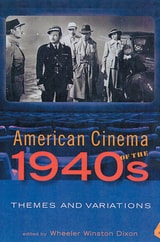
American Cinema of the 1940s
Themes and VariationsDixon, Wheeler Winston
Rutgers University Press, 2005
The 1940s was a watershed decade for American cinema and the nation. Shaking off the grim legacy of the Depression, Hollywood launched an unprecedented wave of production, generating some of its most memorable classics, including Citizen Kane, Rebecca, The Lady Eve, Sergeant York, and How Green Was My Valley. In 1942, Hollywood joined the national war effort with a vengeance, creating a series of patriotic and escapist films, such as Casablanca, Mrs. Miniver, The Road to Morocco, and Yankee Doodle Dandy.
With the end of the war, returning GIs faced a new America, in which the country had been transformed overnight. Film noir reflected a new public mood of pessimism and paranoia, in such classic films of betrayal and conflict as Kiss of Death, Force of Evil, Caught, and Apology for Murder, depicting a poisonous universe of femme fatales, crooked lawyers, and corrupt politicians.
With the threat of the atom bomb lurking in the background and the beginnings of the Hollywood Blacklist, the 1940s was a decade of crisis and change. Featuring essays by a group of respected film scholars and historians, American Cinema of the 1940s brings this dynamic and turbulent decade to life. Illustrated with many rare stills and filled with provocative insights, the volume will appeal to students, teachers, and to all those interested in cultural history and American film of the twentieth century.
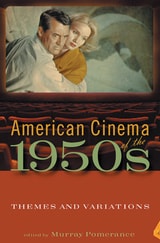
American Cinema of the 1950s
Themes and VariationsPomerance, Murray
Rutgers University Press, 2005
From cold war hysteria and rampant anticommunist witch hunts to the lure of suburbia, television, and the new consumerism, the 1950s was a decade of sensational commercial possibility coupled with dark nuclear fears and conformist politics. Amid this amalgamation of social, political, and cultural conditions, Hollywood was under siege: from the Justice Department, which pressed for big film companies to divest themselves of their theater holdings; from the middleclass, whose retreat to family entertainment inside the home drastically decreased the filmgoing audience; and from the House Un-American Activities Committee, which was attempting to purge the country of dissenting political views. In this difficult context, however, some of the most talented filmmakers of all time, including John Ford, Alfred Hitchcock, Vincente Minnelli, Nicholas Ray, and Billy Wilder produced some of their most remarkable work.
Bringing together original essays by ten respected scholars in the field, American Cinema of the 1950s explores the impact of the cultural environment of this decade on film, and the impact of film on the American cultural milieu. Contributors examine the signature films of the decade, including From Here to Eternity, Sunset Blvd., Singin' in the Rain, Shane, Rear Window, and Rebel Without a Cause, as well as lesser-known but equally compelling films, such as Dial 1119, Mystery Street, Suddenly, Summer Stock, The Last Hunt, and many others.
Provocative, engaging, and accessible to general readers as well as scholars, this volume provides a unique lens through which to view the links between film and the prevailing social and historical events of the decade.
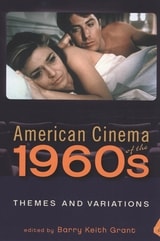
American Cinema of the 1960s
Themes and VariationsGrant, Barry Keith
Rutgers University Press, 2008
At the same time, American cinema underwent radical change as well. The studio system crumbled, and the Production Code was replaced by a new ratings system. Among the challenges faced by the film industry was the dawning shift in theatrical exhibition from urban centers to surburban multiplexes, an increase in runaway productions, the rise of independent producers, and competition from both television and foreign art films. Hollywood movies became more cynical, violent, and sexually explicit, reflecting the changing values of the time.
In ten original essays, American Cinema of the 1960s examines a range of films that characterized the decade, including Hollywood movies, documentaries, and independent and experimental films. Among the films discussed are Elmer Gantry, The Apartment, West Side Story, The Manchurian Candidate, To Kill a Mockingbird, Cape Fear, Bonnie and Clyde, 2001: A Space Odyssey, Midnight Cowboy, and Easy Rider.
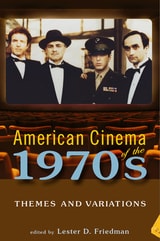
American Cinema of the 1970s
Themes and VariationsFriedman, Lester D
Rutgers University Press, 2007
Far from a placid era, the seventies was a decade of social upheavals. Events such as the killing of students at Kent State and Jackson State universities, the Watergate investigations, the legalization of abortion, and the end of the American involvement in Vietnam are only a few among the many landmark occurrences that challenged the foundations of American culture. The director-driven movies of this era reflect this turmoil, experimenting with narrative structures, offering a gallery of scruffy antiheroes, and revising traditional genre conventions.
Bringing together ten original essays, American Cinema of the 1970s examines the range of films that marked the decade, including Jaws, Rocky, Love Story, Shaft, Dirty Harry, The Godfather, Deliverance, The Exorcist, Shampoo, Taxi Driver, Star Wars, Saturday Night Fever, Kramer vs. Kramer,and Apocalypse Now .
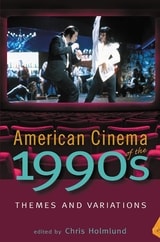
American Cinema of the 1990s
Themes and VariationsHolmlund, Chris
Rutgers University Press, 2008
The essays in American Cinema of the 1990s examine the big-budget blockbusters and critically acclaimed independent films that defined the decade. The 1990s' most popular genre, action, channeled anxieties about global threats such as AIDS and foreign terrorist attacks into escapist entertainment movies. Horror films and thrillers were on the rise, but family-friendly pictures and feel-good romances netted big audiences too. Meanwhile, independent films captured hearts, engaged minds, and invaded Hollywood: by decade's end every studio boasted its own "art film" affiliate.
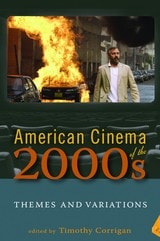
American Cinema of the 2000s
Themes and VariationsCorrigan, Timothy
Rutgers University Press, 2012
The decade from 2000 to 2009 is framed, at one end, by the traumatic catastrophe of the 9/11 attacks on the World Trade Center and, at the other, by the election of the first African American president of the United States. In between, the United States and the world witnessed the rapid expansion of new media and the Internet, such natural disasters as Hurricane Katrina, political uprisings around the world, and a massive meltdown of world economies.
Amid these crises and revolutions, American films responded in multiple ways, sometimes directly reflecting these turbulent times, and sometimes indirectly couching history in traditional genres and stories. In American Cinema of the 2000s, essays from ten top film scholars examine such popular series as the groundbreaking Matrix films and the gripping adventures of former CIA covert operative Jason Bourne; new, offbeat films like Juno; and the resurgence of documentaries like Michael Moore’s Fahrenheit 9/11. Each essay demonstrates the complex ways in which American culture and American cinema are bound together in subtle and challenging ways.
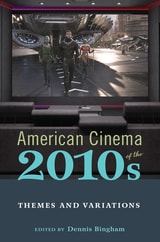
American Cinema of the 2010s
Themes and VariationsDennis Bingham
Rutgers University Press, 2022
The newest installment in the Screen Decades series, American Cinema in the 2010s takes a close look at the memorable movies, visionary filmmakers, and behind-the-scenes drama that made this decade such an exciting time to be a moviegoer. Each chapter offers an in-depth examination of a specific year, covering a wide variety of films, from blockbuster superhero movies like Black Panther and animated films like Frozen to smaller-budget biopics like I, Tonya and horror films like Hereditary. This volume introduces readers to a decade in which established auteurs like Quentin Tarantino were joined by an exceptionally diverse set of new talents, taking American cinema in new directions.
American Drama in the Age of Film
Zander Brietzke
University of Alabama Press, 2007
Is theater really dead? Does the theater, as its champions insist, really provide a more intimate experience than film? If so, how have changes in cinematic techniques and technologies altered the relationship between stage and film? What are the inherent limitations of representing three-dimensional spaces in a two-dimensional one, and vice versa?
American Drama in the Age of Film examines the strengths and weaknesses of both the dramatic and cinematic arts to confront the standard arguments in the film-versus-theater debate. Using widely known adaptations of ten major plays, Brietzke seeks to highlight the inherent powers of each medium and draw conclusions not just about how they differ, but how they ought to differ as well. He contrasts both stage and film productions of, among other works, David Mamet’s Glengarry Glen Ross, Sam Shepard’s True West, Edward Albee’s Who’s Afraid of Virginia Woolf, Margaret Edson’s Wit, Tony Kushner’s Angels in America, Tennessee Williams’s Cat on a Hot Tin Roof, Arthur Miller’s Death of a Salesman, and August Wilson’s The Piano Lesson. In reading the dual productions of these works, Brietzke finds that cinema has indeed stolen much of theater’s former thunder, by making drama more intimate, and visceral than most live events.
But theater is still vital and matters greatly, Brietzke argues, though for reasons that run counter to many of the virtues traditionally attributed to it as an art form, such as intimacy and spontaneity. Brietzke seeks to revitalize perceptions of theater by challenging those common pieties and offering a new critical paradigm, one that champions spectacle and simultaneity as the most, not least, important elements of drama.
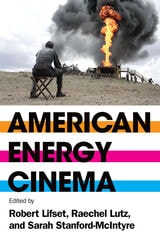
American Energy Cinema
Robert Lifset
West Virginia University Press, 2023
Historians investigate the relationships between film, culture, and energy.
American Energy Cinema explores how Hollywood movies have portrayed energy from the early film era to the present. Looking at classics like Giant, Silkwood, There Will Be Blood, and Matewan, and at quirkier fare like A Is for Atom and Convoy, it argues that films have both reflected existing beliefs and conjured new visions for Americans about the role of energy in their lives and their history.
The essays in this collection show how film provides a unique and informative lens to understand perceptions of energy production, consumption, and infrastructure networks. By placing films that prominently feature energy within historical context and analyzing them as historical objects, the contributing authors demonstrate how energy systems of all kinds are both integral to the daily life of Americans and inextricable from larger societal changes and global politics.
American Film Cycles
Reframing Genres, Screening Social Problems, and Defining SubculturesBy Amanda Ann Klein
University of Texas Press, 2011
A series of movies that share images, characters, settings, plots, or themes, film cycles have been an industrial strategy since the beginning of cinema. While some have viewed them as "subgenres," mini-genres, or nascent film genres, Amanda Ann Klein argues that film cycles are an entity in their own right and a subject worthy of their own study. She posits that film cycles retain the marks of their historical, economic, and generic contexts and therefore can reveal much about the state of contemporary politics, prevalent social ideologies, aesthetic trends, popular desires, and anxieties.
American Film Cycles presents a series of case studies of successful film cycles, including the melodramatic gangster films of the 1920s, the 1930s Dead End Kids cycle, the 1950s juvenile delinquent teenpic cycle, and the 1990s ghetto action cycle. Klein situates these films in several historical trajectories—the Progressive movement of the 1910s and 1920s, the beginnings of America's involvement in World War II, the "birth" of the teenager in the 1950s, and the drug and gangbanger crises of the early 1990s. She shows how filmmakers, audiences, film reviewers, advertisements, and cultural discourses interact with and have an impact on the film texts. Her findings illustrate the utility of the film cycle in broadening our understanding of established film genres, articulating and building upon beliefs about contemporary social problems, shaping and disseminating deviant subcultures, and exploiting and reflecting upon racial and political upheaval.
American Films of the 70s
Conflicting VisionsBy Peter Lev
University of Texas Press, 2000
While the anti-establishment rebels of 1969's Easy Rider were morphing into the nostalgic yuppies of 1983's The Big Chill, Seventies movies brought us everything from killer sharks, blaxploitation, and disco musicals to a loving look at General George S. Patton. Indeed, as Peter Lev persuasively argues in this book, the films of the 1970s constitute a kind of conversation about what American society is and should be—open, diverse, and egalitarian, or stubbornly resistant to change.
Examining forty films thematically, Lev explores the conflicting visions presented in films with the following kinds of subject matter:
- Hippies (Easy Rider, Alice's Restaurant)
- Cops (The French Connection, Dirty Harry)
- Disasters and conspiracies (Jaws, Chinatown)
- End of the Sixties (Nashville, The Big Chill)
- Art, Sex, and Hollywood (Last Tango in Paris)
- Teens (American Graffiti, Animal House)
- War (Patton, Apocalypse Now)
- African-Americans (Shaft, Superfly)
- Feminisms (An Unmarried Woman, The China Syndrome)
- Future visions (Star Wars, Blade Runner)
As accessible to ordinary moviegoers as to film scholars, Lev's book is an essential companion to these familiar, well-loved movies.
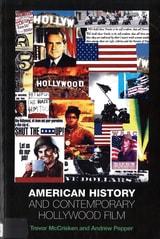
American History and Contemporary Hollywood Film
McCrisken, Trevor
Rutgers University Press, 2005
Hollywood has always been fascinated by America's past, but never more so than in the past fifteen years. Bringing exciting new perspectives to how and why Hollywood has sought to repicture American history, this book offers analysis of more than twenty mainstream contemporary films, including The Patriot, Amistad, Glory, Ride with the Devil, Cold Mountain, Saving Private Ryan, TheThin Red Line, Pearl Harbor, U-571, Platoon, Born on the Fourth of July, Heaven and Earth, JFK, Nixon, Malcolm X, Ali, Black Hawk Down, and Three Kings.
Both authoritative and engaging, American History and Contemporary Hollywood Film is the first book to comprehensively explore the post-cold war period of filmmaking, and to navigate the complex ways that film mediates history-sometimes challenging or questioning, but more frequently reaffirming traditional interpretations. The authors consider why such films are becoming increasingly integral to the ambitions of a globally focused American film industry.
Structured by historical periods, chapters cover significant events and eras such as the American Revolution, slavery and the Civil War, World War II, the sixties and seventies, civil rights and black nationalism, the Vietnam War, and post-cold war global conflicts. The lessons learned from the examples will be illuminating for general readers and college students alike.
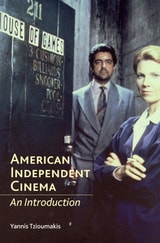
American Independent Cinema
An IntroductionTzioumakis, Yannis
Rutgers University Press, 2006
From the prestige films of Cagney Productions to recent, ultra-low budget cult hits, such as Clerks and The Blair Witch Project, American independent cinema has produced some of the most distinctive films ever made. This comprehensive introduction draws on key films, filmmakers, and film companies from the early twentieth century to the present to examine the factors that shaped this vital and evolving mode of filmmaking.
Specifically, it explores the complex and dynamic relations between independent and mainstream Hollywood cinema, showing how institutional, industrial, and economic changes in the latter have shaped and informed the former. Ordered chronologically, the book begins with Independent Filmmaking in the Studio Era (examining both top-rank and low-end film production), moves to the 1950s and 1960s (discussing both the adoption of independent filmmaking as the main method of production as well as exploitation filmmaking), and finishes with contemporary American independent cinema (exploring areas such as the New Hollywood, the rise of mini-major and major independent companies and the institutionalization of independent cinema in the 1990s). Each chapter includes case studies which focus on specific films, filmmakers, and production and distribution companies.
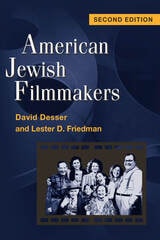
American Jewish Filmmakers
David Desser and Lester D. Friedman
University of Illinois Press, 2003
The effects of the Holocaust linger, both in gripping dramatic form (Mazursky's Enemies, a Love Story) and in black comedy (Brooks's The Producers). In his trilogy consisting of Serpico, Prince of the City, and Q&A, Lumet focuses on the failure of society's institutions to deliver social justice. Woody Allen portrays urban life and family relationships (Manhattan and Hannah and Her Sisters), sometimes with a nostalgic twist (Radio Days).
This edition concludes with a newly written discussion of the careers of other prominent Jewish filmmakers such as Steven Spielberg, Barry Levinson, Brian Singer, and Darren Aronofsky.
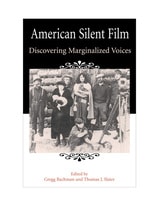
American Silent Film
Discovering Marginalized VoicesEdited by Gregg Bachman and Thomas J. Slater
Southern Illinois University Press, 2002
Gregg Bachman and Thomas J. Slater present an array of essays that reveal the incredible complexity of silent films and the era in which they were produced. Essentially, silent films conjure the names of Mary Pickford and a few white men, including Charlie Chaplin and D. W. Griffith. These eleven essays, however, demonstrate that minorities and women other than Pickford also responded to the times through film. The contributors deal with changing American society at a crucial time, examining our hopes and fears as a nation during the silent film era.
Opening new vistas, this book introduces us to people, films, issues, and concepts that few of us have encountered. One example is screenwriter June Mathis, who wrote more than one hundred scripts, brought Rudolph Valentino to stardom, and supervised all productions at the Goldwyn Studios in 1923. Equally intriguing is Nita Naldi, whose career and tragic life speak volumes about America’s combined fascination with and fear of ethnic minorities. Other key players in the drama of silent films include John Randolph Bray (animated cartoons), Roscoe “Fatty” Arbuckle, and female producer, writer, and director Nell Shipman.
Contributors are Kay Armatage, Jean Chateauvert, Maureen Furniss, Mark Langer, Anne Morey, Diane Negra, George Potamianos, Joanna Rapf, Thomas J. Slater, Sam Stoloff, and Judith Thissen.
Seventeen illustrations enliven this study of silent film.
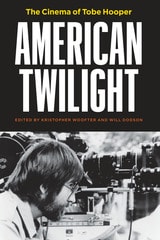
American Twilight
The Cinema of Tobe HooperBy Kristopher Woofter and Will Dodson
University of Texas Press, 2021
A master of gritty horror, Tobe Hooper captured on-screen an America in constant crisis and upended myths of prosperity to reveal the country’s internal decay.
Tobe Hooper's productions, which often trespassed upon the safety of the family unit, cast a critical eye toward an America in crisis. Often dismissed by scholars and critics as a one-hit wonder thanks to his 1974 horror classic The Texas Chain Saw Massacre, Hooper nevertheless was instrumental in the development of a robust and deeply political horror genre from the 1960s until his death in 2017. In American Twilight, the authors assert that the director was an auteur whose works featured complex monsters and disrupted America’s sacrosanct perceptions of prosperity and domestic security.
American Twilight focuses on the skepticism toward American institutions and media and the articulation of uncanny spaces so integral to Hooper’s vast array of feature and documentary films, made-for-television movies, television episodes, and music videos. From Egg Shells (1969) to Poltergeist (1982), Djinn (2013), and even Billy Idol’s music video for “Dancing with Myself” (1985), Tobe Hooper provided a singular directorial vision that investigated masculine anxiety and subverted the idea of American exceptionalism.
American War Stories
Brenda M. Boyle
Rutgers University Press, 2021

Amusement, Inc.
Disneyland’s Corporate Apparatus and the Making of the Theme ParkRoland Betancourt
Duke University Press, 2027
An Aesthetics of Narrative Performance
Transnational Theater, Literature, and Film in Contemporary GermanyClaudia Breger
The Ohio State University Press, 2012
An Amorous History of the Silver Screen
Shanghai Cinema, 1896-1937Zhang Zhen
University of Chicago Press, 2005
The first sustained historical study of the emergence of cinema in China, An Amorous History of the Silver Screen is a fascinating narrative that illustrates the immense cultural significance of film and its power as a vehicle for social change. Named after a major feature film on the making of Chinese cinema, only part of which survives, An Amorous History of the Silver Screen reveals the intricacies of this cultural movement and explores its connections to other art forms such as photography, architecture, drama, and literature. In light of original archival research, Zhang Zhen examines previously unstudied films and expands the important discussion of how they modeled modern social structures and gender roles in early twentieth-century China.
The first volume in the new and groundbreaking series Cinema and Modernity, An Amorous History of the Silver Screen is an innovative—and well illustrated—look at the cultural history of Chinese modernity through the lens of this seminal moment in Shanghai cinema.
An Archaeology of Sympathy
The Sentimental Mode in Literature and CinemaJames Chandler
University of Chicago Press, 2013
An Eye for Hitchcock
Pomerance, Murray
Rutgers University Press, 2004
In An Eye for Hitchcock, these movies are seen in a striking new way. Pomerance takes us deep into the structure of Hitchcock’s vision and his screen architecture, revealing key elements that have never been written about before. Pomerance also clearly reveals the link between Hitchcock’s work and a wide range of thinkers and artists in other fields, thereby offering viewers of Hitchcock’s films the rare opportunity to see them in an entirely new light.
Analyzing Performance
Theater, Dance, and FilmPatrice Pavis
University of Michigan Press, 2003
Anarchitectural Experiments
When Unbuilt Designs Turn to FilmMaciej Stasiowski
Intellect Books, 2022
This book outlines the impact of film and animation on architectural representation through key projects. The opening analysis is useful in contextualizing speculative architectural projects, while the later chapters link the theory to imagery. To support his argument, Maciej Stasiowski here curates a diverse collection of interesting case studies that are accessible and easy to read.
Through its comprehensive review of speculative architecture and various media that describe it, Stasiowski’s book sets itself apart from other works in the discipline by discussing speculative projects that engage with cinematic strategies of portrayal and specifically the effect that modern technologies have on the subject now and in its potential futures. This thorough examination of the use of cinema and animation as a method of architectural visualization offers insights into a converging field of architectural and filmic disciplines and will appeal to architects and designers, filmmakers, academics, artists, set designers, and film production designers.
Andrei Tarkovsky
Elements of CinemaRobert Bird
Reaktion Books, 2008
Bird brings a novel approach to his dissection of Tarkovsky’s wholly original techniques and sensibilities, arranging the films into elemental categories of Water, Fire, Earth, and Air. Solaris, Ivan’s Childhood, Mirror, Nostalgia, Andrei Rublev, and Sacrifice all get their due here; through them, Bird explores how the filmmaker probed the elusive correlation between cinematic representation and a more primeval perception of the world. Though the book also considers Tarkovsky’s work in radio, theatre, and opera—as well as his work as an actor, screenwriter, and film theorist—Bird throughout keeps his focus firmly on Tarkovsky as a consummate filmmaker.
Animated Personalities
Cartoon Characters and Stardom in American Theatrical ShortsBy David McGowan
University of Texas Press, 2019
A CHOICE Outstanding Academic Title, 2019
Mickey Mouse, Betty Boop, Donald Duck, Bugs Bunny, Felix the Cat, and other beloved cartoon characters have entertained media audiences for almost a century, outliving the human stars who were once their contemporaries in studio-era Hollywood. In Animated Personalities, David McGowan asserts that iconic American theatrical short cartoon characters should be legitimately regarded as stars, equal to their live-action counterparts, not only because they have enjoyed long careers, but also because their star personas have been created and marketed in ways also used for cinematic celebrities.
Drawing on detailed archival research, McGowan analyzes how Hollywood studios constructed and manipulated the star personas of the animated characters they owned. He shows how cartoon actors frequently kept pace with their human counterparts, granting “interviews,” allowing “candid” photographs, endorsing products, and generally behaving as actual actors did—for example, Donald Duck served his country during World War II, and Mickey Mouse was even embroiled in scandal. Challenging the notion that studios needed actors with physical bodies and real off-screen lives to create stars, McGowan demonstrates that media texts have successfully articulated an off-screen existence for animated characters. Following cartoon stars from silent movies to contemporary film and television, this groundbreaking book broadens the scope of star studies to include animation, concluding with provocative questions about the nature of stardom in an age of digitally enhanced filmmaking technologies.