Results by title
18284 books match the query 'United States' and 1653 start with a

Americana Portrait Sessions
Jeff Fasano
Vanderbilt University Press, 2023
Fasano's unparalleled access to Americana artists like Sheryl Crow, Rhiannon Giddens, Vince Gill, Keb' Mo', Judy Collins, John Oates, The Avett Brothers, The McCrary Sisters, Lucinda Williams, Margo Price, Blind Boys of Alabama, and Kris Kristofferson gives Americana Portrait Sessions the kind of authority that comes from true reach into the breadth of the genre. But this collection is as important for the artists few fans know as for the ones with successful careers behind them. While the book champions the diversity of race, gender, sexuality, and age inherent in Americana music, it also spans career arcs to bring lesser-known acts into the spotlight.
Americana Portrait Sessions brings you backstage to the greenrooms and quiet corners where artists like The War and Treaty, Jewel, Jason Isbell, and The Wooten Brothers aren't just artists performing, but people hanging out.
Americanization, Acculturation, and Ethnic Identity
The Nisei Generation in HawaiiEileen H. Tamura
University of Illinois Press, 1994
Wartime hysteria over "foreign" ways fueled a movement for Americanization that swept the United States during and after World War I. Eileen H. Tamura examines the forms that hysteria took in Hawai'i, where the Nisei (children of Japanese immigrants) were targets of widespread discrimination.
Tamura analyzes Hawaii's organized effort to force the Nisei to adopt "American" ways, discussing it within the larger phenomenon of Nisei acculturation. While racism was prevalent in "paradise," the Nisei and their parents also performed as active agents in their own lives, with the older generation attempting to maintain Japanese cultural ways and the younger wishing to become "true Americans." Caucasian "Americanizers," often associated with powerful agricultural interests, wanted labor to remain cheap and manageable; they lobbied for racist laws and territorial policies, portending the treatment of ethnic Japanese on the U.S. mainland during World War II.
Tamura offers a wealth of original source material, using personal accounts as well as statistical data to create an essential resource for students of American ethnic history and U.S. race and class relations.
Americans All
Good Neighbor Cultural Diplomacy in World War IIBy Darlene J. Sadlier
University of Texas Press, 2012
Cultural diplomacy—“winning hearts and minds” through positive portrayals of the American way of life—is a key element in U.S. foreign policy, although it often takes a backseat to displays of military might. Americans All provides an in-depth, fine-grained study of a particularly successful instance of cultural diplomacy—the Office of the Coordinator of Inter-American Affairs (CIAA), a government agency established by President Franklin D. Roosevelt in 1940 and headed by Nelson A. Rockefeller that worked to promote hemispheric solidarity and combat Axis infiltration and domination by bolstering inter-American cultural ties.
Darlene J. Sadlier explores how the CIAA used film, radio, the press, and various educational and high-art activities to convince people in the United States of the importance of good neighbor relations with Latin America, while also persuading Latin Americans that the United States recognized and appreciated the importance of our southern neighbors. She examines the CIAA’s working relationship with Hollywood’s Motion Picture Society of the Americas; its network and radio productions in North and South America; its sponsoring of Walt Disney, Orson Welles, John Ford, Gregg Toland, and many others who traveled between the United States and Latin America; and its close ties to the newly created Museum of Modern Art, which organized traveling art and photographic exhibits and produced hundreds of 16mm educational films for inter-American audiences; and its influence on the work of scores of artists, libraries, book publishers, and newspapers, as well as public schools, universities, and private organizations.
Americans First
Chinese Americans and the Second World WarK. Scott Wong
Temple University Press, 2008
In Americans First, K. Scott Wong uses archival research and oral histories to provide the first detailed account of Chinese Americans in the American military. Wong traces the history of the 14th Air Service Group, a segregated outfit of Chinese Americans sent to China in support of the American Army Air Corps and the Chinese Air Force. His ethnic history of inclusion shows how this new generation of Chinese Americans was more socially accepted, moving from the margins of society into the American mainstream during a time of pervasive racism.
Americans View Their Dust Bowl Experience
John R. Wunder
University Press of Colorado, 2001
Americans and Their Land
The House Built on AbundanceAnne Mackin
University of Michigan Press, 2006
—James Carroll, author of House of War and An American Requiem, winner of the National Book Award
“Anne Mackin has taken a fresh and provocative look at that most fascinating of relationships: the one between the American people and the American land.”
—Michael Pollan, Knight Professor of Journalism and Director of the Knight Program in Science and Environmental Journalism at University of California Berkeley, contributing writer to the New York Times Magazine, and author of The Omnivore's Dilemma and The Botany of Desire
“Anne Mackin has given us a valuable and less-used lens to view the development of our neighborhoods, towns and cities: the land itself. Our relationship to the earth beneath our feet—how we dig it, buy it, sell it, zone it, pave it, spoil it or pamper it—helps explain what is produced on top of the land in our nation, from farms to homes to skyscrapers. All in all, Mackin takes us on a novel and erudite journey, from one coast to the other, and from Colonial times to the present. This valuable book marks a significant and lasting contribution to the way we see and understand our landscape and ourselves.”
—Alex Marshall, author of How Cities Work: Suburbs, Sprawl, and the Roads Not Taken
“To really understand the origins of the range war now raging between smart growth and property rights advocates over the future of the American land, you need to read this exceptional book.”
—Robert D. Yaro, President Regional Plan Association and Professor in Practice, University of Pennsylvania
Thomas Malthus once said, “The happiness of the Americans depended much less upon their peculiar degree of civilization than . . . upon their having a great plenty of fertile uncultivated land.”
Malthus knew. Lord MacCaulay knew. Albert Gallatin knew. America and its people would change as a growing population whittled away the supply of land.
Nothing has shaped the American character like the abundance of land that met the colonist, the pioneer, and the early suburbanite. With today’s political and economic institutions shaped by the largesse of yesteryear, how will Americans fare in the new landscape of water wars, expensive housing, rising fuel prices, environmental and property rights battles, and powerful industrial lobbies?
Why is land the key to American democracy? How can we protect our democracy as more people and industries compete more intensively for our remaining resources? Americans and Their Land begins an important, overdue discussion of these questions. Anne Mackin takes the reader story by story from frontier history to the present and shows how land shaped the American political landscape. She shows how our evolving traditions of apportioning resources have allowed diminished supplies to create our present, increasingly unequal society, and she asks how 300 million Americans living in the new American landscape of growing competition can better share those resources.
Americans and the Holocaust
A ReaderDaniel Greene
Rutgers University Press, 2021
Americans and the Holocaust explores these enduring questions by gathering together more than one hundred primary sources that reveal how Americans debated their responsibility to respond to Nazism. Drawing on groundbreaking research conducted for the United States Holocaust Memorial Museum’s Americans and the Holocaust exhibition, these carefully chosen sources help readers understand how Americans’ responses to Nazism were shaped by the challenging circumstances in the United States during the 1920s, 1930s, and 1940s, including profound economic crisis, fear of communism, pervasive antisemitism and racism, and widespread isolationism.
Collecting newspaper and magazine articles, popular culture materials, and government records, Americans and the Holocaust is a valuable resource for students and historians seeking to shed light on this dark era in world history.
To explore further, visit the United States Holocaust Memorial Museum's digital exhibit, available here: https://exhibitions.ushmm.org/americans-and-the-holocaust
Published in association with the United States Holocaust Memorial Museum.
Americans in the Treasure House
Travel to Porfirian Mexico and the Cultural Politics of EmpireBy Jason Ruiz
University of Texas Press, 2014
When railroads connected the United States and Mexico in 1884 and overland travel between the two countries became easier and cheaper, Americans developed an intense curiosity about Mexico, its people, and its opportunities for business and pleasure. Indeed, so many Americans visited Mexico during the Porfiriato (the long dictatorship of Porfirio Díaz, 1876–1911) that observers on both sides of the border called the hordes of tourists and business speculators a “foreign invasion,” an apt phrase for a historical moment when the United States was expanding its territory and influence.
Americans in the Treasure House examines travel to Mexico during the Porfiriato, concentrating on the role of travelers in shaping ideas of Mexico as a logical place for Americans to extend their economic and cultural influence in the hemisphere. Analyzing a wealth of evidence ranging from travelogues and literary representations to picture postcards and snapshots, Jason Ruiz demonstrates that American travelers constructed Mexico as a nation at the cusp of modernity, but one requiring foreign intervention to reach its full potential. He shows how they rationalized this supposed need for intervention in a variety of ways, including by representing Mexico as a nation that deviated too dramatically from American ideals of progress, whiteness, and sexual self-control to become a modern “sister republic” on its own. Most importantly, Ruiz relates the rapid rise in travel and travel discourse to complex questions about national identity, state power, and economic relations across the U.S.–Mexico border.
Americans, Congress, and Democratic Responsiveness
Public Evaluations of Congress and Electoral ConsequencesDavid R. Jones and Monika L. McDermott
University of Michigan Press, 2010
rampant in the political science literature, Jones and McDermott show that the people are in control, determining not only the direction of policy in Congress, but also who stays, who retires, and who faces difficult reelection efforts. This book makes an important correction to our understanding of how Congress operates."
---Sean M. Theriault, University of Texas at Austin
Americas Jews
Chaim Waxman
Temple University Press, 1983
The book is a social history and sociology of American Jewry. It provides an up-to-date analysis of the contemporary American Jewish community, an analysis that includes educational, occupational, income, and political patterns of American Jews; the American Jewish family; anti-semitism; the relationship between American Jews and Israel; and the recent immigration of Soviet, Israeli, and Iranian Jews to the USA.
In synthesizing a vast array of empirical studies, the author argues that while American Jews have been successful in their quest to integrate into the American social system, recent developments both in the American social and cultural system, at large, and within the Jewish community, in particular, indicate that this ethno-religious group is confronting the challenge to its continuity and its manifesting survivalist strengths which were not readily apparent in earlier generations.
America's Jews in Transition should interest students in a wide range of fields, among them sociology, ethnic studies, Jewish studies, American studies, and religious studies. Because of its breadth and the freshness of its material, the book should also appeal to the general reader.
America’s Hardscrabble General
Ulysses S. Grant, from Farm Boy to ShilohJack Hurst
Southern Illinois University Press, 2022
Renowned for his skill, courage, and indomitability during the Civil War, Ulysses S. Grant is considered a model for outstanding American generalship. However, unlike most of his fellow officers, Grant came from humble Midwestern beginnings and experienced a number of professional failures before rising to military prominence.
Grant grew up on a farm on the Ohio frontier and reluctantly attended West Point, where he finished in the middle of his class. In his early army career, he was often underestimated by his peers despite valiant service. After the Mexican War Grant’s “Hardscrabble” farm outside St. Louis failed, and when he decided to rejoin the U.S. army, he was given the unenviable command of a rowdy volunteer regiment, the 21st Illinois.
How did Grant—an average student, failed farmer, and common man—turn the 21st Illinois into a showcase regiment and become a successful general? In this engaging analysis, Jack Hurst argues that Grant’s military brilliance stemmed not from his West Point education but rather from his roots in America’s lower middle class and its commonsense values. His upbringing in the antebellum rural Midwest undergirded his military skill and helped him develop an innate humility, sense of justice, and ability to focus, leading him to form close relationships with his men.
Through a detailed account of Grant’s early years, from boyhood through the Battle of Shiloh, Hurst explores how Grant’s modest start and experiences in the Mexican War prefigured his greatest military triumphs. Ultimately Grant abandoned the traditional military practice of his time, which relied upon maneuver, and instead focused on fighting. His strategy to always move forward, win or lose, turned even his losses into essential elements of victory and characterized the aggressive, relentless approach that would ultimately win the Civil War and save the Union.
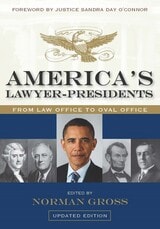
America’s Lawyer-Presidents
From Law Office to Oval OfficeNorman Gross
Northwestern University Press, 2009
The historic election of Barack Obama was rife with references to Abraham Lincoln, perhaps the greatest lawyer-president, whose legal career spanned 25 years and 5,100 cases. President Obama’s ties to Lincoln are part of a great tradition begun by John Adams, the first lawyer-president, who combined a twenty-year law practice with major contributions to our nation’s founding charters. His son, John Quincy Adams, argued landmark U.S. Supreme Court cases both before and after his presidency, one of eight lawyer-presidents to appear as counsel before the highest court in the land. And Rutherford B. Hayes and Benjamin Harrison were among those lawyer-presidents who handled notable high-profile cases, including sensational murder trials.
These are but a few of the fascinating—yet still largely unknown—stories about America’s lawyer-presidents. Now available in an updated, expanded paperback edition, America’s Lawyer-Presidents sheds light on the legal backgrounds of each of these chief executives and how their experiences as lawyers impacted and shaped their presidencies. Written by historians and presidential scholars and featuring an engaging and image-rich presentation, America’s Lawyer-Presidents provides unique insights into our national leaders and their lives and times, from colonial days to the present.
America’s New Racial Battle Lines
Protect versus RepairRogers M. Smith and Desmond King
University of Chicago Press, 2024
A sobering portrait of the United States’ divided racial politics.
For nearly two decades, Rogers M. Smith and Desmond King have charted the shifting racial policy alliances that have shaped American politics across different eras. In America’s New Racial Battle Lines, they show that US racial policy debates are undergoing fundamental change. Disputes over colorblind versus race-conscious policies have given way to new lines of conflict. Today’s conservatives promise to protect traditionalist, predominantly white, Christian Americans against what they call the “radical” Left. Meanwhile, today’s progressives seek not just to integrate American institutions but to more fully transform and “repair” pervasive systemic racism.
Drawing on interviews with activists, surveys, social network analyses, and comprehensive reviews of federal, state, and local policies and advocacy groups, Smith and King map the memberships and goals of two rival racial policy alliances and delineate the contrasting stories each side tells. They also show that these increasingly polarized racial policy alliances are substantially funded on both the Left and Right.
Placing today’s conflicts in theoretical and historical perspectives, Smith and King analyze where these intensifying clashes may take the nation in the years ahead. They highlight the great potential for mounting violence, as well as the remaining possibilities for finding common ground.
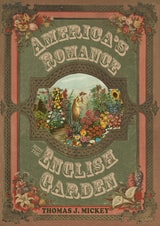
America’s Romance with the English Garden
Thomas J. Mickey
Ohio University Press, 2013
Named one of “the year’s best gardening books” by The Spectator (UK, Nov. 2014)
The 1890s saw a revolution in advertising. Cheap paper, faster printing, rural mail delivery, railroad shipping, and chromolithography combined to pave the way for the first modern, mass-produced catalogs. The most prominent of these, reaching American households by the thousands, were seed and nursery catalogs with beautiful pictures of middle-class homes surrounded by sprawling lawns, exotic plants, and the latest garden accessories—in other words, the quintessential English-style garden.
America’s Romance with the English Garden is the story of tastemakers and homemakers, of savvy businessmen and a growing American middle class eager to buy their products. It’s also the story of the beginnings of the modern garden industry, which seduced the masses with its images and fixed the English garden in the mind of the American consumer. Seed and nursery catalogs delivered aspirational images to front doorsteps from California to Maine, and the English garden became the look of America.

Amherst in the World
Martha Saxton
Amherst College Press, 2020
Contributions by Martha Saxton, Gary J. Kornblith, David W. Wills, Frederick E. Hoxie, Trent Maxey, Nicholas L. Syrett, Wendy H. Bergoffen, Rick López, Matthew Alexander Randolph, Daniel Levinson Wilk, K. Ian Shin, David S. Reynolds, Jane F. Thrailkill, Julie Dobrow, Richard F. Teichgraeber III, Debby Applegate, Michael E. Jirik, Bruce Laurie, Molly Michelmore, and Christian G. Appy.
Amid the Fall, Dreaming of Eden
Du Bois, King, Malcolm X, and Emancipatory CompositionBradford T. Stull
Southern Illinois University Press, 1999
Whom, or what, does composition—defined here as an intentional process of study, either oral or written—serve? Bradford T. Stull contends that composition would do well to articulate, in theory and practice, what could be called "emancipatory composition." He argues that emancipatory composition is radically theopolitical: it roots itself in the foundational theological and political language of the American experience while it subverts this language in order to emancipate the oppressed and, thereby, the oppressors.
To articulate this vision, Stull looks to those who compose from an oppressed place, finding in the works of W. E. B. Du Bois, Martin Luther King Jr., and Malcolm X radical theopolitical practices that can serve as a model for emancipatory composition. While Stull acknowledges that there are many sites of oppression, he focuses on what Du Bois has called the problem of the twentieth century: the color line, positing that the unique and foundational nature of the color line provides a fecund place in which, from which, a theory and practice of emancipatory composition might be elucidated.
By focusing on four key theopolitical tropes—The Fall, The Orient, Africa, and Eden—that inform the work of Du Bois, King, and Malcolm X, Stull discovers the ways in which these civil rights leaders root themselves in the vocabulary of the American experience in order to subvert it so that they might promote emancipation for African Americans, and thus all Americans.
In drawing on the work of Paulo Freire, Kenneth Burke, Edward Said, Christopher Miller, Ernst Bloch, and others, Stull also locates this study within the larger cultural context. By reading Du Bois, King, and Malcolm X together in a way that they have never before been read, Stull presents a new vision of composition practice to the African American studies community and a reading of African American emancipatory composition to the rhetoric and composition community, thus extending the question of emancipatory composition into new territory.
Amish in Michigan
Gertrude Enders Huntington
Michigan State University Press, 2001
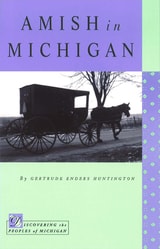
Driving the rural roads of Michigan one might suddenly come upon a black buggy driven by a bonneted woman or a bearded Amish man. In 1955 there were fewer than five hundred Amish in Michigan—in 2000 there were more than seven thousand. The Amish, with their unique life-style, are found only in North America where approximately 170,000 live in twenty-four states and one Canadian province. This sensitive and fascinating volume explores the Amish historical background, immigration into Michigan, occupations, marriage patterns, cultural conflicts, community-financed schools, medical practices, and cultural survival.
Among Friends
Engendering the Social Site of PoetryAnne Dewey and Libbie Rifkin
University of Iowa Press, 2013

Among the Afghans
Arthur Bonner
Duke University Press, 1987
Bonner therefore brings both recent experience and the sharp eye of a veteran journalist to an analysis of the Afghan situation: the tenacity and courage of the resistance, the massive emmigration, and the toll taken by the seemingly endless conflict on the country and its people.
The author has seen both the great and small of Afghanistan--both the seared flesh of the hand that an Afghan mujahidin held in the fire to demonstrate his courage and the geopolitical reasons that impelled the former Soviet Union of set its might and treasure against a people who resisted with a fierce and sometimes (to Western eyes) thoughtless courage. This is the story of these antagonists--sobering, chilling, and finally enlightening.

Among the Lowest of the Dead
The Culture of Capital PunishmentDavid Von Drehle
University of Michigan Press, 2010
"Has all the tension of the best true crime stories . . . This is journalism at its best."
--Library Journal
"A compelling argument against capital punishment. . . . Examining politicians, judges (including Supreme Court Justices), prosecutors, defense attorneys and the condemned themselves, the author makes an effective case that, despite new laws, execution is no less a lottery than it has always been."
--Publishers Weekly
"In a fine and important book, Von Drehle writes elegantly and powerfully. . . . Anyone certain of their opinion about the death penalty ought to read this book."
-- Booklist
"An extremely well-informed and richly insightful book of great value to students of the death penalty as well as intelligent general readers with a serious interest in the subject, Among the Lowest of the Dead is also exciting reading. The book is an ideal guide for new generations of readers who want to form knowledgeable judgments in the continuing--and recently accelerating--controversies about capital punishment."
--Anthony Amsterdam, New York University
"Among the Lowest of the Dead is a powerfully written and meticulously researched book that makes an invaluable contribution to the growing public dialogue about capital punishment in America. It's one of those rare books that bridges the gap between mass audiences and scholarly disciplines, the latter including sociology, political science, criminology and journalism. The book is required reading in my Investigative Journalism classes--and my students love it!"
--David Protess, Northwestern University
"Among The Lowest of the Dead deserves a permanent place in the literature as literature, and is most relevant to today's death penalty debate as we moderate advocates and abolitionists search for common ground."
--Robert Blecker, New York Law School
David Von Drehle is Senior Writer, The Washington Post and author of Triangle: The Fire that Changed America.
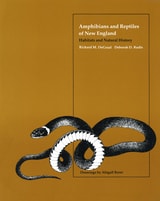
Amphibians and Reptiles of New England
Habitats and Natural HistoryRichard M. DeGraaf
University of Massachusetts Press, 1983
Although numerous species of amphibians and reptiles live in New England and the northeastern Untied States, few people are aware of their existence of know much about their life histories, habitats, or distributions. This illustrated work provides such information, compiling the latest data on nearly sixty species. Included is a detailed account of each species' range, relative abundance, habitat, breeding period (from egg deposition through larval period), home range and movements, and food habitats. Additional comments and selected references are provided throughout.
The book is designed specifically for use in New England. The regional approach makes it possible to examine the details of distribution and habitat preference, important factors because many of these species have local, disjunct populations. The authors stress that these species constitute a valuable resource requiring and deserving conservative measures and urge that reptiles and amphibians be considered in wildlife-management policy.
Amphibious Campaign For West Florida and Louisiana
Wilburt S. Brown
University of Alabama Press, 1969
Strategy, sea, and swamp—redefining the battle that shaped America’s Gulf frontier.
Amphibious Campaign for West Florida and Louisiana, 1814–1815 is a definitive military history of the Gulf Coast operations that culminated in the Battle of New Orleans, one of the most pivotal engagements of the War of 1812. Written by retired Marine Corps Major General Wilburt S. Brown, this book offers a deeply analytical and interpretive account of the campaign, grounded in a meticulous review of primary sources and informed by modern military doctrine.
Brown examines the strategic decisions, logistical challenges, and tactical maneuvers of both British and American forces as they vied for control of West Florida and Louisiana. He reconstructs the complex amphibious operations, the coordination between naval and land forces, and the leadership of figures such as Andrew Jackson and Sir Edward Pakenham. With military precision and narrative clarity, Brown brings to life the suspense and significance of the campaign, emphasizing its broader implications for American sovereignty and military development.
This volume stands out not only for its scholarly rigor but also for its ability to engage readers with the drama and urgency of historical warfare. It remains one of the most authoritative accounts of the Gulf Coast theater and is essential reading for historians, military scholars, and anyone interested in the evolution of American defense strategy.
Amy Lowell, American Modern
Bradshaw, Melissa
Rutgers University Press, 2004
For decades, the work of one of America’s most influential poets, 1925 Pulitzer Prize–winner Amy Lowell (1874–1925), has been largely overlooked. This vigorous, courageous poet gave voice to an erotic, thoroughly American sensibility. Cigar-smoker, Boston Brahmin, lesbian, impresario, entrepreneur, and prolific poet, Lowell heralded the rush of an American poetic flowering. A best-selling poet as well as a wildly popular lecturer (autograph-seeking fans were sometimes so boisterous that she required a police escort), she was a respected authority on modern poetry, forging the path that led to the works of Allen Ginsberg, May Sarton, Sylvia Plath, and beyond. Yet, since her death, her work has suffered critical neglect.
This volume presents an essential revaluation of Lowell, and builds a solid critical basis for evaluating her poetry, criticism, politics, and influence. Essays explore the varied contributions of Lowell as a woman poet, a modernist, and a significant force of the literary debates of early twentieth-century poetics. In addition to placing Lowell in her proper historical context, contributors demonstrate her centrality to current critical and theoretical discussions: feminist, gay and lesbian, and postcolonial, in as well as in disability, American, and cultural studies. The book includes a transatlantic group of literary critics and scholars.
Amy Lowell, American Modern offers the most sustained examination of Lowell to date. It returns her to conversation and to literary history where she belongs.
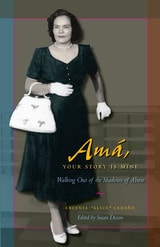
Amá, Your Story Is Mine
Walking Out of the Shadows of AbuseBy Ercenia "Alice" Cedeño
University of Texas Press, 2007
In the preface to her memoir, Ercenia "Alice" Cedeño recalls the secrecy and turmoil that marked her youth: "I spent most of my growing years mad at my mother and wanting her to change to fit in with the rest of the world," she writes. "When my sisters and I wanted her to visit our friends' mothers, she would say, 'Why do people need to know other peoples' lives?' Looking back, I wonder if she was really saying, 'I don't want them to know our business.' There was so much to hide."
Now bringing those hidden memories to light, Amá, Your Story Is Mine traces the hardship, violence, deceit, and defiance that shaped the identity of two generations of women in Alice's family. Born in the mountains of northern Mexico, Alice's mother married at age 14 into a family rife with passion that often turned to anger. After losing several infant children to disease, the young couple crossed into the United States seeking a better life.
Unfolding in a series of powerful vignettes, Amá, Your Story Is Mine describes in captivating detail a daring matriarch who found herself having to protect her children from their own father while facing the challenges of cultural discrimination. By turns wry and tender, Alice's recollections offer a rare memoir that fully encompasses the Latina experience in the United States.
An Absent Presence
Japanese Americans in Postwar American Culture, 1945-1960Caroline Chung Simpson
Duke University Press, 2001
Simpson argues that when popular journals or social theorists engaged the topic of Japanese American history or identity in the Cold War era they did so in a manner that tended to efface or diminish the complexity of their political and historical experience. As a result, the shadowy figuration of Japanese American identity often took on the semblance of an “absent presence.” Individual chapters feature such topics as the case of the alleged Tokyo Rose, the Hiroshima Maidens Project, and Japanese war brides. Drawing on issues of race, gender, and nation, Simpson connects the internment episode to broader themes of postwar American culture, including the atomic bomb, McCarthyism, the crises of racial integration, and the anxiety over middle-class gender roles.
By recapturing and reexamining these vital flashpoints in the projection of Japanese American identity, Simpson fills a critical and historical void in a number of fields including Asian American studies, American studies, and Cold War history.
An Abundance of Flowers
More Great Flower Breeders of the PastJudith M. Taylor
Ohio University Press, 2018
Walk into any nursery, florist, or supermarket, and you’ll encounter displays of dozens of gorgeous flowers, from chrysanthemums to orchids. At one time these fanciful blooms were the rare trophies of the rich and influential—even the carnation, today thought of as one of the humblest cut flowers. Every blossom we take for granted now is the product of painstaking and imaginative planning, breeding, horticultural ingenuity, and sometimes chance. The personalities of the breeders, from an Indiana farmer to Admiral Lord Gambier’s gardener, were as various and compelling as the beauty they conjured from skilled hybridization.
In Visions of Loveliness: Great Flower Breeders of the Past, Judith Taylor wrote engagingly about the vivid history and characters behind eighteen types of popular flowers. In this companion volume she uncovers information about another eight familiar flowers: poinsettias, chrysanthemums, gladioli, pansies, carnations, water lilies, clematis, and penstemons.
Taylor has tapped into an enormous trove of stories about extraordinary people with vision and skill who added to our enjoyment piece by piece, starting about 150 years ago. This beautifully illustrated book will please flower enthusiasts, gardeners, and history buffs alike.
An Accidental Journalist
The Adventures of Edmund Stevens, 1934-1945Cheryl Heckler
University of Missouri Press, 2007
When an idealistic American named Edmund Stevens arrived in Moscow in 1934, his only goal was to do his part for the advancement of international Communism. His job writing propaganda led to a reporting career and an eventual Pulitzer Prize in 1950 for his uncensored descriptions of Stalin’s purges. This book tells how Stevens became an accidental journalist—and the dean of the Moscow press corps.
The longest-serving American-born correspondent working from within the Soviet Union, Stevens was passionate about influencing the way his stateside readers thought about Russia’s citizens, government, and social policy. Cheryl Heckler now traces a career that spanned half a century and four continents, focusing on Stevens’s professional work and life from 1934 to 1945 to tell how he set the standards for reporting on Soviet affairs for the Christian Science Monitor.
Stevens was a keen observer and thoughtful commentator, and his analytical mind was just what the Monitor was looking for in a foreign correspondent. He began his journalism career reporting on the Russo-Finnish War in 1939 and was the Monitor’s first man in the field to cover fighting in World War II. He reported on the Italian invasion of Greece, participated in Churchill’s Moscow meeting with Stalin as a staff translator, and distinguished himself as a correspondent with the British army in North Africa.
Drawing on Stevens’s memoirs—to which she had exclusive access—as well as his articles and correspondence and the unpublished memoirs of his wife, Nina, Heckler traces his growth as a frontline correspondent and interpreter of Russian culture. She paints a picture of a man hardened by experience, who witnessed the brutal crushing of the Iron Guard in 1941 Bucharest and the Kharkov hangings yet who was a failure on his own home front and who left his wife during a difficult pregnancy in order to return to the war zone. Heckler places his memoirs and dispatches within the larger context of events to shed new light on both the public and the private Stevens, portraying a reporter adapting to new roles and circumstances with a skill that journalists today could well emulate.
By exposing the many facets of Stevens’s life and experience, Heckler gives readers a clear understanding of how this accidental journalist was destined to distinguish himself as a war reporter, analyst, and cultural interpreter. An Accidental Journalist is an important contribution to the history of war reporting and international journalism, introducing readers to a man whose inside knowledge of Stalinist Russia was beyond compare as it provides new insight into the Soviet era.
An Actor's Tale
Theater, Culture, and Everyday Life in the Nineteenth-Century United StatesAmy Hughes
University of Michigan Press, 2025
Ultimately, Hughes reveals how this actor’s tale illuminates the widespread tendency to ignore, deny, and forgive White male mediocrity in US culture, and how a deeper understanding of people like Watkins can transform our understanding of the past—and our understanding of ourselves.

An Age of Accountability
How Standardized Testing Came to Dominate American Schools and Compromise EducationJohn L. Rury
Rutgers University Press, 2024
An Alabama Songbook
Ballads, Folksongs, and Spirituals Collected by Byron ArnoldRobert W. Halli Jr.
University of Alabama Press, 2004
Alabama is a state rich in folksong tradition, from old English ballads sung along the Tennessee River to children’s game songs played in Mobile, from the rhythmic work songs of the railroad gandy dancers of Gadsden to the spirituals of the Black Belt. The musical heritage of blacks and whites, rich and poor, hill folk and cotton farmers, these songs endure as a living part of the state’s varied past.
In the mid 1940s Byron Arnold, an eager young music professor from The University of Alabama, set out to find and record as many of these songs as he could and was rewarded by unstinting cooperation from many informants. Mrs. Julia Greer Marechal of Mobile, for example, was 90 years old, blind, and a semi-invalid, but she sang for Arnold for three hours, allowing the recording of 33 songs and exhausting Arnold and his technician. Helped by such living repositories as Mrs. Marechal, the Arnold collection grew to well over 500 songs, augmented by field notes and remarkable biographical information on the singers.
An Alabama Songbook is the result of Arnold’s efforts and those of his informants across the state and has been shaped by Robert W. Halli Jr. into a narrative enriched by more than 200 significant songs-lullabies, Civil War anthems, African-American gospel and secular songs, fiddle tunes, temperance songs, love ballads, play-party rhymes, and work songs. In the tradition of Alan Lomax’s The Folk Songs of North America and Vance Randolph’s Ozark Folksongs, this volume will appeal to general audiences, folklorists, ethnomusicologists, preservationists, traditional musicians, and historians.
An Alternate Pragmatism for Going Public
Jim Webber
Utah State University Press, 2017
An Alternate Pragmatism for Going Public interrogates composition’s most prominent responses to contemporary K–16 education reform. By “going public,” teachers, scholars, and administrators rightfully reassert their expertise against corporate-political standards and assessments like the Common Core, Complete College America, and the Collegiate Learning Assessment. However, author Jim Webber shows that composition’s professional imperative for self-defense only partly fulfils the broader aims of “going public,” which include fostering public participation that can assess and potentially affirm the public good of professional judgment.
Drawing on the pragmatic/democratic tradition, Webber envisions an alternate rhetoric of professionalism, one that not only reasserts compositionists’ expertise but also expands opportunities for publics to authorize this expertise. While this public inquiry and engagement may not safeguard professional standing against neoliberal reform, it reorients composition toward an equally important goal, enabling publics to gauge the adequacy of the educational standardization so often advocated by contemporary reform.
An Alternate Pragmatism for Going Public shows how public engagement can serve composition’s efforts related to “going public.”
An American Body | Politic
A Deleuzian ApproachBernd Herzogenrath
Dartmouth College Press, 2010
An American Colony
Regionalism and the Roots of Midwestern CultureEdward Watts
Ohio University Press, 2002
The Old Northwest—the region now known as the Midwest—has been largely overlooked in American cultural history, represented as a place smoothly assimilated into the expanding, manifestly-destined nation. An American Colony: Regionalism and the Roots of Midwestern Culture studies the primary texts and principal conflicts of the settlement of the Old Northwest to reveal that its entry into the nation’s culture was not without problems. In fact, Edward Watts argues that it is best understood as a colony of the United States, just as the eastern states were colonies of the British Empire.
Reconsidered as a colony, the Old Northwest becomes a crucible revealing the complex entanglement of local, indigenous, and regional interests with the coercions of racism, nationalism, and imperialism. This conflicted setting, like those of all settlement colonies, was beset by competing views of local identity, especially as they came to contradict writers from the eastern seaboard.
Using postcolonial theories developed to describe other settlement colonies, An American Colony identifies the Old Northwest as a colony and its culture as less than fully participating in either the nation’s or its own writing and identity. This embedded sense of cultural inferiority, Watts argues, haunts Midwestern culture even today.
An American Dilemma Revisited
Race Relations in a Changing WorldObie, Jr. Clayton
Russell Sage Foundation, 1996
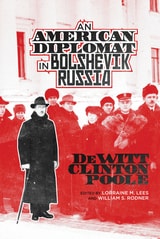
An American Diplomat in Bolshevik Russia
DeWitt Clinton Poole, Edited by Lorraine M. Lees and William S. Rodner
University of Wisconsin Press, 2014
Historians Lorraine M. Lees and William S. Rodner introduce and annotate Poole's recollections, which give a fresh, firsthand perspective on monumental events in world history and reveal the important impact DeWitt Clinton Poole (1885–1952) had on U.S.–Soviet relations. He was active in implementing U.S. policy, negotiating with the Bolshevik authorities, and supervising American intelligence operations that gathered information about conditions throughout Russia, especially monitoring anti-Bolshevik elements and areas of German influence. Departing Moscow in late 1918 via Petrograd, he was assigned to the port of Archangel, then occupied by Allied and American forces, and left Russia in June 1919.
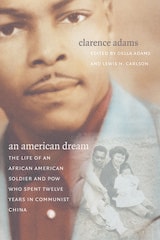
An American Dream
The Life of an African American Soldier and POW Who Spent Twelve Years in Communist ChinaClarence Adams
University of Massachusetts Press, 2007
Throughout his life, Clarence Adams exhibited self-reliance, ambition, ingenuity, courage, and a commitment to learning—character traits often equated with the successful pursuit of the American Dream. Unfortunately, for an African American coming of age in the 1930s and 1940s, such attributes counted for little, especially in the South.
Adams was a seventeen-year-old high school dropout in 1947 when he fled Memphis and the local police to join the U.S. Army. Three years later, after fighting in the Korean War in an all-black artillery unit that he believed to have been sacrificed to save white troops, he was captured by the Chinese. After spending almost three years as a POW, during which he continued to suffer racism at the hands of his fellow Americans, he refused repatriation in 1953, choosing instead the People's Republic of China, where he hoped to find educational and career opportunities not readily available in his own country.
While living in China, Adams earned a university degree, married a Chinese professor of Russian, and worked in Beijing as a translator for the Foreign Languages Press. During the Vietnam War he made a controversial anti-war broadcast over Radio Hanoi, urging black troops not to fight for someone else's political and economic freedoms until they enjoyed these same rights at home.
In 1966, having come under suspicion during the Chinese Cultural Revolution, he returned with his wife and two children to the United States, where he was subpoenaed to appear before the House Committee on Un-American Activities to face charges of “disrupting the morale of American fighting forces in Vietnam and inciting revolution in the United States.” After these charges were dropped, he and his family struggled to survive economically. Eventually, through sheer perseverance, they were able to fulfill at least part of the American Dream. By the time he died, the family owned and operated eight successful Chinese restaurants in his native Memphis.
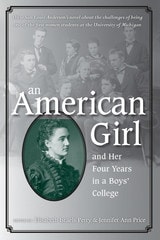
An American Girl, and Her Four Years in a Boys' College
Olive San Louie Anderson
University of Michigan Press, 2006
In 1870, the University of Michigan-one of the oldest, largest, and most prestigious public universities in the United States-admitted its first woman student. An American Girl, and Her Four Years in a Boys' College, written by one of the first woman graduates from the University of Michigan and published pseudonymously in 1878, describes what it was like to be a member of this tiny group of brave coeds. The story is told through the eyes of Wilhelmine Elliot, an untraditional girl who enrolls at the fictional University of Ortonville, a thinly disguised stand-in for the University of Michigan.
Will's challenges mirror those of other women college students of the era, including the reactions of male faculty and students, relationships with other women students and with family and friends back home, and social attitudes toward the women's movement and liberal religious values. The editors' engaging introduction places the novel in its relevant historical and literary contexts, as do helpful annotations throughout the text.
"The 1870s were an important moment of debate over women's roles and responsibilities. What's here is very interesting not only about higher education, and 'strong-minded women,' but about religion, domesticity, independence, marriage, and homosocial bonding."
--Carol Lasser, Oberlin College
Olive San Louie Anderson (ca. 1852-86) graduated from the University of Michigan in 1875 and published An American Girl in 1878 under the name SOLA. Elisabeth Israels Perry is John Francis Bannon Professor of History, Saint Louis University. Jennifer Ann Price is a Ph.D. candidate in American Studies at Saint Louis University.

An American Obsession
Science, Medicine, and Homosexuality in Modern SocietyJennifer Terry
University of Chicago Press, 1999
Terry's overarching argument is compelling: that homosexuality served as a marker of the "abnormal" against which malleable, tenuous, and often contradictory concepts of the "normal" were defined. One of the few histories to take into consideration homosexuality in both women and men, Terry's work also stands out in its refusal to erase the agency of people classified as abnormal. She documents the myriad ways that gays, lesbians, and other sexual minorities have coauthored, resisted, and transformed the most powerful and authoritative modern truths about sex. Proposing this history as a "useable past," An American Obsession is an indispensable contribution to the study of American cultural history.
An American Provence
Thomas P. Huber
University Press of Colorado, 2011
-From An American Provence
In this poetic personal narrative, Thomas P. Huber reflects on two seemingly unrelated places-the North Fork Valley in western Colorado and the Coulon River Valley in Provence, France-and finds a shared landscape and sense of place. What began as a simple comparison of two like places in distant locations turned into a more complex, interesting, and personal task. Much is similar-the light, the valleys, the climate, the agriculture. And much is less so-the history, the geology, the physical makeup of villages. Using a geographer's eye and passion for the land and people, Huber examines the regions' similarities and differences to explore the common emotional impact of each region. Part intimate travelogue and part case study of geography in the real world, An American Provence illuminates the importance sense of place plays in who we are.
An American Rabbi in Korea
A Chaplain's Journey in the Forgotten WarMilton J. Rosen, translated and edited by Stanley R. Rosen
University of Alabama Press, 2004
During the height of the Korean conflict, 1950–51, Orthodox Jewish chaplain Milton J. Rosen wrote 19 feature-length articles for Der Morgen Zhornal, a Yiddish daily in New York, documenting his wartime experiences as well as those of the servicemen under his care. An American Rabbi in Korea is an English translation of Rosen's important articles prepared by his son and annotated with background about Rosen's military service, a general introduction to the war and conflict on the Korean peninsula, and numerous maps and photographs.
Rosen was among those nearly caught in the Chinese entrapment of American and Allied forces in North Korea in late 1950, and some of his most poignant writing details the trying circumstances that faced both soldiers and civilians during that time. As chaplain, Rosen was able to offer a unique account of the American Jewish experience on the frontlines and in the United States military while also describing the impact of the American presence on Korean citizens and their culture. His interest in Korean attitudes toward Jews is also a significant theme within these articles. The sum is a readable account of war and its turmoil from an astute and compassionate observer.

An American Travesty
Legal Responses to Adolescent Sexual OffendingFranklin E. Zimring
University of Chicago Press, 2004
An American Travesty is the first scholarly book in half a century to analyze the justice system’s response to sexual misconduct by children and adolescents in the United States. Writing with a refreshing dose of common sense, Franklin E. Zimring discusses our society's failure to consider the developmental status of adolescent sex offenders. Too often, he argues, the American legal system ignores age and developmental status when adjudicating young sexual offenders, in many cases responding as they would to an adult.
“An opinionated, articulate, and forceful critique of current politics and practices. . . . I would recommend this book for anyone interested in rethinking the fundamental questions of how our courts and systems should respond to these cases.”—Law and Politics Book Review
“One of the most important new books in the field of juvenile justice. . . . Zimring offers a thoughtful, research-based analysis of what went wrong with legal policy development.”—Barry Krisberg, President, National Council on Crime and Delinquency
An American Vein
Critical Readings in Appalachian LiteratureDanny L. Miller
Ohio University Press, 2005
The blossoming of Appalachian studies began some thirty years ago. Thousands of young people from the hills have since been made aware of their region’s rich literary tradition through high school and college courses. An entire generation has discovered that their own landscapes, families, and communities had been truthfully portrayed by writers whose background was similar to their own.
An American Vein: Critical Readings in Appalachian Literature is an anthology of literary criticism of Appalachian novelists, poets, and playwrights. The book reprises critical writing of influential authors such as Joyce Carol Oates, Cratis Williams, and Jim Wayne Miller. It introduces new writing by Rodger Cunningham, Elizabeth Engelhardt, and others.
Many writers from the mountains have found success and acclaim outside the region, but the region itself as a thriving center of literary creativity has not been widely appreciated. The editors of An American Vein have remedied this, producing the first general collection of Appalachian literary criticism. This book is a resource for those who teach and read Appalachian literature. What’s more, it holds the promise of introducing new readers, nationally and internationally, to Appalachian literature and its relevance to our times.
An American in the Making
The Life Story of an ImmigrantKellman, Steven G
Rutgers University Press, 2009
Steven G. Kellman brings Ravage's story to life again in this new edition, providing a brief biography and introduction that place the memoir within historical and literary contexts. An American in the Making contributes to a broader understanding of the global notion of "America" and remains timely, especially in an era when massive immigration, now from Latin America and Asia, challenges ideas of national identity.

An Amulet of Greek Earth
Generations of Immigrant Folk CultureHelen Papanikolas
Ohio University Press, 2002
The boys and men who left their Greek valley and mountain villages in the early 1900s for America came with amulets their mothers had made for them. Some were miniature sacks attached to a necklace; more often they were merely a square of fabric enclosing the values of their lives: a piece of a holy book or a sliver of the True Cross representing their belief in Greek Orthodoxy; a thyme leaf denoting their wild terrain; a blue bead to ward off the Evil Eye; and a pinch of Greek earth.
In her evocative and meticulously researched book An Amulet of Greek Earth, author Helen Papanikolas explains and examines the vibrant culture these immigrants brought with them to the new world. The Romiosini culture, as it was called, provided the foundation for their new lives and was oftentimes the cause of strife as they passed on their beliefs and traditions to successive generations of Greek Americans.
In the tradition of her fictional accounts of Greek immigrant life, Helen Papanikolas unearths the cultural beliefs and passions that compelled the Greek-American community to make its own way into the broader culture of America. Based on extensive study, personal interviews, and a lifetime of experience, An Amulet of Greek Earth is a revealing and informative chronicle of the immigrant’s experience in becoming an American.
An Analysis of Effigy Mound Complexes in Wisconsin
William M. Hurley
University of Michigan Press, 1975
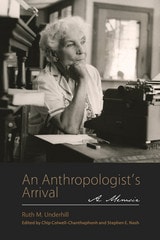
An Anthropologist's Arrival
A MemoirRuth M. Underhill, Edited by Chip Colwell-Chanthaphonh and Stephen E. Nash
University of Arizona Press, 2014
In brutally honest words, Underhill describes her uneven passage through life, beginning with a searing portrait of the Victorian restraints on women and her struggle to break free from her Quaker family’s privileged but tightly laced control. Tenderly and with humor she describes her transformation from a struggling “sweet girl” to wife and then divorcée. Professionally she became a welfare worker, a novelist, a frustrated bureaucrat at the Bureau of Indian Affairs, a professor at the University of Denver, and finally an anthropologist of distinction.
Her witty memoir reveals the creativity and tenacity that pushed the bounds of ethnography, particularly through her focus on the lives of women, for whom she served as a role model, entering a working retirement that lasted until she was nearly 101 years old.
No quotation serves to express Ruth Underhill’s adventurous view better than a line from her own poetry: “Life is not paid for. Life is lived. Now come.”
An Appalachian New Deal
West Virginia in the Great DepressionJerry Bruce Thomas
West Virginia University Press, 2011
In this paperback edition of An Appalachian New Deal: West Virginia in the Great Depression, Jerry Bruce Thomas examines the economic and social conditions of the state of West Virginia before, during, and after the Great Depression. Thomas’s exploration of personal papers by leading political and social figures, newspapers, and the published and unpublished records of federal, state, local, and private agencies, traces a region’s response to an economic depression and a presidential stimulus program. This dissection of federal and state policies implemented under Franklin D. Roosevelt’s New Deal program reveals the impact of poverty upon political, gender, race, and familial relations within the Mountain State—and the entire country. Through An Appalachian New Deal, Thomas documents the stories of ordinary citizens who survived a period of economic crisis and echoes a message from our nation’s past to a new generation enduring financial hardship and uncertainty.

An Appalachian Reawakening
West Virginia and the Perils of the New Machine Age, 1945-1972JERRY B. THOMAS
West Virginia University Press, 2010
As the long boom of post-World War II economic expansion spread across the globe, dreams of white picket fences, democratic ideals, and endless opportunities flourished within the United States. Middle America experienced a period of affluent stability built upon a modern age of industrialization. Yet for the people of Appalachia, this new era brought economic, social, and environmental devastation, preventing many from realizing the American Dream. Some families suffered in silence; some joined a mass exodus from the mountains; while others, trapped by unemployment, poverty, illness, and injury became dependent upon welfare. As the one state most completely Appalachian, West Virginia symbolized the region's dilemma, even as it provided much of the labor and natural resources that fueled the nation's prosperity.
An Appalachian Reawakening: West Virginia and the Perils of the New Machine Age, 1945-1972 recounts the difficulties the state of West Virginia faced during the post-World War II period. While documenting this turmoil, this valuable analysis also traces the efforts of the New Frontier and Great Society programs, which stimulated maximum feasible participation and lead to the ultimate rise of grass roots activities and organizations that improved life and labor in the region and undermined the notion of Appalachian fatalism.
An Appeal in Favor of That Class of Americans Called Africans
Lydia Maria Child
University of Massachusetts Press, 1996
Child's treatise anticipated twentieth-century inquiries into the African origins of European and American culture as well as current arguments against school and job discrimination based on race.
This new edition--the first oriented toward the classroom--is enhanced by Carolyn L. Karcher's illuminating introduction. Included is a chronology of Child's life and a list of books for further reading.
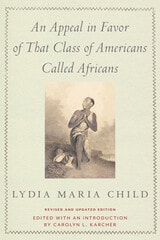
An Appeal in Favor of That Class of Americans Called Africans
Revised and Updated EditionLydia Maria Child, Edited with an introduction by Carolyn L. Karcher
University of Massachusetts Press, 2023
Published in Boston in 1833, Lydia Maria Child’s An Appeal in Favor of That Class of Americans Called Africans provided the abolitionist movement with its first full-scale analysis of race and enslavement. Controversial in its own time, the Appeal surveyed the institution of slavery from historical, political, economic, legal, racial, and moral perspectives and advocated for the immediate emancipation of the enslaved without compensation to their enslavers. By placing American slavery in historical context and demonstrating how slavery impacted—and implicated—Americans of all regions and races, the Appeal became a central text for the abolitionist movement that continues to resonate in the present day.
This revised and updated edition is enhanced by Carolyn L. Karcher’s illuminating introduction, a chronology of Child’s life, and a list of books for further reading.