Results by title
22279 books match the query 'Social Science' and 1819 start with a
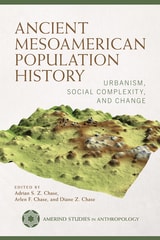
Ancient Mesoamerican Population History
Urbanism, Social Complexity, and ChangeAdrian S. Z. Chase, Arlen F. Chase, and Diane Z. Chase
University of Arizona Press, 2024
Establishing ancient population numbers and determining how they were distributed across a landscape over time constitute two of the most pressing problems in archaeology. Accurate population data is crucial for modeling, interpreting, and understanding the past. Now, advances in both archaeology and technology have changed the way that such approximations can be achieved.
Including research from both highland central Mexico and the tropical lowlands of the Maya and Olmec areas, this book reexamines the demography in ancient Mesoamerica. Contributors present methods for determining population estimates, field methods for settlement pattern studies to obtain demographic data, and new technologies such as LiDAR (light detecting and ranging) that have expanded views of the ground in forested areas. Contributions to this book provide a view of ancient landscape use and modification that was not possible in the twentieth century. This important new work provides new understandings of Mesoamerican urbanism, development, and changes over time.
Contributors
Traci Ardren
M. Charlotte Arnauld
Bárbara Arroyo
Luke Auld-Thomas
Marcello A. Canuto
Adrian S. Z. Chase
Arlen F. Chase
Diane Z. Chase
Elyse D. Z. Chase
Javier Estrada
Gary M. Feinman
L. J. Gorenflo
Julien Hiquet
Scott R. Hutson
Gerardo Jiménez Delgado
Eva Lemonnier
Rodrigo Liendo Stuardo
José Lobo
Javier López Mejía
Michael L. Loughlin
Deborah L. Nichols
Christopher A. Pool
Ian G. Robertson
Jeremy A. Sabloff
Travis W. Stanton
Ancient Mesopotamia at the Dawn of Civilization
The Evolution of an Urban LandscapeGuillermo Algaze
University of Chicago Press, 2008
In Ancient Mesopotamia at the Dawn of Civilization, Guillermo Algaze draws on the work of modern economic geographers to explore how the unique river-based ecology and geography of the Tigris-Euphrates alluvium affected the development of urban civilization in southern Mesopotamia. He argues that these natural conditions granted southern polities significant competitive advantages over their landlocked rivals elsewhere in Southwest Asia, most importantly the ability to easily transport commodities. In due course, this resulted in increased trade and economic activity and higher population densities in the south than were possible elsewhere. As southern polities grew in scale and complexity throughout the fourth millennium, revolutionary new forms of labor organization and record keeping were created, and it is these socially created innovations, Algaze argues, that ultimately account for why fully developed city-states emerged earlier in southern Mesopotamia than elsewhere in Southwest Asia or the world.
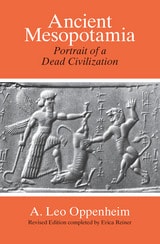
Ancient Mesopotamia
Portrait of a Dead CivilizationA. Leo Oppenheim
University of Chicago Press, 1977
Ancient Mesopotamia—the area now called Iraq—has always received less attention from scholars and the general public than ancient Egypt and other long-extinct and more spectacular civilizations. But numerous small clay tablets buried in the desert soil for thousands of years make it possible for us to know more about the people of ancient Mesopotamia than any other land in the early Near East.
A. Leo Oppenheim, who studied these tablets for more than thirty years, used his intimate knowledge of long-dead languages to put together a distinctively personal picture of the Mesopotamians of some three thousand years ago. At the time of his death in 1974, Oppenheim was working on revisions of the manuscript that, with the help of Erica Reiner, who used the author's revision outline, completed the work that became this book. In the decades since, it has become the definitive work on Ancient Mesopotamia.
Ancient Muses
Archaeology and the ArtsEdited by John H. Jameson Jr., John E. Ehrenhard, and Christine A. Finn
University of Alabama Press, 2003
Known widely in Europe as “interpretive narrative archaeology,” the practice of using creative methods to interpret and present current knowledge of the past is gaining popularity in North America. This book is the first compilation of international case studies of the various artistic methods used in this new form of education—one that makes archaeology “come alive” for the nonprofessional. Plays, opera, visual art, stories, poetry, performance dance, music, sculpture, digital imagery—all can effectively communicate archaeological processes and cultural values to public audiences.
The contributors to this volume are a diverse group of archaeologists, educators, and artisans who have direct experience in schools, museums, and at archaeological sites. Citing specific examples, such as the film The English Patient, science fiction mysteries, and hypertext environments, they explain how creative imagination and the power of visual and audio media can personalize, contextualize, and demystify the research process. A 16-page color section illuminates their examples, and an accompanying CD includes relevant videos, music, web sites, and additional color images.
*
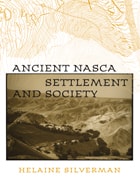
Ancient Nasca Settlement
Helaine Silverman
University of Iowa Press, 2002
Nasca society arose on the south coast of Peru two thousand years ago and evolved over the course of the next seven hundred years. Helaine Silverman's long-term, multistage work on the south coast of Peru has established her as one of the world's preeminent authorities on this brilliant and enigmatic civilization. Ancient Nasca Settlement and Society is the first extended treatment of the range of sites occupied by the people responsible for some of the most exquisite art, largest ground drawings, most intense hunting of human heads as trophies, and most ingenious hydraulic engineering of the pre-Columbian world.
Ancient Nasca Settlement and Society is based on Silverman's comprehensive survey of the Ingenio Valley, a water-rich tributary of the Río Grande de Nazca drainage; it also includes a critical synthesis of the settlement pattern data from the other river valleys of the system maps and tables, Silverman allows comparisons among the various phases of change in Nasca society. A companion CD-ROM provides a great deal of graphic material and allows users to manipulate the data in alternative scenarios.
Silverman situates the various classes of Nasca material culture within the spatial, social, economic, political, and ideological realities that can be adduced from the archaeological record. A work of archaeo-logical ethnography focused on a once-living society, this convincing and highly original book illuminates the ancient Nasca people's social construction of space and cultural meaning through their manipulation of their natural setting and their creation of particular kinds of built environments.
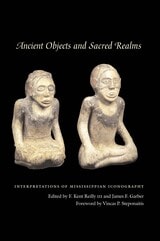
Ancient Objects and Sacred Realms
Interpretations of Mississippian IconographyEdited by F. Kent Reilly, III, and James F. Garber
University of Texas Press, 2006
Between AD 900-1600, the native peoples of the Mississippi River Valley and other areas of the Eastern Woodlands of the United States conceived and executed one of the greatest artistic traditions of the Precolumbian Americas. Created in the media of copper, shell, stone, clay, and wood, and incised or carved with a complex set of symbols and motifs, this seven-hundred-year-old artistic tradition functioned within a multiethnic landscape centered on communities dominated by earthen mounds and plazas. Previous researchers have referred to this material as the Southeastern Ceremonial Complex (SECC).
This groundbreaking volume brings together ten essays by leading anthropologists, archaeologists, and art historians, who analyze the iconography of Mississippian art in order to reconstruct the ritual activities, cosmological vision, and ideology of these ancient precursors to several groups of contemporary Native Americans. Significantly, the authors correlate archaeological, ethnographic, and art historical data that illustrate the stylistic differences within Mississippian art as well as the numerous changes that occur through time. The research also demonstrates the inadequacy of the SECC label, since Mississippian art is not limited to the Southeast and reflects stylistic changes over time among several linked but distinct religious traditions. The term Mississippian Iconographic Interaction Sphere (MIIS) more adequately describes the corpus of this Mississippian art. Most important, the authors illustrate the overarching nature of the ancient Native American religious system, as a creation unique to the native American cultures of the eastern United States.
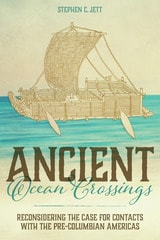
Ancient Ocean Crossings
Reconsidering the Case for Contacts with the Pre-Columbian AmericasStephen C. Jett
University of Alabama Press, 2017
In Ancient Ocean Crossings: Reconsidering the Case for Contacts with the Pre-Columbian Americas, Stephen Jett encourages readers to reevaluate the common belief that there was no significant interchange between the chiefdoms and civilizations of Eurasia and Africa and peoples who occupied the alleged terra incognita beyond the great oceans.
More than a hundred centuries separate the time that Ice Age hunters are conventionally thought to have crossed a land bridge from Asia into North America and the arrival of Columbus in the Bahamas in 1492. Traditional belief has long held that earth’s two hemispheres were essentially cut off from one another as a result of the post-Pleistocene meltwater-fed rising oceans that covered that bridge. The oceans, along with arctic climates and daunting terrestrial distances, formed impermeable barriers to interhemispheric communication. This viewpoint implies that the cultures of the Old World and those of the Americas developed independently.
Drawing on abundant and concrete evidence to support his theory for significant pre-Columbian contacts, Jett suggests that many ancient peoples had both the seafaring capabilities and the motives to cross the oceans and, in fact, did so repeatedly and with great impact. His deep and broad work synthesizes information and ideas from archaeology, geography, linguistics, climatology, oceanography, ethnobotany, genetics, medicine, and the history of navigation and seafaring, making an innovative and persuasive multidisciplinary case for a new understanding of human societies and their diffuse but interconnected development.
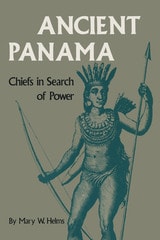
Ancient Panama
Chiefs in Search of PowerBy Mary W. Helms
University of Texas Press, 1979
Ancient Panama adds depth to our understanding of the political and religious elite ruling in Panama at the time of the European conquest. Mary W. Helms's research greatly expands knowledge of the distribution, extent, and structural nature of these pre-Columbian chiefdoms.
In addition, Helms delves more deeply into select aspects of ancient Panamanian political systems, including the relationship between elite competition and chiefly status, the use of sumptuary goods in the expression of elite power, and the role of elites in regional and long-distance exchange networks. In a significant departure from traditional thinking, she proposes that the search for esoteric knowledge was more important than economic trade in developing long-distance contact among chiefdoms.
The primary data for the study are derived from sixteenth-century Spanish records by Oviedo y Valdés, Andagoya, Balboa, and others. The author also turns to ethnographic data from contemporary native people of Panama, Colombia, tropical America, and Polynesia for analogy and comparison. The result is a highly innovative study which illuminates not only pre-Columbian Panamanian elites but also the nature of chiefdoms as a distinctive cultural type.
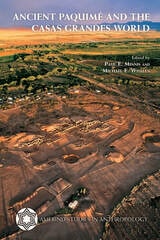
Ancient Paquimé and the Casas Grandes World
Edited by Paul E. Minnis and Michael E. Whalen
University of Arizona Press, 2015
The Joint Casas Grandes Expedition revealed the extraordinary nature of this site: monumental architecture, massive ball courts, ritual mounds, over a ton of shell artifacts, hundreds of skeletons of multicolored macaws and their pens, copper from west Mexico, and rich political and religious life with Mesoamerican-related images and rituals. Paquimé was not one sole community but was surrounded by hundreds of outlying villages in the region, indicating a zone that sustained thousands of inhabitants and influenced groups much farther afield.
In celebration of the Amerind Foundation’s seventieth anniversary, sixteen scholars with direct and substantial experience in Casas Grandes archaeology present nine chapters covering its economy, chronology, history, religion, regional organization, and importance. The two final chapters examine Paquimé in broader geographic perspectives. This volume sheds new light on Casas Grandes/Paquimé, a great town well-adapted to its physical and economic environment that disappeared just before Spanish contact.
Ancient Plants and People
Contemporary Trends in ArchaeobotanyEdited by Marco Madella, Carla Lancelotti, and Manon Savard
University of Arizona Press, 2014
Food has both a public and a private role, and it permeates the life of all people in a society. Food choice, production, and distribution probably represent the most complex indicators of social life, and thus a study of foods consumed by ancient peoples reveals many clues about their lifestyles. But in addition to yielding information about food production, distribution, preparation, and consumption, plant remains recovered from archaeological sites offer precious insights on past landscapes, human adaptation to climate change, and the relationship between human groups and their environment. Revealing important aspects of past human societies, these plant-driven insights widen the spectrum of information available to archaeologists as we seek to understand our history as a biological and cultural species.
Often answers raise more questions. As a result, archaeobotanists are constantly pushed to reflect on the methodological and theoretical aspects of their discipline. The contributors discuss timely methodological issues and engage in debates on a wide range of topics from plant utilization by hunter-gatherers and agriculturalists, to uses of ancient DNA. Ancient Plants and People provides a global perspective on archaeobotanical research, particularly on the sophisticated interplay between the use of plants and their social or environmental context.

Ancient Records of Egypt
Vol. 3: The Nineteenth DynastyTranslated and Edited by James Henry Breasted
University of Illinois Press, 2001
In the context of a long history of mutilating and altering reliefs for political purposes, Breasted discusses the insertion into a relief of the figure of Ramesses II in order to reinforce his claim to the throne. This volume also includes the treaty of alliance that sealed peace with the Hittites under Ramesses II; a series of documents that record the invasion of Libyans and Mediterranean Sea people during the reign of Merneptah; and the Great Temple of Abu Simbel, the most remarkable of the rock-cut temples of Egypt.
This first complete paperback edition of Breasted's five-volume Ancient Records of Egypt makes available to a new audience a milestone in Egyptology and in the compilation of documentary histories. Clearly annotated for the lay reader, the documents provide copious evidence of trade relations, construction activities, diplomatic envoys, foreign expeditions, and other aspects of a vigorous, highly organized, and centrally controlled society. Breasted's commentary is both rigorously documented and accessible, suffused with a contagious fascination for the events, the personalities, the cultural practices, and the sophistication these records indicate
Ancient Records of Egypt
Vol. 5: Supplementary Bibliographies and IndicesTranslated and Edited by James Henry Breasted: Supplementary Bibliographies by Peter A. Piccione
University of Illinois Press, 2001
An indispensable companion to any of the other volumes of Ancient Records of Egypt, the Supplementary Bibliographies and Indices facilitates direct access to specific information on the people, places, and inscriptions catalogued by James Henry Breasted. Exhaustively compiled and intelligently arranged, these indices include the kings and queens, temples and geographical locations, divine names, and titles and ranks encompassed by three thousand years of Egyptian history. Also provided are indices of all Egyptian, Hebrew, and Arabic terms mentioned in the texts, as well as a complete listing of the records with their location in Lepsius's Denkmäler.
This first paperback edition of Ancient Records of Egypt features the important addition of bibliographies by Peter A. Piccione, together with an introduction that puts Breasted's historical commentaries into modern perspective. These bibliographies offer valuable guidance on new translations and modern treatments of the inscriptions included in Ancient Records of Egypt. Professor Piccione points the reader toward recent studies of Egyptian chronology and modern scholarship on Egyptian and Nubian history. He also provides information on anthologies of Egyptian texts in translation and topographical bibliographies that suggest further reading on specific ancient Egyptian monuments, texts, and reliefs.

Ancient Sisterhood
The Lost Traditions of Hagar and SarahSavina J. Teubal
Ohio University Press, 1997
Ancient Sisterhood cites evidence that Hebrew women actually enjoyed the privileges and sanctity of their own religious practices. These practices, however, were gradually eroded and usurped by the establishment of patriarchal monarchies that were based on militaristic conquest and power. Teubal examines the figures of Hagar and Sarah from a feminist perspective that combines thorough scholarship with an informed and detailed understanding of the cultural and religious influences from which the mysterious biblical figure of Hagar emerged. She looks at Hagar's important role in the genesis of Hebrew culture, her role as mother of the Islamic nations, and her power as a matriarch as opposed to her apparent status as a concubine.
Teubal posits two distinct sources for the Hagar episodes: Hagar as companion to Sarah and an unknown woman whom she refers to as the desert matriarch. She explores whether Hagar was a slave to Abraham or Sarah, the differences between Hagar and the desert matriarch, and the obscurantism of these important elements in biblical texts. Teubal sheds considerable light on two central figures of these world religions and “the disassociation of woman from her own female religious experience.”
Ancient Society
Lewis Henry Morgan; Foreword by Elisabeth Tooker
University of Arizona Press, 1985
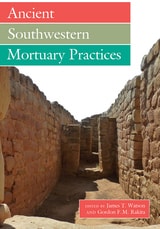
Ancient Southwestern Mortuary Practices
James T. Watson
University Press of Colorado, 2020
Ancient Southwestern Mortuary Practices chronicles the modal patterns, diversity, and change of ancient mortuary practices from across the US Southwest and northwest Mexico over four thousand years of Prehispanic occupation. The volume summarizes new methodological approaches and theoretical issues concerning the meaning and importance of burial practices to different peoples at different times throughout the ancient Greater Southwest.
Chapters focus on normative mortuary patterns, the range of variability of mortuary patterns, how the contexts of burials reflect temporal shifts in ideology, and the ways in which mortuary rituals, behaviors, and funerary treatments fulfill specific societal needs and reflect societal beliefs. Contributors analyze extensive datasets—archived and accessible on the Digital Archaeological Record (tDAR)—from various subregions, structurally standardized and integrated with respect to biological and cultural data.
Ancient Southwestern Mortuary Practices, together with the full datasets preserved in tDAR, is a rich resource for comparative research on mortuary ritual for indigenous descendant groups, cultural resource managers, and archaeologists and bioarchaeologists in the Greater Southwest and other regions.
Contributors: Nancy J. Akins, Jessica I. Cerezo-Román, Mona C. Charles, Patricia A. Gilman, Lynne Goldstein, Alison K. Livesay, Dawn Mulhern, Ann Stodder, M. Scott Thompson, Sharon Wester, Catrina Banks Whitley
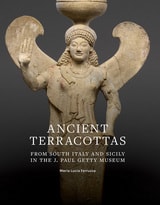
Ancient Terracottas from South Italy and Sicily in the J. Paul Getty Museum
Maria Lucia Ferruzza
J. Paul Getty Trust, The, 2016
Reflecting the Getty's commitment to open content, Ancient Terracottas from South Italy and Sicily in the J. Paul Getty Museum is available online at www.getty.edu/publications/terracottas and may be downloaded for free.
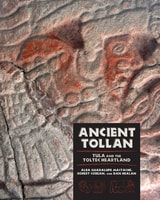
Ancient Tollan
Tula and the Toltec HeartlandAlba Guadalupe Mastache
University Press of Colorado, 2002
Chapters of the book are dedicated to topics ranging from the Teotihuancan occupation in the area, architectural and iconographic analysis of Tula's Sacred Precinct, the urban domestic architecture, settlement patterns, and irrigation systems. Using a wealth of data and focusing on the developmental processes of the city's functions on a regional level, Mastche, Cobean, and Healan offer a fresh view and a new understanding of this cultural center, its urban structure, and its rural environment.
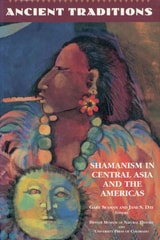
Ancient Traditions
Shamanism in Central Asia and the AmericasGary Seaman
University Press of Colorado, 1994
Over the centuries, shamanism has endured as an abiding topic of interest not only because of a human concern with the past but also because of a common yearning to acknowledge life lived in closer symbolic relationship to the earth. For readers interested in indigenous cultures and religions, this collection of essays clarifies much of the New Age speculation on universals in shamanism, offering solid research on specific ethnic and historical expressions.
In Ancient Traditions, prominent scholars in ethnography, anthropology, and the study of world religions bring to bear their diverse perspectives on this singularly fascinating topic. Contributors include Vladimir N. Basilov, Robert S. Carlsen, James A. Clifton, Jane S. Day, Vladimir Diachenko, Vera P. Diakonova, Peter T. Furst, Larisa R. Pavlinskaya, Martin Prechtel, Gary Seaman, Omer C. Stewart, Lawrence E. Sullivan, Robert J. Theodoratus, and Johannes Wilbert. Co-published with the Denver Museum of Nature and Science.
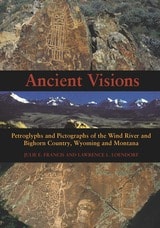
Ancient Visions
Petroglyphs and Pictographs of the Wind River and Bighorn Country, Wyoming and MontanaJulie Francis
University of Utah Press, 2004
The Bighorn and Wind River basins of north-central Wyoming and southern Montana have been home to Native American tribes for at least 11,000 years and contain some of the most diverse assemblages of hunter-gatherer rock art anywhere in the world. Most notable are the spectacular and surreal images of the Dinwoody tradition, but there is also a startling array of other forms from shield-bearing warriors to animals, plants, and abstract images. Ancient Visions presents a sampling of these wonderful rock art figures.
Julie Francis and Lawrence Loendorf contend that Native Americans, past and present, hold traditional knowledge that is central to an understanding of these images. By combining the ethnographic record with consultation of traditional leaders in modern Native communities, they offer compelling evidence that highly complex belief systems and religious experience form the context for the vast majority of petroglyphs and pictographs in the region.
The authors also show how this ancient imagery can be integrated with the archaeological record. Modern advances in rock-art dating techniques allow them to begin the process of incorporating image styles with archaeological chronologies. The result is a new approach that offers a much different archaeological picture of the ancient Bighorn and Wind River basins.
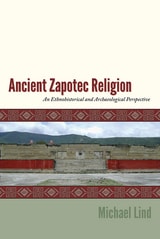
Ancient Zapotec Religion
An Ethnohistorical and Archaeological PerspectiveMichael Lind
University Press of Colorado, 2015
Ancient Zapotec Religion is the first comprehensive study of Zapotec religion as it existed in the southern Mexican state of Oaxaca on the eve of the Spanish Conquest. Author Michael Lind brings a new perspective, focusing not on underlying theological principles but on the material and spatial expressions of religious practice.
Using sixteenth- and seventeenth-century Spanish colonial documents and archaeological findings related to the time period leading up to the Spanish Conquest, he presents new information on deities, ancestor worship and sacred bundles, the Zapotec cosmos, the priesthood, religious ceremonies and rituals, the nature of temples, the distinctive features of the sacred and solar calendars, and the religious significance of the murals of Mitla—the most sacred and holy center. He also shows how Zapotec religion served to integrate Zapotec city-state structure throughout the valley of Oaxaca, neighboring mountain regions, and the Isthmus of Tehuantepec.
Ancient Zapotec Religion is the first in-depth and interdisciplinary book on the Zapotecs and their religious practices and will be of great interest to archaeologists, epigraphers, historians, and specialists in Native American, Latin American, and religious studies.
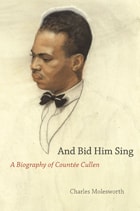
And Bid Him Sing
A Biography of Countée CullenCharles Molesworth
University of Chicago Press, 2012

And Justice for All
Families & the Criminal Justice System: Groves Monographs on Marriage and Family (Volume 4)Tessa le Roux
Michigan Publishing Services, 0
Groves Monographs on Marriage and Family is an edited book series based on the annual meetings of the Groves Conference on Marriage and Family, an interdisciplinary, interprofessional organization of limited invited membership founded in 1934. Groves Monographs publishes work on the leading edges of theory development and empirical research in the field of family studies. Individual volumes are edited by the chairs of the annual Groves Conferences and include peer-reviewed chapters by the conference presenters and invited authors. Topics are timely and provocative with diverse themes.
And Justice for All?
The Claims of Human Rights, Volume 103Ian Balfour and Eduardo Cadava, eds.
Duke University Press, 0
Grappling with the philosophical and theoretical questions at the heart of human rights, these essays take into consideration current political configurations such as sovereignty, genocide, humanitarian intervention, and the neglected domain of cultural rights (the right to a cultural identity). Drawing on Enlightenment thinking about human rights at the same time that they analyze the central concepts at work there—including the “humanity of man” and the nature of rights or of law—the contributors make a necessary intervention in a world system that Enlightenment thinkers could scarcely have envisioned.
Contributors. Etienne Balibar, Rony Brauman, Wendy Brown, Rebecca Comay, Jacques Derrida, Paul Downes, Werner Hamacher, Thomas Keenan, Susan Maslan, Jacques Rancière, Bruce Robbins, Avital Ronell, Gayatri Chakravorty Spivak, Elsa Stamatopoulou, Slavoj Zizek

And Other Neighborly Names
Social Process and Cultural Image in Texas FolkloreEdited by Richard Bauman and Roger D. Abrahams
University of Texas Press, 1981
"And Other Neighborly Names"—the title is from a study by Americo Paredes of the names, complimentary and otherwise, exchanged across cultural boundaries by Anglos and Mexicans—is a collection of essays devoted to various aspects of folk tradition in Texas. The approach builds on the work of the folklorists who have helped give the study of folklore in Texas such high standing in the field-Mody Boatright, J. Frank Dobie, John Mason Brewer, the Lomaxes, and of course Paredes himself, to whom this book is dedicated.
Focusing on the ways in which traditions arise and are maintained where diverse peoples come together, the editors and other essayists—John Holmes McDowell, Joe Graham, Alicia María González, Beverly J. Stoeltje, Archie Green, José E. Limón, Thomas A. Green, Rosan A. Jordan, Patrick B. Mullen, and Manuel H. Peña—examine conjunto music, the corrido, Gulf fishermen's stories, rodeo traditions, dog trading and dog-trading tales, Mexican bakers' lore, Austin's "cosmic cowboy" scene, and other fascinating aspects of folklore in Texas. Their emphasis is on the creative reaction to socially and culturally pluralistic situations, and in this they represent a distinctively Texan way of studying folklore, especially as illustrated in the performance-centered approach of Paredes, Boatright, and others who taught at the University of Texas at Austin. As an overview of this approach—its past, present, and future—"And Other Neighborly Names" makes a valuable contribution both to Texas folklore and to the discipline as a whole.
And They Lived Happily Ever After
Norms and Everyday Practices of Family and Parenthood in Russia and Eastern EuropeHelene Carlback
Central European University Press, 2012

And They Were Wonderful Teachers
Florida's Purge of Gay and Lesbian TeachersKaren L. Graves
University of Illinois Press, 2008
Karen L. Graves details how teachers were targeted, interrogated, and stripped of their professional credentials, and she examines the extent to which these teachers resisted the invasion of their personal lives. She contrasts the experience of three groups--civil rights activists, gay and lesbian teachers, and University of South Florida personnel--called before the committee and looks at the range of response and resistance to the investigations. Based on archival research conducted on a recently opened series of Investigation Committee records in the State Archives of Florida, this work highlights the importance of sexuality in American and education history and argues that Florida's attempt to govern sexuality in schools implies that educators are distinctly positioned to transform dominant ideology in American society.

And Who Will Witness Us?
A Histofuturist Account of Black Literacies on the Rust BeltS. R. Toliver
University of Chicago Press, 2027
An imaginative exploration of the historical narratives that shape Black life today, showing how the past is never truly left behind, but is always alive in the present, shaping the future.
Most people have probably never heard of New Castle, a Rust Belt city in western Pennsylvania. Education scholar S. R. Toliver describes it as “a stop on the road to elsewhere. But as a former resident, New Castle remains the endpoint of my journey, the highway exit I take, the place I go when I say I’m headed home.” Combining an autoethnography of growing up and being educated in New Castle with a remarkable study of Histofuturism, Toliver’s And Who Will Witness Us? reveals the historical erasure of Black people and their literary practices.
First, Toliver turns to the past, presenting a multifaceted portrayal of Black life in New Castle. She draws from personal insights, archival data, and oral histories to uncover historical disinvestment and the violence of anti-Blackness and anti-Indigeneity sown into the soil and soul of a city. At the same time, she highlights how, despite systemic neglect, Black people have used their stories to author themselves into existence, creating counter histories that reflect the richness and depth of Black lives. Toliver explains how these acts of creation, in turn, shape the future, allowing Black people to resist imposed narratives and envision possibilities beyond the limits of traditional ways of thinking, knowing, and doing.
Innovative in both form and style, And Who Will Witness Us? shares how research opens space for Black people to relearn themselves and their communities. It is a reckoning with what it means to call a place, a city, a people, home.

And a Time to Die
How American Hospitals Shape the End of LifeSharon R. Kaufman
University of Chicago Press, 2006
“An act of courage and a public service.”—San Francisco Chronicle
“This beautifully synthesized and disquieting account of how hospital patients die melds disciplined description with acute analysis, incorporating the voices of doctors, nurses, social workers, and patients in a provocative analysis of the modern American quest for a ‘good death.’”—Publishers Weekly
“Kaufman exposes the bureaucratic and ethical quandaries that hover over the modern deathbed.”—Psychology Today
“Kaufman’s analysis illuminates the complexity of the care of critically ill and dying patients [and] the ambiguity of slogans such as ‘death with dignity,’ ‘quality of life,’ and ‘stopping life support.’ . . . Thought-provoking reading for everyone contemplating the fate of us all.”—New England Journal of Medicine
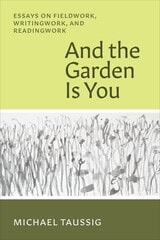
And the Garden Is You
Essays on Fieldwork, Writingwork, and ReadingworkMichael Taussig
University of Chicago Press, 2024
Michael Taussig’s work is known for its critical insights and bold, experimental style. In the eleven essays in this new collection, Taussig reflects on the act of writing itself, demonstrating its importance for anthropological practice and calling for the discipline to keep experiential knowledge from being extinguished as fieldnotes become scholarship.
Setting out to show how this can be done, And the Garden Is You exemplifies a form of exploratory writing that preserves the spontaneity of notes scribbled down in haste. In these essays, the author’s reflections take us from his childhood in Sydney to trips to Afghanistan, Colombia, Finland, Italy, Turkey, and Syria. Along the way, Taussig explores themes of fabulation and provocation that are central to his life’s work, in addition to the thinkers dearest to him—Bataille, Benjamin, Burroughs, and Nietzsche, among others. This collection is vintage Taussig, bound to interest longtime readers and newcomers alike.
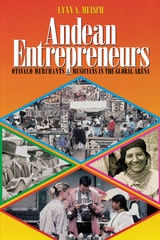
Andean Entrepreneurs
Otavalo Merchants and Musicians in the Global ArenaBy Lynn A. Meisch
University of Texas Press, 2002
Native to a high valley in the Andes of Ecuador, the Otavalos are an indigenous people whose handcrafted textiles and traditional music are now sold in countries around the globe. Known as weavers and merchants since pre-Inca times, Otavalos today live and work in over thirty countries on six continents, while hosting more than 145,000 tourists annually at their Saturday market.
In this ethnography of the globalization process, Lynn A. Meisch looks at how participation in the global economy has affected Otavalo identity and culture since the 1970s. Drawing on nearly thirty years of fieldwork, she covers many areas of Otavalo life, including the development of weaving and music as business enterprises, the increase in tourism to Otavalo, the diaspora of Otavalo merchants and musicians around the world, changing social relations at home, the growth of indigenous political power, and current debates within the Otavalo community over preserving cultural identity in the face of globalization and transnational migration. Refuting the belief that contact with the wider world inevitably destroys indigenous societies, Meisch demonstrates that Otavalos are preserving many features of their culture while adopting and adapting modern technologies and practices they find useful.
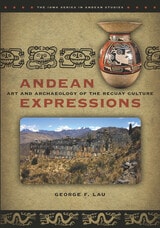
Andean Expressions
Art and Archaeology of the Recuay CultureGeorge F. Lau
University of Iowa Press, 2011
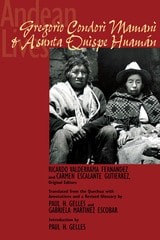
Andean Lives
Gregorio Condori Mamani and Asunta Quispe HuamánRicardo Valderrama Fernández and Carmen Escalante Gutiérrez, Original Editors
University of Texas Press, 1996
Gregorio Condori Mamani and Asunta Quispe Huamán were runakuna, a Quechua word that means "people" and refers to the millions of indigenous inhabitants neglected, reviled, and silenced by the dominant society in Peru and other Andean countries. For Gregorio and Asunta, however, that silence was broken when Peruvian anthropologists Ricardo Valderrama Fernández and Carmen Escalante Gutiérrez recorded their life stories. The resulting Spanish-Quechua narrative, published in the mid-1970s and since translated into many languages, has become a classic introduction to the lives and struggles of the "people" of the Andes.
Andean Lives is the first English translation of this important book. Working directly from the Quechua, Paul H. Gelles and Gabriela Martínez Escobar have produced an English version that will be easily accessible to general readers and students, while retaining the poetic intensity of the original Quechua. It brings to vivid life the words of Gregorio and Asunta, giving readers fascinating and sometimes troubling glimpses of life among Cuzco's urban poor, with reflections on rural village life, factory work, haciendas, indigenous religion, and marriage and family relationships.

András Visky's Barrack Dramaturgy
Memories of the BodyEdited by Jozefina Komporaly
Intellect Books, 2017
The book includes the first English-language anthology of Visky’s best known plays—Juliet, I Killed My Mother, and Porn—as well as critical analysis and an exploration of Visky’s “Barrack Dramaturgy,” a dramaturgical theory in which he considers the theater as a space for exploring feelings of cultural and personal captivity. Inspired by personal experience of the oppressive communist regime in Romania, Visky’s work explores the themes of gender, justice, and trauma, encouraging shared moments of remembrance and collective memory. This collection makes use of scripts and director’s notes, as well as interviews with creative teams behind the productions, to reveal a holistic, insider’s view of Visky’s artistic vision. Scholars and practitioners alike will benefit from this rare, English-language collection of Visky’s work and dramaturgy.
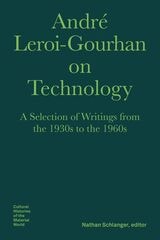
André Leroi-Gourhan on Technology
A Selection of Writings from the 1930s to the 1960sAndré Leroi-Gourhan
Bard Graduate Center, 2023
André Leroi-Gourhan is undoubtedly one of the most acclaimed figures of twentieth-century anthropology and archaeology. In France, his intellectual importance rivals that of the Claude Lévi-Strauss, yet Leroi-Gourhan’s major contributions are almost entirely unknown in the Anglophone world. This collection seeks to change that. This selection highlights some of his chief influences, such as elaborating a theory of technology, which argues that material culture focuses on the object in use and how use is a dynamic feature that has specific consequences for human evolution and human society. With serious ramifications for our understanding of material culture, putting Leroi-Gourhan’s thinking about technology into English will have an immediate and transformative impact on material culture studies.

Andy Warhol'S Blow Job
Roy Grundmann
Temple University Press, 2003
Grundmann draws on discourses of art history, film theory, queer studies, and cultural studies to situate Warhol's work at the nexus of Pop art, portrait painting, avant-garde film, and mainstream cinema. His close textual analysis of the film probes into its ambiguities and the ways in which viewers respond to what is and what is not on screen. Presenting rarely reproduced Warhol art and previously unpublished Ed Wallowitch photographs along with now iconic publicity shots of James Dean, Grundmann establishes Blow Job as a consummate example of Warhol's highly insightful engagement with a broad range of representational codes of gender and sexuality.

Andy Warhol, Publisher
Lucy Mulroney
University of Chicago Press, 2018
Journeying from the 1950s, when Warhol was starting to make his way through the New York advertising world, through the height of his career in the 1960s, to the last years of his life in the 1980s, Andy Warhol, Publisher unearths fresh archival material that reveals Warhol’s publications as complex projects involving a tantalizing cast of collaborators, shifting technologies, and a wide array of fervent readers.
Lucy Mulroney shows that whether Warhol was creating children’s books, his infamous “boy book” for gay readers, writing works for established houses like Grove Press and Random House, helping found Interview magazine, or compiling a compendium of photography that he worked on to his death, he readily used the elements of publishing to further and disseminate his art. Warhol not only highlighted the impressive variety in our printed culture but also demonstrated how publishing can cement an artistic legacy.
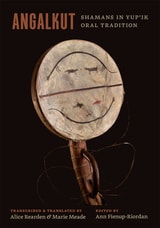
Angalkut/Shamans in Yup'ik Oral Tradition
Ann Fienup-Riordan
University of Alaska Press, 2025
The book begins with an English introduction that places Yup’ik oral traditions in the context of shamanism in Alaska and other parts of the Arctic. Then first-person accounts presented in the original Yup’ik with accompanying English translations discuss the importance of shamans and shamanism in general, good and bad shamans, and shamans as healers. Narratives from Nelson Island, Canineq, Kuskokwim River, Akulmiut, and Yukon River describe shamans as healers, shaman journeys and performances, shamans and masked dances requesting abundance, shamans and the dead, malicious shamans, shaman confrontations, becoming a shaman, and those who have shaman abilities today. A detailed glossary and references are also included.
Today, not only are these angalkut gone, but so are those who witnessed and participated in their activities. Angalkut/Shamans in Yup’ik Oral Tradition is the first book devoted exclusively to Yup’ik angalkut; never before has the variety of angalkut roles been profiled in publication, including the richness of elders’ recollections of these individuals and their roles. There is great value in the stories they left behind. This fine-grained presentation of unique, bilingual first-person narratives is an essential resource for scholars and students interested in Yup’ik heritage, Yugtun language, shaman ethnography, and Alaska Native oral traditions.
Anglo-American Feminist Challenges to the Rhetorical Traditions
Virginia Woolf, Mary Daly, Adrienne RichKrista Ratcliffe
Southern Illinois University Press, 1996
Although women and men have different relationships to language and to each other, traditional theories of rhetoric do not foreground such gender differences. Krista Ratcliffe argues that because feminists generally have not conceptualized their language theories from the perspective of rhetoric and composition studies, rhetoric and composition scholars must construct feminist theories of rhetoric by employing a variety of interwoven strategies: recovering lost or marginalized texts; rereading traditional rhetoric texts; extrapolating rhetorical theories from such nonrhetoric texts as letters, diaries, essays, cookbooks, and other sources; and constructing their own theories of rhetoric.
Focusing on the third option, Ratcliffe explores ways in which the rhetorical theories of Virginia Woolf, Mary Daly, and Adrienne Rich may be extrapolated from their Anglo-American feminist texts through examination of the interrelationship between what these authors write and how they write. In other words, she extrapolates feminist theories of rhetoric from interwoven claims and textual strategies. By inviting Woolf, Daly, and Rich into the rhetorical traditions and by modeling the extrapolation strategy/methodology on their writings, Ratcliffe shows how feminist texts about women, language, and culture may be reread from the vantage point of rhetoric to construct feminist theories of rhetoric. She also outlines the pedagogical implications of these three feminist theories of rhetoric, thus contributing to ongoing discussions of feminist pedagogies.
Traditional rhetorical theories are gender-blind, ignoring the reality that women and men occupy different cultural spaces and that these spaces are further complicated by race and class, Ratcliffe explains. Arguing that issues such as who can talk, where one can talk, and how one can talk emerge in daily life but are often disregarded in rhetorical theories, Ratcliffe rereads Roland Barthes’ "The Old Rhetoric" to show the limitations of classical rhetorical theories for women and feminists. Discovering spaces for feminist theories of rhetoric in the rhetorical traditions, Ratcliffe invites readers not only to question how women have been located as a part of— and apart from—these traditions but also to explore the implications for rhetorical history, theory, and pedagogy.
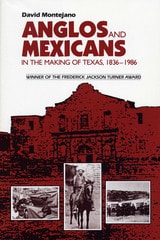
Anglos and Mexicans in the Making of Texas, 1836-1986
By David Montejano
University of Texas Press, 1987
Winner, Frederick Jackson Turner Award, Organization Of American Historians, 1988
American Historical Association, Pacific Branch Book Award, 1989
Texas Institute of Letters Friends Of The Dallas Public Library Award, 1987
Texas Historical Commission T. R. Fehrenbach Award, Best Ethnic, Minority, And Women's History Publication, 1987
Anguish of Snails
Native American Folklore in the WestBarre Toelken
Utah State University Press, 2003
Winner of the 2004 Chicago Folklore Prize, The Anguish of Snails is an essential work for the collection of any serious reader in folklore or Native American studies.
Anguyiim Nalliini/Time of Warring
The History of Bow-and-Arrow Warfare in Southwest AlaskaAnn Fienup-Riordan and Alice Rearden
University of Alaska Press, 2016
The book is presented in bilingual format, with facing-page translations, and it will be hailed as a landmark work in the study of Alaska Native history and anthropology.
Animacies
Biopolitics, Racial Mattering, and Queer AffectMel Y. Chen
Duke University Press, 2012
Chen's book is the first to bring the concept of animacy together with queer of color scholarship, critical animal studies, and disability theory. Through analyses of dehumanizing insults, the meanings of queerness, animal protagonists in recent Asian/American art and film, the lead in toys panic in 2007, and the social lives of environmental illness, Animacies illuminates a hierarchical politics infused by race, sexuality, and ability. In this groundbreaking book, Chen rethinks the criteria governing agency and receptivity, health and toxicity, productivity and stillness—and demonstrates how attention to the affective charge of matter challenges commonsense orderings of the world.
Animal Advocacy and Englishwomen, 1780-1900
Patriots, Nation, and EmpireMoira Ferguson
University of Michigan Press, 1998
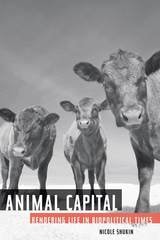
Animal Capital
Rendering Life in Biopolitical TimesNicole Shukin
University of Minnesota Press, 2009
Illuminates the profound contingency of market life on animal figures and flesh
The juxtaposition of biopolitical critique and animal studies—two subjects seldom theorized together—signals the double-edged intervention of Animal Capital. Nicole Shukin pursues a resolutely materialist engagement with the “question of the animal,” challenging the philosophical idealism that has dogged the question by tracing how the politics of capital and of animal life impinge on one another in market cultures of the twentieth and early twenty-first centuries.
Shukin argues that an analysis of capital’s incarnations in animal figures and flesh is pivotal to extending the examination of biopower beyond its effects on humans. “Rendering” refers simultaneously to cultural technologies and economies of mimesis and to the carnal business of boiling down and recycling animal remains. Rendering’s accommodation of these discrepant logics, she contends, suggests a rubric for the critical task of tracking the biopolitical conditions and contradictions of animal capital across the spaces of culture and economy.From the animal capital of abattoirs and automobiles, films and mobile phones, to pandemic fear of species-leaping diseases such as avian influenza and mad cow, Shukin makes startling linkages between visceral and virtual currencies in animal life, illuminating entanglements of species, race, and labor in the conditions of capitalism. In reckoning with the violent histories and intensifying contradictions of animal rendering, Animal Capital raises provocative and pressing questions about the cultural politics of nature.
Animal Crossing
New Horizons: Can a Game Take Care of Us?Noah Wardrip-Fruin
University of Chicago Press, 2025
A moving, personal exploration of what we looked for, and found, in the gaming sensation Animal Crossing during and after the pandemi
Animal Crossing: New Horizons was released on March 20, 2020—just as a pandemic kept many from family, work, restaurants, and the rest of their regularly scheduled lives. At its height, the game averaged one million copies sold per day, as players sought comfort, escape, and a virtual means of connection. In this book, game scholar Noah Wardrip-Fruin, isolated with his family by both lockdown and disability, explores the power of this game and the mixed emotions of a player and a parent trying to make it from one day to the next—while his kids’ obsession with Animal Crossing creates conflicts between them and pushback against family rules.
Wardrip-Fruin helps both Animal Crossing fans and newcomers understand the unexpected beneath the game’s surface: like the story of the first Animal Crossing, codesigned by an absent father seeking connection; like the hallmarks of video game manipulation, from “streak” bonuses to game-determined playtimes; like the appeal of endless shopping, in a kind of “safe” capitalism; and, of course, like the character quirks of a raccoon dog, Tom Nook, who provides a world of both safety and strange paternalism.
For many, this blockbuster game offered a comforting world compared to a reality of danger. In this first entry in the Replay series, Wardrip-Fruin offers an absorbing investigation of a game’s role in contemporary social life and a book that belongs on the shelf of anyone who loves or is puzzled by this Nintendo sensation.
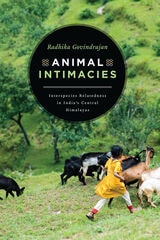
Animal Intimacies
Interspecies Relatedness in India's Central HimalayasRadhika Govindrajan
University of Chicago Press, 2018
Built on extensive ethnographic fieldwork in the mountain villages of India’s Central Himalayas, Radhika Govindrajan’s book explores the number of ways that human and animal interact to cultivate relationships as interconnected, related beings. Whether it is through the study of the affect and ethics of ritual animal sacrifice, analysis of the right-wing political project of cow-protection, or examination of villagers’ talk about bears who abduct women and have sex with them, Govindrajan illustrates that multispecies relatedness relies on both difference and ineffable affinity between animals. Animal Intimacies breaks substantial new ground in animal studies, and Govindrajan’s detailed portrait of the social, political and religious life of the region will be of interest to cultural anthropologists and scholars of South Asia as well.
Animal Myths and Metaphors in South America
URTON
University of Utah Press, 1985
The contributors to this anthology have not limited themselves to the notion that clans and moieties are the only sources and objects of metaphorical comparisons between humans and animals. They suggest a shift in perspective that has metaphorical comparisons generated by conceived similarities and differences between animals and particular types of human beings. Some examples of this include macaw fledglings as adolescents; pumas as fully initiated men, and foxes as young married men. With this shift of emphasis, a significantly different analytic focus in the study of human-animal relations is produced.
Animal Resistance in the Global Capitalist Era
Sarat Colling
Michigan State University Press, 2020

Animal Rights
History and Scope of a Radical Social MovementHarold D. Guither
Southern Illinois University Press, 1998
In the past decade, philosopher Bernard Rollin points out, we have "witnessed a major revolution in social concern with animal welfare and the moral status of animals." Adopting the stance of a moderate, Harold Guither attempts to provide an unbiased examination of the paths and goals of the members of the animal rights movement and of its detractors.
Given the level of confusion, suspicion, misunderstanding, and mistrust between the two sides, Guither admits the difficulty in locating, much less staying in, the middle of the road. The philosophical conflict, however, is fairly clear: those who resist reform, fearing that radical change in the treatment of animals will infringe on their business and property rights, versus the new activists who espouse a different set of moral and ethical obligations toward animals.
From his position as a moderate, Guither presents a brief history of animal protection and the emergence of animal rights, describes the scope of the movement, and identifies major players such as Paul and Linda McCartney and organizations such as People for the Ethical Treatment of Animals that are actively involved in the movement. He concentrates on what is actually happening in the 1990s, discussing in detail the possible consequences of the current debate for those who own, use, or enjoy animals in entertainment and leisure pursuits. A reference work for students in animal sciences and veterinary medicine, the book also poses questions for philosophers, sociologists, and public policymakers as well as animal owners, animal and biomedical researchers, and manufacturers and distributors of animal equipment and supplies.
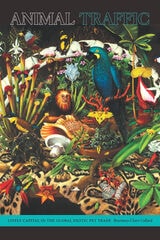
Animal Traffic
Lively Capital in the Global Exotic Pet TradeRosemary-Claire Collard
Duke University Press, 2020