Results by title
28167 books match the query 'History' and 2536 start with a
An Absent Presence
Japanese Americans in Postwar American Culture, 1945-1960Caroline Chung Simpson
Duke University Press, 2001
Simpson argues that when popular journals or social theorists engaged the topic of Japanese American history or identity in the Cold War era they did so in a manner that tended to efface or diminish the complexity of their political and historical experience. As a result, the shadowy figuration of Japanese American identity often took on the semblance of an “absent presence.” Individual chapters feature such topics as the case of the alleged Tokyo Rose, the Hiroshima Maidens Project, and Japanese war brides. Drawing on issues of race, gender, and nation, Simpson connects the internment episode to broader themes of postwar American culture, including the atomic bomb, McCarthyism, the crises of racial integration, and the anxiety over middle-class gender roles.
By recapturing and reexamining these vital flashpoints in the projection of Japanese American identity, Simpson fills a critical and historical void in a number of fields including Asian American studies, American studies, and Cold War history.
An Abundance of Flowers
More Great Flower Breeders of the PastJudith M. Taylor
Ohio University Press, 2018
Walk into any nursery, florist, or supermarket, and you’ll encounter displays of dozens of gorgeous flowers, from chrysanthemums to orchids. At one time these fanciful blooms were the rare trophies of the rich and influential—even the carnation, today thought of as one of the humblest cut flowers. Every blossom we take for granted now is the product of painstaking and imaginative planning, breeding, horticultural ingenuity, and sometimes chance. The personalities of the breeders, from an Indiana farmer to Admiral Lord Gambier’s gardener, were as various and compelling as the beauty they conjured from skilled hybridization.
In Visions of Loveliness: Great Flower Breeders of the Past, Judith Taylor wrote engagingly about the vivid history and characters behind eighteen types of popular flowers. In this companion volume she uncovers information about another eight familiar flowers: poinsettias, chrysanthemums, gladioli, pansies, carnations, water lilies, clematis, and penstemons.
Taylor has tapped into an enormous trove of stories about extraordinary people with vision and skill who added to our enjoyment piece by piece, starting about 150 years ago. This beautifully illustrated book will please flower enthusiasts, gardeners, and history buffs alike.
An Accidental Triumph
The Improbable History of American Higher EducationSol Gittleman
Vesto Books, 2023
"Hardly a day passes without reference to some scandal, fraud, intellectual or moral failure, or other ill associated with American academic institutions,” writes Sol Gittleman in his bracing new book, An Accidental Triumph. “If American higher education is such a failure, why are students and scholars from all over the world still so eager to secure a place in one of these institutions? Is American higher education a disaster or the envy of the world?”
Gittleman confronts this contradiction in this dynamic mix of history, analysis, and personal reflection. An Accidental Triumph tells the engaging story of how American higher education evolved from a patchwork of seminaries in the early nineteenth century into the world’s leader in research by the middle of the twentieth. Gittleman links this fascinating story to his own fifty-year academic career, which coincided with an explosive rise in enrollment, spurred by the GI Bill, and an unparalleled postwar boom in faculty hiring, prompted by massive new federal support for academic research from organizations such as the National Science Foundation.
Writing with authority, frankness, and unfailing wry good humor, Gittleman surveys the triumphs, tragedies, and tensions of the history of American higher education. Despite the relentless criticism, Gittleman finds good reason to remain optimistic about the future of teaching and research at the college and university level in the United States.
An Account of the Antiquities of the Indians
A New Edition, with an Introductory Study, Notes, and Appendices by José Juan ArromFray Ramon Pané
Duke University Press, 1999
Edited by the noted Hispanist José Juan Arrom, Pané’s report is the only surviving direct source of information about the myths, ceremonies, and lives of the New World inhabitants whom Columbus first encountered. The friar’s text contains many linguistic and cultural observations, including descriptions of the Taíno people’s healing rituals and their beliefs about their souls after death. Pané provides the first known description of the use of the hallucinogen cohoba, and he recounts the use of idols in ritual ceremonies. The names, functions, and attributes of native gods; the mythological origin of the aboriginal people’s attitudes toward sex and gender; and their rich stories of creation are described as well.
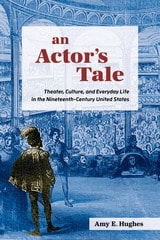
An Actor's Tale
Theater, Culture, and Everyday Life in the Nineteenth-Century United StatesAmy Hughes
University of Michigan Press, 2025
Ultimately, Hughes reveals how this actor’s tale illuminates the widespread tendency to ignore, deny, and forgive White male mediocrity in US culture, and how a deeper understanding of people like Watkins can transform our understanding of the past—and our understanding of ourselves.
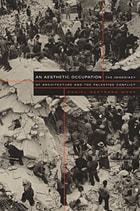
An Aesthetic Occupation
The Immediacy of Architecture and the Palestine ConflictDaniel Bertrand Monk
Duke University Press, 2002
In An Aesthetic Occupation Daniel Bertrand Monk unearths the history of the unquestioned political immediacy of “sacred” architecture in the conflict between Palestinians and Israelis. Monk combines groundbreaking archival research with theoretical insights to examine in particular the Mandate era—the period in the first half of the twentieth century when Britain held sovereignty over Palestine. While examining the relation between monuments and mass violence in this context, he documents Palestinian, Zionist, and British attempts to advance competing arguments concerning architecture’s utility to politics.
Succumbing neither to the view that monuments are autonomous figures onto which political meaning has been projected, nor to the obverse claim that in Jerusalem shrines are immediate manifestations of the political, Monk traces the reciprocal history of both these positions as well as describes how opponents in the conflict debated and theorized their own participation in its self-representation. Analyzing controversies over the authenticity of holy sites, the restorations of the Dome of the Rock, and the discourse of accusation following the Buraq, or Wailing Wall, riots of 1929, Monk discloses for the first time that, as combatants looked to architecture and invoked the transparency of their own historical situation, they simultaneously advanced—and normalized—the conflict’s inability to account for itself.
This balanced and unique study will appeal to anyone interested in Israel or Zionism, the Palestinians, the Middle East conflict, Jerusalem, or its monuments. Scholars of architecture, political theory, and religion, as well as cultural and critical studies will also be informed by its arguments.
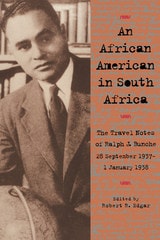
An African American in South Africa
The Travel Notes of Ralph J. Bunche 28 September 1937–1 January 1938Ralph Bunche
Ohio University Press, 2001
Ralph Bunche, who received the Nobel Peace Prize in 1950, traveled to South Africa for three months in 1937. His notes, which have been skillfully compiled and annotated by historian Robert R. Edgar, provide unique insights on a segregated society.
An African Perspective on the Thought of Benedict XVI
Agbaw-ebai
St. Augustine's Press, 2023
An African Voice
The Role of the Humanities in African IndependenceRobert W. July
Duke University Press, 1987
An African in Paris
Bernard Binlin Dadié; Translated by Karen C. Hatch
University of Illinois Press, 1994
In 1959, when Un Negre a Paris first appeared, the French still held West Africa under colonial rule. Dadié's subtle parodies draw on intimate knowledge obtained over decades spent observing the colonizers abroad and now, suddenly, on their own home terrain. His remarks on Parisian living conditions, wordplay, manners, and and morals are entertaining and poignant, charming yet profound.

An Age of Accountability
How Standardized Testing Came to Dominate American Schools and Compromise EducationJohn L. Rury
Rutgers University Press, 2024
An Agenda for Antiquity
Henry Fairfield Osborn and Vertebrate Paleontology at the American Museum of Natural History, 1890-1935Ronald Rainger
University of Alabama Press, 1991
With a main focus on Henry Fairfield Osborn (1857-1935), a prominent scientist and administrator who dominated vertebrate paleontology in that era and played a pivotal role in creating a leading institution and a manor program of research in that field.
Born into a wealthy New York family, Osborn was in a unique position to follow vigorously his scientific interests in vertebrate paleontology and further worldwide science education through use of the considerable social, political, and financial resources at his command. Yet he was able to guide the development of the American Museum of Natural History’s program in vertebrate paleontology in such a manner as to avoid conflict with the values and beliefs associated with the interests of the upper-class elite who supported the program.
His ties to a wide network of influential figures, including the trustees of the American Museum, provided him with the political and financial resources necessary to build a major program in vertebrate paleontology. An ambitious and energetic man, Osborn took advantage of those opportunities to promote his field of study and to establish himself as a leading administrator at the American Museum, Colombia University, and the New York Zoological Society.
An Alabama Songbook
Ballads, Folksongs, and Spirituals Collected by Byron ArnoldRobert W. Halli Jr.
University of Alabama Press, 2004
Alabama is a state rich in folksong tradition, from old English ballads sung along the Tennessee River to children’s game songs played in Mobile, from the rhythmic work songs of the railroad gandy dancers of Gadsden to the spirituals of the Black Belt. The musical heritage of blacks and whites, rich and poor, hill folk and cotton farmers, these songs endure as a living part of the state’s varied past.
In the mid 1940s Byron Arnold, an eager young music professor from The University of Alabama, set out to find and record as many of these songs as he could and was rewarded by unstinting cooperation from many informants. Mrs. Julia Greer Marechal of Mobile, for example, was 90 years old, blind, and a semi-invalid, but she sang for Arnold for three hours, allowing the recording of 33 songs and exhausting Arnold and his technician. Helped by such living repositories as Mrs. Marechal, the Arnold collection grew to well over 500 songs, augmented by field notes and remarkable biographical information on the singers.
An Alabama Songbook is the result of Arnold’s efforts and those of his informants across the state and has been shaped by Robert W. Halli Jr. into a narrative enriched by more than 200 significant songs-lullabies, Civil War anthems, African-American gospel and secular songs, fiddle tunes, temperance songs, love ballads, play-party rhymes, and work songs. In the tradition of Alan Lomax’s The Folk Songs of North America and Vance Randolph’s Ozark Folksongs, this volume will appeal to general audiences, folklorists, ethnomusicologists, preservationists, traditional musicians, and historians.
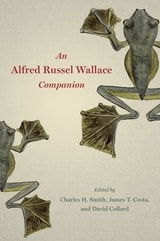
An Alfred Russel Wallace Companion
Edited by Charles H. Smith, James T. Costa, and David A. Collard
University of Chicago Press, 2019
Wallace declared his eight years of exploration in southeast Asia to be “the central and controlling incident” of his life. As 2019 marks one hundred and fifty years since the publication of The Malay Archipelago, Wallace’s canonical work chronicling his epic voyage, this collaborative book gathers an interdisciplinary array of writers to celebrate Wallace’s remarkable life and diverse scholarly accomplishments. Wallace left school at the age of fourteen and was largely self-taught, a voracious curiosity and appetite for learning sustaining him throughout his long life. After years as a surveyor and builder, in 1848 he left Britain to become a professional natural history collector in the Amazon, where he spent four years. Then, in 1854, he departed for the Malay Archipelago. It was on this voyage that he constructed a theory of natural selection similar to the one Charles Darwin was developing, and the two copublished papers on the subject in 1858, some sixteen months before the release of Darwin’s On the Origin of Species.
But as the contributors to the Companion show, this much-discussed parallel evolution in thought was only one epoch in an extraordinary intellectual life. When Wallace returned to Britain in 1862, he commenced a career of writing on a huge range of subjects extending from evolutionary studies and biogeography to spiritualism and socialism. An Alfred Russel Wallace Companion provides something of a necessary reexamination of the full breadth of Wallace’s thought—an attempt to describe not only the history and present state of our understanding of his work, but also its implications for the future.

An Alternative History of Hyperactivity
Food Additives and the Feingold DietSmith, Matthew
Rutgers University Press, 2011
Matthew Smith asserts that those scientific conclusions were, in fact, flawed. An Alternative History of Hyperactivity explores the origins of the Feingold diet, revealing why it became so popular, and the ways in which physicians, parents, and the public made decisions about whether it was a valid treatment for hyperactivity. Arguing that the fate of Feingold's therapy depended more on cultural, economic, and political factors than on the scientific protocols designed to test it, Smith suggests the lessons learned can help resolve medical controversies more effectively.

An Alternative Path
The Making and Remaking of Hahnemann Medical College and HospitalNaomi Rogers
Rutgers University Press, 1998
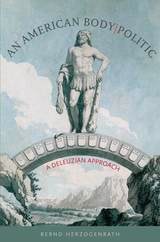
An American Body | Politic
A Deleuzian ApproachBernd Herzogenrath
Dartmouth College Press, 2010
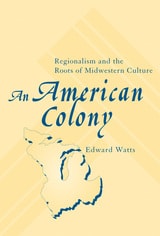
An American Colony
Regionalism and the Roots of Midwestern CultureEdward Watts
Ohio University Press, 2002
The Old Northwest—the region now known as the Midwest—has been largely overlooked in American cultural history, represented as a place smoothly assimilated into the expanding, manifestly-destined nation. An American Colony: Regionalism and the Roots of Midwestern Culture studies the primary texts and principal conflicts of the settlement of the Old Northwest to reveal that its entry into the nation’s culture was not without problems. In fact, Edward Watts argues that it is best understood as a colony of the United States, just as the eastern states were colonies of the British Empire.
Reconsidered as a colony, the Old Northwest becomes a crucible revealing the complex entanglement of local, indigenous, and regional interests with the coercions of racism, nationalism, and imperialism. This conflicted setting, like those of all settlement colonies, was beset by competing views of local identity, especially as they came to contradict writers from the eastern seaboard.
Using postcolonial theories developed to describe other settlement colonies, An American Colony identifies the Old Northwest as a colony and its culture as less than fully participating in either the nation’s or its own writing and identity. This embedded sense of cultural inferiority, Watts argues, haunts Midwestern culture even today.
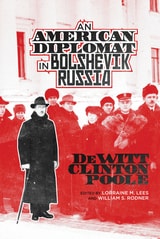
An American Diplomat in Bolshevik Russia
DeWitt Clinton Poole, Edited by Lorraine M. Lees and William S. Rodner
University of Wisconsin Press, 2014
Historians Lorraine M. Lees and William S. Rodner introduce and annotate Poole's recollections, which give a fresh, firsthand perspective on monumental events in world history and reveal the important impact DeWitt Clinton Poole (1885–1952) had on U.S.–Soviet relations. He was active in implementing U.S. policy, negotiating with the Bolshevik authorities, and supervising American intelligence operations that gathered information about conditions throughout Russia, especially monitoring anti-Bolshevik elements and areas of German influence. Departing Moscow in late 1918 via Petrograd, he was assigned to the port of Archangel, then occupied by Allied and American forces, and left Russia in June 1919.
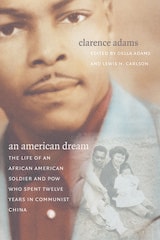
An American Dream
The Life of an African American Soldier and POW Who Spent Twelve Years in Communist ChinaClarence Adams
University of Massachusetts Press, 2007
Throughout his life, Clarence Adams exhibited self-reliance, ambition, ingenuity, courage, and a commitment to learning—character traits often equated with the successful pursuit of the American Dream. Unfortunately, for an African American coming of age in the 1930s and 1940s, such attributes counted for little, especially in the South.
Adams was a seventeen-year-old high school dropout in 1947 when he fled Memphis and the local police to join the U.S. Army. Three years later, after fighting in the Korean War in an all-black artillery unit that he believed to have been sacrificed to save white troops, he was captured by the Chinese. After spending almost three years as a POW, during which he continued to suffer racism at the hands of his fellow Americans, he refused repatriation in 1953, choosing instead the People's Republic of China, where he hoped to find educational and career opportunities not readily available in his own country.
While living in China, Adams earned a university degree, married a Chinese professor of Russian, and worked in Beijing as a translator for the Foreign Languages Press. During the Vietnam War he made a controversial anti-war broadcast over Radio Hanoi, urging black troops not to fight for someone else's political and economic freedoms until they enjoyed these same rights at home.
In 1966, having come under suspicion during the Chinese Cultural Revolution, he returned with his wife and two children to the United States, where he was subpoenaed to appear before the House Committee on Un-American Activities to face charges of “disrupting the morale of American fighting forces in Vietnam and inciting revolution in the United States.” After these charges were dropped, he and his family struggled to survive economically. Eventually, through sheer perseverance, they were able to fulfill at least part of the American Dream. By the time he died, the family owned and operated eight successful Chinese restaurants in his native Memphis.
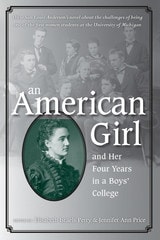
An American Girl, and Her Four Years in a Boys' College
Olive San Louie Anderson
University of Michigan Press, 2006
In 1870, the University of Michigan-one of the oldest, largest, and most prestigious public universities in the United States-admitted its first woman student. An American Girl, and Her Four Years in a Boys' College, written by one of the first woman graduates from the University of Michigan and published pseudonymously in 1878, describes what it was like to be a member of this tiny group of brave coeds. The story is told through the eyes of Wilhelmine Elliot, an untraditional girl who enrolls at the fictional University of Ortonville, a thinly disguised stand-in for the University of Michigan.
Will's challenges mirror those of other women college students of the era, including the reactions of male faculty and students, relationships with other women students and with family and friends back home, and social attitudes toward the women's movement and liberal religious values. The editors' engaging introduction places the novel in its relevant historical and literary contexts, as do helpful annotations throughout the text.
"The 1870s were an important moment of debate over women's roles and responsibilities. What's here is very interesting not only about higher education, and 'strong-minded women,' but about religion, domesticity, independence, marriage, and homosocial bonding."
--Carol Lasser, Oberlin College
Olive San Louie Anderson (ca. 1852-86) graduated from the University of Michigan in 1875 and published An American Girl in 1878 under the name SOLA. Elisabeth Israels Perry is John Francis Bannon Professor of History, Saint Louis University. Jennifer Ann Price is a Ph.D. candidate in American Studies at Saint Louis University.

An American Obsession
Science, Medicine, and Homosexuality in Modern SocietyJennifer Terry
University of Chicago Press, 1999
Terry's overarching argument is compelling: that homosexuality served as a marker of the "abnormal" against which malleable, tenuous, and often contradictory concepts of the "normal" were defined. One of the few histories to take into consideration homosexuality in both women and men, Terry's work also stands out in its refusal to erase the agency of people classified as abnormal. She documents the myriad ways that gays, lesbians, and other sexual minorities have coauthored, resisted, and transformed the most powerful and authoritative modern truths about sex. Proposing this history as a "useable past," An American Obsession is an indispensable contribution to the study of American cultural history.
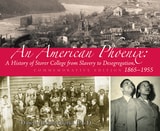
An American Phoenix
A History of Storer College from Slavery to Desegregation 1865-1955, Commemorative EditionDawne Raines Burke
West Virginia University Press, 2015
In the first book-length study of Storer College, Dawne Raines Burke tells the story of the historically black institution from its Reconstruction origins to its demise in 1955. Established by Northern Baptists in the abolitionist flashpoint of Harpers Ferry, Storer was the first college open to African Americans in West Virginia, and it played a central role in regional and national history. In addition to educating generations of students of all races, genders, and creeds, Storer served as the second meeting place (and the first on U.S. soil) for the Niagara Movement, a precursor to the NAACP.
An American Phoenix provides a comprehensive and extensively illustrated history of this historically black college, bringing to life not just the institution but many of the individuals who taught or were educated there. It fills a significant gap in our knowledge of African American history and the struggle for rights in West Virginia and the wider world.
An American Provence
Thomas P. Huber
University Press of Colorado, 2011
-From An American Provence
In this poetic personal narrative, Thomas P. Huber reflects on two seemingly unrelated places-the North Fork Valley in western Colorado and the Coulon River Valley in Provence, France-and finds a shared landscape and sense of place. What began as a simple comparison of two like places in distant locations turned into a more complex, interesting, and personal task. Much is similar-the light, the valleys, the climate, the agriculture. And much is less so-the history, the geology, the physical makeup of villages. Using a geographer's eye and passion for the land and people, Huber examines the regions' similarities and differences to explore the common emotional impact of each region. Part intimate travelogue and part case study of geography in the real world, An American Provence illuminates the importance sense of place plays in who we are.
An American Rabbi in Korea
A Chaplain's Journey in the Forgotten WarMilton J. Rosen, translated and edited by Stanley R. Rosen
University of Alabama Press, 2004
During the height of the Korean conflict, 1950–51, Orthodox Jewish chaplain Milton J. Rosen wrote 19 feature-length articles for Der Morgen Zhornal, a Yiddish daily in New York, documenting his wartime experiences as well as those of the servicemen under his care. An American Rabbi in Korea is an English translation of Rosen's important articles prepared by his son and annotated with background about Rosen's military service, a general introduction to the war and conflict on the Korean peninsula, and numerous maps and photographs.
Rosen was among those nearly caught in the Chinese entrapment of American and Allied forces in North Korea in late 1950, and some of his most poignant writing details the trying circumstances that faced both soldiers and civilians during that time. As chaplain, Rosen was able to offer a unique account of the American Jewish experience on the frontlines and in the United States military while also describing the impact of the American presence on Korean citizens and their culture. His interest in Korean attitudes toward Jews is also a significant theme within these articles. The sum is a readable account of war and its turmoil from an astute and compassionate observer.
An American Vein
Critical Readings in Appalachian LiteratureDanny L. Miller
Ohio University Press, 2005
The blossoming of Appalachian studies began some thirty years ago. Thousands of young people from the hills have since been made aware of their region’s rich literary tradition through high school and college courses. An entire generation has discovered that their own landscapes, families, and communities had been truthfully portrayed by writers whose background was similar to their own.
An American Vein: Critical Readings in Appalachian Literature is an anthology of literary criticism of Appalachian novelists, poets, and playwrights. The book reprises critical writing of influential authors such as Joyce Carol Oates, Cratis Williams, and Jim Wayne Miller. It introduces new writing by Rodger Cunningham, Elizabeth Engelhardt, and others.
Many writers from the mountains have found success and acclaim outside the region, but the region itself as a thriving center of literary creativity has not been widely appreciated. The editors of An American Vein have remedied this, producing the first general collection of Appalachian literary criticism. This book is a resource for those who teach and read Appalachian literature. What’s more, it holds the promise of introducing new readers, nationally and internationally, to Appalachian literature and its relevance to our times.

An American in Hitler's Berlin
Abraham Plotkin's Diary, 1932-33Abraham Plotkin; Edited & with an introduction by Catherine Collomp & Bruno Grop
University of Illinois Press, 2007
Compared to the writings of other American observers of the Third Reich, Plotkin's diary is unique in style, scope, themes, and time span. Most accounts of Hitler's rise to power emphasize political institutions by focusing on the Nazi party's clashes with other political forces. In contrast, Plotkin is especially attentive to socioeconomic factors, providing an alternative view from the left that stems from his access to key German labor and socialist leaders. Chronologically, the diary reports on the moment when Hitler's seizure of power was not yet inevitable and when leaders on the left still believed in a different outcome of the crisis, but it also includes Plotkin's account of the complete destruction of German labor in May 1933.
An American in the Making
The Life Story of an ImmigrantKellman, Steven G
Rutgers University Press, 2009
Steven G. Kellman brings Ravage's story to life again in this new edition, providing a brief biography and introduction that place the memoir within historical and literary contexts. An American in the Making contributes to a broader understanding of the global notion of "America" and remains timely, especially in an era when massive immigration, now from Latin America and Asia, challenges ideas of national identity.
An Amorous History of the Silver Screen
Shanghai Cinema, 1896-1937Zhang Zhen
University of Chicago Press, 2005
The first sustained historical study of the emergence of cinema in China, An Amorous History of the Silver Screen is a fascinating narrative that illustrates the immense cultural significance of film and its power as a vehicle for social change. Named after a major feature film on the making of Chinese cinema, only part of which survives, An Amorous History of the Silver Screen reveals the intricacies of this cultural movement and explores its connections to other art forms such as photography, architecture, drama, and literature. In light of original archival research, Zhang Zhen examines previously unstudied films and expands the important discussion of how they modeled modern social structures and gender roles in early twentieth-century China.
The first volume in the new and groundbreaking series Cinema and Modernity, An Amorous History of the Silver Screen is an innovative—and well illustrated—look at the cultural history of Chinese modernity through the lens of this seminal moment in Shanghai cinema.

An Amulet of Greek Earth
Generations of Immigrant Folk CultureHelen Papanikolas
Ohio University Press, 2002
The boys and men who left their Greek valley and mountain villages in the early 1900s for America came with amulets their mothers had made for them. Some were miniature sacks attached to a necklace; more often they were merely a square of fabric enclosing the values of their lives: a piece of a holy book or a sliver of the True Cross representing their belief in Greek Orthodoxy; a thyme leaf denoting their wild terrain; a blue bead to ward off the Evil Eye; and a pinch of Greek earth.
In her evocative and meticulously researched book An Amulet of Greek Earth, author Helen Papanikolas explains and examines the vibrant culture these immigrants brought with them to the new world. The Romiosini culture, as it was called, provided the foundation for their new lives and was oftentimes the cause of strife as they passed on their beliefs and traditions to successive generations of Greek Americans.
In the tradition of her fictional accounts of Greek immigrant life, Helen Papanikolas unearths the cultural beliefs and passions that compelled the Greek-American community to make its own way into the broader culture of America. Based on extensive study, personal interviews, and a lifetime of experience, An Amulet of Greek Earth is a revealing and informative chronicle of the immigrant’s experience in becoming an American.
An Analysis of Effigy Mound Complexes in Wisconsin
William M. Hurley
University of Michigan Press, 1975
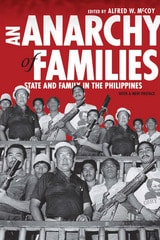
An Anarchy of Families
State and Family in the PhilippinesAlfred W. McCoy
University of Wisconsin Press, 2009
Edited by Alfred W. McCoy, An Anarchy of Families explores the pervasive influence of the modern dynasties that have led the Philippines during the past century. Exemplified by the Osmeñas and Lopezes, elite Filipino families have formed a powerful oligarchy—controlling capital, dominating national politics, and often owning the media. Beyond Manila, strong men such as Ramon Durano, Ali Dimaporo, and Justiniano Montano have used “guns, goons, and gold” to accumulate wealth and power in far-flung islands and provinces. In a new preface for this revised edition, the editor shows how this pattern of oligarchic control has continued into the twenty-first century, despite dramatic socio-economic change that has supplanted the classic “three g’s” of Philippine politics with the contemporary “four c’s”—continuity, Chinese, criminality, and celebrity.
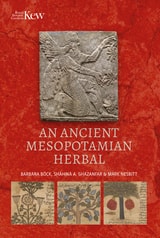
An Ancient Mesopotamian Herbal
Barbara Boeck, Shahina Ghazanfar, and Mark Nesbitt
Royal Botanic Gardens, Kew, 2024
Traditional medical systems continue to impact the lives of people around the globe. These systems vary greatly in their underlying beliefs, but all commonly rely on the consumption of plant matter as a central practice. An Ancient Mesopotamian Herbal is a new, fully illustrated book that explores the uses of plants in traditional medicine and how these botanical roots extend to modern, “conventional” medicinal treatments.
Divided into two parts, An Ancient Mesopotamian Herbal introduces the lands and ancient cultures of Mesopotamia before surveying the different forms of evidence and research methods informing this academic book. The book then looks to the modern day, focusing on thirty case studies of plant-based drugs. Bridging the divide between the humanities and sciences and using new research and data from modern-day Iraq and surrounding areas, An Ancient Mesopotamian Herbal draws on the expertise of archeo-botanists, scientists, and Assyriologists specializing in historic Mesopotamian medicine to provide new identifications of Assyrian and Babylonian herbal medicines while giving a concise overview of ancient Mesopotamian herbal lore.
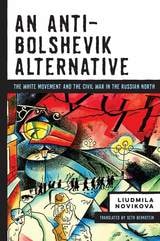
An Anti-Bolshevik Alternative
The White Movement and the Civil War in the Russian NorthLiudmila Novikova, Translated by Seth Bernstein
University of Wisconsin Press, 2018
Novikova draws on declassified archives and sources in both Russia and the West to reveal the White movement in the north as a complex social and political phenomenon with a distinct regional context. She documents the politics of the Northern Government and its relations with the British and American forces who had occupied the ports of Murmansk and Arkhangelsk at the end of World War I. As the civil war continued, the increasing involvement of the local population transformed the conflict into a ferocious "people's war" until remaining White forces under General Yevgeny Miller evacuated the region in February 1920.

An Appalachian New Deal
West Virginia in the Great DepressionJerry Bruce Thomas
West Virginia University Press, 2011
In this paperback edition of An Appalachian New Deal: West Virginia in the Great Depression, Jerry Bruce Thomas examines the economic and social conditions of the state of West Virginia before, during, and after the Great Depression. Thomas’s exploration of personal papers by leading political and social figures, newspapers, and the published and unpublished records of federal, state, local, and private agencies, traces a region’s response to an economic depression and a presidential stimulus program. This dissection of federal and state policies implemented under Franklin D. Roosevelt’s New Deal program reveals the impact of poverty upon political, gender, race, and familial relations within the Mountain State—and the entire country. Through An Appalachian New Deal, Thomas documents the stories of ordinary citizens who survived a period of economic crisis and echoes a message from our nation’s past to a new generation enduring financial hardship and uncertainty.
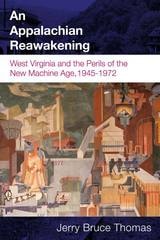
An Appalachian Reawakening
West Virginia and the Perils of the New Machine Age, 1945-1972JERRY B. THOMAS
West Virginia University Press, 2010
As the long boom of post-World War II economic expansion spread across the globe, dreams of white picket fences, democratic ideals, and endless opportunities flourished within the United States. Middle America experienced a period of affluent stability built upon a modern age of industrialization. Yet for the people of Appalachia, this new era brought economic, social, and environmental devastation, preventing many from realizing the American Dream. Some families suffered in silence; some joined a mass exodus from the mountains; while others, trapped by unemployment, poverty, illness, and injury became dependent upon welfare. As the one state most completely Appalachian, West Virginia symbolized the region's dilemma, even as it provided much of the labor and natural resources that fueled the nation's prosperity.
An Appalachian Reawakening: West Virginia and the Perils of the New Machine Age, 1945-1972 recounts the difficulties the state of West Virginia faced during the post-World War II period. While documenting this turmoil, this valuable analysis also traces the efforts of the New Frontier and Great Society programs, which stimulated maximum feasible participation and lead to the ultimate rise of grass roots activities and organizations that improved life and labor in the region and undermined the notion of Appalachian fatalism.
An Appeal in Favor of That Class of Americans Called Africans
Lydia Maria Child
University of Massachusetts Press, 1996
Child's treatise anticipated twentieth-century inquiries into the African origins of European and American culture as well as current arguments against school and job discrimination based on race.
This new edition--the first oriented toward the classroom--is enhanced by Carolyn L. Karcher's illuminating introduction. Included is a chronology of Child's life and a list of books for further reading.
An Appeal in Favor of That Class of Americans Called Africans
Revised and Updated EditionLydia Maria Child, Edited with an introduction by Carolyn L. Karcher
University of Massachusetts Press, 2023
Published in Boston in 1833, Lydia Maria Child’s An Appeal in Favor of That Class of Americans Called Africans provided the abolitionist movement with its first full-scale analysis of race and enslavement. Controversial in its own time, the Appeal surveyed the institution of slavery from historical, political, economic, legal, racial, and moral perspectives and advocated for the immediate emancipation of the enslaved without compensation to their enslavers. By placing American slavery in historical context and demonstrating how slavery impacted—and implicated—Americans of all regions and races, the Appeal became a central text for the abolitionist movement that continues to resonate in the present day.
This revised and updated edition is enhanced by Carolyn L. Karcher’s illuminating introduction, a chronology of Child’s life, and a list of books for further reading.
An Appeal to Justice
Litigated Reform of Texas PrisonsBy Ben M. Crouch and James W. Marquart
University of Texas Press, 1989
How does a prison achieve institutional order while safeguarding prisoners' rights? Since the early 1960s, prison reform advocates have aggressively used the courts to extend rights and improve life for inmates, while prison administrators have been slow to alter the status quo. Litigated reform has been the most significant force in obtaining change.
An Appeal to Justice is a critical tudy of how the Texas Department of Corrections was transformed by Ruiz v. Estelle, the most sweeping class-action suit in correctional law history. Orders from federal judge William W. Justice rapidly moved the Texas system from one of the most autonomous, isolated, and paternalistic system to a more constitutional bureaucracy. In many respects the Texas experience is a microcosm of the transformation of American corrections over the second half of the twentieth century.
This is a careful account of TDC's fearful past as a plantation system, its tumultuous litigated reform, and its subsequent efforts to balance prisoner rights and prison order. Of major importance is the detailed examination of the broad stages of the reform process (and its costs and benefits) and an intimate look at prison brutality and humanity. The authors examine the terror tactics of the inmate guards, the development of prisoner gangs and widespread violence during the reforms, and the stability that eventually emerged. They also detail the change of the guard force from a relatively small, cohesive cadre dependent on discretion, personal loyalty, and physical dominance to a larger and more fragmented security staff controlled by formal procedures.
Drawing on years of research in archival sources and on hundreds of interviews with prisoners, administrators, and staff, An Appeal to Justice is a unique basis for assessing the course and consequences of prison litigation and will be valuable reading for legislators, lawyers, judges, prison administrators, and concerned citizens, as well as prison and public policy scholars.
An Appraisal of Tree-Ring Dated Pottery in the Southwest
David A. Breternitz
University of Arizona Press, 1966
An Aqueous Territory
Sailor Geographies and New Granada's Transimperial Greater Caribbean WorldErnesto Bassi
Duke University Press, 2017
An Archive of Taste
Race and Eating in the Early United StatesLauren F. Klein
University of Minnesota Press, 2020
A groundbreaking synthesis of food studies, archival theory, and early American literature
There is no eating in the archive. This is not only a practical admonition to any would-be researcher but also a methodological challenge, in that there is no eating—or, at least, no food—preserved among the printed records of the early United States. Synthesizing a range of textual artifacts with accounts (both real and imagined) of foods harvested, dishes prepared, and meals consumed, An Archive of Taste reveals how a focus on eating allows us to rethink the nature and significance of aesthetics in early America, as well as of its archive.
Lauren F. Klein considers eating and early American aesthetics together, reframing the philosophical work of food and its meaning for the people who prepare, serve, and consume it. She tells the story of how eating emerged as an aesthetic activity over the course of the eighteenth century and how it subsequently transformed into a means of expressing both allegiance and resistance to the dominant Enlightenment worldview. Klein offers richly layered accounts of the enslaved men and women who cooked the meals of the nation’s founders and, in doing so, directly affected the development of our national culture—from Thomas Jefferson’s emancipation agreement with his enslaved chef to Malinda Russell’s Domestic Cookbook, the first African American–authored culinary text.
The first book to examine the gustatory origins of aesthetic taste in early American literature, An Archive of Taste shows how thinking about eating can help to tell new stories about the range of people who worked to establish a cultural foundation for the United States.
An Arizona Chronology
Statehood, 1913–1936Douglas D. Martin; Edited by Patricia Paylore
University of Arizona Press, 1966
Here were the years in which Arizona’s “bad men” virtually dropped out of sight, and the trigger-blast was displaced by the gavel-thumping sound of law and order as a Territory grew up and became a state. The problem of the Apache was no more, and the problem of water began to loom large. Depression and prohibition were the counter-themes. And Arizona’s three C's—Copper, Cattle, and Cotton—were about to strike for their place in the national limelight.
It was a time of conversion. The vital currents of frontier energy were turned into the channels of modern agriculture, finance, and urban growth. As this volume’s editor, Patricia Paylore, points out, the transformation reaffirms Douglas Martin’s view of Arizona history as the “persistence of the pioneer spirit of the nineteenth century” in terms of “the strength and optimism of a young people determined to take its place in the Union.”
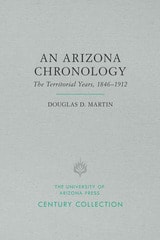
An Arizona Chronology
The Territorial Years, 1846–1912Douglas D. Martin
University of Arizona Press, 1963
Who better to choose news items giving a key to the times than Douglas D. Martin, who first set newspaper type when he was 15, filled news and magazine columns and book pages galore, and today at 75 is still writing for print? He knows newspapers from the composing room to the editor's desk—Detroit Free Press—not excepting reportorial beats, having received the Pulitzer Prize for reporting on his own.
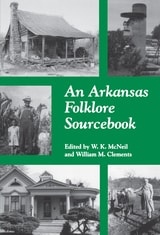
An Arkansas Folklore Sourcebook
W.K. McNeil
University of Arkansas Press, 1992
Arkansas’s rich folk tradition is shown by the variety of its manifestations: a 250-year-old ballad, an archaic method of hewing railroad crossties with a broadax, the use of poultices and toddies to treat the common cold, and swamps of evil repute are all parts of the tradition that constitutes Arkansas folklore. In fact, as the essays selected by W.K. McNeil and William M. Clements show, these few examples only begin to tell the story.
Starting with a working description of folklore as “cultural material that is traditional and unofficial” and characterized by a pattern of oral transmission, variation, formulaic structures, and usually uncertain origin, the authors survey in detail a wide array of folk objects, activities, beliefs, and customs. Among the rich offerings in this sourcebook are a discussion of the history of folklore research in Arkansas, an examination of some of the traditional songs and music still being preformed, a thoughtful exploration of the serious side of “tall tales” and “windies,” an investigation of folk architecture in Arkansas and what it reveals about our cultural origins, a study of many traditional foods and there preparation methods, an analysis of superstitions and beliefs, and a description of festivals and celebrations that are observed to this day.
Complemented by biographies of reference works and audio and video recordings of the state’s folk materials, An Arkansas Folklore Sourcebook is the first complete guide to the study of one state’s “unofficial culture.”
An Arkansas History for Young People
Fourth EditionShay E. Hopper
University of Arkansas Press, 2008
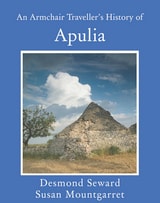
An Armchair Traveller's History of Apulia
Desmond Seward
Haus Publishing, 2013

An Armchair Traveller's History of Beijing
Jonathan Clements
Haus Publishing, 2016
Home to capitals of several states over time, the site of modern Beijing has been ruled by Mongolian chiefs and the glorious Ming emperors, whose tombs can still be found on its outskirts. Through Beijing, we can experience Chinese history itself, including its more famous residents—including Khubilai Khan, Mulan, and Marco Polo. Special emphasis is placed on Beijing’s precarious heritage in the twenty-first century, as modern construction wipes out much of the old city to make way for homes for twenty million people.
This book also offers detailed information on sites of tourist interest, including the pros and cons of different sections of the Great Wall and the best ways to see the Forbidden City and the fast-disappearing relics of the city’s Manchu and Maoist eras. A chapter on food and drink examines not only local delicacies, but the many other Chinese dishes that form part of Beijing’s rich dining traditions. With its blend of rich history and expert tips, An Armchair Traveller’s History of Beijing is an essential introduction to one of the world’s most remarkable cities.

An Armchair Traveller's History of Cambridge
Richard Tames
Haus Publishing, 2014

An Armchair Traveller's History of Finland
Jonathan Clements
Haus Publishing, 2014
Clements travels the length of the country as he tells these stories, along the way offering accounts of Finland’s public artworks, literary giants, legends and folktales, and famous figures. The result is the perfect introduction to Finland for armchair and actual travelers alike.