22279 books match the query 'Social Science' and 1819 start with a

cover of Athapaskan Migrations: The Archaeology of Eagle Lake, British Columbia

Athapaskan Migrations

The Archaeology of Eagle Lake, British Columbia

R. G. Matson and Martin P. R. Magne

University of Arizona Press, 2007

Migration as an instrument of cultural change is an undeniable feature of the archaeological record. Yet reliable methods of identifying migration are not always accessible.

In Athapaskan Migrations, authors R. G. Matson and Martin P. R. Magne use a variety of methods to identify and describe the arrival of the Athapaskan-speaking Chilcotin Indians in west central British Columbia. By contrasting two similar geographic areas—using the parallel direct historical approach—the authors define this aspect of Athapaskan culture. They present a sophisticated model of Northern Athapaskan migrations based on extensive archaeological, ethnographic, and dendrochronological research.

A synthesis of 25 years of work, Athapaskan Migrations includes detailed accounts of field research in which the authors emphasize ethnic group identification, settlement patterns, lithic analysis, dendrochronology, and radiocarbon dating. Their theoretical approach will provide a blueprint for others wishing to establish the ethnic identity of archaeological materials. Chapter topics include basic methodology and project history; settlement patterns and investigation of both the Plateau Pithouse and British Columbia Athapaskan Traditions; regional surveys and settlement patterns; excavated Plateau Pithouse Tradition and Athapaskan sites and their dating; ethnic identification of recovered material; the Chilcotin migration in the context of the greater Pacific Athapaskan, Navajo, and Apache migrations; and summaries and results of the excavations. The text is abundantly illustrated with more than 70 figures and includes access to convenient online appendixes. This substantial work will be of special importance to archaeologists, anthropologists, linguists, and scholars in Athapaskan studies and Canadian First Nation studies.
[more]
cover of Athenian Assessment of 425 B. C.

Athenian Assessment of 425 B. C.

Benjamin Dean Meritt and Allen Brown West

University of Michigan Press, 1934
The Athenian Assessment of 425 B. C. is a scholarly examination of the inscriptional evidence for the Athenian assessment decree of 425 BCE, now located in Athens’ Epigraphical Museum. A reading of the inscription is presented, including consideration of difficult readings, drawing in part upon A. Kirchoff’s initial publication in IG 1.37.
[more]
cover of Athenian Financial Documents of the Fifth Century

Athenian Financial Documents of the Fifth Century

Benjamin Dean Meritt

University of Michigan Press, 1932

Athenian Financial Documents of the Fifth Century is a consideration of Athenian financial records preserved on inscriptions in the Epigraphical Museum in Athens, Greece.
[more]
cover of Athlete and Activist: 28 Sports Stars Who Changed the Game

Athlete and Activist

28 Sports Stars Who Changed the Game

Jules Boykoff, Alex C. Davis, and Amira Rose Davis Illustrations by Martin French

University of Illinois Press, 2026

Time and again, great athletes seem to do the impossible. Their skills amaze us. Their work ethic inspires awe. Their talent is next level. At the same time, an athlete’s fame gives them a platform to speak out on important issues. With words and actions, a basketball star or Olympic legend can reach millions of people with their message.

Athlete and Activist highlights sports figures who risked their popularity and even their careers to stand against injustice. Each profile takes readers inside the issues that motivated an athlete’s activism. Striking portraits by award-winning illustrator Martin French add a visual dimension to the dramatic stories. Throughout, the authors show athletes using different kinds of activism. Some spoke out. Others performed silent gestures. Still others let their success speak for itself.

A different kind of sports history, Athlete and Activist is an inspiring look at heroic acts beyond our favorite games.

[more]
cover of Atlanta Paradox

Atlanta Paradox

David L. Sjoquist

Russell Sage Foundation, 2000
Despite the rapid creation of jobs in the greater Atlanta region, poverty in the city itself remains surprisingly high, and Atlanta's economic boom has yet to play a significant role in narrowing the gap between the suburban rich and the city poor. This book investigates the key factors underlying this paradox. The authors show that the legacy of past residential segregation as well as the more recent phenomenon of urban sprawl both work against inner city blacks. Many remain concentrated near traditional black neighborhoods south of the city center and face prohibitive commuting distances now that jobs have migrated to outlying northern suburbs. The book also presents some promising signs. Few whites still hold overt negative stereotypes of blacks, and both whites and blacks would prefer to live in more integrated neighborhoods. The emergence of a dynamic, black middle class and the success of many black-owned businesses in the area also give the authors reason to hope that racial inequality will not remain entrenched in a city where so much else has changed. A Volume in the Multi-City Study of Urban Inequality
[more]
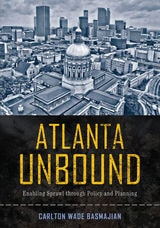
cover of Atlanta Unbound: Enabling Sprawl through Policy and Planning

Atlanta Unbound

Enabling Sprawl through Policy and Planning

Carlton Wade Basmajian

Temple University Press, 2015
Looking at Atlanta, Georgia, one might conclude that the city’s notorious sprawl, degraded air quality, and tenuous water supply is a result of a lack of planning—particularly an absence of coordination at the regional level. In Atlanta Unbound, Carlton Wade Basmajian shows that Atlanta’s low-density urban form and its associated problems have been both highly coordinated and regionally planned.
 
Basmajian’s shrewd analysis shows how regional policies spanned political boundaries and   framed local debates over several decades. He examines the role of the Atlanta Regional Commission’s planning deliberations that appear to have contributed to the urban sprawl that they were designed to control. Basmajian explores four cases—regional land development plans, water supply strategies, growth management policies, and transportation infrastructure programs—to provide a detailed account of the interactions between citizens, planners, regional commissions, state government, and federal agencies.
 
In the process, Atlanta Unbound answers the question: Toward what end and for whom is Atlanta’s regional planning process working?
 
In the series Urban Life, Landscape, and Policy, edited by Zane L. Miller, David Stradling, and Larry Bennett
[more]
cover of Atlanta: Race, Class And Urban Expansion

Atlanta

Race, Class And Urban Expansion

Larry Keating

Temple University Press, 2001

Atlanta, the epitome of the New South, is a city whose economic growth has transformed it from a provincial capital to a global city, one that could bid for and win the 1996 Summer Olympics. Yet the reality is that the exceptional growth of the region over the last twenty years has exacerbated inequality, particularly for African Americans. Atlanta, the city of Martin Luther King, Jr., remains one of the most segregated cities  in the United States.

Despite African American success in winning the mayor's office and control of the City Council, development plans have remained in the control of private business interests. Keating  tells  a number of  troubling stories. The development of the Underground Atlanta, the construction of the rapid rail system (MARTA), the building of a new stadium for the Braves, the redevelopment of public housing, and the arrangements for the Olympic Games all share a lack of democratic process. Business and political elites ignored protests from neighborhood groups, the interests of the poor, and the advice of planners.

[more]
cover of Atlantis, an Autoanthropology

Atlantis, an Autoanthropology

Nathaniel Tarn

Duke University Press, 2022

Over the course of his long career, Nathaniel Tarn has been a poet, anthropologist, and book editor, while his travels have taken him into every continent. Born in France, raised in England, and earning a Ph.D. from the University of Chicago, he knew André Breton, Salvador Dalí, Marcel Duchamp, Margot Fonteyn, Charles Olson, Claude Lévi-Strauss, and many more of the twentieth century’s major artists and intellectuals. In Atlantis, an Autoanthropology he writes that he has "never (yet) been able to experience the sensation of being only one person.” Throughout this literary memoir and autoethnography, Tarn captures this multiplicity and reaches for the uncertainties of a life lived in a dizzying array of times, cultures, and environments. Drawing on his practice as an anthropologist, he takes himself as a subject of study, examining the shape of a life devoted to the study of the whole of human culture. Atlantis, an Autoanthropology prompts us to consider our own multiple selves and the mysteries contained within.
[more]
cover of Atlas of the Pacific Northwest

Atlas of the Pacific Northwest

Philip Jackson

Oregon State University Press, 1993

[more]
cover of Atlas of the Pacific Northwest, 9th Ed

Atlas of the Pacific Northwest, 9th Ed

Philip Jackson

Oregon State University Press, 2003
[more]
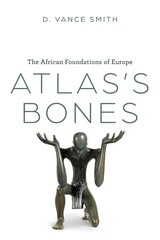
cover of Atlas's Bones: The African Foundations of Europe

Atlas's Bones

The African Foundations of Europe

D. Vance Smith

University of Chicago Press, 2025

A major new look at Africa’s influence on European culture and how colonization remade Africa in the image of a medieval Europe.
  
Virgil. Chaucer. Petrarch. These names resonate with many as cornerstones of European culture. Yet, in Atlas’s Bones, D. Vance Smith reveals that much of what is claimed as European culture up to the Middle Ages—its great themes in literature, its sources in political thought, its religious beliefs—originated in the writings of African thinkers like Augustine, Fulgentius, and Martianus Capella, or Europeans who thought extensively about Africa. In fact, a third of Virgil’s Aeneid takes place in Africa. Francis Petrarch believed his most important achievement was his epic Africa; while Geoffrey Chaucer wrote repeatedly about the figures of Scipio Africanus, actually two different men who defeated and destroyed Carthage.
 
Smith tells the story of how Europe created a false “medieval” version of Africa to acquire resources and power during the era of imperialism and colonialism. The first half of the book, “Reading Africa,” traces Egypt’s, Libya’s, and Carthage’s influence on classical and medieval thinking about Africa, highlighting often ignored literary and legendary traditions, for example, that Alexander the Great named himself the son of an African god. The second part, “Writing Africa,” focuses on how the different cultures of the two great African cities—Carthage and Alexandria—shaped modern literary criticism and political theology and examines the cross-influences of modern anthropology, medieval studies, and colonial law.
 
Atlas’s Bones firmly re-establishes the significance of Africa in European intellectual history. It will be essential reading for anyone seeking to understand how much of Africa informs our artistic and cultural world.
[more]
cover of Atlas, or the Anxious Gay Science

Atlas, or the Anxious Gay Science

Georges Didi-Huberman

University of Chicago Press, 2018

Aby Warburg’s Mnemosyne Atlas (1925–1929) is a prescient work of mixed media assemblage, made up of hundreds of images culled from antiquity to the Renaissance and arranged into startling juxtapositions. Warburg’s allusive atlas sought to illuminate the pains of his final years, after he had suffered a breakdown and been institutionalized. It continues to influence contemporary artists today, including Gerhard Richter and Mark Dion.
 
In this illustrated exploration of Warburg and his great work, Georges Didi-Huberman leaps from Mnemosyne Atlas into a set of musings on the relation between suffering and knowledge in Western thought, and on the creative results of associative thinking. Deploying writing that delights in dramatic jump cuts reminiscent of Warburg’s idiosyncratic juxtapositions, and drawing on a set of sources that ranges from ancient Babylon to Walter Benjamin, Atlas, or the Anxious Gay Science is rich in Didi-Huberman’s trademark combination of elan and insight.
[more]
cover of Atmospheres of Violence: Structuring Antagonism and the Trans/Queer Ungovernable

Atmospheres of Violence

Structuring Antagonism and the Trans/Queer Ungovernable

Eric A. Stanley

Duke University Press, 2021
Advances in LGBTQ rights in the recent past—marriage equality, the repeal of Don't Ask, Don't Tell, and the expansion of hate crimes legislation—have been accompanied by a rise in attacks against trans, queer and/or gender-nonconforming people of color. In Atmospheres of Violence, theorist and organizer Eric A. Stanley shows how this seeming contradiction reveals the central role of racialized and gendered violence in the United States. Rather than suggesting that such violence is evidence of individual phobias, Stanley shows how it is a structuring antagonism in our social world. Drawing on an archive of suicide notes, AIDS activist histories, surveillance tapes, and prison interviews, they offer a theory of anti-trans/queer violence in which inclusion and recognition are forms of harm rather than remedies to it. In calling for trans/queer organizing and worldmaking beyond these forms, Stanley points to abolitionist ways of life that might offer livable futures.
[more]
cover of Atmospheric Noise: The Indefinite Urbanism of Los Angeles

Atmospheric Noise

The Indefinite Urbanism of Los Angeles

Marina Peterson

Duke University Press, 2021
In Atmospheric Noise, Marina Peterson traces entanglements of environmental noise, atmosphere, sense, and matter that cohere in and through encounters with airport noise since the 1960s. Exploring spaces shaped by noise around Los Angeles International Airport (LAX), she shows how noise is a way of attuning toward the atmospheric: through noise we learn to listen to the sky and imagine the permeability of bodies and matter, sensing and conceiving that which is diffuse, indefinite, vague, and unformed. In her account, the “atmospheric” encompasses the physicality of the ephemeral, dynamic assemblages of matter as well as a logic of indeterminacy. It is audible as well as visible, heard as much as breathed. Peterson develops a theory of “indefinite urbanism” to refer to marginalized spaces of the city where concrete meets sky, windows resonate with the whine of departing planes, and endangered butterflies live under flight paths. Offering a conceptualization of sound as immanent and non-objectified, she demonstrates ways in which noise is central to how we know, feel, and think atmospherically.
[more]
cover of Atmospheric Things: On the Allure of Elemental Envelopment

Atmospheric Things

On the Allure of Elemental Envelopment

Derek P. McCormack

Duke University Press, 2018

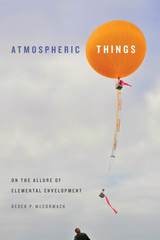
In Atmospheric Things Derek P. McCormack explores how atmospheres are imagined, understood, and experienced through experiments with a deceptively simple object: the balloon. Since the invention of balloon flight in the late eighteenth century, balloons have drawn crowds at fairs and expositions, inspired the visions of artists and writers, and driven technological development from meteorology to military surveillance. By foregrounding the distinctive properties of the balloon, McCormack reveals its remarkable capacity to disclose the affective and meteorological dimensions of atmospheres. Drawing together different senses of the object, the elements, and experience, McCormack uses the balloon to show how practices and technologies of envelopment allow atmospheres to be generated, made meaningful, and modified. He traces the alluring entanglement of envelopment in artistic, political, and technological projects, from the 2009 Pixar movie Up and Andy Warhol’s 1966 installation Silver Clouds to the use of propaganda balloons during the Cold War and Google's experiments with delivering internet access with stratospheric balloons. In so doing, McCormack offers new ways to conceive of, sense, and value the atmospheres in which life is immersed.
[more]
cover of Atomic Bombshells: How Plastics Shaped Postwar Bodies

Atomic Bombshells

How Plastics Shaped Postwar Bodies

Isabelle Held

Duke University Press, 2026
Bullet bras, bazookas, bombshells, bikinis. In Atomic Bombshells, Isabelle Held challenges the usual narratives of how war technologies enter domestic use by following plastics on their journey into women’s bodies. Held explores the effects of military-industrial science and the emergence of nylon, silicone, and plastic foams on embodied and expressive configurations of gender, sexuality, and race. She focuses on the United States between the late 1930s with the launch of nylon—whose potential was widely celebrated as the world’s first fully synthetic fiber and the ideal replacement for silk stockings—and the late 1970s, when policies began addressing the dangerous health consequences of implantable plastics. Held untangles the complex relationships between chemical companies, the US military, the Federal Drug Administration, plastic surgeons, advertising agencies, the Hollywood star system, go-go dancers, drag queens, and fashion and industrial designers. Using feminist, queer, and trans lenses, she shows that there was never just one bombshell identity. In so doing, Held complicates typical understandings of the shaping and reshaping of gender.
[more]
cover of Atomic Culture: How We Learned to Stop Worrying and Love the Bomb

Atomic Culture

How We Learned to Stop Worrying and Love the Bomb

Michael A. Amundson

University Press of Colorado, 2004

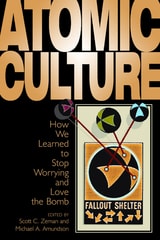
In Atomic Culture, eight scholars examine the range of cultural expressions of atomic energy from the 1940s to the early twenty-first century, including comic books, nuclear landscapes, mushroom-cloud postcards, the Los Alamos suburbs, uranium-themed board games, future atomic waste facilities, and atomic-themed films such as Dr. Strangelove and The Atomic Kid.

Despite the growing interest in atomic culture and history, the body of relevant scholarship is relatively sparse. Atomic Culture opens new doors into the field by providing a substantive, engaging, and historically based consideration of the topic that will appeal to students and scholars of the Atomic Age as well as general readers.

Contributors include Michael A. Amundson, Mick Broderick, Peter Goin, John Hunner, Ferenc M. Szasz, A. Costandina Titus, Peter C. van Wyck, and Scott C. Zeman.

[more]
cover of Attachments to War: Biomedical Logics and Violence in Twenty-First-Century America

Attachments to War

Biomedical Logics and Violence in Twenty-First-Century America

Jennifer Terry

Duke University Press, 2017

In Attachments to War Jennifer Terry traces how biomedical logics entangle Americans in a perpetual state of war. Focusing on the Afghanistan and Iraq wars between 2002 and 2014, Terry identifies the presence of a biomedicine-war nexus in which new forms of wounding provoke the continual development of complex treatment, rehabilitation, and prosthetic technologies. At the same time, the U.S. military rationalizes violence and military occupation as necessary conditions for advancing medical knowledge and saving lives. Terry examines the treatment of war-generated polytrauma, postinjury bionic prosthetics design, and the development of defenses against infectious pathogens, showing how the interdependence between war and biomedicine is interwoven with neoliberal ideals of freedom, democracy, and prosperity. She also outlines the ways in which military-sponsored biomedicine relies on racialized logics that devalue the lives of Afghan and Iraqi citizens and U.S. veterans of color. Uncovering the mechanisms that attach all Americans to war and highlighting their embeddedness and institutionalization in everyday life via the government, media, biotechnology, finance, and higher education, Terry helps lay the foundation for a more meaningful opposition to war.
[more]
cover of Attraction of Opposites: Thought and Society in the Dualistic Mode

Attraction of Opposites

Thought and Society in the Dualistic Mode

David Maybury-Lewis and Uri Almagor, Editors

University of Michigan Press, 1989
The Attraction of Opposites considers a puzzling phenomenon: Why do societies all over the world organize their social thought and institutions in patterns of opposites? The essays collected in this volume examine contemporary societies throughout the world that organize their social theories or institutions in binary form. Through analysis of these rich materials, the distinguished contributors explore the enduring human attraction to dualism. They consider whether this is due to the natural “twoness” of things and, if not, why polarity should play such a prominent role in both ancient cosmologies and modern philosophies, in early empires and in modern two-party systems. This study of dual organization tells us something important about human beings, illuminating a mode of thought and social organization that has represented an attractive option throughout human history.
[more]
cover of Au Te Waate / We Remember It: Hiaki Survival Through a Bitter War

Au Te Waate / We Remember It

Hiaki Survival Through a Bitter War

Maria Fernanda Leyva; Edited by Heidi Harley

University of Arizona Press, 2025

This compelling work delves into the personal narratives of Hiaki (Yaqui) individuals who endured the tumultuous period from 1900 to 1930, when they faced systematic attacks, conscription, deportation, and enslavement under Mexican government policies. Presented in both the original Hiaki language and English translation, these accounts offer an unparalleled glimpse into the lives of those who resisted and survived the era’s harsh realities. The narratives describe military engagements, the struggles of refugee life, forced labor, and the resilience of families under extreme duress. This work provides a unique and unvarnished account of the impacts of Mexican colonialism and aggression on individuals and families, completely from the Hiaki perspective.

Au Te Waate / We Remember It is not just a historical account but a linguistic treasure, preserving the naturally produced speech of five Hiaki speakers from a previous era. Transcriptions of interviews recorded by author Maria Fernanda Leyva with family members and friends provide invaluable insights into the Hiaki language. The interviews document and preserve the narrative styles, vocabulary, and grammatical constructions of the time.

This work also serves as a crucial resource for scholars of linguistics and history alike, capturing dialect variation and illustrating the linguistic evolution of the Hiaki community. Additionally, for Hiaki people studying their own language, this book stands as a rich repository of cultural and linguistic heritage, meticulously maintained through side-by-side translations and contextual historical introductions.

The narratives in this book are anchored by the experiences of five Hiaki speakers, whose stories of displacement, survival, and resistance provide a deeply personal perspective on the broader historical events of the Porfirio Díaz dictatorship and the early years of the Mexican Revolution. Au Te Waate / We Remember It stands as an important record, preserving these critical voices for future generations and offering profound insights into the resilience of the Hiaki people.


[more]
cover of Audiences and Publics: When Cultural Engagement Matters for the Public Sphere

Audiences and Publics

When Cultural Engagement Matters for the Public Sphere

Edited by Sonia Livingstone

Intellect Books, 2005
In today’s thoroughly mass-mediated world, audiences and publics are, of course, composed of the same people. Yet social science traditionally treats them quite differently. Indeed, it is commonplace to define audiences in opposition to the public: in both popular and elite discourses, audiences are denigrated as trivial, passive, individualised, while publics are valued as active, critically engaged and politically significant.
[more]
cover of Audionarratology: Lessons from Radio Drama

Audionarratology

Lessons from Radio Drama

Edited by Lars Bernaerts and Jarmila Mildorf

The Ohio State University Press, 2021
Radio drama has been around for more than one hundred years and is still vibrant in many countries. A narrative-dramatic genre and art form in its own right, radio drama has traditionally crossed medial and generic boundaries and continues to do so in our age of digitization. Audionarratology: Lessons from Audio Drama, edited by Lars Bernaerts and Jarmila Mildorf, explores radio drama from a narratological angle. The contributions cover key questions surrounding audiophonic meaning-making, storyworld creation, mediation, focalization, suspense, unreliability, and ambiguity as well as the relationship between script and performance, seriality, antinarrative tendencies, and radio drama’s political implications now and in its early days. The book thus explores the interplay between sound, voices, music, language, silence, electroacoustic manipulation, and narrative structures. Providing examples from American, Australian, British, Dutch, and German radio drama—such as I Love a Mystery, The War of the Worlds, and The Hitchhiker’s Guide to the Galaxy—this book has important insights for scholars working in transmedial narratology, media studies, literary and cultural studies, theatre and performance studies, and communication studies as well as for practitioners and lovers of radio drama alike.
[more]
cover of Audre Lorde’s Transnational Legacies

Audre Lorde’s Transnational Legacies

Stella Bolaki

University of Massachusetts Press, 2015

Among the most influential and insightful thinkers of her generation, Audre Lorde (1934–1992) inspired readers and activists through her poetry, autobiography, essays, and her political action. Most scholars have situated her work within the context of the women's, gay and lesbian, and black civil rights movements within the United States. However, Lorde forged coalitions with women in Europe, the Caribbean, Canada, Australia, New Zealand, and Africa, and twenty years after her passing, these alliances remain largely undocumented and unexplored.

Audre Lorde's Transnational Legacies is the first book to systematically document and thoroughly investigate Lorde's influence beyond the United States. Arranged in three thematically interrelated sections—Archives, Connections, and Work—the volume brings together scholarly essays, interviews, Lorde's unpublished speech about Europe, and personal reflections and testimonials from key figures throughout the world. Using a range of interdisciplinary approaches, contributors assess the reception, translation, and circulation of Lorde's writing and activism within different communities, audiences, and circles. They also shed new light on the work Lorde inspired across disciplinary borders.

In addition the volume editors, contributors include Sarah Cefai, Cassandra Ellerbe-Dueck, Paul M. Farber, Tiffany N. Florvil, Katharina Gerund, Alexis Pauline Gumbs, Gloria Joseph, Jackie Kay, Marion Kraft, Christiana Lambrinidis, Zeedah Meierhofer-Mangeli, Rina Nissim, Chantal Oakes, Lester C. Olson, Pratibha Parmar, Peggy Piesche, Dagmar Schultz, Tamara Lea Spira, and Gloria Wekker.
[more]
cover of Aunt Sammy's Radio Recipes: The Original 1927 Cookbook and Housekeeper's Chat

Aunt Sammy's Radio Recipes

The Original 1927 Cookbook and Housekeeper's Chat

Justin Nordstrom

University of Arkansas Press, 2018

From the 1920s through the 1940s, American kitchens had a welcome guest in “Aunt Sammy,” a creation of the US Department of Agriculture and its Bureau of Home Economics. Through the radio program Housekeeper’s Chat, Aunt Sammy gave lively advice on food preparation, household chores, parenting and children, and gender dynamics as she encouraged women to embrace the radio and a host of modern consumer household products. The recipes she shared were gathered, in 1927, into a cookbook that became a valuable household manual for tens of thousands of Americans.

Aunt Sammy’s Radio Recipes revives the famous cookbook and joins it with extensive excerpts from the accompanying radio broadcasts, providing a fascinating study of how a witty and charming fictionalized personae became one of the early celebrity chefs of the radio age.
[more]
cover of Aurrera!: A Textbook for Studying Basque, Volume 1

Aurrera!

A Textbook for Studying Basque, Volume 1

Linda White

University of Nevada Press, 2008
The Basque language is one of Europe’s most ancient, its origins as mysterious as those of the Basque people themselves. It is also the official language of Euskadi, the bustling, modern Basque Autonomous Region of Spain, and the preferred tongue of tens of thousands of Basques and their descendants living in the European Basque Country and in diaspora around the world. Aurrera! is a comprehensive text for beginning-level students who are learning Basque (the Batua form approved by the Academy of the Basque Language) in a classroom setting or on their own. Each chapter introduces an element of grammar and offers students new vocabulary, written and spoken exercises, dialogues, and other activities that demonstrate the language in action, plus Basque reading texts that will entertain while they illustrate the material covered in the chapter. The complexities of Basque grammar are explained in clear, easy-to-understand terms, and the dialogues and exercises introduce students to common idioms and the basics of social conversation. Volume 1 covers material for the first two semesters of college-level language-classroom work. It is also designed to give independent learners a sound foundation in the language that will allow them to make their own way in a Basque-speaking environment and to read basic Basque texts.
[more]
cover of Aurrera!: A Textbook for Studying Basque, Volume 2

Aurrera!

A Textbook for Studying Basque, Volume 2

Linda White

University of Nevada Press, 2010
Aurrera! is a comprehensive text for beginning-level students who are learning Basque (the Batua form approved by the Academy of the Basque Language) in a classroom setting or on their own. Each chapter introduces elements of grammar and offers students written and spoken exercises, vocabulary, dialogues, and other activities that demonstrate the language in action, plus Basque reading texts that entertain while they illustrate the points of the chapter. The complexities of Basque grammar are explained in clear, easy-to-understand terms, and the dialogues and exercises introduce students to common idioms and the basics of social conversation. Volume 1 covers material for the first two semesters of college-level language-classroom work, and volume 2 covers a third and fourth seme- ster of study, addressing more advanced grammatical structures and introducing additional vocabulary. Aurrera! offers a systematic and engaging approach to teaching Basque in a classroom. In addition, it gives independent learners a sound foundation in the language that will allow them to make their own way in a Basque-speaking environment and to read basic Basque texts.
[more]
cover of Aussie Fans: Uniquely Placed in Global Popular Culture

Aussie Fans

Uniquely Placed in Global Popular Culture

Celia Lam and Jackie Raphael

University of Iowa Press, 2019

Australia holds a unique place in the global scheme of fandom. Much of the media consumed by Australian audiences originates from either the United States or the United Kingdom, yet several Australian productions have also attracted international fans in their own right. This first-ever academic study of Australian fandom explores the national popular culture scene through themes of localization and globalization.

The essays within reveal how Australian audiences often seek authentic imports and eagerly embrace different cultures, examining both Hollywood’s influence on Australian fandom and Australian fan reactions to non-Western content. By shining a spotlight on Australian fandom, this book not only provides an important case study for fan studies scholars, it also helps add nuance to a field whose current literature is predominantly U.S. and U.K. focused.

Contributors: Kate Ames, Ahmet Atay, Jessica Carniel, Toija Cinque, Ian Dixon, Leigh Edmonds, Sharon Elkind, Jacqui Ewart, Lincoln Geraghty, Sarah Keith, Emerald L. King, Renee Middlemost
[more]
cover of Austentatious: The Evolving World of Jane Austen Fans

Austentatious

The Evolving World of Jane Austen Fans

Holly Luetkenhaus and Zoe Weinstein

University of Iowa Press, 2019

The amount of fan-generated content about Jane Austen and her novels has long surpassed the author’s original canon. Adaptations like Clueless, Pride and Prejudice and Zombies, Jane Austen’s Fight Club, and The Lizzie Bennet Diaries have given Austen fans priceless opportunities to enjoy the classic texts anew, and continue to bring new and younger fans into the fold. Now, through online culture, the amount and type of fan-created works has exponentially multiplied in recent years. Fans write stories, create art, make videos, and craft memes, all in homage to one of the most celebrated authors of all time.

This book explores online fan spaces in search of “Janeites” all over the world to discover what fans are making, how fans are sharing their work, and why it matters that so many women and nonbinary individuals find a haven not only in Jane Austen, but also in Jane Austen fandom. In relatable chapters based on firsthand experience, the authors explore how Austen fandom has and continues to build communities around women, people of color, and the LGBTQ+ community. Whether Janeites are shrewdly picking up on the latent sexual tension between women in Emma or casting people of color in leading roles, Luetkenhaus and Weinstein argue that Austen fans are particularly adept at marrying fantasy and feminism.
[more]
cover of Australian Film Theory and Criticism: Volume 3: Documents

Australian Film Theory and Criticism

Volume 3: Documents

Edited by Deane Williams and Constantine Verevis

Intellect Books, 2017

The third part of a three-volume work devoted to mapping the transnational history of Australian film studies, Volume 3: Documents concludes the project by gathering together the documents that were produced during the rise of film studies in Australian academia from 1975–85. Through these sources we see the development of the particularities of Australian film theory and criticism, its relationship to its international counterparts, and the establishment of key positions and the directions in which they develop. Editors Deane Williams and Constantine Verevis here collect key articles, including the works of Paul Willemen, Sam Rohdie, Ross Gibson, and Meaghan Morris, among many others, in order to conclude this pioneering historiographic account of Australian film studies.
[more]
cover of Australian TV News: New Forms, Functions, and Futures

Australian TV News

New Forms, Functions, and Futures

Stephen Harrington

Intellect Books, 2013
Australian TV News explores the important role of entertainment in Australian television news over the past decade. Through the use of textual analysis, industry interviews, and audience research, it argues that “infotainment” and satire are increasingly becoming significant methods of informing audiences about serious news issues. The work examines the changing relationships between television news, politics, and everyday people, finding that these often humorous programs are used by audiences as sources of political information and fact, and this book challenges traditional assumptions about what form TV news should take and what functions it ought to serve.

[more]
cover of Authentically African: Arts and the Transnational Politics of Congolese Culture

Authentically African

Arts and the Transnational Politics of Congolese Culture

Sarah Van Beurden

Ohio University Press, 2015

Together, the Royal Museum for Central Africa in Tervuren, Belgium, and the Institut des Musées Nationaux du Zaire (IMNZ) in the Congo have defined and marketed Congolese art and culture. In Authentically African, Sarah Van Beurden traces the relationship between the possession, definition, and display of art and the construction of cultural authenticity and political legitimacy from the late colonial until the postcolonial era. Her study of the interconnected histories of these two institutions is the first history of an art museum in Africa, and the only work of its kind in English.

Drawing on Flemish-language sources other scholars have been unable to access, Van Beurden illuminates the politics of museum collections, showing how the IMNZ became a showpiece in Mobutu’s effort to revive “authentic” African culture. She reconstructs debates between Belgian and Congolese museum professionals, revealing how the dynamics of decolonization played out in the fields of the museum and international heritage conservation. Finally, she casts light on the art market, showing how the traveling displays put on by the IMNZ helped intensify collectors’ interest and generate an international market for Congolese art.

The book contributes to the fields of history, art history, museum studies, and anthropology and challenges existing narratives of Congo’s decolonization. It tells a new history of decolonization as a struggle over cultural categories, the possession of cultural heritage, and the right to define and represent cultural identities.

[more]
cover of Authentically Jewish: Identity, Culture, and the Struggle for Recognition

Authentically Jewish

Identity, Culture, and the Struggle for Recognition

Stuart Z. Charmé

Rutgers University Press, 2022

This book analyzes the different conceptions of authenticity that are behind conflicts over who and what should be recognized as authentically Jewish.  Although the concept of authenticity has been around for several centuries, it became a central focus for Jews since existentialist Jean-Paul Sartre raised the question in the 1940s. Building on the work of Sartre, later Jewish thinkers, philosophers, anthropologists, and cultural theorists, the book offers a model of Jewish authenticity that seeks to balance history and tradition, creative freedom and innovation, and the importance of recognition among different groups within an increasingly multicultural Jewish community.
 
Author Stuart Z. Charmé explores how debates over authenticity and struggles for recognition are a key to understanding a wide range of controversies between Orthodox and liberal Jews, Zionist and diaspora Jews, white Jews and Jews of color, as well as the status of intermarried and messianic Jews, and the impact of Jewish genetics.  In addition, it discusses how and when various cultural practices and traditions such as klezmer music, Israeli folk dance, Jewish yoga and meditation, and others are recognized as authentically Jewish, or not.
 
[more]
cover of Authenticity Guaranteed: Masculinity and the Rhetoric of Anti-Consumerism in American Culture

Authenticity Guaranteed

Masculinity and the Rhetoric of Anti-Consumerism in American Culture

Sally Robinson

University of Massachusetts Press, 2018

Americans love to hate consumerism. Scholars, intellectuals, musicians, and writers of all kinds take pleasure in complaining that consumer culture endangers the “real” things in life, including self-determination and individualism. In Authenticity Guaranteed, Sally Robinson brings to light the unacknowledged gender and class assumptions of anti-consumerist critique in the second half of the twentieth century. American anti-consumerism, despite its apparent complexity, takes a remarkably consistent and predictable narrative form. From the mid-century Organization Man to the millennial No Logo, anti-consumerist critique reinforces the gender order by insisting that authenticity is threatened, and masculine agency curtailed, by the feminizing forces of consumer culture.

Robinson identifies a tradition of masculine protest and rebellion against feminization in iconic texts such as The Catcher in the Rye and Fight Club, as well as in critiques of postmodernism, academic denunciations of shopping, and a variety of other discourses that aim to diagnose what ails American consumer culture. This fresh and timely argument enters into conversation with a wide range of existing scholarship and opens up new questions for scholarly and political discussion.
[more]
cover of Authoring Autism: On Rhetoric and Neurological Queerness

Authoring Autism

On Rhetoric and Neurological Queerness

M. Remi Yergeau

Duke University Press, 2018
In Authoring Autism M. Remi Yergeau defines neurodivergence as an identity—neuroqueerness—rather than an impairment. Using a queer theory framework, Yergeau notes the stereotypes that deny autistic people their humanity and the chance to define themselves while also challenging cognitive studies scholarship and its reification of the neurological passivity of autistics. They also critique early intensive behavioral interventions—which have much in common with gay conversion therapy—and questions the ableist privileging of intentionality and diplomacy in rhetorical traditions. Using storying as their method, they present an alternative view of autistic rhetoricity by foregrounding the cunning rhetorical abilities of autistics and by framing autism as a narrative condition wherein autistics are the best-equipped people to define their experience. Contending that autism represents a queer way of being that simultaneously embraces and rejects the rhetorical, Yergeau shows how autistic people queer the lines of rhetoric, humanity, and agency. In so doing, they demonstrate how an autistic rhetoric requires the reconceptualization of rhetoric’s very essence.
[more]
cover of Authority: Construction and Corrosion

Authority

Construction and Corrosion

Bruce Lincoln

University of Chicago Press, 1994

What is authority? How is it constituted? How ought one understand the subtle (and sometimes not-so-subtle) relations between authority and coercion? Between authorized and subversive speech? In this fascinating and intricate analysis, Bruce Lincoln argues that authority is not an entity but an effect. More precisely, it is an effect that depends for its power on the combination of the right speaker, the right speech, the right staging and props, the right time and place, and an audience historically and culturally conditioned to judge what is right in all these instances and to respond with trust, respect, and even reverence.

Employing a vast array of examples drawn from classical antiquity, Scandinavian law, Cold War scholarship, and American presidential politics, Lincoln offers a telling analysis of the performance of authority, and subversions of it, from ancient times to the present. Using a small set of case studies that highlight critical moments in the construction of authority, he goes on to offer a general examination of "corrosive" discourses such as gossip, rumor, and curses; the problematic situation of women, who often are barred from the authorizing sphere; the role of religion in the construction of authority; the question of whether authority in the modern and postmodern world differs from its premodern counterpart; and a critique of Hannah Arendt's claims that authority has disappeared from political life in the modern world. He does not find a diminution of authority or a fundamental change in the conditions that produce it. Rather, Lincoln finds modern authority splintered, expanded, and, in fact, multiplied as the mechanisms for its construction become more complex—and more expensive.
[more]
cover of Authorizing Superhero Comics: On the Evolution of a Popular Serial Genre

Authorizing Superhero Comics

On the Evolution of a Popular Serial Genre

Daniel Stein

The Ohio State University Press, 2021
Authorizing Superhero Comics examines the comic book superhero as a lasting phenomenon of US popular serial storytelling. Moving beyond linear- or creator-centered models of genre development, Daniel Stein identifies authorization conflicts that have driven the genre’s evolution from the late 1930s to the present. These conflicts include paratextually mediated exchanges between officially authorized comic book producers and, alternatively, authorized fans that trouble the distinction between production and its reception; storyworld-building processes that subsume producers and fans into a collective rooted in a common style; parodies that ensure the genre’s longevity by deflating criticism through self-reflexive humor; and collecting and archiving as forms of memory management that align the genre’s past with the demands of the present. Taking seriously the serial agencies of the superhero comic book as a material artifact with a particular mediality, the study analyzes letter columns, editorial commentary, fanzines, encyclopedias, and other forms of comic book communication as critical frameworks for understanding the evolution of the genre—assessing rarely covered archival sources alongside some of the most treasured figures from the superhero’s multi-decade history, from Batman and Spider-Man to Wonder Woman and Captain America.
[more]
cover of Authors of the Storm: Meteorologists and the Culture of Prediction

Authors of the Storm

Meteorologists and the Culture of Prediction

Gary Alan Fine

University of Chicago Press, 2007

Whether it is used as an icebreaker in conversation or as the subject of serious inquiry, “the weather” is one of the few subjects that everyone talks about. And though we recognize the faces that bring us the weather on television, how government meteorologists and forecasters go about their jobs is rarely scrutinized. Given recent weather-related disasters, it’s time we find out more. In Authors of the Storm, Gary Alan Fine offers an inside look at how meteorologists and forecasters predict the weather.

Based on field observation and interviews at the Storm Prediction Center in Oklahoma, the National Weather Service in Washington, D.C., and a handful of midwestern outlets, Fine finds a supremely hard-working, insular clique of professionals who often refer to themselves as a “band of brothers.” In Fine’s skilled hands, we learn their lingo, how they “read” weather conditions, how forecasts are written, and, of course, how those messages are conveyed to the public. Weather forecasts, he shows, are often shaped as much by social and cultural factors inside local offices as they are by approaching cumulus clouds. By opening up this unique world to us, Authors of the Storm offers a valuable and fascinating glimpse of a crucial profession.
[more]
cover of Autism and Gender: From Refrigerator Mothers to Computer Geeks

Autism and Gender

From Refrigerator Mothers to Computer Geeks

Jordynn Jack

University of Illinois Press, 2014

The reasons behind the increase in autism diagnoses have become hotly contested in the media as well as within the medical, scholarly, and autistic communities. Jordynn Jack suggests the proliferating number of discussions point to autism as a rhetorical phenomenon that engenders attempts to persuade through arguments, appeals to emotions, and representational strategies.
 
In Autism and Gender: From Refrigerator Mothers to Computer Geeks, Jack focuses on the ways gender influences popular discussion and understanding of autism's causes and effects. She identifies gendered theories like the “refrigerator mother” theory, for example, which blames emotionally distant mothers for autism, and the “extreme male brain” theory, which links autism to the modes of systematic thinking found in male computer geeks. Jack's analysis reveals how people employ such highly gendered theories to craft rhetorical narratives around stock characters--fix-it dads, heroic mother warriors rescuing children from autism--that advocate for ends beyond the story itself while also allowing the storyteller to gain authority, understand the disorder, and take part in debates.
 
Autism and Gender reveals the ways we build narratives around controversial topics while offering new insights into the ways rhetorical inquiry can and does contribute to conversations about gender and disability.

[more]
cover of Autism in Film and Television: On the Island

Autism in Film and Television

On the Island

Edited by Murray Pomerance and R. Barton Palmer

University of Texas Press, 2022

Global awareness of autism has skyrocketed since the 1980s, and popular culture has caught on, with film and television producers developing ever more material featuring autistic characters. Autism in Film and Television brings together more than a dozen essays on depictions of autism, exploring how autistic characters are signified in media and how the reception of these characters informs societal understandings of autism.

Editors Murray Pomerance and R. Barton Palmer have assembled a pioneering examination of autism’s portrayal in film and television. Contributors consider the various means by which autism has been expressed in films such as Phantom Thread, Mercury Rising, and Life Animated and in television and streaming programs including Atypical, The Bridge, Stranger Things, Star Trek: The Next Generation, and Community. Across media, the figure of the brilliant, accomplished, and “quirky” autist has proven especially appealing. Film and television have thus staked out a progressive position on neurodiversity by insisting on screen time for autism but have done so while frequently ignoring the true diversity of autistic experience. As a result, this volume is a welcome celebration of nonjudgmental approaches to disability, albeit one that is still freighted with stereotypes and elisions.
[more]
cover of Autistic Disturbances: Theorizing Autism Poetics from the DSM to Robinson Crusoe

Autistic Disturbances

Theorizing Autism Poetics from the DSM to Robinson Crusoe

Julia Miele Rodas

University of Michigan Press, 2018
While research on autism has sometimes focused on special talents or abilities, autism is typically characterized as impoverished or defective when it comes to language. Autistic Disturbances reveals the ways interpreters have failed to register the real creative valence of autistic language and offers a theoretical framework for understanding the distinctive aesthetics of autistic rhetoric and semiotics. Reinterpreting characteristic autistic verbal practices such as repetition in the context of a more widely respected literary canon, Julia Miele Rodas argues that autistic language is actually an essential part of mainstream literary aesthetics, visible in poetry by Walt Whitman and Gertrude Stein, in novels by Charlotte Brontë and Daniel Defoe, in life writing by Andy Warhol, and even in writing by figures from popular culture. Autistic Disturbances pursues these resonances and explores the tensions of language and culture that lead to the classification of some verbal expression as disordered while other, similar expression enjoys prized status as literature. It identifies the most characteristic patterns of autistic expression-repetition, monologue, ejaculation, verbal ordering or list-making, and neologism-and adopts new language to describe and reimagine these categories in aesthetically productive terms. In so doing, the book seeks to redress the place of verbal autistic language, to argue for the value and complexity of autistic ways of speaking, and to invite recognition of an obscured tradition of literary autism at the very center of Anglo-American text culture.
[more]
cover of Autistic Intelligence: Interaction, Individuality, and the Challenges of Diagnosis

Autistic Intelligence

Interaction, Individuality, and the Challenges of Diagnosis

Douglas W. Maynard and Jason Turowetz

University of Chicago Press, 2022

Winner 2024 Outstanding Recent Contribution in Social Psychology Award, Social Psychology Section, American Sociological Association

Winner 2024 Melvin Pollner Prize, Ethnomethodology and Conversation Analysis Section, American Sociological Association

As autism has grown in prevalence, so too have our attempts to make sense of it. From placing unfounded blame on vaccines to seeking a genetic cause, Americans have struggled to understand what autism is and where it comes from. Amidst these efforts, however, a key aspect of autism has been largely overlooked: the diagnostic process itself. That process is the central focus of Autistic Intelligence. The authors ask us to question the norms by which we measure autistic behavior, to probe how that behavior can be considered sensible rather than disordered, and to explore how we can better appreciate the individuality of those who receive the diagnosis.
 
Drawing on hundreds of hours of video recordings and ethnographic observations at a clinic where professionals evaluated children for autism, the authors’ analysis of interactions among clinicians, parents, and children demystifies the categories, tools, and practices involved in the diagnostic process. Autistic Intelligence shows that autism is not a stable category; it is the outcome of complex interactional processes involving professionals, children, families, and facets of the social and clinical environments they inhabit. The authors suggest that diagnosis, in addition to carefully classifying children, also can highlight or include unique and particular contributions those with autism potentially can make to the world around us.
 
[more]
cover of Autobiography and Decolonization: Modernity, Masculinity, and the Nation-State

Autobiography and Decolonization

Modernity, Masculinity, and the Nation-State

Philip Holden

University of Wisconsin Press, 2008

Philip Holden reveals deeply gendered connections between the writing of individual lives and of the narratives of nations emerging from colonialism. Autobiography and Decolonization is the first book to give serious academic attention to autobiographies of nationalist leaders in the process of decolonization, attending to them not simply as partial historical documents, but as texts involved in remaking the world views of their readers.
            Holden examines Mohandas K. Gandhi’s An Autobiography: The Story of My Experiments with Truth, Marcus Garvey’s fragmentary Autobiography,Joseph Ephraim Casely Hayford’s Ethiopia Unbound, Lee Kuan Yew’s The Singapore Story, Nelson Mandela’s Long Walk to Freedom, Jawaharlal Nehru’s An Autobiography, and Kwame Nkrumah’s Ghana:The Autobiography of Kwame Nkrumah.
            Holden argues that these examples of life writing have had significant influence on the formation of new, and often profoundly gendered, national identities. These narratives constitute the nation less as an imagined community than as an imagined individual. Moving from the past to the promise of the future, they mediate relationships between public and private, and between individual and collective stories. Ultimately, they show how the construction of modern selfhood is inextricably linked to the construction of a postcolonial polity.
[more]
cover of Autobiography and Other Writings

Autobiography and Other Writings

Ana de San Bartolomé

University of Chicago Press, 2008

Ana de San Bartolomé (1549–1626), a contemporary and close associate of St. Teresa of Ávila, typifies the curious blend of religious activism and spiritual forcefulness that characterized the first generation of Discalced, or reformed Carmelites. Known for their austerity and ethics, their convents quickly spread throughout Spain and, under Ana’s guidance, also to France and the Low Countries. Constantly embroiled in disputes with her male superiors, Ana quickly became the most vocal and visible of these mystical women and the most fearless of the guardians of the Carmelite Constitution, especially after Teresa’s death.

Her autobiography, clearly inseparable from her religious vocation, expresses the tensions and conflicts that often accompanied the lives of women whose relationship to the divine endowed them with an authority at odds with the temporary powers of church and state. Last translated into English in 1916, Ana’s writings give modern readers fascinating insights into the nature of monastic life during the highly charged religious and political climate of late-sixteenth- and early-seventeenth-century Spain.

[more]
cover of Autobiography of My Hungers

Autobiography of My Hungers

Rigoberto González

University of Wisconsin Press, 2019

Rigoberto González, author of the critically acclaimed memoir Butterfly Boy: Memories of a Chicano Mariposa, takes a second piercing look at his past through a startling new lens: hunger.
            The need for sustenance originating in childhood poverty, the adolescent emotional need for solace and comfort, the adult desire for a larger world, another lover, a different body—all are explored by González in a series of heartbreaking and poetic vignettes.
            Each vignette is a defining moment of self-awareness, every moment an important step in a lifelong journey toward clarity, knowledge, and the nourishment that comes in various forms—even "the smallest biggest joys" help piece together a complex portrait of a gay man of color who at last defines himself by what he learns, not by what he yearns for.

Bill Whitehead Award for Lifetime Literary Achievement, Publishing Triangle

“Told in a series of revealing vignettes and poems, González’s Autobiography of my Hungers turns moments of need and want into revelations of truth and self-awareness, creating the portrait of an artist that is complex if not entirely complete.”—El Paso Times

“Through his provocative vignettes, González communicates a lifetime of struggle for affirmation and self-acceptance.”—Make/Shift 
[more]
cover of Autobiography of an Androgyne

Autobiography of an Androgyne

Ralph Werther and Edited by Scott Herring

Rutgers University Press, 2008
First printed in 1918, Ralph Werther's Autobiography of an Androgyne charts his emerging self-understanding as a member of the "third sex" and documents his explorations of queer underworlds in turn-of-the-century New York City. Werther presents a sensational life narrative that begins with a privileged upper-class birth and a youthful realization of his difference from other boys. He concludes with a decision to undergo castration. Along the way, he recounts intimate stories of adolescent sexual encounters with adult men and women, escapades as a reckless "fairie" who trolled Brooklyn and the Bowery in search of working-class Irish and Italian immigrants, and an immersion into the subculture of male "inverts." This new edition also includes a critical introduction by Scott Herring that situates the text within the scientific, historical, literary, and social contexts of urban American life in the late-nineteenth and early-twentieth centuries. Tracing how this pioneering autobiography engages with conversations on immigration, gender, economics, metropolitan working-class culture, and the invention of homosexuality across class lines, this edition is ideal for courses on topics ranging from Victorian literature to modern American sexuality.
[more]
cover of Autochthonomies: Transnationalism, Testimony, and Transmission in the African Diaspora

Autochthonomies

Transnationalism, Testimony, and Transmission in the African Diaspora

Myriam J. A. Chancy

University of Illinois Press, 2020

In Autochthonomies, Myriam J. A. Chancy engages readers in an interpretive journey. She lays out a radical new process that invites readers to see creations by artists of African descent as legible within the context of African diasporic historical and cultural debates. By invoking a transnational African/diasporic lens and negotiating it through a lakou or ”yard space,” we can see such identities transfigured, recognized, and exchanged. Chancy demonstrates how the process can examine the salient features of texts and art that underscore African/diasporic sensibilities and render them legible. What emerges is a potential for richer readings of African diasporic works that also ruptures the Manichean binary dynamics that have dominated previous interpretations of the material. The result: an enriching interpretive mode focused on the transnational connections between subjects of African descent as the central pole for reader investigation.

A bold challenge to established scholarship, Autochthonomies ranges from Africa to Europe and the Americas to provide powerful new tools for charting the transnational interactions between African cultural producers and sites.
[more]
cover of Automatic Religion: Nearhuman Agents of Brazil and France

Automatic Religion

Nearhuman Agents of Brazil and France

Paul Christopher Johnson

University of Chicago Press, 2021

What distinguishes humans from nonhumans? Two common answers—free will and religion—are in some ways fundamentally opposed. Whereas free will enjoys a central place in our ideas of spontaneity, authorship, and deliberation, religious practices seem to involve a suspension of or relief from the exercise of our will. What, then, is agency, and why has it occupied such a central place in theories of the human?

Automatic Religion explores an unlikely series of episodes from the end of the nineteenth century, when crucial ideas related to automatism and, in a different realm, the study of religion were both being born. Paul Christopher Johnson draws on years of archival and ethnographic research in Brazil and France to explore the crucial boundaries being drawn at the time between humans, “nearhumans,” and automata. As agency came to take on a more central place in the philosophical, moral, and legal traditions of the West, certain classes of people were excluded as less-than-human. Tracking the circulation of ideas across the Atlantic, Johnson tests those boundaries, revealing how they were constructed on largely gendered and racial foundations. In the process, he reanimates one of the most mysterious and yet foundational questions in trans-Atlantic thought: what is agency?
[more]
cover of Automobile and American Culture

Automobile and American Culture

David L. Lewis and Laurence Goldstein, Editors

University of Michigan Press, 1983
The Automobile and American Culture, edited by David L. Lewis and Laurence Goldstein, offers a sweeping exploration of the automobile’s impact on American society. Integrating both scholarly and popular approaches, this landmark anthology brings together essays, memoirs, fiction, poetry, and graphics to describe the profound and multifaceted impact of one of the twentieth century’s most fascinating inventions on American life. Now in its revised and expanded form, the collection provides an even closer look at the past, present, and future of America’s automobile revolution.With contributions from acclaimed writers, artists, musicians, and scholars, this volume examines the automobile’s influence on every corner of American society—the city and the farm, fashion and art, domestic life, popular culture, youth, gender, sexuality, and the evolving American psyche. Iconic figures such as Chuck Berry, Carl Sandburg, and Bruce Springsteen appear alongside incisive academic analysis, underscoring the car’s central place in both creative imagination and lived experience.Organized thematically, The Automobile and American Culture explores how the automobile not only transformed the physical landscape and economy, but also became a powerful cultural symbol—one both praised and critiqued as it shaped the nation’s identity, values, and dreams. From the industry’s Michigan roots to roadside Americana and critiques of modern car culture, this anthology stands as the definitive reference for anyone seeking to understand the enduring love affair between Americans and their cars, and the way this relationship continues to influence society today.
[more]
cover of Automobiles and the Future: Competition, Cooperation, and Change

Automobiles and the Future

Competition, Cooperation, and Change

Robert E. Cole, Editor

University of Michigan Press, 1983

At the time of the U.S.-Japan auto conferences in March 1983, the hoped-for economic recovery as manifested in auto sales had revealed itself quite modestly. Three months later, the indicators were more robust and certainly long overdue for those whose livelihood depends on the health of the industry--some of whom are university professors.
With Japanese import restrictions in place until March 1984 and drastically reduced break-even points for domestic manufactures, rising consumer demand holds great promise for the industry. The rapidly rising stock prices of the auto-makers captures well the sense of heightened optimism, as do the various forecasts for improved profits.
While the news is certainly welcome, it nevertheless should be greeted with caution. As Mr. Perkins noted at the conference, "we have a tendency to forget things very quickly. If we have a boom market this year, there is a good chance that a lot of things we learned will be forgotten."
To put the matter differently and more bluntly, with growing prosperity there is the risk that management will fall back into old habits, making impossible the achievement of sustained quality and productivity improvement. Similarly, the commitment to develop cooperative relations with workers and suppliers will weaken. The union will be under membership pressure to retrieve concessions rather than to take the longer-term view. This longer-term view recognizes that "up-front increases" and adherence to existing work rules increasingly come at the sacrifice of future job security. Government policymakers will turn their attention away from the industry. This may not mean a great deal given how weakly focused their attentions has been during the last three years and how mixed and contradictory government auto policies have been for over a decade.
[more]
cover of Available Light: Omar Badsha and the Struggle for Change in South Africa

Available Light

Omar Badsha and the Struggle for Change in South Africa

Daniel Magaziner

Ohio University Press, 2024

Available Light tells the story of an activist, an artist, a uniquely South African individual, and his community and family across the second half of the twentieth century. Omar Badsha was born in Durban, on the country’s southeastern coast in 1945. His was the third generation of his Gujarati family to call South Africa home. Before he turned five, the country’s white electorate had voted to institute apartheid to strip the rights and privileges of citizenship from most of the population, including Badsha’s Indian community and especially the country’s Black majority. By the time he turned fifteen, nonviolent protest against apartheid had been quashed; by the time he turned twenty, so too had the armed struggle to dislodge white supremacy within the country. The ongoing, resilient, and oft-rebuffed struggle against apartheid was a definitive factor in Badsha’s life. Furthermore, Badsha was raised in a community where art—painting, carving, music, poetry, theater—was inseparable from other values, whether Islamic and conservative or radical and urgently committed. When Badsha struggled in school, he, like his father, turned to art to express what he otherwise had difficulty conveying. Art brought him into contact with people of disparate backgrounds from far beyond Durban. In time, his friendships with other artists helped him refine his voice, first in drawing and eventually in photography, and capture the political ethic by which he strove to live his life and which he shared with similarly committed artist-activists. Daniel Magaziner chronicles how art and politics became intertwined in South Africa and explains what it takes to maintain a critical aesthetic approach to political crises in the past and present. The book tracks the personal and social costs that commitment can incur, while also appreciating how Badsha and others like him have maintained their vision of an equitable, transformed society even today, when the ideals that once animated the South African struggle are on the back foot worldwide.
[more]