Results by title
3576 books match the query 'American' and 350 start with a
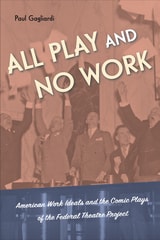
All Play and No Work
American Work Ideals and the Comic Plays of the Federal Theatre ProjectGagliardi, Paul
Temple University Press, 2024
All Play and No Work directly contradicts the promoted ideals of work found in American society, culture, and within the broader New Deal itself. Gagliardi shows how comedies of the Great Depression engaged questions of labor, labor history, and labor ethics. He considers the breadth of the FTP’s production history, staging plays including Ah, Wilderness!, Help Yourself, and Mississippi Rainbow.
Gagliardi examines backstage comedies, middle-class comedies, comedies of chance, and con-artist comedies that employed diverse casts and crew and contained radical economic and labor ideas. He contextualizes these plays within the ideologically complicated New Deal, showing how programs like the Social Security Act straddled progressive ideals and conservative, capitalist norms. Addressing topics including the politicization of theatrical labor and the real dangers of unchecked economic con artists, the comic plays of the FTP reveal acts of political resistance and inequality that reflected the concerns of their audiences.
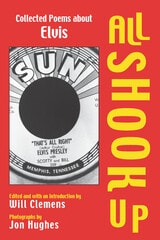
All Shook Up
Collected Poems about ElvisWill Clemens
University of Arkansas Press, 2001
All That Divides Us
PoemsElinor Benedict foreword by Maxine Kumin
Utah State University Press, 2000
All Things At Once
Sonnets and SongsRoger Armbrust
Parkhurst Brothers, Inc., 2022
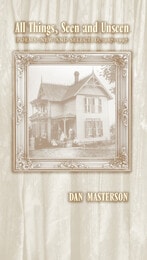
All Things, Seen and Unseen
Poems: New and Selected, 1967-1997Dan Masterson
University of Arkansas Press, 1997
With clarity and precise detail, Dan Masterson creates a narrative of how we live, love, and die. In blank verse and rhymed stanzas, in free verse and taut lyrics, he delivers the story of a woman trap ped in an avalanche, a husband daring himself to death in an ocean swim, or a son arranging the final affairs of his parents. There is always an edge to Masterson’s characters—they are everyday people, but we meet them on the one day when the stakes are highest.
He holds a reverence for the particulars of a place, for gardens and homes, for dresser drawers and work benches, for cabins in the Adirondacks, ponds, tree houses, and ornamental stones. The leavings of loved ones—strong boxes, pajamas, rosaries—are passed on as relics that both heal and trouble. In Masterson’s world, characters learn how to lose, how to change, and even how to survive their most painful memories.
Selected from thirty years of work, and including an eclectic selection of new poems, this book unfurls Masterson’s full canvas of abilities: his penchant for startling descriptions, his keen insight into our nobility and fallibility, and his skill at making us live his poems.
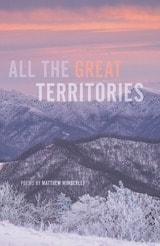
All the Great Territories
Matthew Wimberley
Southern Illinois University Press, 2020
In 2012 Matthew Wimberley took a two-month journey, traveling and living out of his car, during which time he had planned to spread his father’s ashes. By trip’s end, the ashes remained, but Wimberley had begun a conversation with his deceased father that is continued here in his debut collection.
All the Great Territories is a book of elegies for a father as well as a confrontation with the hostile, yet beautiful landscape of southern Appalachia. In the wake of an estranged father’s death, the speaker confronts that loss while celebrating the geography of childhood and the connections formed between the living and the dead. The narrative poems in this collection tell one story through many: a once failed relationship, the conversations we have with those we love after they are gone. In an attempt to make sense of the father-son relationship, Wimberley embraces and explores the pain of personal loss and the beauty of the natural world.
Stitching together sundered realms—from Idaho to the Blue Ridge Mountains and from the ghost of memory to the iron present of self—Wimberley produces a map for reckoning with grief and the world’s darker forces. At once a labor of love and a searing indictment of those who sensationalize and dehumanize the people and geography of Appalachia, All the Great Territories sparks the reader forward, creating a homeland all its own. “Because it’s my memory I can give it to you,” Wimberley’s speaker declares, and it’s a promise well kept in this tender and remarkable debut.
All the Lavish in Common
Allan Peterson
University of Massachusetts Press, 2006
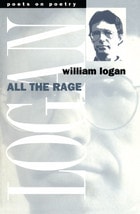
All the Rage
William Logan
University of Michigan Press, 1998
Logan was among the first critics to review a generation of poets now in creative maturity, and his comments on the early works of Jorie Graham, Gjertrud Schnackenberg, and the late Amy Clampitt show the enthusiasm of fresh discovery. But he is no respecter of old reputation, as his reviews of John Ashbery and Robert Penn Warren demonstrate. In total, his criticism considers virtues with their defects and always speaks its author's mind. Some contemporary poetry has had few better friends, and some few greater enemies, than William Logan.
William Logan is the author of Sad-Faced Men, Difficulty, Sullen Weedy Lakes, and Vain Empires. He is Alumni/ae Professor of English, University of Florida.
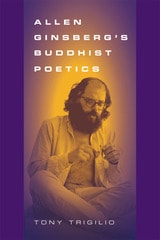
Allen Ginsberg's Buddhist Poetics
Tony Trigilio
Southern Illinois University Press, 2007
The book also considers the place of Ginsberg’s poetry in the cultural and aesthetic contexts of his career, covering the rise of an “American Buddhism”; the antiwar, drug decriminalization, and gay civil rights movements; and the shift from modern to postmodern strategies in contemporary U.S. poetry.
Alliance, Illinois
Dave Etter
Northwestern University Press, 2005
Altar for Broken Things
PoemsDeborah A. Miranda
BkMk Press, 2020
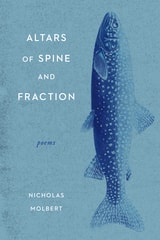
Altars of Spine and Fraction
PoemsNicholas Molbert
Northwestern University Press, 2024
A debut poetry collection set in and around Louisiana’s fishing village of Cocodrie
Altars of Spine and Fraction follows its protagonist through the joys and dangers of childhood on the rural Gulf Coast, through familial loss, and into adulthood. Refusing to romanticize what has been lost, Molbert instead interrogates how nostalgia is most often enjoyed by those with the privilege to reject or indulge it.
Violent hurricanes sweep across the landscapes of the poems, and Molbert probes the class inequalities that these climate crises lay bare. Moving from outdoor rural spaces in its first half to indoor domestic spaces in its second half, the collection explores family history, generational trauma, and the toxic masculinity that is shouldered by boys raised in the Deep South.
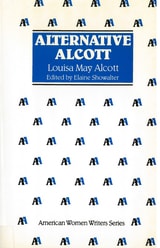
Alternative Alcott
Showalter, Elaine
Rutgers University Press, 1988
Alternative Alcott includes works never before reprinted, including "How I Went Out to Service," "My Contraband," and "Psyche's Art." It also contains Behind a Mask, her most important sensation story; the full and correct text of her last unfinished novel, Diana and Persis; "Transcendental Wild Oats"; Hospital Sketches; and Alcott's other important texts on nineteenth-century social history. This anthology brings together for the first time a variety of Louisa May Alcott's journalistic, satiric, feminist, and sensation texts. Elaine Showalter has provided an excellent introduction and notes to the collection.
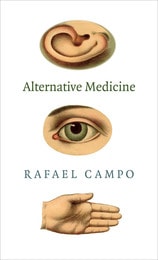
Alternative Medicine
Rafael Campo
Duke University Press, 2013
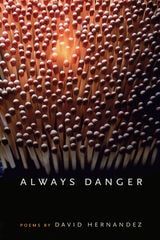
Always Danger
David Hernandez
Southern Illinois University Press, 2006
Always Danger offers a lyrical and highly imaginative exploration into the hazards that surround people’s lives—whether it’s violence, war, mental illness, car accidents, or the fury of Mother Nature. In his second collection of poems, David Hernandez embraces the element of surprise: a soldier takes refuge inside a hollowed-out horse, a man bullies a mountain, and a giant pink donut sponsors age-old questions about beliefs. Hernandez typically eschews the politics that often surround the inner circle of contemporary literature, but in this volume he quietly sings a few bars with a political tone: one poem shadows the conflict in Iraq, another reflects our own nation’s economic and cultural divide. Always Danger parallels Hernandez’s joy of writing: unmapped, spontaneous, and imbued with nuanced revelation.
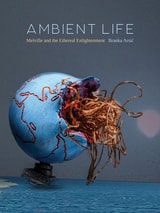
Ambient Life
Melville and the Ethereal EnlightenmentBranka Arsic
University of Minnesota Press, 2026
Rethinking the human through Melville’s encounters with oceans, ecologies, and non-Western cosmologies
Ambient Life offers a bold reimagining of Herman Melville’s writing through the lens of ecology. Renowned literary critic Branka Arsić reframes Melville not just as a novelist but as an environmental thinker—one who reoriented the terms of human identity, perception, and relation. Rather than treating Melville’s texts as separate literary objects, Arsić gathers them collectively to stage a philosophical meeting between Western Enlightenment epistemologies and the cosmologies of Polynesian and African traditions.
In Ambient Life, Melville’s thinking becomes a site where vegetal, animal, and elemental images dissolve the distinction between inner life and outer world, yielding a radically relational form of individuation. Showing how Melville envisioned the human body not as a bounded, rational mind-container but as a porous, sensing organ infused with its surroundings, Arsić presents the mind as ambient rather than internal—a “coral psyche” shaped by atmospheric, aesthetic, and affective entanglements. Drawing from rich historical archives and ethnographic narratives, Arsić’s archipelagic method mirrors this fluidity, traveling across oceans and epistemes to map a mode of thought.
Pushing the boundaries of scholarly form and content, Ambient Life is a resonant meditation on the unstable boundaries of the self that positions Melville as a witness to the ecological precarity of our time—and an unwitting ancestor of posthumanist thought.
Retail e-book files for this title are screen-reader friendly with images accompanied by short alt text and/or extended descriptions.
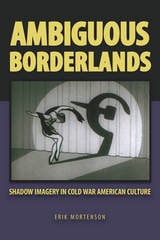
Ambiguous Borderlands
Shadow Imagery in Cold War American CultureErik Mortenson
Southern Illinois University Press, 2016
After contextualizing the postwar use of shadow imagery in the wake of the atomic bomb, Ambiguous Borderlands looks at shadows in print works, detailing the reemergence of the pulp fiction crime fighter the Shadow in the late-1950s writings of Sylvia Plath, Amiri Baraka, and Jack Kerouac. Using Freudian and Jungian conceptions of the unconscious, Mortenson then discusses Kerouac’s and Allen Ginsberg’s shared dream of a “shrouded stranger” and how it shaped their Beat aesthetic. Turning to the visual, Mortenson examines the dehumanizing effect of shadow imagery in the Cold War photography of Robert Frank, William Klein, and Ralph Eugene Meatyard. Mortenson concludes with an investigation of the use of chiaroscuro in 1950s film noir and the popular television series The Twilight Zone, further detailing how the complexities of Cold War society were mirrored across these media in the ubiquitous imagery of light and dark.
From comics to movies, Beats to bombs, Ambiguous Borderlands provides a novel understanding of the Cold War cultural context through its analysis of the image of the shadow in midcentury media. Its interdisciplinary approach, ambitious subject matter, and diverse theoretical framing make it essential reading for anyone interested in American literary and popular culture during the fifties and sixties.
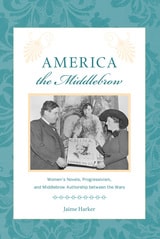
America the Middlebrow
Women's Novels, Progressivism, and Middlebrow Authorship between the WarsJaime Harker
University of Massachusetts Press, 2007
Between the two world wars, American publishing entered a “golden age” characterized by an explosion of new publishers, authors, audiences, distribution strategies, and marketing techniques. The period was distinguished by a diverse literary culture, ranging from modern cultural rebels to working-class laborers, political radicals, and progressive housewives. In America the Middlebrow, Jaime Harker focuses on one neglected mode of authorship in the interwar period—women's middlebrow authorship and its intersection with progressive politics.
With the rise of middlebrow institutions and readers came the need for the creation of the new category of authorship. Harker contends that these new writers appropriated and adapted a larger tradition of women's activism and literary activity to their own needs and practices. Like sentimental women writers and readers of the 1850s, these authors saw fiction as a means of reforming and transforming society. Like their Progressive Era forebears, they replaced religious icons with nationalistic images of progress and pragmatic ideology. In the interwar period, this mode of authorship was informed by Deweyan pragmatist aesthetics, which insisted that art provided vicarious experience that could help create humane, democratic societies.
Drawing on letters from publishers, editors, agents, and authors, America the Middlebrow traces four key moments in this distinctive culture of letters through the careers of Dorothy Canfield, Jessie Fauset, Pearl Buck, and Josephine Herbst. Both an exploration of a virtually invisible culture of letters and a challenge to monolithic paradigms of modernism, the book offers fresh insight into the ongoing tradition of political domestic fiction that flourished between the wars.
America's Gothic Fiction
The Legacy of Magnalia Christi AmericanaDorothy Z. Baker
The Ohio State University Press, 2007
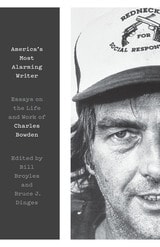
America's Most Alarming Writer
Essays on the Life and Work of Charles BowdenEdited by Bill Broyles and Bruce J. Dinges
University of Texas Press, 2019
The author of more than twenty books and a revered contributor to numerous national publications, Charles Bowden (1945–2014) used his keen storyteller’s eye to reveal both the dark underbelly and the glorious determination of humanity, particularly in the borderlands between the United States and Mexico. In America’s Most Alarming Writer, key figures in his life—including his editors, collaborators, and other writers—deliver a literary wake for the man who inspired them throughout his forty-year career.
Part revelation, part critical assessment, the fifty essays in this collection span the decades from Bowden’s rise as an investigative journalist through his years as a singular voice of unflinching honesty about natural history, climate change, globalization, drugs, and violence. As the Chicago Tribune noted, “Bowden wrote with the intensity of Joan Didion, the voracious hunger of Henry Miller, the feral intelligence and irony of Hunter Thompson, and the wit and outrage of Edward Abbey.” An evocative complement to The Charles Bowden Reader, the essays and photographs in this homage brilliantly capture the spirit of a great writer with a quintessentially American vision. Bowden is the best writer you’ve (n)ever read.
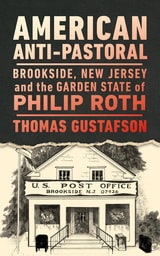
American Anti-Pastoral
Brookside, New Jersey and the Garden State of Philip RothThomas Gustafson
Rutgers University Press, 2024
American Anti-Pastoral reads the events in Roth’s novel in relation to the history of Brookside and its region. While Roth’s protagonist Seymour “Swede” Levov initially views Old Rimrock as an idyllic paradise within the Garden State, its real-world counterpart has a more complex past in its origins as a small industrial village, as well as a site for the politics of exclusionary zoning and a 1960s anti-war protest at its celebrated 4th of July parade. Literary historian and Brookside native Thomas Gustafson casts Roth’s canonical novel in a fresh light as he studies both Old Rimrock in comparison to Brookside and the novel in relationship to NJ literature, making a case for it as the Great New Jersey novel. For Roth fans and history buffs alike, American Anti-Pastoral peels back the myths about the bucolic Garden State countryside to reveal deep fissures along the fault-lines of race and religion in American democracy.
American Architects and Their Books, 1840-1915
Kenneth Hafertepe
University of Massachusetts Press, 2007
In this well-illustrated volume, a chronological sequel to American Architects and Their Books to 1848, twelve distinguished historians of architecture discuss from various points of view the books that inspired architects both famous and not-so-famous, and the books the architects themselves produced. They examine the multifaceted relationship of nineteenth- and early twentieth-century architects to print culture—the literary works that architects collected, used, argued over, wrote, illustrated, designed, printed, were inspired by, cribbed from, educated clients with, advertised their services through, designed libraries for, or just plain enjoyed. The result is a volume that presents the intersection of the history of architecture, the history of ideas, and the history of the book. Changes in print culture during this period had a significant impact on the architectural profession, as revealed in these well-informed scholarly essays.
In addition to the editors, contributors include Jhennifer A. Amundson, Edward R. Bosley, Ted Cavanagh, Elspeth Cowell, Elaine Harrington, Michael J. Lewis, Anne E. Mallek, Daniel D. Reiff, Earle G. Shettleworth, Jr., and Chris Szczesny-Adams. Among the architects discussed are A. J. Downing, Charles Sumner Greene, James Sims, Samuel Sloan, John Calvin Stevens, Thomas U. Walter, and Frank Lloyd Wright.
American Art, volume 36 number 2 (Summer 2022)
The University of Chicago Press
University of Chicago Press Journals, 2022

American Art, volume 36 number 3 (Fall 2022)
The University of Chicago Press
University of Chicago Press Journals, 2022
American Art, volume 37 number 1 (Spring 2023)
The University of Chicago Press
University of Chicago Press Journals, 2023
American Art, volume 37 number 2 (Summer 2023)
The University of Chicago Press
University of Chicago Press Journals, 2023
American Art, volume 37 number 3 (Fall 2023)
The University of Chicago Press
University of Chicago Press Journals, 2023
American Art, volume 38 number 1 (Spring 2024)
The University of Chicago Press
University of Chicago Press Journals, 2024
American Art, volume 38 number 2 (Summer 2024)
The University of Chicago Press
University of Chicago Press Journals, 2024
American Art, volume 38 number 3 (Fall 2024)
The University of Chicago Press
University of Chicago Press Journals, 2024
American Art, volume 39 number 1 (Spring 2025)
The University of Chicago Press
University of Chicago Press Journals, 2025
American Art, volume 39 number 2 (Summer 2025)
The University of Chicago Press
University of Chicago Press Journals, 2025
American Art, volume 39 number 3 (Fall 2025)
The University of Chicago Press
University of Chicago Press Journals, 2025
American Art, volume 40 number 1-2 (Spring 2026)
The University of Chicago Press
University of Chicago Press Journals, 2026
American Audacity
Literary Essays North and SouthChristopher Benfey
University of Michigan Press, 2010
---William H. Pritchard
American Autobiography after 9/11
Megan Brown
University of Wisconsin Press, 2017
This lively and theoretically grounded book analyzes twenty-first-century memoirs from Three Cups of Tea to Fun Home, emphasizing the ways in which they reinforce and circulate ideologies, becoming guides or models for living. Brown expands her inquiry beyond books to the autobiographical narratives in reality television and political speeches. She offers a persuasive explanation for the memoir boom: the genre as a response to an era of uncertainty and struggle.
American Cinema of the 1980s
Themes and VariationsPrince, Stephen
Rutgers University Press, 2007
Bringing together original essays by ten respected scholars in the field, American Cinema of the 1980s examines the films that marked the decade, including Ordinary People, Body Heat, Blade Runner, Zelig, Platoon, Top Gun, Aliens, Blue Velvet, Robocop, Fatal Attraction, Die Hard, Batman, and sex, lies & videotape.
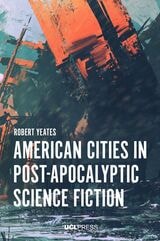
American Cities in Post-Apocalyptic Science Fiction
Robert Yeates
University College London, 2021
American Cities in Post-Apocalyptic Science Fiction traces the image of urban ruins across twentieth- and twenty-first-century American media. Surveying pulp magazines, radio dramas, films, video games, and the transmedia franchise, Robert Yeates explores how the synergy of technological innovation and artistic vision created an increasingly immersive space to reimagine the urban future. Through a series of medium-specific case studies, Yeates offers provocative new readings of familiar works such as Blade Runner and The Walking Dead situated against a fresh history of ruined cities in American literature.
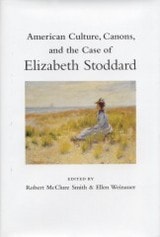
American Culture, Canons, and the Case of Elizabeth Stoddard
Robert McClure Smith
University of Alabama Press, 2003
Elizabeth Stoddard was a gifted writer of fiction, poetry, and journalism; successfully published within her own lifetime; esteemed by such writers as William Dean Howells and Nathaniel Hawthorne; and situated at the epicenter of New York’s literary world. Nonetheless, she has been almost excluded from literary memory and importance. This book seeks to understand why. By reconsidering Stoddard’s life and work and her current marginal status in the evolving canon of American literary studies, it raises important questions about women’s writing in the 19th century and canon formation in the 20th century.
Essays in this study locate Stoddard in the context of her contemporaries, such as Dickinson and Hawthorne, while others situate her work in the context of major 19th-century cultural forces and issues, among them the Civil War and Reconstruction, race and ethnicity, anorexia and female invalidism, nationalism and localism, and incest. One essay examines the development of Stoddard’s work in the light of her biography, and others probe her stylistic and philosophic originality, the journalistic roots of her voice, and the elliptical themes of her short fiction. Stoddard’s lifelong project to articulate the nature and dynamics of woman’s subjectivity, her challenging treatment of female appetite and will, and her depiction of the complex and often ambivalent relationships that white middle-class women had to their domestic spaces are also thoughtfully considered.
The editors argue that the neglect of Elizabeth Stoddard’s contribution to American literature is a compelling example of the contingency of critical values and the instability of literary history. This study asks the question, “Will Stoddard endure?” Will she continue to drift into oblivion or will a new generation of readers and critics secure her tenuous legacy?
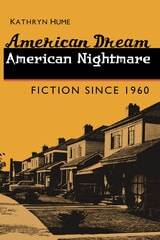
American Dream, American Nightmare
Fiction since 1960Kathryn Hume
University of Illinois Press, 2000
In breaking down the divisions among standard categories of race, religion, ethnicity, and gender, Hume identifies shared core concerns, values, and techniques among seemingly disparate and unconnected writers including T. Coraghessan Boyle, Ralph Ellison, Russell Banks, Gloria Naylor, Tim O'Brien, Maxine Hong Kingston, Walker Percy, N. Scott Momaday, John Updike, Toni Morrison, William Kennedy, Julia Alvarez, Thomas Pynchon, Leslie Marmon Silko, and Don DeLillo.
Hume explores fictional treatments of the slippage in the immigrant experience between America's promise and its reality. She exposes the political link between contemporary stories of lost innocence and liberalism's inadequacies. She also invites us to look at the literary challenge to scientific materialism in various searches for a spiritual dimension in life.
The expansive future promised by the American Dream has been replaced, Hume finds, by a sense of tarnished morality and a melancholy loss of faith in America's exceptionalism. American Dream, American Nightmare examines the differing critiques of America embedded in nearly a hundred novels and points to the source for recovery that appeals to many of the authors.
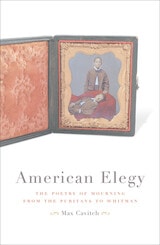
American Elegy
The Poetry of Mourning from the Puritans to WhitmanMax Cavitch
University of Minnesota Press, 2007
American Examples, Vol 2
New Conversations about ReligionEdited by Samah Choudhury, Prea Persaud, and Michael J. Altman
University of Alabama Press, 2022
Fresh new perspectives on the study of religion, ranging from SoulCycle to Mark Twain
American Examples: New Conversations about Religion, Volume Two, is the second in a series of annual anthologies produced by the American Examples workshop hosted by the Department of Religious Studies at The University of Alabama. In the latest volume from this dynamic academic project, nine scholars with diverse topics and methodologies vividly reimagine the meaning of all three words in the phrase “American religious history.” The essays use case studies from America, broadly conceived, to ask trenchant theoretical questions that are of interest to scholars and students beyond the subfield of American religious history.
Cody Musselman uses a Weberian analysis to explore questions of identity, authority, and authenticity in the world of SoulCycle while Zachary T. Smith finds commonality between the rhetoric and practices of scholarship and mixed martial arts. Erik Kline provides a new perspective on the psychedelic mysticism of the 1960s, and Brook Wilensky-Lanford takes stock of the cultural power of parody in Mark Twain’s last work of fiction. Christopher Cannon Jones examines the reciprocal relationship between religious texts and cultural contexts by comparing early Mormon missions to Hawai‘i and Jamaica and Lindsey Jackson explores what debates over circumcision can tell us about gender stereotypes and motherhood. Dana Lloyd uses the 1988 Supreme Court decision in Lyng v. Northwest Indian Cemetery Protective Association as a case study in order to consider how Indigenous religion and sovereignty have been understood and adjudicated in the American legal system. Matt Sheedy studies the identity categories of “atheist” and “ex-Muslim” and Brad Stoddard uses ethnographic fieldwork to evaluate the role of religious pluralism in regulating and policing correctional institutions. Editors Samah Choudhury and Prea Persaud provide an introduction that reconsiders the trajectory of the American Examples project in light of the siege on the US Capitol in January 2021 and the continuing COVID pandemic.
Visit americanexamples.ua.edu for more information on upcoming workshop dates and future projects.
CONTRIBUTORS
Michael J. Altman / Samah Choudhury / Lindsey Jackson / Christopher Cannon Jones / / Erik Kline / Dana Lloyd / Cody Musselman / Prea Persaud / Matt Sheedy / Zachary T. Smith / Brad Stoddard / Brook Wilensky-Lanford
American Exceptionalism as Religion
Postmodern DiscontentJordan Carson
The Ohio State University Press, 2020
As American exceptionalism resurfaces in public discourse, Carson’s timely work invites readers to reconsider the nexus of religion, politics, and culture. Carson argues that defining religion according to secularist criteria has insulated ostensibly secular ideologies as well as traditional religion from public scrutiny. DeLillo’s, Castillo’s, Pynchon’s, Saunders’s, and Robinson’s redefinitions of religion result in a better grasp of how individuals actually live out their religious lives. More importantly, these authors help erect a framework for constructively engaging American exceptionalism and the ideas that support it.
American Faces
A Cultural History of Portraiture and IdentityRichard H. Saunders
University Press of New England, 2016
American Fiction and the Metaphysics of the Grotesque
Dieter Meindl
University of Missouri Press, 1996
By synthesizing Kayser's and Bakhtin's views of the grotesque and Heidegger's philosophy of Being, American Fiction and the Metaphysics of the Grotesque seeks to demonstrate that American fiction from Poe to Pynchon has tried to convey the existential dimension: the pre-individual totality or flow of life, which defines itself against the mind and its linguistic capacity. Dieter Meindl shows how the grotesque, through its self-contradictory nature, has been instrumental in expressing this reality-conception, an antirationalist stance in basic agreement with existential thought. The historical validity of this new metaphysics, which grants precedence to Being--the context of cognition--over the cognizant subject, must be upheld in the face of deconstructive animadversions upon any metaphysics of presence. The notion of decentering the subject, Meindl argues, did not originate with deconstruction.
The existential grotesque confirms the protomodernist character of classic American fiction. Meindl traces its course through a number of well-known texts by Melville, James, Gilman, Anderson, Faulkner, and O'Connor, among others. To convey life conceived as motion, these writers had to capture--that is, immobilize--it in their art: an essentially distortive and, therefore, grotesque device. Melville's "Bartleby," dealing with a mort vivant, is the seminal text in this mode of indirectness. As opposed to the existential grotesque, which grants access to a preverbal realm, the linguistic grotesque of postmodern fiction works on the assumption that all reality is referable to language in a textual universe.
American Fiction and the Metaphysics of the Grotesque will significantly alter our understanding of certain traditions in American literature.
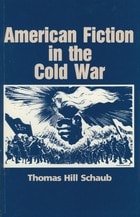
American Fiction in the Cold War
Thomas H. Schaub
University of Wisconsin Press, 1991
In American Fiction in the Cold War Thomas Hill Schaub makes it clear that Trilling’s summary was in itself a mythic reconstruction, a prominent example of the way liberal writers in the late 1940s and 1950s came to terms with their political past. Schaub’s book brilliantly analyzes their efforts to reshape an “old” liberalism alleged to hold naively optimistic views of human nature, scientific reason, and social progress into a “new,” skeptical liberalism that recognized the persistence of human evil, the fragility of reason, and the ambiguity of moral decision.
Most important, as American Fiction in the Cold War demonstrates, these liberal reassessments of history, politics, human nature, and destiny—what Schaub calls the “liberal narrative”—mediated the critical and imaginative production of the literary community after World War II. Schaub shows that the elements of this narrative are visible in a wide spectrum of cultural narratives in American history, political philosophy, and social criticism during the Cold War era. His analysis of the dominant critical communities of the late 1940s—led by critics such as Lionel Trilling and Irving Howe, Cleanth Brooks and Allen Tate—recovers the political meanings embedded within their debates over the nature of literary realism, the definition of the novel, and speculations on its “death.”
In the second part of his study, Schaub turns to Ralph Ellison, Flannery O’Connor, Norman Mailer, and John Barth. His readings of their fiction isolate the political and cultural content of works often faulted for their apparent efforts to transcend social history. Reviewing John Barth’s End of the Road, for example, he shows the politics of culture concealed within what seems to be a philosophical narrative. In novel after novel, he demonstrates, the liberal narrative is operating from within, tuning and steering the direction of the plot and the creation of the character. Schaub’s penetrating exploration of the relationship between U.S. political and social thought and the literary consciousness in the early postwar years will be of interest to intellectual historians and to students of American literary culture.
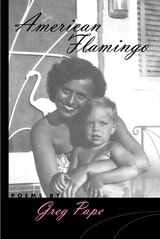
American Flamingo
Greg Pape
Southern Illinois University Press, 2005
Taking its title from an Audubon painting, American Flamingo shares with the artist an exquisite attention to detail and the suggestion of a larger sense of time and place through depictions of the intimate interactions between creatures and their habitats. In his fifth collection of poetry, Greg Pape melds memorable images from the natural world with the drama of ordinary experience to capture small transformations of human character in American settings from Arizona’s Sonora Desert to the icy streets of Washington, D.C. Through elegies, character sketches, and lyric and narrative evocations of family and place, Pape offers lucid and startling poems that bridge the spaces between the past and the present, men and women, and urban and rural landscapes.
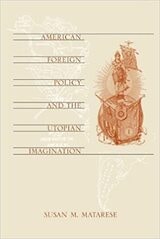
American Foreign Policy and the Utopian Imagination
Susan M. Matarese
University of Massachusetts Press, 2010
However U.S. policymakers may resolve such issues, their thinking will be influenced by assumptions deeply embedded in American culture. Some of those beliefs derive from the nation's distinctive history, geography, and resources. But others are rooted in what Susan M. Matarese calls the "national image"--a set of emotionally charged, relatively coherent ideas about the special qualities of the United States and its place in the world.
Building on a long tradition of scholarship that looks to works of literature for insights into national myths and symbols, Matarese examines a rich trove of utopian fiction written by Americans during the late nineteenth century. Such writings, she shows, provide a useful window into the popular imagination, revealing widely shared notions about the foreign policy of an idealized America--notions that have proven remarkably resilient in the twentieth century as well. Indeed, even in the post-Cold War era, one can find striking similarities between the foreign policy goals of the Bush and Clinton administrations and the dreams of America's utopian architects a century earlier.
The author concludes with an appeal for greater humility and realism in the formation of U.S. foreign policy, and a recognition of the limits of American power in what is likely to be an increasingly fluid, fragmented, and multipolar world.
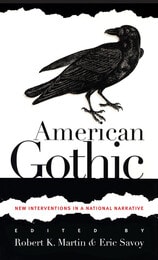
American Gothic
New Interventions in a National NarrativeRobert K. Martin
University of Iowa Press, 1998
In America as in Britain, the rise of the Gothic represented the other—the fearful shadows cast upon Enlightenment philosophies of common sense, democratic positivism, and optimistic futurity. Many critics have recognized the centrality of these shadows to American culture and self-identification. American Gothic, however, remaps the field by offering a series of revisionist essays associated with a common theme: the range and variety of Gothic manifestations in high and popular art from the roots of American culture to the present.
The thirteen essayists approach the persistence of the Gothic in American culture by providing a composite of interventions that focus on specific issues—the histories of gender and race, the cultures of cities and scandals and sensations—in order to advance distinct theoretical paradigms. Each essay sustains a connection between a particular theoretical field and a central problem in the Gothic tradition.
Drawing widely on contemporary theory—particularly revisionist views of Freud such as those offered by Lacan and Kristeva—this volume ranges from the well-known Gothic horrors of Edgar Allan Poe and Nathaniel Hawthorne to the popular fantasies of Stephen King and the postmodern visions of Kathy Acker. Special attention is paid to the issues of slavery and race in both black and white texts, including those by Ralph Ellison and William Faulkner. In the view of the editors and contributors, the Gothic is not so much a historical category as a mode of thought haunted by history, a part of suburban life and the lifeblood of films such as The Exorcist and Fatal Attraction.
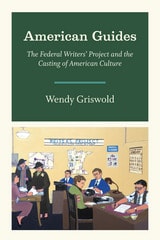
American Guides
The Federal Writers’ Project and the Casting of American CultureWendy Griswold
University of Chicago Press, 2016
Griswold’s subject here is the Project’s American Guides, an impressively produced series that set out not only to direct travelers on which routes to take and what to see throughout the country, but also to celebrate the distinctive characteristics of each individual state. Griswold finds that the series unintentionally diversified American literary culture’s cast of characters—promoting women, minority, and rural writers—while it also institutionalized the innovative idea that American culture comes in state-shaped boxes. Griswold’s story alters our customary ideas about cultural change as a gradual process, revealing how diversity is often the result of politically strategic decisions and bureaucratic logic, as well as of the conflicts between snobbish metropolitan intellectuals and stubborn locals. American Guides reveals the significance of cultural federalism and the indelible impact that the Federal Writers’ Project continues to have on the American literary landscape.