Results by title
4154 books match the query 'State & Local' and 398 start with a
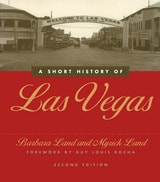
A Short History of Las Vegas
Barbara Land
University of Nevada Press, 2004
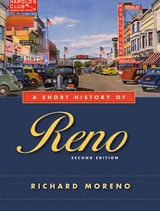
A Short History of Reno, Second Edition
Richard Moreno
University of Nevada Press, 2015
Moreno brings the city’s history up-to-date with coverage of the businesspeople and civic leaders who helped make Reno an attraction that still lures millions of visitors each year. Today’s travelers and residents explore Reno’s flamboyant heart and scenic wonders, topics the author examines in an accessible and lively fashion.
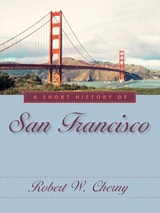
A Short History of San Francisco
Robert W. Cherny
University of Nevada Press, 2026
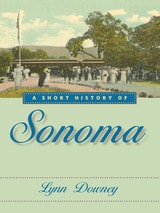
A Short History of Sonoma
Lynn Downey
University of Nevada Press, 2013
The book also addresses such topics as the development of local ranching and businesses and of transportation links to San Francisco that helped to make Sonoma and the surrounding Valley of the Moon a popular location for summer homes and resorts. It discusses the role of the nearby hot springs in attracting visitors and permanent residents, including people seeking cures for various ailments. There are also accounts of some of the famous people who lived in or near Sonoma and helped establish its mystique, including Mexican general Mariano Vallejo, the town’s first leader; Hungarian winemaker Agoston Haraszthy, who first saw the region’s potential for producing superior wines; and writers Jack London and M. F. K. Fisher, who made their homes in the Valley of the Moon, drawn by its beauty and bucolic lifestyle.
A Short History of Sonoma is generously illustrated with vintage photographs. It is a delightful account of one of America’s most charming towns and its evolution from rowdy frontier settlement to the paragon of sophisticated living that it is today.
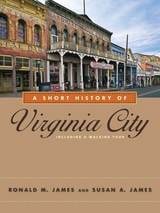
A Short History of Virginia City
Ronald M. James
University of Nevada Press, 2014
The city’s story did not end when the Comstock Lode played out. Beginning in the 1930s, bohemian artists, literati, and tourists were intrigued by this remnant of the Old West. The leader of Manhattan’s café society, Lucius Beebe, moved here and relaunched the Territorial Enterprise in 1950. Television’s most popular western from 1959 to 1973, Bonanza, located its fictional Ponderosa Ranch nearby. In the summer of 1965, a handful of Bay Area musicians, including Big Brother and the Holding Company, performed at the Red Dog Saloon and launched psychedelic rock, part of the inspiration for a defining decade of youth culture. Today it is both a National Historic Landmark District and a living community. Visitors come to enjoy its saloons and restaurants, admire its architecture, and learn from its museums and exhibits. A Short History of Virginia City will enhance their experience and will also be enjoyed by anyone interested in the history of Nevada, mining, and the Old West.
• Includes an illustrated walking tour describing more than thirty buildings and sites
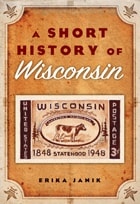
A Short History of Wisconsin
Erika Janik
Wisconsin Historical Society Press, 2010
Rediscover Wisconsin history from the very beginning. A Short History of Wisconsin recounts the landscapes, people, and traditions that have made the state the multifaceted place it is today. With an approach both comprehensive and accessible, historian Erika Janik covers several centuries of Wisconsin's remarkable past, showing how the state was shaped by the same world wars, waves of new inhabitants, and upheavals in society and politics that shaped the nation.
Swift, authoritative, and compulsively readable, A Short History of Wisconsin commences with the glaciers that hewed the region's breathtaking terrain, the Native American cultures who first called it home, and French explorers and traders who mapped what was once called "Mescousing." Janik moves through the Civil War and two world wars, covers advances in the rights of women, workers, African Americans, and Indians, and recent shifts involving the environmental movement and the conservative revolution of the late 20th century. Wisconsin has hosted industries from fur-trapping to mining to dairying, and its political landscape sprouted figures both renowned and reviled, from Fighting Bob La Follette to Joseph McCarthy. Janik finds the story of a state not only in the broad strokes of immigration and politics, but also in the daily lives shaped by work, leisure, sports, and culture. A Short History of Wisconsin offers a fresh understanding of how Wisconsin came into being and how Wisconsinites past and present share a deep connection to the land itself.
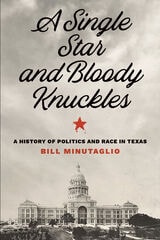
A Single Star and Bloody Knuckles
A History of Politics and Race in TexasBy Bill Minutaglio
University of Texas Press, 2021
For John Nance “Cactus Jack” Garner, there was one simple rule in politics: “You’ve got to bloody your knuckles.” It’s a maxim that applies in so many ways to the state of Texas, where the struggle for power has often unfolded through underhanded politicking, backroom dealings, and, quite literally, bloodshed. The contentious history of Texas politics has been shaped by dangerous and often violent events, and been formed not just in the halls of power but by marginalized voices omitted from the official narratives.
A Single Star and Bloody Knuckles traces the state’s conflicted and dramatic evolution over the past 150 years through its pivotal political players, including oft-neglected women and people of color. Beginning in 1870 with the birth of Texas’s modern political framework, Bill Minutaglio chronicles Texas political life against the backdrop of industry, the economy, and race relations, recasting the narrative of influential Texans. With journalistic verve and candor, Minutaglio delivers a contemporary history of the determined men and women who fought for their particular visions of Texas and helped define the state as a potent force in national affairs.

A Sister's Memories
The Life and Work of Grace Abbott from the Writings of Her Sister, Edith AbbottEdited by John Sorensen
University of Chicago Press, 2015
A Sister’s Memories is the inspiring story of Grace Abbott (1878–1939), as told by her sister and social justice comrade, Edith Abbott (1876–1957). Edith recalls in vivid detail the Nebraska childhood, impressive achievements, and struggles of her sister who, as head of the Immigrants’ Protective League and the U.S. Children’s Bureau, championed children’s rights from the slums of Chicago to the villages of Appalachia. Grace’s crusade can perhaps be best summed up in her well-known credo: “Justice for all children is the high ideal in a democracy.” Her efforts saved the lives of thousands of children and immigrants and improved those of millions more. These trailblazing social service works led the way to the creation of the Social Security Act and UNICEF and caused the press to nickname her “The Mother of America’s 43 Million Children.” She was the first woman in American history to be nominated to the presidential cabinet and the first person to represent the United States at a committee of the League of Nations.
Edited by Abbott scholar John Sorensen, A Sister’s Memories is destined to become a classic. It shapes the diverse writings of Edith Abbott into a cohesive narrative for the first time and fills in the gaps of our understanding of Progressive Era reforms. Readers of all backgrounds will find themselves engrossed by this history of the unstoppable, pioneer feminist Abbott sisters.
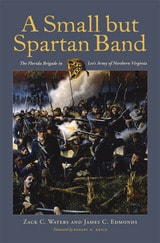
A Small but Spartan Band
The Florida Brigade in Lee's Army of Northern VirginiaZack C. Waters
University of Alabama Press, 2013
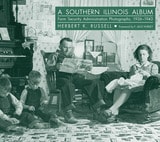
A Southern Illinois Album
Farm Security Administration Photographs, 1936-1943Herbert K. Russell. Foreword by F. Jack Hurley
Southern Illinois University Press, 1990

A Sporting Time
New York City and the Rise of Modern Athletics, 1820-70Melvin L. Adelman
University of Illinois Press, 1986
A Store Almost in Sight
The Economic Transformation of Missouri from the Lousiana Purchase to the Civil WarJeff Bremer
University of Iowa Press, 2014
Most Missourians welcomed the opportunity to take part in commercial markets. Farmwomen sold eggs or butter to peddlers and in nearby towns, while men took surplus corn or pork to stores for credit. Immigrants searched for the most fertile land closest to waterways, to ensure they would have large harvests and an easy way to ship them to market. Families floated farm goods downriver until steamboats transformed rural life by drastically reducing the cost of transportation and boosting farm production and consumption. Traders also trekked west across the plains to trade at the inland entrepôt of Santa Fe. The waves of migrants headed for Oregon and California in the 1840s and 1850s further encouraged commercial development. However, most white settlers lacked the necessary financial means to be capitalists in a technical sense, seeking instead a “competency,” or comfortable independence.
This fresh reinterpretation of the American frontier will interest anyone who wants to understand the economic and social significance of westward migration in U.S. history. It gives the reader a gritty, grassroots sense of how ordinary people made their livings and built communities in the lands newly opened to American settlement.
A Strike Like No Other Strike
Law and Resistance During the Pittston Coal Strike of 1989-1990Richard A. Brisbin, Jr.
West Virginia University Press, 2010
The miners' strike against Pittston Coal in 1989–1990, which spread throughout southwestern Virginia, southern West Virginia, and eastern Kentucky, was one of the most important strikes in the history of American labor, and, as Richard Brisbin observes, "one of the longest and largest incidents of civil disorder and civil disobedience in the United States in the second half of the twentieth century." The company aggressively sought to break the strike, and workers and their families used a variety of tactics—lawful and unlawful—to resist Pittston's efforts as the situation quickly turned ugly.
In A Strike like No Other Strike: Law and Resistance during the Pittston Coal Strike of 1989–1990, Richard Brisbin offers a compelling study of the exercise of political power. In considering the legal significance of the strike, Brisbin asks the larger question of whether even extreme transgression or resistance can fracture the "imagined coherence of the law." He shows how each party in the strike invoked the law to justify its actions while attacking those of the other side as unlawful. In the end, both sides lost; although the U.S. Supreme Court ultimately ruled in favor of the union, most of the strikers faced elimination of their jobs and an ongoing struggle for pensions and health benefits.
A Study of Some Michigan Indians
Frances Densmore
University of Michigan Press, 1949
A Study of the Glacial Kame Culture in Michigan, Ohio, and Indiana
Wilbur M. Cunningham
University of Michigan Press, 1948

A Tale of Two Bridges
The San Francisco–Oakland Bay Bridges of 1936 and 2013Stephen Mikesell
University of Nevada Press, 2017
A Tale of Two Bridges is a history of two versions of the San Francisco—Oakland Bay Bridge: the original bridge built in 1936 and a replacement for the eastern half of the bridge finished in 2013. The 1936 bridge revolutionized transportation in the Bay Area and profoundly influenced settlement patterns in the region. It was also a remarkable feat of engineering. In the 1950s the American Society of Civil Engineers adopted a list of the “Seven Engineering Wonders” of the United States. The 1936 structure was the only bridge on the list, besting even the more famous Golden Gate Bridge. One of its greatest achievements was that it was built on time (in less than three years) and came in under budget. Mikesell explores in fascinating detail how the bridge was designed by a collection of the best-known engineers in the country as well as the heroic story of its construction by largely unskilled laborers from California, joined by highly skilled steel workers.
By contrast, the East Span replacement, which was planned between 1989 and 1998, and built between 1998 and 2013, fell victim to cost overruns in the billions of dollars, was a decade behind schedule, and suffered from structural problems that has made it a perpetual maintenance nightmare.
This is narrative history in its purest form. Mikesell excels at explaining highly technical engineering issues in language that can be understood and appreciated by general readers. Here is the story of two very important bridges, which provides a fair but uncompromising analysis of why one bridge succeeded and the other did not.
A Theater of Our Own
A History and a Memoir of 1,001 Nights in ChicagoRichard Christiansen, with a foreword by Brian Dennehy
Northwestern University Press, 2004
A Theater of Our Own is a fascinating, fast-paced, and fact-filled chronicle of Chicago's legendary theater scene by the long-time chief critic for the Chicago Tribune. Who produced the first stage adaptation of "The Wizard of Oz" in 1902-nearly forty years before the movie classic? What entertainment juggernaut began in a converted Chinese laundry on Wells Street in 1959? Where did Louis (Studs) Terkel make his stage debut? When did the original production of "Grease" open at Kingston Mines Theater? Richard Christiansen, former chief critic for the Chicago Tribune, answers these and many more questions about the rich role of the theater in Chicago, from its earliest days in 1837 to its present state as a diverse community of artists with international stature.
In A Theater of Our Own, he draws upon his exclusive interviews, insights, and memories gathered over a period of more than forty years of reviewing the arts. This history and memoir traces the evolution of the Chicago theater scene from small theaters to major institutions such as the Steppenwolf Theatre Company, the Goodman Theater, and The Second City. Along the way, Richard Christiansen relates his behind-the-scenes conversations with some of Chicago's most acclaimed writers, directors, and actors--David Mamet, Frank Galati, Mary Zimmerman, John Malkovich, Laurie Metcalf, Harold Ramis, Gary Sinise, and Joe Mantegna--all a part of Chicago's theater renaissance from the 1970s onward. To this day, Chicago remains a city known for its imaginative, innovative, and influential theaters and artists. A Theater of Our Own, a valuable contribution to the history of theater, is a book written for anyone who enjoys the theater and its people as well as the story of Chicago.

A Thousand Deer
Four Generations of Hunting and the Hill CountryBy Rick Bass
University of Texas Press, 2012
In November, countless families across Texas head out for the annual deer hunt, a ritual that spans generations, ethnicities, socioeconomics, and gender as perhaps no other cultural experience in the state. Rick Bass’s family has returned to the same hardscrabble piece of land in the Hill Country—“the Deer Pasture”—for more than seventy-five years. In A Thousand Deer, Bass walks the Deer Pasture again in memory and stories, tallying up what hunting there has taught him about our need for wildness and wilderness, about cycles in nature and in the life of a family, and particularly about how important it is for children to live in the natural world.
The arc of A Thousand Deer spans from Bass’s boyhood in the suburbs of Houston, where he searched for anything rank or fecund in the little oxbow swamps and pockets of woods along Buffalo Bayou, to his commitment to providing his children in Montana the same opportunity—a life afield—that his parents gave him in Texas. Inevitably this brings him back to the Deer Pasture and the passing of seasons and generations he has experienced there. Bass lyrically describes his own passage from young manhood, when the urge to hunt was something primal, to mature adulthood and the waning of the urge to take an animal, his commitment to the hunt evolving into a commitment to family and to the last wild places.

A Thousand Pieces of Paradise
Landscape and Property in the Kickapoo ValleyLynne Heasley
University of Wisconsin Press, 2012
A Thousand Pieces of Paradise is an ecological history of property and a cultural history of rural ecosystems set in one of the Midwest’s most historically significant regions, the Kickapoo River Valley. Whether examining the national war on soil erosion, Amish migration, a Corps of Engineers dam project, or Native American land claims, Lynne Heasley traces the history of modern American property debates. Her book holds powerful lessons for rural communities seeking to reconcile competing values about land and their place in it.
A Thrilling Narrative
The Memoir of a Southern UnionistDennis E. Haynes
University of Arkansas Press, 2006
A Tiger Walk through History
The Complete Story of Auburn Football from 1892 to the Tuberville EraPaul Hemphill
University of Alabama Press, 2008
In this lively and fascinating book, noted writer and Auburn alum Paul Hemphill tells the story of the progress of Auburn from that first game coached by Auburn legend George Petrie through the team’s growth and development into the national force it is today. Hemphill records the many highs and occasional lows, and the heartbreak and jubilation each caused, noting the standouts great and small on the way.
A Tiger Walk through History contains 172 photographs, many of them rare and surprising. The text and photos capture the many great players and coaches in the Auburn football experience: Auburn’s first bowl appearance in 1936; coaching eras of innovative football genius John Heisman, after whom the Heisman trophy is named; “Iron Mike” Donahue; Ralph “Shug” Jordan, who brought Auburn its first national championship in 1957; Pat Dye, Terry Bowden, and present coach Tommy Tuberville; Auburn’s two Heisman trophy winners Pat Sullivan and Bo Jackson; and victories over rivals Alabama and Georgia. The 2007-2008 season is highlighted, including the sixth straight win over Alabama and a bowl victory over Clemson. As the game has grown, Auburn and its team have grown with it, and Auburn now ranks as a perennial power both in its conference and in the nation.
Vince Dooley states in his foreword that “beyond the famous coaches and players and their heroics on behalf of the Orange and Blue, A Tiger Walk through History is also about time-honored traditions—rallying cries like ‘Sullivan-to-Beasley’ and ‘Punt Bama Punt’ and ‘Rolling Toomer’s Corner’—that echo in resounding fashion from the pages of Paul Hemphill’s remarkable book.”
No fan, whether casual or devoted, can afford to miss this riveting account of the Plainsmen’s journey from the very beginning to today, which is the record of a great university as well as the story of the development of a great football team.
A Tough Little Patch of History
Gone with the Wind and the Politics of MemoryJennifer W. Dickey
University of Arkansas Press, 2014
More than seventy-five years after its publication, Gone with the Wind remains thoroughly embedded in American culture. Margaret Mitchell’s novel and the film produced by David O. Selznick have melded with the broader forces of southern history, southern mythology, and marketing to become, and remain, a cultural phenomenon.
A Tough Little Patch of History (the phrase was coined by a journalist in 1996 to describe the Margaret Mitchell home after it was spared from destruction by fire) explores how Gone with the Wind has remained an important component of public memory in Atlanta through an analysis of museums and historic sites that focus on this famous work of fiction. Jennifer W. Dickey explores how the book and film threw a spotlight on Atlanta, which found itself simultaneously presented as an emblem of both the Old South and the New South. Exhibitions produced by the Atlanta History Center related to Gone with the Wind are explored, along with nearby Clayton County’s claim to fame as “the Home of Gone with the Wind,” a moniker bestowed on the county by Margaret Mitchell’s estate in 1969. There’s a recounting of the saga of “the Dump,” the tiny apartment in midtown Atlanta where Margaret Mitchell wrote the book, and how this place became a symbol for all that was right and all that was wrong with Mitchell’s writing.
A Union for Appalachian Healthcare Workers
The Radical Roots and Hard Fights of Local 1199John Hennen
West Virginia University Press, 2021
The union of hospital workers usually referred to as the 1199 sits at the intersection of three of the most important topics in US history: organized labor, health care, and civil rights. John Hennen’s book explores the union’s history in Appalachia, a region that is generally associated with extractive industries but has seen health care grow as a share of the overall economy.
With a multiracial, largely female, and notably militant membership, 1199 was at labor’s vanguard in the 1970s, and Hennen traces its efforts in hospitals, nursing homes, and healthcare centers in West Virginia, eastern Kentucky, and Appalachian Ohio. He places these stories of mainly low-wage women workers within the framework of shake-ups in the late industrial and early postindustrial United States, relying in part on the words of Local 1199 workers and organizers themselves. Both a sophisticated account of an overlooked aspect of Appalachia’s labor history and a key piece of context for Americans’ current concern with the status of “essential workers,” Hennen’s book is a timely contribution to the fields of history and Appalachian studies and to the study of social movements.
A University Turns to the World
Ralph H. Smuckler
Michigan State University Press, 2003
A University Turns to the World examines the growth of Michigan State University’s pacesetting International program beginning in 1956, when President John Hannah named the nation’s first international dean, Glen Taggart, to head a university-wide effort. In the years that followed, MSU’s technical assistance projects in Asia, Africa, and Latin America were an important contribution to economic growth and development, and they were integral to broad efforts to strengthen the international dimension at home. The faculty members who went to Okinawa, Colombia, Brazil, South Vietnam, and Pakistan in the early years defined important goals and they learned much. As the years passed, their experiences led to increased sensitivity to the complexities of development activity and the need for patience.
Smuckler’s leadership of the international program and intimate involvement in MSU’s work at home and abroad enable him to recapture the dreams and disappointments of the development promise. Ultimately, Smuckler demonstrates that the development programs of the mid-twentieth century paved the way for valuable new research activities and long-term mutually beneficial ties between MSU faculty and institutions and colleagues overseas.
A War State All Over
Alabama Politics and the Confederate CauseBen H. Severance
University of Alabama Press, 2020
Alabama’s military forces were fierce and dedicated combatants for the Confederate cause.In his study of Alabama during the Civil War, Ben H. Severance argues that Alabama’s electoral and political attitudes were, in their own way, just as unified in their support for the cause of southern independence. To be sure, the civilian populace often expressed unease about the conflict, as did a good many of Alabama’s legislators, but the majority of government officials and military personnel displayed pronounced Confederate loyalty and a consistent willingness to accept a total war approach in pursuit of their new nation’s aims. As Severance puts it, Alabama was a “war state all over.”
In A War State All Over: Alabama Politics and the Confederate Cause, Severance examines the state’s political leadership at multiple levels of governance—congressional, gubernatorial, and legislative—and orients much of his analysis around the state elections of 1863. Coming at the war’s midpoint, these elections provide an invaluable gauge of popular support for Alabama’s role in the Civil War, particularly at a time when the military situation for Confederate forces was looking bleak. The results do not necessarily reflect a society that was unreservedly prowar, but they clearly establish a polity that was committed to an unconditional Confederate victory, in spite of the probable costs.
Severance’s innovative work focuses on the martial character of Alabama’s polity while simultaneously acknowledging the widespread angst of Alabama’s larger culture and society. In doing so, it puts a human face on the election returns by providing detailed character sketches of the principal candidates that illuminate both their outlook on the war and their role in shaping policy.
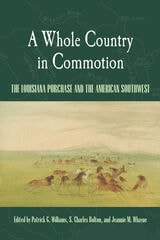
A Whole Country in Commotion
The Louisiana Purchase and the American SouthwestPatrick G. Williams
University of Arkansas Press, 2005
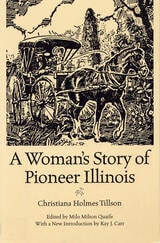
A Woman's Story of Pioneer Illinois
Christiana Holmes Tillson
Southern Illinois University Press, 1995
Christiana and John Tillson moved from Massachusetts to central Illinois in 1822. Upon arriving in Montgomery County near what would soon be Hillsboro, they set up a general store and real estate business and began to raise a family.
A half century later, Christiana Tillson wrote about her early days in Illinois in a memoir published by R. R. Donnelley in 1919. In it she describes her husband’s rise to wealth through the speculative land boom during the 1820s and 1830s and his loss of fortune when the land business went bust after the Specie Circular was issued in 1836.
The Tillsons lived quite ordinary lives in extraordinary times, notes Kay J. Carr, introducing this edition. Their views and sensibilities, Carr says, might seem strange to us, but they were entirely normal to people in the early nineteenth century. Thus Tillson’s memoir provides vignettes of ordinary nineteenth-century American life.

A Word on Words
The Best of John Seigenthaler's InterviewsEdited by Pat Toomay and Frye Gaillard; Epilogue by Andrew Maraniss
Vanderbilt University Press, 2023
Featuring interviews with:
Arna Bontemps • Marshall Chapman • Pat Conroy • Rodney Crowell • John Egerton • Jesse Hill Ford • Charles Fountain • William Price Fox • Kinky Friedman • Frye Gaillard • Nikki Giovanni • Doris Kearns Goodwin • David Halberstam • Waylon Jennings • John Lewis • David Maraniss • William Marshall • Jon Meacham • Ann Patchett • Alice Randall • Dori Sanders • John Seigenthaler Sr. • Marty Stuart • Pat Toomay
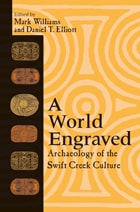
A World Engraved
Archaeology of the Swift Creek CultureEdited by Mark Williams and Daniel T. Elliott
University of Alabama Press, 1998
This major summary of the current state of archaeological research on the Swift Creek culture is the first comprehensive collection ever published concerning the Swift Creek people.
The Swift Creek people, centered in Georgia and surrounding states from A.D. 100 to 700, are best known from their pottery, which was decorated before firing with beautiful paddle-stamped designs--some of the most intricate and fascinating in the world.
Comprehensive in scope, this volume details the discovery of this culture, summarizes what is known about it at the present time, and shows how continued improvements in the collection and analysis of archaeological data are advancing our knowledge of this extinct society.
Although they know nothing of Swift Creek language and little about its society, archaeologists have collected valuable information about the
economic strategies of Swift Creek inhabitants. What archaeologists know best, however, is that the Swift Creek people were some of the best wood carvers the world has seen, and their pottery will stand as their lasting legacy for all time. This book presents and preserves their legacy.
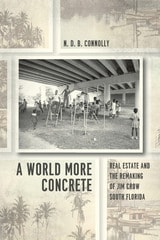
A World More Concrete
Real Estate and the Remaking of Jim Crow South FloridaN. D. B. Connolly
University of Chicago Press, 2014
A World More Concrete argues that black and white landlords, entrepreneurs, and even liberal community leaders used tenements and repeated land dispossession to take advantage of the poor and generate remarkable wealth. Through a political culture built on real estate, South Florida’s landlords and homeowners advanced property rights and white property rights, especially, at the expense of more inclusive visions of equality. For black people and many of their white allies, uses of eminent domain helped to harden class and color lines. Yet, for many reformers, confiscating certain kinds of real estate through eminent domain also promised to help improve housing conditions, to undermine the neighborhood influence of powerful slumlords, and to open new opportunities for suburban life for black Floridians.
Concerned more with winners and losers than with heroes and villains, A World More Concrete offers a sober assessment of money and power in Jim Crow America. It shows how negotiations between powerful real estate interests on both sides of the color line gave racial segregation a remarkable capacity to evolve, revealing property owners’ power to reshape American cities in ways that can still be seen and felt today.

A Zion Canyon Reader
Nathan N. Waite
University of Utah Press, 2014
Published in Partnership with Zion Natural History Association.
Zion National Park is one of the country’s most-visited and best-loved national parks. For the first time, lovers of the park have in one volume the best that has been written about the canyon. A Zion Canyon Reader is a collection of historical and literary accounts that presents diverse perspectives on Zion Canyon—and the surrounding southern Utah region—through the eyes of native inhabitants, pioneer settlers, boosters, explorers, artists, park rangers, developers, and spiritual seekers. Through the pages of this book, both the newest visitors to Zion and those who return to the park again and again will come to understand what this place has meant to different people over the centuries.
Among the works included are well-known historical accounts of exploration by John Wesley Powell, Clarence Dutton, and Everett Ruess. Writings by Edward Abbey, Wallace Stegner, Juanita Brooks, and others enlighten and excite in numerous memorable chapters. Here and there the book bears witness to conflicting viewpoints on controversies associated with the national park, especially development vs. preservation and locals vs. outsiders.
Lyman Hafen, author and executive director of the Zion Natural History Association, calls the book “the most comprehensive, insightful, and inspiring compilation of Zion writing ever assembled.” As readers learn about the plants, animals, geology, history, and people of Zion Canyon, they will discover unfamiliar corners of the park and see favorite hikes in a new light.

AIA Guide to Chicago
American Institute of Architects Chicago; Edited by Alice Sinkevitch and Laurie McGovern Petersen; Preface by Geoffrey Baer; Introduction by Perry Duis
University of Illinois Press, 2014
Four hundred photos and thirty-four specially commissioned maps make it easy to find each of the one thousand-plus featured buildings, while a comprehensive index organizes buildings by name and architect. This edition also features an introduction providing an indispensable overview of Chicago's architectural history.
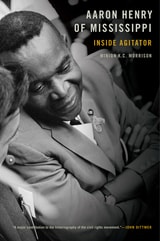
Aaron Henry of Mississippi
Inside AgitatorMinion K. C. Morrison
University of Arkansas Press, 2015
When Aaron Henry returned home to Mississippi from World War II service in 1946, he was part of wave of black servicemen who challenged the racial status quo. He became a pharmacist through the GI Bill, and as a prominent citizen, he organized a hometown chapter of the NAACP and relatively quickly became leader of the state chapter.
From that launching pad he joined and helped lead an ensemble of activists who fundamentally challenged the system of segregation and the almost total exclusion of African Americans from the political structure. These efforts were most clearly evident in his leadership of the integrated Mississippi Freedom Democratic Party delegation, which, after an unsuccessful effort to unseat the lily-white Democratic delegation at the Democratic National Convention in 1964, won recognition from the national party in 1968.
The man who the New York Times described as being “at the forefront of every significant boycott, sit-in, protest march, rally, voter registration drive and court case” eventually became a rare example of a social-movement leader who successfully moved into political office. Aaron Henry of Mississippi covers the life of this remarkable leader, from his humble beginnings in a sharecropping family to his election to the Mississippi house of representatives in 1979, all the while maintaining the social-change ideology that prompted him to improve his native state, and thereby the nation.
Aboriginal Relationships between Culture and Plant Life in the Upper Great Lakes Region
Richard Asa Yarnell
University of Michigan Press, 1964
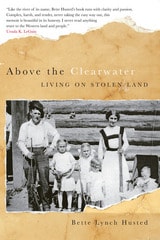
Above the Clearwater
Living on Stolen LandBette Lynch Husted
Oregon State University Press, 2004
Like her father before her, Bette Husted grew up on stolen land. The bench land above the Clearwater River in north-central Idaho had been a home for the Nez Perce Indians until the Dawes Act opened their reservation to settlement in 1895. As a child on the family homestead, Husted felt the presence of the Nez Perce: "But they were always just out of sight, like a smoky shadow behind me that I couldn't quite turn around quickly enough to catch."
Above the Clearwater chronicles her family's history on the land, revealing their joys and sorrows, their triumphs and tragedies. In a series of graceful and moving essays, Husted traces this intimate history, from her Cold War childhood to her struggles as a parent and finally to her life as a woman and teacher in the rural West. Her family's stories echo those of countless other families in the American West: the conflicts with guns, the struggles over land ownership and water rights, the isolation of women, the separations by race and class, the family secrets of mental illness and suicide.
With a powerful, poetic voice, Husted illuminates the tangled relationship between the history of a particular place and the history of the families who inhabit that place over time. As Above the Clearwater explores one family's search for a home on land taken from its original inhabitants, it quietly asks all readers to examine their own homes in the same light.
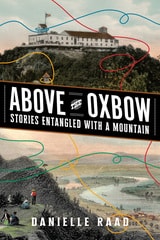
Above the Oxbow
Stories Entangled with a MountainDanielle R. Raad
West Virginia University Press, 2026
Above the Oxbow is a journey through the tangle of rich narratives surrounding Mount Holyoke, a locally cherished mountain in Western Massachusetts. It explores how visitors have forged connections with the mountain through various activities over the past two centuries. In an accessible blend of storytelling and scholarly analysis, Danielle Raad shows the significance of the landscape, historic sites, and material culture, revealing how cultural perspectives, community activism, collective memory, and personal experiences shape our understanding of a place. Situated at the intersection of public history and environmental history, this ethnography of place also discloses the curious stories of the Summit House, an erstwhile tramway, an airplane crash, and the local fight to conserve Mount Holyoke as a natural space and celebrates its myriad uses today.
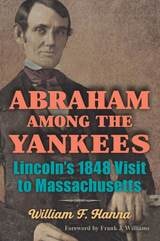
Abraham among the Yankees
Lincoln's 1848 Visit to MassachusettsWilliam F. Hanna
Southern Illinois University Press, 1983
Hanna provides excellent context on the politics of the era, particularly the question of slavery, both in Massachusetts and nationwide, and he features the people Lincoln met and the cities or towns in which he spoke. Lincoln stumped for Taylor in Worcester, New Bedford, Boston, Lowell, Dorchester, Chelsea, Dedham, Cambridge, and Taunton. He gave twelve speeches in eleven days to audiences who responded with everything from catcalls to laughter to applause. Whatever they thought of Lincoln’s arguments, those who saw him were impressed by his unusual western style and remembered his style more than the substance of his talks.
Meticulously researched, Abraham among the Yankees invites readers to take an East Coast journey with a thirty-nine-year-old Lincoln during election season in 1848 to see how Massachusetts audiences responded to the humorous, informal approach that served Lincoln well during the rest of his political career.

Academic Freedom Imperiled
The Mccarthy Era At The University Of NevadaJ. Dee Kille
University of Nevada Press, 2004
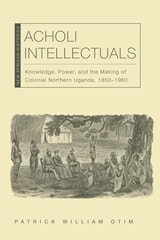
Acholi Intellectuals
Knowledge, Power, and the Making of Colonial Northern Uganda, 1850–1960Patrick William Otim
Ohio University Press, 2024
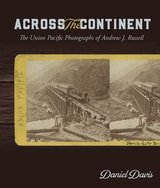
Across the Continent
The Union Pacific Photographs of Andrew Joseph RussellDaniel Davis
University of Utah Press, 2018
Copublished with the Utah State Historical Society. Affiliated with the Utah Division of State History, Utah Department of Heritage & Arts
Andrew J. Russell is primarily known as the man who photographed the famous “East and West Shaking Hands” image of the Golden Spike ceremony on May 10, 1869. He also took nearly one thousand other images that document almost every aspect of the construction of the Union Pacific Railroad. Across the Continent is the most detailed study to date of the life and work of an often-overlooked but prolific artist who contributed immensely not only to documentation of the railroad but also to the nation’s visualization of the American West and, earlier, the Civil War.
The central focus in the book is on the large body of work Russell produced primarily to satisfy the needs of the Union Pacific. Daniel Davis posits that this set of Russell’s photos is best understood not through one or a handful of individual images, but as a photographic archive. Taken as a whole, that archive shows that Russell intended for viewers never to forget who built the Union Pacific. His images celebrate working people—masons working on bridge foundations, freighters and their wagons, surveyors with their transits, engine crews posed on their engines, as well as tracklayers, laborers, cooks, machinists, carpenters, graders, teamsters, and clerks pushing paper.
Russell contributed to a golden age of Western photography that visually introduced the American West to the nation, changing its public image from that of a Great American Desert to a place of apparently unlimited economic potential.
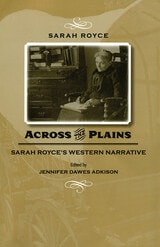
Across the Plains
Sarah Royce’s Western NarrativeSarah Royce; Edited by Jennifer Dawes Adkison
University of Arizona Press, 2009
In a new introduction Adkison reveals Across the Plains to be far more than a simple narrative of one pioneer woman’s journey west. She explains that Royce wrote the book at the request of her son, Josiah Royce, a well-known professor of philosophy at Harvard University with motives of his own. She crafted the narrative that her son wanted: an argument for spiritual faith and fortitude as foundational to California’s history. Yet the narrative itself, in addition to offering a window into a world that has long lacked close documentation, gives us the opportunity to study the ways in which nineteenth-century western women asserted this primacy of faith and crafted their experience into stories with larger cultural and social resonance.
Scholars have long used Across the Plains to mold and support an iconic image of the resolute pioneer woman. However, until now no one has considered Royce’s own self-conscious creation of this persona. Readers will discover that in many ways, Sarah Royce’s careful construction of this cultural portrait deepens our respect for her and our delight in her travels, travails, and triumphs.
Acting Up and Getting Down
Plays by African American TexansBy Sandra M. Mayo and Elvin Holt
University of Texas Press, 2014
One of the few books of its kind, Acting Up and Getting Down brings together seven African American literary voices that all have a connection to the Lone Star state. Covering Texas themes and universal ones, this collection showcases often-overlooked literary talents to bring to life inspiring facets of black theatre history.
Capturing the intensity of racial violence in Texas, from the Battle of San Jacinto to a World War I–era riot at a Houston training ground, Celeste Bedford Walker’s Camp Logan and Ted Shine’s Ancestors provide fascinating narratives through the lens of history. Thomas Meloncon’s Johnny B. Goode and George Hawkins’s Br’er Rabbit explore the cultural legacies of blues music and folktales. Three unflinching dramas (Sterling Houston’s Driving Wheel, Eugene Lee’s Killingsworth, and Elizabeth Brown-Guillory’s When the Ancestors Call) examine homosexuality, a death in the family, and child abuse, bringing to light the private tensions of intersections between the individual and the community.
Supplemented by a chronology of black literary milestones as well as a playwrights’ canon, Acting Up and Getting Down puts the spotlight on creative achievements that have for too long been excluded from Texas letters. The resulting anthology not only provides new insight into a regional experience but also completes the American story as told onstage.
Adapting to the Land
A History of Agriculture in ColoradoJohn F. Freeman
University Press of Colorado, 2021
Ancestral Puebloans farmed and grazed within the limits of nature. Early settlers adjusted their cultivation methods through trial and error, while later agriculturists relied on research and technical advice from the Colorado Agricultural College. As part of wartime mobilization, the federal government prompted farmers to efficiently increase yields. To meet the demand for food and fiber scientific and technical innovations led to the development of new plant cultivars and livestock breeds, advances in mechanization, and widespread use of synthetic amendments. Increasing concern over soil fertility and the loss of irrigation water to urbanization contributed to more changes. Despite, or perhaps because of, what we see today along the Front Range, Colorado may still have a chance to slow or even reverse its seemingly unrestrained growth, creating a more vibrant, earth-friendly society in which agriculture plays an increasingly significant part. Scientific discoveries and innovations in regenerative cultivation are clearing the path to a more sustainable future.
Adapting to the Land adds an ecological and horticultural perspective to historical interpretations of recurring agricultural issues in the state and tracks the concept of stewardship, suggesting that spiritual beliefs continue to contribute to debates over acceptable agricultural practices and the effects of urbanization upon the land. This book will be a key resource for students, scholars, and general readers interested in agricultural and Colorado history, sustainability, and rural sociology.
Adeline & Julia
Growing Up in Michigan and on the Kansas Frontier: Diaries from 19th-Century AmericaJanet C. Coryell
Michigan State University Press, 2000
The keeping of journals and diaries became an almost everyday pastime for many Americans in the nineteenth century. Adeline and Julia Graham, two young women from Berrien Springs, Michigan, were both drawn to this activity, writing about the daily events in their lives, as well as their 'grand adventures.' These are fascinating, deeply personal accounts that provide an insight into the thoughts and motivation of two sisters who lived more than a century ago. Adeline began keeping a diary when she was sixteen, from mid-1880 through mid-1884; through it we see a young woman coming of age in this small community in western Michigan. Paired with Adeline's account is her sister Julia's diary, which begins in 1885 when she sets out with three other young women to homestead in Greeley County, Kansas, just east of the Colorado border. It is a vivid and colorful narrative of a young woman's journey into America's western landscape.

Advancing Immigrant Rights in Houston
Els de Graauw and Shannon Gleeson
Temple University Press, 2024
In Advancing Immigrant Rights in Houston, Els de Graauw and Shannon Gleeson recount how local and multi-level contexts shape the creation, contestation, and implementation of immigrant rights policies and practices in the city. They examine the development of a city immigrant affairs office, interactions between local law enforcement and federal immigration enforcement officials, local public-private partnerships around federal immigration benefits, and collaborations between labor, immigrant rights, faith, and business leaders to combat wage theft.
The case study of Houston provides a bellwether for how other U.S. cities will deal with their growing immigrant populations and underscores the importance of public-private collaborations to advance immigrant rights.
Advertising Revolutionary
The Life and Work of Tom BurrellJason P. Chambers
University of Illinois Press, 2024
Over a forty-year career, Chicagoan Tom Burrell changed the face of advertising and revolutionized the industry’s approach to African Americans as human beings and consumers. Jason P. Chambers offers a biography of the groundbreaking creator and entrepreneur that explores Burrell’s role in building brands like McDonald’s and Coca-Cola within a deeply felt vision of folding positive images of Black people into mainstream American life. While detailing Burrell’s successes, Chambers tells a parallel story of what Burrell tried to do that sheds light on the motivations of advertising creators who viewed their work as being about more than just selling. Chambers also highlights how Burrell used his entrepreneurial gifts to build an agency that opened the door for Black artists, copywriters, directors, and other professionals to earn livings, build careers, and become leaders within the industry.
Compelling and multidimensional, Advertising Revolutionary combines archival research and interviews with Burrell and his colleagues to provide a long overdue portrait of an advertising industry legend and his times.
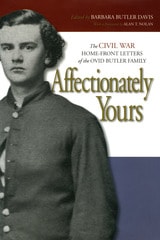
Affectionately Yours
The Civil War Home-Front Letters of the Ovid Butler FamilyBarbara Butler Davis
Indiana Historical Society Press, 2004
Afloat on the Ohio
An Historical Pilgrimage of a Thousand Miles in a Skiff, from Redstone to CairoReuben Gold Thwaites
Southern Illinois University Press, 1999
This edition is a reprinting of the original 1897 edition.
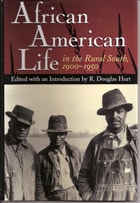
African American Life in the Rural South, 1900-1950
Edited with an introduction by R. Douglas Hurt
University of Missouri Press, 2003
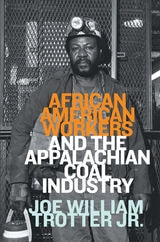
African American Workers and the Appalachian Coal Industry
Joe William Trotter
West Virginia University Press, 2024
This collection brings together nearly three decades of research on the African American experience, class, and race relations in the Appalachian coal industry. It shows how, with deep roots in the antebellum era of chattel slavery, West Virginia’s Black working class gradually picked up steam during the emancipation years following the Civil War and dramatically expanded during the late nineteenth and early twentieth centuries.
From there, African American Workers and the Appalachian Coal Industry highlights the decline of the region’s Black industrial proletariat under the impact of rapid technological, social, and political changes following World War II. It underscores how all miners suffered unemployment and outmigration from the region as global transformations took their toll on the coal industry, but emphasizes the disproportionately painful impact of declining bituminous coal production on African American workers, their families, and their communities. Joe Trotter not only reiterates the contributions of proletarianization to our knowledge of US labor and working-class history but also draws attention to the gender limits of studies of Black life that focus on class formation, while calling for new transnational perspectives on the subject. Equally important, this volume illuminates the intellectual journey of a noted labor historian with deep family roots in the southern Appalachian coalfields.