28167 books match the query 'History' and 2536 start with a
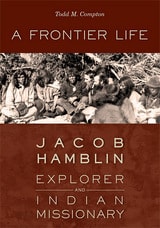
cover of A Frontier Life: Jacob Hamblin, Explorer and Indian Missionary

A Frontier Life

Jacob Hamblin, Explorer and Indian Missionary

Todd M. Compton

University of Utah Press, 2013

Winner of the Juanita Brooks Prize in Mormon Studies
Winner of the Evans Biography Award, the John Whitmer Historical Society Best Biography Award, and the Francis Armstrong Madsen Best Book Award

Frontiersman, colonizer, missionary to the Indians, and explorer of the American West, Jacob Hamblin has long been one of the most enigmatic figures in Mormon history. In this defining biography, Todd Compton examines and disentangles many of the myths and controversies surrounding Hamblin. His Grand Canyon adventures and explorations as a guide alongside John Wesley Powell are well documented, as are his roles as a missionary, cultural liaison, and negotiator to the Indian tribes of southern Utah and Arizona. Hamblin struggled in this latter role, sometimes unable to bridge the gulf between Mormonism and Indian culture. He disavowed violent conflict and ceaselessly sought peaceful resolutions where others resorted to punitive action. He strove above all for mutual understanding in the absence of conversion.

A Frontier Life provides a rich narrative that fleshes out a picture of a sometimes vilified figure, particularly in regard to his connection to the infamous Mountain Meadows Massacre, where Compton provides nuanced discussion clarifying Hamblin’s post-massacre role—he was not present at the massacre, but reported on it to both Brigham Young and military investigators. Compton’s engagement with Mormon historiography and previous Hamblin portrayals will make this work of particular interest to both scholars and students. The casual reader will take pleasure in learning of a true pioneer who lived life at the geographical, cultural, and spiritual boundaries of his era. This dramatic, entertaining biography is a truly significant contribution to Mormon history.
[more]
cover of A Fuego y Sangre: Early Zapotec Imperialism in the Cuicatlán Cañada, Oaxaca

A Fuego y Sangre

Early Zapotec Imperialism in the Cuicatlán Cañada, Oaxaca

Elsa M. Redmond

University of Michigan Press, 1983
In this volume, Elsa M. Redmond reconstructs the history of the Cuicatec region in Oaxaca, Mexico, from the Middle Formative period through the Lomas phase, when the Zapotec state based at Monte Albán took control, into the Trujano phase and the Spanish conquest. Redmond integrates archaeological data and sixteenth-century ethnohistoric records to inform her study of the political and social strategies of the Cuicatec region during these time periods. From 1977 to 1978, Redmond conducted an archaeological survey in this region, and she presents the results of that fieldwork here.
[more]
cover of A Future History of Water

A Future History of Water

Andrea Ballestero

Duke University Press, 2019
Based on fieldwork among state officials, NGOs, politicians, and activists in Costa Rica and Brazil, A Future History of Water traces the unspectacular work necessary to make water access a human right and a human right something different from a commodity. Andrea Ballestero shows how these ephemeral distinctions are made through four technolegal devices—formula, index, list and pact. She argues that what is at stake in these devices is not the making of a distinct future but what counts as the future in the first place. A Future History of Water is an ethnographically rich and conceptually charged journey into ant-filled water meters, fantastical water taxonomies, promises captured on slips of paper, and statistical maneuvers that dissolve the human of human rights. Ultimately, Ballestero demonstrates what happens when instead of trying to fix its meaning, we make water’s changing form the precondition of our analyses.
[more]
cover of A Garden Of Bristlecones: Tales Of Change In The Great Basin

A Garden Of Bristlecones

Tales Of Change In The Great Basin

Michael P. Cohen

University of Nevada Press, 1998

An engaging, well-illustrated natural and cultural history of the oldest living organism—the bristlecone pine. Since Edmund Schulman discovered in 1958 that individual bristlecones live nearly 5,000 years, the trees have been investigated primarily for the elaborate record their rings contain. The trees have been "read' closely, with major consequences for natural and human history. Historians have read local and global environmental change. Archaeologists have rewritten the history of civilization. Writers have transformed them into figures pertinent to the human dilemmas of time and eternity. A Garden of Bristlecones investigates professional and popular conceptions as a set of narratives drawn from the outside and inside of the trees. It reveals the premises of the investigators, the nature of their inquiry, and the extent of their knowledge, while also revealing the Great Basin bristlecone itself. Illustrations by Valerie Cohen.
[more]
cover of A Gazetteer of Buildings in Muslim Palestine

A Gazetteer of Buildings in Muslim Palestine

Andrew Petersen

Council for British Research in the Levant, 2001

The aim of the survey on which this book is based was to make a record of all buildings constructed in Palestine during the medieval and Ottoman periods. The survey area covers the modern state of Israel excluding West Jerusalem and Ramla (which are covered in separate publications). The West Bank and Gaza will be the subject of Volume II.


Library of Congress subject headings for this publication:
Architecture, Islamic -- Palestine -- Guidebooks.
Architecture, Ottoman -- Palestine -- Guidebooks.
Architecture, Medieval -- Palestine -- Guidebooks.
Historic buildings -- Palestine -- Guidebooks.
[more]
cover of A Gendered Past: A Critical Bibliography of Gender in Archaeology

A Gendered Past

A Critical Bibliography of Gender in Archaeology

Foreword by Alison Wylie. Edited by Elisabeth A. Bacus, Alex W. Barker, Jeffrey D. Bonevich, Sandra L. Dunavan, J. Benjamin Fitzhugh, Debra L. Gold, Nurit S. Goldman-Finn, William Griffin, and Karen M. Mudar

University of Michigan Press, 1993

This annotated bibliography reviews contributions from a wide variety of theoretical orientations, many from geographical or temporal contexts.
[more]
cover of A Genealogy of Manners: Transformations of Social Relations in France and England from the Fourteenth to the Eighteenth Century

A Genealogy of Manners

Transformations of Social Relations in France and England from the Fourteenth to the Eighteenth Century

Jorge Arditi

University of Chicago Press, 1998

Remarkable for its scope and erudition, Jorge Arditi's new study offers a fascinating history of mores from the High Middle Ages to the Enlightenment. Drawing on the pioneering ideas of Norbert Elias, Michel Foucault, and Pierre Bourdieu, Arditi examines the relationship between power and social practices and traces how power changes over time.

Analyzing courtesy manuals and etiquette books from the thirteenth to the eighteenth century, Arditi shows how the dominant classes of a society were able to create a system of social relations and put it into operation. The result was an infrastructure in which these classes could successfully exert power. He explores how the ecclesiastical authorities of the Middle Ages, the monarchies from the fifteenth through the seventeenth century, and the aristocracies during the early stages of modernity all forged their own codes of manners within the confines of another, dominant order. Arditi goes on to describe how each of these different groups, through the sustained deployment of their own forms of relating with one another, gradually moved into a position of dominance.

[more]
cover of A Genealogy of Terror in Eighteenth-Century France

A Genealogy of Terror in Eighteenth-Century France

Ronald Schechter

University of Chicago Press, 2018

In contemporary political discourse, it is common to denounce violent acts as “terroristic.” But this reflexive denunciation is a surprisingly recent development. In A Genealogy of Terror in Eighteenth-Century France, Ronald Schechter tells the story of the term’s evolution in Western thought, examining a neglected yet crucial chapter of our complicated romance with terror.
 
For centuries prior to the French Revolution, the word “terror” had largely positive connotations. Subjects flattered monarchs with the label “terror of his enemies.” Lawyers invoked the “terror of the laws.” Theater critics praised tragedies that imparted terror and pity. By August 1794, however, terror had lost its positive valence. As revolutionaries sought to rid France of its enemies, terror became associated with surveillance committees, tribunals, and the guillotine. By unearthing the tradition that associated terror with justice, magnificence, and health, Schechter helps us understand how the revolutionary call to make terror the order of the day could inspire such fervent loyalty in the first place—even as the gratuitous violence of the revolution eventually transformed it into the dreadful term we would recognize today. Most important, perhaps, Schechter proposes that terror is not an import to Western civilization—as contemporary discourse often suggests—but rather a domestic product with a long and consequential tradition. 
[more]
cover of A General History of Quadrupeds: The Figures Engraved on Wood

A General History of Quadrupeds

The Figures Engraved on Wood

Thomas Bewick

University of Chicago Press, 2009

In the late eighteenth century, the British took greater interest than ever before in observing and recording all aspects of the natural world. Travelers and colonists returning from far-flung lands provided dazzling accounts of such exotic creatures as elephants, baboons, and kangaroos. The engraver Thomas Bewick (1753–1828) harnessed this newfound interest by assembling the most comprehensive illustrated guide to nature of his day.

A General History of Quadrupeds, first published in 1790, showcases Bewick’s groundbreaking engraving techniques that allowed text and images to be published on the same page. From anteaters to zebras, armadillos to wolverines, this delightful volume features engravings of over four hundred animals alongside descriptions of their characteristics as scientifically understood at the time. Quadrupeds reaffirms Bewick’s place in history as an incomparable illustrator, one whose influence on natural history and book printing still endures today.

[more]
cover of A Generation Divided: German Children and the Berlin Wall

A Generation Divided

German Children and the Berlin Wall

Thomas A. Davey

Duke University Press, 1987

An inquiry into the lives of children of similar, if not identical, historical an cultural heritage who today find themselves in radically opposed ideological worlds, regarding one another across the concrete manifestation of their considerable differences, the Berlin Wall. Under these circumstances, what are the significant factors that contribute to the development in children of feelings of loyalty to or alienation from their nation? How do they view not only themselves, but the "other" Germans as well? How do they come to terms, emotionally and cognitively, with a unique, frequently painful, and frustrating reality? What are the lessons intended for them by their societies, and what lessons do they in fact learn? How do these children persist as Germans while at the same time becoming something else -- "communists? or "capitalists"?

Thomas Davey conducted interviews with children both sides of the Wall, participated in their daily lives, collected their drawings, talked with their teachers and families and grew aware of just how attentive children can be to moral and political subtleties of national life. The result is a revealing and dramatic portrait of a young generation coming to terms with complex national and historical circumstances of the two cites of East and West Berlin.

[more]
cover of A Generation of Writers and Bulgarian Cultural Politics: From Independence to Communism

A Generation of Writers and Bulgarian Cultural Politics

From Independence to Communism

Irina Gigova

Central European University Press, 2026

In the aftermath of Bulgaria’s liberation from Ottoman rule, a cohort of young men and women found a home in the European arts. This book follows the lives and works of the post-1878 generation of cultural producers who defined Bulgarian identity. A sweeping narrative of social and political change and personal adaptation, the book explores the country’s evolving literary and artistic scene from the 1890s to the 1950s. It traces the impact of wars and coups, ideological shifts and state policies. The book highlights the contributions of key figures and professional associations, their struggles for artistic autonomy, and their efforts to bridge the gaps between high culture and mass entertainment, national and universal art. A portrait of a generation that transformed Bulgarian culture as it navigated the tumult of the early twentieth century, this book offers insights into the broader patterns of transformation, disruption, and cultural negotiation in modern Europe.
[more]
cover of A Ghetto Takes Shape: Black Cleveland, 1870-1930

A Ghetto Takes Shape

Black Cleveland, 1870-1930

Kenneth L. Kusmer

University of Illinois Press, 1976

[more]
cover of A Gift of Presence: The Theology and Poetry of the Eucharist in Thomas Aquinas

A Gift of Presence

The Theology and Poetry of the Eucharist in Thomas Aquinas

Jan Heiner Tück

Catholic University of America Press, 2018

Jan-Heiner Tück presents a work that explores the sacramental theology, lived spirituality, and Eucharistic poetry of the Church’s doctor communis, St. Thomas Aquinas. Although Aquinas’ Eucharistic poetry has long occupied an important place in the Church’s liturgical prayer and her repertoire of sacred music, the depth of these poems remains hidden until one grasps the rich sacramental theology underlying it. Consequently, Tück first offers a detailed but approachable primer of Aquinas’ theology of the sacraments, before diving deeply into the Angelic Doctor’s theology and poetry of the Eucharist. The Scriptural accounts stand at the heart of the systematic framework developed by Aquinas, and thus significant attention is devoted to showing the harmony between the accounts of Christ’s passion and the detailed exposition of the Summa theologiae. Moreover, the Eucharistic controversies of the ninth and eleventh centuries provide the contrapuntal context in which Aquinas did his thinking, praying, and writing. Not surprisingly, therefore, the response he crafts to these controversies draws upon both speculative powers and contemplative prayer, brought together in the unity of Aquinas’ theology and spirituality. The net result is a twofold treasure for the Church: a careful systematic presentation of Eucharistic theology and the lived devotional expression of the same in the carefully constructed—and now much beloved—stanzas of Pange lingua gloriosi, Lauda Sion, Adoro te devote, etc. By revealing the lively interplay of the saint’s powerful speculative intellect and a heart steeped in love for the Eucharistic Lord, Tück offers a sophisticated exposition of Aquinas’ Eucharistic poetry and the roots it sinks into a wider theological framework. Finally, the contemporary significance and power of Aquinas’ work is drawn out, not only in the rarefied realm of intellectual inquiry but also in the everyday expanse of ordinary life.
[more]
cover of A Global Enlightenment: Western Progress and Chinese Science

A Global Enlightenment

Western Progress and Chinese Science

Alexander Statman

University of Chicago Press, 2023

A revisionist history of the idea of progress reveals an unknown story about European engagement with Chinese science.
 
The Enlightenment gave rise not only to new ideas of progress but consequential debates about them. Did distant times and places have anything to teach the here and now? Voltaire could believe that they did; Hegel was convinced that they did not. Early philosophes praised Chinese philosophy as an enduring model of reason. Later philosophes rejected it as stuck in the past. Seeking to vindicate ancient knowledge, a group of French statesmen and savants began a conversation with the last great scholar of the Jesuit mission to China. Together, they drew from Chinese learning to challenge the emerging concept of Western advancement.
 
A Global Enlightenment traces this overlooked exchange between China and the West to make compelling claims about the history of progress, notions of European exceptionalism, and European engagement with Chinese science. To tell this story, Alexander Statman focuses on a group of thinkers he terms “orphans of the Enlightenment,” intellectuals who embraced many of their contemporaries’ ideals but valued ancient wisdom. They studied astronomical records, gas balloons, electrical machines, yin-yang cosmology, animal magnetism, and Daoist medicine. And their inquiries helped establish a new approach to the global history of science.

Rich with new archival research and fascinating anecdotes, A Global Enlightenment deconstructs two common assumptions about the early to late modern period. Though historians have held that the idea of a mysterious and inscrutable East was inherent in Enlightenment progress theory, Statman argues that it was the orphans of the Enlightenment who put it there: by identifying China as a source of ancient wisdom, they turned it into a foil for scientific development. But while historical consensus supposes that non-Western ideas were banished from European thought over the course of the Enlightenment, Statman finds that Europeans became more interested in Chinese science—as a precursor, then as an antithesis, and finally as an alternative to modernity.
[more]
cover of A Good Long Drive: Fifty Years of Texas Country Reporter

A Good Long Drive

Fifty Years of Texas Country Reporter

Bob Phillips

University of Texas Press, 2021

In 2021, Texas Country Reporter celebrates its fiftieth season on the air. Broadcast every week on stations across Texas, it focuses on “ordinary people doing extraordinary things.” And at the center of it is Bob Phillips, the show’s creator and host—an erstwhile poor kid from Dallas who ended up with a job that allowed him to rub elbows with sports figures, entertainers, and politicians but who preferred to spend his time on the back roads, listening to less-famous Texans tell their stories.

In this memoir, Phillips tells his own story, from his early days as a reporter and his initial pitch for the show while a student at SMU to his ongoing work at the longest-running independently produced TV show in American television history. As we travel with Phillips on his journey, we meet Willie Nelson and former Dallas Cowboys coach Tom Landry; reflect on memorable, unusual, and challenging show segments; experience the behind-the-scenes drama that goes on in local television; witness the launching of an annual festival; and discover the unbelievable allure of Texas, its culture, and, especially, its people. Spanning generations, A Good Long Drive is proof that life’s journey really is a destination unto itself.

[more]
cover of A Good Place to Do Business: The Politics of Downtown Renewal since 1945

A Good Place to Do Business

The Politics of Downtown Renewal since 1945

Roger Biles and Mark H. Rose

Temple University Press, 2022

The “Pittsburgh Renaissance,” an urban renewal effort launched in the late 1940s, transformed the smoky rust belt city’s downtown. Working-class residents and people of color saw their neighborhoods cleared and replaced with upscale, white residents and with large corporations housed in massive skyscrapers. Pittsburgh’s Renaissance’s apparent success quickly became a model for several struggling industrial cities, including St. Louis, Cleveland, Detroit, Chicago, and Philadelphia. 

In A Good Place to Do Business, Roger Biles and Mark Rose chronicle these urban “makeovers” which promised increased tourism and fashionable shopping as well as the development of sports stadiums, convention centers, downtown parks, and more. They examine the politics of these government-funded redevelopment programs and show how city politics (and policymakers) often dictated the level of success. 

As city officials and business elites determined to reorganize their downtowns, a deeply racialized politics sacrificed neighborhoods and the livelihoods of those pushed out. Yet, as A Good Place to Do Business demonstrates, more often than not, costly efforts to bring about the hoped-for improvements failed to revitalize those cities, or even their downtowns.

[more]
cover of A Good Quarrel: America's Top Legal Reporters Share Stories from Inside the Supreme Court

A Good Quarrel

America's Top Legal Reporters Share Stories from Inside the Supreme Court

Timothy R. Johnson and Jerry Goldman, Editors

University of Michigan Press, 2009

While reading what top legal reporters say about some of the most important U.S. Supreme Court oral arguments in recent history, go to www.goodquarrel.com to listen to audio and hear for yourself the very style and delivery of the oral arguments that have shaped the history of our nation's highest law. See Preface for full instructions.

Contributors

  • Charles Bierbauer, CNN
  • Lyle Denniston, scotusblog.com
  • Fred Graham, Court TV
  • Brent Kendall, Los Angeles Daily Journal
  • Steve Lash, Houston Chronicle
  • Dahlia Lithwick, Slate.com
  • Tony Mauro, American Lawyer Media
  • Tim O'Brien, ABC News
  • David Savage, Los Angeles Times
  • Greg Stohr, Bloomberg News
  • Nina Totenberg, NPR

Timothy R. Johnson teaches in the Department of Political Science and the Law School at the University of Minnesota.

Jerry Goldman teaches political science at Northwestern University and directs the OYEZ Project, a multimedia archive devoted to the Supreme Court, at www.oyez.org.

Cover sketch by Dana Verkouteren

"Supreme Court oral arguments are good government in action. A Good Quarrel brilliantly showcases this important aspect of the Court's work."
---Paul Clement, Partner, King & Spalding, and former United States Solicitor General

"Few legal experiences are as exhilarating as a Supreme Court oral argument---a unique art form that this superb collection brings vividly to life."
---Kathleen Sullivan, Partner, Quinn Emanuel Urquhart Oliver and Hedges, and former Dean, Stanford Law School

"[A Good Quarrel] shines a brilliant spotlight on the pivotal moment of advocacy when the Supreme Court confronts the nation's most profound legal questions."
---Thomas C. Goldstein, Partner, Akin Gump, and Lecturer, Supreme Court Litigation, Harvard Law School and Stanford Law School

"A brilliant way to understand America's most important mysterious institution."
---Lawrence Lessig, Stanford Law School

[more]
cover of A Government of Laws: Political Theory, Religion, and the American Founding

A Government of Laws

Political Theory, Religion, and the American Founding

Ellis Sandoz

University of Missouri Press, 2001

In A Government of Laws, which includes a new preface, Ellis Sandoz re-evaluates the traditional understanding of the philosophic and intellectual background of the American founding.  Through an exhaustive assessment of Renaissance, medieval, and ancient political philosophy, he shows that the founding fathers were consciously and explicitly seeking to create a political order that would meet the demands of human nature and society.  This rigorous and searching analysis of the sources of political and constitutional theory generates an original and provocative approach to American thought and experience.

[more]
cover of A Governor and His Image in Baroque Brazil: The Funereal Eulogy of Afonso Furtado de Castro do Rio de Mendonca

A Governor and His Image in Baroque Brazil

The Funereal Eulogy of Afonso Furtado de Castro do Rio de Mendonca

Juan Sierra

University of Minnesota Press, 1979

A Governor and His Image in Baroque Brazil was first published in 1979. Minnesota Archive Editions uses digital technology to make long-unavailable books once again accessible, and are published unaltered from the original University of Minnesota Press editions.This seventeenth-century manuscript describes the life and death of Afonso Furtado, governor of Brazil from 1671 to 1675. The obscure author, Juan Lopes Sierra, was an eyewitness to many of the governor’s activities and was clearly a great admirer of Furtado, whom he calls in his text “Our Hero.” The manuscript is a useful cultural and historical document focusing on the governor’s administration and, especially, on his direction of military campaigns into the heart of Brazil to subdue hostile Indians and search for mineral wealth. The author’s descriptions of religious life in the capital city of Salvador and of the elaborate funeral arrangements for the governor reveal the attitudes and aspirations of the Brazilian colonial elite. Most important, perhaps, the document covers on of the least studied periods in Brazilian history, the years between the great century of sugar and the half-century of gold. Lopes Sierra wrote in Spanish, though his subject was Portuguese Brazil, and his manuscript is peppered with Portuguese/Spanish coinages and classical allusions. Ruth Jones has mastered the difficult task of translation and Stuart Schwartz provides a historical context and notes to the translation. The book is a publication from the James Ford Bell Library of the University of Minnesota.
[more]
cover of A Grammar of Ugaritic

A Grammar of Ugaritic

John Screnock

SBL Press, 2022

A Grammar of Ugaritic is an accessible yet academically rigorous textbook for first-year students of Ugaritic. Eight digestible lessons include more than 150 exercises to strengthen readers’ understanding through translation and composition of not only vocalized Ugaritic but also transcribed texts and cuneiform script—strategies that develop language skills and provide a sound basis for classroom teaching. Short stories interspersed among the lessons help students consolidate their knowledge and bolster recognition of forms. An introduction to the language and its historical context, glossaries, paradigms, and a bibliography and guide for further learning supplement the lessons. Students who work through the grammar in the classroom or individually will be rewarded with the ability to read real Ugaritic texts in cuneiform.
[more]
cover of A Great Basin Mosaic: The Cultures of Rural Nevada

A Great Basin Mosaic

The Cultures of Rural Nevada

James W. Hulse

University of Nevada Press, 2017

The Nevada of lesser-known cities, towns, and outposts deserve their separate chronicles, and here Hulse fills a wide gap. He contributes in a text rich with memories tramping through rural Nevada as a child, then as a journalist seeking news and gossip, then later as an academic historian and a parent trying to share the wonders of the high desert with his family. Nobody is more qualified to write about the cultural nuances of rural Nevada than Hulse, who retired after 35 years as a professor of history at University of Nevada, Reno.

Robert Laxalt wrote an article in National Geographic in 1974 entitled “The Other Nevada” in which he referred to “the Nevada that has been eclipsed by the tinsel trimmings of Las Vegas, the round-the-clock casinos, the ski slopes of the Sierra. It is a Nevada that few tourists see.” With this book Hulse reflects on Laxalt’s insights and shows changes—often slow-moving and incremental—that have occurred since then. Much of the terrain of rural Nevada has not changed at all, while others have adapted to technological revolutions of recent times. Hulse states that there is no single “other” Nevada, but several subcultures with distinct features. He offers a tour of sorts to what John Muir called the “bewildering abundance” of the Nevada landscape.

[more]
cover of A Great Fear: Luís de Onís and the Shadow War against Napoleon in Spanish America, 1808–1812

A Great Fear

Luís de Onís and the Shadow War against Napoleon in Spanish America, 1808–1812

Timothy Hawkins

University of Alabama Press, 2019

How fear of Napoleon's shadow empire helped shape the fate of Spanish America.

A Great Fear: Luís de Onís and the Shadow War against Napoleon in Spanish America, 1808–1812 explores why Spanish Americans did not take the opportunity to seize independence in this critical period when Spain was overrun by French armies and, arguably, in its weakest state. In the first years after his appointment as Spanish ambassador to the United States, Luís de Onís claimed the heavy responsibility of defending Spanish America from the wave of French spies, subversives, and soldiers whom he believed Napoleon was sending across the Atlantic to undermine the empire.

As a leading representative of Spain’s loyalist government in the Americas, Onís played a central role in identifying, framing, and developing what soon became a coordinated response from the colonial bureaucracy to this perceived threat. This crusade had important short-term consequences for the empire. Since it paralleled the emergence of embryonic independence movements against Spanish rule, colonial officials immediately conflated these dangers and attributed anti-Spanish sentiment to foreign conspiracies.

Little direct evidence of Napoleon’s efforts at subversion in Spanish America exists. However, on the basis of prodigious research, Hawkins asserts that the fear of French intervention mattered far more than the reality. Reinforced by detailed warnings from Ambassador Onís, who found the United States to be the staging ground for many of the French emissaries, colonial officials and their subjects became convinced that Napoleon posed a real threat. The official reaction to the threat of French intervention increasingly led Spanish authorities to view their subjects with suspicion, as potential enemies rather than allies in the struggle to preserve the empire. In the long term, this climate of fear eroded the legitimacy of the Spanish Crown among Spanish Americans, a process that contributed to the unraveling of the empire by the 1820s.

This study draws on documents and official records from both sides of the Hispanic Atlantic, with extensive research conducted in Spain, Guatemala, Argentina, and the United States. Overall, it is a provocative interpretation of the repercussions of Napoleonic intrigue and espionage in the New World and a stellar examination of late Spanish colonialism in the Americas.

[more]
cover of A Great and Rising Nation: Naval Exploration and Global Empire in the Early US Republic

A Great and Rising Nation

Naval Exploration and Global Empire in the Early US Republic

Michael A. Verney

University of Chicago Press, 2022

A Great and Rising Nation illuminates the unexplored early decades of the United States’ imperialist naval aspirations.

Conventional wisdom holds that, until the Spanish-American War of 1898, the United States was a feeble player on the world stage, with an international presence rooted in commerce rather than military might. Michael A. Verney’s A Great and Rising Nation flips this notion on its head, arguing that early US naval expeditions, often characterized as merely scientific, were in fact deeply imperialist. Circling the globe from the Mediterranean to South America and the Arctic, these voyages reflected the diverse imperial aspirations of the new republic, including commercial dominance in the Pacific World, religious empire in the Holy Land, proslavery expansion in South America, and diplomatic prestige in Europe. As Verney makes clear, the United States had global imperial aspirations far earlier than is commonly thought.
[more]
cover of A Great and Rising Nation: Naval Exploration and Global Empire in the Early US Republic

A Great and Rising Nation

Naval Exploration and Global Empire in the Early US Republic

Michael A. Verney

University of Chicago Press, 2022

This is an auto-narrated audiobook version of this book.

A Great and Rising Nation illuminates the unexplored early decades of the United States’ imperialist naval aspirations.


Conventional wisdom holds that, until the Spanish-American War of 1898, the United States was a feeble player on the world stage, with an international presence rooted in commerce rather than military might. Michael A. Verney’s A Great and Rising Nation flips this notion on its head, arguing that early US naval expeditions, often characterized as merely scientific, were in fact deeply imperialist. Circling the globe from the Mediterranean to South America and the Arctic, these voyages reflected the diverse imperial aspirations of the new republic, including commercial dominance in the Pacific World, religious empire in the Holy Land, proslavery expansion in South America, and diplomatic prestige in Europe. As Verney makes clear, the United States had global imperial aspirations far earlier than is commonly thought.
[more]
cover of A Greater Ireland: The Land League and Transatlantic Nationalism in Gilded Age America

A Greater Ireland

The Land League and Transatlantic Nationalism in Gilded Age America

Ely M. Janis

University of Wisconsin Press, 2014

During the early 1880s a continual interaction of events, ideas, and people in Ireland and the United States created a "Greater Ireland" spanning the Atlantic that profoundly impacted both Irish and American society. In A Greater Ireland: The Land League and Transatlantic Nationalism in Gilded Age America, Ely M. Janis closely examines the Irish National Land League, a transatlantic organization with strong support in Ireland and the United States. Founded in Ireland in 1879 against the backdrop of crop failure and agrarian unrest, the Land League pressured the British government to reform the Irish landholding system and allow Irish political self-rule. The League quickly spread to the United States, with hundreds of thousands of Irish Americans participating in branches in their local communities.
            As this "Greater Ireland" flourished, new opportunities arose for women and working-class men to contribute within Irish-American society. Exploring the complex interplay of ethnicity, class, and gender, Janis demonstrates the broad range of ideological, social, and political opinion held by Irish Americans in the 1880s. Participation in the Land League deeply influenced a generation that replaced their old county and class allegiances with a common cause, shaping the future of Irish-American nationalism.
[more]
cover of A Green River Reader

A Green River Reader

Alan Blackstock

University of Utah Press, 2005

"There is something ominous about a swift river, and something thrilling about a river of any kind."—from Beyond the Hundredth Meridian by Wallace Stegner

Beginning above Flaming Gorge Dam in southwestern Wyoming, the Green River traverses the complete variety of terrain on the Colorado Plateau before joining the Colorado River above Cataract Canyon in southeastern Utah. Like its more famous cousin, the Colorado, the Green has captivated, capsized, and cajoled all types of characters with challenges and beauty to match its geologic variety.

In A Green River Reader editor Alan Blackstock brings this mysterious, magnificent, thrilling river to the reader with an interpretive guide that will inform both river novices and river veterans. Assembled here is every significant written testament to this "awesome ditch," from Domínguez-Escalante to Kit Carson and John C. Frémont; to contemporary American naturalists and writers including Wallace Stegner, Bernard DeVoto, David Brower, Ann Zwinger, Ellen Melloy, and Edward Abbey. Those with a story to tell—those who trapped the Green’s beavers, endured its wild rapids, were humbled by its imposing canyon walls, fought for its beautiful landscapes, or whose "pulse was hurried" by the "lofty chasms, walled in by precipices of red rock"—are collected here.

If you’re headed down the Green, make sure that your dry bag or ammo can has room for just one more thing, your copy of A Green River Reader.

[more]
cover of A Gringa in Bogotá: Living Colombia's Invisible War

A Gringa in Bogotá

Living Colombia's Invisible War

By June Carolyn Erlick

University of Texas Press, 2010

To many foreigners, Colombia is a nightmare of drugs and violence. Yet normal life goes on there, and, in Bogotá, it's even possible to forget that war still ravages the countryside. This paradox of perceptions—outsiders' fears versus insiders' realities—drew June Carolyn Erlick back to Bogotá for a year's stay in 2005. She wanted to understand how the city she first came to love in 1975 has made such strides toward building a peaceful civil society in the midst of ongoing violence. The complex reality she found comes to life in this compelling memoir.

Erlick creates her portrait of Bogotá through a series of vivid vignettes that cover many aspects of city life. As an experienced journalist, she lets the things she observes lead her to larger conclusions. The courtesy of people on buses, the absence of packs of stray dogs and street trash, and the willingness of strangers to help her cross an overpass when vertigo overwhelms her all become signs of convivencia—the desire of Bogotanos to live together in harmony despite decades of war. But as Erlick settles further into city life, she finds that "war in the city is invisible, but constantly present in subtle ways, almost like the constant mist that used to drip down from the Bogotá skies so many years ago."

Shattering stereotypes with its lively reporting, A Gringa in Bogotá is must-reading for going beyond the headlines about the drug war and bloody conflict.

[more]
cover of A Guide to Editing Middle English

A Guide to Editing Middle English

Vincent McCarren and Douglas Moffat, Editors

University of Michigan Press, 1998

Those who undertake a scholarly edition of a Middle English text have until now had no general guide for their work. All who study English literary works must rely on editions at some stage, and this volume will provide them with many perspectives on the formation of these necessary scholarly tools. Editors of texts in other medieval languages and indeed all those engaged with questions of scholarly editing--whether practical, historical, or theoretical--will also find important contributions in this volume.
A Guide to Editing Middle English collects nineteen essays and three appendices written by leading text editors in Middle English. A number of essays deal primarily with theoretical questions, while others offer assessments of historical developments in editing, especially in regard to the most well-known Middle English works. Most of the essays deal with practical matters: how to use a computer in preparing and presenting an edition; how to form and arrange the standard parts of an edition; and how to handle problems presented by texts in areas such as science, astrology, and cooking. The three appendices provide bibliographical references to dictionaries, facsimiles, and manuscript description.
Contributors, in addition to the editors, are Peter Baker, Richard Beadle, Norman Blake, Helen Cooper, A. S. G. Edwards, Jennifer Fellows, David C. Greetham, Mary Hamel, Constance Heiatt, Nicholas Jacobs, Geroge Keiser, Peter J. Lucas, Maldwyn Mills, Linne Mooney, and Peter Robinson.
The many and varied perspectives of this volume will make it of interest to readers of Middle English texts, those involved in textual scholarship, and those interested in editing in general. It occupies a unique place in the field of Middle English studies and will likely remain a standard reference tool for a long time.
Vincent McCarren is a Research Associate with the Middle English Dictionary at the University of Michigan. Douglas Moffat, formerly with the Middle English Dictionary, is a Development Officer with the University of Michigan.
[more]
cover of A Guide to Eric Voegelin's Political Reality

A Guide to Eric Voegelin's Political Reality

Montgomery Erfourth

St. Augustine's Press, 2014

[more]
cover of A Guide to Formation Advising for Seminarians

A Guide to Formation Advising for Seminarians

Edward J. McCormack

Catholic University of America Press, 2020

The future of the Church depends, in part, on forming future priests and ministers who are ready to accompany, lead, and love the People of God. Formation advising is one important part of that work. A Guide to Formation Advising for Seminarians/Seminary Faculty offers a practical guide to formation advising as a ministry of accompaniment, participation, and evaluation. Deacon Edward McCormack offers a comprehensive introduction to the ministry of formation advising for seminarians studying for priestly ministry. These volumes are for men and women who are new to the ministry of formation advising. The recent Vatican guidelines for seminary formation call for professional accompaniment of seminarians throughout their formation. This book explains in concrete detail how to do this through the entire formation process. Beginning with an overview of the formation process, A Guide to Formation Advising for Seminarians/Seminary Faculty explains the role of the formation advisor and the skills required for that ministry. It describes the various ways the formation advisor accompanies a person through the formation process. McCormack also provides concrete suggestions for how to promote in seminarians’ active participation in the process. Formators will also find explanation of the evaluation process with a style sheet and examples of written evaluations. The handbook contains an annotated bibliography on all the major topics a formation advisor comes across.
[more]
cover of A Guide to Formation Advising for Seminary Faculty: Accompaniment, Participation, and Evaluation

A Guide to Formation Advising for Seminary Faculty

Accompaniment, Participation, and Evaluation

Edward J. McCormack

Catholic University of America Press, 2020

The future of the Church depends, in part, on forming future priests and ministers who are ready to accompany, lead, and love the People of God. Formation advising is one important part of that work. A Guide to Formation Advising for Seminarians/Seminary Faculty offers a practical guide to formation advising as a ministry of accompaniment, participation, and evaluation. Deacon Edward McCormack offers a comprehensive introduction to the ministry of formation advising for seminarians studying for priestly ministry. These volumes are for men and women who are new to the ministry of formation advising. The recent Vatican guidelines for seminary formation call for professional accompaniment of seminarians throughout their formation. This book explains in concrete detail how to do this through the entire formation process.

Beginning with an overview of the formation process, A Guide to Formation Advising for Seminarians/Seminary Faculty explains the role of the formation advisor and the skills required for that ministry. It describes the various ways the formation advisor accompanies a person through the formation process. McCormack also provides concrete suggestions for how to promote in seminarians’ active participation in the process. Formators will also find explanation of the evaluation process with a style sheet and examples of written evaluations. The handbook contains an annotated bibliography on all the major topics a formation advisor comes across.
[more]
cover of A Guide to John Henry Newman: His Life and Thought

A Guide to John Henry Newman

His Life and Thought

Juan R. Velez

Catholic University of America Press, 2022

John Henry Newman (1801-1890), renowned thinker and writer, Anglican clergyman and later Roman Catholic priest and cardinal, has had a lasting influence on both Anglicans and Catholics, in the fields of literature, education, and theology. On October 13, 2019, Pope Francis declared him a saint in Rome. Appealing to both the student and the scholar, A Guide to John Henry Newman provides a wide range of subjects on Newman’s life and thought relevant for our times and complementary to biographies of Newman. The contributors include authors from many different disciplines such as theology, education, literature, history, and philosophy, highlighting the wide range of Newman’s work. These authors offer a positive assessment of Newman’s thought and contribute to the discussion of the recent scholarship of others. A Guide to John Henry Newman will interest educated readers and professors alike, and serve as a text for college seminars for the purpose of studying Newman.
[more]
cover of A Guide to Mexican Art: From Its Beginnings to the Present

A Guide to Mexican Art

From Its Beginnings to the Present

Justino Fernández

University of Chicago Press, 1969

A Guide to Mexican Art, a survey of more than twenty centuries of art, has a double purpose. It provides an ample version of one of the great national arts by a leading art historian, and it serves simultaneously as a practical guide to the art's outstanding masterpieces. The Guide will thus be of value to specialists and students of Latin American art and to sightseers as an introduction and guide to the art and architecture of Mexico. To facilitate its use for the latter purpose, Professor Fernández has based his exposition on the sensitive analysis of works to be found almost exclusive in museums and public buildings accessible to the tourist.

The book was originally published in Spanish in 1958 and revised in 1961. This English translation, from the second edition has been brought up to date by the author and translator.
[more]
cover of A Guide to New Jersey's Revolutionary War Trail: for Families and History Buffs

A Guide to New Jersey's Revolutionary War Trail

for Families and History Buffs

Di Ionno, Mark

Rutgers University Press, 2000

Hit the road with journalist Mark DiIonno as he takes you on a tour of New Jersey’s extraordinary Revolutionary War history. Listing more than 350 historic sites throughout the state, DiIonno has compiled the most complete guide ever to the Revolutionary War in the Garden State.

New Jersey’s role in the Revolutionary War is widely overlooked. Every school kid learns about the Boston Tea Party but not the Greenwich tea burning; and about the miserable winter at Valley Forge but not Jockey Hollow. Schools fund class trips to Philadelphia’s Independence Hall but not Princeton’s Nassau Hall. To find history in New Jersey, all you need is DiIonno’s book as your guide. His easy-to-read volume helps readers explore the cities and the countryside from Bergen to Cape May County to find out exactly what happened there during the Revolutionary War.

While previously published books center on the highlights — Fort Lee and Washington’s retreat across the state, victories at Trenton and Princeton, the brutal winter encampment at Jockey Hollow and the Battle of Monmouth —  DiIonno fills in the blanks. Battlefields, churches, homes of the famous and infamous, cemeteries, parks, taverns, liberty poles, bridges, creeks, hills, museums, encampment sites, lighthouses, historical societies, walking trails, monuments, plaques—if it played a part in or commemorates the Revolutionary War in New Jersey, DiIonno tells you what happened there, the personalities involved, and how to see it for yourself.

The sites are conveniently cataloged by county, with a helpful summary of the area’s war history beginning each chapter. Each entry lists the town and directions to each site, and where appropriate, a complete address, telephone numbers, and hours of operation. Both public and private sites are described, and DiIonno advises readers of which private sites tours can be arranged.
[more]
cover of A Guide to Oak Park's Frank Lloyd Wright and Prairie School Historic District

A Guide to Oak Park's Frank Lloyd Wright and Prairie School Historic District

Oak Park Historic Preservation Committee

University of Chicago Press, 2000

The Frank Lloyd Wright and Prairie School Historic District in suburban Oak Park, Illinois is home to a truly remarkable collection of late-nineteenth and early-twentieth-century residential architecture. Within this seventy-eight block district lies the world's greatest concentration of residences designed by Prairie School architects. It includes twenty-six Frank Lloyd Wright buildings, as well as more than sixty buildings designed by members of the Prairie School, all of which are documented in this new Guide.

Internationally famous as the birthplace of the Prairie style, Oak Park is less well-known for other historically significant types of well-preserved architecture, ranging from the simple farm houses of its early settlers to the grand estates of Chicago's industrial giants. In addition to their architectural merit, these structures provide an important context for understanding and appreciating the work of the Prairie School. The district as a whole encapsulates the major trends in residential American architecture of the late nineteenth and early twentieth century.

This guide to Oak Park's Frank Lloyd Wright and Prairie School Historic District includes five walking tours of this architecturally fascinating area. It features one hundred eighteen structures, an illustrated guide to architectural styles, architects' biographies, and detailed maps. With well over a hundred splendid black and white photographs, this elegantly produced guide is an indispensable reference for tourists, students, and aficionados world-wide. 

A Guide to Oak Park's Frank Lloyd Wright and Prairie School Historic District was produced by the Oak Park Historic Preservation Committee.
[more]
cover of A Guide to Oregon South Coast History: Traveling the Jedediah Smith Trail

A Guide to Oregon South Coast History

Traveling the Jedediah Smith Trail

Nathan Douthit

Oregon State University Press, 1999

[more]
cover of A Guide to Projectile Points of Iowa, Part 1: Paleoindian, Late Paleoindian, Early Archaic, and Middle Archaic Points

A Guide to Projectile Points of Iowa, Part 1

Paleoindian, Late Paleoindian, Early Archaic, and Middle Archaic Points

Joseph A. Tiffany

University of Iowa Press, 2009

“Projectile point” is a collective term for spear and dart points, arrowheads, and hafted knives. The many Native Americans who have inhabited Iowa shaped points primarily of various cherts and chalcedonies found locally or traded regionally. The single point types illustrated in this two-part guide, the first to provide color photographs to scale for all types found in Iowa, show the wide range of variability as forms evolved from the Paleoindian period, 11,100–10,750 BC, to the Late Prehistoric period, AD 1000–1200.

The two beautifully illustrated parts depict a total of sixty-one full-size stone point types in color by archaeological period. References are provided for those wishing to learn more about each type shown. Archaeologist Joseph Tiffany lists the stone type for each point as well as its estimated range of use based on calibrated radiocarbon age, catalog number, and the county where it was found. By providing actual-size color images of the typed points, each part is very easy to use in the field, lab, or classroom.

From the highly finished Clovis points of the Paleoindian period to the delicate notched and stemmed points of the Woodland period, these tangible remnants of vanished cultures reveal the huge changes in the lifeways of Iowa’s native populations over time. Lay and professional archaeologists, collectors, students, and enthusiasts will appreciate the beauty of the photos and the usefulness of the information in this pocket guide to Iowa projectile points.
[more]
cover of A Guide to Projectile Points of Iowa, Part 2: Middle Archaic, Late Archaic, Woodland, and Late Prehistoric Points

A Guide to Projectile Points of Iowa, Part 2

Middle Archaic, Late Archaic, Woodland, and Late Prehistoric Points

Tiffany, Joseph A.

University of Iowa Press, 2009

“Projectile point” is a collective term for spear and dart points, arrowheads, and hafted knives. The many Native Americans who have inhabited Iowa shaped points primarily of various cherts and chalcedonies found locally or traded regionally. The single point types illustrated in this two-part guide, the first to provide color photographs to scale for all types found in Iowa, show the wide range of variability as forms evolved from the Paleoindian period, 11,100–10,750 BC, to the Late Prehistoric period, AD 1000–1200.

The two beautifully illustrated parts depict a total of sixty-one full-size stone point types in color by archaeological period. References are provided for those wishing to learn more about each type shown. Archaeologist Joseph Tiffany lists the stone type for each point as well as its estimated range of use based on calibrated radiocarbon age, catalog number, and the county where it was found. By providing actual-size color images of the typed points, each part is very easy to use in the field, lab, or classroom.

From the highly finished Clovis points of the Paleoindian period to the delicate notched and stemmed points of the Woodland period, these tangible remnants of vanished cultures reveal the huge changes in the lifeways of Iowa’s native populations over time. Lay and professional archaeologists, collectors, students, and enthusiasts will appreciate the beauty of the photos and the usefulness of the information in this pocket guide to Iowa projectile points.
[more]
cover of A Guide to Scenes of Daily Life on Athenian Vases

A Guide to Scenes of Daily Life on Athenian Vases

John H. Oakley

University of Wisconsin Press, 2020

Painted vases are the richest and most complex images that remain from ancient Greece. Over the past decades, a great deal has been written on ancient art that portrays myths and rituals. Less has been written on scenes of daily life, and what has been written has been tucked away in hard-to-find books and journals. A Guide to Scenes of Daily Life on Athenian Vases synthesizes this material and expands it: it is the first comprehensive volume to present visual representations of everything from pets and children's games to drunken revelry and funerary rituals.
John H. Oakley's clear, accessible writing provides sound information with just the right amount of detail. Specialists of Greek art will welcome this book for its text and illustrations. This guide is an essential and much-needed reference for scholars and an ideal sourcebook for classics and art history.
[more]
cover of A Guide to Southern Utah's Hole-in-the-Rock Trail

A Guide to Southern Utah's Hole-in-the-Rock Trail

Stewart Aitchison

University of Utah Press, 2005

In 1879, 230 settlers in southwestern Utah heeded the call from leaders of the Church of Jesus Christ of Latter-day Saints to pull up stakes and move to the distant San Juan country of southeastern Utah. Their year-long journey became one of the most extraordinary wagon trips ever undertaken in North America, their trail one of peril, difficulty, and spectacular vistas. Beginning in Cedar City, Utah, this trail crosses today’s Dixie National Forest, skirts Bryce Canyon National Park, bisects the Grand Staircase-Escalante National Monument, crosses the Glen Canyon National Recreation Area, and comes close to Natural Bridges National Monument on its way to Bluff, Utah.

Though the trail that these devoted pioneers broke across raw frontier was used for several years afterward, no highway was built over most of the route because it was deemed too rugged for modern vehicles. In addition to the historical value of the story of these pioneers, this guide includes road logs, maps, and hiking trails along the historic trail. It also points out fascinating natural history along the way, making A Guide to Southern Utah’s Hole-in-the-Rock Trail a significant reference for a variety of readers. 
[more]
cover of A Guide to Southern Utah's Hole-in-the-Rock Trail: Updated Edition

A Guide to Southern Utah's Hole-in-the-Rock Trail

Updated Edition

Stewart Aitchison

University of Utah Press, 2026

Updated Edition

In 1879, more than 230 settlers in southwestern Utah heeded the call from leaders of the Church of Jesus Christ of Latter-day Saints to pull up stakes and move to the distant San Juan country of southeastern Utah. Their year-long journey became one of the most extraordinary wagon trips ever undertaken in North America, and their trail became one of peril, difficulty, and spectacular vistas. Beginning in Cedar City, Utah, this trail crosses today’s Dixie National Forest, skirts Bryce Canyon National Park, bisects Grand Staircase-Escalante National Monument, crosses Glen Canyon National Recreation Area, and cuts through   Bears Ears National Monument on its way to Bluff, Utah.

Though the trail that these devoted pioneers broke across the raw frontier was used for several years afterward, no highway was built over most of the route because it was deemed too rugged for modern vehicles. This updated edition features pioneer family histories and updated natural history, road logs, maps, and hiking trails along the historic route, making A Guide to Southern Utah’s Hole-in-the-Rock Trail a significant reference for a variety of readers.

[more]
cover of A Handbook of Scandinavian Names

A Handbook of Scandinavian Names

Nancy L. Coleman

University of Wisconsin Press, 2010

Are you looking for
•    A Scandinavian name for your baby?
•    The names of Norse gods and heroes?
•    The history and meaning of Scandinavian first names?
•    Variations and alternate spellings for common Scandinavian names?
•    Naming traditions and customs in Norway, Sweden, and Denmark?

A Handbook of Scandinavian Names includes a dictionary of more than fifteen hundred given names from Norway, Sweden, and Denmark, plus some from Iceland and Finland. Each entry provides a guide to pronunciation and the origin and meaning of the name. Many entries also include variations and usage in the Scandinavian countries and famous bearers of the name.
    Adding engaging context to the dictionary section is an extensive comparative guide to naming practices. The authors discuss immigration to North America from Scandinavia and the ways given names and surnames were adapted in the New World. Also included in the book is a history of Scandinavian names, information on “Name Days,” and discussion of significant names from mythology and history, including naming traditions in royal families.

Winner, Reference Book of the Year, Midwest Book Awards

Finalist, USA Best Books Award for Parenting/Family Reference


[more]
cover of A Hanging in Nacogdoches: Murder, Race, Politics, and Polemics in Texas's Oldest Town, 1870-1916

A Hanging in Nacogdoches

Murder, Race, Politics, and Polemics in Texas's Oldest Town, 1870-1916

By Gary B. Borders

University of Texas Press, 2006

On October 17, 1902, in Nacogdoches, Texas, a black man named James Buchanan was tried without representation, condemned, and executed for the murder of a white family—all in the course of three hours. Two white men played pivotal roles in these events: Bill Haltom, a leading local Democrat and the editor of the Nacogdoches Sentinel, who condemned lynching but defended lynch mobs, and A. J. Spradley, a Populist sheriff who, with the aid of hundreds of state militiamen, barely managed to keep the mob from burning Buchanan alive, only to escort him to the gallows following his abbreviated trial. Each man's story serves to illuminate a part of the path that led to the terrible parody of justice which lies at the heart of A Hanging in Nacogdoches.

The turn of the twentieth century was a time of dramatic change for the people of East Texas. Frightened by the Populist Party's attempts to unite poor blacks and whites in a struggle for economic justice, white Democrats defended their power base by exploiting racial tensions in a battle that ultimately resulted in the complete disenfranchisement of the black population of East Texas. In telling the story of a single lynching, Gary Borders dramatically illustrates the way politics and race combined to bring horrific violence to small southern towns like Nacogdoches.

[more]
cover of A Hard Fight for We: Women's Transition from Slavery to Freedom in South Carolina

A Hard Fight for We

Women's Transition from Slavery to Freedom in South Carolina

Leslie A. Schwalm

University of Illinois Press, 1997

African-American women fought for their freedom with courage and vigor during and after the Civil War. Leslie Schwalm explores the vital roles of enslaved and formerly enslaved women on the rice plantations of lowcountry South Carolina, both in antebellum plantation life and in the wartime collapse of slavery. From there, she chronicles their efforts as freedwomen to recover from the impact of the war while redefining their lives and labor. 

Freedwomen asserted their own ideas of what freedom meant and insisted on important changes in the work they performed both for white employers and in their own homes. As Schwalm shows, these women rejected the most unpleasant or demeaning tasks, guarded the prerogatives they gained under the South's slave economy, and defended their hard-won freedoms against unwanted intervention by Northern whites and the efforts of former owners to restore slavery's social and economic relations during Reconstruction. A bold challenge to entrenched notions, A Hard Fight for We places African American women at the center of the South's transition from a slave society.

[more]
cover of A Hebrew Chronicle from Prague, C. 1615

A Hebrew Chronicle from Prague, C. 1615

Abraham David

University of Alabama Press, 1993

Translated by Leon J. Weinberger with Dena Ordan

"This slender anonymous work, spanning 1389 to 1611, presents the priorities and concerns of a Jewish community straddling the late medieval and early modern periods. Ample footnotes and explanations provide the lay reader with sufficient background to understand the references to historical events and figures, to ideologies and to institutions. A comprehensive introduction presents the realities of Prague and Bohemia, as well as offering a helpful discussion of the chronicle and other contemporary Jewish accounts."
—Conservative Jewish Quarterly

"In about 1615 an anonymous Jew from Prague composed a short Hebrew chronicle to recount 'the expulsions, miracles, and other occurrences befalling [the Jews] in Prague and the other lands of our long exile.' Abraham David discovered the manuscript [and] added glosses, historical notes, and an introduction. . . . The chronicle, with its brief annual entries, is not a continuous narrative, but does give a feeling of immediacy, like a newspaper."
—Polin: Studies in Polish Jewry

[more]
cover of A Hercules in the Cradle: War, Money, and the American State, 1783–1867

A Hercules in the Cradle

War, Money, and the American State, 1783–1867

Max M. Edling

University of Chicago Press, 2014

Explores the origin and evolution of American public finance and shows how the nation’s rise to great-power status in the nineteenth century rested on its ability to go into debt.

Two and a half centuries after the American Revolution the United States stands as one of the greatest powers on earth and the undoubted leader of the western hemisphere. This stupendous evolution was far from a foregone conclusion at independence. The conquest of the North American continent required violence, suffering, and bloodshed. It also required the creation of a national government strong enough to go to war against, and acquire territory from, its North American rivals.

In A Hercules in the Cradle, Max M. Edling argues that the federal government’s abilities to tax and borrow money, developed in the early years of the republic, were critical to the young nation’s ability to wage war and expand its territory. He traces the growth of this capacity from the time of the founding to the aftermath of the Civil War, including the funding of the War of 1812 and the Mexican War. Edling maintains that the Founding Fathers clearly understood the connection between public finance and power: a well-managed public debt was a key part of every modern state. Creating a debt would always be a delicate and contentious matter in the American context, however, and statesmen of all persuasions tried to pay down the national debt in times of peace. 
[more]
cover of A Hero Perished: The Diary and Selected Letters of Nile Kinnick

A Hero Perished

The Diary and Selected Letters of Nile Kinnick

Paul Baender

University of Iowa Press, 1992

A Hero Perished tells Nile Kinnick's story. This grandson of an Iowa governor, the son of parents who disciplined him to strive for his measure of greatness, became a Heisman Trophy winner and national celebrity through a combination of talent and circumstance. Following his college successes, Kinnick began legal study to prepare for a political career, but with the approach of war he entered the Navy Air Corps to refashion himself as a fighter pilot. Assigned to the carrier USS Lexington on its premier cruise, he took off in a defective plane—and his death shocked a nation grown almost used to tragic loss.

For the first time, Kinnick tells his own tale through his engaging letters—all but one previously unpublished—and his diary, printed in its entirety for the first time. The result is a human, intimate look at the true person behind the myth, revealing both his foibles and his essential principles. A Hero Perished also includes a definitive text of Kinnick's moving Heisman Award acceptance speech and his impassioned commencement supper address, calling on the new Iowa graduates to achieve moral courage in a time of depression and war.

An illuminating comment on a time and attitude that have passed, A Hero Perished is of and about a football player, but it is not a football book—it is far more. This volume displays Kinnick—who was, despite his great gifts and achievements, a vulnerable and decent young man—in a time of great change and peril when a phase of our culture was passing away.

[more]
cover of A Hero on Mount St. Helens: The Life and Legacy of David A. Johnston

A Hero on Mount St. Helens

The Life and Legacy of David A. Johnston

Melanie Holmes. Foreword by Jeff Renner

University of Illinois Press, 2019

Serendipity placed David Johnston on Mount St. Helens when the volcano rumbled to life in March 1980. Throughout that ominous spring, Johnston was part of a team conducting scientific research that underpinned warnings about the mountain. Those warnings saved thousands of lives when the most devastating volcanic eruption in U.S. history blew apart Mount St. Helens but killed Johnston on the ridge that now bears his name.

Melanie Holmes tells the story of Johnston's journey from a nature-loving Boy Scout to a committed geologist. Blending science with personal detail, Holmes follows Johnston through his encounters with Aleutian volcanoes, his work helping the Portuguese government assess the geothermal power of the Azores, and his dream job as a volcanologist with the U.S. Geological Survey. Interviews and personal writings reveal what a friend called “the most unjaded person I ever met,” an imperfect but kind and intelligent young scientist passionately in love with his life and work and determined to make a difference.

[more]
cover of A Hero on Mount St. Helens: The Life and Legacy of David A. Johnston

A Hero on Mount St. Helens

The Life and Legacy of David A. Johnston

Melanie Holmes. Narrated by Jeff Renner. Foreword by Jeff Renner

University of Illinois Press, 2024

Serendipity placed David Johnston on Mount St. Helens when the volcano rumbled to life in March 1980. Throughout that ominous spring, Johnston was part of a team conducting scientific research that underpinned warnings about the mountain. Those warnings saved thousands of lives when the most devastating volcanic eruption in U.S. history blew apart Mount St. Helens but killed Johnston on the ridge that now bears his name.

Melanie Holmes tells the story of Johnston's journey from a nature-loving Boy Scout to a committed geologist. Blending science with personal detail, Holmes follows Johnston through his encounters with Aleutian volcanoes, his work helping the Portuguese government assess the geothermal power of the Azores, and his dream job as a volcanologist with the U.S. Geological Survey. Interviews and personal writings reveal what a friend called “the most unjaded person I ever met,” an imperfect but kind and intelligent young scientist passionately in love with his life and work and determined to make a difference.

[more]
cover of A Herzen Reader

A Herzen Reader

Alexander Herzen, Kathleen Parthe

Northwestern University Press, 2012

A Herzen Reader presents in English for the first time one hundred essays and editorials by the radical Russian thinker Alexander Herzen (1812–1870). Herzen wrote most of these pieces for The Bell, a revolutionary newspaper he launched with the poet Nikolai Ogaryov in London in 1857. Smugglers secretly carried copies of The Bell into Russia, where it influenced debates over the emancipation of the serfs and other reforms. With his characteristic irony, Herzen addressed such issues as freedom of speech, a nonviolent path to socialism, and corruption and paranoia at the highest levels of government. He discussed what he saw as the inability of even a liberator like Czar Alexander II to commit to change. A Herzen Reader stands on its own for its fascinating glimpse into Russian intellectual life of the 1850s and 1860s. It also provides invaluable context for understanding Herzen’s contemporaries, including Fyodor Dostoevsky and Ivan Turgenev.


[more]