Results by title
8812 books match the query 'Political Science' and 626 start with a
A. Philip Randolph and the Struggle for Civil Rights
Cornelius L. Bynum
University of Illinois Press, 2010
AFSCME's Philadelphia Story
Municipal Workers and Urban Power in the Twentieth CenturyFrancis Ryan
Temple University Press, 2011
AFSCME's Philadelphia Story provides the most comprehensive account of the early years of the American Federation of State, County and Municipal Employees, which is one of the nation’s largest and most politically powerful unions in the AFL-CIO. Author Francis Ryan details the emergence of the Quaker City's interracial union, charting its beginnings in the political patronage system of one of the nation's most notorious political machines to the first decade of the twenty-first century. Ryan provides new insight into the working class origins of African American political power in the late twentieth century as well as a thorough overview of the role the municipal state played in the urban economy of one of the nation's largest cities.
Ryan describes the work processes and how they changed, and uses workers' testimonies to ground the detailed accounts of issues and negotiations. Beginning in the 1920s and ending in the 2000s, Ryan's study offers a long-term analysis of the growth of a single union in a major American city.
AI for Everyone?
Critical PerspectivesPieter Verdegem
University of Westminster Press, 2021
Editor Pieter Verdegem was shortlisted for best edited collection in the 2022 MeCCSA outstanding achievement awards. See https://uwestminsterpress.blog/2022/08/18/original-and-timely-uwp-title-shortlisted-for-major-academic-book-prize/ for more details.
We are entering a new era of technological determinism and solutionism in which governments and business actors are seeking data-driven change, assuming that Artificial Intelligence is now inevitable and ubiquitous. But we have not even started asking the right questions, let alone developed an understanding of the consequences. Urgently needed is debate that asks and answers fundamental questions about power. This book brings together critical interrogations of what constitutes AI, its impact and its inequalities in order to offer an analysis of what it means for AI to deliver benefits for everyone. The book is structured in three parts: Part 1, AI: Humans vs. Machines, presents critical perspectives on human-machine dualism. Part 2, Discourses and Myths About AI, excavates metaphors and policies to ask normative questions about what is ‘desirable’ AI and what conditions make this possible. Part 3, AI Power and Inequalities, discusses how the implementation of AI creates important challenges that urgently need to be addressed. Bringing together scholars from diverse disciplinary backgrounds and regional contexts, this book offers a vital intervention on one of the most hyped concepts of our times.

AIDS TV
Identity, Community, and Alternative VideoAlexandra Juhasz
Duke University Press, 1995
An AIDS videomaker herself, Juhasz writes from the standpoint of an AIDS activist and blends feminist film critique with her own experience. She offers a detailed description of alternative AIDS video, including her own work on the Women’s AIDS Video Enterprise (WAVE). Along with WAVE, Juhasz discusses amateur video tapes of ACT UP demonstrations, safer sex videos produced by Gay Men’s Health Crisis, public access programming, and PBS documentaries, as well as network television productions.
From its close-up look at camcorder AIDS activism to its critical account of mainstream representations, AIDS TV offers a better understanding of the media, politics, identity, and community in the face of AIDS. It will challenge and encourage those who hope to change the course of this crisis both in the ‘real world’ and in the world of representation.

AMBASSADORIAL DIARIES
THE COURT OF ST. JAMES'S 1918-1921JULIA DAVIS
West Virginia University Press, 1993
John W. Davis (1873-1955) was the most important national politician to call West Virginia home. Nominated for president by the Democratic Party in 1924, Davis lost to the incumbent Calvin Coolidge. This diary is an engaging day-by-day account of Davis's service as U.S. ambassador to England at a pivotal point in modern history. The recent World War and Russian Revolution, the new thirst for oil, the old strife in Ireland, and the final days of the Wilson presidency fill this diary with enduring significance. Davis also offers a look at the personalities which shaped the post-war world and describes the pageantry and social life of America's most coveted ambassadorial assignment.
Aaron Henry of Mississippi
Inside AgitatorMinion K. C. Morrison
University of Arkansas Press, 2015
When Aaron Henry returned home to Mississippi from World War II service in 1946, he was part of wave of black servicemen who challenged the racial status quo. He became a pharmacist through the GI Bill, and as a prominent citizen, he organized a hometown chapter of the NAACP and relatively quickly became leader of the state chapter.
From that launching pad he joined and helped lead an ensemble of activists who fundamentally challenged the system of segregation and the almost total exclusion of African Americans from the political structure. These efforts were most clearly evident in his leadership of the integrated Mississippi Freedom Democratic Party delegation, which, after an unsuccessful effort to unseat the lily-white Democratic delegation at the Democratic National Convention in 1964, won recognition from the national party in 1968.
The man who the New York Times described as being “at the forefront of every significant boycott, sit-in, protest march, rally, voter registration drive and court case” eventually became a rare example of a social-movement leader who successfully moved into political office. Aaron Henry of Mississippi covers the life of this remarkable leader, from his humble beginnings in a sharecropping family to his election to the Mississippi house of representatives in 1979, all the while maintaining the social-change ideology that prompted him to improve his native state, and thereby the nation.

Abbie Hoffman
American RebelJezer, Marty
Rutgers University Press, 1993
"... Abbie, more than any other radical, showed potheads how to demonstrate and radicals how to dance." -- Chicago Tribune
"... deeply sympathetic and scrupulously detached-a triumph of judicious empathy." -- MARTIN DUBERMAN, Distinguished Professor of History, Lehman/The Graduate School, C.U.N.Y.
"... details Hoffman's humor, manic energy, depressive spells, political skills, and above all, his Incurable and still contagious optimism." -- Entertainment Weekly
"Here's the Abbie I knew and loved! Marty Jezer has captured him in all his complexity, dedication, humor, and heart." -- ANITA HOFFMAN

Abiding by Sri Lanka
On Peace, Place, and PostcolonialityQadri Ismail
University of Minnesota Press, 2005
Abiding by Sri Lanka examines how the disciplines of anthropology, history, and literature treat the Sri Lankan ethnic conflict. Anthropology, Ismail contends, approaches Sri Lanka as an object from an “outside” and western point of view. History, addressing the conflict from the “inside,” abides by the place and so promotes change that is nationalist and exclusive. Neither of these fields imagines an inclusive community. Literature, Ismail argues, can.
With close readings of texts that “abide” by Sri Lanka, texts that have a commitment to it, Ismail demonstrates that the problems in Sri Lanka raise fundamental concerns for us all regarding the relationship between democracies and minorities. Recognizing the structural as well as political tendencies of representative democracies to suppress minorities, Ismail rethinks democracy by redefining the concept of the minority perspective, not as a subject-position of numerical insignificance, but as a conceptual space that opens up the possibility for distinction without domination and, ultimately, peace.
Qadri Ismail is associate professor of English at the University of Minnesota. He has also been a journalist in Sri Lanka.

Abolition Archives, Feminist Futures
Kathi Weeks
Duke University Press, 2026
Abolition Of White Democracy
Joel Olson
University of Minnesota Press, 2004
Offers a new way of understanding the tortured relationship between race and democracy in the United States
Racial discrimination embodies inequality, exclusion, and injustice and as such has no place in a democratic society. And yet racial matters pervade nearly every aspect of American life, influencing where we live, what schools we attend, the friends we make, the votes we cast, the opportunities we enjoy, and even the television shows we watch.
Joel Olson contends that, given the history of slavery and segregation in the United States, American citizenship is a form of racial privilege in which whites are equal to each other but superior to everyone else. In Olson’s analysis we see how the tension in this equation produces a passive form of democracy that discourages extensive participation in politics because it treats citizenship as an identity to possess rather than as a source of empowerment. Olson traces this tension and its disenfranchising effects from the colonial era to our own, demonstrating how, after the civil rights movement, whiteness has become less a form of standing and more a norm that cements white advantages in the ordinary operations of modern society. To break this pattern, Olson suggests an “abolitionist-democratic” political theory that makes the fight against racial discrimination a prerequisite for expanding democratic participation.
Abolition Revolution
Aviah Day
Pluto Press, 2022
George Floyd's murder in Minneapolis triggered abolitionist shockwaves. Calls to defund the police found receptive ears around the world. Shortly after, Sarah Everard's murder by a serving police officer sparked a national abolitionist movement in Britain. But to abolish the police, prisons and borders, we must confront the legacy of Empire.
Abolition Revolution is a guide to abolitionist politics in Britain, drawing out rich histories of resistance from rebellion in the colonies to grassroots responses to carceral systems today. The authors argue that abolition is key to reconceptualising revolution for our times - linking it with materialist feminisms, anti-capitalist class struggle, internationalist solidarity and anti-colonialism.
Perfect for reading groups and activist meetings, this is an invaluable book for those new to abolitionist politics - whilst simultaneously telling a passionate and authoritative story about the need for abolition and revolution in Britain and globally.
Abolitionist Politics and the Coming of the Civil War
James Brewer Stewart
University of Massachusetts Press, 2008
Before the Civil War, slaveholders made themselves into the most powerful, most deeply rooted, and best organized private interest group within the United States. Not only did slavery represent the national economy's second largest capital investment, exceeded only by investment in real estate, but guarantees of its perpetuation were studded throughout the U.S. Constitution. The vast majority of white Americans, in North and South, accepted the institution, and pro-slavery presidents and congressmen consistently promoted its interests.
In Abolitionist Politics and the Coming of the Civil War, James Brewer Stewart explains how a small group of radical activists, the abolitionist movement, played a pivotal role in turning American politics against this formidable system. He examines what influence the movement had in creating the political crises that led to civil war and evaluates the extent to which a small number of zealous reformers made a truly significant political difference when demanding that their nation face up to its most excruciating moral problem. In making these assessments, Stewart addresses a series of more specific questions: What were the abolitionists actually up against when seeking the overthrow of slavery and white supremacy? What motivated and sustained them during their long and difficult struggles? What larger historical contexts (religious, social, economic, cultural, and political) influenced their choices and determined their behavior? What roles did extraordinary leaders play in shaping the movement, and what were the contributions of abolitionism's unheralded “foot soldiers”? What factors ultimately determined, for better or worse, the abolitionists' impact on American politics and the realization of their equalitarian goals?

Abolition’s Public Sphere
Robert Fanuzzi
University of Minnesota Press, 2003
An innovative analysis of the Enlightenment’s effects on the anti-slavery movement
Echoes of Thomas Paine and Enlightenment thought resonate throughout the abolitionist movement and in the efforts of its leaders to create an antislavery reading public. In Abolition’s Public Sphere Robert Fanuzzi critically examines the writings of William Lloyd Garrison, Frederick Douglass, Henry David Thoreau, and Sarah and Angelina Grimke, and their massive abolition publicity campaign—pamphlets, newspapers, petitions, and public gatherings—geared to an audience of white male citizens, free black noncitizens, women, and the enslaved. Including provocative readings of Thoreau’s Walden and of the symbolic space of Boston’s Faneuil Hall, Abolition’s Public Sphere demonstrates how abolitionist public discourse sought to reenact eighteenth-century scenarios of revolution and democracy in the antebellum era.
Fanuzzi illustrates how the dissemination of abolitionist tracts served to create an “imaginary public” that promoted and provoked the discussion of slavery. However, by embracing Enlightenment abstractions of liberty, reason, and progress, Fanuzzi argues, abolitionist strategy introduced aesthetic concerns that challenged political institutions of the public sphere and prevailing notions of citizenship. Insightful and thought-provoking, Abolition’s Public Sphere questions standard versions of abolitionist history and, in the process, our understanding of democracy itself.
Abortion Pills, Test Tube Babies, and Sex Toys
Emerging Sexual and Reproductive Technologies in the Middle East and North AfricaL. L. Wynn
Vanderbilt University Press, 2017
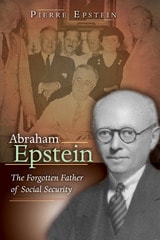
Abraham Epstein
The Forgotten Father of Social SecurityPierre Epstein
University of Missouri Press, 2006
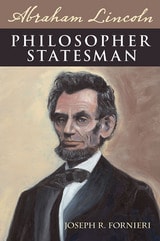
Abraham Lincoln, Philosopher Statesman
Joseph R. Fornieri
Southern Illinois University Press, 2014
2015 ISHS Superior Achievement Award
What constitutes Lincoln’s political greatness as a statesman? As a great leader, he saved the Union, presided over the end of slavery, and helped to pave the way for an interracial democracy. His great speeches provide enduring wisdom about human equality, democracy, free labor, and free society. Joseph R. Fornieri contends that Lincoln’s political genius is best understood in terms of a philosophical statesmanship that united greatness of thought and action, one that combined theory and practice. This philosophical statesmanship, Fornieri argues, can best be understood in terms of six dimensions of political leadership: wisdom, prudence, duty, magnanimity, rhetoric, and patriotism. Drawing on insights from history, politics, and philosophy, Fornieri tackles the question of how Lincoln’s statesmanship displayed each of these crucial elements.
Providing an accessible framework for understanding Lincoln’s statesmanship, this thoughtful study examines the sixteenth president’s political leadership in terms of the traditional moral vision of statecraft as understood by epic political philosophers such as Aristotle and St. Thomas Aquinas. Fornieri contends that Lincoln’s character is best understood in terms of Aquinas’s understanding of magnanimity or greatness of soul, the crowning virtue of statesmanship. True political greatness, as embodied by Lincoln, involves both humility and sacrificial service for the common good. The enduring wisdom and timeless teachings of these great thinkers, Fornieri shows, can lead to a deeper appreciation of statesmanship and of its embodiment in Abraham Lincoln.
With the great philosophers and books of western civilization as his guide, Fornieri demonstrates the important contribution of normative political philosophy to an understanding of our sixteenth president. Informed by political theory that draws on the classics in revealing the timelessness of Lincoln’s example, his interdisciplinary study offers profound insights for anyone interested in the nature of leadership, statesmanship, political philosophy, political ethics, political history, and constitutional law.
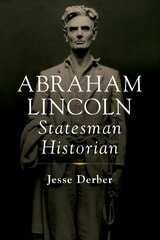
Abraham Lincoln, Statesman Historian
Jesse Derber
University of Illinois Press, 2024
Abraham Lincoln drew upon history in his political career and particularly when crafting the rhetorical masterpieces that still resonate in the present day. Jesse Derber explores how Lincoln’s views of the limits of human understanding drove a belief in--and untiring pursuit of--historical truth.
Lincoln embraced the traditional ideas that good history made good statesmanship and that an understanding of the past informed decision-making in the present. Seeing history as a source of wisdom, Lincoln strove for accuracy through a combination of research, reasoning ability, emotional maturity, and a willingness to admit his mistakes and challenge his biases. His philosophy flowed from an idea that authentic history could enlighten people about human nature. Though he revered precedents, Lincoln understood the past could be imperfect, and that progress through change was an ineffable part of building a better nation.
Perceptive and revealing, Abraham Lincoln, Statesman Historian looks at how the Lincoln practiced history and applied its lessons to politics and leadership.
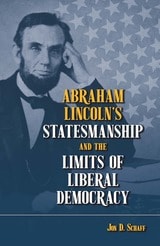
Abraham Lincoln’s Statesmanship and the Limits of Liberal Democracy
Jon D. Schaff
Southern Illinois University Press, 2019
Though Lincoln’s presidency is inextricably linked to the Civil War, and he is best known for his defense of the Union and executive wartime leadership, Lincoln believed that Congress should be at the helm of public policy making. Likewise, Lincoln may have embraced limited government in vague terms, but he strongly supported effective rule of law and distribution of income and wealth. Placing the Lincoln presidency within a deeper and more meaningful historical context, Abraham Lincoln’s Statesmanship and the Limits of Liberal Democracy highlights Lincoln’s significance in the development of American power institutions and social movement politics.
Using Lincoln’s prepresidential and presidential words and actions, this book argues that decent government demands a balance of competing goods and the strong statesmanship that Lincoln exemplified. Instead of relying too heavily on the will of the people and institutional solutions to help prevent tyranny, Jon D. Schaff proposes that American democracy would be better served by a moderate and prudential statesmanship such as Lincoln’s, which would help limit democratic excesses.
Schaff explains how Lincoln’s views on prudence, moderation, natural rights, and economics contain the notion of limits, then views Lincoln’s political and presidential leadership through the same lens. He compares Lincoln’s views on governmental powers with the defense of unlimited government by twentieth-century progressives and shows how Lincoln’s theory of labor anticipated twentieth-century distributist economic thought. Schaff’s unique exploration falls squarely between historians who consider Lincoln a protoprogressive and those who say his presidency was a harbinger of industrialized, corporatized America.
In analyzing Lincoln’s approach, Abraham Lincoln’s Statesmanship and the Limits of Liberal Democracy rejects the idea he was a revolutionary statesman and instead lifts up Lincoln’s own affinity for limited presidential power, making the case for a modest approach to presidential power today based on this understanding of Lincoln’s statesmanship. As a counterpoint to the contemporary landscape of bitter, uncivil politics, Schaff points to Lincoln’s statesmanship as a model for better ways of engaging in politics in a democracy.
Abuse of Power
How Cold War Surveillance and Secrecy Policy Shaped the Response to 9/11Authored by Athan Theoharis
Temple University Press, 2011
Athan Theoharis, long a respected authority on surveillance and secrecy, established his reputation for meticulous scholarship with his work on the loyalty security program developed under Truman and McCarthy. In Abuse of Power, Theoharis continues his investigation of U.S. government surveillance and historicizes the 9/11 response.
Criticizing the U.S. government's secret activities and policies during periods of "unprecedented crisis," he recounts how presidents and FBI officials exploited concerns about foreign-based internal security threats.
Drawing on information sequestered until recently in FBI records, Theoharis shows how these secret activities in the World War II and Cold War eras expanded FBI surveillance powers and, in the process, eroded civil liberties without substantially advancing legitimate security interests.
Passionately argued, this timely book speaks to the costs and consequences of still-secret post-9/11 surveillance programs and counterintelligence failures. Ultimately, Abuse of Power makes the case that the abusive surveillance policies of the Cold War years were repeated in the government's responses to the September 11 attacks.

Academic Freedom in a Plural World
Global Critical PerspectivesFrédéric Mégret
Central European University Press, 2024
The notion of academic freedom dates back to the creation of universities and has long been understood to be central to their vocation. This freedom has come under attack by different actors throughout its history. In the current context, rising threats to democracy and human liberties, the corporatization of research, concerns about diversity and increased societal polarization, are putting a considerable pressure on its exercise. However, academic freedom is also a concept that suffers from persistent ambiguities associated with the general notion of freedom as well as debates about the function of universities.
This edited collection addresses the question of academic freedom by situating it in its broader global context. More conceptual treatments contribute to an understanding of academic freedom as distinct and separate from, although related to, freedom of expression, or student rights. These conceptual treatments are combined with studies of actual struggles over the scope of academic freedom in specific universities. The contributions come from a broad variety of sites seek to deprovincialize the conversation beyond North America or the English-speaking world.

Academic Freedom
The Global ChallengeMichael Ignatieff
Central European University Press, 2018
Academic and Entrepreneurial Research
Consequences of Diversity in Federal Evaluation StudiesIlene Nagel Bernstein
Russell Sage Foundation, 1975
Acceptable Risks
Politics, Policy, and Risky TechnologiesC. F. Larry Heimann
University of Michigan Press, 1998
Accidental Occidental
Economics and Culture of Transition in Mitteleuropa, the Baltic and the Balkan AreaLajos Bokros
Central European University Press, 2013

Accidental Shepherd
How a California Girl Rescued an Ancient Mountain Farm in NorwayLiese Greensfelder
University of Minnesota Press, 2024
A summer job turns serious when a young woman takes the reins on a remote farm—and learns far more than how to herd sheep
In May 1972, Liese Greensfelder arrived in the small Norwegian town of Øystese to startling news: Johannes, the farmer who hired her for the summer, had just been hospitalized after a stroke. Could she please watch over his place for a month or so, until he got back on his feet? Twenty years old and with no farming experience, Liese was dropped off the next day at a centuries-old mountain farm at the end of a dirt road high above the magnificent Hardanger Fjord—with 115 sheep, two cows, one calf, a draft horse, and a Norwegian herding dog to care for.
Armed with a command of Danish that enabled rudimentary communication, Liese began learning from neighbors who spoke an ancient Norwegian dialect—how to feed the animals, milk by hand, and supervise her first lambing. The farm was run in the old way: horses and wagons instead of tractors, haymaking in the rain, and hikes into the mountains to check on the sheep that ranged free over those wild peaks all summer. And, she was quick to discover, the farm was on the brink of ruin, for Johannes was a heartless man who had abused his animals and neglected his buildings and equipment for decades.
Although her employer had alienated his neighbors, they immediately welcomed the American newcomer and offered her help. As “a month or so” stretched to a year and Liese struggled for the survival of the farm, she joined this tight-knit enclave of farmers, learning their stories and history, adopting their dialect, and growing intimately familiar with the grass-based farming practices that had sustained them for generations.
From moments of levity, such as sampling a neighbor’s fruit wines, Christmas parties, and skiing; to soul-battering challenges, including the directive to kill a fox, sending sheep to slaughter, rotten silage, and vicious weather; to the yearnings of a young woman awash in a sea of masculinity, Accidental Shepherd is a candid account of Liese’s year in a remote farmhouse. Confronted with dangers and obstacles for which she was utterly unprepared, she tells a story of remarkable resilience and records the fascinating but rapidly vanishing traditions of the community that took her in.

Accidental Shepherd
How a California Girl Rescued an Ancient Mountain Farm in NorwayLiese Greensfelder
University of Minnesota Press, 2024
A summer job turns serious when a young woman takes the reins on a remote farm—and learns far more than how to herd sheep
In May 1972, Liese Greensfelder arrived in the small Norwegian town of Øystese to startling news: Johannes, the farmer who hired her for the summer, had just been hospitalized after a stroke. Could she please watch over his place for a month or so, until he got back on his feet? Twenty years old and with no farming experience, Liese was dropped off the next day at a centuries-old mountain farm at the end of a dirt road high above the magnificent Hardanger Fjord—with 115 sheep, two cows, one calf, a draft horse, and a Norwegian herding dog to care for.
Armed with a command of Danish that enabled rudimentary communication, Liese began learning from neighbors who spoke an ancient Norwegian dialect—how to feed the animals, milk by hand, and supervise her first lambing. The farm was run in the old way: horses and wagons instead of tractors, haymaking in the rain, and hikes into the mountains to check on the sheep that ranged free over those wild peaks all summer. And, she was quick to discover, the farm was on the brink of ruin, for Johannes was a heartless man who had abused his animals and neglected his buildings and equipment for decades.
Although her employer had alienated his neighbors, they immediately welcomed the American newcomer and offered her help. As “a month or so” stretched to a year and Liese struggled for the survival of the farm, she joined this tight-knit enclave of farmers, learning their stories and history, adopting their dialect, and growing intimately familiar with the grass-based farming practices that had sustained them for generations.
From moments of levity, such as sampling a neighbor’s fruit wines, Christmas parties, and skiing; to soul-battering challenges, including the directive to kill a fox, sending sheep to slaughter, rotten silage, and vicious weather; to the yearnings of a young woman awash in a sea of masculinity, Accidental Shepherd is a candid account of Liese’s year in a remote farmhouse. Confronted with dangers and obstacles for which she was utterly unprepared, she tells a story of remarkable resilience and records the fascinating but rapidly vanishing traditions of the community that took her in.
Accountability in State Legislatures
Steven Rogers
University of Chicago Press, 2023
A troubling portrait of democracy in US state legislatures.
State legislatures hold tremendous authority over key facets of our lives, ranging from healthcare to marriage to immigration policy. In theory, elections create incentives for state legislators to produce good policies. But do they?
Drawing on wide-ranging quantitative and qualitative evidence, Steven Rogers offers the most comprehensive assessment of this question to date, testing different potential mechanisms of accountability. His findings are sobering: almost ninety percent of American voters do not know who their state legislator is; over one-third of incumbent legislators run unchallenged in both primary and general elections; and election outcomes have little relationship with legislators’ own behavior.
Rogers’s analysis of state legislatures highlights the costs of our highly nationalized politics, challenging theories of democratic accountability and providing a troubling picture of democracy in the states.
Accounting for Fundamentalisms
The Dynamic Character of MovementsEdited by Martin E. Marty and R. Scott Appleby
University of Chicago Press, 1994

Accounting for Violence
Marketing Memory in Latin AmericaKsenija Bilbija and Leigh A. Payne, eds.
Duke University Press, 2011
Contributors. Rebecca J. Atencio, Ksenija Bilbija, Jo-Marie Burt, Laurie Beth Clark, Cath Collins, Susana Draper, Nancy Gates-Madsen, Susana Kaiser, Cynthia E. Milton, Alice A. Nelson, Carmen Oquendo Villar, Leigh A. Payne, José Ramón Ruisánchez Serra, Maria Eugenia Ulfe
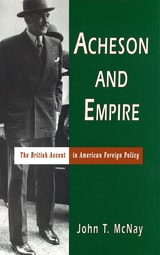
Acheson and Empire
The British Accent in American Foreign PolicyJohn T. McNay
University of Missouri Press, 2001
Acheson and Empire offers a compelling reassessment of Dean Acheson's policies toward the former colonial world during his period as secretary of state from 1949 to 1953. John T. McNay argues that Acheson inherited through his own personal history a way of understanding the world that encouraged imperial-style international relationships. This worldview represented a well-developed belief system rooted in his Ulster Protestant heritage that remained consistent throughout his life.
By exploring relationships of the United States with Britain and countries formerly or then controlled by Britain, such as India, Ireland, Iran, and Egypt, McNay shows the significance of Acheson's beliefs. McNay argues that Acheson's support of existing imperial relationships was so steadfast that it often led other nations to perceive that the United States was nothing more than a front for British interests. He believes this approach to foreign policy damaged American relations with emerging countries and misled the British regarding possibilities of an Anglo-American partnership.
Acheson and Empire contends that the widely accepted view of Acheson as a foreign policy realist is misleading and that historians should acknowledge that his affinity for the British Empire went beyond his clothing and mannerisms. McNay maintains that the widely accepted view of Acheson as one of a group of "wise men" who shaped the Cold War world by basing their decisions on cold calculation of American interests should be reconsidered.
Drawing from extensive research in archival sources, including the Truman Library, the National Archives, the Public Record Office in London, and Acheson's personal papers at Yale, Acheson and Empire offers a fresh look at Dean Acheson that runs counter to previous biographies and many histories of the Cold War.
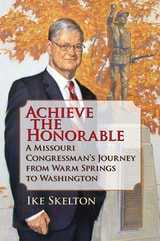
Achieve the Honorable
A Missouri Congressman's Journey from Warm Springs to WashingtonIke Skelton
Southern Illinois University Press, 2013
During his years in the U.S. House of Representatives, Skelton became known as a bipartisan negotiator and a champion of the Armed Services. Throughout the decades, he helped steer the nation through its most dangerous challenges, from Communism to terrorism; took a leading role in the reform of the Department of Defense; dedicated himself to fulfilling the interests of his constituents; and eventually rose to become chair of the House Armed Services Committee during such pivotal events as the wars in Iraq and Afghanistan. In addition to detailing Skelton’s political career and its accompanying challenges and triumphs, Achieve the Honorable provides inside glimpses into the lives of political titans like Harry Truman, Richard Nixon, and Bill Clinton. Along the way, we are treated to Skelton’s engaging humor and shrewd insight into twentieth- and twenty-first-century U.S. politics.

Achieving the Impossible Dream
HOW JAPANESE AMERICANS OBTAINED REDRESSMitchell T. Maki, Harry H. L. Kitano, and S. Megan Berthold; Foreword by Robert T. Matsui
University of Illinois Press, 1999
Acholi Intellectuals
Knowledge, Power, and the Making of Colonial Northern Uganda, 1850–1960Patrick William Otim
Ohio University Press, 2024
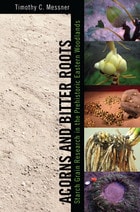
Acorns and Bitter Roots
Starch Grain Research in the Prehistoric Eastern WoodlandsTimothy C. Messner
University of Alabama Press, 2011
Messner’s analysis is based on extensive reviews of the literature on early historic, prehistoric native plant use, and the collation of all available archaeobotanical data, a review of which also guided the author in selecting contemporary botanical specimens to identify and in interpreting starch residues recovered from ancient plant-processing technologies. The evidence presented here sheds light on many local ecological and cultural developments as ancient people shifted their subsistence focus from estuarine to riverine settings. These archaeobotanical datasets, Messner argues, illuminate both the conscious and unintentional translocal movement of ideas and ecologies throughout the Eastern Woodlands.
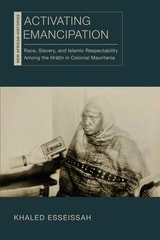
Activating Emancipation
Race, Slavery, and Islamic Respectability Among the Hratin in Colonial MauritaniaKhaled Esseissah
Ohio University Press, 0
Activating Emancipation boldly interrogates our knowledge of the history of slavery, emancipation, race, and Islam in Mauritania, where slavery was abolished only in 1981 and criminalized in 2007. It centers on the voices and stories of Ḥrāṭīn peoples, a complex and ambiguous social category encompassing people with mixed free and servile ancestral backgrounds. The stigma of enslavement, along with their racialized status as Black, has placed them at the bottom of a social hierarchy dominated by Arab and Amazigh elites, racialized as “White.”
In this groundbreaking study, Ḥrāṭīn historian Khaled Esseissah mobilizes oral and written sources to confront a long tradition in which Ḥrāṭīn are rendered invisible or shown as passive victims of oppression and narrates a new history of Ḥrāṭīn contributions to the building of modern Mauritania. Despite being emancipated or born free, Ḥrāṭīn men and women continued to face “White” threats to reenslave them or subject them to economic, religious, and sexual exploitation. Esseissah demonstrates that only by “activating their emancipation” have the Ḥrāṭīn challenged Arab dominance. He unravels complex and varied Ḥrāṭīn strategies, including engaging with French colonizers through collaboration and revolt, appealing to the Qur’an and Ḥadith, acquiring wealth, building political power, engaging in nationalist struggle, and exercising communal agency to support others, garner respectability, and assert their autonomy during the colonial period. He also illuminates Ḥrāṭīn adwaba, or villages of emancipation, as critical sites of slave liberation and freedom. In so doing, Activating Emancipation reframes the story of abolition in colonial Mauritania that is often either ignored or told from the French colonial perspective, which sees abolition merely as a legal event. The Ḥrāṭīn experience of emancipation is long and complex, challenging simple binaries between bondage and free labor, between colonial and anticolonial.
Activating Emancipation reorients academic studies and international media coverage of Ḥrāṭīn communities, demonstrating the broad range of Ḥrāṭīn historical experiences that are not understood, or even visible, to many in Mauritania, Africa, and beyond. It provides a grounded historical analysis that moves us beyond both the orientalist and apologetic Muslim discourses that have long characterized journalistic, popular, and even scholarly debates about slavery, Islam, and Ḥrāṭīn experience in Mauritania.
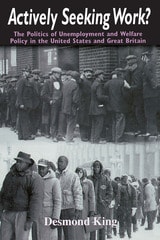
Actively Seeking Work?
The Politics of Unemployment and Welfare Policy in the United States and Great BritainDesmond King
University of Chicago Press, 1995
The goal of work-welfare policy in both countries has been to provide financial aid, training, and placement services for the unemployed. In order to muster support for these programs, however, work-welfare programs had to incorporate liberal requirements that they not interfere with private market forces, and that they prevent the "undeserving" from obtaining benefits. For King, the attempt to integrate these incompatible functions is the defining feature of British and American policies as well as the cause of their failure.
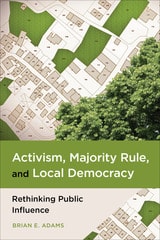
Activism, Majority Rule, and Local Democracy
Rethinking Public InfluenceBrian E. Adams
Temple University Press, 2026
Local democracy doesn’t work as it should, declares Brian Adams in Activism, Majority Rule, and Local Democracy. Local politics is where citizens have the most opportunity for direct participation, control, and influence, but that activism doesn’t necessarily translate into majority rule.
While greater local engagement can produce policy that better reflects activists’ strong preferences, Adams explains that activists are not representative of the public-at-large and states that a reconceptualization of how the public should be able to influence local officials is required. Based on interviews with activists in San Diego, California, Adams concludes that activism can be beneficial, but we need to view it as distinct from majority rule, with a focus on managing the tension between the two.
Improving local democracy is not just a matter of generating more activism. It requires articulating when we want policy to reflect majority preferences and when we want activists to hold sway.
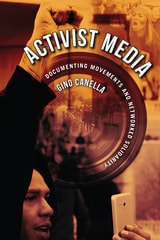
Activist Media
Documenting Movements and Networked SolidarityGino Canella
Rutgers University Press, 2022
Now more than ever, activists are using media to document injustice and promote social and political change. Yet with so many media platforms available, activists sometimes fail to have a coherent media and communication strategy.
Drawing from his experiences as a documentary filmmaker with Black Lives Matter 5280 and Service Employees International Union (SEIU) Local 105 in Denver, Colorado, Gino Canella argues that activist media create opportunities for activists to navigate conflict and embrace their political and ideological differences. Canella details how activist media practices—interviewing organizers, script writing, video editing, posting on social media, and hosting community screenings—foster solidarity among grassroots organizers.
Informed by media theory, this book explores how activists are using media to mobilize supporters, communicate their values, and reject anti-union rhetoric. Furthermore, it demonstrates how collaborative media projects can help activists build broad-based coalitions and amplify their vision for a more equitable and just society.

Activists and the Surveillance State
Learning from RepressionEdited by Aziz Choudry
Pluto Press, 2018
Drawing on the knowledge of activists and academics from the United States, the United Kingdom, Canada, New Zealand, Australia, South Africa, and Chile, Activists and the Surveillance State delves into the harassment, infiltration, and disruption that has colored state responses to those deemed threats to national security. The book shows that, ultimately, movements can learn from their own repression, developing a critical and complex understanding of the nature of states and capital today that can crucially inform the struggles of tomorrow.
Actors, Athletes, and Astronauts
Political Amateurs in the United States CongressDavid T. Canon
University of Chicago Press, 1990
Written in a lucid style accessible to the nonspecialist, David T. Canon's Actors, Athletes, and Astronauts is a definitive study of political amateurs in elections and in Congress. Canon examines the political conditions that prompt amateurs to run for office, why they win or lose, and whether elected amateurs behave differently from their experienced counterparts. Challenging previous work which presumed stable career structures and progressively ambitious candidates, his study reveals that amateurs are disproportionately elected in periods of high political opportunity, such as the 1930s for Democrats and 1980s for Republicans.
Canon's detailed findings call for significant revision of our prevailing understanding of ambition theory and disarm monolithic interpretations of political amateurs. His unique typology of amateurism differentiates among policy-oriented, "hopeless," or ambitious amateurs. The latter resemble their professional counterparts; "hopeless" amateurs are swept into office by strong partisan motivations and decision-making styles of each type vary, affecting their degree of success, but each type of amateur provides a necessary electoral balance by defeating entrenched incumbents rarely challenged by more experienced politicians.
Acts of Hope
Creating Authority in Literature, Law, and PoliticsJames Boyd White
University of Chicago Press, 1994
In this book, James Boyd White shows how texts by some of our most important thinkers and writers—including Plato, Shakespeare, Dickinson, Mandela, and Lincoln—answer these questions, not in the abstract, but in the way they wrestle with the claims of the world and self in particular historical and cultural contexts. As they define afresh the institutions or practices for which they claim (or resist) authority, they create authorities of their own, in the very modes of thought and expression they employ. They imagine their world anew and transform the languages that give it meaning.
In so doing, White maintains, these works teach us about how to read and judge claims of authority made by others upon us; how to decide to which institutions and practices we should grant authority; and how to create authorities of our own through our thoughts and arguments. Elegant and accessible, this book will appeal to anyone wanting to better understand one of the primary processes of our social and political lives.

Acts of Repair
Justice, Truth, and the Politics of Memory in ArgentinaNatasha Zaretsky
Rutgers University Press, 2021

Adapting to the Land
A History of Agriculture in ColoradoJohn F. Freeman
University Press of Colorado, 2021
Ancestral Puebloans farmed and grazed within the limits of nature. Early settlers adjusted their cultivation methods through trial and error, while later agriculturists relied on research and technical advice from the Colorado Agricultural College. As part of wartime mobilization, the federal government prompted farmers to efficiently increase yields. To meet the demand for food and fiber scientific and technical innovations led to the development of new plant cultivars and livestock breeds, advances in mechanization, and widespread use of synthetic amendments. Increasing concern over soil fertility and the loss of irrigation water to urbanization contributed to more changes. Despite, or perhaps because of, what we see today along the Front Range, Colorado may still have a chance to slow or even reverse its seemingly unrestrained growth, creating a more vibrant, earth-friendly society in which agriculture plays an increasingly significant part. Scientific discoveries and innovations in regenerative cultivation are clearing the path to a more sustainable future.
Adapting to the Land adds an ecological and horticultural perspective to historical interpretations of recurring agricultural issues in the state and tracks the concept of stewardship, suggesting that spiritual beliefs continue to contribute to debates over acceptable agricultural practices and the effects of urbanization upon the land. This book will be a key resource for students, scholars, and general readers interested in agricultural and Colorado history, sustainability, and rural sociology.

Addiction Becomes Normal
On the Late-Modern American SubjectJaeyoon Park
University of Chicago Press, 2024
Over the last forty years, a variety of developments in American science, politics, and culture have reimagined addiction in their own ways, but they share an important understanding: increasingly, addiction is described as normal, the natural result of a body that has been exposed to potent stimuli. This shift in thinking suggests that addiction is a condition latent in all of us, a common response to a society rich in thrills.
In Addiction Becomes Normal, Jaeyoon Park provides a history and critical analysis of the normalization of addiction in late-modern American society. By exploring addiction science, diagnostic manuals, judicial reform, and public health policy, he shows how seeing addiction as normal has flourished in recent decades and is supported throughout cultural life in the United States by the language of wellness, psychotherapy, and more. Building on Michel Foucault’s depiction of the human figure, Park argues that this shift reflects the emergence of a new American subject, one formed by the accretion of experiences. This view of the human subject challenges the idea that our compulsions reflect our characters, wills, or spirits. For if addiction is an extreme but ordinary attachment, and if compulsive consumption resembles healthy behavior, then desire is no longer an expression of the soul so much as the pursuit of a past reward. A perceptive work of recent history and political theory, Addiction Becomes Normal raises new questions about what it means to be human in America today.

Addiction Becomes Normal
On the Late-Modern American SubjectJaeyoon Park
University of Chicago Press, 2024
Addiction is now seen as an ordinary feature of human nature, an idea that introduces new doubts about the meaning of our desires.
Over the last forty years, a variety of developments in American science, politics, and culture have reimagined addiction in their own ways, but they share an important understanding: increasingly, addiction is described as normal, the natural result of a body that has been exposed to potent stimuli. This shift in thinking suggests that addiction is a condition latent in all of us, a common response to a society rich in thrills.
In Addiction Becomes Normal, Jaeyoon Park provides a history and critical analysis of the normalization of addiction in late-modern American society. By exploring addiction science, diagnostic manuals, judicial reform, and public health policy, he shows how seeing addiction as normal has flourished in recent decades and is supported throughout cultural life in the United States by the language of wellness, psychotherapy, and more. Building on Michel Foucault’s depiction of the human figure, Park argues that this shift reflects the emergence of a new American subject, one formed by the accretion of experiences. This view of the human subject challenges the idea that our compulsions reflect our characters, wills, or spirits. For if addiction is an extreme but ordinary attachment, and if compulsive consumption resembles healthy behavior, then desire is no longer an expression of the soul so much as the pursuit of a past reward. A perceptive work of recent history and political theory, Addiction Becomes Normal raises new questions about what it means to be human in America today.

Addiction
Entries and ExitsJon Elster
Russell Sage Foundation, 1999
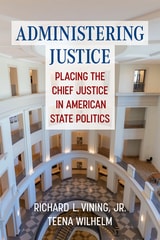
Administering Justice
Placing the Chief Justice in American State PoliticsRichard L. Vining Jr. and Teena Wilhelm
University of Michigan Press, 2023
Administering Justice examines the leadership role of chief justices in the American states, including how those duties require chief justices to be part of the broader state political environment. Vining and Wilhelm focus extensively on the power of chief justices as public spokespersons, legislative liaisons, and reform leaders. In contrast to much existing research on chief justices in the states, this study weighs their extrajudicial responsibilities rather than intracourt leadership. By assessing the content of State of the Judiciary remarks delivered over a period of sixty years, Vining and Wilhelm are able to analyze the reform agendas advanced by chief justices and determine what factors influence the likelihood of success. These analyses confirm that chief justices engage with state politics in meaningful ways and that reactions to their proposals are influenced by ideological congruence with other political elites and the scope of their requests. Administering Justice also examines the chief justice position as an institution, provides a collective profile of its occupants, and surveys growing diversity among court leaders.
Administrative Aspects of Investment-Based Social Security Reform
Edited by John B. Shoven
University of Chicago Press, 2000
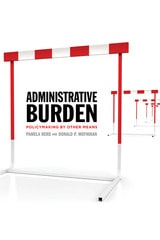
Administrative Burden
Policymaking by Other MeansPamela Herd
Russell Sage Foundation, 2018
Winner of the 2020 Outstanding Book Award Presented by the Public and Nonprofit Section of the National Academy of Management
Winner of the 2019 Louis Brownlow Book Award from the National Academy of Public Administration
Through in-depth case studies of federal programs and controversial legislation, the authors show that administrative burdens are the nuts-and-bolts of policy design. Regarding controversial issues such as voter enfranchisement or abortion rights, lawmakers often use administrative burdens to limit access to rights or services they oppose. For instance, legislators have implemented administrative burdens such as complicated registration requirements and strict voter-identification laws to suppress turnout of African American voters. Similarly, the right to an abortion is legally protected, but many states require women seeking abortions to comply with burdens such as mandatory waiting periods, ultrasounds, and scripted counseling. As Herd and Moynihan demonstrate, administrative burdens often disproportionately affect the disadvantaged who lack the resources to deal with the financial and psychological costs of navigating these obstacles.
However, policymakers have sometimes reduced administrative burdens or shifted them away from citizens and onto the government. One example is Social Security, which early administrators of the program implemented in the 1930s with the goal of minimizing burdens for beneficiaries. As a result, the take-up rate is about 100 percent because the Social Security Administration keeps track of peoples’ earnings for them, automatically calculates benefits and eligibility, and simply requires an easy online enrollment or visiting one of 1,200 field offices. Making more programs and public services operate this efficiently, the authors argue, requires adoption of a nonpartisan, evidence-based metric for determining when and how to institute administrative burdens, with a bias toward reducing them. By ensuring that the public’s interaction with government is no more onerous than it need be, policymakers and administrators can reduce inequality, boost civic engagement, and build an efficient state that works for all citizens.

Administrative Districts and Field Offices of the Minnesota State Government
Ivan Hinderaker
University of Minnesota Press, 1943