Results by title
3388 books match the query 'Fiction' and 293 start with a
Appointed
An American NovelWilliam H. Anderson
West Virginia University Press, 2019
Appointed is a recently recovered novel written by William Anderson and Walter Stowers, two of the editors of the Detroit Plaindealer, a long-running and well-regarded African American newspaper of the late nineteenth century. Drawing heavily on nineteenth-century print culture, the authors tell the story of John Saunders, a college-educated black man living and working in Detroit. Through a bizarre set of circumstances, Saunders befriends his white employer’s son, Seth Stanley, and the two men form a lasting, cross-racial bond that leads them to travel together to the American South. On their journey, John shows Seth the harsh realities of American racism and instructs him in how he might take responsibility for alleviating the effects of racism in his own home and in the white world broadly.
As a coauthored novel of frustrated ambition, cross-racial friendship, and the tragedy of lynching, Appointed represents a unique contribution to African American literary history. This is the first scholarly edition of Appointed, and it includes a collection of writings from the Plaindealer, the authors’ short story “A Strange Freak of Fate,” and an introduction that locates Appointed and its authors within the journalistic and literary currents of the United States in the late nineteenth century.
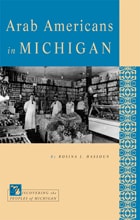
Arab Americans in Michigan
Rosina J. Hassoun
Michigan State University Press, 2003
The state of Michigan hosts one of the largest and most diverse Arab American populations in the United States. As the third largest ethnic population in the state, Arab Americans are an economically important and politically influential group. It also reflects the diversity of national origins, religions, education levels, socioeconomic levels, and degrees of acculturation. Despite their considerable presence, Arab Americans have always been a misunderstood ethnic population in Michigan, even before September 11, 2001 imposed a cloud of suspicion, fear, and uncertainty over their ethnic enclaves and the larger community. In Arab Americans in Michigan Rosina J. Hassoun outlines the origins, culture, religions, and values of a people whose influence has often exceeded their visibility in the state.
Aram's Notebook
Maria Àngels Anglada
Swan Isle Press, 2024
Like any other fifteen-year-old boy, Aram might never have written the events of his still young life, except that he found himself suddenly plunged into exile, fleeing certain death. In 1915, the Ottoman authorities undertook the wholesale extermination of the Armenian people; hundreds of thousands of men, women, and children like Aram suffered one of the twentieth century’s most savage persecutions. Inspired by the plight of the murdered modernist poet Daniel Varoujan (1884–1915), this novel follows Aram and his widowed mother on their flight toward a new life on—and under—the sea. From recollections of his father’s meditations on Homer to a life-changing apprenticeship as a coral fisherman off the coasts of Cataluña and Marseille, Aram’s tale dives into a future that might help redeem a harrowing past. Aram's Notebook examines the Armenian Genocide through a narrative in which poets and poetry loom large. Aram’s tale evokes a struggle not simply for physical survival, but for saving memory from the clutches of destruction. Evocatively translated from the original Catalan by Ara Merjian.
Aransas
A NovelBy Stephen Harrigan
University of Texas Press, 2014
Arc and the Sediment
a NovelChristine Allen-Yazzie
Utah State University Press, 2007
This tale, though dark and difficult, is infused with tart, twisted humor. Confused, disheveled, self-deprecating, and self-destructive, Gretta is also sharp and funny. Here, first-time novelist Christine Allen-Yazzie breaks apart her own narrative arc but with gritty reality seals it near-shut again, if in rearrangement, drawing us into Gretta's wrestling match with herself, her husband, her addiction, and the road.
The Arc and the Sediment received an honorable mention from the James Jones First Novel Competition, and it won the Utah Arts Council Annual Writing Competiton Publishing Prize.
Arcadio
William Goyen
Northwestern University Press, 1994
Archyology
The Long Lost Tales of Archy and MehitabelDon Marquis
University Press of New England, 2009
Are You Sure About That?
Discerning Fact from FictionKaren A. Cerulo
Rutgers University Press, 2027
Phone in hand, TV on, we wake up and fall asleep to endless information. There’s no escape—we are drowning in a sea of breaking news, notifications, and popular beliefs and claims. Every day, we encounter hundreds of posts and podcasts on politics, celebrities, or current events. People share links to “expert” recommendations on Instagram or Reddit. YouTube and TikTok bring us those who want to instruct us on the realities of the world or pass on longstanding conventional wisdom, all in the hopes of influencing our decisions and actions.
The information overload of the constant news and information cycle is exhausting and extremely frustrating. You may ask: Just what or whom should we believe? Are You Sure About That? Discerning Fact from Fiction helps readers navigate the perilous informational terrain of contemporary life. We provide a game plan of strategies and guidance for easily and reliably assessing the accuracy of any claim, helping readers to cut through the noise and adjust what they know.
Aristotle Detective
An Aristotle Detective NovelMargaret Doody
University of Chicago Press, 2014
In Aristotle Detective, we first meet Stephanos—naive Watson to Aristotle’s learned Holmes—a young landed Athenian and student of Aristotle. With the aid of his cunning, olive-loving teacher, Stephanos must clear his exiled cousin of murder and save his family’s honor in a tense public trial. Will Stephanos survive to cinch the case?
Aristotle and Poetic Justice
An Aristotle Detective NovelMargaret Doody
University of Chicago Press, 2014
Stephanos and his teacher return in Aristotle and Poetic Justice, when a party given by wealthy Athenian silver miners leads to kidnapping, a ghost, a road trip to Delphi, and, of course, murder. More historical fiction than a detective novel, this sequel runs the gamut of Athenian social customs, myth, politics, and economics—from the trials of virgin love to the dangers of silver lust.
Aristotle and the Secrets of Life
An Aristotle Detective NovelMargaret Doody
University of Chicago Press, 2014
With Aristotle and the Secrets of Life, tensions between the Athenians and the Makedonians—followers of another of Aristotle’s former students, Alexander the Great—draw our heroes across the Aegean Sea. Even as Aristotle and Stephanos escape from pirates, uncover conspiracy, and face the horrors of war, Aristotle finds time to discuss his studies of the natural world in this gripping tale of their quest into darkness.
Arkansas, Arkansas Volume 1
Writers and Writings from the Delta to the Ozarks, 1541-1969John C. Guilds
University of Arkansas Press, 1999
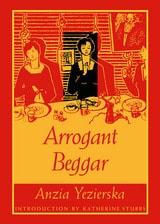
Arrogant Beggar
Anzia Yezierska
Duke University Press, 1996
The second half of the novel takes Adele back to her ghetto origins as she explores an alternative model of philanthropy by opening a restaurant that combines the communitarian ideals of Old World shtetl tradition with the contingencies of New World capitalism. Within the context of this radical message, Yezierska revisits the themes that have made her work famous, confronting complex questions of ethnic identity, assimilation, and female self-realization.
Katherine Stubbs’s introduction provides a comprehensive and compelling historical, social, and literary context for this extraordinary novel and discusses the critical reaction to its publication in light of Yezierska’s biography and the once much-publicized and mythologized version of her life story. Unavailable for over sixty years, Arrogant Beggar will be enjoyed by general readers of fiction and be of crucial importance for feminist critics, students of ethnic literature. It will also prove an exciting and richly rewarding text for students and scholars of Jewish studies, immigrant literature, women’s writing, American history, and working-class fiction.
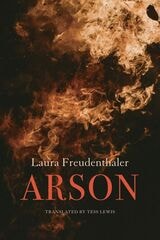
Arson
Laura Freudenthaler
Seagull Books, 2025
A feverish and unsettling meditation on climate collapse, Arson is told through the fragmented perspectives of two individuals struggling to make sense of a world consumed by fire. An unnamed narrator, a writer plagued by anxiety and writer’s block, watches as the planet, her relationships, and even her ability to dream are ravaged by environmental disaster. Meanwhile, an insomniac scientist, obsessed with tracking wildfires, clings to data as his last grip on control, meticulously recording every flame that devours the forests.
Their narratives unfold in a disorienting rhythm—one slipping between lyrical introspection and panic, the other drowning in statistics and methodical observation. As fires rage across the planet, both search for meaning and survival: the narrator wanders the charred countryside in search of life amid destruction, while the scientist compulsively documents landscapes that should never be burning. Echoing Ingeborg Bachmann’s famous words, “With my burned hand I write about the nature of fire,” Laura Freudenthaler crafts a haunting, kaleidoscopic portrait of a world on the brink. Arson is not just a novel about climate change—it is an urgent, dreamlike reckoning with our fascination and horror at the beauty and devastation wrought by fire.
Art Is Everything
A NovelYxta Maya Murray
Northwestern University Press, 2021
In her funny, idiosyncratic, and propulsive new novel, Art Is Everything, Yxta Maya Murray offers us a portrait of a Chicana artist as a woman on the margins. L.A. native Amanda Ruiz is a successful performance artist who is madly in love with her girlfriend, a wealthy and pragmatic actuary named Xōchitl. Everything seems under control: Amanda’s grumpy father is living peacefully in Koreatown; Amanda is about to enjoy a residency at the Guggenheim Museum in New York and, once she gets her NEA, she’s going to film a groundbreaking autocritical documentary in Mexico.
But then everything starts to fall apart when Xōchitl’s biological clock begins beeping, Amanda’s father dies, and she endures a sexual assault. What happens to an artist when her emotional support vanishes along with her feelings of safety and her finances? Written as a series of web posts, Instagram essays, Snapchat freakouts, rejected Yelp reviews, Facebook screeds, and SmugMug streams-of-consciousness that merge volcanic confession with eagle-eyed art criticism, Art Is Everything shows us the painful but joyous development of a mid-career artist whose world implodes just as she has a breakthrough.
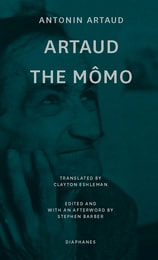
Artaud the Mômo
Antonin Artaud
Diaphanes, 2020
This edition is translated by Clayton Eshleman, the acclaimed foremost translator of Artaud’s work. This will be the first edition since the original 1947 publication to present the work in the spatial format Artaud intended. It also incorporates eight original drawings by Artaud—showing reconfigured bodies as weapons of resistance and assault—which he selected for that edition, after having initially attempted to persuade Pablo Picasso to collaborate with him. Additional critical material draws on Artaud’s previously unknown manuscript letters written between 1946 and 1948 to the book’s publisher, Pierre Bordas, which give unique insights into the work from its origins to its publication.
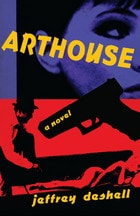
Arthouse
A NovelJeffrey DeShell
University of Alabama Press, 2011
From film to film, Jeffrey DeShell follows a forty-something failed film studies academic—The Professor. While The Professor is reinvented with each new chapter (or film), what remains is DeShell’s inventive deconstruction and representation of modern cinema. At times borrowing imagery, plot, or character elements, and at times rendering lighting, rhythm, costuming, or shot sequences into fictional language, The Professor’s journey sends him from the Southwestern town of Pueblo, Colorado, into the role of rescuer as he aids an attempted-rape victim, and finally to Italy. Ultimately though, The Professor is left alone, struggling to reconcile the real world with his life in cinema.
Arthurian Intertextualities
Misreading and Rereading Malory's Morte Darthur and the Alliterative and Stanzaic MortesFiona Tolhurst and K. S. Whetter
University of Michigan Press, 2025
Arthurian Intertextualities offers new readings of Malory’s Morte as well as the two English poems that most influenced him. Tolhurst and Whetter situate Malory’s Arthur story in the context of fourteenth- and fifteenth-century England. Combining these contexts with intertextual analysis of scenes and characters from Le Morte Darthur and both sources, the authors illustrate the full extent of Malory’s debt to these two English poems while making a stronger case for Malory’s artistry—and the stanzaic-poet’s artistry—than previous scholarship has acknowledged. These new readings demand a reassessment of Arthurian women, kingship, and warfare and heroism, including reconsidering the alliterative-poet’s attitude to war and to Arthur as conqueror. The authors also offer a spirited defense of Malory’s Guenevere, who remains frequently maligned by scholars, and argue for Palomydes’s acceptance by his Round Table Fellowship. Arthurian Intertextualities will appeal to readers who are interested in the book that serves as the source for most of the Arthuriana (whether novels, plays, works of art, or films) in today’s world: Le Morte Darthur.
Articles of Faith
Elizabeth Oness
University of Iowa Press, 2000
In her award-winning collection, Elizabeth Oness travels a vast emotional terrain, from the loss of innocence to sexual betrayal to the helplessness of parents before their children. In “Momentum, ” a woman carries the burden of a dead friend's secret for years until she finally decides to reveal it, only to discover that other, darker secrets still lie in wait. “Rufus” follows the quandary of a young man who is forced to choose between the affection of his girlfriend and his compassion for a homeless man who has taken up residence in his car.
Articles of Faith is a collection of stories about silence and the complications that arise when a silence is kept too long or suddenly broken. As one narrator relates, “I knew that life was full of these things which matter so enormously and make us what we are—but remain unsaid because to voice them does not make them go away, and instead shakes everything around us apart. ”
Artificial Respiration
Ricardo Piglia
Duke University Press, 1994
As a prize winning detective novel, Artificial Respiration reaches through many levels of mystery to explore the forces that have been at play in Argentina throughout its violent history. The narrator, a writer named Renzi, begins to look for an uncle who has vanished, a man he knows only through a web of contradictory family stories and an exchange of letters. Through these letters he learns about his uncle’s research into the life of Enrique Ossario, secretary to the 19th-century Argentine dictator Rosas and spy for the dictator’s enemy. As Renzi’s search leads further into his uncle’s work and to conversations with his literary and chess-playing friends, the reader is led by Piglia to consider the nature of Argentine identity, its literature and history, and its relation, for example, to Europe, exile, and democracy. Finally, and made most vividly appreciable by the retelling of a story in which Kafka meets Hitler, it is the encounter between literature and history that is explored.
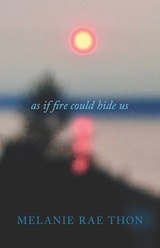
As If Fire Could Hide Us
Melanie Rae Thon
University of Alabama Press, 2023
Three lives. One song. A fire that reveals what cannot be hidden.
As If Fire Could Hide Us explores the expansiveness of consciousness and compassion through and beyond the human body.
A twelve-year-old girl slips out a basement window, steals a bike, and sets off on a perilous adventure. Injured and slowly bleeding out, Orelia enters a vast, spectacularly animate environment where she senses the limits of self disintegrating, her being entangled with the forest.
A prison guard and member of the strap down team witnesses a painfully prolonged execution and is delivered to a heart-cracking sense of identification with the ones he’s killed. Every grieving mother is his own. Any man might be himself, his closest friend, his brother.
An organ donor’s body is restored and resurrected through the bodies of multitudes. Spiritually and physically, one human being becomes many. Everything in the cosmos is intertwined and interchangeable. Embracing this awareness may bring fear or euphoria—desolation, peace, despair, rapture.
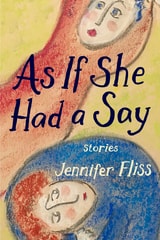
As If She Had a Say
StoriesJennifer Fliss
Northwestern University Press, 2023
Who has a right to tell us how to experience our grief? How to perform—or not perform—the roles society prescribes to us based on our various points of identity?
As If She Had a Say, the second story collection from Jennifer Fliss, uses an absurdist lens to showcase characters—predominantly women—plumbing their resources as they navigate misogyny, abuse, and grief. In these stories, a woman melts in the face of her husband’s cruelty; a seven-tablespoons-long woman lives inside a refrigerator and engages in an affair with the man of the house; a balloon-animal artist attends a funeral to discover he was invited as more than entertainment; and a man loses all his nouns.
Fans of Karen Russell and Carmen Maria Machado will appreciate how As If She Had a Say’s inventive narratives expose inequities by taking us on imaginative romps through domesticity and patriarchal expectations. Each story functions as a magnifying glass through which we might examine our own lives and see ourselves more clearly.
As If a Bird Flew By Me
A NovelSara Greenslit
University of Alabama Press, 2011
“The world is full of continuous conversations: Now is surrounded by Past, and both are encircled by Forever.” So states an unnamed narrator in As if a Bird Flew by Me.
Celia lives in the contemporary Midwest. Ann is an accused witch, executed during the Salem witch trials. Two women separated by time and place yet yoked by heritage and history. Set in three time periods, stories within stories unfold, and Greenslit’s language seamlessly weaves Celia’s modern life with the historical record of Ann’s demise alongside dazzling renderings of animal life. Greenslit’s hybrid of fiction and nonfiction occupies that rarest of airs: it is a book that illuminates, line by line and page by page, how it should be read.
As She Was Discovering Tigony
Olympe Bhêly-Quenum
Michigan State University Press, 2016
Ascension to Death
Mahmoud Azzam
Haus Publishing, 2009
The controller of Salma’s fate is her tyrannical uncle, who, as her guardian and a powerful community leader with governmental ties, is all too pleased to unload the burden of his brother’s daughter onto the first man to propose. As Salma desperately tries to escape the marriage, the novel follows her attempt to flee with her lover. But after her family colludes with the authorities against her, Salma finds herself trapped in a nightmarish ordeal of imprisonment, torture, and abandonment.
One of the most beloved Syrian novels of our time, Ascension to Death is a dark, inventive, and unflinchingly honest look at both the best and the worst to be found in human nature and our modern world.
Ascension
A NovelSteve Tomasula
University of Alabama Press, 2022
A visually stunning narrative of three eras in humankind’s vexed relationship with nature.
Ascension is a novel about the end of nature, or rather, the end of three “natures”: the time just before Darwin changed the natural world; the 1980s, just as the digital and genetic revolutions begin to replace “nature” with “environment”; and today, a time when we have the ability to manipulate nature at both the scale of the planet and at the genome. The narrative follows three different biologists on the brink of each of these cultural extinctions to explore how nature occupies our imaginations and how our imaginations bring the natural world, and our place in it, into existence.
Ascension is a story of how we continually remake the world and are in turn remade by the new nature we’ve created. It is the story of humans yearning to understand their families, themselves, and the world they live in as it comes to a close, leaving them to anticipate what will follow. Rich in visual depictions of the natural world—from nineteenth century engraving and paintings to twentieth century photography and twenty-first century databases—Ascension uses the materials of three eras to drive home our inability to escape nature, and the ways our fates are irrevocably bound together even as our actions usher in an end-time.
Ashes and Diamonds
Jerzy Andrzejewski
Northwestern University Press, 1997
Ashes of Izalco
Claribel Alegría and Darwin J. Flakoll
Northwestern University Press, 1995
Ask Your Dad
Jan Balabán
Karolinum Press, 2026
The final novel of acclaimed Czech fiction writer Jan Balabán.
Ask Your Dad centers on what Christian tradition calls “the last things.” Three siblings struggle to come to terms with the death of their father, the doctor Jan Nedoma, while also confronting a posthumous accusation made by his best friend, who accuses Nedoma of having collaborated with communist authorities. The bitter irony at the heart of the novel is that it is no longer possible for the siblings to ask their father what really happened. Questions of meaning, moral integrity, and the consequences of human actions permeate the meditative novel and are rendered with a harrowing directness. Poignantly, the novel was published posthumously.
Ask the Parrot
A Parker NovelRichard Stark
University of Chicago Press, 2017
Richard Stark's Parker novels are the hardest of hard-boiled, classic crime novels where the heists are huge, the body counts are high, and the bad guys usually win.
The Parker novels have been a huge influence on countless writers and filmmakers, including Quentin Tarantino, George Pelecanos, Colson Whitehead, Lucy Sante, and many more. Their stripped-down language and hard-as-nails amorality create an unforgettable world where the next score could be the big one, but your next mistake could also be your last. There's nothing else like them.
In Ask the Parrot, Parker’s back on the run, dodging dogs, cops, and even a helicopter. His escape brings him to rural Massachusetts, where he meets a small-town recluse who Forced to work with a small-town recluse nursing a grudge against the racetrack that fired him. Even on the run, Parker manages to get up to no good. It'll be a deadly day at the races.
Asphodel
(Hilda Doolittle) H.D.
Duke University Press, 1992
A sequel to the author's HERmione, Asphodel takes the reader into the bohemian drawing rooms of pre-World War I London and Paris, a milieu populated by such thinly disguised versions of Ezra Pound, Richard Aldington, May Sinclair, Brigit Patmore, and Margaret Cravens; on the other side of what H.D. calls "the chasm," the novel documents the war's devastating effect on the men and women who considered themselves guardians of beauty. Against this riven backdrop, Asphodel plays out the story of Hermione Gart, a young American newly arrived in Europe and testing for the first time the limits of her sexual and artistic identities. Following Hermione through the frustrations of a literary world dominated by men, the failures of an attempted lesbian relationship and a marriage riddled with infidelity, the birth of an illegitimate child, and, finally, happiness with a female companion, Asphodel describes with moving lyricism and striking candor the emergence of a young and gifted woman from her self-exile.
Editor Robert Spoo's introduction carefully places Asphodel in the context of H.D.'s life and work. In an appendix featuring capsule biographies of the real figures behind the novel's fictional characters, Spoo provides keys to this roman à clef.
Assault on Paradise
Tatiana Lobo
Northwestern University Press, 1998
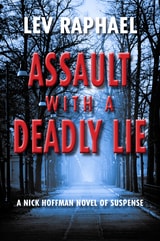
Assault with a Deadly Lie
A Nick Hoffman Novel of SuspenseLev Raphael
University of Wisconsin Press, 2014
A novel of suspense set in the academic world, Assault with a Deadly Lie probes the disturbing psychological impact of slander, harassment, stalking, police brutality, and the loss of personal safety. What will Nick do when his world threatens to collapse? How can he reestablish order in a suddenly chaotic life?
Assault with a Deadly Lie, the eighth installment of Lev Raphael's Nick Hoffman Mysteries, propels the series to a new level of danger and intrigue as Nick and Stefan are catapulted out of their tranquil existence by shocking accusations.
Finalist, Midwest Book Award for Mystery/Thriller Fiction, Midwest Independent Publishers Association
“A riveting great read for mystery/suspense fans, author Lev Raphael once again documents his impressive gifts as a storyteller, holding the reader’s rapt attention from beginning to end with unexpected plot twists and surprise twists.”—Jack Mason, Midwest Book Review
“Raphael portrays with frightening power the wrenching experience of victimization by the corporatized, PR-prioritized groves of academia, where both men teach, and by local authorities militarized into SWAT teams practicing police brutality. . . . The compelling core of this unusual novel is Raphael’s depiction of the agonizing reality of victims’ shame, in which someone ‘feels doubly exposed talking about the violation’ and so says nothing.”—Booklist
“Professor Nick Hoffman learns that even tenure can’t guarantee real security.”—Kirkus Reviews
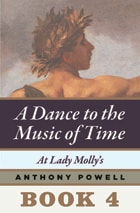
At Lady Molly's
Book 4 of A Dance to the Music of TimeAnthony Powell
University of Chicago Press, 1995
Anthony Powell’s universally acclaimed epic A Dance to the Music of Time offers a matchless panorama of twentieth-century London. Now, for the first time in decades, readers in the United States can read the books of Dance as they were originally published—as twelve individual novels—but with a twenty-first-century twist: they’re available only as e-books.
As the fourth book, At Lady Molly’s (1957), opens, the heady pleasures of the 1920s have begun to give way to the austerity and worries of the 1930s. Even so, the whirl of London life continues: friends commit to causes and to spouses, confess adulteries, and fall victim to dissipation and disillusion. As Nick moves ever more comfortably in the worlds of art, culture, and society, Powell’s palette broadens: old friends make appearances, but new ones take places on the stage as well—including Isobel Tolland, whom Nick knows at first sight he’s destined to marry.
"Anthony Powell is the best living English novelist by far. His admirers are addicts, let us face it, held in thrall by a magician."--Chicago Tribune
"A book which creates a world and explores it in depth, which ponders changing relationships and values, which creates brilliantly living and diverse characters and then watches them grow and change in their milieu. . . . Powell's world is as large and as complex as Proust's."--Elizabeth Janeway, New York Times
"One of the most important works of fiction since the Second World War. . . . The novel looked, as it began, something like a comedy of manners; then, for a while, like a tragedy of manners; now like a vastly entertaining, deeply melancholy, yet somehow courageous statement about human experience."--Naomi Bliven, New Yorker
“The most brilliant and penetrating novelist we have.”--Kingsley Amis
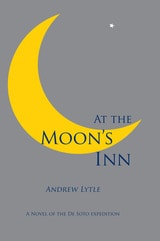
At the Moon's Inn
Andrew Lytle
University of Alabama Press, 2009
At the Moon’s Inn, first published in 1941, provides a fictional account of De Soto’s famous Spanish expedition to La Florida and through the southeastern United States between 1539 and 1543. The novel begins in Spain in 1538, where De Soto and his chief lieutenants, veterans of the campaigns in South America, pledge themselves to a new enterprise to explore and exploit La Florida. The narrative follows them on their voyage to Cuba, where they rest and obtain additional supplies, then set sail for the area now known as Tampa Bay. Lytle’s brilliant historical novel takes the readers with the conquistadores through the hot, humid land, where despite their advantage in military technology they found they must rely on the Indians for food. The author explores the cultural confrontation that seriously weakened the Indians, while the Spaniards’ dreams of gold gradually turned to hopes of survival in the hostile environment.
Drawing his facts from the 1939 United States De Soto Commission Report and from the surviving historical chronicles of the expedition, Lytle weaves a fascinating tale that brings to life the history of Spanish efforts to establish a controlling presence in the New World during the first half of the 16th century.
In his introduction, Douglas Jones places At the Moon’s Inn within the context of the documentary record, as well as within the framework of its distinguished author’s career.
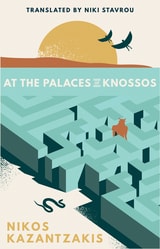
At the Palaces of Knossos
Nikos Kazantzakis
Ohio University Press, 2025
A captivating retelling—newly translated—of the rise and fall of the Minoan civilization interwoven with some of ancient Greece’s most enduring myths
At the Palaces of Knossos is a vivid reimagining of ancient Crete, blending history and mythology into an epic tale of heroism, love, and destiny. Set against the grandeur of the Minoan court, the novel brings to life the legendary stories of Theseus, the Minotaur, Ariadne, Daedalus, and Icarus.
The story follows Theseus, the prince of Athens, who arrives in Crete as part of the annual tribute of young Athenians sent to feed the monstrous Minotaur. Determined to end this brutal cycle, he infiltrates the labyrinthine palace of Knossos, where he crosses paths with Princess Ariadne. Struggling between loyalty to her people and her love for the courageous stranger, Ariadne risks everything to help Theseus in his quest.
Through the eyes of palace attendants, acrobats, and the inventor Daedalus and his son Icarus, Kazantzakis transports readers into the splendor of Minoan culture—its sacred rituals, breathtaking bull-leaping ceremonies, and vibrant city life. But as Theseus prepares to face his destiny, a tragic chain of events unfolds, leading to heartbreak, betrayal, and the downfall of a once-mighty civilization.
Rich with philosophical depth and lyrical prose, At the Palaces of Knossos is more than a mythological retelling—it is a meditation on power, freedom, and the eternal struggle between fate and human will. Perfect for fans of historical fiction and Greek mythology, this novel offers a compelling journey into one of the ancient world’s most fascinating eras.
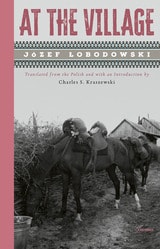
At the Village
Józef Lobodowski
Central European University Press, 2026
The book’s protagonist, Stas, finds himself the guest of the Cossack Jakov Antonovich, a scholar as well as a military leader and an agricultural potentate. His time at Antonovich’s stanitsa provides him with an incomparable education in the history of the old Polish Commonwealth of nations, which at its height encompassed Poland, Ukraine, Belarus, Lithuania, Latvia and Estonia. It is a lesson all the more engaging to the reader in that it is presented from a perspective that is neither Polish nor Russian, but Cossack. Through Lobodowski’s interweaving of historical reflection with sumptuous descriptions of agricultural life on the well-ordered stanitsa, At the Village is sometimes compared to the Polish national epic, Adam Mickiewicz’s Pan Tadeusz (1834), upon which Lobodowski is said to have consciously modelled the novel.
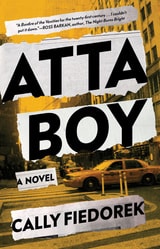
Atta Boy
Cally Fiedorek
University of Iowa Press, 2024
A Vulture Best Book of 2024
In December 2018, we meet Rudy Coyle, a bar owner’s son from Flushing, Queens, in the throes of a major quarter-life crisis. Cut out of the family business, he gets a Hail Mary job as a night doorman in a storied Park Avenue apartment building, where he comes under the wing of the family in 4E, the Cohens.
Jacob “Jake” Cohen, the fast-talking patriarch, is one of a generation of financiers who made hundreds of millions of dollars in the cutthroat taxi medallion industry in the early 2000s, largely by preying on the hopes and dreams of impoverished immigrant drivers. As Jake tries to stop the bleed from the debt crisis now plaguing his company, clawing back his assets from an increasingly dangerous coterie of Russian American associates, Rudy gets promoted from doorman to errand boy to bodyguard to something like Jake’s right-hand man.
By turns a gripping portrait of corruption and a tender family dramedy, Atta Boy combines the urban cool of Richard Price with the glossy, uptown charm of Taffy Brodesser-Akner. Here is a novel richly attuned to its time and place, but with something for everyone—high-wire prose and a story wedding ripped from the headlines, social realism with the warmth, angst, and humor of its indelible voices.
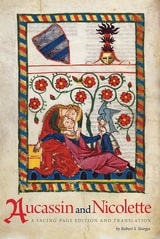
Aucassin and Nicolette
A Facing-Page Edition and TranslationRobert S. Sturges
Michigan State University Press, 2015
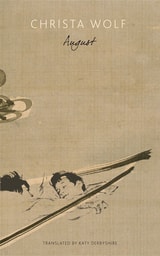
August
Christa Wolf
Seagull Books, 2019
August is Christa Wolf’s last piece of fiction, written in a single sitting as an anniversary gift to her husband. In it, she revisits her stay at a tuberculosis hospital in the winter of 1946, a real life event that was the inspiration for the closing scenes of her 1976 novel Patterns of Childhood. This time, however, her fictional perspective is very different. The story unfolds through the eyes of August, a young patient who has lost both his parents to the war. He adores an older girl, Lilo, a rebellious teenager who controls the wards. Sixty years later, August reflects on his life and the things that she taught him.
Written in taut, affectionate prose, August offers a new entry into Christa Wolf’s work and, incidentally, her first and only male protagonist. More than a literary artifact, this new novel is a perfectly constructed story of a quiet life well lived. For both August and Christa Wolf, the past never dies.
Aunt Rachel's Fur
Raymond Federman
University of Alabama Press, 2001
In Aunt Rachel’s Fur, Raymond Federman—French by birth, American by adoption, Jew by memory—plays with the language of his childhood to construct a story from digressions. Federman’s narrative spirals into a temporal abyss as he rummages in old memories tattooed with cabbages, plump breasts, and the Final Solution. His book swirls with the narrative innovations that mark him as a leading experimental surfictioneer.
Aunt Rachel’s Fur is a novel about its own telling, an intimate meeting between voice and reader, in which flesh and blood are reduced to fiction, and fiction, by its telling, becomes fact. Reymond Namredef, a French expatriate, has returned to France after a disastrous decade in America, with 365 boxes of pasta and the hope of publishing his novel about a novelist. In a cafe in Paris, he meets a "professional listener," and, through a series of conversations, offers a loose account of his life that shows little respect for chronology. His story is woven of fragments, branching out over a lifetime and capturing the alchemy of fiction and memory.
Faced with the chaos of the twentieth century, Federman finds humanity in the absurd. Like novelists Mark Amerika and Ronald Sukenick, he skewers literary convention and pushes the boundary of postmodernism. Aunt Rachel’s Fur is both a tribute to his love of the word—the story as it is told—and a further exploration of our understanding of fiction.
Aunty Lily
and other delightfully perverse storiesJennifer Munro
Parkhurst Brothers, Inc., 2016
Munro’s stories were born five decades ago in a small English village where children were seen and not heard, fathers were wacky, neighbors were snoopy, and maiden aunts were beautifully crafted artifices. Her original stories, dolloped with characters reminiscent of those from her childhood, telling of domestic shenanigans and outings gone revealingly awry are written with meticulous timing. Rich in details about the frailty and strength of the human spirit, her stories resonate with the truth of what is means to be human.
Avala Is Falling
Biljana Jovanovic
Central European University Press, 2020
In Avala Is Falling, Jovanović’s breakout success in 1978, a young woman challenges the expectations that teachers, parents, bus drivers, and doctors have for her. The “Avala” of the title refers to a mountain south of Belgrade which is home to some of Serbia’s most important nationalist monuments and shrines; it is also the site of the main mental hospital for the region, and its “falling” is the unexpected fulfillment of a prophecy from a traditional Serbian folk song. Jovanović’s use of stream of consciousness in her characters’ thinking and speaking, as well as of intertextuality in description and plot advancement heralded the arrival of an innovative new writer who was determined to break with the of traditional concerns of earlier women writers.
This book is now recognized as much more than “jeans prose,” although the fame the book achieved under that characterization eventually pushed it to cult status. Jovanović is now considered a major avant-garde writer, whose stylistic innovations were as challenging as her women-centered themes.