Results by title
4155 books match the query 'State & Local' and 398 start with a
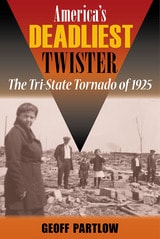
America's Deadliest Twister
The Tri-State Tornado of 1925Geoff Partlow
Southern Illinois University Press, 2014
Winner, ISHS Certificate of Excellence, 2015
Disaster relief as we know it did not exist when the deadliest tornado in U.S. history gouged a path from southeast Missouri through southern Illinois and into southwestern Indiana. The tri-state tornado of 1925 hugged the ground for 219 miles, generated wind speeds in excess of 300 miles per hour, and killed 695 people. Drawing on survivor interviews, public records, and newspaper archives, America’s Deadliest Twister offers a detailed account of the storm, but more important, it describes life in the region at that time as well as the tornado’s lasting cultural impact, especially on southern Illinois.
Author Geoff Partlow follows the storm from town to town, introducing us to the people most affected by the tornado, including the African American population of southern Illinois. Their narratives, along with the stories of the heroes who led recovery efforts in the years following, add a hometown perspective to the account of the storm itself.
In the discussion of the aftermath of the tornado, Partlow examines the lasting social and economic scars in the area, but he also looks at some of the technological firsts associated with this devastating tragedy. Partlow shows how relief efforts in the region began to change the way people throughout the nation thought about disaster relief, which led to the unified responses we are familiar with today.
America's First Olympics
The St. Louis Games of 1904George R. Matthews
University of Missouri Press, 2005
America's Religious Crossroads
Faith and Community in the Emerging MidwestStephen T. Kissel
University of Illinois Press, 2021
Perceptive and broad in scope, America’s Religious Crossroads illuminates the integral relationship between communal and spiritual growth in early Midwestern history.
America's Switzerland
Estes Park and Rocky Mountain National Park, the Growth YearsJames H. Pickering
University Press of Colorado, 2005
American Anti-Pastoral
Brookside, New Jersey and the Garden State of Philip RothThomas Gustafson
Rutgers University Press, 2024
American Anti-Pastoral reads the events in Roth’s novel in relation to the history of Brookside and its region. While Roth’s protagonist Seymour “Swede” Levov initially views Old Rimrock as an idyllic paradise within the Garden State, its real-world counterpart has a more complex past in its origins as a small industrial village, as well as a site for the politics of exclusionary zoning and a 1960s anti-war protest at its celebrated 4th of July parade. Literary historian and Brookside native Thomas Gustafson casts Roth’s canonical novel in a fresh light as he studies both Old Rimrock in comparison to Brookside and the novel in relationship to NJ literature, making a case for it as the Great New Jersey novel. For Roth fans and history buffs alike, American Anti-Pastoral peels back the myths about the bucolic Garden State countryside to reveal deep fissures along the fault-lines of race and religion in American democracy.
American Atrocity
The Types of Violence in LynchingGuy Lancaster
University of Arkansas Press, 2021
Lynching is often viewed as a narrow form of violence: either the spontaneous act of an angry mob against accused individuals, or a demonstration of white supremacy against an entire population considered subhuman. However, in this new treatise, historian Guy Lancaster exposes the multiple forms of violence hidden beneath the singular label of lynching.
Lancaster, who has written extensively on racial violence, details several lynchings of Blacks by white posses in post-Reconstruction Arkansas. Drawing from the fields of history, philosophy, cognitive science, sociology, and literary theory, and quoting chilling contemporary accounts, he argues that the act of lynching encompasses five distinct but overlapping types of violence. This new framework reveals lynching to be even more of an atrocity than previously understood: that mobs did not disregard the humanity of their victims but rather reveled in it; that they were not simply enacting personal vengeance but manifesting an elite project of subjugation. Lancaster thus clarifies and connects the motives and goals of seemingly isolated lynch mobs, embedding the practice in the ongoing enforcement of white supremacy. By interrogating the substance of lynching, American Atrocity shines new light on both past anti-Black violence and the historical underpinnings of our present moment.

American Birkebeiner
The Nation's Greatest Ski MarathonJerome P. Poling
Wisconsin Historical Society Press, 2025
An exhilarating behind-the-scenes journey into the history of America’s largest cross-country ski race
Each February, cross-country skiers from across the nation and around the world descend upon the sleepy northern Wisconsin town of Hayward to compete in the American Birkebeiner—the largest cross-country ski race in North America. In American Birkebeiner: The Nation’s Greatest Ski Marathon, author and skier Jerome P. Poling traces the remarkable history of the famed “Birkie,” from its modest origins in the early 1970s to its modern incarnation as an international Nordic-themed festival and multi-day racing event drawing more than 30,000 skiers and spectators.
American Birkebeiner offers an up-close, behind-the-scenes tour of all things Birkie—from pre-race preparations and skier profiles to race-day highlights and history-making finishes. It also tells the story of visionary race founder Tony Wise and his efforts to popularize the sport of cross-country skiing in the Upper Midwest. The book delves into the origin and evolution of the world-class Birkebeiner Trail and the communities that support it, as well as the ways the American Birkebeiner Ski Foundation is adapting to climate change to help ensure the event thrives for years to come.
American Birkebeiner sparks with lively, narrative-driven prose and is based on extensive archival research, reporting, and personal interviews. The lavishly illustrated book also features 150 photographs, including intimate portraits of athletes pushed to the limits of their endurance, sweeping aerial shots of skiers and cheering crowds, and awe-inspiring winter vistas. An exquisitely crafted ode to an extraordinary race, American Birkebeiner will inspire winter sports fans and outdoor enthusiasts alike.
American City
A Rank and File History of MinneapolisCharles Rumford Walker
University of Minnesota Press, 2005
American Daughter
A Midcentury Memoir of Black Life on the PlainsEra Bell Thompson
University of Chicago Press, 2026
A portrait of Black life in the Great Plains, written by a key figure in the Chicago Renaissance and decades-long editor of Ebony.
Era Bell Thompson grew up on the plains of North Dakota, where she and her family were some of the only Black people amid an overwhelmingly white population. American Daughter, originally published in 1946, recounts her childhood in the rural West, her college years in Iowa, and the social and racial revelations she experienced upon arriving in Chicago, where she first encountered a large Black community.
Her memories defy contemporary assumptions. She was a popular high school student, even if she was forced to disarm ignorant questions from her peers. She describes her father’s work for the governor, her family’s interactions with diverse Midwestern immigrant communities, the natural beauty of the landscape, and the collaborative spirit necessary to survive the harsh weather conditions in North Dakota. As an adult in Chicago, she discovered lifestyles and attitudes that were entirely unfamiliar after her childhood in predominantly white spaces. While Thompson endured discrimination in rural and urban settings alike, she relied on her trademark humor to defuse tensions and bridge differences. Her memoir similarly radiates optimism, curiosity, and wit.
Long out of print, this new edition includes a foreword by the Chicago-based journalist Natalie Y. Moore, who not only contextualizes the memoir for contemporary readers but also explores Thompson’s life after American Daughter, including her trailblazing career as an editor for Ebony magazine.
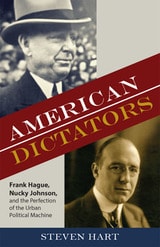
American Dictators
Frank Hague, Nucky Johnson, and the Perfection of the Urban Political MachineHart, Steven
Rutgers University Press, 2013
One man was tongue-tied and awkward around women, in many ways a mama's boy at heart, although his reputation for thuggery was well earned. The other was a playboy, full of easy charm and ready jokes, his appetite for high living a matter of public record. One man tolerated gangsters and bootleggers as long as they paid their dues to his organization. The other was effectively a gangster himself, so crooked that he hosted a national gathering of America's most ruthless killers. One man never drank alcohol. The other, from all evidence, seldom drank anything else.
American Dictators is the dual biography of two of America’s greatest political bosses: Frank Hagueand Enoch “Nucky” Johnson. Packed with compelling information and written in an informal, sometimes humorous style, the book shows Hague and Johnson at the peak of their power and the strength of their political machines during the years of Prohibition and the Great Depression. Steven Hart compares how both men used their influence to benefit and punish the local citizenry, amass huge personal fortunes, and sometimes collaborate to trounce their enemies.
Similar in their ruthlessness, both men were very different in appearance and temperament. Hague, the mayor of Jersey City, intimidated presidents and wielded unchallenged power for three decades. He never drank and was happily married to his wife for decades. He also allowed gangsters to run bootlegging and illegal gambling operations as long as they paid protection money. Johnson, the political boss of Atlantic City, and the inspiration for the hit HBO series Boardwalk Empire, presided over corruption as well, but for a shorter period of time. He was notorious for his decadent lifestyle. Essentially a gangster himself, Johnson hosted the infamous Atlantic City conference that fostered the growth of organized crime.
Both Hague and Johnson shrewdly integrated otherwise disenfranchised groups into their machines and gave them a stake in political power. Yet each failed to adapt to changing demographics and circumstances. In American Dictators, Hart paints a balanced portrait of their accomplishments and their failures.

American Dunkirk
The Waterborne Evacuation of Manhattan on 9/11James M Kendra
Temple University Press, 2016
When the terrorist attacks struck New York City on September 11, 2001, boat operators and waterfront workers quickly realized that they had the skills, the equipment, and the opportunity to take definite, immediate action in responding to the most significant destructive event in the United States in decades. For many of them, they were “doing what needed to be done.”
American Dunkirk shows how people, many of whom were volunteers, mobilized rescue efforts in various improvised and spontaneous ways on that fateful date. Disaster experts James Kendra and Tricia Wachtendorf examine the efforts through fieldwork and interviews with many of the participants to understand the evacuation and its larger implications for the entire practice of disaster management.
The authors ultimately explore how people—as individuals, groups, and formal organizations—pull together to respond to and recover from startling, destructive events. American Dunkirk asks, What can these people and lessons teach us about not only surviving but thriving in the face of calamity?
American Hotel
The Waldorf-Astoria and the Making of a CenturyDavid Freeland
Rutgers University Press, 2021
American Hotel takes us behind the glittering image to reveal the full extent of the Waldorf’s contribution toward shaping twentieth-century life and culture. Historian David Freeland examines the Waldorf from the opening of its first location in 1893 through its rise to a place of influence on the local, national, and international stage. Along the way, he explores how the hotel’s mission to provide hospitality to a diverse range of guests was put to the test by events such as Prohibition, the anticommunist Red Scare, and civil rights struggles.
Alongside famous guests like Frank Sinatra, Martin Luther King, Richard Nixon, and Eleanor Roosevelt, readers will meet the lesser-known men and women who made the Waldorf a leader in the hotel industry and a key setting for international events. American Hotel chronicles how institutions such as the Waldorf-Astoria played an essential role in New York’s growth as a world capital.
American Indians and National Forests
Theodore Catton
University of Arizona Press, 2016
Marginalized in American society and long denied a seat at the table of public land stewardship, American Indian tribes have at last taken their rightful place and are making themselves heard. Weighing indigenous perspectives on the environment is an emerging trend in public land management in the United States and around the world. The Forest Service has been a strong partner in that movement over the past quarter century.
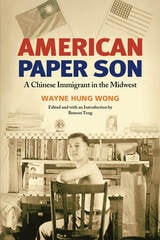
American Paper Son
A Chinese Immigrant in the MidwestWayne Hung Wong
University of Illinois Press, 2005
In the early and mid-twentieth century, Chinese migrants evaded draconian anti-immigrant laws by entering the US under false papers that identified them as the sons of people who had returned to China to marry. Wayne Hung Wong tells the story of his life after emigrating to Wichita, Kansas, as a thirteen-year-old paper son. After working in his father’s restaurant as a teen, Wong served in an all-Chinese Air Force unit stationed in China during World War II. His account traces the impact of race and segregation on his service experience and follows his postwar life from finding a wife in Taishan through his involvement in the government’s amnesty program for Chinese immigrants and career in real estate. Throughout, Wong describes the realities of life as part of a small Chinese American community in a midwestern town.
Vivid and rich with poignant insights, American Paper Son explores twentieth-century Asian American history through one person’s experiences.
American Pogrom
The East St. Louis Race Riot and Black PoliticsCharles L. Lumpkins
Ohio University Press, 2008
Charles Lumpkins shows that black residents of East St. Louis had engaged in formal politics since the 1870s, exerting influence through the ballot and through patronage in a city dominated by powerful real estate interests even as many African Americans elsewhere experienced setbacks in exercising their political and economic rights.
While Lumpkins asserts that the race riots were a pogrom—an organized massacre of a particular ethnic group—orchestrated by certain businessmen intent on preventing black residents from attaining political power and on turning the city into a “sundown” town permanently cleared of African Americans, he also demonstrates how the African American community survived. He situates the activities of the black citizens of East St. Louis in the context of the larger story of the African American quest for freedom, citizenship, and equality.
American Sweepstakes
How One Small State Bucked the Church, the Feds, and the Mob to Usher in the Lottery AgeKevin Flynn
University Press of New England, 2015
American Warsaw
The Rise, Fall, and Rebirth of Polish ChicagoDominic A. Pacyga
University of Chicago Press, 2019
Every May, a sea of 250,000 people decked out in red and white head to Chicago’s Loop to celebrate the Polish Constitution Day Parade. In the city, you can tune in to not one but four different Polish-language radio stations or jam out to the Polkaholics. You can have lunch at pierogi food trucks or pick up pączkis at the grocery store. And if you’re lucky, you get to take off work for Casimir Pulaski Day. For more than a century, Chicago has been home to one of the largest Polish populations outside of Poland, and the group has had an enormous influence on the city’s culture and politics. Yet, until now, there has not been a comprehensive history of the Chicago Polonia.
With American Warsaw, award-winning historian and Polish American Dominic A. Pacyga chronicles more than a century of immigration, and later emigration back to Poland, showing how the community has continually redefined what it means to be Polish in Chicago. He takes us from the Civil War era until today, focusing on how three major waves of immigrants, refugees, and fortune seekers shaped and then redefined the Polonia. Pacyga also traces the movement of Polish immigrants from the peasantry to the middle class and from urban working-class districts dominated by major industries to suburbia. He documents Polish Chicago’s alignments and divisions: with other Chicago ethnic groups; with the Catholic Church; with unions, politicians, and city hall; and even among its own members. And he explores the ever-shifting sense of Polskość, or “Polishness.”
Today Chicago is slowly being eclipsed by other Polish immigrant centers, but it remains a vibrant—and sometimes contentious—heart of the Polish American experience. American Warsaw is a sweeping story that expertly depicts a people who are deeply connected to their historical home and, at the same time, fiercely proud of their adopted city. As Pacyga writes, “While we were Americans, we also considered ourselves to be Poles. In that strange Chicago ethnic way, there was no real difference between the two.”
Amish in Michigan
Gertrude Enders Huntington
Michigan State University Press, 2001
Driving the rural roads of Michigan one might suddenly come upon a black buggy driven by a bonneted woman or a bearded Amish man. In 1955 there were fewer than five hundred Amish in Michigan—in 2000 there were more than seven thousand. The Amish, with their unique life-style, are found only in North America where approximately 170,000 live in twenty-four states and one Canadian province. This sensitive and fascinating volume explores the Amish historical background, immigration into Michigan, occupations, marriage patterns, cultural conflicts, community-financed schools, medical practices, and cultural survival.
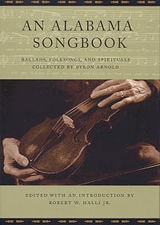
An Alabama Songbook
Ballads, Folksongs, and Spirituals Collected by Byron ArnoldRobert W. Halli Jr.
University of Alabama Press, 2004
Alabama is a state rich in folksong tradition, from old English ballads sung along the Tennessee River to children’s game songs played in Mobile, from the rhythmic work songs of the railroad gandy dancers of Gadsden to the spirituals of the Black Belt. The musical heritage of blacks and whites, rich and poor, hill folk and cotton farmers, these songs endure as a living part of the state’s varied past.
In the mid 1940s Byron Arnold, an eager young music professor from The University of Alabama, set out to find and record as many of these songs as he could and was rewarded by unstinting cooperation from many informants. Mrs. Julia Greer Marechal of Mobile, for example, was 90 years old, blind, and a semi-invalid, but she sang for Arnold for three hours, allowing the recording of 33 songs and exhausting Arnold and his technician. Helped by such living repositories as Mrs. Marechal, the Arnold collection grew to well over 500 songs, augmented by field notes and remarkable biographical information on the singers.
An Alabama Songbook is the result of Arnold’s efforts and those of his informants across the state and has been shaped by Robert W. Halli Jr. into a narrative enriched by more than 200 significant songs-lullabies, Civil War anthems, African-American gospel and secular songs, fiddle tunes, temperance songs, love ballads, play-party rhymes, and work songs. In the tradition of Alan Lomax’s The Folk Songs of North America and Vance Randolph’s Ozark Folksongs, this volume will appeal to general audiences, folklorists, ethnomusicologists, preservationists, traditional musicians, and historians.
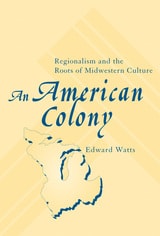
An American Colony
Regionalism and the Roots of Midwestern CultureEdward Watts
Ohio University Press, 2002
The Old Northwest—the region now known as the Midwest—has been largely overlooked in American cultural history, represented as a place smoothly assimilated into the expanding, manifestly-destined nation. An American Colony: Regionalism and the Roots of Midwestern Culture studies the primary texts and principal conflicts of the settlement of the Old Northwest to reveal that its entry into the nation’s culture was not without problems. In fact, Edward Watts argues that it is best understood as a colony of the United States, just as the eastern states were colonies of the British Empire.
Reconsidered as a colony, the Old Northwest becomes a crucible revealing the complex entanglement of local, indigenous, and regional interests with the coercions of racism, nationalism, and imperialism. This conflicted setting, like those of all settlement colonies, was beset by competing views of local identity, especially as they came to contradict writers from the eastern seaboard.
Using postcolonial theories developed to describe other settlement colonies, An American Colony identifies the Old Northwest as a colony and its culture as less than fully participating in either the nation’s or its own writing and identity. This embedded sense of cultural inferiority, Watts argues, haunts Midwestern culture even today.
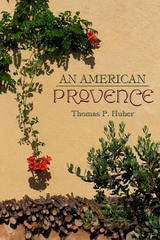
An American Provence
Thomas P. Huber
University Press of Colorado, 2011
-From An American Provence
In this poetic personal narrative, Thomas P. Huber reflects on two seemingly unrelated places-the North Fork Valley in western Colorado and the Coulon River Valley in Provence, France-and finds a shared landscape and sense of place. What began as a simple comparison of two like places in distant locations turned into a more complex, interesting, and personal task. Much is similar-the light, the valleys, the climate, the agriculture. And much is less so-the history, the geology, the physical makeup of villages. Using a geographer's eye and passion for the land and people, Huber examines the regions' similarities and differences to explore the common emotional impact of each region. Part intimate travelogue and part case study of geography in the real world, An American Provence illuminates the importance sense of place plays in who we are.
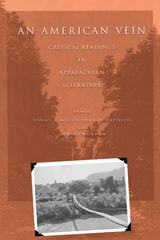
An American Vein
Critical Readings in Appalachian LiteratureDanny L. Miller
Ohio University Press, 2005
The blossoming of Appalachian studies began some thirty years ago. Thousands of young people from the hills have since been made aware of their region’s rich literary tradition through high school and college courses. An entire generation has discovered that their own landscapes, families, and communities had been truthfully portrayed by writers whose background was similar to their own.
An American Vein: Critical Readings in Appalachian Literature is an anthology of literary criticism of Appalachian novelists, poets, and playwrights. The book reprises critical writing of influential authors such as Joyce Carol Oates, Cratis Williams, and Jim Wayne Miller. It introduces new writing by Rodger Cunningham, Elizabeth Engelhardt, and others.
Many writers from the mountains have found success and acclaim outside the region, but the region itself as a thriving center of literary creativity has not been widely appreciated. The editors of An American Vein have remedied this, producing the first general collection of Appalachian literary criticism. This book is a resource for those who teach and read Appalachian literature. What’s more, it holds the promise of introducing new readers, nationally and internationally, to Appalachian literature and its relevance to our times.
An Analysis of Effigy Mound Complexes in Wisconsin
William M. Hurley
University of Michigan Press, 1975
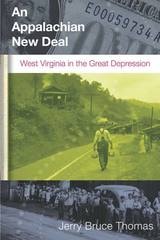
An Appalachian New Deal
West Virginia in the Great DepressionJerry Bruce Thomas
West Virginia University Press, 2011
In this paperback edition of An Appalachian New Deal: West Virginia in the Great Depression, Jerry Bruce Thomas examines the economic and social conditions of the state of West Virginia before, during, and after the Great Depression. Thomas’s exploration of personal papers by leading political and social figures, newspapers, and the published and unpublished records of federal, state, local, and private agencies, traces a region’s response to an economic depression and a presidential stimulus program. This dissection of federal and state policies implemented under Franklin D. Roosevelt’s New Deal program reveals the impact of poverty upon political, gender, race, and familial relations within the Mountain State—and the entire country. Through An Appalachian New Deal, Thomas documents the stories of ordinary citizens who survived a period of economic crisis and echoes a message from our nation’s past to a new generation enduring financial hardship and uncertainty.
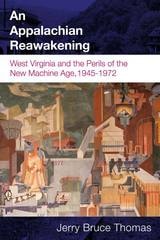
An Appalachian Reawakening
West Virginia and the Perils of the New Machine Age, 1945-1972JERRY B. THOMAS
West Virginia University Press, 2010
As the long boom of post-World War II economic expansion spread across the globe, dreams of white picket fences, democratic ideals, and endless opportunities flourished within the United States. Middle America experienced a period of affluent stability built upon a modern age of industrialization. Yet for the people of Appalachia, this new era brought economic, social, and environmental devastation, preventing many from realizing the American Dream. Some families suffered in silence; some joined a mass exodus from the mountains; while others, trapped by unemployment, poverty, illness, and injury became dependent upon welfare. As the one state most completely Appalachian, West Virginia symbolized the region's dilemma, even as it provided much of the labor and natural resources that fueled the nation's prosperity.
An Appalachian Reawakening: West Virginia and the Perils of the New Machine Age, 1945-1972 recounts the difficulties the state of West Virginia faced during the post-World War II period. While documenting this turmoil, this valuable analysis also traces the efforts of the New Frontier and Great Society programs, which stimulated maximum feasible participation and lead to the ultimate rise of grass roots activities and organizations that improved life and labor in the region and undermined the notion of Appalachian fatalism.
An Appeal to Justice
Litigated Reform of Texas PrisonsBy Ben M. Crouch and James W. Marquart
University of Texas Press, 1989
How does a prison achieve institutional order while safeguarding prisoners' rights? Since the early 1960s, prison reform advocates have aggressively used the courts to extend rights and improve life for inmates, while prison administrators have been slow to alter the status quo. Litigated reform has been the most significant force in obtaining change.
An Appeal to Justice is a critical tudy of how the Texas Department of Corrections was transformed by Ruiz v. Estelle, the most sweeping class-action suit in correctional law history. Orders from federal judge William W. Justice rapidly moved the Texas system from one of the most autonomous, isolated, and paternalistic system to a more constitutional bureaucracy. In many respects the Texas experience is a microcosm of the transformation of American corrections over the second half of the twentieth century.
This is a careful account of TDC's fearful past as a plantation system, its tumultuous litigated reform, and its subsequent efforts to balance prisoner rights and prison order. Of major importance is the detailed examination of the broad stages of the reform process (and its costs and benefits) and an intimate look at prison brutality and humanity. The authors examine the terror tactics of the inmate guards, the development of prisoner gangs and widespread violence during the reforms, and the stability that eventually emerged. They also detail the change of the guard force from a relatively small, cohesive cadre dependent on discretion, personal loyalty, and physical dominance to a larger and more fragmented security staff controlled by formal procedures.
Drawing on years of research in archival sources and on hundreds of interviews with prisoners, administrators, and staff, An Appeal to Justice is a unique basis for assessing the course and consequences of prison litigation and will be valuable reading for legislators, lawyers, judges, prison administrators, and concerned citizens, as well as prison and public policy scholars.
An Appraisal of Tree-Ring Dated Pottery in the Southwest
David A. Breternitz
University of Arizona Press, 1966
An Arizona Chronology
Statehood, 1913–1936Douglas D. Martin; Edited by Patricia Paylore
University of Arizona Press, 1966
Here were the years in which Arizona’s “bad men” virtually dropped out of sight, and the trigger-blast was displaced by the gavel-thumping sound of law and order as a Territory grew up and became a state. The problem of the Apache was no more, and the problem of water began to loom large. Depression and prohibition were the counter-themes. And Arizona’s three C's—Copper, Cattle, and Cotton—were about to strike for their place in the national limelight.
It was a time of conversion. The vital currents of frontier energy were turned into the channels of modern agriculture, finance, and urban growth. As this volume’s editor, Patricia Paylore, points out, the transformation reaffirms Douglas Martin’s view of Arizona history as the “persistence of the pioneer spirit of the nineteenth century” in terms of “the strength and optimism of a young people determined to take its place in the Union.”
An Arizona Chronology
The Territorial Years, 1846–1912Douglas D. Martin
University of Arizona Press, 1963
Who better to choose news items giving a key to the times than Douglas D. Martin, who first set newspaper type when he was 15, filled news and magazine columns and book pages galore, and today at 75 is still writing for print? He knows newspapers from the composing room to the editor's desk—Detroit Free Press—not excepting reportorial beats, having received the Pulitzer Prize for reporting on his own.
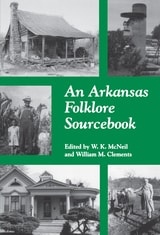
An Arkansas Folklore Sourcebook
W.K. McNeil
University of Arkansas Press, 1992
Arkansas’s rich folk tradition is shown by the variety of its manifestations: a 250-year-old ballad, an archaic method of hewing railroad crossties with a broadax, the use of poultices and toddies to treat the common cold, and swamps of evil repute are all parts of the tradition that constitutes Arkansas folklore. In fact, as the essays selected by W.K. McNeil and William M. Clements show, these few examples only begin to tell the story.
Starting with a working description of folklore as “cultural material that is traditional and unofficial” and characterized by a pattern of oral transmission, variation, formulaic structures, and usually uncertain origin, the authors survey in detail a wide array of folk objects, activities, beliefs, and customs. Among the rich offerings in this sourcebook are a discussion of the history of folklore research in Arkansas, an examination of some of the traditional songs and music still being preformed, a thoughtful exploration of the serious side of “tall tales” and “windies,” an investigation of folk architecture in Arkansas and what it reveals about our cultural origins, a study of many traditional foods and there preparation methods, an analysis of superstitions and beliefs, and a description of festivals and celebrations that are observed to this day.
Complemented by biographies of reference works and audio and video recordings of the state’s folk materials, An Arkansas Folklore Sourcebook is the first complete guide to the study of one state’s “unofficial culture.”
An Arkansas History for Young People
Fourth EditionShay E. Hopper
University of Arkansas Press, 2008
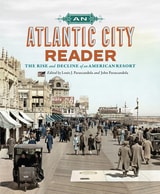
An Atlantic City Reader
The Rise and Decline of an American ResortLouis J. Parascandola
Rutgers University Press, 2026
As Atlantic City grew to become one of the largest tourist destinations on the East Coast, it loomed ever larger in the imaginations of American writers. Generation upon generation of novelists, journalists, musicians, and poets visited Atlantic City and left with vivid impressions of its kaleidoscopic delights and its seedy underbelly.
This new reader collects all of these diverse perspectives on the city in one place, including accounts of Atlantic City by such famous visitors as Walt Whitman, William Carlos Williams, Fanny Hurst, Arthur Conan Doyle, Damon Runyon, Langston Hughes, Elmore Leonard, and Bruce Springsteen. Arranged chronologically, the anthology traces the city’s history from its humble beginnings as a quiet health resort to its rapid ascent to the world’s playground, its gradual decline, and its hopeful if tenuous future. Together, the pieces in this collection take us inside the city’s glitz, glamor, and gambling palaces, but they also don’t shy away from its troubling histories of racial discrimination, political corruption, and urban decay. Compiling fiction, poetry, drama, memoirs, newspaper stories, and magazine reports, The Atlantic City Reader presents an engaging and multifaceted portrait of this iconic resort town.
An Early Woodland Community at the Schultz Site 20SA2 in the Saginaw Valley and the Nature of the Early Woodland Adaptation in the Great Lakes Region
Doreen Ozker
University of Michigan Press, 1982
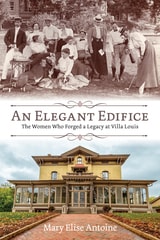
An Elegant Edifice
The Women Who Forged a Legacy at Villa LouisMary Elise Antoine
Wisconsin Historical Society Press, 2026
On the banks of the upper Mississippi River at Prairie du Chien, Wisconsin, stands Villa Louis, the majestic Italianate-style mansion and estate built by the prosperous Dousman family in 1871. An Elegant Edifice tells the stories of the women of the Dousman residence. Jane, who outlived her husband by fourteen years, oversaw the estate and maintained the family’s presence in Prairie du Chien. Jane’s daughter-in-law, Nina, managed the property and assumed the role of head of the family following her husband’s death, ensuring stability for her children during times of tragedy. Finally, Nina’s daughters Violet and Virginia helped to restore the family home in the 1930s, secure its future as a historic site, and record the Dousmans’ history for posterity.
An Elegant Edifice illustrates the broad strokes of American expansionism through the backgrounds and activities of these influential women, complete with marriages and separations, births and deaths, business disputes, lawsuits, and reconciliations. With stories of St. Louis and St. Paul society, the stylish shops of New York City, and the prominence of Prairie du Chien in the nineteenth century, this book reveals the leisure activities and extravagant lifestyle afforded to the family by their wealth—Tiffany jewelry and housewares, William Morris wallpaper and fabrics, Jaccard silver, and a fine art collection to rival the public museums of the era.
Thanks to the women’s fortitude and shared conviction in the importance of family, Villa Louis has been preserved and restored to its 1890s splendor and is today considered one of the most authentically restored Italianate villas in the United States. While previous histories have focused on the Dousman patriarchs, public historian Mary Elise Antoine offers a new perspective on the Dousman family history by bringing into focus Jane, Nina, Violet, and Virginia. These women’s lives—historically less well-documented than the lives of their husbands, fathers, and sons—contributed greatly to the preservation of Villa Louis and to our understanding of an important chapter in American history.
An Enduring Legacy
The Story Of Basques In IdahoMark Bieter
University of Nevada Press, 2003
In this volume, brothers Mark and John Bieter chronicle three generations of Basque presence in Idaho from 1890 to the present, resulting in an engaging story that begins with a few solitary sheepherders and follows their evolution into the prominent ethnic community of today.
An Epitaph for Little Rock
A Fiftieth Anniversary Retrospective on the Central High CrisisJohn A. Kirk
University of Arkansas Press, 2008
An Illini Place
Building the University of Illinois CampusIncoronata Inserra
University of Illinois Press, 2017
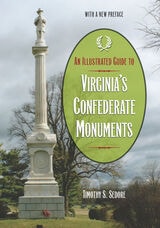
An Illustrated Guide to Virginia's Confederate Monuments
Timothy S. Sedore
Southern Illinois University Press, 2011
From well-known battlefields, such as Manassas, Fredericksburg, and Appomattox, to lesser-known sites, such as Sinking Spring Cemetery and Rude’s Hill, Sedore leads readers on a vivid journey through Virginia’s Confederate history. Tablets, monoliths, courthouses, cemeteries, town squares, battlefields, and more are cataloged in detail and accompanied by photographs and meticulous commentary. Each entry contains descriptions, fascinating historical information, and location, providing a complete portrait of each site.
Much more than a visual tapestry or a tourist’s handbook, An Illustrated Guide to Virginia’s Confederate Monuments draws on scholarly and field research to reveal these sites as public efforts to reconcile mourning with Southern postwar ideologies. Sedore analyzes in depth the nature of these attempts to publicly explain Virginia’s sense of grief after the war, delving deep into the psychology of a traumatized area. From commemorations of famous generals to memories of unknown soldiers, the dead speak from the pages of this sweeping companion to history.
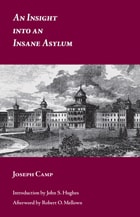
An Insight into an Insane Asylum
Joseph Camp
University of Alabama Press, 2011
A rare 19th‑century voice revealing what asylum life felt like from the inside.
In 1881, Joseph Camp, an elderly and self-trained Methodist minister from Talladega County in eastern Alabama, was brought by his family to Bryce Hospital, an insane asylum in Tuscaloosa, where he remained for over five months. Camp, misled by relatives concerning the purpose of the trip, was shocked and angered at his loss of freedom and his treatment in the hospital. After his release, he composed an account of his stay and published it at his own expense, providing a rare glimpse of 19th century mental health care from a patient’s viewpoint. Camp’s account reveals his naive trust in others, but also a sharp and retentive memory. Camp is remarkably accurate in his account of the details of his treatment and the operation and staff of the hospital, although his emotional assessments reflect his unhappiness with his situation. Adding to the importance of Camp’s account is the fact that in the 19th century Bryce was considered a remarkably humane institution focused on recovery. Camp provides a glimpse into how treatment for the insane felt to the recipient.
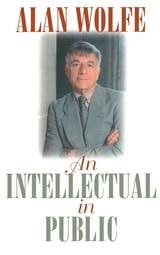
An Intellectual in Public
Alan Wolfe
University of Michigan Press, 2004
". . . proof that the spirit of the free-ranging public intellectual is still very much alive."
-Newsday
"Alan Wolfe is one of liberalism's last and most loyal sons. His mind is naturally decent and diversified; large enough and fair enough to contain both conviction and doubt. His profound respect for real people does not interfere with his profound respect for real thought. The criticism that he practices is, I fear, a dying art, but it is also one of the glories of American democracy."
-Leon Wieseltier, New Republic
"Alan Wolfe is one of America's indispensable essayists. On a broad range of topics-race, religion, politics, the marketplace, the university, and more-he combines a scholar's erudition with a historian's feel for the past and a journalist's keen attunement to the shifting patterns of the current scene. Above all he is a true writer, graceful but fearless, who ponders the deep questions so often ignored in the clamor of our ongoing civic conversation. Anyone who wonders what the term 'public intellectual' really means will find the answer-in fact many answers-in this scintillating collection."
-Sam Tanenhaus, Vanity Fair
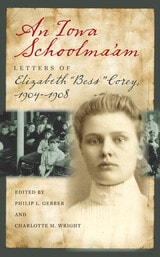
An Iowa Schoolma’am
Letters of Elizabeth “Bess” Corey, 1904–1908Philip L. Gerber
University of Iowa Press, 2011
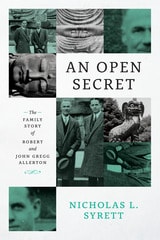
An Open Secret
The Family Story of Robert and John Gregg AllertonNicholas L. Syrett
University of Chicago Press, 2021
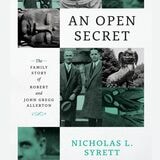
An Open Secret tells the striking story of these two iconoclasts, locating them among their queer contemporaries and exploring why becoming father and son made a surprising kind of sense for a twentieth-century couple who had every monetary advantage but one glaring problem: they wanted to be together publicly in a society that did not tolerate their love. Deftly exploring the nature of their design, domestic, and philanthropic projects, Nicholas L. Syrett illuminates how viewing the Allertons as both a same-sex couple and an adopted family is crucial to understanding their relationship’s profound queerness. By digging deep into the lives of two men who operated largely as ciphers in their own time, he opens up provocative new lanes to consider the diversity of kinship ties in modern US history.
An Open Secret
The Family Story of Robert and John Gregg AllertonNicholas L. Syrett
University of Chicago Press, 2021
This is an auto-narrated audiobook edition of this book.
In 1922 Robert Allerton—described by the Chicago Tribune as the “richest bachelor in Chicago”—met a twenty-two-year-old University of Illinois architecture student named John Gregg, who was twenty-six years his junior. Virtually inseparable from then on, they began publicly referring to one another as father and son within a couple years of meeting. In 1960, after nearly four decades together, and with Robert Allerton nearing ninety, they embarked on a daringly nonconformist move: Allerton legally adopted the sixty-year-old Gregg as his son, the first such adoption of an adult in Illinois history.
An Open Secret tells the striking story of these two iconoclasts, locating them among their queer contemporaries and exploring why becoming father and son made a surprising kind of sense for a twentieth-century couple who had every monetary advantage but one glaring problem: they wanted to be together publicly in a society that did not tolerate their love. Deftly exploring the nature of their design, domestic, and philanthropic projects, Nicholas L. Syrett illuminates how viewing the Allertons as both a same-sex couple and an adopted family is crucial to understanding their relationship’s profound queerness. By digging deep into the lives of two men who operated largely as ciphers in their own time, he opens up provocative new lanes to consider the diversity of kinship ties in modern US history.
An Uncertain Tradition
David Kenney and Robert E. Hartley
Southern Illinois University Press, 2003
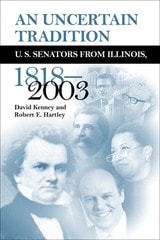
This sweeping survey constitutes the first comprehensive treatment of the forty-seven individuals—forty-six white males and one African American female—who have been chosen to represent Illinois in the United States Senate from 1818 to 2003. David Kenney and Robert E. Hartley underscore nearly two centuries of Illinois history with these biographical and political portraits, compiling an incomparably rich resource for students, scholars, teachers, journalists, historians, politicians, and any Illinoisan interested in the state’s heritage.
An Uncertain Tradition:U. S. Senators from Illinois, 1818–2003 is a fresh and careful study of the shifting set of political issues occurring over time and illuminated by the lives of participants in the politics of choice and service in the Senate. Kenney and Hartley plot the course of the state’s varied senatorial leadership, from the state’s founding and the appearance of political parties, through the Civil War and its aftermath, and into the diverse political climate of the twenty-first century. From the notorious to the heroic, the popular to the pioneering, the senatorial roster includes such luminaries as “The Little Giant” Stephen A. Douglas; Lyman Trumbull, who served three terms in the Civil War era; “Uncle Dick” and “Black Jack,” also known as Richard Oglesby and John A. Logan; the “Wizard of Ooze” Everett Dirksen; and modern leaders such as Adlai Stevenson III, Paul Simon, and Carol Moseley-Braun.
Kenney and Hartley offer incisive commentary on the quality of senate service in each case, as well as timeline graphs relating to the succession of individuals in each of the two sequences of service, the geographical distribution of senators within the state, and the variations in party voting for senate candidates. Rigorously documented and supremely readable, this convenient reference volume is enhanced by portraits of many of the senators.
An Unseen Unheard Minority
Asian American Students at the University of IllinoisSharon S. Lee
Rutgers University Press, 2022
Ancient Chiefdoms of the Tombigbee
John H. Blitz
University of Alabama Press, 1993
Focuses on both the small- and large-scale Mississippian societies in the Tombigbee-Black Warrior River region of Alabama and Mississippi
Within the last 50 years archaeologists have discovered that around the 10th century AD, native southeastern peoples began a process of cultural change far more complex than anything that had occurred previously. These late prehistoric societies—known as Mississippian—have come to be regarded as chiefdoms. The chiefdoms are of great anthropological interest because in these kinds of societies social hierarchies or rank and status were first institutionalized.
Ancient Chiefdoms of the Tombigbee focuses on both the small- and large-scale Mississippian societies in the Tombigbee-Black Warrior River region of Alabama and Mississippi. Exploring the relationships involving polity size, degree of social ranking, and resource control provides insights into cycles of chiefdom development and fragmentation. Blitz concludes that the sanctified, security maintenance roles of communal food storage management and war leadership were a sufficient basis for formal chiefly authority but insufficient for economically based social stratification.
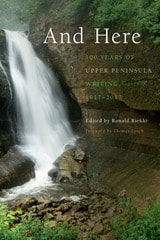
And Here
100 Years of Upper Peninsula Writing, 1917–2017Ronald Riekki
Michigan State University Press, 2017

And Other Neighborly Names
Social Process and Cultural Image in Texas FolkloreEdited by Richard Bauman and Roger D. Abrahams
University of Texas Press, 1981
"And Other Neighborly Names"—the title is from a study by Americo Paredes of the names, complimentary and otherwise, exchanged across cultural boundaries by Anglos and Mexicans—is a collection of essays devoted to various aspects of folk tradition in Texas. The approach builds on the work of the folklorists who have helped give the study of folklore in Texas such high standing in the field-Mody Boatright, J. Frank Dobie, John Mason Brewer, the Lomaxes, and of course Paredes himself, to whom this book is dedicated.
Focusing on the ways in which traditions arise and are maintained where diverse peoples come together, the editors and other essayists—John Holmes McDowell, Joe Graham, Alicia María González, Beverly J. Stoeltje, Archie Green, José E. Limón, Thomas A. Green, Rosan A. Jordan, Patrick B. Mullen, and Manuel H. Peña—examine conjunto music, the corrido, Gulf fishermen's stories, rodeo traditions, dog trading and dog-trading tales, Mexican bakers' lore, Austin's "cosmic cowboy" scene, and other fascinating aspects of folklore in Texas. Their emphasis is on the creative reaction to socially and culturally pluralistic situations, and in this they represent a distinctively Texan way of studying folklore, especially as illustrated in the performance-centered approach of Paredes, Boatright, and others who taught at the University of Texas at Austin. As an overview of this approach—its past, present, and future—"And Other Neighborly Names" makes a valuable contribution both to Texas folklore and to the discipline as a whole.
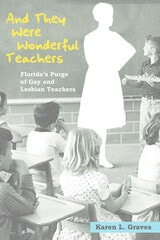
And They Were Wonderful Teachers
Florida's Purge of Gay and Lesbian TeachersKaren L. Graves
University of Illinois Press, 2008
Karen L. Graves details how teachers were targeted, interrogated, and stripped of their professional credentials, and she examines the extent to which these teachers resisted the invasion of their personal lives. She contrasts the experience of three groups--civil rights activists, gay and lesbian teachers, and University of South Florida personnel--called before the committee and looks at the range of response and resistance to the investigations. Based on archival research conducted on a recently opened series of Investigation Committee records in the State Archives of Florida, this work highlights the importance of sexuality in American and education history and argues that Florida's attempt to govern sexuality in schools implies that educators are distinctly positioned to transform dominant ideology in American society.

Andrew Jackson Donelson
Jacksonian and UnionistRichard Douglas Spence
Vanderbilt University Press, 2017
As his uncle's secretary, he weathered Old Hickory's tumultuous presidency, including the notorious "Petticoat War." Building his own political career, he served as US chargé d'affaires to the Republic of Texas, where he struggled against an enigmatic President Sam Houston, British and French intrigues, and the threat of war by Mexico, to achieve annexation. As minister to Prussia, Donelson enjoyed a ringside seat to the revolutions of 1848 and the first attempts at German unification. A firm Unionist in the mold of his uncle, Donelson denounced the secessionists at the Nashville Convention of 1850. He attempted as editor of the Washington Union to reunite the Democratic party, and, when he failed, he was nominated as Millard Fillmore's vice-presidential running mate on the Know-Nothing party ticket in 1856. He lived to see the Civil War wreck the Union he loved, devastate his farms, and take the lives of two of his sons.