Results by title
22277 books match the query 'Social Science' and 1819 start with a
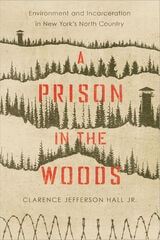
A Prison in the Woods
Environment and Incarceration in New York's North CountryClarence Jefferson Hall
University of Massachusetts Press, 2020
Clarence Jefferson Hall Jr. reveals that the introduction of correctional facilities—especially in the last three decades of the twentieth century—unearthed long-standing conflicts over the proper uses of Adirondack nature, particularly since these sites have contributed to deforestation, pollution, and habitat decline, even as they've provided jobs and spurred economic growth. Additionally, prison plans have challenged individuals' commitment to environmental protection, tested the strength of environmental regulations, endangered environmental and public health, and exposed tensions around race, class, place, and belonging in the isolated prison towns of America's largest state park.

A Private State
StoriesCharlotte Bacon
University of Massachusetts Press, 1998
Here is a finely crafted collection of stories about women who have arrived at awkward edges in their lives. Some are adolescents, some at the brink of old age, and some find themselves suddenly ill or pregnant. Others come to the abrupt discovery that their marriages are not as whole as they had believed, while a few tumble onto startling secrets. But despite their range in age and situation, they all try to use their new knowledge to stitch together a fresh pattern by which to live.
While most of the action unfolds along the East Coast—in Maryland, Maine, Boston, Philadelphia, New York—several of the women travel to Arizona, California, and Jamaica. Often the light is too bright in these glittery places and they wonder why they have come. Many seem to be searching for a sense of home, which one girl describes as a place that is “complete and full of longing all at once.”
Yet this desire for a personal territory, a point of constancy, is not necessarily rewarded: in this book, separations lead to divorce, sisters continue to misread each other, cancers kill. Still, the women refuse to turn their gaze away from what the world has thrown in their path. Often as not, they pick it up, wonder at it, test its relevance, and continue on, not happier perhaps, but certainly more knowing.
With humor and insight, Charlotte Bacon illuminates the unexpected ambiguities of women's lives. A Private State marks the arrival of an extremely talented writer.
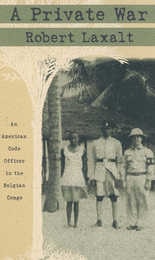
A Private War
An American Code Officer in the Belgian CongoRobert Laxalt
University of Nevada Press, 1998
In this vivid memoir, Laxalt recalls his service during WWII as a code officer in the Belgian Congo. In this remote jungle outpost, a secret war was being fought for control of the world’s future. Deep in the Congo lay a mine that produced a little-known substance called uranium, and for reasons no one then understood, the Allies and the Germans were struggling ferociously to control this mine and its ore. The cloth edition is a limited numbered, signed edition.

A Problem Like Maria
Gender and Sexuality in the American MusicalStacy Wolf
University of Michigan Press, 2002
Chapter by chapter, the book analyzes the stars' best-known and best-loved roles, including Martin as Nellie in South Pacific, Merman as Momma Rose in GypsyAndrews as Eliza in My Fair Lady and Guinevere in Camelot, and Streisand as Fanny Brice in Funny Girl. The final chapter scrutinizes the Broadway and film versions of The Sound of Music, illuminating its place in the hearts of lesbian spectators and the "delicious queerness" of Andrews's troublesome nun. As the first feminist and lesbian study of the American Broadway musical, A Problem Like Maria is a groundbreaking contribution to feminist studies, queer studies, and American studies and a delight for fans of musical theater.
Stacy Wolf is Associate Professor of Theatre and Dance, University of Texas, Austin.
A Problem of Fit
How the Complexity of College Pricing Hurts Students—and UniversitiesPhillip B. Levine
University of Chicago Press, 2022
How much does it cost to attend college in the United States today? The answer is more complex than many realize. College websites advertise a sticker price, but uncovering the actual price—the one after incorporating financial aid—can be difficult for students and families. This inherent uncertainty leads some students to forgo applying to colleges that would be the best fit for them, or even not attend college at all. The result is that millions of promising young people may lose out on one of society’s greatest opportunities for social mobility. Colleges suffer too, losing prospective students and seeing lower enrollments and less socioeconomic diversity. If markets require prices to function well, then the American higher-education system—rife as it is with ambiguity in its pricing—amounts to a market failure.
In A Problem of Fit, economist Phillip B. Levine explains why institutions charge the prices they do and discusses the role of financial aid systems in facilitating—and discouraging—access to college. Affordability issues are real, but price transparency is also part of the problem. As Levine makes clear, our conversations around affordability and free tuition miss a larger truth: that the opacity of our current college-financing systems is a primary driver of inequities in education and society. In a clear-eyed assessment of educational access and aid in a post-COVID-19 economy, A Problem of Fit offers a trenchant new argument for educational reforms that are well within reach.

A Prodigy's Calling
The Early Musical Biography of Cosmas Magaya, Zimbabwean Mbira MasterPaul F. Berliner
University of Chicago Press, 2024
Ethnomusicologist Paul F. Berliner has been studying Zimbabwean mbira for more than fifty years. When he first arrived in what was then Rhodesia after the nation declared independence from the United Kingdom, he met Cosmas Magaya, a mbira player who would become his teacher and lifelong collaborator. A Prodigy’s Calling chronicles the early years of Magaya’s life, documenting the master mbira player’s journey from child prodigy to established expert. As a child, Magaya was immersed in mbira music through his father’s work as a healer and spirit medium. As Magaya grew, so too did his world; his performances extended beyond the family compound as his skill and knowledge increased, bringing him into contact with a society fraught with decolonial conflict.
Following Magaya’s childhood, readers will learn how his upbringing guided his journey through the community’s social networks and how his early sensibilities, proclivities, and talents shaped his development. At the same time, his deepening engagement with music and the ancestors was affected by overlapping tensions between Shona cosmology and Christian ideology, rural and urban lifestyles, and the escalating African nationalist struggle and the white supremacist state. While Magaya’s story reflects profound social changes in the nation, it is also a story of musical apprenticeship. Readers following Magaya’s discovery of ever finer details in the music’s richly layered patterns will enhance their ability to hear mbira music’s forms, variations, and sonic qualities. Linocut illustrations by South African artist Lucas Bambo bring the narrative to life, and Berliner’s spirited storytelling is accompanied by QR codes that take readers directly to recordings of music as Magaya learns it. Appendices for musicians interested in learning or improving their mbira playing complement the story of Magaya’s early life. Inviting the reader into the very tradition it recounts, the book offers intimate insights into the relationships among music, Shona cosmology, and colonial politics in everyday life.
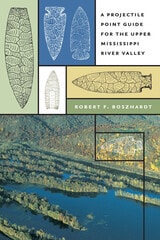
A Projectile Point Guide for the Upper Mississippi River Valley
Robert F. Boszhardt
University of Iowa Press, 2003
The most common relics of the 12,000-year occupancy of the Upper Mississippi River Valley may be the chipped stone projectile points that Native Americans fastened to the ends of their spears, darts, and arrow shafts. This useful guide provides a key to identifying the various styles of points found along the Upper Mississippi River in the Driftless region stretching roughly from Dubuque, Iowa, to Red Wing, Minnesota, but framed within a somewhat larger area extending from the Rock Island Rapids at the modern Moline-Rock Island area to the Falls of St. Anthony at Minneapolis-St. Paul.
Logging tens of thousands of miles and visiting private collectors from all walks of life since 1982, Robert Boszhardt has documented thousands of projectile points found in this region. In addition to drawings of each style, he provides other accepted names as well as names of related points, age, distribution, a description (including length and width), material, and references for each type. The guide is meant for the many avocational archaeologists who collect projectile points in the Upper Midwest and will be a useful reference tool for professional field archaeologists as well.
Emphasizing the preservation of sites as well as a mutual exchange of information between professional and avocational archaeologists, this guide will reveal projectile points as clues to the past, time markers which embody crucial information about the cultures of the Mississippi River Valley's early inhabitants.
A Promise And A Way Of Life
White Antiracist ActivismBecky Thompson
University of Minnesota Press, 2001
The first in-depth look at white people’s activism in fighting racism during the past fifty years.
Not since the Civil Rights Movement of the 1950s and 1960s, when many white college students went south to fight against Jim Crow laws, has white antiracist activity held the public’s attention. Yet there have always been white people involved in fighting racism. In this passionate work, Becky Thompson looks at white Americans who have struggled against racism, offering examples of both successes and failures, inspirations, practical philosophies, and a way ahead.
A Promise and a Way of Life weaves an account of the past half-century based on the life histories of thirty-nine people who have placed antiracist activism at the center of their lives. Through a rich and fascinating narrative that links individual experiences with social and political history, Thompson shows the ways, both public and personal, in which whites have opposed racism during several social movements: the Civil Rights and Black Power movements, multiracial feminism, the Central American peace movement, the struggle for antiracist education, and activism against the prison industry. Beginning with the diverse catalysts that started these activists on their journeys, this book demonstrates the contributions and limitations of white antiracism in key social justice movements.
Through these stories, crucial questions are raised: Does antiracist work require a repudiation of one’s whiteness or can that identity be transformed through political commitment and alliances? What do white people need to do to undermine white privilege? What would it take to build a multiracial movement in which white people are responsible for creating antiracist alliances while not co-opting people of color?
Unique in its depth and thoroughness, A Promise and a Way of Life is essential for anyone currently fighting racism or wondering how to do so. Through its demonstration of the extraordinary personal and social transformations ordinary people can make, it provides a new paradigm for movement activity, one that will help to incite and guide future antiracist activism.
A Promise in Haiti
A Reporter's Notes on Families and Daily LivesMark Curnutte
Vanderbilt University Press, 2011
A Promise in Haiti is Curnutte's story of his time, spanning the last decade, living among several families in Gonaives, a city of 200,000 people a hundred kilometers north of Port-au-Prince. He began traveling to Haiti as a volunteer with the aid organization Hands Together, eventually building trust and credibility with many Haitians. Curnutte introduces the reader to the Cenecharles family, strained by entrenched unemployment and the need to continually travel for work. He is invited into the home of the Henrisma family, and is forced to reconcile journalistic detachment with basic compassion as he contributes financially to help them. The reader is confronted with a complicated, conflicted written and photographic record of a worldview that evolves right on the page. As a reporter, Curnutte found parallels between the lives he encountered in Gonaives and the world of the Great Depression recounted in James Agee and Walker Evans's Let Us Now Praise Famous Men. Agee and Evans loom large as a challenge and inspiration to Curnutte.
The result is equal parts homage to that historic chronicle, on-the-ground reporting, and introspective narrative on the lessons Gonaives taught Curnutte about his own life and family. In late February 2010, Curnutte went back to Haiti on assignment, but conditions made it impossible for him to return to Gonaives. The resulting frustration provoked a meditation on the monumental challenges that face Haiti -- and on the destructive cycle of international attention that constantly moves on to "The Next Big Story."

A Promising Problem
The New Chicana/o HistoryEdited by Carlos Kevin Blanton
University of Texas Press, 2016
Chicana/o history has reached an intriguing juncture. While academic and intellectual studies are embracing new, highly nuanced perspectives on race, class, gender, education, identity, and community, the field itself continues to be viewed as a battleground, subject to attacks from outside academia by those who claim that the discipline promotes racial hatred and anti-Americanism. Against a backdrop of deportations and voter suppression targeting Latinos, A Promising Problem presents the optimistic voices of scholars who call for sophisticated solutions while embracing transnationalism and the reality of multiple, overlapping identities.
Showcasing a variety of new directions, this anthology spans topics such as growth and reassessment in Chicana/o history manifested in a disruption of nationalism and geographic essentialism, the impact of legal history, interracial relations and the experiences of Latino subpopulations in the US South, race and the politics of religious history, transborder feminism in the early twentieth century, and aspirations for a field that increasingly demonstrates the relational dynamics of cultural production. As they reflect on the state of their field, the contributors offer significant insights into sociology, psychology, anthropology, political science, education, and literature, while tracing the history of activism throughout the last century and debating the very concepts of “Chicano” and “Chicano history.” Although the political landscape is fraught with closed-off rhetoric, A Promising Problem encourages diversity of thought and opens the possibilities of historical imagination.

A Psalm for Cottondale
PoemsSharony A. Green
University of Alabama Press, 2026
A lyrical journey through memory, place, and resilience in the heart of Alabama
A Psalm for Cottondale is a lyrical meditation on memory, place, and survival in the American South. Through a sequence of interconnected free-verse poems, Sharony Green reflects on life in Cottondale, Alabama, where change unfolds in ways that can be both poignant and unexpected. Rooted in the histories, landscapes, and cultural currents of an Alabama college town, the collection explores how one place can evoke the memory of many others, inviting readers to consider broader questions of identity, belonging, and endurance.
Written in a clear, steady voice, these poems balance intimacy with historical awareness, allowing inherited stories, silences, and everyday moments to emerge with quiet power. Green’s careful craftsmanship and emotional restraint lend authority to the collection, while a subtle psalmic undercurrent adds spiritual depth without sacrificing nuance. As the poems move through themes of joy, grief, witness, and renewal, Cottondale becomes both a physical community and a symbolic terrain shaped by race, land, memory, and hope.
Inspired by writings that engage history, geography, and culture, A Psalm for Cottondale offers an elegant and deeply attentive reflection on Southern and American life, illuminating the ways people endure, adapt, and find meaning in a changing world. Ideal for readers of contemporary poetry, Southern literature, African American studies, place-based writing, and works that explore history, memory, faith, and community through a lyrical lens.

A Publisher's Paradise
Expatriate Literary Culture in Paris, 1890-1960Colette Colligan
University of Massachusetts Press, 2014
From 1890 to 1960, some of Anglo-America's most heated cultural contests over books, sex, and censorship were staged not at home, but abroad in the City of Light. Paris, with its extraordinary liberties of expression, became a special place for interrogating the margins of sexual culture and literary censorship, and a wide variety of English language “dirty books” circulated through loose expatriate publishing and distribution networks.
A Publisher's Paradise explores the political and literary dynamics that gave rise to this expatriate cultural flourishing, which included everything from Victorian pornography to the most daring and controversial modernist classics. Colette Colligan tracks the British and French politicians and diplomats who policed Paris editions of banned books and uncovers offshore networks of publishers, booksellers, authors, and readers. She looks closely at the stories the “dirty books” told about this publishing haven and the smut peddlers and literary giants it brought together in transnational cultural formations. The book profiles an eclectic group of expatriates living and publishing in Paris, from relatively obscure figures such as Charles Carrington, whose list included both The Picture of Dorian Gray and the pornographic novel Randiana, to bookshop owner Sylvia Beach, famous for publishing James Joyce's Ulysses in 1922.
A Publisher's Paradise is a compelling exploration of the little-known history of foreign pornography in Paris and the central role it played in turning the city into a modernist outpost for literary and sexual vanguardism, a reputation that still lingers today in our cultural myths of midnight in Paris.
A Queen Mother Defiant
Irene Drusilla Namaganda and the Remaking of Power and Gender in Colonial UgandaNakanyike B. Musisi
University of Wisconsin Press, 2026
In 1941, Irene Drusilla Namaganda, the reigning queen mother of British-occupied Buganda, shocked the kingdom when she revealed she was six months pregnant—only fifteen months after the king’s death. The father of her child, a schoolteacher nearly two decades her junior, quickly became the focal point for a scandal that engulfed the monarchy. The ensuing political crisis led to Namaganda’s removal from the office of queen mother (Nnamasole) and her companion’s exile, spurring her own departure.
Drawing from extensive archival research and in-depth oral interviews, this long-awaited biography analyzes Namaganda’s roles as wife, mother, widow, and prominent yet controversial cultural-political icon. Nakanyike Musisi moves beyond the scandal to explore how the monarch’s character and personal choices defied expectations of royal women and redefined motherhood, power, and tradition. She challenges dominant narratives in African political history and gender studies to show how African women navigated competing systems of authority and in doing so reshaped both the institution of monarchy and broader cultural and historical landscapes.
A Queer History of Flamenco
Diversions, Transitions, and Returns in Flamenco Dance (1808–2018)Fernando López Rodríguez, translation by Ryan Rockmore
University of Michigan Press, 2024
Tracing flamenco’s development from its birth up to the contemporary era, the book places flamenco within significant historical periods such as the Spanish Civil War, Franco’s dictatorship, the transition to democracy, and the economic crisis of 2008, up to contemporary performances of the late 2010s. In taking a queer approach to History, the author abandons antiquated debates about purities and impurities; anecdotes about the lives of artists that are completely detached from their processes of creation; and myths about geniuses who seem to make art alone and completely detached from their collaborators and the historical, social, economic and artistic moment in which they lived. A Queer History of Flamenco is not only about the present and the queerness of people living, performing, or creating in it, but also about flamenco’s past in which so many queer artists and practices and their lives have remained unearthed and unaddressed.
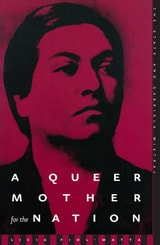
A Queer Mother For The Nation
The State And Gabriela MistralLicia Fiol-Matta
University of Minnesota Press, 2002
Chilean writer Gabriela Mistral (1889-1957), the first Latin American to win theNobel Prize for Literature, was a poetic idol for generations of Latin Americans who viewed her as Womanhood incarnate, the national schoolteacher-mother. How this distinctly masculine woman who never gave birth came to occupy this role, and what Mistral’s image, poetry, and life have to say about the relations-and realities-of race, gender, and sexual politics in her time, are the questions Licia Fiol-Matta pursues in this book, recreating the story of a woman whose misrepresentation is at least as intriguing, and as instructive, as her fame.
A Queer Mother for the Nation weaves a nuanced understanding of how Mistral cooperated with authority and fashioned herself as the figure of Motherhood in collaboration with the state. Drawing on Mistral’s little-known political and social essays, her correspondence and photographs, Fiol-Matta reconstructs Mistral’s relationship to state politics. Her work questions the notion of queer bodies as outlaws, and insists on the many ways in which queer subjects have participated in and sustained the normative discourses they seem to rebel against
A Queer Sort of Materialism
Recontextualizing American TheaterDavid Savran
University of Michigan Press, 2003
The selections presented here are by turns entertaining, informative, sophisticated, and polemical, reflecting the author's dual citizenship as rigorous scholar and engaging theater critic. This book also provides a model for a kind of queer historical materialism that will prove useful to a wide range of disciplines, including theater and performance, gender and sexuality, queer/gay/lesbian/transgender studies, American studies, and popular culture.
David Savran is Professor of Theater, the Graduate Center, the City University of New York, and author of Cowboys, Communists, and Queers and Taking It Like a Man.
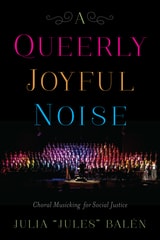
A Queerly Joyful Noise
Choral Musicking for Social JusticeJulia "Jules" Balén
Rutgers University Press, 2017
Honorable Mention, 2019 Herndon Book Prize - (SEM-GST)
A Queerly Joyful Noise examines how choral singing can be both personally transformative and politically impactful. As they blend their different voices to create something beautiful, LGBTIQ singers stand together and make themselves heard. Comparing queer choral performances to the uses of group singing within the civil rights and labor movements, Julia “Jules” Balén maps the relationship between different forms of oppression and strategic musical forms of resistance. She also explores the potential this queer communal space creates for mobilizing progressive social action.
A proud member of numerous queer choruses, Balén draws from years of firsthand observations, archival research, and extensive interviews to reveal how queer chorus members feel shared vulnerability, collective strength, and even moments of ecstasy when performing. A Queerly Joyful Noise serves as a testament to the power of music, intimately depicting how participation in a queer chorus is more than a pastime, but a meaningful form of protest through celebration.
A Question of Class
The Redneck Stereotype in Southern FictionDuane Carr
University of Wisconsin Press, 1997

A Question of Quality
Popularity and Value in Modern Creative WritingEdited by Louis Filler
University of Wisconsin Press, 1976
The subjects treated in this symposium have one major characteristic in common, that they have recently, or relatively recently, enjoyed high popularity among readers. Also, they have received from substantial to torrents of comment.
A Question of Sex
Feminism, Rhetoric, and Differences That MatterKristan Poirot
University of Massachusetts Press, 2014
Poirot focuses on five case studies—the circulation of Sojourner Truth's "Ain't I a Woman?" in early and contemporary feminist contexts; the visual rhetorics of the feminist self-help health movement; the public discourse of Elizabeth Cady Stanton and early nineteenth-century ideas about suffrage, sex, and race; the conflicts over lesbian sexuality in the 1960s and 1970s; and the discourse that surrounds twenty-first-century SlutWalks. In the process, Poirot rethinks the terms through which we understand U.S. feminist movements to explore the ways feminism has questioned sexed distinctions and practices over time. She emphasizes the importance of reading feminist engagements with sex as rhetorical endeavors—practices that are shaped by the instrumental demands of movements, the exigent situations that call for feminists to respond, and the enduring philosophical traditions that circulate in U.S. political contexts., reviewing a previous edition or volume
A Quiet Victory for Latino Rights
FDR and the Controversy Over "Whiteness"Patrick D. Lukens
University of Arizona Press, 2012
In 1935 a federal court judge handed down a ruling that could have been disastrous for Mexicans, Mexican Americans, and all Latinos in the United States. However, in an unprecedented move, the Roosevelt administration wielded the power of "administrative law" to neutralize the decision and thereby dealt a severe blow to the nativist movement. A Quiet Victory for Latino Rights recounts this important but little-known story.
To the dismay of some nativist groups, the Immigration Act of 1924, which limited the number of immigrants who could be admitted annually, did not apply to immigrants from Latin America. In response to nativist legal maneuverings, the 1935 decision said that the act could be applied to Mexican immigrants. That decision, which ruled that the Mexican petitioners were not "free white person[s]," might have paved the road to segregation for all Latinos.
The League of United Latin American Citizens (LULAC), founded in 1929, had worked to sensitize the Roosevelt administration to the tenuous position of Latinos in the United States. Advised by LULAC, the Mexican government, and the US State Department, the administration used its authority under administrative law to have all Mexican immigrants—and Mexican Americans—classified as "white." It implemented the policy when the federal judiciary "acquiesced" to the New Deal, which in effect prevented further rulings.
In recounting this story, complete with colorful characters and unlikely bedfellows, Patrick D. Lukens adds a significant chapter to the racial history of the United States.
A Quieter Illness
Narratives, Selves, and SilencesArthur W. Frank
University of Chicago Press, 0
In this sequel to The Wounded Storyteller, Arthur W. Frank reminds us of the power of narrative in the lives of ill people and those who care for them.
The Wounded Storyteller became a classic by witnessing the voices of ill people, recognizing how they express themselves in three prevalent narratives: restitution stories, evocations of chaos, and quest stories. Thirty years later, Frank expands this framework. He proposes a fourth narrative: one that seeks no restitution, claims no quest, yet feels no chaos—the stillness narrative. This story allows us to see more clearly our interdependence as well as the wisdom of uncertainty; it also teaches the value of letting go and waiting.
In the stillness narrative, Frank finds new opportunities for dialogue with clinical professionals. They too need healing, and healing moments occur when everyone recognizes their mutual, if asymmetrical, dependence. As Frank tells the stories that won’t leave him, he guides readers toward understanding how the stories they tell and hear affect their capacity to heal both themselves and others.
A Race at Bay
New York Times Editorials on "the Indian Problem," 1860 - 1900Robert G. Hays. Foreword by Paul Simon
Southern Illinois University Press, 1997
Robert G. Hays chronicles the "Indian problem" precisely as it was explained to Americans through the editorial columns of the New York Times between 1860 and 1900, the years when battles between white settlers and Native Americans split a nation and its spirit apart.
Covering the final forty-one years of the nineteenth century, Hays’s collection of Times editorials gives readers what current accounts cannot: perspectives by contemporary writers with unique insights into the public images of Native Americans and their place in a nation bent on expansion. The authentic voices of a national newspaper’s daily record speak with an urgency both immediate and real.
These editorials express the unbridled bitterness and raw ambition of a nation immersed in an agenda of conquest. They also resonate with the struggle to find a common ground. Some editorials are patronizing and ironic: "Yet it seems pitiful to cage so fine a savage among a herd of vulgar criminals in a penitentiary." Others include a willingness to poke fun: "Many persons on the platform were astonished to find that an ‘illiterate barbarian’ could handle the weapon of sarcasm. The truth is that the Indians spoke far better than ninety-nine out of a hundred members of congress." And yet others evince an attitude of respect, which set the tone for reconciling national ambition with natural rights.
In some instances, the Times allowed Native Americans to tell their own stories, as in this eloquent, moving account of the testimony of Satanta, the warrior chief of the Kiowas: "A certain dim foreboding of the Indians’ fate swept across his mind, and in its passage lit his eyes up with a fierce light, and his voice rose to a pitch of frenzy as he exclaimed: ‘We don’t want to settle—I love to roam over the prairie; there I am free and happy."
History demonstrates that the costs of owning one’s soil and one’s destiny remain without measure. Many of the problems blocking the progress of Native Americans continue unsolved: unemployment, infant mortality, suicide, crime, alcoholism, and poverty. Following such works as Helen Hunt Jackson’s A Century of Dishonor and Dee Brown’s Bury My Heart at Wounded Knee, Hays looks back on the records of national history for the roots of our challenges today.
A Rainbow of Gangs
Street Cultures in the Mega-CityBy James Diego Vigil
University of Texas Press, 2002
Winner, Best Book on Ethnic and Racial Politics in a Local or Urban Setting , Organized Section on Race, Ethnicity, and Politics of the American Political Science Association, 2002
This cross-cultural study of Los Angeles gangs identifies the social and economic factors that lead to gang membership and underscores their commonality across four ethnic groups--Chicano, African American, Vietnamese, and Salvadorian.
With nearly 1,000 gangs and 200,000 gang members, Los Angeles holds the dubious distinction of being the youth gang capital of the United States. The process of street socialization that leads to gang membership now cuts across all ethnic groups, as evidenced by the growing numbers of gangs among recent immigrants from Asia and Latin America.
This cross-cultural study of Los Angeles gangs identifies the social and economic factors that lead to gang membership and underscores their commonality across four ethnic groups—Chicano, African American, Vietnamese, and Salvadorian. James Diego Vigil begins at the community level, examining how destabilizing forces and marginalizing changes have disrupted the normal structures of parenting, schooling, and policing, thereby compelling many youths to grow up on the streets. He then turns to gang members' life stories to show how societal forces play out in individual lives. His findings provide a wealth of comparative data for scholars, policymakers, and law enforcement personnel seeking to respond to the complex problems associated with gangs.
A Rainbow of Gangs
Street Cultures in the Mega-CityBy James Diego Vigil
University of Texas Press, 2002
Winner, Best Book on Ethnic and Racial Politics in a Local or Urban Setting , Organized Section on Race, Ethnicity, and Politics of the American Political Science Association, 2002
This cross-cultural study of Los Angeles gangs identifies the social and economic factors that lead to gang membership and underscores their commonality across four ethnic groups--Chicano, African American, Vietnamese, and Salvadorian.
With nearly 1,000 gangs and 200,000 gang members, Los Angeles holds the dubious distinction of being the youth gang capital of the United States. The process of street socialization that leads to gang membership now cuts across all ethnic groups, as evidenced by the growing numbers of gangs among recent immigrants from Asia and Latin America.
This cross-cultural study of Los Angeles gangs identifies the social and economic factors that lead to gang membership and underscores their commonality across four ethnic groups—Chicano, African American, Vietnamese, and Salvadorian. James Diego Vigil begins at the community level, examining how destabilizing forces and marginalizing changes have disrupted the normal structures of parenting, schooling, and policing, thereby compelling many youths to grow up on the streets. He then turns to gang members' life stories to show how societal forces play out in individual lives. His findings provide a wealth of comparative data for scholars, policymakers, and law enforcement personnel seeking to respond to the complex problems associated with gangs.
A Rebellious People
Basques, Protests, And PoliticsCyrus Ernesto Zirakzadeh
University of Nevada Press, 1991
In this scholarly work, Zirakzadeh argues that there is a calculated reasoning behind ETA's political violence that is often overlooked by researchers. His book is a comprehensive account of the Basque region's grassroots politics.

A Received Grace
Slavery, Heirlooms, and the Feminine Labor of ForgettingMacushla Robinson
Duke University Press, 2027
A Refuge of Lies
Reflections on Faith and FictionCesareo Bandera
Michigan State University Press, 2013
Erich Auerbach’s seminal Mimesis: The Representation of Reality in Western Literature was published more than sixty years ago and is deservedly considered a classic. The book brought into focus the fundamental difference that exists between the two basic approaches to the textual representation of reality in Western culture. These two “styles,” as Auerbach called them, were archetypically displayed in Homer’s poems and in the Old Testament, respectively. Auerbach’s differentiation is the starting point for Bandera’s insightful work, which expands and develops on this theory in several key ways. One of the more significant differences between the two styles transcends and grounds all the others. It concerns the truth of each of the two archetypal texts, or rather, the attitude exhibited in those texts with regard to the truth of what they narrate. Auerbach, Bandera notes, is amazed at the Bible’s “passionate” concern for the truth of what it says—a concern he found absent in Homer. Bandera finds that what the prophet Isaiah called “a refuge of lies” defines Homer’s work. He draws on his own research and René Girard’s theory of the sacred to develop an enhanced perspective of the relationship between these texts.

A Refugee's American Dream
From the Killing Fields of Cambodia to the U.S. Secret ServiceLeth Oun with Joe Samuel Starnes
Temple University Press, 2023
“I saw many killed. I almost starved. But I escaped to refugee camps in Thailand and eventually made it to the U.S.” Thus begins Leth Oun’s poignant and vivid memoir. A survivor of the Cambodian Killing Fields—having spent a torturous three years, eight months, and ten days imprisoned by the Khmer Rouge—Oun thrived in America, learning English, becoming a citizen, and working as an officer in the United States Secret Service Uniformed Division.
In A Refugee’s American Dream, Oun shares hard memories of Cambodia, where his father was executed, and his family enslaved in labor camps.
Following the fall of the Khmer Rouge, Oun survived a year of homelessness then nearly four years in refugee camps. Arriving in America, 17 and penniless, Oun struggled, washing dishes at a Chinese restaurant for $3.15 an hour. Still, he persevered, graduating from Widener University and completing thousands of hours of training to pursue a career in the Secret Service.
While on President Obama’s protection team, he returns to Cambodia after 32 years, reunites with family, and bonds with Reik, the Secret Service dog he handles. Through his most difficult moments, Oun displays truly inspiring resilience that ultimately leads to great achievements.
The authors’ proceeds will go to help Cambodians in need
A Regarded Self
Caribbean Womanhood and the Ethics of Disorderly BeingKaiama L. Glover
Duke University Press, 2021
A Region among States
Law and Non-sovereignty in the CaribbeanLee Cabatingan
University of Chicago Press, 2023
How is it that a great swath of the independent, English-speaking Caribbean continues to accept the judicial oversight of their former colonizer via the British institution of the Privy Council? And what possibilities might the Caribbean Court of Justice—a judicial institution responsive to the region, not to any single nation—offer for untangling sovereignty and regionhood, law and modernity, and postcolonial Caribbean identity?
Joining the Court as an intern, Lee Cabatingan studied its work up close: she attended each court hearing and numerous staff meetings, served on committees, assisted with the organization of conferences, and helped prepare speeches and presentations for the judges. She now offers insight into not only how the Court positions itself vis-à-vis the Caribbean region and the world but also whether the Court—and, perhaps, the region itself as an overarching construct—might ever achieve a real measure of popular success. In their quest for an accepting, eager constituency, the Court is undertaking a project of extrajudicial region building that borrows from the toolbox of the nation-state. In each chapter, Cabatingan takes us into an analytical dimension familiar from studies of nation and state building—myth, territory, people, language, and brand—to help us understand not only the Court and its ambitions but also the regionalist project, beset as it is with false starts and disappointments, as a potential alternative to the sovereign state.
A Renegade Union
Interracial Organizing and Labor RadicalismLisa Phillips
University of Illinois Press, 2013
A Reporter At Large
Dateline: Pyramid Lake, NevadaAj Liebling
University of Nevada Press, 1999
Liebling recorded the litigation over the fate of the Pyramid Lake Reservation lands in a series of articles published in The New Yorker in 1955. Reprinted here in their entirety, the essays discuss the affair in detail, following it from the shores of the lake to the halls of Congress, and introducing readers to the colorful world of 1950s Nevada. This is a valuable record of one of Nevada’s most enduring and significant debates over the uses of the land and the precious water that nourishes it. Introduction by Elmer R. Rusco.
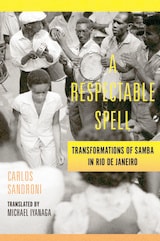
A Respectable Spell
Transformations of Samba in Rio de JaneiroCarlos Sandroni
University of Illinois Press, 2021
Incisive and comprehensive, A Respectable Spell tells the compelling story of an iconic Brazilian musical genre.

A Return to Servitude
Maya Migration and the Tourist Trade in CancúnM. Bianet Castellanos
University of Minnesota Press, 2010
A Return to Servitude is an ethnography of Maya migration within Mexico that analyzes the foundational role indigenous peoples play in the development of the modern nation-state. Focusing on tourism in the Yucatán Peninsula, M. Bianet Castellanos examines how Cancún came to be equated with modernity, how this city has shaped the political economy of the peninsula, and how indigenous communities engage with this vision of contemporary life. More broadly, she demonstrates how indigenous communities experience, resist, and accommodate themselves to transnational capitalism.
Tourism and the social stratification that results from migration have created conflict among the Maya. At the same time, this work asserts, it is through engagement with modernity and its resources that they are able to maintain their sense of indigeneity and community.
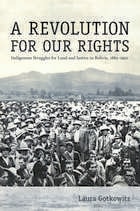
A Revolution for Our Rights
Indigenous Struggles for Land and Justice in Bolivia, 1880-1952Laura Gotkowitz
Duke University Press, 2008
Gotkowitz combines an emphasis on national political debates and congresses with a sharply focused analysis of Indian communities and large estates in the department of Cochabamba. The fragmented nature of Cochabamba’s Indian communities and the pioneering significance of its peasant unions make it a propitious vantage point for exploring contests over competing visions of the nation, justice, and rights. Scrutinizing state authorities’ efforts to impose the law in what was considered a lawless countryside, Gotkowitz shows how, time and again, indigenous activists shrewdly exploited the ambiguous status of the state’s pro-Indian laws to press their demands for land and justice. Bolivian indigenous and social movements have captured worldwide attention during the past several years. By describing indigenous mobilization in the decades preceding the revolution of 1952, A Revolution for Our Rights illuminates a crucial chapter in the long history behind present-day struggles in Bolivia and contributes to an understanding of indigenous politics in modern Latin America more broadly.
A Revolution in Fragments
Traversing Scales of Justice, Ideology, and Practice in BoliviaMark Goodale
Duke University Press, 2019
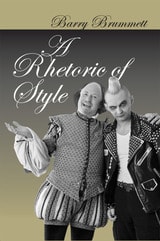
A Rhetoric of Style
Barry Brummett
Southern Illinois University Press, 2008
Exploring style in a global culture
In A Rhetoric of Style, Barry Brummett illustrates how style is increasingly a global system of communication as people around the world understand what it means to dress a certain way, to dance a certain way, to decorate a certain way, to speak a certain way. He locates style at the heart of popular culture and asserts that it is the basis for social life and politics in the twenty-first century.
Brummett sees style as a system of signification grounded largely in image, aesthetics, and extrarational modes of thinking. He discusses three important aspects of this system—its social and commercial structuring, its political consequences, and its role as the chief rhetorical system of the modern world. He argues that aesthetics and style are merging into a major engine of the global economy and that style is becoming a way to construct individual identity, as well as social and political structures of alliance and opposition. It is through style that we stereotype or make assumptions about others’ political identities, their sexuality, their culture, and their economic standing.
To facilitate theoretical and critical analysis, Brummett develops a systematic rhetoric of style and then demonstrates its use through an in-depth exploration of gun culture in the United States. Armed with an understanding of how this rhetoric of style works methodologically, students and scholars alike will have the tools to do their own analyses. Written in clear and engaging prose, A Rhetoric of Style presents a novel discussion of the workings of style and sheds new light on a venerable and sometimes misunderstood rhetorical concept by illustrating how style is the key to constructing a rhetoric for the twenty-first century.
A Rhetorical Crime
Genocide in the Geopolitical Discourse of the Cold WarWeiss-Wendt, Anton
Rutgers University Press, 2018
A Rhetorical Crime shows how genocide morphed from a legal concept into a political discourse used in propaganda battles between the United States and the Soviet Union. Over the course of the Cold War era, nearly eighty countries were accused of genocide, and yet there were few real-time interventions to stop the atrocities committed by genocidal regimes like the Cambodian Khmer Rouge.
Renowned genocide scholar Anton Weiss-Wendt employs a unique comparative approach, analyzing the statements of Soviet and American politicians, historians, and legal scholars in order to deduce why their moral posturing far exceeded their humanitarian action.
A Rich and Tantalizing Brew
A History of How Coffee Connected the WorldJeanette M. Fregulia
University of Arkansas Press, 2019
The history of coffee is much more than the tale of one luxury good—it is a lens through which to consider various strands of world history, from food and foodways to religion and economics and sociocultural dynamics.
A Rich and Tantalizing Brew traces the history of coffee from its cultivation and brewing first as a private pleasure in the highlands of Ethiopia and Yemen through its emergence as a sought-after public commodity served in coffeehouses first in the Muslim world, and then traveling across the Mediterranean to Italy, to other parts of Europe, and finally to India and the Americas. At each of these stops the brew gathered ardent aficionados and vocal critics, all the while reshaping patterns of socialization.
Taking its conversational tone from the chats often held over a steaming cup, A Rich and Tantalizing Brew offers a critical and entertaining look at how this bitter beverage, with a little help from the tastes that traveled with it—chocolate, tea, and sugar—has connected people to each other both within and outside of their typical circles, inspiring a new context for sharing news, conducting business affairs, and even plotting revolution.
A Rift in the Clouds
Race and the Southern Federal Judiciary, 1900-1910Brent J. Aucoin
University of Arkansas Press, 2007

A Right to Health
Medicine, Marginality, and Health Care Reform in Northeastern BrazilBy Jessica Scott Jerome
University of Texas Press, 2015
In 1988, a new health care system, the Sistema Único de Saúde (Unified Health Care System or SUS) was formally established in Brazil. The system was intended, among other goals, to provide universal access to health care services and to redefine health as a citizen’s right and a duty of the state. A Right to Health explores how these goals have unfolded within an urban peripheral community located on the edges of the northeastern city of Fortaleza. Focusing on the decade 1998–2008 and the impact of health care reforms on one low-income neighborhood, Jessica Jerome documents the tensions that arose between the ideals of the reforms and their entanglement with pervasive socioeconomic inequality, neoliberal economic policy, and generational tension with the community.
Using ethnographic and historical research, the book traces the history of political activism in the community, showing that, since the community’s formation in the early 1930s, residents have consistently fought for health care services. In so doing, Jerome develops a multilayered portrait of urban peripheral life and suggests that the notion of health care as a right of each citizen plays a major role not only in the way in which health care is allocated, but, perhaps more importantly, in how health care is understood and experienced.
A Right to Housing
Foundation for a New Social AgendaRachel Bratt
Temple University Press, 2006
The contributors to A Right to Housing consider the key issues related to America's housing crisis, including income inequality and insecurity, segregation and discrimination, the rights of the elderly, as well as legislative and judicial responses to homelessness. The book offers a detailed examination of how access to adequate housing is directly related to economic security.
With essays by leading activists and scholars, this book presents a powerful and compelling analysis of the persistent inability of the U.S. to meet many of its citizens' housing needs, and a comprehensive proposal for progressive change.
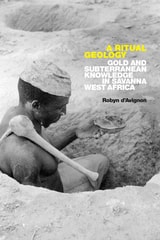
A Ritual Geology
Gold and Subterranean Knowledge in Savanna West AfricaRobyn d'Avignon
Duke University Press, 2022
A Rogue's Paradise
Crime and Punishment in Antebellum Florida, 1821-1861James M. Denham
University of Alabama Press, 1997
A history of frontier justice and legal systems in early Florida.
The pervasive influence of the frontier is fundamental to an understanding of antebellum Florida. James M. Denham traces the growth and social development of this sparsely settled region through its experience with crime and punishment. He examines such issues as Florida's criminal code, its judicial and law enforcement officers, the accommodation of criminals in jails and courts, outlaw gangs, patterns of punishment, and the attitude of the public toward lawbreakers.
Using court records, government documents, newspapers, and personal papers, Denham explores how crime affected ordinary Floridians—whites and blacks, perpetrators, victims, and enforcers. He contends that although the frontier determined the enforcement and administration of the law, the ethic of honor dominated human relationships.
A Roof Over My Head
Homeless Women and the Shelter IndustryJean Calterone Williams
University Press of Colorado, 2003
The author draws upon interviews with homeless women, interviews with housed people, and, finally, evaluations of shelter services, philosophies, and policies to get at the causes and social construction of homelessness. A Roof Over My Head is a ground-breaking study that unveils the centrality of abuse and poverty in homeless women's lives and outlines ways in which societal responses can and should be more effective.

A Room of His Own
A Literary-Cultural Study of Victorian ClublandBarbara Black
Ohio University Press, 2012
In nineteenth-century London, a clubbable man was a fortunate man, indeed. The Reform, the Athenaeum, the Travellers, the Carlton, the United Service are just a few of the gentlemen’s clubs that formed the exclusive preserve known as “clubland” in Victorian London—the City of Clubs that arose during the Golden Age of Clubs. Why were these associations for men only such a powerful emergent institution in nineteenth-century London? Distinctly British, how did these single-sex clubs help fashion men, foster a culture of manliness, and assist in the project of nation building? What can elite male affiliative culture tell us about nineteenth-century Britishness?
A Room of His Own sheds light on the mysterious ways of male associational culture as it examines such topics as fraternity, sophistication, nostalgia, social capital, celebrity, gossip, and male professionalism. The story of clubland (and the literature it generated) begins with Britain’s military heroes home from the Napoleonic campaign and quickly turns to Dickens’s and Thackeray’s acrimonious Garrick Club Affair. It takes us to Richard Burton’s curious Cannibal Club and Winston Churchill’s The Other Club; it goes underground to consider Uranian desire and Oscar Wilde’s clubbing and resurfaces to examine the problematics of belonging in Trollope’s novels. The trespass of French socialist Flora Tristan, who cross-dressed her way into the clubs of Pall Mall, provides a brief interlude. London’s clubland—this all-important room of his own—comes to life as Barbara Black explores the literary representations of clubland and the important social and cultural work that this urban site enacts. Our present-day culture of connectivity owes much to nineteenth-century sociability and Victorian networks; clubland reveals to us our own enduring desire to belong, to construct imagined communities, and to affiliate with like-minded comrades.

A Room of His Own
A Literary-Cultural Study of Victorian ClublandBarbara Black
Ohio University Press, 0
A Room of His Own sheds light on the mysterious ways of male associational culture as it examines such topics as fraternity, sophistication, nostalgia, social capital, celebrity, gossip, and male professionalism. The story of clubland (and the literature it generated) begins with Britain’s military heroes home from the Napoleonic campaign and quickly turns to Dickens’s and Thackeray’s acrimonious Garrick Club Affair. It takes us to Richard Burton’s curious Cannibal Club and Winston Churchill’s The Other Club; it goes underground to consider Uranian desire and Oscar Wilde’s clubbing and resurfaces to examine the problematics of belonging in Trollope’s novels. The trespass of French socialist Flora Tristan, who cross-dressed her way into the clubs of Pall Mall, provides a brief interlude. London’s clubland—this all-important room of his own—comes to life as Barbara Black explores the literary representations of clubland and the important social and cultural work that this urban site enacts. Our present-day culture of connectivity owes much to nineteenth-century sociability and Victorian networks; clubland reveals to us our own enduring desire to belong, to construct imagined communities, and to affiliate with like-minded comrades.

A Route 66 Companion
Edited by David King Dunaway
University of Texas Press, 2012
Even before there was a road, there was a route. Buffalo trails, Indian paths, the old Santa Fe trace—all led across the Great Plains and the western mountains to the golden oasis of California. America’s insatiable westering urge culminated in Route 66, the highway that ran from Chicago to Los Angeles. Opened in 1926, Route 66 became the quintessential American road. It offered the chance for freedom and a better life, whether you were down-and-out Okies fleeing the Dust Bowl in the 1930s or cool guys cruising in a Corvette in the 1960s. Even though the interstates long ago turned Route 66 into a bylane, it still draws travelers from around the world who long to experience the freedom of the open road.
A Route 66 Companion gathers fiction, poetry, memoir, and oral history to present a literary historical portrait of America’s most storied highway. From accounts of pioneering trips across the western plains to a sci-fi fantasy of traveling Route 66 in a rocket, here are stories that explore the mystique of the open road, told by master storytellers ranging from Washington Irving to Raymond Chandler, Joan Didion, Sylvia Plath, Leslie Marmon Silko, and John Steinbeck. Interspersed among them are reminiscences that, for the first time, honor the varied cultures—Native American, Mexican American, and African American, as well as Anglo—whose experiences run through the Route 66 story like the stripe down the highway. So put the top down, set the cruise control, and “make that California trip” with A Route 66 Companion.

A Rule for Children and Other Writings
Jacqueline Pascal
University of Chicago Press, 2003
This book presents selections from the whole of Pascal's career as a writer, including her witty adolescent poetry and her pioneering treatise on the education of women, A Rule for Children, which drew on her experiences as schoolmistress at Port-Royal. Readers will also find Pascal's devotional treatise, which matched each moment in Christ's Passion with a corresponding virtue that his female disciples should cultivate; a transcript of her interrogation by church authorities, in which she defended the controversial theological doctrines taught at Port-Royal; a biographical sketch of her abbess, which presented Pascal's conception of the ideal nun; and a selection of letters offering spirited defenses of Pascal's right to practice her vocation, regardless of patriarchal objections.