Results by title
402 books match the query 'American poetry' and 15 start with b
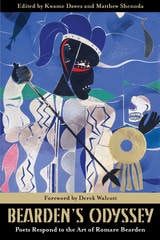
Bearden's Odyssey
Poets Respond to the Art of Romare BeardenEdited by Kwame Dawes and Matthew Shenoda, Foreword by Derek Walcott
Northwestern University Press, 2017
Borrowing from Romare Bearden’s aesthetic palette and inspired by his Odysseus series, Bearden’s Odyssey gathers, for the first time, poems from thirty-five of the most revered African diaspora poets in the United States. Poetic echoes come forth in themes of inspiration with historical intersections of one of the greatest visual artists of the twentieth century.
The award-winning editors, Kwame Dawes and Matthew Shenoda, assemble an esteemed literary congregation, with original poems by Chris Abani, Rita Dove, Lyrae Van Clief-Stefanon, Ed Roberson, Aracelis Girmay, Yusef Komunyakaa, and more. With a powerful foreword by Nobel laureate Derek Walcott and stunning visual reproductions of select Bearden masterpieces, this anthology fuses art and literature, standing as a testament to Romare Bearden’s power and influence in the contemporary artistic world.
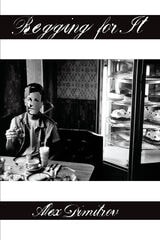
Begging for It
Alex Dimitrov
Four Way Books, 2013
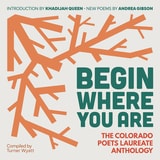
Begin Where You Are
The Colorado Poets Laureate AnthologyTurner Wyatt
University Press of Colorado, 2025
This book contains celebrated works from Thomas Hornsby Ferril and others, alongside never-before-published pieces from Bobby LeFebre, Joseph Hutchison, David Mason, and Mary Crow. Contemporary poets offer perspectives on how serving as Colorado poet laureate shaped their writing and worlds.
Spearheaded by award-winning social entrepreneur Turner Wyatt, this book is a movement with a mission: A portion of the proceeds will fund poetry programming in underserved Colorado schools, libraries, and rural areas, making each purchase an investment in expanding access to this essential art form.
Featured poets: Andrea Gibson, Bobby LeFebre, Joseph Hutchison, David Mason, Mary Crow, Thomas Hornsby Ferril, Milford E. Shields, Margaret Clyde Robertson, Nellie Burget Miller, Alice Polk Hill
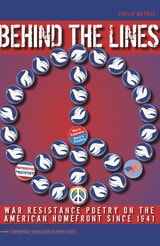
Behind the Lines
War Resistance Poetry on the American Home Front since 1941Philip Metres
University of Iowa Press, 2007
Behind the Lines investigates American war resistance poetry from the Second World War through the Iraq wars. Rather than simply chronicling the genre, Philip Metres argues that this poetry gets to the heart of who is authorized to speak about war and how it can be represented. As such, he explores a largely neglected area of scholarship: the poet’s relationship to dissenting political movements and the nation.
In his elegant study, Metres examines the ways in which war resistance is registered not only in terms of its content but also at the level of the lyric. He proposes that protest poetry constitutes a subgenre that—by virtue of its preoccupation with politics, history, and trauma—probes the limits of American lyric poetry. Thus, war resistance poetry—and the role of what Shelley calls unacknowledged legislators—is a crucial, though largely unexamined, body of writing that stands at the center of dissident political movements.
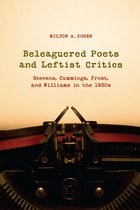
Beleaguered Poets and Leftist Critics
Stevens, Cummings, Frost, and Williams in the 1930sMilton A. Cohen
University of Alabama Press, 2011
A critical examination of modernist poetry and the demands of leftist literary theory.
Different as they were as poets, Wallace Stevens, E. E. Cummings, Robert Frost, and William Carlos Williams grappled with the highly charged literary politics of the 1930s in comparable ways. As other writers moved sharply to the Left, and as leftist critics promulgated a proletarian aesthetics, these modernist poets keenly felt the pressure of the times and politicized literary scene. All four poets saw their reputations critically challenged in these years and felt compelled to respond to the new politics, literary and national, in distinct ways, ranging from rejection to involvement.
Beleaguered Poets and Leftist Critics closely examines the dynamics of these responses: what these four poets wrote—in letters, essays, lectures, fiction (for Williams), and most importantly, in their poems; what they believed politically and aesthetically; how critics, particularly leftist critics, reviewed their work; how these poets reacted to that criticism and to the broader milieu of leftism. Each poet’s response and its subsequent impact on his poetic output is a unique case study of the conflicting demands of art and politics in a time of great social change.
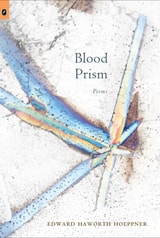
Blood Prism
Edward Haworth Hoeppner
The Ohio State University Press, 2011
The poems in Blood Prism span a lifetime. Its three sections, “Memory,” “Politics,” and “Age,” frame meditations on a violence-blotched world with reflections on the author’s childhood and conclusions about a decades-long life of writing. “I’m 60 and still . . . alive in this world, with love and with its palindrome,” one poem says. And the argument of the book turns on that precise puzzle: on evol, invoking as it does both evil and evolve, both human wrong and life as something more than mere survival. In a variety of styles—prose poems, standard and dislocated forms—Hoeppner uses “blood” to represent family and history, his surprising and richly imagistic language rendering the emptiness he calls imagination “into remains. Into what persists.”
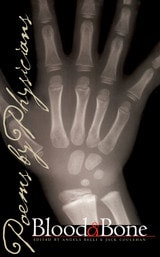
Blood and Bone
Poems by PhysiciansAngela Belli
University of Iowa Press, 1998
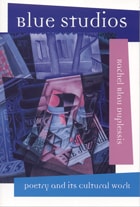
Blue Studios
Poetry and Its Cultural WorkRachel Blau DuPlessis
University of Alabama Press, 2006
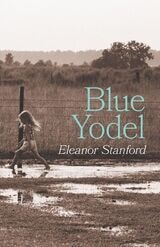
Blue Yodel
Eleanor Stanford
Carnegie Mellon University Press, 2024
These poems take the reader from Mexico City to West Philadelphia to Karachi. The works wade into the difficult joys of mothering, self-exploration, and romantic entanglement in midlife. Throughout, Eleanor Stanford embraces the mysticism of Hildegard of Bingen, the abjection of Tammy Wynette, and the wry self-appraisal of Sylvia Plath, fashioning it all into something entirely its own.
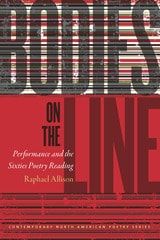
Bodies on the Line
Performance and the Sixties Poetry ReadingRaphael Allison
University of Iowa Press, 2014
By comparing these two dominant styles of reading, Allison argues that attention to sixties poetry readings reveals poets struggling between the kind of immediacy and presence that readings suggested and a private retreat from such performance-based publicity, one centered on the text itself. Recordings of Robert Frost, Charles Olson, Gwendolyn Brooks, Larry Eigner, and William Carlos Williams—all of whom emphasized voice, breath, and spoken language and who were inveterate professional readers in the sixties—expose this struggle in often surprising ways. In deconstructing assertions about the role and importance of the poetry reading during this period, Allison reveals just how dramatic, political, and contentious poetry readings could be. By discussing how to "hear" as well as "read" poetry, Bodies on the Line offers startling new vantage points from which to understand American poetry since the 1960s as both performance and text.

Boomer Girls
Poems by Women from the Baby Boom GenerationPamela Gemin
University of Iowa Press, 1999
Where were you between Betty Crocker and Gloria Steinem? With that question in mind poets Pamela Gemin and Paula Sergi began collecting the poems in Boomer Girls, an anthology of coming-of-age poems written by women born between 1945 and 1964, give or take a few years on either side. The answers to that question fill this volume with the energy, passion, heartbreak, and giddiness of women's lives from childhood to adolescence to middle age.
The poems in Boomer Girls are by unknown, emerging, and established writers, women who participated in the second wave of feminism. From Sandra Cisneros' "My Wicked Wicked Ways" to Barbara Crooker's "Nearing Menopause, I Run into Elvis at Shoprite," from Wendy Mnookin's "Polio Summer" to Kyoko Mori's "Barbie Says Math Is Hard," these poems call for us to celebrate (in the words of poet Diane Seuss-Brakeman) "glances, romances, beauty and guilt, regret, remorse, rebates and rejuvenations."
Boomer Girls share a common culture, bound by their generation's political history, by pop icons like Barbie—that pedestaled Boomer Girl who's just turned forty—and by the music that's never stopped playing: Janis Joplin, Marvin Gaye, Jimi Hendrix, the Ronettes, Van Morrison, Patsy Cline, John Lennon. The Boomer poets in this feisty anthology speak with diverse voices and embody a wide range of experiences, yet their generation's universal images—the hula hoops, TV shows, finned automobiles, and other household gods of their youth—unite them in ways both hilarious and tender.

Boy
Tracy Youngblom
CavanKerry Press, 2023
The death of a youngest child. An alcoholic and distant father. A grief-stricken family. A tentative faith. These are the building blocks of Boy, a sequence of poems that explores how death and loss color memory and influence the ways family members relate to each other and to their shared history.
Inspired by the death of her own younger brother, Tracy Youngblom has written a poetry collection that serves as a companion to grief. This book is for those who love poetry and those who are intimidated by it, those interested in the way childhood experience shapes life, and those interested in the psychology of addiction.
Breakfast Served Any Time All Day
Essays on Poetry New and SelectedDonald Hall
University of Michigan Press, 2004
Praise for Breakfast Served:
". . . the essays in this book are engaging, passionate, strange, and unified. Hall has been around a long time, and you can trace the concerns of a generation through the mind of this one man: questions about the diminished scope of poetry, the diminished ambitions of poets, how a poem 'means,' etc. . . . . Criticism . . . is an exercise in sanity, of which these essays are a splendid and useful example."
-Poetry
"A luminous and essential volume about the sensuality of language, its pleasures and sounds."
-Ploughshares
"It is in this merger of a poet's biography and a poem's body that Hall does his best work. . . . [Breakfast Served Any Time All Day] has an undeniably infectious quality to it. Finishing it, you cannot help but want to return to your bookshelf, and read-again or for the first time-the great forgotten poems of our past."
-Nathan Greenwood Thompson, Rain Taxi
Breaking the Jaws of Silence
Sixty American Poets Speak to the WorldSholeh Wolpé
University of Arkansas Press, 2013
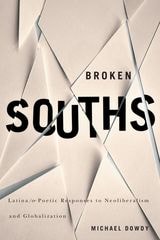
Broken Souths
Latina/o Poetic Responses to Neoliberalism and GlobalizationMichael Dowdy
University of Arizona Press, 2013
Dowdy argues that a transnational Latina/o imaginary has emerged in response to neoliberalism—the free-market philosophy that underpins what many in the northern hemisphere refer to as “globalization.” His work examines how poets represent the places that have been “broken” by globalization’s political, economic, and environmental upheavals. Broken Souths locates the roots of the new imaginary in 1968, when the Mexican student movement crested and the Chicano and Nuyorican movements emerged in the United States. It theorizes that Latina/o poetics negotiates tensions between the late 1960s’ oppositional, collective identities and the present day’s radical individualisms and discourses of assimilation, including the “post-colonial,” “post-national,” and “post-revolutionary.” Dowdy is particularly interested in how Latina/o poetics reframes debates in cultural studies and critical geography on the relation between place, space, and nature.
Broken Souths features discussions of Latina/o writers such as Victor Hernández Cruz, Martín Espada, Juan Felipe Herrera, Guillermo Verdecchia, Marcos McPeek Villatoro, Maurice Kilwein Guevara, Judith Ortiz Cofer, Jack Agüeros, Marjorie Agosín, Valerie Martínez, and Ariel Dorfman, alongside discussions of influential Latin American writers, including Roberto Bolaño, Ernesto Cardenal, David Huerta, José Emilio Pacheco, and Raúl Zurita.