Results by title
244 books match the query 'Arkansas' and 9 start with b
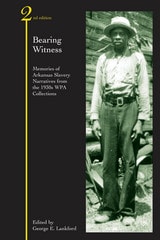
Bearing Witness
Memories of Arkansas SlaveryGeorge E. Lankford
University of Arkansas Press, 2006
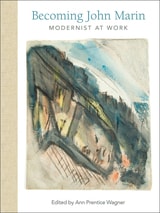
Becoming John Marin
Modernist at WorkAnn Prentice Wagner
University of Arkansas Press, 2018
John Marin was a major figure among the cutting-edge circle of American modernist artists who showed his work in Alfred Stieglitz’s New York galleries from 1909 until 1950. A new collection of the artist’s work at the Arkansas Arts Center, given by Marin’s daughter-in-law, forms the basis of this first book of essays and images to concentrate on Marin’s drawings in the context of Marin’s life, his watercolors, and his etchings.
We follow Marin to his most famous subject matter: New York City and the coast of Maine. Foundational drawings and an unfinished watercolor of the towering Woolworth Building, still under construction when they were made in 1912, begin the story of a renowned group of watercolors first exhibited in 1913 at Alfred Stieglitz’s 291 Gallery and then at the ground-breaking 1913 Armory Show. Other images take us to lesser-known locales, such as the Ramapo Mountains in New York and New Jersey where Marin often painted when he couldn’t get to Maine. More obscure aspects of the artist’s career explored in this collection include portraits of friends and family, charming drawings of animals, and circus scenes.
Becoming John Marin invites readers to look over this important artist’s shoulder as he created and honed the sketches he would interpret into completed watercolors and etchings, illustrating the evolution of his style and methods as he transformed from intuitive draftsman to innovative modernist watercolorist and etcher.
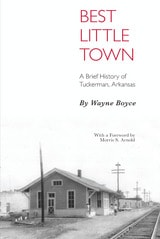
Best Little Town
A Brief History of Tuckerman, ArkansasWayne Boyce
Mockingbird Press, 2015
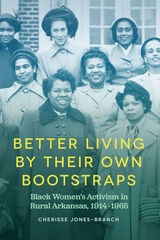
Better Living by Their Own Bootstraps
Black Women's Activism in Rural Arkansas, 1914-1965Cherisse Jones-Branch
University of Arkansas Press, 2021
The first major study to consider Black women’s activism in rural Arkansas, Better Living by Their Own Bootstraps foregrounds activists’ quest to improve Black communities through language and foodways as well as politics and community organizing. In reexamining these efforts, Cherisse Jones-Branch lifts many important figures out of obscurity, positioning them squarely within Arkansas’s agrarian history.
The Black women activists highlighted here include home demonstration agents employed by the Arkansas Agricultural Cooperative Extension Service and Jeanes Supervising Industrial Teachers, all of whom possessed an acute understanding of the difficulties that African Americans faced in rural spaces. Examining these activists through a historical lens, Jones-Branch reveals how educated, middle-class Black women worked with their less-educated rural sisters to create all-female spaces where they confronted economic, educational, public health, political, and theological concerns free from white regulation and interference.
Centered on the period between 1914 and 1965, Better Living by Their Own Bootstraps brings long-overdue attention to an important chapter in Arkansas history, spotlighting a group of Black women activists who uplifted their communities while subverting the formidable structures of white supremacy.
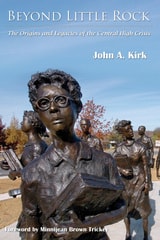
Beyond Little Rock
The Origins and Legacies of the Central High CrisisJohn A. Kirk
University of Arkansas Press, 2007
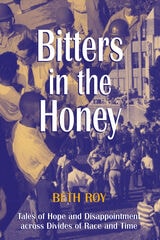
Bitters in the Honey
Tales of Hope and Disappointment across Divides of Race and TimeBeth Roy
University of Arkansas Press, 1999
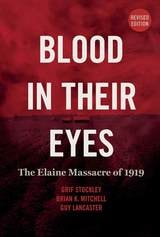
Blood in Their Eyes
The Elaine Massacre of 1919Grif Stockley
University of Arkansas Press, 2020
The first edition of Grif Stockley’s Blood in Their Eyes, published in 2001, brought renewed attention to the Elaine Massacre and sparked valuable new studies on racial violence and exploitation in Arkansas and beyond. With contributions from fellow historians Brian K. Mitchell and Guy Lancaster, this revised edition draws from recently uncovered source material and explores in greater detail the actions of the mob, the lives of those who survived the massacre, and the regime of fear and terror that prevailed under Jim Crow.
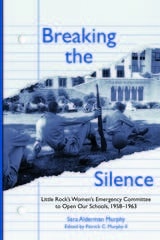
Breaking the Silence
The Little Rock Women's Emergency Committee to Open Our Schools, 1958–1963Sara Murphy
University of Arkansas Press, 1997
The Little Rock Central High School integration crisis did not end in1957 when President Eisenhower sent a portion of the first Airborne Division to protect nine black students. The turmoil was entering its second year in 1958 when Arkansas governor Orval Faubus invoked a hastily passed state law to close the high schools rather than obey the federal court orders that would integrate them.
A group of respectable, middle-class white women, faced with the prospect of no schools as well as the further loss of their city’s good name, turned militant. Led by Adolphine Fletcher Terry, a prominent, “old family” civic leader in her seventies, the women quickly put together the Women’s Emergency Committee to Open Our Schools (WEC), a highly effective organization that bombarded the city with ads, fliers, and statements challenging Faubus’s action. At peak membership, the WEC mustered two thousand to their cause. Largely inexperienced in politics when they joined the WEC, these women became articulate, confident promoters of public schools and helped others to understand that those schools must be fully integrated.
Forty years later, Sara Murphy, a key member of the WEC, recounts the rarely told sto1y of these courageous women who formed a resistance movement. With passion and sensitivity, she reconstructs the challenges and triumphs of that battle, which issued from the mutual link Southern white women shared with disfranchised African Americans in their common goal for full citizenship.
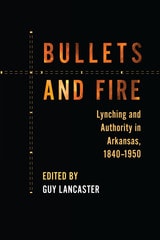
Bullets and Fire
Lynching and Authority in Arkansas, 1840-1950Guy Lancaster
University of Arkansas Press, 2017
Among the topics discussed are the lynching of slaves, the Arkansas Council of the Association of Southern Women for the Prevention of Lynching, the 1927 lynching of John Carter in Little Rock, and the state’s long opposition to a federal anti-lynching law.
Throughout, the work reveals how the phenomenon of lynching—as the means by which a system of white supremacy reified itself, with its perpetrators rarely punished and its defenders never condemned—served to construct authority in Arkansas. Bullets and Fire will add depth to the growing body of literature on American lynching and integrate a deeper understanding of this violence into Arkansas history.