Results by title
1272 books match the query 'Asia' and 43 start with b
Backstaging Modern Chinese Theatre
Intellectuals, Amateurs, and Cultural Entrepreneurs, 1910s–1940sMan He
University of Michigan Press, 2025
Backward Glances
Contemporary Chinese Cultures and the Female Homoerotic ImaginaryFran Martin
Duke University Press, 2010
As Martin explains, memorial schoolgirl love stories are popular throughout contemporary Chinese cultures. The same-sex attracted young woman appears in both openly homophobic and proudly queer-affirmative narratives, as well as in stories whose ideological valence is less immediately clear. Martin demonstrates that the stories, television programs, and films she analyzes are not idiosyncratic depictions of marginal figures, but manifestations of a broader, mainstream cultural preoccupation. Her investigation of representations of same-sex love between women sheds new light on contemporary Chinese understandings of sex, love, gender, marriage, and the cultural ordering of human life.
Bactria
The History of a Forgotten EmpireHugh George Rawlinson
Westholme Publishing, 2013
“If through the Bactrian Empire European ideas were transmitted to the Far East, through that and similar channels Asiatic ideas found their way to Europe.”—Intellectual Development of Europe
Following the Macedonian invasion of Persian in the fourth century B.C., an independent Greek-ruled empire emerged over an area encompassing modern Afghanistan, eastern Iran, and northern Pakistan. This ancient empire, called Bactria, is recorded in texts, both Asian and European, as well as through coins, inscriptions, and architectural remnants. Bactria served as a contact point between Europe, South Asia, and the Far East for more than two hundred years before disappearing under the pressure of a resurgent Persia to the west and Indian states to the east. In Bactria: The History of a Forgotten Empire, historian Hugh G. Rawlinson begins with the early history of Bactria and its subjugation by Persia, and then describes the conquest of Iran by Alexander the Great and the establishment of an independent Bactria ruled by Greeks. The Bactrians adopted Buddhism early on and helped establish the religion throughout the area. The author then follows the history of the empire through its rulers, including Menander, until Greek rule was extinguished around 135 B.C. Finally, the author discusses the effects of Greek occupation on the region. Based on meticulous research in ancient texts from Greece, Persia, and India, and using material evidence of the time, this history, which won the Hare University Prize at Cambridge in 1909, remains relevant today, providing a fascinating portrait of a little-known connection between East and West.
Bad Water
Nature, Pollution, and Politics in Japan, 1870-1950Robert Stolz
Duke University Press, 2014
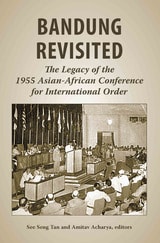
Bandung Revisited
The Legacy of the 1955 Asian-African Conference for International OrderEdited by Amitav Acharya and Tan See Seng
National University of Singapore Press, 2008
The authors in the present volume argue that the Bandung Conference had a lasting normative influence on the contemporary regional order of Asia, and that it underlies the diplomatic principles and loosely defined normative framework that characterize present-day Asian international relations.
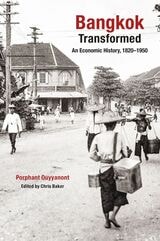
Bangkok Transformed
An Economic History, 1820–1950Porphant Ouyyanont
National University of Singapore Press, 2026
For much of its early history, Bangkok was little more than a riverside settlement, yet by the mid-twentieth century, it had become the commercial and political heart of Thailand. Bangkok Transformed deciphers this progress, outlining how the city’s economy and urban landscape were shaped by global trade and royal intervention. As the rice trade boomed, Chinese immigrants poured in, forming the backbone of Bangkok’s labor force and entrepreneurial class. Meanwhile, the Siamese monarchy, particularly under King Chulalongkorn, wielded economic power through state-run enterprises and control over key industries. These forces propelled Bangkok into modernity but also left behind a centralized governance structure that continues to influence the city today.
Written by Thailand’s foremost economic historian, Porphant Ouyyanont, and completed posthumously by historian Chris Baker, this meticulously researched study offers an innovative economic and social history of Bangkok. Spanning from the early nineteenth century to 1950, it displays how the foundations of contemporary Bangkok were laid in its first great transformation.
Banner Legacy
The Rise of the Fengtian Local Elite at the End of the QingYoshiki Enatsu
University of Michigan Press, 2004
Basques in the Philippines
Marciano R. De Borja
University of Nevada Press, 2012
The Basques played a remarkably influential role in the creation and maintenance of Spain’s colonial establishment in the Philippines. Their skills as shipbuilders and businessmen, their evangelical zeal, and their ethnic cohesion and work-oriented culture made them successful as explorers, colonial administrators, missionaries, merchants, and settlers. They continued to play prominent roles in the governance and economy of the archipelago until the end of Spanish sovereignty, and their descendants still contribute in significant ways to the culture and economy of the contemporary Philippines. This book offers important new information about a little-known aspect of Philippine history and the influence of Basque immigration in the Spanish Empire, and it fills an important void in the literature of the Basque diaspora.
Beauty Regimes
A History of Power and Modern Empire in the Philippines, 1898–1941Genevieve Alva Clutario
Duke University Press, 2023
Becoming Imperial Citizens
Indians in the Late-Victorian EmpireSukanya Banerjee
Duke University Press, 2010
Interpreting autobiography, fiction, election speeches, economic analyses, parliamentary documents, and government correspondence, Banerjee foregrounds the narrative logic sustaining the unprecedented claims to citizenship advanced by racialized colonial subjects. She focuses on the writings of figures such as Dadabhai Naoroji, known as the first Asian to be elected to the British Parliament; Surendranath Banerjea, among the earliest Indians admitted into the Indian Civil Service; Cornelia Sorabji, the first woman to study law in Oxford and the first woman lawyer in India; and Mohandas K. Gandhi, who lived in South Africa for nearly twenty-one years prior to his involvement in Indian nationalist politics. In her analysis of the unexpected registers through which they carved out a language of formal equality, Banerjee draws extensively from discussions in both late-colonial India and Victorian Britain on political economy, indentured labor, female professionalism, and bureaucratic modernity. Signaling the centrality of these discussions to the formulations of citizenship, Becoming Imperial Citizens discloses a vibrant transnational space of political action and subjecthood, and it sheds new light on the complex mutations of the category of citizenship.
Becoming Refugee American
The Politics of Rescue in Little SaigonPhuong Nguyen
University of Illinois Press, 2017
Phuong Tran Nguyen examines the phenomenon of refugee nationalism among Vietnamese Americans in Southern California. Here, the residents of Little Saigon keep alive nostalgia for the old regime and, by extension, their claim to a lost statehood. Their refugee nationalism is less a refusal to assimilate than a mode of becoming, in essence, a distinct group of refugee Americans. Nguyen examines the factors that encouraged them to adopt this identity. His analysis also moves beyond the familiar rescue narrative to chart the intimate yet contentious relationship these Vietnamese Americans have with their adopted homeland. Nguyen sets their plight within the context of the Cold War, an era when Americans sought to atone for broken promises but also saw themselves as providing a sanctuary for people everywhere fleeing communism.

Beethoven in Beijing
Stories from the Philadelphia Orchestra's Historic Journey to ChinaJennifer Lin
Temple University Press, 2022
In 1973, Western music was banned in the People’s Republic of China. But in a remarkable breakthrough cultural exchange, the Philadelphia Orchestra conducted a tour of closed-off China, becoming the first American orchestra to visit the communist nation. Jennifer Lin’s Beethoven in Beijing provides a fabulous photo-rich oral history of this boundary-breaking series of concerts the orchestra performed under famed conductor Eugene Ormandy.
Lin draws from interviews, personal diaries, and news accounts to give voice to the American and Chinese musicians, diplomats, journalists, and others who participated in and witnessed this historic event. Beethoven in Beijing is filled with glorious images as well as anecdotes ranging from amusing sidewalk Frisbee sessions and acupuncture treatments for sore musicians to a tense encounter involving Madame Mao dictating which symphony was to be played at a concert.
A companion volume to the film of the same name, Beethoven in Beijing shows how this 1973 tour came at the dawn of a resurgence of interest in classical music in China—now a vital source of revenue for touring orchestras.
Before the Nation
Kokugaku and the Imagining of Community in Early Modern JapanSusan L. Burns
Duke University Press, 2003
Central to Burns's analysis is Motoori Norinaga’s Kojikiden, arguably the most important intellectual work of Japan's early modern period. Burns situates the Kojikiden as one in a series of attempts to analyze and interpret the mythohistories dating from the early eighth century, the Kojiki and Nihon shoki. Norinaga saw these texts as keys to an original, authentic, and idyllic Japan that existed before being tainted by "flawed" foreign influences, notably Confucianism and Buddhism. Hailed in the nineteenth century as the begetter of a new national consciousness, Norinaga's Kojikiden was later condemned by some as a source of Japan's twentieth-century descent into militarism, war, and defeat. Burns looks in depth at three kokugaku writers—Ueda Akinari, Fujitani Mitsue, and Tachibana Moribe—who contested Norinaga's interpretations and produced competing readings of the mythohistories that offered new theories of community as the basis for Japanese social and cultural identity. Though relegated to the footnotes by a later generation of scholars, these writers were quite influential in their day, and by recovering their arguments, Burns reveals kokugaku as a complex debate—involving history, language, and subjectivity—with repercussions extending well into the modern era.
Beijing from Below
Stories of Marginal Lives in the Capital's CenterHarriet Evans
Duke University Press, 2020
Bengal in Global Concept History
Culturalism in the Age of CapitalAndrew Sartori
University of Chicago Press, 2008
Sartori weaves the narrative of Bengal’s embrace of culturalism into a worldwide history of the concept, from its origins in eighteenth-century Germany, through its adoption in England in the early 1800s, to its appearance in distinct local guises across the non-Western world. The impetus for the concept’s dissemination was capitalism, Sartori argues, as its spread across the globe initiated the need to celebrate the local and the communal. Therefore, Sartori concludes, the use of the culture concept in non-Western sites was driven not by slavish imitation of colonizing powers, but by the same problems that repeatedly followed the advance of modern capitalism. This remarkable interdisciplinary study will be of significant interest to historians and anthropologists, as well as scholars of South Asia and colonialism.
Bengali Women
Manisha Roy
University of Chicago Press, 1992
In a new Afterword, Roy discusses changes in Bengali society and culture over the last two decades which have direct bearings on women's lives: divorce and the breakup of the joint family, education, increasing Westernization via television and women's magazines, and the erosion of traditional religious practices.
Best Practice
Management Consulting and the Ethics of Financialization in ChinaKimberly Chong
Duke University Press, 2018
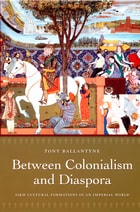
Between Colonialism and Diaspora
Sikh Cultural Formations in an Imperial WorldTony Ballantyne
Duke University Press, 2006
Constructing an expansive historical archive, Ballantyne draws on film, sculpture, fiction, and Web sites, as well as private papers, government records, journalism, and travel narratives. He proceeds from a critique of recent historiography on the development of Sikhism to an analysis of how Sikh identity changed over the course of the long nineteenth century. Ballantyne goes on to offer a reading of the contested interpretations of the life of Dalip Singh, the last Maharaja of Punjab. He concludes with an exploration of bhangra, a traditional form of Punjabi dance that diasporic artists have transformed into a globally popular music style. Much of bhangra’s recent evolution stems from encounters of the Sikh and Afro-Caribbean communities, particularly in the United Kingdom. Ballantyne contends that such cross-cultural encounters are central in defining Sikh identity both in Punjab and the diaspora.
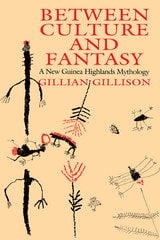
Between Culture and Fantasy
A New Guinea Highlands MythologyGillian Gillison
University of Chicago Press, 1993
Gillison shows how the themes expressed in Gimi myths—especially sexual hostility and an obsession with menstrual blood—are dramatized in the elaborate public rituals that accompany marriage, death, and other life crises. The separate myths of Gimi women and men seem to speak to one another, to protest, alter, and enlarge upon myths of the other sex. The sexes cast blame in the veiled imagery of myth and then play out their debate in joint rituals, cooperating in shows of conflict and resolution that leave men undefeated and accord women the greater blame for misfortune.
Between the Eagle and the Sun
Traces of JapanIhab Hassan
University of Alabama Press, 1996
A fascinating memoir by Egypt-born American literary theorist and writer Ihab Hassan about his life in Japan. Part recollection, part cultural perception, Between the Eagle and the Sun records his journey, living and seeing himself sometimes as another, assaying always to read the hieroglyphs of his past in the scripts of Japan. As lucid as it is intensely felt, at once lyrical and critical, the work offers a beguiling vision of Japan and, by tacit contrast, of America. For writing, the author says, is more than praise or blame, it is also knowledge, empathy, and delight. These attributes are evident in Hassan's treatment of Japanese culture, its people and scenes. Indeed, the people, rendered in vibrant portraits throughout the book, abide when all the shadows of romance and exasperation have fled.
True to its moment, the work also reinvests the forms of memoir, travel, and quest. Cultural essays, travel anecdotes, autobiographical meditations, portraits of Japanese friends, a section titled "Entries, A to Z," fit into a tight frame, with clear transitions from one section to another. The style, however, alters subtly to suit topic, occasion, and mood.
Japan may not hold the key to this planet's future; no single nation does. Yet the continuing interest in its history, society, and people and the incresed awareness of its recent trends and growing global impact engage an expanding audience. Avoiding cliches, sympathetic to its subject yet analytical, unflinching in judgment, and withal highly personal, Between the Eagle and the Sun offers a unique image of its subject by a distinguished and well-traveled critic, at home in several cultures.
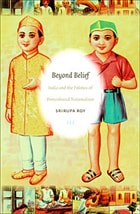
Beyond Belief
India and the Politics of Postcolonial NationalismSrirupa Roy
Duke University Press, 2007
Roy considers several different ways that identification with the Indian nation-state was produced and consolidated during the 1950s and 1960s. She looks at how the Films Division of India, a state-owned documentary and newsreel production agency, allowed national audiences to “see the state”; how the “unity in diversity” formation of nationhood was reinforced in commemorations of India’s annual Republic Day; and how the government produced a policy discourse claiming that scientific development was the ultimate national need and the most pressing priority for the state to address. She also analyzes the fate of the steel towns—industrial townships built to house the workers of nationalized steel plants—which were upheld as the exemplary national spaces of the new India. By prioritizing the role of actual manifestations of and encounters with the state, Roy moves beyond theories of nationalism and state formation based on collective belief.
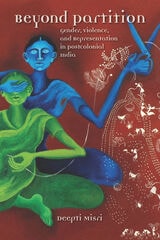
Beyond Partition
Gender, Violence and Representation in Postcolonial IndiaDeepti Misri
University of Illinois Press, 2014
Deepti Misri shows how Partition began a history of politicized animosity associated with the differing ideas of ""India"" held by communities and in regions on one hand, and by the political-military Indian state on the other. She moves beyond that formative national event, however, in order to examine other forms of gendered violence in the postcolonial life of the nation, including custodial rape, public stripping, deturbanning, and enforced disappearances. Assembling literary, historiographic, performative, and visual representations of gendered violence against women and men, Misri establishes that cultural expressions do not just follow violence but determine its very contours, and interrogates the gendered scripts underwriting the violence originating in the contested visions of what ""India"" means.
Ambitious and ranging across disciplines, Beyond Partition offers both an overview of and nuanced new perspectives on the ways caste, identity, and class complicate representations of violence, and how such representations shape our understandings of both violence and India.
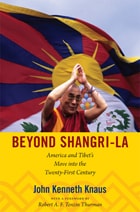
Beyond Shangri-La
America and Tibet's Move into the Twenty-First CenturyJohn Kenneth Knaus
Duke University Press, 2012
Since the late 1950s, the rugged resolve of the Dalai Lama and his people and the growing respect for their efforts to free their homeland from Chinese occupation have made Tibet's political and cultural status a pressing issue in international affairs. So has the realization by nations, including the United States, that their geopolitical interests would best be served by the defeat of the Chinese and the achievement of Tibetan self-determination. Beyond Shangri-La provides unique insight into the efforts of the U.S. government and committed U.S. citizens to support a free Tibet.
Beyond the Iron Rice Bowl
Regimes of Production and Industrial Relations in ChinaBoy Lüthje, Siqi Luo, and Hao Zhang
Campus Verlag, 2013
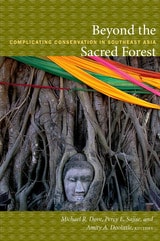
Beyond the Sacred Forest
Complicating Conservation in Southeast AsiaMichael R. Dove, Percy E. Sajise, and Amity A. Doolittle, eds.
Duke University Press, 2011
Contributors. Upik Djalins, Amity A. Doolittle, Michael R. Dove, Levita Duhaylungsod, Emily E. Harwell, Jeyamalar Kathirithamby-Wells, Lye Tuck-Po, Percy E. Sajise, Endah Sulistyawati, Yunita T. Winarto
BitterSweet
The Memoir of a Chinese-Indonesian Family in the Twentieth CenturyStuart Pearson
Ohio University Press, 2008
BitterSweet is the account of one Chinese-Indonesian family whose story stretches over the generations as their fortunes waxed and waned through revolution, riots, war, depression, occupation, and finally emigration to yet another country—Australia.
BitterSweet offers a unique insight into a world rarely seen before. An Sudibjo’s memoir, written from a woman’s perspective, is a valuable resource for anyone studying Indonesian history or the Chinese Diaspora.
Black Wave
How Networks and Governance Shaped Japan’s 3/11 DisastersDaniel P. Aldrich
University of Chicago Press, 2019
Black Wave illuminates two critical factors that had a direct influence on why survival rates varied so much across the Tōhoku region following the 3/11 disasters and why the rebuilding process has also not moved in lockstep across the region. Individuals and communities with stronger networks and better governance, Daniel P. Aldrich shows, had higher survival rates and accelerated recoveries. Less-connected communities with fewer such ties faced harder recovery processes and lower survival rates. Beyond the individual and neighborhood levels of survival and recovery, the rebuilding process has varied greatly, as some towns and cities have sought to work independently on rebuilding plans, ignoring recommendations from the national government and moving quickly to institute their own visions, while others have followed the guidelines offered by Tokyo-based bureaucrats for economic development and rebuilding.
Blessings from Beijing
Inside China's Soft-Power War on TibetGreg C. Bruno
University Press of New England, 2018
Blind in Early Modern Japan
Disability, Medicine, and IdentityWei Yu Wayne Tan
University of Michigan Press, 2022
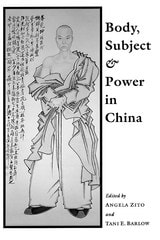
Body, Subject, and Power in China
Edited by Angela Zito and Tani E. Barlow
University of Chicago Press, 1994
Contributors investigate problems of bodiliness, engendered subjectivities, and discourses of power through a variety of sources that include written texts, paintings, buildings, interviews, and observations. Taken together, the essays show that bodies in China have been classified, represented, discussed, ritualized, gendered, and eroticized in ways as rich and multiple as those described in critical histories of the West. Silk robes, rocks, winds, gestures of bowing, yin yang hierarchies, and cross-dressing have helped create experiences of the body specific to Chinese historical life. By pointing to multiple examples of reimagining subjectivity and renegotiating power, the essays encourage scholars to avoid making broad generalizations about China and to rethink traditional notions of power, subject, and bodiliness in light of actual Chinese practices. Body, Subject, and Power in China is at once an example of the changing face of China studies and a work of importance to the entire discipline of cultural studies.
Bomb Children
Life in the Former Battlefields of LaosLeah Zani
Duke University Press, 2019
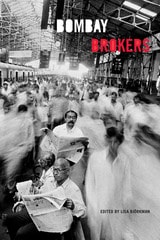
Bombay Brokers
Lisa Björkman, editor
Duke University Press, 2021
Contributors. Anjali Arondekar, Sarthak Bagchi, Tobias Baitsch, Sangeeta Banerji, Srimati Basu, Tarini Bedi, Amita Bhide, Lisa Björkman, Uday Chandra, Simon Chauchard, Ka-Kin Cheuk, Michael Collins, Daisy Deomampo, Maura Finkelstein, Ajay Gandhi, Rupali Gupte, Kathryn C. Hardy, Lalitha Kamath, Prasad Khanolkar, Bhushan Korgaonkar, Ratoola Kundu, Ken Kuroda, Annelies Kusters, Lisa Mitchell, Shailaja Paik, Gautam Pemmaraju, Lubaina Rangwala, Llerena Guiu Searle, Atreyee Sen, Prasad Shetty, Rohan Shivkumar, Edward Simpson, David Strohl, Rachel Sturman, R. Swaminathan, Aneri Taskar, Yaffa Truelove, Sahana Udupa, Lalit Vachani, Leilah Vevaina
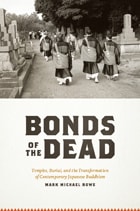
Bonds of the Dead
Temples, Burial, and the Transformation of Contemporary Japanese BuddhismMark Michael Rowe
University of Chicago Press, 2011
Despite popular images of priests seeking enlightenment in snow-covered mountain temples, the central concern of Japanese Buddhism is death. For that reason, Japanese Buddhism’s social and economic base has long been in mortuary services—a base now threatened by public debate over the status, treatment, and location of the dead. Bonds of the Dead explores the crisis brought on by this debate and investigates what changing burial forms reveal about the ways temple Buddhism is perceived and propagated in contemporary Japan.
Borders of Chinese Civilization
Geography and History at Empire's EndD. R. Howland
Duke University Press, 1996
With Japan’s decision in the 1870s to modernize and westernize, China’s relationship with Japan underwent a crucial change—one that resulted in its decisive separation from Chinese civilization and, according to Howland, a destabilization of China’s worldview. His examination of the ways in which Chinese perceptions of Japan altered in the 1880s reveals the crucial choice faced by the Chinese of whether to interact with Japan as “kin,” based on geographical proximity and the existence of common cultural threads, or as a “barbarian,” an alien force molded by European influence.
By probing China’s poetic and expository modes of portraying Japan, Borders of Chinese Civilization exposes the changing world of the nineteenth century and China’s comprehension of it. This broadly appealing work will engage scholars in the fields of Asian studies, Chinese literature, history, and geography, as well as those interested in theoretical reflections on travel or modernism.
Breaking the Chains
Slavery, Bondage, and Emancipation in Modern Africa and AsiaMartin A. Klein
University of Wisconsin Press, 1993
“Martin Klein has brought together recent work on the abolition of slavery, from Ottoman Turkey to Thailand and from South India to West Africa. This anthology builds on the recent scholarship on both slavery in Asia and Africa and the end of slavery as a world-wide historical phenomenon. Whereas other anthologies have tended to focus on either Africa or Asia, this project brings together in one volume case studies and methodological approaches concerning both regions. Breaking the Chains will be an important part of the relatively sparse literature on emancipation in comparative and global context.”—Richard Roberts, Stanford University
Because the American history of slavery and emancipation tends to be foremost in Western minds, few realize that traditional forms of servitude still exist in a variety of places around the world: children are sold on the streets of Bangkok, bondage persists in India despite official efforts to abolish it, and until 1980 slavery was legal in Mauritania.
Breaking the Chains deals with emancipation in African and Asian societies which were either colonized or came under the domination of European powers in the nineteenth century. In these societies, emancipation involved the imposition on non-European societies of an explicitly European discourse on slavery, and, in most cases, a free labor ideology. Most of the slave masters described in these essays were not European and found European ideas on emancipation difficult to accept.
Against this backdrop, the essayists (many of whom contribute their own non-Western perspective) focus on the transition from slavery (or other forms of bondage) to emancipation. They show that in each case the process involved pressure from European abolition movements, the extension of capitalist relations of production, the concerns and perceptions of the colonial state, and the efforts of non-Western elites to modernize their cultures.
Martin A. Klein argues that the Asian and African experience has much in common with the American experience, particularly in efforts to control labor and family life. The struggle to control the labor of former slaves has often been intense and, he suggests, has had a continuing impact on the social order in former slave societies.

Brown Skins, White Coats
Race Science in India, 1920–66Projit Bihari Mukharji
University of Chicago Press, 2022
There has been a recent explosion in studies of race science in the twentieth and twenty-first centuries, but most have focused either on Europe or on North America and Australia. In this stirring history, Projit Bihari Mukharji illustrates how India appropriated and repurposed race science to its own ends and argues that these appropriations need to be understood within the national and regional contexts of postcolonial nation-making—not merely as footnotes to a Western history of “normal science.”
The book comprises seven factual chapters operating at distinct levels—conceptual, practical, and cosmological—and eight fictive interchapters, a series of epistolary exchanges between the Bengali author Hemendrakumar Ray (1888–1963) and the protagonist of his dystopian science fiction novel about race, race science, racial improvement, and dehumanization. In this way, Mukharji fills out the historical moment in which the factual narrative unfolded, vividly revealing its moral, affective, political, and intellectual fissures.
Brunei
From the Age of Commerce to the 21st CenturyMarie-Sybille de Vienne
National University of Singapore Press, 2015
Today home to some 393,000 inhabitants and comprising 5,765 square kilometers in area, Brunei first appears in the historical record at the end of the 10th century. After the Spanish attack of 1578, Brunei struggled to regain and expand its control on coastal West Borneo and to remain within the trading networks of the South China Sea. It later fell under British sway, and a residency was established in 1906, but it took the discovery of oil in Seria in 1929 before the colonial power began to establish the bases of a modern state.
Governed by an absolute monarchy, Bruneians today nonetheless enjoy a high level of social protection and rule of law. Ranking second (after Singapore) in Southeast Asia in terms of standards of living, the sultanate is implementing an Islamic penal code for the first time of its history. Focusing on Brunei’s political economy, history and geography, this book aims to understand the forces behind Brunei’s to-and-fro of tradition and modernisation.

Brutal Ephemerality
Migrant Temporalities on China's Urban FringeYang Zhan
University of Michigan Press, 2027
How do you build a hopeful future when your present is designed to be temporary? Brutal Ephemerality reveals that the sprawling urban villages on the edge of megacities such as Beijing aren’t slums that grew by accident. Instead, urban villages are intentionally kept in a state of uncertainty, allowing the city to have a ready supply of cheap land and flexible labor to fuel its rapid growth. Yang Zhan proposes the concept of “migrant venturers” (chuǎngdàng de rén) and argues that “venturing” (chuǎngdàng) represents a distinct survival strategy of mobility, risk-taking, and opportunity seeking, rather than rooting oneself in a specific place or profession. This strategy is an active practice of “future-making”—an effort to project a meaningful future from an uncertain present.
Brutal Ephemerality demonstrates how time is not a neutral backdrop, but the central arena for political struggle, ethical practice, and imaginative creation among marginalized groups. Zhan shows how hope and suffering are paradoxically intertwined, and how the very struggle for a better life can, itself, become a source of harm.
Building Globalization
Transnational Architecture Production in Urban ChinaXuefei Ren
University of Chicago Press, 2011
From the years 2004 to 2008, Beijing and Shanghai witnessed the construction of an extraordinary number of new buildings, many of which were designed by architectural firms overseas. Combining ethnographic fieldwork, historical research, and network analysis, Building Globalization closely scrutinizes the growing phenomenon of transnational architecture and its profound effect on the development of urban space.
Roaming from construction sites in Shanghai to architects’ offices in Paris, Xuefei Ren interviews hundreds of architects, developers, politicians, residents, and activists to explore this issue. She finds that in the rapidly transforming cities of modern China, iconic designs from prestigious international architects help private developers to distinguish their projects, government officials to advance their careers, and the Chinese state to announce the arrival of modern China on the world stage.
China leads the way in the globalization of architecture, a process whose ramifications can be felt from Beijing to Dubai to Basel. Connecting the dots between real estate speculation, megaproject construction, residential displacement, historical preservation, housing rights, and urban activism, Building Globalization reveals the contradictions and consequences of this new, global urban frontier.
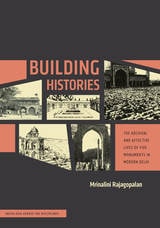
Building Histories
The Archival and Affective Lives of Five Monuments in Modern DelhiMrinalini Rajagopalan
University of Chicago Press, 2016
Mrinalini Rajagopalan argues that the modern construction of the history of these monuments entailed the careful selection, manipulation, and regulation of the past by both the colonial and later postcolonial states. Although framed as objective “archival” truths, these histories were meant to erase or marginalize the powerful and persistent affective appropriations of the monuments by groups who often existed outside the center of power. By analyzing these archival and affective histories together, Rajagopalan works to redefine the historic monument—far from a symbol of a specific past, the monument is shown in Building Histories to be a culturally mutable object with multiple stories to tell.
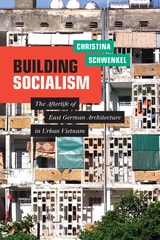
Building Socialism
The Afterlife of East German Architecture in Urban VietnamChristina Schwenkel
Duke University Press, 2020
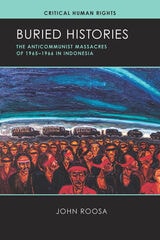
Buried Histories
The Anticommunist Massacres of 1965–1966 in IndonesiaJohn Roosa
University of Wisconsin Press, 2022
Drawing upon years of research and interviews with survivors, Buried Histories is an impressive contribution to the literature on genocide and mass atrocity, crucially addressing the topics of media, military organization, economic interests, and resistance.
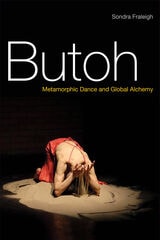
Butoh
Metamorphic Dance and Global AlchemySondra Fraleigh
University of Illinois Press, 2010