Results by title
159 books match the query 'Birds' and 34 start with b
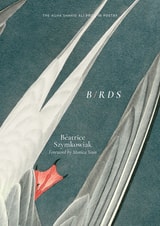
B/RDS
Béatrice Szymkowiak
University of Utah Press, 2023
B/RDS endeavors to dismantle discourses that create an artificial distinction between nature and humanity through a subversive erasure of an iconic work of natural history: John James Audubon’s Birds of America (1827-1838). This process of erasure considers the text of Birds of America as an archival cage. The author selectively erases words from the textual cage to reveal its ambiguity and the complex relationship between humanity and the other-than-human world. As the cage disappears, leaving a space for scarce, lyrical poems, birds break free, their voices inextricably entangled with ours.
Prose poems written in the author’s own words and prompted by the erasure process are also interspersed throughout the collection. These migratory poems, like ripples, trace the link between past and present and reveal the human-nature disconnect at the root cause of environmental and social problems, including the COVID-19 pandemic.
Along its five movements, B/RDS also explores how we can reimagine our relationship to environment through language within new frameworks of interconnectedness. Thus, as the collection resists the distinction between nature and culture on which traditional nature poetry relies, it also acts as an ecopoetic manifesto. It suggests that a critical, lyrical poetry could contribute to ecological awareness by singing humanity back within nature.
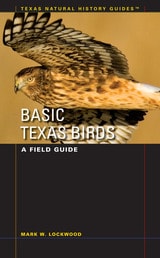
Basic Texas Birds
A Field GuideBy Mark W. Lockwood
University of Texas Press, 2007
Finding all the birds in Texas can be a lifetime pursuit. Basic Texas Birds, an easy-to-use field guide, will help you identify over 180 species of birds that are found across the state, including a selection of the rarer "Texas specialties" that draw birders to Texas from around the world. These are the birds that form the basis of a birder's life list for Texas.
Basic Texas Birds is organized by bird families to aid in identifying any bird you see in the wild. It is loaded with resources, including:
- 200 full-color, close-up photos of the birds
- State-of-the-art range maps—the most accurate of any currently available—that show each species' distribution within the state
- Up-to-date species accounts that provide a wealth of current and historical information, including each bird's appearance, habitat, status, and distribution, and that also identify similar species
- A glossary of terms used in bird identification
- A list of selected readings for learning more about birds found in Texas
- The Texas Ornithological Society's list of birds documented in Texas
Much more convenient for identifying common birds than a comprehensive state or national field guide, Basic Texas Birds is a must-have resource for both beginning and experienced birders.

Best of Companions
Henry Ford and the Protection of Birdlife in AmericaRick Simek
University of Michigan Press, 2027
Immediately following the success of the Model T, Henry Ford turned to how he could apply his newfound wealth toward protecting birdlife on his new rural acreage in Dearborn, Michigan. Best of Companions weaves Henry Ford’s personal and very public participation in bird protection into the overall national push to save disappearing North American birdlife in the early twentieth century.
Acting on his love of birds, Ford formed acquaintances and friendships with some of the most prominent North American wildlife conservation activists of the time. Michigan Audubon Society President Jefferson Butler was recruited to plan, establish, and promote an expansive, visionary bird protection project known as Henry Ford’s Bird Farm. Highlighting the economic benefit of birds, the farm modeled how farmers could use both natural and artificial means to boost populations of native insectivorous bird species on their land, reducing crop damage from insects and increasing agricultural productivity. Best of Companions takes readers on an exciting journey through Ford’s ambitious efforts to secure passage of the first federal bird protection law in the United States, to support the Migratory Bird Treaty with Canada, and to improve the lives of farmers.
Bird Day
A Story of 24 Hours and 24 Avian LivesMark E. Hauber
University of Chicago Press, 2023
From morning to night and from the Antarctic to the equator, birds have busy days. In this short book, ornithologist Mark E. Hauber shows readers exactly how birds spend their time. Each chapter covers a single bird during a single hour, highlighting twenty-four different bird species from around the globe, from the tropics through the temperate zones to the polar regions. We encounter owls and nightjars hunting at night and kiwis and petrels finding their way in the dark. As the sun rises, we witness the beautiful songs of the “dawn chorus.” At eleven o’clock in the morning, we float alongside a common pochard, a duck resting with one eye open to avoid predators. At eight that evening, we spot a hawk swallowing bats whole, gorging on up to fifteen in rapid succession before retreating into the darkness.
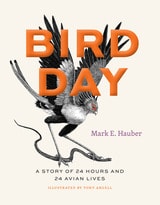
For each chapter, award-winning artist Tony Angell has depicted these scenes with his signature pen and ink illustrations, which grow increasingly light and then dark as our bird day passes. Working closely together to narrate and illustrate these unique moments in time, Hauber and Angell have created an engaging read that is a perfect way to spend an hour or two—and a true gift for readers, amateur scientists, and birdwatchers.
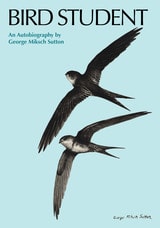
Bird Student
An AutobiographyAn Autobiography by George Miksch Sutton
University of Texas Press, 1980
At thirteen, George Miksch Sutton planned a school of ornithology centered around his collection of bird skins, feathers, bones, nests, eggs, and a prized stuffed crow. As an adult, he became one of the most prominent ornithologists and bird artists of the twentieth century. He describes his metamorphosis from amateur to professional in Bird Student.
Born in 1898, Sutton gives us his clearest memories of his boyhood in Nebraska, Minnesota, Oregon, Illinois, Texas, and West Virginia with his closely knit family. Recognizing birds, identifying them correctly, drawing them, and writing about them became more and more important to him. His intense admiration for Louis Agassiz Fuertes had a good deal to do with his beginning to draw birds in earnest, and his correspondence and his 1916 summer visit with the generous Fuertes taught him to look at birds with the eyes of a professional artist and to consider the possibility of making ornithology his career.
By 1918, Sutton had talked himself into a job at the Carnegie Museum of Natural History in Pittsburgh, which gave him fresh opportunities to learn and travel, and his 1920 field trip to the Labrador Peninsula stimulated his lifelong interest in arctic birds. Further expeditions to James Bay, the east coast of Hudson Bay—on leave from his job as state ornithologist of Pennsylvania—and Southampton Island at the north end of Hudson Bay, in search of the elusive blue goose and its nesting grounds, give us glimpses of field methods before the days of sophisticated equipment. Sutton ends his autobiography in 1935, with an account of his graduate days at Cornell University and his position as curator of the Fuertes Memorial Collection of Birds.
Bird Student is about raising young roadrunners and owls and prairie dogs, sailing (and being stranded) in arctic waters, preparing specimens in the hold of a ship, hunting birds and caribou and bears in almost inaccessible regions, canoeing in the Far North, camping in Florida, and delivering speeches in Pennsylvania. Sutton's gift for mixing facts and philosophy lets us see the evolution of a naturalist, as his inherent curiosity and innocent enjoyment of beauty led to a permanent desire to preserve this beauty.
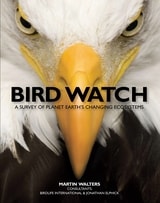
Bird Watch
A Survey of Planet Earth's Changing EcosystemsMartin Walters
University of Chicago Press, 2011
From the tufted puffin in the Pacific Northwest to the hook-billed hermit in the Brazilian rainforest, birds suffer from the effects of climate change in every corner of the globe. Scientists have found declines of up to 90 percent in some troubled bird populations and unprecedented reproductive failure in others. The most recent studies suggest dire prospects: 1,227 avian species are threatened with extinction and an additional 838 near-threatened species are urgent priorities for conservation action.
As much an indispensable guide as a timely call to action, Bird Watch is an illustrated tour of these endangered birds and their habitats. Encyclopedic in scope, this book features all 1,227 species on the International Union for Conservation of Nature (IUCN) Red List, thoroughly detailing the environmental pressures and conservation prescriptions that hold their futures in the balance. After introducing readers to the main threats to birds and regions at high risk, Bird Watch presents a visually stunning and scientifically accurate flight over the major bird habitats, including tropical forests; temperate and northern forests; deserts; mountains; grasslands; and Mediterranean, marine, freshwater, and oceanic islands. The volume concludes with an overview of bird species by region—categorized by family within each region, and a guide to the world’s best birding sites. Produced in cooperation with BirdLife International, Bird Watch is a celebration of the beauty and diversity of birds and their habitats—and a warning of the dangers they face around the world.
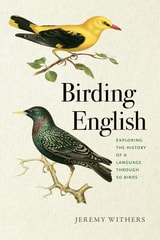
Birding English
Exploring the History of a Language Through 50 BirdsJeremy Withers
University of Iowa Press, 2026
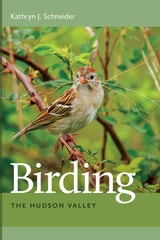
Birding the Hudson Valley
Kathryn J. Schneider
University Press of New England, 2018
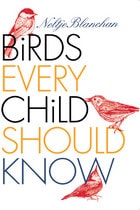
Birds Every Child Should Know
Neltje Blanchan
University of Iowa Press, 2000
Originally published in 1907, Birds Every Child Should Know is a collection of storylike descriptions of more than one hundred birds commonly found in the United States. Neltje Blanchan's detailed descriptions of birds—their physical attributes, calls, nesting and mating habits, and other behaviors—are nothing less than enchanting, and some read almost like fairy tales. Take for instance the mockingbird's call:
“when the moonlight sheds a silvery radiance about every sleeping creature, the mockingbird sings to his mate such delicious music as only the European nightingale can rival. Perhaps the stillness of the hour, the beauty and fragrance of the place where the singer is hidden among the orange blossoms or magnolia, increase the magic of his almost pathetically sweet voice; but surely there is no lovelier sound in nature on this side of the sea.”
or the yellow warbler's nest:
“an exquisite little cradle of silvery plant fiber, usually shreds of milkweed stalk, grass, leaves, and caterpillar's silk, neatly lined with hair, feathers, and downy felt of fern fronds.”
Blanchan includes folk history (how Native Americans and southern slaves thwarted mosquitoes by hanging gourds to attract purple martins) as well as common threats to birds that foreshadow current dangers to avian life (the toll taken on songbirds by lighthouses and electric towers). Such informative details, along with the author's disarming enthusiasm for her subject, will charm adult bird-watchers as well as children.
Cornelia Mutel's informative foreword places Blanchan's writing in the historical context of a turn-of-the-century environmental reawakening and burgeoning activism and research by women on behalf of dwindling bird populations.
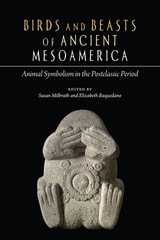
Birds and Beasts of Ancient Mesoamerica
Animal Symbolism in the Postclassic PeriodSusan Milbrath
University Press of Colorado, 2025
Representations of animal deities in Mesoamerica can be traced back at least to Middle Preclassic Olmec murals, stone carvings, and portable art such as lapidary work and ceramics. Throughout the history of Mesoamerica real animals were merged with fantastical creatures, creating zoological oddities not unlike medieval European bestiaries. According to Spanish chroniclers, the Aztec emperor was known to keep exotic animals in royal aviaries and zoos. The Postclassic period was characterized by an iconography that was shared from central Mexico to the Yucatan peninsula and south to Belize. In addition to highlighting the symbolic importance of nonhuman creatures in general, this volume focuses on the importance of the calendrical and astronomical symbolism associated with animals and birds.
Inspired by and dedicated to the work of Mesoamerican scholar Cecelia Klein and featuring imagery from painted books, monumental sculpture, portable arts, and archaeological evidence from the field of zooarchaeology, Birds and Beasts of Ancient Mesoamerica highlights the significance of the animal world in Postclassic and early colonial Mesoamerica. It will be important to students and scholars studying Mesoamerican art history, archaeology, ethnohistory, and zoology.
Birds and Feathers in the Ancient and Colonial Mesoamerican World
Allison Caplan and Lisa Sousa, special issue editors
Duke University Press, 0
Contributors: Allison Caplan, Martha Few, León García Garagarza, James Maley, John McCormack, Iris Montero Sobrevilla, Lisa Sousa
Birds and Other Wildlife of South Central Texas
A HandbookBy Edward A. Kutac and S. Christopher Caran
University of Texas Press, 1993
Nature takes a surprising turn in the heart of Texas. The flat Gulf Coastal Plains, which become the fertile Blackland Prairies in Central Texas, end abruptly at the Balcones Escarpment, one of the state’s most dramatic geological features, and the rolling, more sparsely vegetated Hill Country begins. The animal life varies as dramatically as the land. More than 400 species of birds alone, nearly three-fourths of all Texas birds, can be spotted in the region.
This handbook offers a concise natural history of Central Texas and a complete checklist of all native and naturalized vertebrate animals, including birds, mammals, reptiles, amphibians, and fish, as well as invertebrates that include butterflies and land snails. The listings cite both scientific and common names for each species, relative abundance in the region, and preferred habitats.
A distinguishing feature of the handbook is its list of parks and recreational areas in the region, which includes the counties of Bastrop, Bell, Bexar, Blanco, Burleson, Burnet, Caldwell, Comal, Fayette, Gillespie, Gonzales, Guadalupe, Hays, Kendall, Lee, Llano, Milam, Travis, and Williamson. The authors describe the recreational facilities available in each park and list the animal species likely to be encountered there.
For birdwatchers, naturalists, visitors, and residents alike, this popular handbook will be the essential "where-to-find-it" reference.
Birds of Algonquin Legend
Compiled and Written by Robert E. Nichols, Jr, with illustrations by Linda Hoffman Kimball
University of Michigan Press, 1996
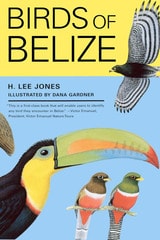
Birds of Belize
By H. Lee Jones
University of Texas Press, 2003
With nearly six hundred identified species of birds—and an average of five "new" species discovered annually—Belize is becoming a birding hotspot for amateur and professional birders from around the globe. Thousands of birders visit the country each year to enjoy Belize's amazing abundance and variety of both temperate and tropical birds in natural habitats that remain largely unspoiled. But until now, despite the growing need for an authoritative identification guide, birders have had to rely on regional field guides that offer only limited information on Belizean birds.
Birds of Belize provides the first complete guide to the identification of all currently known species—574 in all. The birds are grouped by families, with an introduction to each family that highlights its uniquely identifying characteristics and behaviors. The species accounts include all the details necessary for field identification: scientific and common names, size, plumage features, thorough voice descriptions, habitat, distribution, and status in Belize. Full color, expertly drawn illustrations by noted bird artist Dana Gardner present male and female, juvenile and adult, and basic and alternate plumages to aid visual identification throughout the year, while 234 range maps show the birds' distribution and seasonality in Belize. A comprehensive bibliography completes the volume.
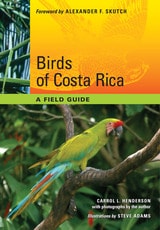
Birds of Costa Rica
A Field GuideText and photographs by Carrol L. Henderson
University of Texas Press, 2010
At the biological crossroads of the Americas, Costa Rica hosts an astonishing array of plants and animals—over half a million species! Ecotourists, birders, and biologists come from around the world, drawn by the likelihood of seeing more than three or four hundred species of birds and other animals during even a short stay. To help all of these visitors, as well as local residents, identify and enjoy the wildlife of Costa Rica, Carrol Henderson published Field Guide to the Wildlife of Costa Rica in 2002, and it became the instant and indispensable guide.
Now Henderson has created a dedicated field guide to the birds that travelers are most likely to see, as well as to the unique or endemic species that are of high interest to birders. Birds of Costa Rica covers 310 birds—an increase of 124 species from the earlier volume—with fascinating accounts of the birds' natural history, identification, and behavior gleaned from Henderson's forty years of traveling and birding in Costa Rica. All of the accounts include beautiful photographs of the birds, most of which were taken in the wild by Henderson. There are new updated distribution maps and a detailed appendix that identifies many of the country's best bird-watching locations and lodges, including contact information for trip planning purposes.
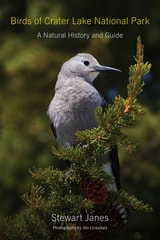
Birds of Crater Lake National Park
A Natural History and GuideStewart Janes
Oregon State University Press, 2026
From the Clark’s Nutcracker to the White-crowned Sparrow, the guide provides species accounts of the most characteristic birds found in the park. Accompanied by detailed color photographs, each entry also includes the scientific name, description, and distribution along with a short narrative.
With essays focusing on the history, climate, geology, and geography of the region, this guide offers a strong foundation to greater understanding of the birds of Crater Lake. Plus, chapters like “Birds Beyond Crater Lake National Park” and “Some Places to Bird in Crater Lake National Park,” along with a birding checklist, offer invaluable resources to beginner and skilled birders alike.
Birds of Fire
Jazz, Rock, Funk, and the Creation of FusionKevin Fellezs
Duke University Press, 2011
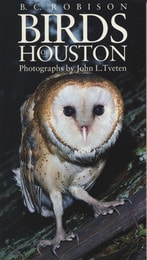
Birds of Houston
By B. C. Robison
University of Texas Press, 1997
No matter where you see birds in the city—in parks or woodlands, on power lines or in parking lots—they are the natural soul of the urban landscape. They enhance the city and the lives of those who watch them.
Nature writer B. C. Robison and wildlife photographer John Tveten have teamed up to produce this field guide for birders who want to identify the birds most commonly seen in Houston. Fifty-five species are included, ranging from such well-known favorites as the mockingbird and cardinal to the more exotic yellow-crowned night heron.
A full-color photograph for each bird appears alongside warm and often witty description. For quick reference, a summary of the primary field marks of the adult bird is also provided. This summary includes not only identifying features of the bird but also its habitats, the time of year it can be found, and its distinctive behavioral traits.
Aimed at the beginning birder, the guide also gives tips on buying binoculars and on attracting birds to your yard.
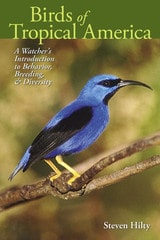
Birds of Tropical America
A Watcher's Introduction to Behavior, Breeding, and DiversityBy Steven Hilty
University of Texas Press, 2005
The guide to neotropical bird behavior that picks up where field guides leave off.
Why are tropical birds like parrots and quetzals so much more colorful than those in more temperate climates? How can a vulture soaring thousands of feet above the canopy spot a dead rodent no bigger than a mouse on the rainforest floor? What permits sparrow-sized antbirds to not only survive but to thrive among relentless hordes of army ants that devour every other living thing in their path?
Steven Hilty has led birding tours to the American Tropics for decades. By providing answers to the hundreds of questions asked by participants of these expeditions, Hilty has produced a natural history of the bird life of the New World Tropics that is at once practical, accurate, and as endlessly fascinating as the species whose lives it reveals.
Birds of Tropical America was published by Chapters Publishing in 1994 and went out of print in 1997. UT Press is pleased to reissue it with a new epilogue and updated references.
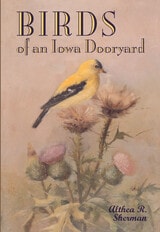
Birds of an Iowa Dooryard
Althea R. Sherman
University of Iowa Press, 1996
Now available in paperback with a new foreword by Marcia Myers Bonta, Birds of an Iowa Dooryard contains Althea Sherman's often caustic, always careful studies of the phoebes, wrens, cuckoos, rails, catbirds, owls, flickers, and many other species that inhabited her Acre of Birds in northern Iowa. Birds of an Iowa Dooryard, first published in 1952, is full of Sherman's meticulous observations of species both avian and human. Her paintings, her notebooks and publications, and her innovative chimney swift tower form a remarkably rich legacy to be valued by naturalists and researchers alike.
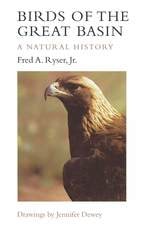
Birds of the Great Basin
A Natural HistoryFred A. Ryser
University of Nevada Press, 1985
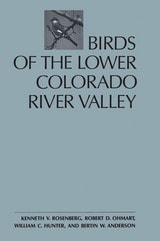
Birds of the Lower Colorado River Valley
Kenneth V. Rosenberg, Robert D. Ohmart, William C. Hunter, and Bertin W. Anderson
University of Arizona Press, 1991
"A tremendous amount of information is included in this book for banders, birders, and people working to restore the 'Nile of the American Southwest.'" —North American Bird Bander
"A report on several years of scientific research undertaken to investigate the ecological relationships among desert riparian wildlife. . . . Well writen and very informative book." —The Canadian Field Naturalist
"This work is a great achievment." —Birding
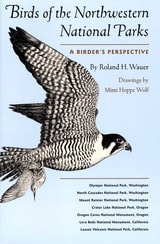
Birds of the Northwestern National Parks
A Birder's PerspectiveBy Roland H. Wauer
University of Texas Press, 2000
From the bald eagle to the pileolated woodpecker, the varied and abundant birdlife of the northwestern national parks is as impressive as the parks' dramatic scenery. To help both beginning and advanced birders make the most of their visits to these parks, Roland Wauer has written this finding guide, which introduces the most common birds and the most likely places to see them.
The book opens with practical advice on getting started in birding—choosing binoculars, bird identification, proper field techniques, etc. Then after a concise discussion of the national parks as "islands" of bird habitat, the succeeding chapters fully describe each park, including its plant and animal communities and the facilities and interpretive activities available to visitors. Wauer takes readers on "walks" through each park's most popular and accessible places, where he explains the identification and behavior of the birds that visitors are most likely to see. He closes each account with a review of the park's bird life and a list of key species. Pen-and-ink drawings illustrate many of the birds.
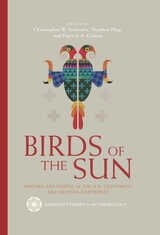
Birds of the Sun
Macaws and People in the U.S. Southwest and Mexican NorthwestEdited by Christopher W. Schwartz, Stephen Plog, and Patricia A. Gilman
University of Arizona Press, 2022
Scarlet macaws are native to tropical forests ranging from the Gulf Coast and southern regions of Mexico to Bolivia, but they are present at numerous archaeological sites in the U.S. Southwest and Mexican Northwest. Although these birds have been noted and marveled at through the decades, new syntheses of early excavations, new analytical methods, and new approaches to understanding the past now allow us to explore the significance and distribution of scarlet macaws to a degree that was previously impossible.
Birds of the Sun explores the many aspects of macaws, especially scarlet macaws, that have made them important to Native peoples living in this region for thousands of years. Leading experts discuss the significance of these birds, including perspectives from a Zuni author, a cultural anthropologist specializing in historic Pueblo societies, and archaeologists who have studied pre-Hispanic societies in Mesoamerica and the U.S. Southwest and Mexican Northwest. Chapters examine the highly variable distribution and frequency of macaws in the past, their presence on rock art and kiva murals, the human experience of living with and transporting macaws, macaw biology and life history, and what skeletal remains suggest about the health of macaws in the past. Experts provide an extensive, region-by-region analysis, from early to late periods, of what we know about the presence, health, and depositional contexts of macaws and parrots, with specific case studies from the Hohokam, Chaco, Mimbres, Mogollon Highlands, Northern Sinagua, and Casas Grandes regions, where these birds are most abundant.
The expertise offered in this stunning new volume, which includes eight full color pages, will lay the groundwork for future research for years to come.
Contributors
Katelyn J. Bishop
Patricia L. Crown
Samantha Fladd
Randee Fladeboe
Patricia A. Gilman
Thomas K. Harper
Michelle Hegmon
Douglas J. Kennett
Patrick D. Lyons
Charmion R. McKusick
Ben A. Nelson
Stephen Plog
José Luis Punzo Díaz
Polly Schaafsma
Christopher W. Schwartz
Octavius Seowtewa
Christine R. Szuter
Kelley L. M. Taylor
Michael E. Whalen
Peter M. Whiteley
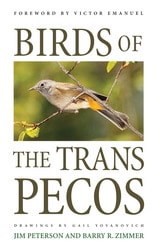
Birds of the Trans-Pecos
By Jim Peterson and Barry R. Zimmer
University of Texas Press, 1998
The Trans-Pecos, that huge region of Texas west of the Pecos River, is richer in recorded bird species than all but three of the United States. Hundreds of birders come here each year in search of species such as the Colima Warbler which are rarely if ever spotted in other parts of the country. Yet, until now, there was no comprehensive birding guide devoted to the entire region.
Designed for intermediate to advanced birders, Birds of the Trans-Pecos provides an annotated checklist of all 482 species found in the region. The species accounts include seasonal distribution, documentation of nesting, most likely habitat, and the bird's status as a "Texas Review Species." The authors also describe the geography and bird habitats of the Trans-Pecos; federal and state parklands in the area (including Big Bend and Guadalupe Mountains), with the species that occur in each; and the mountain-breeding birds and species of special interest.
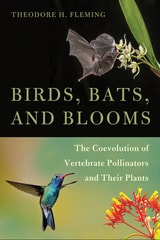
Birds, Bats, and Blooms
The Coevolution of Vertebrate Pollinators and Their PlantsTheodore H. Fleming
University of Arizona Press, 2024
Vertebrate pollinators like bats and birds are keystone species of the Sonoran Desert. Biologist Theodore H. Fleming uses these species—found in the desert around his home—to address two big questions dealing with the evolution of life on Earth: How did these animals evolve, and how did they coevolve with their food plants?
A deeply thoughtful and researched dive into evolutionary history, Birds, Bats, and Blooms offers an engaging trip across evolutionary trajectories as it discusses nectar-feeding birds and bats and their coevolution as pollinators with flowering plants. The primary focus is on New World birds such as hummingbirds and their chiropteran counterparts (nectar-feeding bats in the family Phyllostomidae). It also discusses their Old World ecological counterparts, including sunbirds, honeyeaters, lorikeets, and nectar-feeding bats in the Pteropodidae family. Fleming also addresses the conservation status of these beautiful animals.
Through engaging prose, Fleming pulls together the most recent research in evolutionary biology and pairs it with accounts of his personal interactions with bats and birds. His account includes fourteen color photographs taken by the author during his research trips around the world.
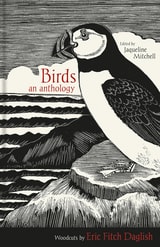
Birds
An AnthologyEdited by Jaqueline Mitchell
Bodleian Library Publishing, 2020
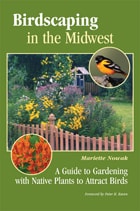
Birdscaping in the Midwest
A Guide to Gardening with Native Plants to Attract BirdsMariette Nowak; Foreword by Peter H. Raven
University of Wisconsin Press, 2012
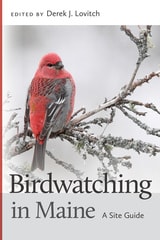
Birdwatching in Maine
A Site GuideEdited by Derek J. Lovitch
University Press of New England, 2017
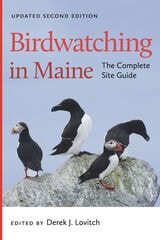
Birdwatching in Maine
The Complete Site GuideDerek J. Lovitch
Brandeis University Press, 2024
With over 470 species of birds recorded, Maine offers an abundance of birding opportunities for people of all levels of interest and experience, from those looking beyond their backyards for the first time to knowledgeable visitors looking to plug a hole in their list of sightings. The state’s wealth of undeveloped land and its extensive coastline, countless islands, and varied habitat combine to host an impressive diversity of birds at all times of the year. Birders travel to Maine from near and far to seek hard-to-find species, from the only Atlantic puffins breeding in the United States on offshore islands to Bicknell’s thrushes high in the mountains.
This book fills an important niche for the birdwatching community by offering comprehensive entries detailing the best locations for finding birds throughout the state for enthusiasts of all levels of skill and interest. It contains descriptions of 202 birding sites in Maine, with explicit directions on how to get there, for all sixteen of the state’s counties, several as large as other New England states! Each chapter features a county map, a brief overview by Derek J. Lovitch, numerous specific site guides, and a list of rarities. The book also contains a detailed and useful species accounts guide for finding the most sought-after birds.
Lavishly illustrated in color throughout, Birdwatching in Maine is the best available resource for finding birds in the largest of the New England states. This updated edition features a new introduction, as well as new birding sites and maps.
Birdwatching in New Hampshire
Eric A. Masterson
University Press of New England, 2013
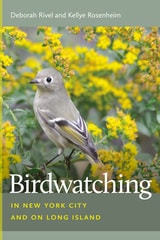
Birdwatching in New York City and on Long Island
Deborah Rivel and Kellye Rosenheim
University Press of New England, 2016
This easy-to-use guide gives seasonal information for both popular birding sites and those off the beaten path. Precise directions to the best viewing locations within the region’s diverse habitats enable birdwatchers to efficiently explore urban and wild birding hotspots. Over 500 species of birds can be seen in New York City’s five boroughs and on Long Island, one of the most densely populated and urbanized regions in North America, which also happens to be situated directly on the Atlantic Flyway. In this fragmented environment of scarce resources, birds concentrate on what’s available. This means that high numbers of birds are found in small spaces. In fact, Central Park alone attracts over 225 species of birds, which birders from around the world flock to see during spring and fall migration. Beyond Central Park, the five boroughs and Long Island have numerous wildlife refuges of extraordinary scenic beauty where resident and migratory birds inhabit forests, wetlands, grasslands, and beaches. These special places present an opportunity to see a wide array of songbirds, endangered nesting shorebirds, raptors, and an unprecedented number and variety of waterfowl. Including the latest information on the seasonal status and distribution of more than 400 species, with 39 maps and over 50 photographs, this full-color guide features information essential to planning a birding visit. It will become the go-to book for both the region’s longtime birders and those exploring the area for the first time.
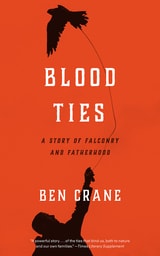
Blood Ties
A Story of Falconry and FatherhoodBen Crane
University of Chicago Press, 2020
In this artful and moving memoir, we follow Crane on his remarkable journey of flight and return. Traveling from the United Kingdom to Pakistan, we learn first about the history and practice of falconry, a beautiful and brutal partnership between humans and birds that has persisted for thousands of years. And as Crane’s personal story unfolds, we come to understand how he found solace and insight through his relationships with these animals. “I saw that my feelings toward nature, and birds of prey in particular, ran in parallel with my feelings for my son,” Crane writes. “I worked out that they were, in fact, two sides of the same coin—the deep love of one could, with gentle observation, inform and unlock the deep love for the other. . . . Perhaps this then is the central theme of my story.”
Many of us rely upon animal companions to provide a sense of joy, compassion, and empathy. But as Blood Ties teaches us, our relationships with the creatures among us can also transform us, illuminating what it means both to be human and to be part of the greater wild—what it means to be alive.
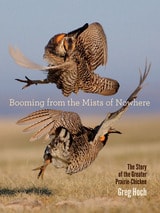
Booming from the Mists of Nowhere
The Story of the Greater Prairie-ChickenGreg Hoch
University of Iowa Press, 2015
Skillfully interweaving lyrical accounts from early settlers, hunters, and pioneer naturalists with recent scientific research on the grouse and its favored grasslands, Hoch reveals that the prairie-chicken played a key role in the American settlement of the Midwest. Many hungry pioneers regularly shot and ate the bird, as well as trapping hundreds of thousands, shipping them eastward by the trainload for coastal suppers. As a result of both hunting and habitat loss, the bird’s numbers plummeted to extinction across 90 percent of its original habitat. Iowa, whose tallgrass prairies formed the very center of the greater prairie-chicken’s range, no longer supports a native population of the bird most symbolic of prairie habitat.
The steep decline in the prairie-chicken population is one of the great tragedies of twentieth-century wildlife management and agricultural practices. However, Hoch gives us reason for optimism. These birds can thrive in agriculturally productive grasslands. Careful grazing, reduced use of pesticides, well-placed wildlife corridors, planned burning, higher plant, animal, and insect diversity: these are the keys. If enough blocks of healthy grasslands are scattered over the midwestern landscape, there will be prairie-chickens—and many of their fellow creatures of the tall grasses. Farmers, ranchers, conservationists, and citizens can reverse the decline of grassland birds and insure that future generations will hear the booming of the prairie-chicken.