Results by title
4531 books match the query 'Cultural & Ethnic Studies' and 388 start with b
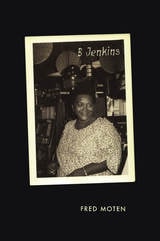
B Jenkins
Fred Moten
Duke University Press, 2010
The first and last poems in the collection are explicitly devoted to Moten’s mother; the others relate more obliquely to her life and legacy. They invoke performers, writers, artists, and thinkers including not only James Baldwin, Roland Barthes, Frederick Douglass, Billie Holiday, Audre Lorde, Charlie Parker, and Cecil Taylor, but also contemporary scholars of race, affect, and queer theory. The book concludes with an interview conducted by Charles Henry Rowell, the editor of the journal Callaloo. Rowell elicits Moten’s thoughts on the relation of his poetry to theory, music, and African American vernacular culture.
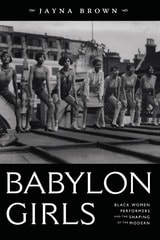
Babylon Girls
Black Women Performers and the Shaping of the ModernJayna Brown
Duke University Press, 2008
Investigating both well-known performers such as Ada Overton Walker and Josephine Baker and lesser-known artists such as Belle Davis and Valaida Snow, Brown weaves the histories of specific singers and dancers together with incisive theoretical insights. She describes the strange phenomenon of blackface performances by women, both black and white, and she considers how black expressive artists navigated racial segregation. Fronting the “picaninny choruses” of African American child performers who toured Britain and the Continent in the early 1900s, and singing and dancing in The Creole Show (1890), Darktown Follies (1913), and Shuffle Along (1921), black women variety-show performers of the early twentieth century paved the way for later generations of African American performers. Brown shows not only how these artists influenced transnational ideas of the modern woman but also how their artistry was an essential element in the development of jazz.
Babylost
Racism, Survival, and the Quiet Politics of Infant Mortality, from A to ZMonica J. Casper
Rutgers University Press, 2021

Backstory in Blue
Ellington at Newport '56John Fass Morton
Rutgers University Press, 2008
Certificate of Merit for the 2009 Association for Recorded Sound Collections Award for Excellence in Historical Recorded Sound Research
It may be that the song most baby boomers identify from July 1956 is a simple twelve-bar blues, hyped on national television by a twenty-one-year-old Elvis Presley and his handlers. But it is a very different song, with its elongated fourteen-bar choruses of rhythm and dissonance, played on the night of July 7, 1956, by a fifty-seven-year-old Duke Ellington and his big band that got everybody on their feet and moving as one. More than fifty years later, “Diminuendo and Crescendo in Blue,” recorded at the 1956 Newport Jazz Festival, still makes a profound statement about postwar America—how we got there and where it all went.
Backstory in Blue is a behind-the-scenes look at this epic moment in American cultural history. It is the story of who and what made Ellington’s composition so compelling and how one piece of music reflected the feelings and shaped the sensibilities of the postwar generation. As John Fass Morton explains, it was music expressed as much by those who performed offstage as by those who performed on.
Written from the point of view of the audience, this unique account draws on interviews with fans and music professionals of all kinds who were there and whose lives were touched, and in some cases changed, by the experience. Included are profiles of George Avakian, who recorded and produced Ellington at Newport 1956; Paul Gonsalves, the tenor sax player responsible for the legendary twenty-seven choruses that enabled the rebirth of Ellington’s career; and the “Bedford Blonde,” Elaine Anderson, whose dance ignited both the band and the crowd.
Duke Ellington once remarked, “I was born at Newport.” Here we learn that Newport was much more than the turning point for Ellington’s career. It was the tipping point for a generation and a musical genre.

Backtalk
Women Writers Speak OutDonna Perry
Rutgers University Press, 1993
Agents or victims, liberated or oppressed, "bad girls" or "good girls." What do these labels mean and do they further or hinder women's progress? How are today's visions of female sexuality and power like or unlike those of the past? How do younger women define feminism? Isn't the personal still political?
Dismayed by the media's tendency to reduce the feminist enterprise to labels and superstars, Donna Perry and Nan Bauer Maglin decided to find out what a diverse group of feminists think about women, sex, and power in the nineties. The result is a provocative and varied collection of twenty-four essays by second- and third-wave feminists; artists and activists; professors and graduate students; professional journalists and just-published writers; mothers and daughters. By focusing on society's construction, containment, and exploitation of female sexuality, in particular, these essays offer fresh perspectives on women's agency or lack of it.
The contributors focus on the oversimplifications and false dichotomies in current discussions of female sexuality, as well as the privileged perspective and individualism that currently dominate the popularized feminist message. Individual writers--including Emma Amos, bell hooks, Ann Jones, Lisa Jones, Paula Kamen, Matuschka, Marge Piercy, Katha Pollitt, Anna Quindlen, Elayne Rapping, Lillian S. Robinson, and Ellen Willis--reexamine women's empowerment in the light of issues like AIDS, battering, acquaintance rape, narratives of childhood sexual abuse, and pornography. Several draw political conclusions from their personal struggles, while others read stories and texts--from history, the art world, the media, popular culture, and social science research--in new and controversial ways.
Bad Boys
Public Schools in the Making of Black MasculinityAnn Arnett Ferguson
University of Michigan Press, 2020

Bad Medicine
Settler Colonialism and the Institutionalization of American IndiansSarah A. Whitt
Duke University Press, 2025

Badass Feminist Politics
Exploring Radical Edges of Feminist Theory, Communication, and ActivismSarah Jane Blithe
Rutgers University Press, 2022
Badass Feminist Politics includes a diverse range of engaging feminist political projects to not only analyze the work being done on the ground but provide an overview for action that can be taken on by those seeking to engage in feminist activism in their own communities. Contributors included here are working for equality and equity and resisting violent, racist, homophobic, transphobic, xenophobic, and sexist language and action during this tension-filled political moment. Collectively, the book explores what it means to live and communicate feminist politics in everyday choices and actions, and how we can facilitate learning by analyzing these examples. Taking up current issues and new theoretical perspectives, the authors offer novel perspectives into what it means to live feminist politics. This book is a testament to resilience, resistance, communication, and forward thinking about what these themes all mean for new feminist agendas. Learning how to resist oppressive structures through words and actions is particularly important for students. Badass Feminist Politics features scholars from non-dominant groups taking up issues of marginalization and oppression, which can help people accomplish their social justice goals of inclusivity on the ground and in the classroom.
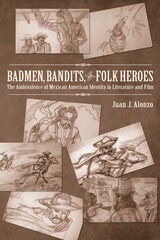
Badmen, Bandits, and Folk Heroes
The Ambivalence of Mexican American Identity in Literature and FilmJuan J. Alonzo
University of Arizona Press, 2009
Alonzo opens his provocative study with a fresh look at the adventure stories of Stephen Crane and the silent Western movies of D. W. Griffith. He also investigates the conflation of the greaser, the bandit, and the Mexican revolutionary into one villainous figure in early Western movies and, more broadly, traces the development of the badman in Westerns. He newly interrogates the writings of Américo Paredes regarding the makeup of Mexican masculinity, and productively trains his analytic eye on the recent films of Jim Mendiola and the contemporary poetry of Evangelina Vigil.
Throughout Badmen, Bandits, and Folk Heroes, Alonzo convincingly demonstrates how fiction and films that formerly appeared one-dimensional in their treatment of Mexicans and Mexican Americans actually offer surprisingly multifarious and ambivalent representations. At the same time, his valuation of indeterminacy, contingency, and hybridity in contemporary cultural production creates new possibilities for understanding identity formation.
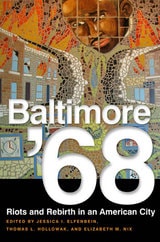
Baltimore '68
Riots and Rebirth in an American CityEdited by Jessica I. Elfenbein, Thomas L. Hollowak and Elizabeth M. Nix
Temple University Press, 2011
In 1968, Baltimore was home to a variety of ethnic, religious, and racial communities that, like those in other American cities, were confronting a quickly declining industrial base. In April of that year, disturbances broke the urban landscape along lines of race and class.
This book offers chapters on events leading up to the turmoil, the riots, and the aftermath as well as four rigorously edited and annotated oral histories of members of the Baltimore community. The combination of new scholarship and first-person accounts provides a comprehensive case study of this period of civil unrest four decades later.
This engaging, broad-based public history lays bare the diverse experiences of 1968 and their effects, emphasizing the role of specific human actions. By reflecting on the stories and analysis presented in this anthology, readers may feel empowered to pursue informed, responsible civic action of their own.
Baltimore '68 is the book component of a larger public history project, "Baltimore '68 Riots: Riots and Rebirth." The project's companion website (http://archives.ubalt.edu/bsr/index.html ) offers many more oral histories plus photos, art, and links to archival sources. The book and the website together make up an invaluable teaching resource on cities, social unrest, and racial politics in the 1960s. The project was the corecipient of the 2009 Outstanding Public History Project Award from the National Council on Public History.
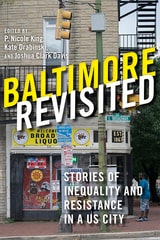
Baltimore Revisited
Stories of Inequality and Resistance in a U.S. CityEdited by P. Nicole King, Kate Drabinski, and Joshua Clark Davis
Rutgers University Press, 2019
To help untangle these apparent paradoxes, the editors of Baltimore Revisited have assembled a collection of over thirty experts from inside and outside academia. Together, they reveal that Baltimore has been ground zero for a slew of neoliberal policies, a place where inequality has increased as corporate interests have eagerly privatized public goods and services to maximize profits. But they also uncover how community members resist and reveal a long tradition of Baltimoreans who have fought for social justice.
The essays in this collection take readers on a tour through the city’s diverse neighborhoods, from the Lumbee Indian community in East Baltimore to the crusade for environmental justice in South Baltimore. Baltimore Revisited examines the city’s past, reflects upon the city’s present, and envisions the city’s future.
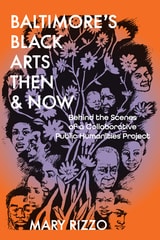
Baltimore's Black Arts Then & Now
Behind the Scenes of a Collaborative Public Humanities ProjectMary Rizzo
University of Iowa Press, 2026
Since 2017, a group of former Chicory editors, scholars, librarians, poets, teachers, and young writers have collaborated to use Chicory as a catalyst for intergenerational dialogue on social justice, race, and place. Baltimore’s Black Arts Then & Now documents this joint effort, offering valuable insights for public historians, educators, and humanists.
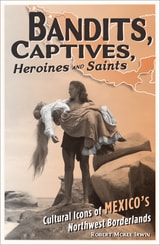
Bandits, Captives, Heroines, and Saints
Cultural Icons of Mexico’s Northwest BorderlandsRobert McKee Irwin
University of Minnesota Press, 2007
Bandits, Captives, Heroines, and Saints investigates cultural icons of the late nineteenth century from Mexico’s largely unstudied northwest borderlands, present-day Sonora, Baja California, and western Chihuahua. Robert McKee Irwin looks at popular figures such as Joaquín Murrieta, the gold rush social bandit; Lola Casanova, the anti-Malinche, whose marriage to a Seri Indian symbolized a forbidden form of mestizaje; and la Santa de Cabora, a young faith healer who inspired armed insurgencies and was exiled to Arizona.
Cultural icons such as Murrieta, Lola Casanova, and la Santa de Cabora are products of intercultural dialogue, Irwin reveals, and their characterizations are unstable. They remain relevant for generations because there is no consensus regarding their meanings, and they are weapons in struggles of representation in the borderlands. The figures studied here are especially malleable, he argues, because they are marginalized from the mainstream of historiography.
A timely analysis, Bandits, Captives, Heroines, and Saints challenges current paradigms of border studies and presents a rich understanding of the ways in which cultural icons influence people’s minds and lives.
Robert McKee Irwin is associate professor of Spanish at the University of California, Davis, and the author of Mexican Masculinities (Minnesota, 2003).
Bangkok after Dark
Maurice Rocco, Transnational Nightlife, and the Making of Cold War IntimaciesBenjamin Tausig
Duke University Press, 2025

Bangladesh’s Changing Mediascape
From State Control to Market ForcesEdited by Brian Shoesmith, Jude William Genilo, and Md Asiuzzaman
Intellect Books, 2013
With contributions from a diverse group of media and communications scholars from around the globe, Bangladesh’s Changing Mediascape presents a pioneering study of the trends, patterns, and prospects shaping the contemporary Bangladeshi media. Among the many topics discussed here are the difference among specific media formats, including television, newspapers, radio, film, and photography; policy issues; and the challenge that new media poses to governance in a developing nation faced with innumerable economic, social, and political problems. Eschewing the currently dominant development communication model, the editors argue that market forces rather than planned state interventions will contribute to a more equitable communication environment.
Bangtan Remixed
A Critical BTS ReaderPatty Ahn, Michelle Cho, Vernadette Vicuña Gonzalez, Rani Neutill, Mimi Thi Nguyen, and Yutian Wong, editors
Duke University Press, 2024
Contributors. Andrea Acosta, Patty Ahn, Carolina Alves, Inez Amihan Anderson, Allison Anne Gray Atis, Kaina “Kai” Bernal, Mutlu Binark, Jheanelle Brown, Sophia Cai, Michelle Cho, Mariam Elba, Ameena Fareeda, Vernadette Vicuña Gonzalez, Rosanna Hall, Dal Yong Jin, JIN Youngsun, Despina Kakoudaki, Yuni Kartika, Alptekin Keskin, Rachel Kuo, Marci Kwon, Courtney Lazore, Regina Yung Lee, S. Heijin Lee, Wonseok Lee, Amanda Lovely, Melody Lynch-Kimery, Maria Mison, Noel Sajid I. Murad, Sara Murphy, UyenThi Tran Myhre, Rani Neutill, Johnny Huy Nguyễn, Mimi Thi Nguyen, Karlina Octaviany, Nykeah Parham, Stefania Piccialli, Raymond San Diego, Hannah Ruth L. Sison, Prerna Subramanian, Havannah Tran, Andrew Ty, Gracelynne West, Yutian Wong, Jaclyn Zhou
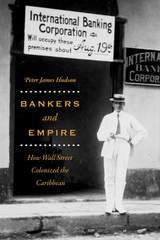
Bankers and Empire
How Wall Street Colonized the CaribbeanPeter James Hudson
University of Chicago Press, 2017

Banking on Stability
Japan and the Cross-Pacific Dynamics of International Financial Crisis ManagementSaori N. Katada
University of Michigan Press, 2001
Banking on Stability looks at Japan's willingness to cooperate financially with the United States--its most important trade partner--in cases where such compliance yields an improvement in relations. Katada argues that the Japanese government carefully weighs the benefits arising in international and domestic realms when taking on the role of collective crisis manager and concludes that Japan is no exception in having private gain as a central motivation during international financial crises.
Saori Katada is Assistant Professor, School of International Relations, University of Southern California.
Barack Obama and African Diasporas
Dialogues and DissensionsPaul Tiyambe Zeleza
Ohio University Press, 2009
In the title essay, Zeleza analyzes the significance of the election of a member of the African diaspora to the presidency of the United States. He also addresses Africa’s urgent political concerns: China’s role in Africa, South Africa's difficulties in making the transition to a postapartheid society, the agony of Zimbabwe, and a discussion of Pan-Africanism, its history and contemporary challenges. Other posts introduce the reader to the rhythms of daily life, including football and other leisure activities, in capturing the different aspects of Africa.
An original and respected voice, Zeleza engages the reader in a series of passionate public conversations on issues and events of utmost importance to the globalized world. He deserves a wide readership.
Bargaining and Learning in Recurring Crises
The Soviet-American, Egyptian-Israeli, and Indo-Pakistani RivalriesRussell J. Leng
University of Michigan Press, 2000
The author uses theoretical work on learning and the role of belief systems on foreign policy-making as the basis to explore the history of each rivalry. Detailed narrative accounts of each of the crises are augmented by tables and figures describing the escalation of each crisis and the behavior of participant states. The approach allows for comparisons of behavior and learning across the three rivalries, as well as a consideration of the influence that the Soviet-American rivalry exerted on the Middle East and South Asian rivalries. The concluding chapter illustrates how the influence of realpolitik beliefs on learning across the three rivalries predisposed policymakers to draw lessons from their crisis experience that weakened conflict management in subsequent crises. The author also shows how superpower mediation in Middle East and South Asian crises and wars had the perverse effect of encouraging greater risk-taking by the participant states in subsequent crises.
The book will be of particular interest to political scientists and historians who study international relations, as well as those interested in decision-making and learning by policymakers.
Russell J. Leng is Professor of Political Science, Middlebury College, and the author of Interstate Crisis Behavior 1816-1980: Realism versus Reciprocity and numerous articles.
Bargaining for Reality
The Construction of Social Relations in a Muslim CommunityLawrence Rosen
University of Chicago Press, 1984
Drawing on the philosophy of speech acts as well as interpretive theory, Rosen shows how, for the people of this Muslim community, reality consists of the network of obligations formed by individuals out of a repertoire of relational possibilities whose defining terms are comprised by a set of essentially negotiable concepts. He thus demonstrates that the bonds of family, tribe, and political alliance take shape only as the bargains struck in and through the malleable terms that describe them take shape; that statements about relationship are no more true than a price mentioned in the marketplace until properly validated; that the relations between men and women, Arabs and Berbers, Muslims and Jews test the limits of interpersonal negotiation; and that the concepts of time, character, and narrative style are consonant with a view of reality as bargained-for network of obligations.
Bargaining for Reality makes an important contribution to our understanding of contemporary Middle Eastern society and to the development of powerful new interpretive strategies for a wide range of social theorists.
"[Rosen's] book is extremely useful for African and Middle Eastern historians, because he challenges some of our most basic ideas about the nature and force of kinship, tribe, ethnicity, and other large- and small-scale political ties."—Allan R. Meyers, International Journal of African Historical Studies
"The book conveys a compelling image of Moroccan social experience and is peppered with vivid anecdotes and case histories."—Stephen William Foster, American Anthropologist
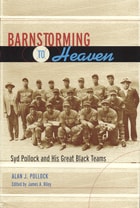
Barnstorming to Heaven
Syd Pollock and His Great Black TeamsAlan J. Pollock
University of Alabama Press, 2006
The Indianapolis Clowns were a black touring baseball team that featured an entertaining mix of comedy, showmanship, and skill. Sometimes referred to as the Harlem Globetrotters of baseball—though many of the Globetrotters’ routines were borrowed directly from the Clowns—they captured the affection of Americans of all ethnicities and classes. Author Alan Pollock was the son of the Clowns' owner Syd Pollock, who owned a series of black barnstorming teams that crisscrossed the country from the late 1920s until the mid-1960s. They played every venue imaginable, from little league fields to Yankee Stadium, and toured the South, the Northeast, the Midwest, the Canadian Rockies, the Dakotas, the Southwest, the Far West—anywhere there was a crowd willing to shell out a few dollars for an unforgettable evening.
Alan grew up around the team and describes in vivid detail the comedy routines of Richard “King Tut” King, “Spec Bebob” Bell, Reece “Goose” Tatum; the “warpaint” and outlandish costumes worn by players in the early days; and the crowd-pleasing displays of amazing skill known as pepperball and shadowball. These men were entertainers, but they were also among the most gifted athletes of their day, making a living in sports the only way a black man could. They played to win.
More than just a baseball story, these recollections tell the story of great societal changes in America from the roaring twenties, through the years of the Great Depression and World War II, and into the Civil Rights era.
Baroque Times in Old Mexico
Seventeenth-Century Persons, Places, and PracticesIrving A. Leonard
University of Michigan Press, 1959
This book opens a window on a forgotten and glorious time—the life of colonial Mexico. Here is the color of that era in a mosaic of life—a worldly ambitious archbishop, a beautiful nun-poetess, a Creole scholar torn between faith and scientific learning, poetasters, inquisitors—and in the background, the first glimmers of Mexican nationalism. Baroque in its intricate pattern of caste and custom, rich with silver pouring from its mines, the feudal society of Old Mexico lives in this account of a vanished time.
Barrio Gangs
Street Life and Identity in Southern CaliforniaBy James Diego Vigil
University of Texas Press, 1988
Within the Mexican American barrios of Los Angeles, gang activity, including crime and violent acts, has grown and flourished. In the past, community leaders and law enforcement officials have approached the problem, not as something that needs to be understood, but only as something to be gotten rid of. Rejecting that approach, James D. Vigil asserts that only by understanding the complex factors that give birth and persistence to gangs can gang violence be ended.
Drawing on many years of experience in the barrios as a youth worker, high school teacher, and researcher, Vigil identifies the elements from which gangs spring: isolation from the dominant culture, poverty, family stress and crowded households, peer pressure, and the adolescent struggle for self-identity. Using interviews with actual gang members, he reveals how the gang often functions as parent, school, and law enforcement in the absence of other role models in the gang members' lives. And he accounts for the longevity of gangs, sometimes over decades, by showing how they offer barrio youth a sense of identity and belonging nowhere else available.
Barrio Libre
Criminalizing States and Delinquent Refusals of the New FrontierGilberto Rosas
Duke University Press, 2012
Rosas argues that although these youths participate in the victimization of others, they should not be demonized. They are complexly and adversely situated. The effects of NAFTA have forced many of them, as well as other Mexicans, to migrate to Nogales. Moving fluidly with the youths through the spaces that they inhabit and control, he shows how the militarization of the border actually destabilized the region and led Barrio Libre to turn to increasingly violent activities, including drug trafficking. By focusing on these youths and their delinquency, Rosas demonstrates how capitalism and criminality shape perceptions and experiences of race, sovereignty, and resistance along the US-Mexico border.
Barrios Norteños
St. Paul and Midwestern Mexican Communities in the Twentieth CenturyBy Dionicio Nodín Valdés
University of Texas Press, 2000
Mexican communities in the Midwestern United States have a history that extends back to the turn of the twentieth century, when a demand for workers in several mass industries brought Mexican agricultural laborers to jobs and homes in the cities. This book offers a comprehensive social, labor, and cultural history of these workers and their descendants, using the Mexican barrio of "San Pablo" (St. Paul) Minnesota as a window on the region.
Through extensive archival research and numerous interviews, Dennis Valdés explores how Mexicans created ethnic spaces in Midwestern cities and how their lives and communities have changed over the course of the twentieth century. He examines the process of community building before World War II, the assimilation of Mexicans into the industrial working class after the war, the Chicano Movement of the 1960s and 1970s, and more recent changes resulting from industrial restructuring and unprecedented migration and population growth. Throughout, Valdés pays particular attention to Midwestern Mexicans' experiences of inequality and struggles against domination and compares them to Mexicans' experiences in other regions of the U.S.
Baseball as Mediated Latinidad
Race, Masculinity, Nationalism, and Performances of IdentityJennifer Domino Rudolph
The Ohio State University Press, 2020

Basketball Trafficking
Stolen Black Panamanian DreamsJavier Wallace
Duke University Press, 2025

Basque Violence
Metaphor And SacramentJoseba Zulaika
University of Nevada Press, 2000
Basques of the American West
New and Collected Essays on History and EthnicityRichard W. Etulain
University of Nevada Press, 2026
This collection offers readers a thoughtful and engaging look at the enduring presence and influence of Basques across the cultural and historical landscape of the American West.
Batos, Bolillos, Pochos, and Pelados
Class and Culture on the South Texas BorderBy Chad Richardson and Michael J. Pisani
University of Texas Press, 2017
A classic account of life on the Texas-Mexico border, Batos, Bolillos, Pochos, and Pelados offers the fullest portrait currently available of the people of the South Texas/Northern Mexico borderlands. First published in 1999, the book is now extensively revised and updated throughout to cover developments since 2000, including undocumented immigration, the drug wars, race relations, growing social inequality, and the socioeconomic gap between Latinos and the rest of American society—issues of vital and continuing national importance.
An outgrowth of the Borderlife Research Project conducted at the University of Texas Rio Grande Valley, Batos, Bolillos, Pochos, and Pelados uses the voices of several hundred Valley residents, collected by embedded student researchers and backed by the findings of sociological surveys, to describe the lives of migrant farmworkers, colonia residents, undocumented domestic servants, maquiladora workers, and Mexican street children. Likewise, it explores social, racial, and ethnic relations in South Texas among groups such as Latinos, Mexican immigrants, wealthy Mexican visitors, Anglo residents or tourists, and Asian and African American residents of South Texas. With this firsthand material and an explanatory focus that utilizes and applies social-science theoretical concepts, the book thoroughly addresses the future composition and integration of Latinos into the society and culture of the United States.
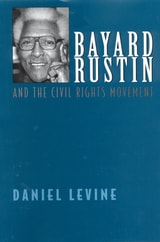
Bayard Rustin and the Civil Rights Movement
Levine, Daniel
Rutgers University Press, 1999
Rustin's long activist career began with his association with A. Phillip Randolph of the Brotherhood of Sleeping Car Porters. Then, as a member of A. J. Muste's Fellowship of Reconciliation, he participated in the "Journey of Reconciliation" (an early version of the "Freedom Rides" of 1961). He was a close associate of Martin Luther King in Montgomery and Atlanta and rose to prominence as organizer of the 1963 March on Washington. Rustin played a key role in applying nonviolent direct action to American race relations while rejecting the separatism of movements like Black Power in the 1960s, even at the risk of his being marginalized by the younger generation of civil rights activists. In his later years he tried to hold the civil rights coalition together and to fight for the economic changes he thought were necessary to decrease racism.
Daniel Levine has written the first scholarly biography that examines Rustin's public as well as private persona in light of his struggles as a gay black man and as an activist who followed his own principles and convictions. The result is a rich portrait of a complex, indomitable advocate for justice in American society.
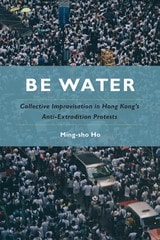
Be Water
Collective Improvisation in Hong Kong's Anti-Extradition ProtestsMing-sho Ho
Temple University Press, 2025
In Be Water, Ming-sho Ho examines the dynamics of the city-wide uprising from the perspective of agency power. He seeks to understand how numerous and anonymous Hongkongers contributed to this epoch-making campaign as well as how they responded to the full-scale state repression that enveloped them. Ho praises and questions the durability of the inventive Be Water Revolution and how the activists encouraged protests spontaneously, through interpersonal networks and by voluntarily collaborating with strangers at great personal risk.
Ho posits a new concept of “collective improvisation” to make sense of such a decentralized yet creative way of protesting. Be Water seeks to understand the rise and long afterlife of this movement and illustrate its efficacy. As Ho shows, these dynamics of collective improvisation have implications for contemporary protest movements around the world.

Bear With Me
A Cultural History of Famous Bears in AmericaDaniel Horowitz
Duke University Press, 2025
Bearing Witness
Memories of Arkansas SlaveryGeorge E. Lankford
University of Arkansas Press, 2006

Beautiful Bottom, Beautiful Shame
Where "Black" Meets "Queer"Kathryn Bond Stockton
Duke University Press, 2006
Stockton engages the domains of African American studies, queer theory, psychoanalysis, film theory, photography, semiotics, and gender studies. She brings together thinkers rarely, if ever, read together in a single study—James Baldwin, Radclyffe Hall, Jean Genet, Toni Morrison, Robert Mapplethorpe, Eldridge Cleaver, Todd Haynes, Norman Mailer, Leslie Feinberg, David Fincher, and Quentin Tarantino—and reads them with and against major theorists, including Georges Bataille, Sigmund Freud, Eve Kosofsky Sedgwick, Jacques Lacan, Roland Barthes, and Leo Bersani. Stockton asserts that there is no clear, mirrored relation between the terms “black” and “queer”; rather, seemingly definitive associations attached to each are often taken up or crossed through by the other. Stockton explores dramatic switchpoints between these terms: the stigmatized “skin” of some queers’ clothes, the description of blacks as an “economic bottom,” the visual force of interracial homosexual rape, the complicated logic of so-called same-sex miscegenation, and the ways in which a famous depiction of slavery (namely, Morrison’s Beloved) seems bound up with depictions of AIDS. All of the thinkers Stockton considers scrutinize the social nature of shame as they examine the structures that make debasements possible, bearable, pleasurable, and creative, even in their darkness.
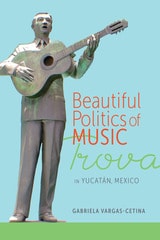
Beautiful Politics of Music
Trova in Yucatán, MexicoGabriela Vargas-Cetina
University of Alabama Press, 2017
An exploration into the history and practice of trova, a genre of music that is the soul of Yucatán.
Yucatecan trova is a music genre comprising a type of romantic song that is considered “the soul of Yucatán and Yucatecans.” This first book on Yucatecan trova offers an insider’s view of the history and practice of a treasured cultural heritage. A central theme of Gabriela Vargas-Cetina’s ethnography is what she refers to as the “beautiful politics of music” practiced by Yucatecan trova patrons and organizations, which is a way of asserting the importance of groups and issues through nonconfrontational means.
Trova emerged on the peninsula at the end of the nineteenth century and continues to be part of the general urban soundscape in the states of Yucatán and Campeche. Until the 1920s, this music was little known outside Yucatán and became absorbed into the larger Latin American Bolero genre, making it difficult to perceive its uniqueness and relation to life in Yucatán.
Vargas-Cetina, a native Yucatecan and trova musician, offers ethnographic insight into the local music scene. With family connections, she embedded herself as a trovadora, and her fieldwork—singing, playing the guitar in a trova group, and extensively researching the genre and talking with fellow enthusiasts and experts—ensued. Trova, like other types of artistic endeavors, is the result of collaboration and social milieu. She describes the dedicated trova clubs, cultural institutions, the Yucatecan economy of agricultural exports, and identity politics that helped the music come about and have maintained it today.
Positioned in the larger context of the music of Mexico and Latin America and engaging with theories of modernity and cosmopolitanism, experimental ethnography, and the anthropology of organizations, Beautiful Politics of Music consists of rigorous scholarship. It is also a warm tribute to performers and songs that have inspired many people around the world for more than two centuries.
Beauty Regimes
A History of Power and Modern Empire in the Philippines, 1898–1941Genevieve Alva Clutario
Duke University Press, 2023
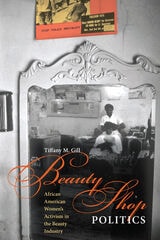
Beauty Shop Politics
African American Women's Activism in the Beauty IndustryTiffany M. Gill
University of Illinois Press, 2010
Looking through the lens of black business history, Beauty Shop Politics shows how black beauticians in the Jim Crow era parlayed their economic independence and access to a public community space into platforms for activism. Tiffany M. Gill argues that the beauty industry played a crucial role in the creation of the modern black female identity and that the seemingly frivolous space of a beauty salon actually has stimulated social, political, and economic change.
From the founding of the National Negro Business League in 1900 and onward, African Americans have embraced the entrepreneurial spirit by starting their own businesses, but black women's forays into the business world were overshadowed by those of black men. With a broad scope that encompasses the role of gossip in salons, ethnic beauty products, and the social meanings of African American hair textures, Gill shows how African American beauty entrepreneurs built and sustained a vibrant culture of activism in beauty salons and schools. Enhanced by lucid portrayals of black beauticians and drawing on archival research and oral histories, Beauty Shop Politics conveys the everyday operations and rich culture of black beauty salons as well as their role in building community.
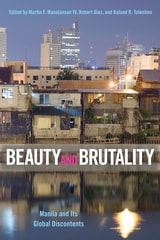
Beauty and Brutality
Manila and Its Global DiscontentsEdited by Martin F. Manalansan IV, Robert Diaz, and Roland B. Tolentino
Temple University Press, 2023
Beauty and Brutality provides an exciting, original, and critical encounter with this labyrinthine city’s imagined and material landscape. The authors and contributors investigate the “messy, fleshy, recalcitrant, mercurial, and immeasurable qualities of the city,” examining its urban space and smell: how it is represented in films, literature, music, and urban streetart; how it has endured the politics of colonialism, U.S. imperialism, neoliberalism, and globalization; as well as how its queer citizens engage with digital media platforms to communicate and connect with each other.
The first volume to offer a cultural and urban studies approach to Manila, Beauty and Brutality considers the tensions of the Filipino diaspora as they migrate and “re-turn,” as well as the citizens’ responses to the Marcos (and post-Marcos) dictatorship, President Duterte’s authoritarianism, and “Drug War.” Essays also map out of geographies of repression and resistance in the urban war of classes, genders and sexualities, ethnicities and races, and generations, along with the violence of urban life and growth. Ultimately, Beauty and Brutality frames Manila as a vibrant and ever-evolving metropolis that, even in the face of its difficulties, instills hope.
Contributors: Paul Michael Leonardo Atienza, Christine Bacareza Balance, Vanessa Banta, Rosa Cordillera A. Castillo, Roland Sintos Coloma, Gary C. Devilles, Faith R. Kares, John B. Labella, Raffy Lerma, Bliss Cua Lim, Ferdinand M. Lopez, Paul Nadal, Jema M. Pamintuan, Oscar Tantoco Serquiña, Jr., Louise Jashil R. Sonido, and the editors.
Because I Don't Have Wings
Stories of Mexican Immigrant LifePhilip Garrison
University of Arizona Press, 2006
Philip Garrison has spent most of his life in this region and shares in vivid prose tales of immigrant life, both contemporary and historical, revealing the dual lives of first-generation Mexican immigrants who move smoothly between the Yakima Valley and their homes in Mexico. And with a scholar’s eye he examines figures of speech that reflect mexicano feelings about immigrant life, offering glimpses of adaptation through offhand remarks, family spats, and town gossip.
Written with irony but bursting with compassion, Because I Don’t Have Wings features vivid characters, telling anecdotes, and poignant reflections on life, unfolding an immigrant’s world strikingly different from the one we usually read about. Adaptation, persistence, and survival, we learn, are traits that mexicano culture values. We also learn that, over time, mexicano immigrants don’t merely adapt to the culture of el norte, they transform it.
Becoming American Becoming Ethnic
edited by Thomas Dublin
Temple University Press, 1996
More than at any time since the 1920's the issues of immigration and ethnicity have become central to discussions of American society and identity. Becoming American, Becoming Ethnic addresses this contemporary debate, bringing together essays written over the past eighteen years by college students exploring their ethnic roots—from the experiences of their forbears to the place of ethnicity in their lives.
The students range from descendants of Europeans whose families immigrated several generations ago to Asian and Latin American immigrants of more recent decades to African-Americans and Hispanics—some have more than one ethnic heritage to grapple with, while others have migrated from one place to another within the United States. Together their voices create a dialogue about the interplay of ethnic traditions and values with American culture.
These are moving personal reflections on the continuities and changes in the ethnic experience in the United States and on the evolving meaning of ethnicity over time and across generations. Despite vocal concerns in recent years about ethnic divisiveness, these student writings show how much many young Americans share even in their differences.
In the series Critical Perspectives on the Past, edited by Susan Porter Benson, Stephen Brier, and Roy Rosenzweig.
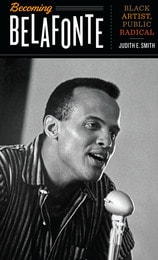
Becoming Belafonte
Black Artist, Public RadicalBy Judith E. Smith
University of Texas Press, 2014
A son of poor Jamaican immigrants who grew up in Depression-era Harlem, Harry Belafonte became the first black performer to gain artistic control over the representation of African Americans in commercial television and film. Forging connections with an astonishing array of consequential players on the American scene in the decades following World War II—from Paul Robeson to Ed Sullivan, John Kennedy to Stokely Carmichael—Belafonte established his place in American culture as a hugely popular singer, matinee idol, internationalist, and champion of civil rights, black pride, and black power.
In Becoming Belafonte, Judith E. Smith presents the first full-length interpretive study of this multitalented artist. She sets Belafonte’s compelling story within a history of American race relations, black theater and film history, McCarthy-era hysteria, and the challenges of introducing multifaceted black culture in a moment of expanding media possibilities and constrained political expression. Smith traces Belafonte’s roots in the radical politics of the 1940s, his careful negotiation of the complex challenges of the Cold War 1950s, and his full flowering as a civil rights advocate and internationally acclaimed performer in the 1960s. In Smith’s account, Belafonte emerges as a relentless activist, a questing intellectual, and a tireless organizer. From his first national successes as a singer of Calypso-inflected songs to the dedication he brought to producing challenging material on television and film regardless of its commercial potential, Belafonte stands as a singular figure in American cultural history—a performer who never shied away from the dangerous crossroads where art and politics meet.
Becoming Black
Creating Identity in the African DiasporaMichelle M. Wright
Duke University Press, 2004
Wright argues that three nineteenth-century American and European works addressing race—Thomas Jefferson’s Notes on the State of Virginia, G. W. F. Hegel’s Philosophy of History, and Count Arthur de Gobineau’s Essay on the Inequality of the Human Races—were particularly influential in shaping twentieth-century ideas about Black subjectivity. She considers these treatises in depth and describes how the revolutionary Black thinkers W. E. B. Du Bois, Aimé Césaire, Léopold Sédar Senghor, and Frantz Fanon countered the theories they promulgated. She explains that while Du Bois, Césaire, Senghor, and Fanon rejected the racist ideologies of Jefferson, Hegel, and Gobineau, for the most part they did so within what remained a nationalist, patriarchal framework. Such persistent nationalist and sexist ideologies were later subverted, Wright shows, in the work of Black women writers including Carolyn Rodgers and Audre Lorde and, more recently, the British novelists Joan Riley, Naomi King, Jo Hodges, and Andrea Levy. By considering diasporic writing ranging from Du Bois to Lorde to the contemporary African novelists Simon Njami and Daniel Biyaoula, Wright reveals Black subjectivity as rich, varied, and always evolving.
Becoming Gods
Medical Training in Mexican HospitalsVania Smith-Oka
Rutgers University Press, 2021
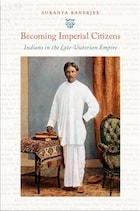
Becoming Imperial Citizens
Indians in the Late-Victorian EmpireSukanya Banerjee
Duke University Press, 2010
Interpreting autobiography, fiction, election speeches, economic analyses, parliamentary documents, and government correspondence, Banerjee foregrounds the narrative logic sustaining the unprecedented claims to citizenship advanced by racialized colonial subjects. She focuses on the writings of figures such as Dadabhai Naoroji, known as the first Asian to be elected to the British Parliament; Surendranath Banerjea, among the earliest Indians admitted into the Indian Civil Service; Cornelia Sorabji, the first woman to study law in Oxford and the first woman lawyer in India; and Mohandas K. Gandhi, who lived in South Africa for nearly twenty-one years prior to his involvement in Indian nationalist politics. In her analysis of the unexpected registers through which they carved out a language of formal equality, Banerjee draws extensively from discussions in both late-colonial India and Victorian Britain on political economy, indentured labor, female professionalism, and bureaucratic modernity. Signaling the centrality of these discussions to the formulations of citizenship, Becoming Imperial Citizens discloses a vibrant transnational space of political action and subjecthood, and it sheds new light on the complex mutations of the category of citizenship.
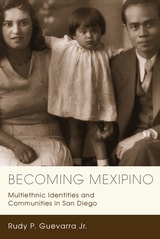
Becoming Mexipino
Multiethnic Identities and Communities in San DiegoGuevarra, Rudy P
Rutgers University Press, 2012
Through racially restrictive covenants and other forms of discrimination, both groups, regardless of their differences, were confined to segregated living spaces along with African Americans, other Asian groups, and a few European immigrant clusters. Within these urban multiracial spaces, Mexicans and Filipinos coalesced to build a world of their own through family and kin networks, shared cultural practices, social organizations, and music and other forms of entertainment. They occupied the same living spaces, attended the same Catholic churches, and worked together creating labor cultures that reinforced their ties, often fostering marriages. Mexipino children, living simultaneously in two cultures, have forged a new identity for themselves. Their lives are the lens through which these two communities are examined, revealing the ways in which Mexicans and Filipinos interacted over generations to produce this distinct and instructive multiethnic experience. Using archival sources, oral histories, newspapers, and personal collections and photographs, Guevarra defines the niche that this particular group carved out for itself.
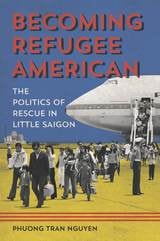
Becoming Refugee American
The Politics of Rescue in Little SaigonPhuong Nguyen
University of Illinois Press, 2017
Phuong Tran Nguyen examines the phenomenon of refugee nationalism among Vietnamese Americans in Southern California. Here, the residents of Little Saigon keep alive nostalgia for the old regime and, by extension, their claim to a lost statehood. Their refugee nationalism is less a refusal to assimilate than a mode of becoming, in essence, a distinct group of refugee Americans. Nguyen examines the factors that encouraged them to adopt this identity. His analysis also moves beyond the familiar rescue narrative to chart the intimate yet contentious relationship these Vietnamese Americans have with their adopted homeland. Nguyen sets their plight within the context of the Cold War, an era when Americans sought to atone for broken promises but also saw themselves as providing a sanctuary for people everywhere fleeing communism.
Becoming Transnational Youth Workers
Independent Mexican Teenage Migrants and Pathways of Survival and Social MobilityIsabel Martinez
Rutgers University Press, 2018
Becoming Trustworthy White Allies
Melanie S. Morrison
Duke University Press, 2025