394 books match the query 'English literature' and 18 start with b
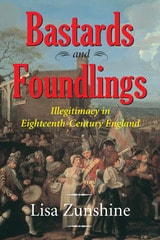
cover of BASTARDS AND FOUNDLINGS: ILLEGITIMACY IN EIGHTEENTH-CENTURY ENGLAND

BASTARDS AND FOUNDLINGS

ILLEGITIMACY IN EIGHTEENTH-CENTURY ENGLAND

Lisa Zunshine

The Ohio State University Press, 2005

In this compelling interdisciplinary study of what has been called the "century of illegitimacy," Lisa Zunshine seeks to uncover the multiplicity of cultural meanings of illegitimacy in the English Enlightenment. Bastards and Foundlings pits the official legal views on illegitimacy against the actual everyday practices that frequently circumvented the law; it reconstructs the history of social institutions called upon to regulate illegitimacy, such as the London Foundling Hospital; and it examines a wide array of novels and plays written in response to the same concerns that informed the emergence and functioning of such institutions. By recreating the context of the national preoccupation with bastardy, with a special emphasis on the gender of the fictional bastard/foundling, Zunshine offers new readings of "canonical" texts, such as Steele's The Conscious Lovers, Defoe's Moll Flanders, Fielding's Tom Jones, Moore's The Foundling, Colman's The English Merchant, Richardson's Clarissa and Sir Charles Grandison, Burney's Evelina, Smith's Emmeline, Edgewort's Belinda, and Austen's Emma, as well as of less well-known works, such as Haywood's The Fortunate Foundlings, Shebbeare's The Marriage Act, Bennett's The Beggar Girl and Her Benefactors, and Robinson's The Natural Daughter.
[more]
cover of Backgrounds of English Literature, 1700-1760

Backgrounds of English Literature, 1700-1760

Cecil Moore

University of Minnesota Press, 1953

Backgrounds of English Literature, 1700-1760 was first published in 1953. Minnesota Archive Editions uses digital technology to make long-unavailable books once again accessible, and are published unaltered from the original University of Minnesota Press editions.The five studies collected in this volume have the common purpose of establishing a background for an understanding of eighteenth-century English literature. Some of the most popular ideas and ideals of the period are traced to their sources in contemporary philosophy, science, politics, and religion.All of the studies relate in some way to what the seventeenth century called the climate of opinion. They confirm the observation of Shelley that all writers are subjected to “a common influence which arises out of an infinite combination of circumstances belonging to the time in which they live.” All the studies belong to that older style of literary investigation to which scholarship owes its name and to which every student interested in basic ideas and the origins of concepts will sooner or later wish to turn.The first two studies, “Shaftesbury and the Ethical Poets” and “The Return to Nature in English Poetry of the Eighteenth Century,” throw as much light on the Romantic poetry of the nineteenth century as they do on the poetry of the eighteenth. The nature worship that one thinks of as peculiarly Wordsworthian is shown to lie at the heart of deism, the rationalistic philosophy of a century earlier.In “Whig Panegyric Verse,” the ideals of the Whig party, as expressed by poets of the time, are examined in relation to Shaftesbury’s moral philosophy. In “John Dunton: Pietist and Impostor,” the morbid gloom familiar in the “graveyard poets” is seen to reflect a widespread popular taste. That the melancholia of the period was so common as to be considered a national characteristic appears from “The English Malady,” which is largely concerned with the medical literature of the time.
[more]
cover of Bad Modernisms

Bad Modernisms

Douglas Mao and Rebecca L. Walkowitz, eds.

Duke University Press, 2006

Modernism is hot again. At the dawn of the twenty-first century, poets and architects, designers and critics, teachers and artists are rediscovering the virtues of the previous century’s most vibrant cultural constellation. Yet this widespread embrace raises questions about modernism’s relation to its own success. Modernism’s “badness”—its emphasis on outrageous behavior, its elevation of negativity, its refusal to be condoned—seems essential to its power. But once modernism is accepted as “good” or valuable (as a great deal of modernist art now is), its status as a subversive aesthetic intervention seems undermined. The contributors to Bad Modernisms tease out the contradictions in modernism’s commitment to badness.

Bad Modernisms thus builds on and extends the “new modernist studies,” recent work marked by the application of diverse methods and attention to texts and artists not usually labeled as modernist. In this collection, these developments are exemplified by essays ranging from a reading of dandyism in 1920s Harlem as a performance of a “bad” black modernist imaginary to a consideration of Filipino American modernism in the context of anticolonialism. The contributors reconsider familiar figures—such as Virginia Woolf, D. H. Lawrence, Josef von Sternberg, Ludwig Wittgenstein, W. H. Auden, and Wyndham Lewis—and bring to light the work of lesser-known artists, including the writer Carlos Bulosan and the experimental filmmaker Len Lye. Examining cultural artifacts ranging from novels to manifestos, from philosophical treatises to movie musicals, and from anthropological essays to advertising campaigns, these essays signal the capaciousness and energy galvanizing the new modernist studies.

Contributors. Lisa Fluet, Laura Frost, Michael LeMahieu, Heather K. Love, Douglas Mao, Jesse Matz, Joshua L. Miller, Monica L. Miller, Sianne Ngai, Martin Puchner, Rebecca L. Walkowitz
[more]
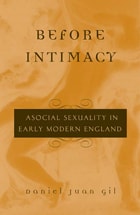
cover of Before Intimacy: Asocial Sexuality in Early Modern England

Before Intimacy

Asocial Sexuality in Early Modern England

Daniel Juan Gil

University of Minnesota Press, 2006

Before the eighteenth-century rise of the ideology of intimacy, sexuality was defined not by social affiliations but by bodies. In Before Intimacy, Daniel Juan Gil examines sixteenth-century English literary concepts of sexuality that frame erotic ties as neither bound by social customs nor transgressive of them, but rather as “loopholes” in people’s experiences and associations. 

Engaging the poems of Wyatt, Sidney’s Astrophil and Stella, Spenser’s Amoretti and The Faerie Queene, and Shakespeare’s Troilus and Cressida and the Sonnets, Gil demonstrates how sexuality was conceived as a relationship system inhabited by men and women interchangeably—set apart from the “norm” and not institutionalized in a private or domestic realm. Going beyond the sodomy-as-transgression analytic, he asserts the existence of socially inconsequential sexual bonds while recognizing the pleasurable effects of violating the supposed traditional modes of bonding and ideals of universal humanity and social hierarchy. 

Celebrating the ability of corporeal emotions to interpret connections between people who share nothing in terms of societal structure, Before Intimacy shows how these works of early modern literature provide a discourse of sexuality that strives to understand status differences in erotic contexts and thereby question key assumptions of modernity. 

Daniel Juan Gil is assistant professor of English at TCU.
[more]
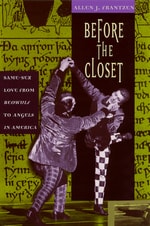
cover of Before the Closet: Same-Sex Love from "Beowulf" to "Angels in America"

Before the Closet

Same-Sex Love from "Beowulf" to "Angels in America"

Allen J. Frantzen

University of Chicago Press, 1998

Allen J. Frantzen challenges the long accepted view that the early Middle Ages tolerated and even fostered same-sex relations and that intolerance of homosexuality developed only late in the medieval period. Frantzen shows that in early medieval Europe, the Church did not tolerate same-sex acts, in fact it was an age before people recognized the existence—or the possibility—of the "closet."

With its ambitious scope and elegant style, Before the Closet sets same-sex relations in Anglo-Saxon sources in relation to the sexual themes of contemporary opera, dance, and theatre. Frantzen offers a comprehensive analysis of sources from the seventh to the twelfth century and traces Anglo-Saxon same-sex behavior through the age of Chaucer and into the Renaissance.

"Frantzen's marvelous book . . . opens up a world most readers will never have even known was there. It's a difficult topic, but Frantzen's comprehensive, readable and even wryly funny treatment makes this an unexpected pleasure."—Publishers Weekly, starred review
[more]
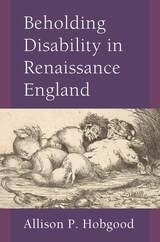
cover of Beholding Disability in Renaissance England

Beholding Disability in Renaissance England

Allison P. Hobgood

University of Michigan Press, 2021

Human variation has always existed, though it has been conceived of and responded to variably. Beholding Disability in Renaissance England interprets sixteenth- and seventeenth-century literature to explore the fraught distinctiveness of human bodyminds and the deliberate ways they were constructed in early modernity as able, and not. Hobgood examines early modern disability, ableism, and disability gain, purposefully employing these contemporary concepts to make clear how disability has historically been disavowed—and avowed too. Thus, this book models how modern ideas and terms make the weight of the past more visible as it marks the present, and cultivates dialogue in which early modern and contemporary theoretical models are mutually informative.

Beholding Disability also uncovers crucial counterdiscourses circulating in the English Renaissance that opposed cultural fantasies of ability and had a keen sensibility toward non-normative embodiments. Hobgood reads impairments as varied as epilepsy, stuttering, disfigurement, deafness, chronic pain, blindness, and castration in order to understand not just powerful fictions of ability present during the Renaissance but also the somewhat paradoxical, surprising ways these ableist ideals provided creative fodder for many Renaissance writers and thinkers. Ultimately, Beholding Disability asks us to reconsider what we think we know about being human both in early modernity, and today.
 
[more]
cover of Between Human and Divine: The Catholic Vision in Contemporary Literature

Between Human and Divine

The Catholic Vision in Contemporary Literature

Mary Reichardt

Catholic University of America Press, 2010
Between Human and Divine is the first collection of scholarly essays published on a wide variety of contemporary (post 1980) Catholic literary works and artists. Its aim is to introduce readers to recent and emerging writers and texts in the tradition.
[more]
cover of Bleak Liberalism

Bleak Liberalism

Amanda Anderson

University of Chicago Press, 2016

Why is liberalism so often dismissed by thinkers from both the left and the right? To those calling for wholesale transformation or claiming a monopoly on “realistic” conceptions of humanity, liberalism’s assured progressivism can seem hard to swallow. Bleak Liberalism makes the case for a renewed understanding of the liberal tradition, showing that it is much more attuned to the complexity of political life than conventional accounts have acknowledged.

Amanda Anderson examines canonical works of high realism, political novels from England and the United States, and modernist works to argue that liberalism has engaged sober and even stark views of historical development, political dynamics, and human and social psychology. From Charles Dickens’s Bleak House and Hard Times to E. M. Forster’s Howards End to Doris Lessing’s The Golden Notebook, this literature demonstrates that liberalism has inventive ways of balancing sociological critique and moral aspiration. A deft blend of intellectual history and literary analysis, Bleak Liberalism reveals a richer understanding of one of the most important political ideologies of the modern era.
[more]
cover of Body Against Soul: Gender and Sowlehele in Middle English Allegory

Body Against Soul

Gender and Sowlehele in Middle English Allegory

Masha Raskolnikov

The Ohio State University Press, 2009

In medieval allegory, Body and Soul were often pitted against one another in debate. In Body Against Soul: Gender and Sowlehele in Middle English Allegory, Masha Raskolnikov argues that such debates function as a mode of thinking about psychology, gender, and power in the Middle Ages. Neither theological nor medical in nature, works of sowlehele (“soul-heal”) described the self to itself in everyday language—moderns might call this kind of writing “self-help.” Bringing together contemporary feminist and queer theory along with medieval psychological thought, Body Against Soul examines Piers Plowman, the “Katherine Group,” and the history of psychological allegory and debate. In so doing, it rewrites the history of the Body to include its recently neglected fellow, the Soul.

The topic of this book is one that runs through all of Western history and remains of primary interest to modern theorists—how “my” body relates to “me.” In the allegorical tradition traced by this study, a male person could imagine himself as a being populated by female personifications, because Latin and Romance languages tended to gender abstract nouns as female. However, since Middle English had ceased to inflect abstract nouns as male or female, writers were free to gender abstractions like “Will” or “Reason” any way they liked. This permitted some psychological allegories to avoid the representational tension caused by placing a female soul inside a male body, instead creating surprisingly queer same-sex inner worlds. The didactic intent driving sowlehele is, it turns out, complicated by the erotics of the struggle to establish a hierarchy of the self’s inner powers.
 
 
[more]
cover of Body Language: Medicine and the Eighteenth-Century Comic Novel

Body Language

Medicine and the Eighteenth-Century Comic Novel

Kathleen Tamayo Alves

Bucknell University Press, 2026

Body Language examines the complex intersections of British eighteenth-century comic fiction and medical discourse. By engaging medical writings of renowned and widely-read physicians of the Enlightenment such as John Freind, Thomas Sydenham, Albrecht von Haller, John Whytt, and William Cullen, with novels of humor by Henry Fielding, Tobias Smollett, Laurence Sterne, and Charlotte Lennox, Alves explains how medicine shaped comic language by dramatizing female-specific phenomena like menstruation, hysteria, nervous disorders, and pregnancy. In these novels, the medical belief that women are incapable of bodily self-regulation becomes an imperative for policing women’s bodies and highlights the enduring shortcomings of patriarchal systems. Ultimately, these comic representations offer a counternarrative of women’s bodies, agency, and selfhood, exposing masculine anxieties about the effectiveness of marriage to regulate women’s sexuality.

Published by Bucknell University Press. Distributed worldwide by Rutgers University Press.
[more]
cover of Bold Conscience: Luther to Shakespeare to Milton

Bold Conscience

Luther to Shakespeare to Milton

Joshua R. Held

University of Alabama Press, 2023

Traces how conscience—inner moral conviction—came to shape public life, fueling martyrdom, free speech, and political revolts

Bold Conscience: Luther to Shakespeare to Milton is a sweeping, original study of how conscience became one of the most powerful ideas in early modern England. Tracing the emergence of what Joshua R. Held calls the “bold conscience,” the book shows how inner moral conviction moved from the realm of private guilt to public action, fueling debates about authority, obedience, free speech, and resistance. By placing conscience at the center of literary, religious, and political conflict, Bold Conscience reveals a vital intellectual throughline linking the Reformation to the birth of modern ideas of liberty and toleration.

The book unfolds chronologically, beginning with Martin Luther and Henry VIII and moving through Shakespeare’s Hamlet and Henry VIII, John Donne’s court sermons, and John Milton’s polemical and poetic works, including Areopagitica and Paradise Lost. Each chapter combines close literary reading with historical and theological analysis, showing how conscience operates across genres—drama, sermon, pamphlet, and epic poetry. Joshua R. Held is a distinguished scholar of early modern literature whose work bridges literary criticism, intellectual history, and religious studies, bringing clarity and narrative energy to complex debates.

Bold Conscience will appeal to scholars and students of early modern literature, Shakespeare, Milton, and Reformation history, as well as readers interested in the origins of religious freedom and political dissent. It will also engage anyone concerned with how moral conviction shapes public life then and now.

[more]
cover of Book and Verse: A Guide to Middle English Biblical Literature

Book and Verse

A Guide to Middle English Biblical Literature

James H. Morey

University of Illinois Press, 2000

Exploding the myth that the Bible was largely unknown to medieval lay folk, Book and Verse presents the first comprehensive catalog of Middle English biblical literature: a body of work that, because of its accessibility and familiarity, was the primary biblical resource of the English Middle Ages.   The medieval Bible, much like the Bible today, consists in practical terms not of a set of texts within a canon but of those stories which, because of a combination of liturgical significance and picturesque qualities, form a provisional "Bible" in the popular imagination. As James Morey explains in his introduction, although the Latin Bible was not accessible to the average English-speaker, paraphrases— systematic appropriation and refashioning of biblical texts—served as a medium through which the Bible was promulgated in the vernacular. This explains why biblical allusions, models, and large-scale appropriations of biblical narrative pervade nearly every medieval genre. 
 Book and Verse is an indispensable guide to the variety and extent of biblical literature in England, exclusive of drama and the Wycliffite Bible that appeared between the twelfth and the fifteenth centuries. Entries provide detailed information on how much of what parts of the Bible appear in Middle English and where this biblical material can be found. Comprehensive indexing by name, keyword, and biblical verse allows a researcher to find, for example, all the occurrences of the Flood Story or of the encounter between Elijah and the Widow of Sarephta. An invaluable resource, Book and Verse provides the first easy access to the "popular Bible" assembled before and after John Wyclif's translation of the Vulgate into English.       
 
[more]
cover of Boredom: The Literary History of a State of Mind

Boredom

The Literary History of a State of Mind

Patricia Meyer Spacks

University of Chicago Press, 1994
This book offers a witty explanation of why boredom both haunts and motivates the literary imagination. Moving from Samuel Johnson to Donald Barthelme, from Jane Austen to Anita Brookner, Spacks shows us at last how we arrived in a postmodern world where boredom is the all-encompassing name we give our discontent. Her book, anything but boring, gives us new insight into the cultural usefulness—and deep interest—of boredom as a state of mind.
[more]
cover of Boys Abducted: The Homoerotics of Empire and Race in Early Modernity

Boys Abducted

The Homoerotics of Empire and Race in Early Modernity

Abdulhamit Arvas

Duke University Press, 2025
In Boys Abducted, Abdulhamit Arvas explores the history of abducted boys in English and Ottoman literary and visual culture to examine the relationships between homoeroticism, race, and empire in the early modern period. The popular literary trope of the abducted beautiful boy—often eroticized as an exotic object of desire—intersects with the historical phenomenon of vulnerable youths who were captured and exchanged within the global traffic in bodies. Arvas offers a queer-historicist analysis of a wide array of Ottoman and English texts and genres ranging from poetry, drama, and travelogue to chronicles, maps, and visual arts. He shows how the boy in these representations crosses boundaries between nations and empires, embodying the tensions and dissonances between the aestheticized eroticism of literary and cultural representations and the violent history of abductions, conversions, and enslavements. In so doing, Arvas presents complex parallels and connections between the two societies, highlighting the circulation of sexual and racial discourses in imperial imaginings to uncover discursive formations and formulations of sexuality, race, and empire.
[more]
cover of British Literature and Technology, 1600-1830

British Literature and Technology, 1600-1830

Kristin M. Girten

Bucknell University Press, 2023

Enlightenment-era writers had not yet come to take technology for granted, but nonetheless were—as we are today—both attracted to and repelled by its potential. This volume registers the deep history of such ambivalence, examining technology’s influence on Enlightenment British literature, as well as the impact of literature on conceptions of, attitudes toward, and implementations of technology. Offering a counterbalance to the abundance of studies on literature and science in seventeenth- and eighteenth-century Britain, this volume’s focus encompasses approaches to literary history that help us understand technologies like the steam engine and the telegraph along with representations of technology in literature such as the “political machine.” Contributors ultimately show how literature across genres provided important sites for Enlightenment readers to recognize themselves as “chimeras”—“hybrids of machine and organism”—and to explore the modern self as “a creature of social reality as well as a creature of fiction.”


[more]
cover of British Romanticism and Prison Reform

British Romanticism and Prison Reform

Jonas Cope

Bucknell University Press, 2025

In eighteenth-century Britain, criminals were routinely whipped, branded, hanged, or transported to America. Only in the last quarter of the century—with the War of American Independence and legal and sociopolitical challenges to capital punishment—did the criminal justice system change, resulting in the reformed prison, or penitentiary, meant to educate, rehabilitate, and spiritualize even hardened felons. This volume is the first to explore the relationship between historical penal reform and Romantic-era literary texts by luminaries such as Godwin, Keats, Byron, and Austen. The works examined here treat incarceration as ambiguous: prison walls oppress and reinforce the arbitrary power of legal structures but can also heighten meditation, intensify the imagination, and awaken the conscience. Jonas Cope skillfully traces the important ideological work these texts attempt: to reconcile a culture devoted to freedom with the birth of the modern prison system that presents punishment as a form of rehabilitation.

Published by Bucknell University Press. Distributed worldwide by Rutgers University Press.
[more]
cover of Brown River, White Ocean: An Anthology of Twentieth-Century Philippine Literature in English

Brown River, White Ocean

An Anthology of Twentieth-Century Philippine Literature in English

Francia, Luis H

Rutgers University Press, 1993
English is often a primary literary language for Filipino writers--not only for those in the Philippines but for those resident in the US; both groups are included in this anthology of 31 stories and 108 poems documenting a tradition that began at the turn-of-the-century. Manila-born poet and writer Francia, an editor at the Village Voice, gathers and validates creative work that has had limited distribution not only here but in Asia. ``In the Philippine context, what is foreign and what is indigenous has always been a tricky and ultimately impossible subject,'' Francia writes in his introduction. ``Filipinos have unconsciously perfected the art of mixing the two up....'' Readers who expect Filipino English to have the unexpected inflections and inventiveness of Indian or Caribbean English will be disappointed: the Filipino writer uses standard American English as a native language, but spices it naturally with words form indigenous and adopted tongues: Tagalog, Spanish, Ilokano, etc. Stories look at unrequited passion (in which the sensual tropical ambiance is at odds with society's rules); village life; the different cultures that have settled in the archipelago--Chinese, Japanese, Spanish, Hindu Indian; and the consequences of military, colonial, and economic occupation. Both poems and stories consider the experience of Filipinos--some intellectual, some humble--in the US. Among the more familiar contributors: Carlos Bulosan, Jos‚ Garc¡a Villa, Jessica Hagedorn, and Ninotchka Rosca. While the prose selected here is more consistent in quality than the poetry, the poems seem more wide-ranging; like the fiction writers, the poets consider love, politics, and metaphysics but move as well into experimentation and the modernist realm. A satisfying and worthwhile project.
[more]
cover of Building Romanticism: Literature and Architecture in Nineteenth-Century Britain

Building Romanticism

Literature and Architecture in Nineteenth-Century Britain

Nicole Reynolds

University of Michigan Press, 2010

Building Romanticism sets the literary culture of Romantic Britain within the context of the period’s architectural productions in order to recover a relationship between these arts that, though deeply valued by writers and architects of the day, has been neglected by modern scholars in both fields. Toward this goal, Nicole Reynolds explores the centrality of architecture and architectural tropes to Romanticism’s dramatic reconceptualization of the individual subject and of the world that subject inhabits.Focusing on the correspondence between the period’s built environments and its literary pursuits, Building Romanticism argues that at this turbulent moment in British history a number of politically charged and aesthetically resonant architectural spaces, both real and imagined, negotiated intense anxieties about shifting notions of gender and sexuality, increased class mobility, the individual’s uncertain place in history, challenges to the British national character and to the project of nation building, and the very form and function of art itself. By tracing the reception of Romantic topoi—rhetorical and literal common places—through the nineteenth century, this book explores how Victorians remodeled Romanticism, its ideological preoccupations and cultural artifacts, according to their own era's social agendas.
[more]