Results by title
1210 books match the query 'Mexico' and 51 start with b
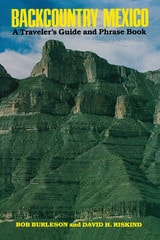
Backcountry Mexico
A Traveler’s Guide and Phrase BookBy Bob Burleson and David H. Riskind
University of Texas Press, 1986
<p>Going well beyond the usual tourist guidebook entries, <cite>Backcountry Mexico</cite> will help you hire a guide and burro, navigate rural roads and trails, and communicate with the friendly and, sometimes, unfriendly folks you are likely to meet in a rural setting.</p>
<p>In addition to English-Spanish and Spanish-English vocabulary lists containing both standard words and numerous terms relating to people, conditions, land, and situations not ordinarily encountered in tourists' lists, the authors have provided literally hundreds of helpful phrases and short conversations in easy-to-use sections arranged according to topics. Experienced unconventional travelers themselves, Burleson and Riskind have become experts in such subjects as "Eating and Staying Well on the Road, " "Camping in Mexico, " "Rural Mexican Village Life," and many more. Their experience, and the resultant wealth of language and cultural information contained in this guide, will help you to enjoy your trip ancd to better understand and appreciate the people and the land you visit.</p>
<p>Throughout the book, the language examples are interwoven with beautifully illustrated anecdotes about culture and lifeways, so that the traveler is equipped with practical knowledge as well as appropriate behavior and speech. Fascinating in its treatment of a culture that is little known and unique in its coverage of rural-style Mexican Spanish, <cite>Backcountry Mexico</cite> will prove invaluable to anyone who ventures forth into northern Mexico.</p>
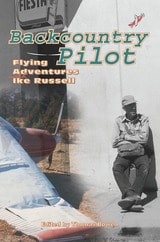
Backcountry Pilot
Flying Adventures with Ike RussellEdited by Thomas Bowen
University of Arizona Press, 2002
This book combines biography and oral history by offering a wide range of anecdotes and remembrances about Ike by friends and family. Many describe the great adventures and gut-wrenching close calls that have become enshrined in local folklore as classic "Ike Russell stories," in all their hair-raising and hilarious splendor.
Russell was an easterner who moved to Arizona for his health and got his pilot's license in 1948—despite suffering from a respiratory disorder that would have kept other men firmly anchored to the ground. Over the years he flew scientists and other scholars to remote field locations in Mexico's Gulf of California and Sierra Madre Occidental that otherwise might not have been investigated. He often landed on short and dangerous airstrips and never seemed to mind running out of gas, getting caught without provisions, or attempting night landings in unlighted terrain. He took along a teapot wherever he went—and wherever he stopped, his first priority was to brew a quick cup.
Backcountry Pilot is the story of a larger-than-life adventurer, with those who knew Ike sharing tales tall and true about his famous exploits, brushes with fate, and sometimes narrow escapes from the jaws of disaster. It includes reminiscences by such scientists and friends as botanist Richard Felger, whom Ike frequently flew down to Seriland; ethnohistorian Bernard Fontana, whom Ike took to Tarahumara country; and paleoecologist Paul Martin, who talked Ike into a nine-month trip through Africa over totally unfamiliar terrain. A concluding chapter by Thomas Bowen offers a brief biographical sketch of Russell.
Ike Russell was a central figure for a generation of people who studied the southwestern desert and who helped others see it as a biological treasure rather than a wasteland. More than a highly skilled bush pilot, he was an extraordinary human being who touched the lives of everyone he met. For those who never got the chance, Backcountry Pilot secures Ike Russell's legacy in the desert skies.
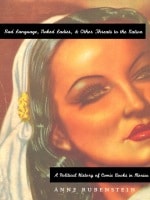
Bad Language, Naked Ladies, and Other Threats to the Nation
A Political History of Comic Books in MexicoAnne Rubenstein
Duke University Press, 1998
Since their first appearance in 1934, comic books enjoyed wide readership, often serving as a practical guide to life in booming new cities. Conservative protest against the so-called immorality of these publications, of mass media generally, and of Mexican modernity itself, however, led the Mexican government to establish a censorship office that, while having little impact on the content of comic books, succeeded in directing conservative ire away from government policies and toward the Mexican media. Bad Language, Naked Ladies, and Other Threats to the Nation examines the complex dynamics of the politics of censorship occasioned by Mexican comic books, including the conservative political campaigns against them, government and industrial responses to such campaigns, and the publishers’ championing of Mexican nationalism and their efforts to preserve their publishing empires through informal influence over government policies. Rubenstein’s analysis suggests a new Mexican history after the revolution, one in which negotiation over cultural questions replaced open conflict and mass-media narrative helped ensure political stability.
This book will engage readers with an interest in Mexican history, Latin American studies, cultural studies, and popular culture.
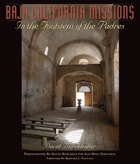
Baja California Missions
In the Footsteps of the PadresDavid Burckhalter; Photographs by David Burckhalter and Mina Sedgwick; Foreword by Bernard L. Fontana
University of Arizona Press, 2013
With gorgeous photographs of the architecture and religious art, and supported by a concise history that outlines the peninsula’s exploration and colonization by Roman Catholic priests, Baja California Missions excels as a book of photography and history. It promises adventure for readers at home, as well as for travelers ready to explore the churches in person.
The eight Spanish colonial stone churches of Baja California endure as the only intact originals of 34 missions built by the padres during the peninsula’s colonization. Due to structural renovations and restorations of the artwork undertaken over the last 30 years, the renowned mission churches have become sources of pride to the citizens of Baja California. Travelers are invited to visit at any time, especially during patron saint day celebrations.
As a guide, Baja California Missions is fully up to date, with directions for navigating Baja’s paved highways and desert and mountain roads. The mission sites are pinpointed on a topographic roadmap of the peninsula. A church floor plan is provided to accompany a walk-through tour for each church interior. The lovely eighteenth-century oil paintings and wooden statues that grace the church altars are also identified and described
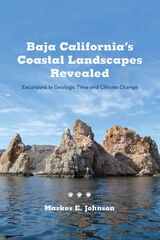
Baja California's Coastal Landscapes Revealed
Excursions in Geologic Time and Climate ChangeMarkes E. Johnson
University of Arizona Press, 2021
Johnson reveals a geologic history that is outside the temporal framework of a human lifetime and scored by violent storms. We see how hurricanes have shaped coastal landscapes all along the peninsula’s inner coast, a fascinating story only possible by disassembling the rocks that on first appraisal seem incomprehensible.
Looking closely, Johnson shows us how geology not only helps us look backward but also forward toward an uncertain future. The landscape Johnson describes may be apart from the rest of Mexico, but his expert eye reveals how it is influenced by the unfolding drama of Planet Earth’s global warming.
Barbarous Mexico
By John Kenneth Turner
University of Texas Press, 1969
American historians preoccupied with the stirring events of the Mexican Revolution and the years following tend to neglect the basic causes of the conflict. John Kenneth Turner—a crusading California newspaperman—presents these causes with brilliance and passion in Barbarous Mexico, his exposé of the Díaz regime. Published serially beginning in the fall of 1909, his articles received scores of favorable reviews. The Rochester Times wrote: "The abolitionists in our own ante bellum days did not formulate an indictment as repulsive as that brought against Mexico by this impassioned writer." A British periodical called Turner "an American humanitarian who deserves the thanks of civilisation." Mexican President Francisco I. Madero himself said that Barbarous Mexico contributed greatly to the success of the Revolution.
Despite its fame early in the twentieth century, Barbarous Mexico was out of print for close to sixty years. The present edition, with an introductory biographical essay on Turner by Sinclair Snow and photographs of the principal characters involved, not only reemphasizes the causes of the Mexican Revolution, but provides both lay reader and scholar with a vivid and exciting account of life in Mexico under Porfirio Díaz.
Baroque Times in Old Mexico
Seventeenth-Century Persons, Places, and PracticesIrving A. Leonard
University of Michigan Press, 1959
This book opens a window on a forgotten and glorious time—the life of colonial Mexico. Here is the color of that era in a mosaic of life—a worldly ambitious archbishop, a beautiful nun-poetess, a Creole scholar torn between faith and scientific learning, poetasters, inquisitors—and in the background, the first glimmers of Mexican nationalism. Baroque in its intricate pattern of caste and custom, rich with silver pouring from its mines, the feudal society of Old Mexico lives in this account of a vanished time.
Barrio Libre
Criminalizing States and Delinquent Refusals of the New FrontierGilberto Rosas
Duke University Press, 2012
Rosas argues that although these youths participate in the victimization of others, they should not be demonized. They are complexly and adversely situated. The effects of NAFTA have forced many of them, as well as other Mexicans, to migrate to Nogales. Moving fluidly with the youths through the spaces that they inhabit and control, he shows how the militarization of the border actually destabilized the region and led Barrio Libre to turn to increasingly violent activities, including drug trafficking. By focusing on these youths and their delinquency, Rosas demonstrates how capitalism and criminality shape perceptions and experiences of race, sovereignty, and resistance along the US-Mexico border.
Barrio Rhythm
Mexican American Music in Los AngelesSteven Loza
University of Illinois Press, 1993
Baskets from the Seri Coast
Comcaac Weavers and Their CraftDavid Burckhalter
University of Arizona Press, 2026
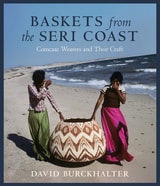
Blending striking photography with reflections from years as a trader and observer of Seri culture, Burckhalter traces the evolution of Seri basketry from a utilitarian craft to a celebrated art form. The book examines how Seri weavers have navigated the influences of the craft economy, outside forces like anthropologists, and changing traditions, while preserving their unique oral history and spiritual connections. With detailed insights into the artistry, labor, and legends surrounding Seri baskets, this work is a tribute to the resilience and creativity of Seri women, whose weaving continues to be passed on to future generations.
Featuring more than two hundred color photographs and historic images, Baskets from the Seri Coast: Comcaac Weavers and Their Craft offers readers a visual feast that celebrates the intricate craftsmanship and cultural significance of a timeless art and the people who make it.
Beautiful Flowers of the Maquiladora
Life Histories of Women Workers in TijuanaBy Norma Iglesias Prieto
University of Texas Press, 1997
Published originally as La flor mas bella de la maquiladora, this beautifully written book is based on interviews the author conducted with more than fifty Mexican women who work in the assembly plants along the U.S.-Mexico border. A descriptive analytic study conducted in the late 1970s, the book uses compelling testimonials to detail the struggles these women face.
The experiences of women in maquiladoras are attracting increasing attention from scholars, especially in the context of ongoing Mexican migration to the country's northern frontier and in light of the North American Free Trade Agreement (NAFTA). This book is among the earliest accounts of the physical and psychological toll exacted from the women who labor in these plants. Iglesias Prieto captures the idioms of these working women so that they emerge as dynamic individuals, young and articulate personalities, inexorably engaged in the daily struggle to change the fundamental conditions of their exploitation.
Beautiful Politics of Music
Trova in Yucatán, MexicoGabriela Vargas-Cetina
University of Alabama Press, 2017
An exploration into the history and practice of trova, a genre of music that is the soul of Yucatán.
Yucatecan trova is a music genre comprising a type of romantic song that is considered “the soul of Yucatán and Yucatecans.” This first book on Yucatecan trova offers an insider’s view of the history and practice of a treasured cultural heritage. A central theme of Gabriela Vargas-Cetina’s ethnography is what she refers to as the “beautiful politics of music” practiced by Yucatecan trova patrons and organizations, which is a way of asserting the importance of groups and issues through nonconfrontational means.
Trova emerged on the peninsula at the end of the nineteenth century and continues to be part of the general urban soundscape in the states of Yucatán and Campeche. Until the 1920s, this music was little known outside Yucatán and became absorbed into the larger Latin American Bolero genre, making it difficult to perceive its uniqueness and relation to life in Yucatán.
Vargas-Cetina, a native Yucatecan and trova musician, offers ethnographic insight into the local music scene. With family connections, she embedded herself as a trovadora, and her fieldwork—singing, playing the guitar in a trova group, and extensively researching the genre and talking with fellow enthusiasts and experts—ensued. Trova, like other types of artistic endeavors, is the result of collaboration and social milieu. She describes the dedicated trova clubs, cultural institutions, the Yucatecan economy of agricultural exports, and identity politics that helped the music come about and have maintained it today.
Positioned in the larger context of the music of Mexico and Latin America and engaging with theories of modernity and cosmopolitanism, experimental ethnography, and the anthropology of organizations, Beautiful Politics of Music consists of rigorous scholarship. It is also a warm tribute to performers and songs that have inspired many people around the world for more than two centuries.
Becoming Aztlan
Mesoamerican Ingluence in the Greater Southwest, A.D. 1200-1500Carroll L Riley
University of Utah Press, 2005
In his latest book, Carroll Riley presents an ambitious overview of the continuities he sees in the geographically vast and culturally complex American Southwest and the adjacent northwest of Mexico. Aided by extensive illustrations, he argues that although the Southwest remained "southwestern" in its basic economy, there were drastic changes beginning around A.D. 1200 that transformed socio-religious life throughout the region. Riley calls this period Aztlan, a name adopted from the mythic Aztec land of origin. A Pueblo Indian in A.D. 800 would have gathered and farmed the same foods as his descendants, but by 1400 those distant relatives had a very different concept of the physical and spiritual universe.
In addition to bringing vast erudition and jargon-free prose to bear on a complex subject, Riley’s conclusions have potentially sweeping implications for the future of archaeological studies in the greater Southwest.
Becoming Gods
Medical Training in Mexican HospitalsVania Smith-Oka
Rutgers University Press, 2021
Becoming Maya
Ethnicity and Social Inequality in Yucatán since 1500Wolfgang Gabbert
University of Arizona Press, 2004
Becoming Transnational Youth Workers
Independent Mexican Teenage Migrants and Pathways of Survival and Social MobilityIsabel Martinez
Rutgers University Press, 2018
Before Kukulkán
Bioarchaeology of Maya Life, Death, and Identity at Classic Period YaxunáVera Tiesler, Andrea Cucina, Travis W. Stanton, and David A. Freidel; Foreword by Traci Ardren
University of Arizona Press, 2017
Using bioarchaeology, mortuary archaeology, and culturally sensitive mainstream archaeology, the authors create an in-depth regional understanding while also laying out broader ways of learning about the Maya past. Part 1 examines ancient lifeways among the Maya at Yaxuná, while part 2 explores different meanings of dying and cycling at the settlement and beyond: ancestral practices, royal entombment and desecration, and human sacrifice. The authors close with a discussion of the last years of occupation at Yaxuná and the role of Chichén Itzá in the abandonment of this urban center.
Before Kukulkán provides a cohesive synthesis of the evolving roles and collective identities of locals and foreigners at the settlement and their involvement in the region’s trajectory. Theoretically informed and contextualized discussions offer unique glimpses of everyday life and death in the socially fluid Maya city. These findings, in conjunction with other documented series of skeletal remains from this region, provide a nuanced picture of the social and biocultural dynamics that operated successfully for centuries before the arrival of the Itzá.
Behind the Mask
Gender Hybridity in a Zapotec CommunityAlfredo Mirandé
University of Arizona Press, 2017
After seeing a video of a muxe vela, or festival, sociologist Alfredo Mirandé was intrigued by the contradiction between Mexico’s patriarchal reputation and its warm acceptance of los muxes. Seeking to get past traditional Mexican masculinity, he presents us with Behind the Mask, which combines historical analysis, ethnographic field research, and interviews conducted with los muxes of Juchitán over a period of seven years. Mirandé observed community events, attended muxe velas, and interviewed both muxes and other Juchitán residents. Prefaced by an overview of the study methods and sample, the book challenges the ideology of a male-dominated Mexican society driven by the cult of machismo, featuring photos alongside four appendixes.
Delving into many aspects of their lives and culture, the author discusses how the muxes are perceived by others, how the muxes perceive themselves, and the acceptance of a third gender status among various North American indigenous groups. Mirandé compares traditional Mexicano/Latino conceptions of gender and sexuality to modern or Western object choice configurations. He concludes by proposing a new hybrid model for rethinking these seemingly contradictory and conflicting gender systems.
Between Art and Artifact
Archaeological Replicas and Cultural Production in Oaxaca, MexicoBy Ronda L. Brulotte
University of Texas Press, 2012
Oaxaca is internationally renowned for its marketplaces and archaeological sites where tourists can buy inexpensive folk art, including replicas of archaeological treasures. Archaeologists, art historians, and museum professionals sometimes discredit this trade in “fakes” that occasionally make their way to the auction block as antiquities. Others argue that these souvenirs represent a long cultural tradition of woodcarving or clay sculpting and are “genuine” artifacts of artisanal practices that have been passed from generation to generation, allowing community members to preserve their cultural practices and make a living. Exploring the intriguing question of authenticity and its relationship to cultural forms in Oaxaca and throughout southern Mexico, Between Art and Artifact confronts an important issue that has implications well beyond the commercial realm.
Demonstrating that identity politics lies at the heart of the controversy, Ronda Brulotte provides a nuanced inquiry into what it means to present “authentic” cultural production in a state where indigenous ethnicity is part of an awkward social and racial classification system. Emphasizing the world-famous woodcarvers of Arrazola and the replica purveyors who come from the same community, Brulotte presents the ironies of an ideology that extols regional identity but shuns its artifacts as “forgeries.” Her work makes us question the authority of archaeological discourse in the face of local communities who may often see things differently. A departure from the dialogue that seeks to prove or disprove “authenticity,” Between Art and Artifact reveals itself as a commentary on the arguments themselves, and what the controversy can teach us about our shifting definitions of authority and authorship.
Between the Lines
Letters Between Undocumented Mexican and Latin American Immigrants and Their Families and FriendsLarry Siems
University of Arizona Press, 1992
Beyond Alterity
Destabilizing the Indigenous Other in MexicoEdited by Paula López Caballero and Ariadna Acevedo-Rodrigo; Afterword by Paul K. Eiss
University of Arizona Press, 2018
Although previous studies have usually focused on the most visible aspects of differences—cosmovision, language, customs, resistance—the contributors to this volume show that emphasizing difference prevents researchers from seeing all the social phenomena where alterity is not obvious. Those phenomena are equally or even more constitutive of social life and include property relations (especially individual or private ones), participation in national projects, and the use of national languages.
The category of “indigenous” has commonly been used as if it were an objective term referring to an already given social subject. Beyond Alterity shows how this usage overlooks the fact that the social markers of differentiation (language, race or ethnic group, phenotype) are historical and therefore unstable. In opposition to any reification of geographical, cultural, or social boundaries, this volume shows that people who (self-)identify as indigenous share a multitude of practices with the rest of society and that the association between indigenous identification and alterity is the product of a specific political history.
Beyond Alterity is essential reading for anyone interested in understanding indigenous identity, race, and Mexican history and politics.
Contributors
Ariadna Acevedo-Rodrigo
Laura Cházaro
Michael T. Ducey
Paul K. Eiss
José Luis Escalona-Victoria
Vivette García Deister
Peter Guardino
Emilio Kourí
Paula López Caballero
Elsie Rockwell
Diana Lynn Schwartz
Gabriela Torres-Mazuera
Beyond Cortés and Montezuma
The Conquest of Mexico RevisitedVitus Huber
University Press of Colorado, 2025
A diverse group of scholars from Europe, Mexico, and the US with varied methodological backgrounds—linguistics, history, art history, and cultural studies—query the “conquest,” or rather conquista, of Mexico through a series of case studies that interrogate how historians, especially in Europe, Mexico, and the US, understand and interact with this concept. They consider the language used to encapsulate the event in Nahuatl documents from the colonial period, how the Spanish veterans led the transition to settlement in taking land for themselves, and the legacy of the conquista in discrimination against Tlaxcallans in modern Mexico.
Beyond Cortés and Montezuma is a compilation of nuanced reflections on the language, narratives, and memories of the conquista that balances the crimes of Spanish colonialism and asymmetries of power that existed within early New Spain with the abilities of Native peoples to resist, negotiate, and survive.
Beyond Mestizaje
Contemporary Debates on Race in MexicoTania Islas Weinstein and Milena Ang, editors
Amherst College Press, 2024
Beyond Smoke and Mirrors
Mexican Immigration in an Era of Economic IntegrationDouglas S. Massey
Russell Sage Foundation, 2002
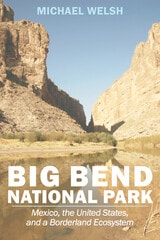
Big Bend National Park
Mexico, the United States, and a Borderland EcosystemMichael Welsh
University of Nevada Press, 2021
Big Bend National Park explores the cultural and diplomatic history of this transborder region that was designated a national park on the US side and the site of a long-hoped-for “international peace park” on the other. Michael Welsh demonstrates the challenges faced and lessons learned by both the US and Mexico as they struggled against political and environmental vicissitudes in their attempts to realize the creation of a shared frontier.
Geopolitical and environmental conflicts such as Cold War fears, immigration, the war on drugs, international water rights, and more stringent American border security measures after 9/11 all hindered relations between the two countries. But more recently, renewed cooperation and ongoing diplomatic relations have led to new developments. Mexican park personnel began assisting American officials with efforts to re-wild the American side of the river with animal species that had been eliminated, and the Obama administration relaxed some post-9/11 restrictions, allowing American visitors to cross over to the Mexican park and its nearby towns.
The ambition of developing a park for peace has yet to materialize, even as individuals and their governments continue to work toward an accord. Big Bend National Park provides a greater understanding of this complex borderland and hopes to help fulfill the aspiration of creating a shared ecosystem and the dream of a park for peace.
Binational Commons
Institutional Development and Governance on the U.S.-Mexico BorderEdited by Tony Payan and Pamela L. Cruz
University of Arizona Press, 2020
This volume addresses the most pertinent binational issues and how they are dealt with by both countries. In this important and timely volume, experts tackle the important problem of cross-border governance by an examination of formal and informal institutions, networks, processes, and mechanisms. Contributors also discuss various social, political, and economic actors and agencies that make up the increasingly complex governance space that is the U.S.-Mexico border.
Binational Commons focuses on whether the institutions that presently govern the U.S.-Mexico transborder space are effective in providing solutions to difficult binational problems as they manifest themselves in the borderlands. Critical for policy-making now and into the future, this volume addresses key binational issues. It explores where there are strong levels of institutional governance development, where it is failing, how governance mechanisms have evolved over time, and what can be done to improve it to meet the needs of the U.S.-Mexico borderlands in the next decades.
Contributors
Silvia M. Chavez-Baray
Kimberly Collins
Irasema Coronado
Guadalupe Correa-Cabrera
Pamela L. Cruz
Adrián Duhalt
James Gerber
Manuel A. Gutiérrez
Víctor Daniel Jurado Flores
Evan D. McCormick
Jorge Eduardo Mendoza Cota
Miriam S. Monroy
Eva M. Moya
Stephen Mumme
Tony Payan
Carla Pederzini Villarreal
Sergio Peña
Octavio Rodríguez Ferreira
Cecilia Sarabia Ríos
Kathleen Staudt
Biocosmism
Vitality and the Utopian Imagination in Postrevolutionary MexicoJorge Quintana Navarrete
Vanderbilt University Press, 2024
Most scholars study postrevolutionary Mexico as a period in which cultural production significantly shaped national identity through murals, novels, essays, and other artifacts that registered the changing political and social realities in the wake of the Revolution. In Biocosmism, Jorge Quintana Navarrete shifts the focus to examine how a group of scientists, artists, and philosophers conceived the manifold relations of the human species with cosmological forces and nonhuman entities (animals, plants, inorganic matter, and celestial bodies, among others).
Drawing from recent theoretical trends in new materialisms, biopolitics, and posthumanism, this book traces for the first time the intellectual constellation of biocosmism or biocosmic thought: the study of universal life understood as the vital vibrancy that animates everything in the cosmos from inorganic matter to living organisms to outer space. It combines both analysis of unexplored areas—such as Alfonso L. Herrera’s plasmogeny—and innovative readings of canonical texts like Vasconcelos’s La raza cósmica to examine how biocosmism produced a wide array of utopian projects and theorizations that continue to challenge anthropocentric, biopolitical frameworks.
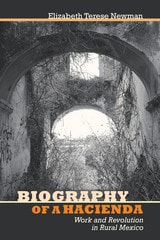
Biography of a Hacienda
Work and Revolution in Rural MexicoElizabeth Terese Newman
University of Arizona Press, 2014
Biography of a Hacienda is a many-voiced reconstruction of events leading up to the Mexican Revolution and the legacy that remains to the present day. Drawing on ethnohistorical, archaeological, and ethnographic data, Elizabeth Terese Newman creates a fascinating model of the interplay between the great events of the Revolution and the lives of everyday people.
In 1910 the Mexican Revolution erupted out of a century of tension surrounding land ownership and control over labor. During the previous century, the elite ruling classes acquired ever-increasingly large tracts of land while peasants saw their subsistence and community independence vanish. Rural working conditions became so oppressive that many resorted to armed rebellion. After the war, new efforts were made to promote agrarian reform, and many of Mexico’s rural poor were awarded the land they had farmed for generations.
Weaving together fiction, memoir, and data from her fieldwork, Newman reconstructs life at the Hacienda San Miguel Acocotla, a site located near a remote village in the Valley of Atlixco, Puebla, Mexico. Exploring people’s daily lives and how they affected the buildup to the Revolution and subsequent agrarian reforms, the author draws on nearly a decade of interdisciplinary study of the Hacienda Acocotla and its descendant community. Newman’s archaeological research recovered information about the lives of indigenous people living and working there in the one hundred years leading up to the Mexican Revolution.
Newman shows how women were central to starting the revolt, and she adds their voices to the master narrative. Biography of a Hacienda concludes with a thoughtful discussion of the contribution of the agrarian revolution to Mexico’s history and whether it has succeeded or simply transformed rural Mexico into a new “global hacienda system.”
Biotic Communities
Southwestern United States and Northwestern MexicoDavid E. Brown
University of Utah Press, 1994
Biotic Communities catalogs and defines by biome, or biotic community, the region centered on Arizona, New Mexico, Sonora, Chihuahua, and Baja California Norte, plus California, Nevada, Utah, Colorado, Texas, Coahuila, Sinaloa, and Baja California Sur. Originally published in 1982 by the Boyce Thompson Southwestern Arboretum, this ambitious book is still a "must-have" for those working in natural resources management and ecological research, as well as non-specialists who wish to know more about a particular locale.
Biotic Communities is arranged by climatic formation with a short chapter for each biome describing climate, physiognomy, distribution, dominant and common plant species, and characteristic vertebrates. Subsequent chapters contain careful descriptions of zonal subdivisions. The text is supplemented with over one hundred black and white photographs illustrating almost every community type.
Birds and Beasts of Ancient Mesoamerica
Animal Symbolism in the Postclassic PeriodSusan Milbrath
University Press of Colorado, 2025
Representations of animal deities in Mesoamerica can be traced back at least to Middle Preclassic Olmec murals, stone carvings, and portable art such as lapidary work and ceramics. Throughout the history of Mesoamerica real animals were merged with fantastical creatures, creating zoological oddities not unlike medieval European bestiaries. According to Spanish chroniclers, the Aztec emperor was known to keep exotic animals in royal aviaries and zoos. The Postclassic period was characterized by an iconography that was shared from central Mexico to the Yucatan peninsula and south to Belize. In addition to highlighting the symbolic importance of nonhuman creatures in general, this volume focuses on the importance of the calendrical and astronomical symbolism associated with animals and birds.
Inspired by and dedicated to the work of Mesoamerican scholar Cecelia Klein and featuring imagery from painted books, monumental sculpture, portable arts, and archaeological evidence from the field of zooarchaeology, Birds and Beasts of Ancient Mesoamerica highlights the significance of the animal world in Postclassic and early colonial Mesoamerica. It will be important to students and scholars studying Mesoamerican art history, archaeology, ethnohistory, and zoology.
Blacks in Colonial Veracruz
Race, Ethnicity, and Regional DevelopmentBy Patrick J. Carroll
University of Texas Press, 1991
Beginning with the Spanish conquest, Mexico has become a racially complex society intermixing Indian, Spanish, and African populations. Questions of race and ethnicity have fueled much political and scholarly debate, sometimes obscuring the experiences of particular groups, especially blacks. Blacks in Colonial Veracruz seeks to remedy this omission by studying the black experience in central Veracruz during virtually the entire colonial period.
The book probes the conditions that shaped the lives of inhabitants in Veracruz from the first European contact through the early formative period, colonial years, independence era, and the postindependence decade. While the primary focus is on blacks, Carroll relates their experience to that of Indians, Spaniards, and castas (racially hybrid people) to present a full picture of the interplay between local populations, the physical setting, and technological advances in the development of this important but little-studied region.
Blockading the Border and Human Rights
The El Paso Operation that Remade Immigration EnforcementBy Timothy J. Dunn
University of Texas Press, 2009
To understand border enforcement and the shape it has taken, it is imperative to examine a groundbreaking Border Patrol operation begun in 1993 in El Paso, Texas, "Operation Blockade." The El Paso Border Patrol designed and implemented this radical new strategy, posting 400 agents directly on the banks of the Rio Grande in highly visible positions to deter unauthorized border crossings into the urban areas of El Paso from neighboring Ciudad Juárez—a marked departure from the traditional strategy of apprehending unauthorized crossers after entry. This approach, of "prevention through deterrence," became the foundation of the 1994 and 2004 National Border Patrol Strategies for the Southern Border. Politically popular overall, it has rendered unauthorized border crossing far less visible in many key urban areas. However, the real effectiveness of the strategy is debatable, at best. Its implementation has also led to a sharp rise in the number of deaths of unauthorized border crossers.
Here, Dunn examines the paradigm-changing Operation Blockade and related border enforcement efforts in the El Paso region in great detail, as well as the local social and political situation that spawned the approach and has shaped it since. Dunn particularly spotlights the human rights abuses and enforcement excesses inflicted on local Mexican Americans and Mexican immigrants as well as the challenges to those abuses. Throughout the book, Dunn filters his research and fieldwork through two competing lenses, human rights versus the rights of national sovereignty and citizenship.
Blood, Ink, and Culture
Miseries and Splendors of the Post-Mexican ConditionRoger Bartra
Duke University Press, 2002
Written with verve over a period of twenty years, these essays—most translated into English here for the first time—suggest why Bartra has become one of Latin America’s leading public intellectuals. The essays cover a broad range of topics, from the canonical forms of Mexican culture to the meaning of postnational identity in a globalizing age, from the repercussions of the 1994 Zapatista uprising to the 2000 election of Vicente Fox and the end of the PRI’s seven-decade rule. Across this range of topics, Bartra imparts astute insights into a critical period of transition in Mexican history, stressing throughout the importance of democracy, the complexity of identity, and the vibrancy of the Left. In Blood, Ink, and Culture, he provides a stimulating inside look at political and intellectual life in the southern reaches of North America.
Bloodsucking Witchcraft
An Epistemological Study of Anthropomorphic Supernaturalism in Rural TlaxcalaHugo G. Nutini
University of Arizona Press, 1993
"The most comprehensive statement on this centrally important ethnographic phenomenon in the last forty years. It bears ready comparison with the two great classics, Evans-Pritchard's Witchcraft Among the Azande and Clyde Kluckhohn's Navaho Witchcraft."—Henry H. Selby
Blues for the Buffalo
Manuel Ramos
Northwestern University Press, 2004
The sun, the sand, a young beauty named Rachel in a white bikini—there's no better way to recover from the aches and pains of your latest case. At least that's what attorney and part-time detective Luis Montez thinks until the woman gives him the manuscript of her novel and vanishes.
Montez just wants to rebuild his Denåver practice, but an aggressive young P.I. with an emotional attachment to Rachel draws him in. With the woman's powerful adopted family on one side and unexplained death of a writer friend on the other, Montez digs up a series of long-told lies and long-hidden ugly truths. He also finds himself confronting one of the great unsolved mysteries of recent Chicano history. What happened to Oscar "Zeta" Acosta, the iconic activist-writer presumed dead since 1974? More to the point, what made Rachel insist the legendary Brown Buffalo was alive-and that he was her real father?
Bones of the Maya
Studies of Ancient SkeletonsEdited by Stephen L. Whittington and David M. Reed
University of Alabama Press, 2006
New techniques in osteology have yielded findings on Maya diet and health that challenge the ecological model of collapse. This benchmark collection of essays defined the state of Mayan skeletal studies. Its coverage spans the formative through colonial periods, with a geographic focus on the Maya lowlands of northern Guatemala, Belize, and western Honduras. Bringing together for the first time a broad spectrum of bioarchaeologists and revealing remarkable data on Maya genetic relationship, demographic, and diseases, the collection covers divers topics such as osteological, dental, bone chemistry, and DNA analyses. The diet and health status of Maya populations is a major theme, especially in relation to social status, gender, and the historical problem of the "collapse."
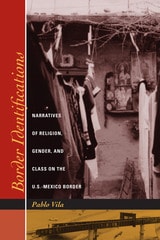
Border Identifications
Narratives of Religion, Gender, and Class on the U.S.-Mexico BorderBy Pablo Vila
University of Texas Press, 2005
From poets to sociologists, many people who write about life on the U.S.-Mexico border use terms such as "border crossing" and "hybridity" which suggest that a unified culture—neither Mexican nor American, but an amalgamation of both—has arisen in the borderlands. But talking to people who actually live on either side of the border reveals no single commonly shared sense of identity, as Pablo Vila demonstrated in his book Crossing Borders, Reinforcing Borders: Social Categories, Metaphors, and Narrative Identities on the U.S.-Mexico Frontier. Instead, people living near the border, like people everywhere, base their sense of identity on a constellation of interacting factors that includes regional identity, but also nationality, ethnicity, and race.
In this book, Vila continues the exploration of identities he began in Crossing Borders, Reinforcing Borders by looking at how religion, gender, and class also affect people's identifications of self and "others" among Mexican nationals, Mexican immigrants, Mexican Americans, Anglos, and African Americans in the Cuidad Juárez-El Paso area. Among the many fascinating issues he raises are how the perception that "all Mexicans are Catholic" affects Mexican Protestants and Pentecostals; how the discourse about proper gender roles may feed the violence against women that has made Juárez the "women's murder capital of the world"; and why class consciousness is paradoxically absent in a region with great disparities of wealth. His research underscores the complexity of the process of social identification and confirms that the idealized notion of "hybridity" is only partially adequate to define people's identity on the U.S.-Mexico border.
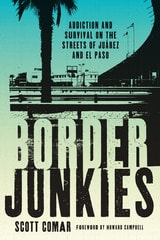
Border Junkies
Addiction and Survival on the Streets of Juárez and El PasoBy Scott Comar
University of Texas Press, 2011
The drug war that has turned Juárez, Mexico, into a killing field that has claimed more than 7,000 lives since 2008 captures headlines almost daily. But few accounts go all the way down to the streets to investigate the lives of individual drug users. One of those users, Scott Comar, survived years of heroin addiction and failed attempts at detox and finally cleaned up in 2003. Now a graduate student at the University of Texas at El Paso in the history department's borderlands doctoral program, Comar has written Border Junkies, a searingly honest account of his spiraling descent into heroin addiction, surrender, change, and recovery on the U.S.-Mexico border.
Border Junkies is the first book ever written about the lifestyle of active addiction on the streets of Juárez. Comar vividly describes living between the disparate Mexican and American cultures and among the fellow junkies, drug dealers, hookers, coyote smugglers, thieves, and killers who were his friends and neighbors in addiction—and the social workers, missionaries, shelter workers, and doctors who tried to help him escape. With the perspective of his anthropological training, he shows how homelessness, poverty, and addiction all fuel the use of narcotics and the rise in their consumption on the streets of Juárez and contribute to the societal decay of this Mexican urban landscape. Comar also offers significant insights into the U.S.-Mexico borderland's underground and peripheral economy and the ways in which the region's inhabitants adapt to the local economic terrain.
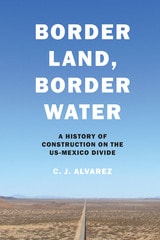
Border Land, Border Water
A History of Construction on the US-Mexico DivideBy C. J. Alvarez
University of Texas Press, 2019
Winner, Abbott Lowell Cummings Award, Vernacular Architecture Forum, 2020
Winner, Elisabeth Blair MacDougall Book Award, Society of Architectural Historians, 2021
From the boundary surveys of the 1850s to the ever-expanding fences and highway networks of the twenty-first century, Border Land, Border Water examines the history of the construction projects that have shaped the region where the United States and Mexico meet.
Tracing the accretion of ports of entry, boundary markers, transportation networks, fences and barriers, surveillance infrastructure, and dams and other river engineering projects, C. J. Alvarez advances a broad chronological narrative that captures the full life cycle of border building. He explains how initial groundbreaking in the nineteenth century transitioned to unbridled faith in the capacity to control the movement of people, goods, and water through the use of physical structures. By the 1960s, however, the built environment of the border began to display increasingly obvious systemic flaws. More often than not, Alvarez shows, federal agencies in both countries responded with more construction—“compensatory building” designed to mitigate unsustainable policies relating to immigration, black markets, and the natural world. Border Land, Border Water reframes our understanding of how the border has come to look and function as it does and is essential to current debates about the future of the US-Mexico divide.
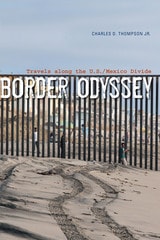
Border Odyssey
Travels along the U.S./Mexico DivideBy Charles D. Thompson, Jr.
University of Texas Press, 2015
“We were trying to change the vision and the conversation about border fears.”
Border Odyssey takes us on a drive toward understanding the U.S./Mexico divide: all 1,969 miles—from Boca Chica to Tijuana—pressing on with the useful fiction of a map.
“We needed to go to the place where countless innocent people had been kicked, cussed, spit on, arrested, detained, trafficked, and killed. It would become clear that the border, la frontera, was more multifaceted and profound than anything we could have invented about it from afar.”
Along the journey, five centuries of cultural history (indigenous, French, Spanish, Mexican, African American, colonist, and U.S.), wars, and legislation unfold. And through observation, conversation, and meditation, Border Odyssey scopes the stories of the people and towns on both sides.
“Stories are the opposite of walls: they demand release, retelling, showing, connecting, each image chipping away at boundaries. Walls are full stops. But stories are like commas, always making possible the next clause.”
Among the terrain traversed: walls and more walls, unexpected roadblocks and patrol officers; a golf course (you could drive a ball across the border); a Civil War battlefield (you could camp there); the southernmost plantation in the United States; a hand-drawn ferry, a road-runner tracked desert, and a breathtaking national park; barbed wire, bridges, and a trucking-trade thoroughfare; ghosts with guns; obscured, unmarked, and unpaved roads; a Catholic priest and his dogs, artwork, icons, and political cartoons; a sheriff and a chain-smoking mayor; a Tex-Mex eatery empty of customers and a B&B shuttering its doors; murder-laden newspaper headlines at breakfast; the kindness of the border-crossing underground; and too many elderly, impoverished, ex-U.S. farmworkers, braceros, lined up to have Thompson take their photograph.
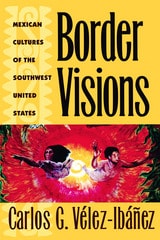
Border Visions
Mexican Cultures of the Southwest United StatesCarlos G. Vélez-Ibáñez
University of Arizona Press, 1996
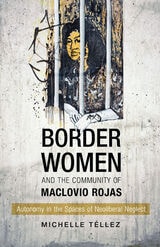
Border Women and the Community of Maclovio Rojas
Autonomy in the Spaces of Neoliberal NeglectMichelle Téllez
University of Arizona Press, 2021
Border Women and the Community of Maclovio Rojas tells the story of the community’s struggle to carve out space for survival and thriving in the shadows of the U.S.-Mexico geopolitical border. This ethnography by Michelle Téllez demonstrates the state’s neglect in providing social services and local infrastructure. This neglect exacerbates the structural violence endemic to the border region—a continuation of colonial systems of power on the urban, rural, and racialized poor. Téllez shows that in creating the community of Maclovio Rojas, residents have challenged prescriptive notions of nation and belonging. Through women’s active participation and leadership, a women’s political subjectivity has emerged—Maclovianas. These border women both contest and invoke their citizenship as they struggle to have their land rights recognized, and they transform traditional political roles into that of agency and responsibility.
This book highlights the U.S.-Mexico borderlands as a space of resistance, conviviality, agency, and creative community building where transformative politics can take place. It shows hope, struggle, and possibility in the context of gendered violences of racial capitalism on the Mexican side of the U.S.-Mexico border.
Borderland Apocrypha
Anthony Cody
Omnidawn, 2019
Rather than a proposal for re-imagining the US/Mexico border, Cody’s collection is an avant-garde examination of how borderlands have remained occupied spaces, and of the necessity of liberation to usher the earth and its people toward healing. Part auto-historia, part docu-poetic, part visual monument, part myth-making, Borderland Apocrypha unearths history in order to work toward survival, reckoning, and the building of a future that both acknowledges and moves on from tragedies of the past.
Borderland Apocrypha won Omnidawn's 2018 1st/2nd Book Prize.
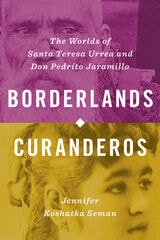
Borderlands Curanderos
The Worlds of Santa Teresa Urrea and Don Pedrito JaramilloBy Jennifer Koshatka Seman
University of Texas Press, 2021
2022 Americo Paredes Award, Center for Mexican American Studies at South Texas College
A historical exploration of the worlds and healing practices of two curanderos (faith healers) who attracted thousands, rallied their communities, and challenged institutional powers.
Santa Teresa Urrea and Don Pedrito Jaramillo were curanderos—faith healers—who, in the late nineteenth and early twentieth centuries, worked outside the realm of "professional medicine," seemingly beyond the reach of the church, state, or certified health practitioners whose profession was still in its infancy. Urrea healed Mexicans, Indigenous people, and Anglos in northwestern Mexico and cities throughout the US Southwest, while Jaramillo conducted his healing practice in the South Texas Rio Grande Valley, healing Tejanos, Mexicans, and Indigenous people there. Jennifer Koshatka Seman takes us inside the intimate worlds of both "living saints," demonstrating how their effective healing—curanderismo—made them part of the larger turn-of-the century worlds they lived in as they attracted thousands of followers, validated folk practices, and contributed to a modernizing world along the US-Mexico border.
While she healed, Urrea spoke of a Mexico in which one did not have to obey unjust laws or confess one's sins to Catholic priests. Jaramillo restored and fed drought-stricken Tejanos when the state and modern medicine could not meet their needs. Then, in 1890, Urrea was expelled from Mexico. Within a decade, Jaramillo was investigated as a fraud by the American Medical Association and the US Post Office. Borderlands Curanderos argues that it is not only state and professional institutions that build and maintain communities, nations, and national identities but also those less obviously powerful.
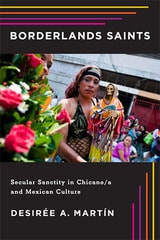
Borderlands Saints
Secular Sanctity in Chicano/a and Mexican CultureMartín, Desirée A
Rutgers University Press, 2013
Winner of the 2014 Latina/o Studies Section - LASA Outstanding Book Award
In Borderlands Saints, Desirée A. Martín examines the rise and fall of popular saints and saint-like figures in the borderlands of the United States and Mexico. Focusing specifically on Teresa Urrea (La Santa de Cabora), Pancho Villa, César Chávez, Subcomandante Marcos, and Santa Muerte, she traces the intersections of these figures, their devotees, artistic representations, and dominant institutions with an eye for the ways in which such unofficial saints mirror traditional spiritual practices and serve specific cultural needs.
Popular spirituality of this kind engages the use and exchange of relics, faith healing, pilgrimages, and spirit possession, exemplifying the contradictions between high and popular culture, human and divine, and secular and sacred. Martín focuses upon a wide range of Mexican and Chicano/a cultural works drawn from the nineteenth century to the present, covering such diverse genres as the novel, the communiqué, drama, the essay or crónica, film, and contemporary digital media. She argues that spiritual practice is often represented as narrative, while narrative—whether literary, historical, visual, or oral—may modify or even function as devotional practice.
Bountiful Deserts
Sustaining Indigenous Worlds in Northern New SpainCynthia Radding
University of Arizona Press, 2022
Common understandings drawn from biblical references, literature, and art portray deserts as barren places that are far from God and spiritual sustenance. In our own time, attention focuses on the rigors of climate change in arid lands and the perils of the desert in the northern Mexican borderlands for migrants seeking shelter and a new life.
Bountiful Deserts foregrounds the knowledge of Indigenous peoples in the arid lands of northwestern Mexico, for whom the desert was anything but barren or empty. Instead, they nurtured and harvested the desert as a bountiful and sacred space. Drawing together historical texts and oral testimonies, archaeology, and natural history, author Cynthia Radding develops the relationships between people and plants and the ways that Indigenous people sustained their worlds before European contact through the changes set in motion by Spanish encounters, highlighting the long process of colonial conflicts and adaptations over more than two centuries. This work reveals the spiritual power of deserts by weaving together the cultural practices of historical peoples and contemporary living communities, centered especially on the Yaqui/Yoeme and Mayo/Yoreme.
Radding uses the tools of history, anthropology, geography, and ecology to paint an expansive picture of Indigenous worlds before and during colonial encounters. She re-creates the Indigenous worlds in both their spiritual and material realms, bringing together the analytical dimension of scientific research and the wisdom of oral traditions in its exploration of different kinds of knowledge about the natural world.
Published in cooperation with the William P. Clements Center for Southwest Studies, Southern Methodist University
Bridging National Borders in North America
Transnational and Comparative HistoriesBenjamin H. Johnson and Andrew R. Graybill, eds.
Duke University Press, 2010
The contributors engage topics such as how mixed-race groups living on the peripheries of national societies dealt with the creation of borders in the nineteenth century, how medical inspections and public-health knowledge came to be used to differentiate among bodies, and how practices designed to channel livestock and prevent cattle smuggling became the model for regulating the movement of narcotics and undocumented people. They explore the ways that U.S. immigration authorities mediated between the desires for unimpeded boundary-crossings for day laborers, tourists, casual visitors, and businessmen, and the restrictions imposed by measures such as the Chinese Exclusion Act of 1882 and the 1924 Immigration Act. Turning to the realm of culture, they analyze the history of tourist travel to Mexico from the United States and depictions of the borderlands in early-twentieth-century Hollywood movies. The concluding essay suggests that historians have obscured non-national forms of territoriality and community that preceded the creation of national borders and sometimes persisted afterwards. This collection signals new directions for continental dialogue about issues such as state-building, national expansion, territoriality, and migration.
Contributors: Dominique Brégent-Heald, Catherine Cocks, Andrea Geiger, Miguel Ángel González Quiroga, Andrew R. Graybill, Michel Hogue, Benjamin H. Johnson, S. Deborah Kang, Carolyn Podruchny, Bethel Saler, Jennifer Seltz, Rachel St. John, Lissa Wadewitz
Published in cooperation with the William P. Clements Center for Southwest Studies, Southern Methodist University.
Bridging the Gaps
Integrating Archaeology and History in Oaxaca, Mexico; A Volume in Memory of Bruce E. BylandDanny Zborover
University Press of Colorado, 2015
Bridging the Gaps: Integrating Archaeology and History in Oaxaca, Mexico does just that: it bridges the gap between archaeology and history of the Precolumbian, Colonial, and Republican eras of the state of Oaxaca, Mexico, a cultural area encompassing several of the longest-enduring literate societies in the world.
Fourteen case studies from an interdisciplinary group of archaeologists, anthropologists, ethnohistorians, and art historians consciously compare and contrast changes and continuities in material culture before and after the Spanish conquest, in Prehispanic and Colonial documents, and in oral traditions rooted in the present but reflecting upon the deep past. Contributors consider both indigenous and European perspectives while exposing and addressing the difficulties that arise from the application of this conjunctive approach.
Inspired by the late Dr. Bruce E. Byland’s work in the Mixteca, which exemplified the union of archaeological and historical evidence and inspired new generations of scholars, Bridging the Gaps promotes the practice of integrative studies to explore the complex intersections between social organization and political alliances, religion and sacred landscape, ethnic identity and mobility, colonialism and resistance, and territoriality and economic resources.
Building the King’s Highway
Labor, Society, and Family on Mexico’s Caminos Reales, 1757-1804Bruce A. Castleman
University of Arizona Press, 2005
Focusing on the camino real linking Mexico City and the port of Veracruz, Bruce Castleman has written a social history of road construction laborers in late Bourbon Mexico. He has drawn on employment and census records to study a major shift in methods used by the Spanish colonial regime to mobilize the supply of unskilled labor—and concomitant changes in the identities those laborers asserted for themselves.
Through a close analysis of wages actually paid to named individuals from one week to the next, Castleman opens a new window on Mexican history. In the 1760s, a free-wage labor regime replaced a draft-labor system, and by examining records of road construction he traces both this transformation and its implications. During this time, free-wage artisans saw their earnings reduced, and they were pushed into the labor pool, and Castleman reveals how a shift occurred in the way that laborers identified themselves as the Spanish casta system of racial classification became increasingly fluid.
In his study, Castleman introduces some of the principle players of eighteenth-century Mexico, from viceroys to tobacco planters to military engineers. He then fleshes out the lives of working persons, drawing on a complete set of construction records from the construction of the Puente de Escamela at Orizaba to forge a collective biography that considers their existences apart from the workplace. By linking census and employment records, he uncovers a host of social indicators such as marriage preference, family structure, and differences over time in how the caste system was used to classify people according to ancestry.
As Castleman shows, roads did not so much link Mexico to the global economy as forge regional markets within New Spain, and his work provides an astute analysis of struggles between the Bourbon colonial state, the important consulados of Mexico City and Veracruz, and more localized interests over road policy. More important, Building the King’s Highway provides a valuable new perspective on people’s lives as it advances our understanding of labor in late colonial Latin America.
Bureaucrats, Planters, and Workers
The Making of the Tobacco Monopoly in Bourbon MexicoBy Susan Deans-Smith
University of Texas Press, 1992
Honorable Mention, Bolton Memorial Prize, Conference on Latin American History
A government monopoly provides an excellent case study of state-society relationships. This is especially true of the tobacco monopoly in colonial Mexico, whose revenues in the later half of the eighteenth century were second only to the silver tithe as the most valuable source of government income. This comprehensive study of the tobacco monopoly illuminates many of the most important themes of eighteenth-century Mexican social and economic history, from issues of economic growth and the supply of agricultural credit to rural relations, labor markets, urban protest and urban workers, class formation, work discipline, and late colonial political culture.
Drawing on exhaustive research of previously unused archival sources, Susan Deans-Smith examines a wide range of new questions. Who were the bureaucrats who managed this colonial state enterprise and what policies did they adopt to develop it? How profitable were the tobacco manufactories, and how rational was their organization? What impact did the reorganization of the tobacco trade have upon those people it affected most—the tobacco planters and tobacco workers?
This research uncovers much that was not previously known about the Bourbon government's management of the tobacco monopoly and the problems and limitations it faced. Deans-Smith finds that there was as much continuity as change after the monopoly's establishment, and that the popular response was characterized by accommodation, as well as defiance and resistance. She argues that the problems experienced by the monopoly at the beginning of the nineteenth century did not originate from any simmering, entrenched opposition. Rather, an emphasis upon political stability and short-term profits prevented any innovative reforms that might have improved the monopoly's long-term performance and productivity.
With detailed quantitative data and rare material on the urban working poor of colonial Mexico, Bureaucrats, Planters, and Workers will be important reading for all students of social, economic, and labor history, especially of Mexico and Latin America.